The stranger standing at Rachel Moore’s door was covered in blood, holding a young man who could barely stand. Behind them, the September storm was tearing through the empty plains.
William turned his hat slowly between his hands.
“Do you remember a man named Thomas Hayes?”
Rachel’s expression changed.
“Thomas Hayes?”
“He was my younger brother.”
She stared at him, searching her memory. Then something came back to her. A wounded young cowboy had arrived at the station nearly seven years earlier. Her husband had carried him inside, and Rachel had spent four days nursing him through a terrible fever.
“He had a broken leg,” she whispered.
William nodded.
“And a bullet wound. He told me a married couple had saved his life when nobody else would stop to help him.”
Rachel looked toward the window.
“I remember him. Whatever happened to that young man?”
“He died three years ago. Pneumonia.”
“I’m terribly sorry.”
“Before he died, he made me promise something. He wanted me to find the people who helped him and repay their kindness.”
William reached into his coat and withdrew a folded piece of paper. It was yellow with age, and the handwriting was almost impossible to read.
Rachel recognized her husband’s signature at the bottom.
It was a receipt for a horse Thomas had purchased before leaving the station.
“That’s how I found you,” William explained. “I was already planning to visit when Eli got hurt. The storm simply brought me here sooner than I intended.”
Rachel swallowed hard.
“So the cooking job was your way of keeping a promise?”
“At first, perhaps.”
“And now?”
William looked directly into her eyes.
“Now I think you’re a woman who deserves an opportunity. And I’d be a fool to hire somebody else when I’ve already tasted your cooking.”
Despite herself, Rachel laughed.
It was a small sound, but it seemed to brighten the entire room.
William smiled.
“I won’t bother you about it again. I just thought you deserved to know the truth.”
He placed his hat back on his head and walked toward the door.
“Mr. Hayes?”
He stopped.
“When does the roundup begin?”
“Monday morning.”
Rachel glanced around the lonely station. For two years, she had been waiting for her circumstances to improve, yet every passing month had taken something else from her.
Perhaps it was time to stop waiting.
“I’ll need a wagon for my cooking equipment.”
William’s smile widened.
“I’ll send one Sunday.”
By Monday afternoon, Rachel found herself surrounded by twenty-three hungry cowboys, hundreds of cattle, and more noise than she had heard in years.
The men watched curiously as she arranged her pots beside the chuck wagon.
One particularly unpleasant cowboy named Frank Dalton leaned against a wagon wheel.
“Never had a woman cook out here before,” he remarked.
“Then I suppose today will be educational for you,” Rachel replied.
Several men laughed.
Frank walked away without another word.
By sunset, Rachel had prepared beef stew, fresh biscuits, and an enormous pot of coffee. The men returned from the range exhausted and covered in dust.
Within minutes, every plate was empty.
Eli appeared beside her with an enormous grin.
“Didn’t I tell you boys she could cook?”
From across the campfire, William watched Rachel accept their compliments.
He hadn’t seen her look so happy before.
Over the following days, Rachel became an indispensable part of the camp. She repaired torn shirts, treated minor injuries, and listened to stories that the men rarely shared with anyone.
William began finding excuses to visit the chuck wagon.
Sometimes he needed coffee. Sometimes he claimed to be checking the supplies.
One evening, Rachel caught him peeling potatoes.
“Surely you’ve got more important things to do.”
“Probably.”
“Then why are you sitting here?”
William considered the question.
“Because I enjoy sitting here.”
Rachel lowered her eyes, suddenly grateful for the fading daylight.
She was beginning to look forward to those quiet evenings more than she wanted to admit.
But not everyone welcomed the widow’s presence.
On the eighth morning, a finely dressed man arrived at the camp with two armed riders.
William’s pleasant expression disappeared.
“Silas Mercer,” he muttered.
Mercer owned the largest cattle operation in the neighboring county. He was also the wealthiest man in town, having acquired several struggling ranches through unpaid debts.
He dismounted and approached William.
“Hayes. I hear you’re moving cattle through the southern valley.”
“That’s right.”
“Those grazing rights are disputed.”
“Only because you keep disputing them.”
Mercer smiled coldly.
His gaze wandered toward Rachel.
“Well, if it isn’t Mrs. Moore.”
Rachel stiffened.
“Mr. Mercer.”
William noticed the sudden tension between them.
“You two know each other?”
“Her late husband owed me a considerable amount of money,” Mercer explained. “I’m afraid the lady hasn’t been particularly cooperative about settling his affairs.”
Rachel’s hands tightened around the coffee pot.
“My husband paid that debt before he died.”
“An interesting claim. Unfortunately, you haven’t produced a receipt.”
Mercer turned back to William.
“Be careful who you employ. Desperate people sometimes develop unfortunate habits.”
William stepped closer.
“You’ve said enough.”
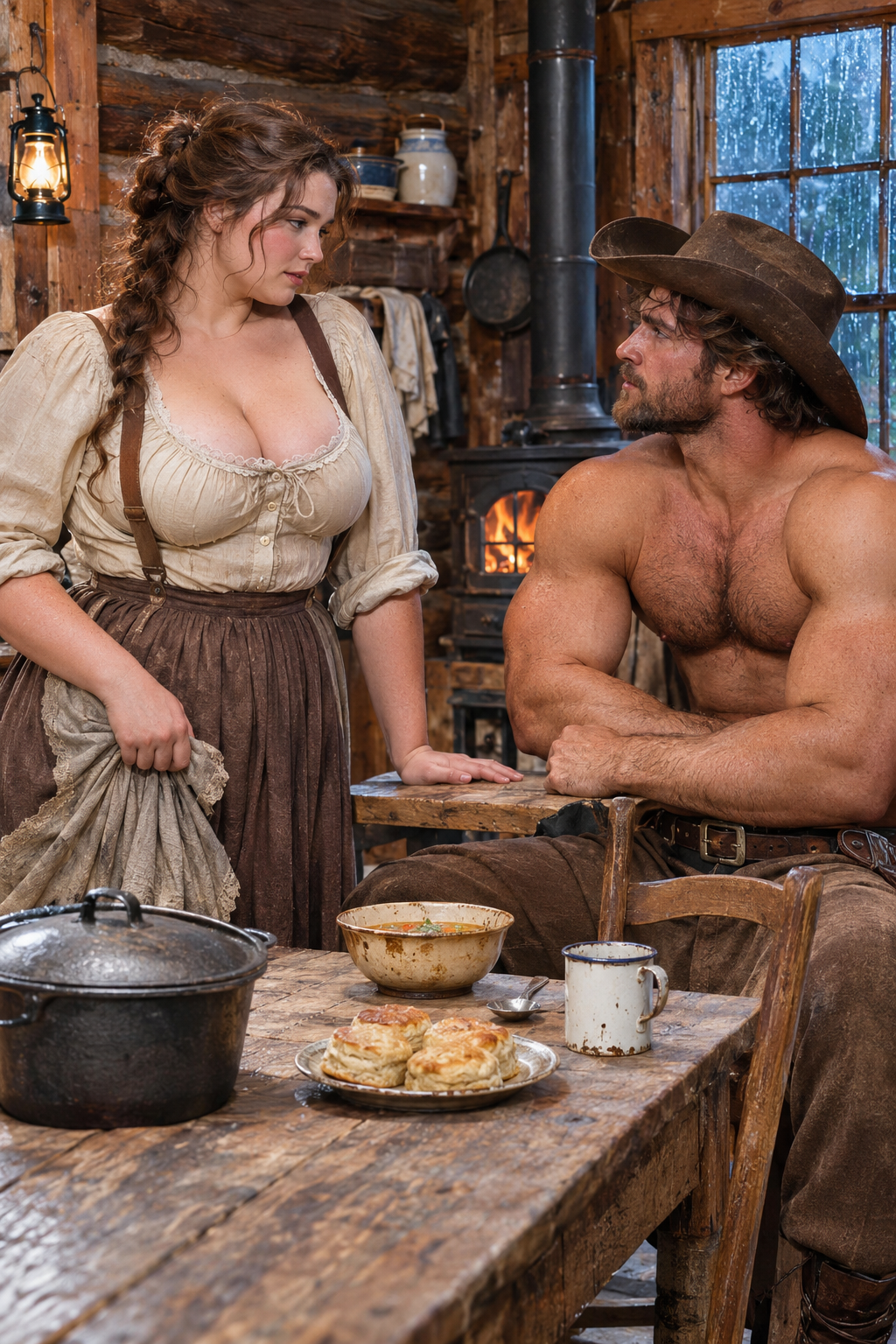
For a moment, the two men stared at each other.
Then Mercer laughed, mounted his horse, and rode away.
That evening, William found Rachel sitting alone beside the wagon.
“Why didn’t you tell me?”
“Because it’s my problem.”
“How much does he claim you owe?”
“Four hundred dollars.”
William was stunned. It was more than the station itself was worth.
“He’s been trying to take the property for nearly two years,” Rachel continued. “My husband told me he’d paid everything. But after the funeral, Mercer arrived with a document claiming otherwise.”
“Did your husband keep records?”
“He did. I’ve searched every drawer and cupboard in that station. I never found anything.”
William sat beside her.
“I could settle the debt.”
Rachel immediately shook her head.
“No.”
“Rachel—”
“I won’t spend the rest of my life owing somebody for the roof over my head. Not even you.”
William remained silent for a moment.
Then he nodded.
“All right. But you shouldn’t have to fight him alone.”
Rachel looked at him.
Nobody had said anything like that to her since her husband’s death.
The following afternoon, disaster struck.
A frightened herd broke through a temporary fence, sending cattle charging toward the camp.
Rachel heard the thunder of hooves before she saw the animals.
Then she noticed Eli standing directly in their path, struggling to free his horse from a tangled rope.
“Eli!”
The young man turned.
Rachel grabbed his sleeve and pulled him behind the chuck wagon just as the first cattle rushed past.
The wagon shook violently.
A wheel splintered, and several heavy crates crashed to the ground.
William and the other cowboys eventually brought the herd under control.
When William returned, he found Rachel kneeling beside Eli, examining a bruised shoulder.
He dismounted so quickly that he nearly stumbled.
“Are you hurt?”
“I’m fine.”
William caught her hands.
“You could have been killed.”
“So could Eli.”
He stared at her, unable to disguise his fear.
For one brief moment, Rachel thought he might embrace her.
Instead, Frank Dalton approached them.
“Fence wasn’t broken by cattle,” he announced. “Somebody cut the ropes.”
William’s expression hardened.
“Show me.”
They discovered three severed ropes and fresh horse tracks leading toward the southern valley.
William suspected Mercer immediately, but there was no proof.
He ordered two men to guard the herd throughout the night.
Rachel barely slept.
Just before dawn, she stepped outside and found Frank searching through William’s saddlebag.
“What are you doing?”
Frank spun around.
“Looking for tobacco.”
“In Mr. Hayes’s belongings?”
His expression darkened.
“You’d be better off minding your own business, widow.”
He walked away before Rachel could answer.
She told William what she had seen.
That evening, William quietly examined his belongings.
Nothing appeared to be missing.
Nevertheless, he began watching Frank more closely.
Two days later, Rachel received a letter delivered by a passing rider.
It contained a notice from the county office.
Unless she paid her husband’s alleged debt within ten days, the stagecoach station would be sold at auction.
She read the notice three times.
The wages William had promised her would not cover even half the amount.
That night, she packed her belongings.
William found her fastening a bundle beside the wagon.
“Going somewhere?”
“I have to return to the station.”
She handed him the notice.
He read it carefully.
“The roundup ends in another week.”
“I know. I’m sorry.”
“Rachel, wait.”
She turned away, fighting tears.
“That station is all I have left of my husband. We built the kitchen together. We planted those cottonwood trees. I buried him beneath one of them.”
William gently placed a hand on her shoulder.
“Then we’ll find a way to save it.”
She wanted desperately to believe him.
The next morning, William sent his foreman ahead with the herd and accompanied Rachel home. Eli insisted on joining them.
They reached the station shortly before sunset.
Rachel knew something was wrong the moment she saw the front door.
It stood wide open.
Inside, furniture had been overturned, cupboards emptied, and mattresses ripped apart.
Her husband’s belongings lay scattered across the floor.
Rachel covered her mouth.
William drew his revolver and searched every room.
Nobody was there.
“Someone was looking for something,” Eli said.
Rachel suddenly understood.
“The receipt.”
William turned toward her.
“If Mercer believes it’s here, then he knows your husband paid him.”
For the first time in two years, Rachel felt something stronger than helplessness.
She felt angry.
Together, they searched the station until midnight.
They examined loose floorboards, old trunks, and every book on the shelves.
Nothing.
Exhausted, Rachel finally sat beneath the portrait of her husband.
“I’ve failed you, Henry,” she whispered.
Eli was standing nearby.
“Was he the man who built this place?”
“Most of it.”
The boy studied the portrait.
“What’s that he’s holding?”
Rachel looked up.
Her husband stood beside a newly constructed fireplace, holding a small wooden box.
“His tobacco box,” she answered.
Then she froze.
Henry had stopped smoking shortly before his death. She remembered teasing him when he insisted on keeping the box.
He had called it his little bank.
Rachel rushed toward the fireplace.
A narrow shelf stood above it, displaying several dusty ornaments.
Behind an old clock sat the wooden box.
Her fingers trembled as she opened it.
Inside were two buttons, a broken pocket watch, and a folded piece of paper.
William leaned over her shoulder.
Rachel unfolded the document.
Received from Henry Moore, four hundred dollars, payment in full.
Beneath the words was Silas Mercer’s signature.
Rachel sank into a chair.
For two years, the proof had been sitting less than ten feet from her kitchen table.
She began laughing and crying at the same time.
William knelt beside her.
“You found it.”
But their celebration ended abruptly when a gunshot shattered the front window.
Eli dropped to the floor.
William extinguished the lamp.
Outside, a familiar voice called through the darkness.
“Hayes! Send the woman out!”
It was Frank Dalton.
William moved toward the window.
“What do you want, Frank?”
“The paper she just found.”
Rachel’s blood turned cold.
Frank had followed them.
Another voice came from outside.
Silas Mercer.
“Mrs. Moore, there’s no need for anybody to get hurt. Give me that receipt, and we’ll forget this unfortunate misunderstanding.”
Rachel clutched the document.
“You’ve been lying to me for two years!”
“Business is business, my dear.”
William fired a warning shot through the broken window.
The men outside scattered.
“Eli,” William whispered, “take Rachel through the back door. Get to the horses.”
Before they could move, smoke began drifting beneath the kitchen door.
Mercer’s men had set fire to the rear of the station.
Flames climbed the dry wooden walls.
Rachel stared in horror.
Her home was burning.
William grabbed her arm.
“We have to get out.”
“But Henry’s things—”
“Rachel, there’s no time!”
A burning beam crashed across the hallway.
Eli screamed as falling debris struck his injured arm.
William lifted the boy and carried him toward the front entrance.
Rachel followed, clutching the receipt.
Outside, Frank appeared from behind the water trough and raised his revolver.
A gunshot rang out.
William staggered.
“William!”
He fell to one knee, blood spreading across his shirt.
Rachel rushed to his side.
Frank approached them, his weapon still raised.
“Hand over the paper.”
Rachel looked at William, then at Eli.
She slowly reached into her pocket.
But before she could surrender the receipt, the sound of approaching horses filled the darkness.
Frank turned.
Six riders emerged through the smoke, led by William’s foreman, an older cowboy named Amos.
“Drop that gun!”
Frank hesitated.
Amos fired into the dirt beside his boots.
The weapon fell from Frank’s hand.
Mercer attempted to escape, but two cowboys intercepted him near the road.
Amos dismounted and hurried toward William.
“Boss!”
William managed a weak smile.
“About time you showed up.”
Amos explained that Frank had disappeared from camp shortly after their departure. Suspicious of his behavior, the foreman had followed his tracks with several men.
Rachel barely heard him.
She tore a strip from her dress and pressed it against William’s wound.
“Stay with me.”
William looked at her pale face.
“Seems I’m making a habit of bringing trouble to your doorstep.”
“Don’t you dare make jokes.”
He reached for her hand.
“I’m glad you opened that door, Rachel.”
Then his eyes closed.
By the time the doctor arrived from town, the station had been reduced to a blackened skeleton.
William was still breathing, but his condition was serious.
The doctor removed the bullet and worked through the night.
Rachel remained beside him until dawn.
Meanwhile, the sheriff arrested Mercer and Frank.
Faced with the prospect of prison, Frank confessed everything. Mercer had paid him to sabotage the roundup, steal William’s grazing documents, and search Rachel’s station.
The sheriff subsequently discovered evidence that Mercer had cheated several other families using similar methods.
But Rachel cared little about any of that while William lay unconscious.
On the second evening, she sat beside his bed in the doctor’s house, holding his hand.
“I’ve already buried one good man,” she whispered. “Please don’t make me bury another.”
A faint voice answered.
“Wasn’t planning on it.”
Rachel lifted her head.
William’s eyes were open.
She began to cry.
He squeezed her fingers.
“Are you all right?”
She laughed through her tears.
“You’ve been shot, and you’re asking whether I’m all right?”
“Somebody has to.”
For the next three weeks, Rachel helped nurse William back to health.
The roundup was completed successfully under Amos’s supervision, and the cowboys visited whenever they could.
Eli brought flowers from the roadside.
Amos brought terrible jokes.
The men even collected money to replace Rachel’s belongings.
When she protested, Eli shook his head.
“You fed us when we were hungry, ma’am. Let us do something for you.”
Rachel accepted their kindness.
She was beginning to understand that receiving help did not diminish the dignity of giving it.
One afternoon, William was finally strong enough to walk outside.
He found Rachel sitting beneath a tree, staring toward the distant plains.
“The judge dismissed Mercer’s claim,” he told her. “The station property belongs to you.”
Rachel smiled sadly.
“Not much station left.”
“We could rebuild it.”
She shook her head.
“I thought losing that place would destroy me. But when it was burning, the only thing I cared about was getting you and Eli out alive.”
William sat beside her.
“I suppose that means something.”
“It does.”
For a while, neither spoke.
Then William reached into his pocket and produced a small velvet box.
Rachel’s breath caught.
“I bought this before we left for the roundup,” he admitted. “Didn’t have the courage to do anything with it.”
Inside was a simple gold ring.
“I’m not asking because you need a home,” William continued. “And I’m not asking because of my brother’s promise. I’m asking because somewhere along the way, you became the person I wanted to come home to.”
Rachel looked at the ring.
Then she looked at the man who had respected her refusal, stood beside her when she was frightened, and nearly given his life protecting her.
“What if I’m a terrible rancher’s wife?”
William smiled.
“Then I reckon I’ll be a terribly happy rancher.”
Rachel laughed.
“Yes, William.”
He blinked.
“Yes?”
“Yes, I’ll marry you.”
They were married the following spring beneath the cottonwood trees beside the ruins of the old stagecoach station.
Eli stood proudly beside William, and Amos cried more than anyone expected.
Rachel placed fresh flowers on Henry’s grave before the ceremony.
She no longer felt that loving another man meant betraying the first.
Henry had taught her what love was.
William had reminded her that love could return.
With the money recovered from Mercer’s estate and her own savings, Rachel eventually rebuilt the station.
But she did not live there again.
Instead, she turned it into a boardinghouse where travelers, struggling families, and injured ranch hands could find an affordable meal and a warm bed.
Those who couldn’t pay were never turned away hungry.
Eli became its manager after marrying a schoolteacher from town.
Years passed.
William and Rachel raised three children, and their ranch became known throughout the county for its generous hospitality.
One September evening, nearly fifteen years after the storm that had brought them together, a young woman appeared at their door.
She was frightened, soaked by the rain, and carrying a sick child.
“Please,” she whispered. “I don’t have any money.”
Rachel stepped aside without hesitation.
“Come inside, dear. We’ll worry about everything else later.”
William watched from his chair as Rachel wrapped the child in a warm blanket and prepared something to eat.
When the woman was finally resting, he joined his wife beside the kitchen stove.
“Remind you of anything?”
Rachel smiled.
“A certain enormous rancher who arrived at my door covered in blood.”
“Handsome fellow, was he?”
“Not particularly.”
William laughed and pulled her gently into his arms.
Outside, the storm continued across the plains.
Inside, the fire burned warmly.
Rachel looked around the home they had built together and thought about the lonely widow she had once been, counting potatoes and wondering how she would survive another winter.
Back then, she had believed she possessed almost nothing.
Yet on the night William arrived, she had shared what little she had with two strangers.
That single act of kindness had changed more lives than she could ever have imagined.
She had learned that strength was not measured by how much suffering a person could endure alone. Sometimes, true strength meant opening a door, accepting an outstretched hand, and trusting that life still had something beautiful to offer.
William kissed her forehead.
“What are you thinking about?”
Rachel rested her head against his shoulder.
“How grateful I am that I didn’t keep that door closed.”
He held her a little tighter.
And as the rain fell against the windows, another stranger slept safely beneath their roof, unaware that the kindness which had once saved two men was still traveling through the world, quietly changing lives, one open door at a time.
Twenty years later, William passed away peacefully in his sleep, with Rachel holding his hand.
The entire county mourned him.
On the morning of his funeral, Rachel discovered a letter inside the drawer of his bedside table.
Her name was written across the envelope.
With trembling fingers, she opened it.
“My dearest Rachel,
If you’re reading this, I suppose I’ve gone ahead of you. Don’t be angry with me for leaving first. You know I’ve never been particularly good at saying goodbye.
Before I met you, I believed a man’s wealth was measured in cattle, land, and money. Then a woman with almost nothing gave me the finest supper of my life.
You taught me that a home isn’t something a man builds with his hands. It’s something people create with their hearts.
Whatever years you have left, promise me you’ll keep living them. Laugh with our children. Watch our grandchildren grow. And never stop opening that door.
Thank you for giving me a life worth remembering.
Forever yours,
William.”
Rachel pressed the letter against her chest and wept.
But she kept her promise.
She continued visiting the boardinghouse, helping families, and telling her grandchildren stories about their grandfather.
One afternoon, a little granddaughter climbed onto her lap.
“Grandma, were you scared when Grandpa first came to your house?”
“Very scared.”
“Then why did you let him inside?”
Rachel smiled.
“Because someone needed help, sweetheart. Sometimes that’s the only reason you need.”
Many years later, when Rachel’s own time finally came, her children gathered around her bed.
Eli, now an old man himself, sat beside her.
“Do you remember the night we met?” he asked.
Rachel smiled faintly.
“You were a terribly hungry boy.”
Eli laughed, wiping his eyes.
“You saved my life that night.”
“And you helped save mine.”
He gently kissed her hand.
Rachel closed her eyes as the evening sunlight filled the room.
Her final thoughts were of a September storm, a frightened young cowboy, and a broad-shouldered stranger standing outside her door.
She could almost hear William’s familiar voice calling her home.
She smiled one last time.
And then she was gone.
Rachel was buried beside William beneath a pair of cottonwood trees overlooking the plains.
At the old boardinghouse, her children placed a wooden sign above the entrance.
It read:
“No stranger leaves this house hungry.”
The boardinghouse remained open for generations, sheltering people whose names Rachel would never know and changing lives she would never witness.
Her greatest legacy was not the ranch, the money, or the property she left behind.
It was the kindness she had taught others to carry forward.
Because sometimes the smallest act of compassion begins a story that continues long after the people who started it are gone.
And sometimes, when life seems to have taken everything from us, the most beautiful chapter is waiting on the other side of an open door.
THE END.