The stranger I saved from a blizzard had his horse packed to leave before sunrise. But when I found out where he was headed, I realized he might be running from something far worse than the storm.
I held my breath as Owen crouched beside his horse, his eyes fixed on the narrow valley below us. The snow was falling so heavily that I could barely see twenty feet ahead, but the voice carried clearly through the cold air.
“Move those cattle before the trail disappears!”
Another man answered, “We can’t move them all tonight. The old man said to wait until morning.”
Owen turned toward me. His face had gone pale beneath his beard.
“Did you hear that?” he whispered.
I nodded.
“Someone’s down there with your family’s cattle.”
“That’s not what worries me,” he said. “I know that first voice.”
Before I could ask who it belonged to, a horse whinnied somewhere below. Owen grabbed my reins and pulled my horse behind a cluster of pine trees.
Three riders appeared through the blowing snow.
The first was a heavyset man wearing a dark coat. The second carried a rifle across his saddle. The third was younger, with a red scarf wrapped around his neck.
They stopped less than thirty yards from our hiding place.
“Boss wants the station cleared before Friday,” the heavyset man said.
My heart slammed against my ribs.
Juniper Pass Station.
My home.
“The widow won’t leave,” the younger rider replied.
“Then Pike will have to convince her.”
The men laughed.
I felt Owen’s hand tighten around my arm.
Walter Pike.
The man who held my debt papers.
The man who had spent months trying to force me to sell my land.
He wasn’t simply waiting for me to fail.
He was planning something.
The riders disappeared into the storm, and Owen slowly released my arm.
“We need to get back,” he said.
“Not until you tell me what you know.”
“Helen, this isn’t the place.”
“Then make it quick.”
He looked toward the valley.
“The man giving orders down there is Caleb Rusk. He used to work for my father. He was fired for stealing cattle.”
“And now he’s working for Pike?”
“Looks that way.”
I stared at the tracks disappearing between the trees.
“Then Pike is stealing cattle and using my land to move them.”
Owen didn’t answer.
Something about his silence frightened me more than the men we’d just seen.
“There’s more,” I said.
He finally met my eyes.
“My brother Lewis disappeared six weeks ago. The last message he sent said he’d found proof of a cattle operation running through Juniper Pass.”
I swallowed.
“Why didn’t you tell me?”
“Because I didn’t know whether you were involved.”
For a moment, I couldn’t speak.
I had fed him, sheltered his injured friend, and trusted him inside the home my husband had built.
And he’d suspected me.
“You thought I was helping cattle thieves?”
“I didn’t know what to think.”
I pulled my reins from his hand.
“Then you should’ve asked.”
I turned my horse toward the station.
Owen followed without another word.
By the time we reached Juniper Pass, darkness had settled over the mountains.
Ben was waiting on the porch with a lantern.
One look at our faces told him something had happened.
“You found them,” he said.
Owen dismounted.
“We found Rusk.”
Ben’s expression changed.
“Then we’re in worse trouble than I thought.”
I stopped beside the porch.
“What does that mean?”
Ben looked at Owen, then back at me.
“I wasn’t hurt falling off my horse, Mrs. Porter.”
The wind rattled the lantern.
“Someone shot me.”
I stared at the bandage beneath his coat.
“Why didn’t you say anything?”
“Because the men who shot me were looking for Lewis.”
Owen stepped closer.
“Ben, you told me you lost him in the storm.”
“I did. But that wasn’t the whole story.”
Ben lowered himself onto the porch bench.
“Three nights before we arrived here, Lewis and I found a hidden holding pen in the southern basin. There were nearly two hundred stolen cattle inside.”
Owen went still.
“You were with Lewis?”
Ben nodded.
“We followed the herd after dark. Lewis wanted to identify the men before going to the sheriff.”
“What happened?”
“Rusk caught us. We split up to escape. I heard gunshots behind me, but I couldn’t go back.”
Owen’s jaw tightened.
“You let me believe you hadn’t seen him for weeks.”
“I was afraid.”
“Of what?”
Ben looked toward the road.
“Rusk told me if I talked, they’d kill anyone helping us. By the time I reached you, I could barely stay on my horse.”
For a long moment, nobody spoke.
Then Owen asked the question I knew he’d been carrying since his brother disappeared.
“Did you see Lewis die?”
Ben shook his head.
“No.”
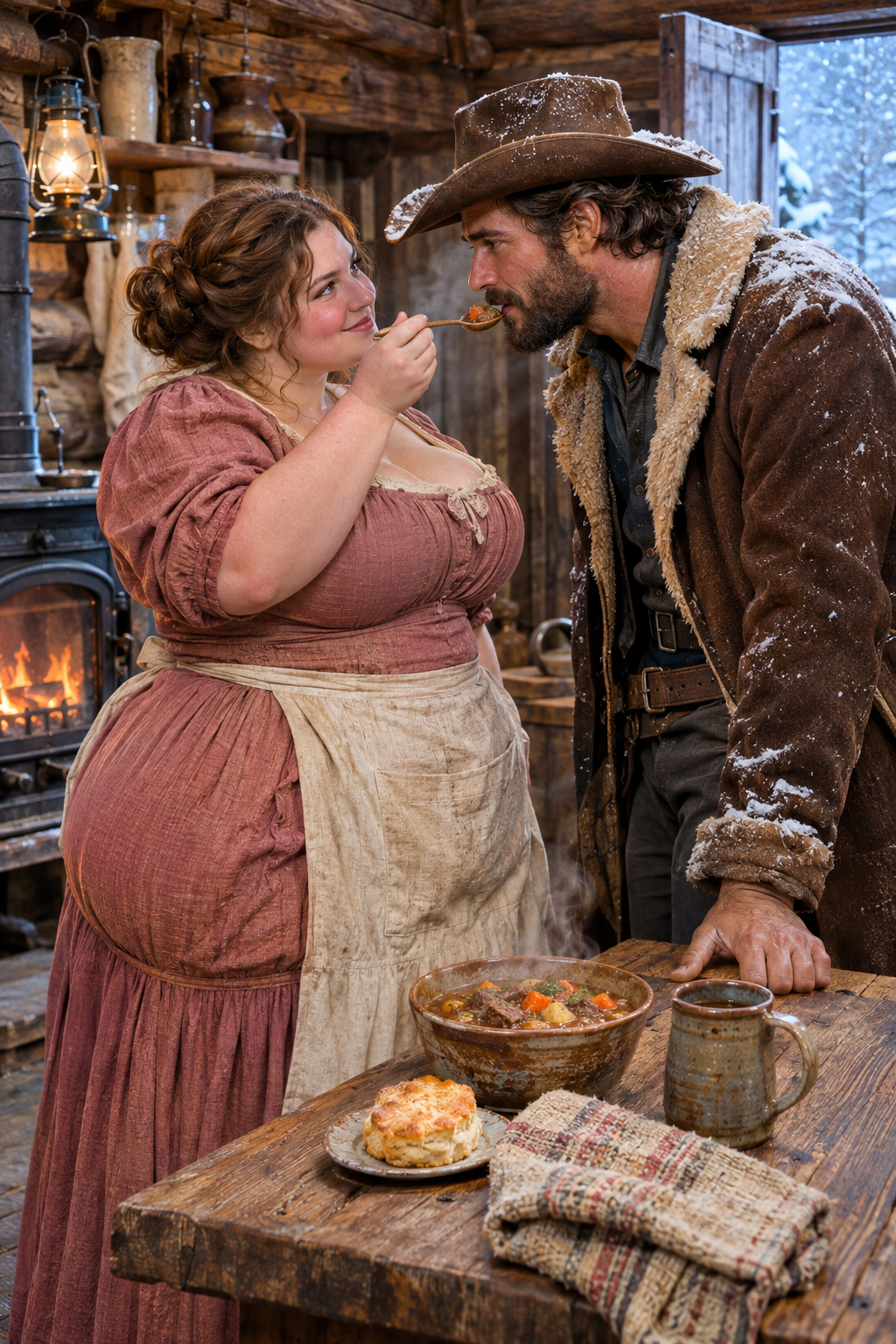
Owen closed his eyes.
It was the smallest piece of hope, but I could see how desperately he needed it.
I opened the door.
“Everyone inside. We’re freezing out here.”
We gathered around the kitchen table while the stove burned low.
I poured coffee into three chipped mugs.
Owen spread his map across the table, and Ben marked the location of the hidden cattle pen.
It was farther south than we’d ridden that afternoon.
Beyond the ridge lay an abandoned mining settlement called Black Creek.
I’d heard of it, but I’d never been there.
“There’s an old freight road through the basin,” Ben explained. “It runs behind the mining camp and joins the southern cattle trail.”
Owen traced it with his finger.
“They could move hundreds of animals without using the main road.”
“And my station sits at the only reliable water crossing for miles,” I said.
Ben nodded.
“Exactly.”
Suddenly, Walter Pike’s interest in my land made terrible sense.
He didn’t want my little station because it was valuable as a business.
He wanted control of the crossing.
As long as I owned Juniper Pass, he couldn’t move stolen cattle through it without risking discovery.
I thought about the money I owed.
The repairs I’d postponed.
The food I’d rationed.
And the way Pike always seemed to know when I was struggling.
“How much do you owe him?” Owen asked quietly.
I hesitated.
“Eight hundred dollars.”
Ben let out a low whistle.
It was more money than I’d seen together since my husband died.
“The loan was originally four hundred,” I continued. “My husband borrowed it after the spring floods damaged the bridge. Then he got sick. The interest kept growing.”
Owen studied me.
“Have you seen the original agreement?”
“Of course.”
“Recently?”
I frowned.
“Pike keeps the papers.”
Owen leaned back.
“That’s convenient.”
Before I could respond, something struck the front door.
All three of us jumped.
A second blow followed.
Then a man’s voice called through the wind.
“Mrs. Porter! Open up!”
Owen reached for his rifle.
I recognized the voice.
It was Sheriff Daniel Mercer.
I hurried to the door.
The sheriff stood outside, snow covering his shoulders. Behind him were two deputies.
“Evening, Helen,” he said.
His expression was unusually serious.
“I need to speak with your guests.”
Owen stepped into the doorway.
“About what?”
Mercer pulled a folded paper from his coat.
“There’s a warrant for your arrest, Mr. McKenna.”
My stomach dropped.
“For what?” I demanded.
“Livestock theft and the suspected murder of Lewis McKenna.”
Owen stared at him.
“That’s my brother.”
“I know.”
“Then whoever gave you that warrant is lying.”
Mercer looked uncomfortable.
“That may be. But I still have to bring you in.”
I stepped between them.
“Who accused him?”
The sheriff hesitated.
“Walter Pike.”
I almost laughed.
Not because anything was funny.
Because the cruelty of it was unbelievable.
“Pike is involved in the cattle thefts,” I said. “We just found evidence.”
Mercer frowned.
“What evidence?”
I told him about the tracks, the branded hide, and the men we’d overheard in the basin.
He listened without interrupting.
When I finished, he looked at Owen.
“Can you prove any of that?”
Owen held up the strip of hide.
Mercer examined it.
“That proves cattle from your ranch passed through here. It doesn’t prove who moved them.”
“Then come with us tomorrow,” I said. “We’ll show you the trail.”
Mercer shook his head.
“Not with an active warrant.”
He motioned to his deputies.
Owen didn’t resist.
But as they led him toward the horses, he looked back at me.
“Helen, don’t trust Pike. And don’t go into that basin alone.”
I wanted to promise him.
Instead, I watched the sheriff take away the only man who might help me save my home.
That night, I barely slept.
Every sound outside made me sit upright.
At dawn, I found Ben standing beside the kitchen window.
“Someone’s been here,” he said.
I followed his gaze.
Fresh boot prints crossed the porch and stopped beneath my bedroom window.
Then I noticed a folded piece of paper tucked beneath the door.
I picked it up.
There were only seven words.
SELL THE STATION OR BURY ANOTHER MAN.
My hands began to shake.
Ben read the note over my shoulder.
“He’s threatening Owen.”
“Or Lewis.”
“Maybe both.”
I looked toward the stable.
For the first time since my husband’s death, I considered packing what I could carry and leaving Juniper Pass forever.
Then I remembered something my husband used to say.
“A place isn’t worth dying for, Helen. But sometimes the people who depend on it are worth fighting for.”
I looked at the empty chairs around our kitchen table.
Travelers had survived storms here.
Families had rested here.
Men had found work when they had nowhere else to go.
Juniper Pass was more than land.
And I wasn’t ready to surrender it to a thief.
“Ben,” I said, “can you ride?”
He touched his injured side.
“Not comfortably.”
“That wasn’t my question.”
He gave me a tired smile.
“Yes, ma’am.”
We left before sunrise.
But instead of heading toward Black Creek, we rode north to the county courthouse.
I needed to see something.
And I had a feeling Walter Pike would do anything to keep it hidden.
The county clerk, Mrs. Abigail Foster, had known my husband for twenty years.
When I explained why I’d come, she led me into a cramped room filled with ledgers.
“Your husband registered the original loan here,” she said.
She pulled a thick book from a shelf.
After several minutes, she found the entry.
I leaned over her shoulder.
Four hundred dollars.
Interest at six percent.
Repayment due over five years.
I read it twice.
Then a third time.
“That can’t be right.”
Mrs. Foster adjusted her glasses.
“What’s wrong?”
“Pike says I owe eight hundred dollars, and he’s threatening foreclosure this week.”
She studied the record.
“According to this, your husband made payments totaling two hundred and seventy dollars before he died.”
I gripped the edge of the desk.
“Then how much should I owe?”
She worked through the figures carefully.
“Without reviewing every payment date, I can’t give you the exact amount. But eight hundred dollars doesn’t match these terms.”
My heart began to pound.
“Can I have a certified copy?”
“Certainly.”
She paused.
“Helen, why didn’t you come sooner?”
I stared at the ledger.
“Because I believed him.”
Mrs. Foster’s expression softened.
“That doesn’t mean he was telling the truth.”
We were preparing to leave when the courthouse door opened.
Sheriff Mercer entered.
He looked surprised to see me.
“Helen?”
“Where’s Owen?”
“At the jail.”
“Has he been charged?”
“Not formally.”
“Then why is he still locked up?”
Mercer sighed.
“Because Pike produced a witness who claims Owen killed his brother during a dispute over stolen cattle.”
Ben stepped forward.
“Who?”
“Caleb Rusk.”
I felt anger rise in my chest.
“Rusk is the man running the stolen herd!”
Mercer looked between us.
“That’s a serious accusation.”
“And accusing a man of murdering his own brother isn’t?”
He didn’t answer.
I placed the certified loan record on the desk.
“Look at this.”
Mercer read it.
His expression grew darker with every line.
“Where did you get it?”
“Your county clerk.”
He glanced toward Mrs. Foster, who nodded.
Mercer folded the paper.
“I think it’s time I had another conversation with Walter Pike.”
“Then let Owen go.”
“I can’t release him based on this alone.”
I stepped closer.
“Sheriff, if Lewis is alive, every hour Owen spends in that cell gives Rusk more time to find him.”
Mercer studied my face.
Then he turned to Ben.
“Can you show me where the cattle are hidden?”
Ben nodded.
“Yes.”
Mercer made a decision.
“I’ll send two deputies to investigate the basin. Helen, you stay in town until I know what’s happening.”
I almost argued.
But I needed him on our side.
So I agreed.
At least, I intended to keep my promise.
That changed when we reached the jail.
Owen was sitting on a narrow cot behind iron bars.
He stood when he saw me.
“You shouldn’t be here.”
“I’ve been hearing that a lot lately.”
I told him everything.
The threatening note.
The courthouse records.
The sheriff’s decision to investigate.
Owen listened carefully.
Then he asked, “Did you tell Mercer about the old freight road?”
“Yes.”
His expression changed.
“Did he say which deputies he was sending?”
“No.”
Owen grabbed the bars.
“Helen, listen carefully. Rusk has someone inside the sheriff’s office.”
I stared at him.
“How do you know?”
“Because Lewis wrote me a letter before he disappeared. He said every time he reported suspicious cattle movements, the thieves knew exactly where he planned to look.”
“Then why didn’t you tell Mercer?”
“Because I didn’t know which man was involved.”
A cold feeling spread through me.
“Ben is going with them.”
Owen nodded.
“And if the wrong deputy hears where they’re headed, they’ll be walking into a trap.”
I ran from the jail.
Outside, the sheriff’s horses were gone.
So was Ben.
I found Mercer at the livery stable, preparing another horse.
“Your deputies,” I said breathlessly. “Who went with Ben?”
“Deputy Collins and Deputy Wade.”
“Which one has been working here longer?”
“Wade. Why?”
“Owen thinks someone in your office is helping Rusk.”
Mercer’s face hardened.
“Wade’s been with me eight years.”
“That doesn’t mean he can’t be bought.”
The sheriff stared at me for a long moment.
Then he tightened his saddle.
“Get your horse.”
We rode hard toward Black Creek.
The weather had cleared, but the cold was bitter.
As we approached the southern ridge, Mercer slowed.
A horse stood riderless beside the trail.
I recognized Ben’s saddle.
My throat tightened.
We dismounted and followed footprints through the snow.
Then we heard a groan.
Deputy Collins lay behind a fallen tree, blood staining his sleeve.
Mercer dropped beside him.
“What happened?”
“Wade,” Collins whispered. “He turned on us.”
“Where’s Ben?”
“Taken to the mining camp.”
Mercer pressed a cloth against the wound.
“Can you ride?”
Collins nodded weakly.
“Get back to town,” Mercer ordered. “Bring every honest man you can find.”
Collins struggled onto his horse and rode north.
I looked toward the valley.
“We can’t wait.”
Mercer checked his rifle.
“I know.”
We moved through the trees until the old mining buildings came into view.
The camp looked abandoned from a distance.
But smoke rose from one chimney, and dozens of cattle stood inside a fenced enclosure.
I counted at least six armed men.
Near the largest building, Ben was tied to a post.
His face was bruised.
Deputy Wade stood beside him.
And Walter Pike was there.
He wore the same polished boots and expensive coat he’d worn when threatening to take my home.
Seeing him among the thieves made my stomach twist.
But what happened next stopped me cold.
Two men dragged someone out of the building.
He was thin, unshaven, and barely able to walk.
Owen had shown me a photograph of his brother.
I recognized him immediately.
Lewis McKenna.
Alive.
I grabbed Mercer’s sleeve.
“That’s him.”
The sheriff raised his rifle slightly.
Then Pike stepped forward.
“Tell me where you hid the records,” he demanded.
Lewis spat into the snow.
“Go to hell.”
Pike struck him across the face.
I flinched.
“You’ve had six weeks to think about this,” Pike said. “I’m done waiting.”
Lewis lifted his head.
“You kill me, you’ll never find them.”
Pike leaned closer.
“Then perhaps I’ll start with your friend.”
He turned toward Ben.
I saw Ben straighten against the post.
Mercer whispered, “We need a distraction.”
I looked at the cattle enclosure.
Then at the narrow slope above it.
An idea formed.
It was dangerous.
Possibly foolish.
But it was the only chance I could see.
“Can you reach the prisoners if the men are busy?” I asked.
“Maybe.”
“Then give me five minutes.”
“Helen, what are you planning?”
“Something my husband taught me.”
Before he could stop me, I moved along the ridge.
The fence surrounding the cattle pen was old, built from rough timber.
One corner rested against a steep bank.
I found a loose gate secured with a chain.
Working carefully, I slipped the chain free.
Then I climbed the bank and began throwing stones toward the far end of the enclosure.
The first few cattle shifted.
Then one animal startled.
Another followed.
I shouted and slapped my coat against a tree.
The herd surged toward the open gate.
Within seconds, dozens of cattle poured into the narrow yard.
Men shouted.
Horses reared.
Someone fired a rifle into the air.
The entire camp erupted in confusion.
I ran downhill toward the buildings.
Mercer emerged from behind the storage shed and struck Wade with the butt of his rifle.
Ben fell forward as the sheriff cut his ropes.
Lewis stumbled toward them.
Then Pike saw me.
“You!”
He drew his revolver.
I froze.
His face was twisted with rage.
“You should’ve sold that miserable station when I gave you the chance!”
“Why?” I shouted. “So you could keep stealing cattle?”
He stepped closer.
“You have no idea what you’ve gotten yourself into.”
“I know you lied about my debt.”
For the first time, uncertainty crossed his face.
I held up the certified courthouse record.
“I know what my husband really borrowed. And I know you’ve been trying to take my land.”
Pike’s eyes narrowed.
“Give me that paper.”
“No.”
He raised his gun.
Before he could fire, a shot cracked from behind the stable.
Pike cried out and dropped his revolver.
Owen stood near the doorway, smoke rising from his rifle.
For a moment, I couldn’t understand what I was seeing.
Then he ran toward me.
“Are you hurt?”
I shook my head.
“How did you get here?”
“Collins reached town. Mrs. Foster convinced the judge to order my release when she heard Lewis might be alive. I came with the men he sent.”
Behind Owen, several armed townsmen entered the camp.
Rusk tried to escape on horseback, but one of the deputies blocked the trail.
A brief struggle followed.
Then the sheriff’s men surrounded him.
Within minutes, the shooting stopped.
Pike sat in the snow, clutching his wounded arm.
Wade was handcuffed beside him.
And Lewis McKenna was alive.
Owen saw his brother standing beside the sheriff.
Everything else seemed to disappear.
“Lewis?”
His brother turned.
For a second, neither man moved.
Then Owen crossed the yard in three long strides.
He caught Lewis before his weakened legs gave way.
I watched the two brothers hold each other.
Neither spoke.
They didn’t need to.
I turned away, blinking against the tears in my eyes.
For the first time in weeks, the cold didn’t seem quite so terrible.
But the story wasn’t over.
Lewis had been held prisoner because he knew something Pike desperately wanted.
And now we needed to find out what it was.
We brought the prisoners back to town under armed guard.
Lewis and Ben were taken to the doctor’s office.
Owen refused to leave his brother’s side.
I waited in the hallway until the doctor finally came out.
“He’s weak and badly bruised,” the doctor said. “But he’ll recover.”
I exhaled.
“Thank God.”
Owen appeared behind him.
“Helen, Lewis wants to speak with you.”
I entered the room.
Lewis was lying beneath a thick quilt, his face pale.
He looked at me with tired but grateful eyes.
“You’re Mrs. Porter?”
“Yes.”
“My brother tells me you saved his life.”
I smiled faintly.
“He did most of the dangerous work.”
Lewis shook his head.
“Owen wouldn’t have found me without you.”
Then he reached beneath the mattress and pulled out a small leather pouch.
“I’ve been keeping this hidden since they brought me here.”
Inside was a folded sheet covered with names, dates, and numbers.
I recognized several ranches from the surrounding counties.
Lewis pointed to the entries.
“These are the cattle Pike and Rusk stole over the past year. They changed the brands, sold the animals farther south, and divided the money.”
I studied the figures.
There were hundreds of cattle.
Thousands of dollars.
“How did you get this?”
“I worked my way into Rusk’s operation pretending to be a buyer. I copied their records before they discovered who I was.”
“Then why didn’t they kill you?”
“Because I hid the original ledger. Pike knew that if the records reached the authorities, he could lose everything.”
Owen leaned against the wall.
“Where’s the ledger?”
Lewis looked at me.
“At Juniper Pass.”
My heart skipped.
“What?”
“I passed through your station seven weeks ago. You were away buying supplies. I hid it in the old feed shed.”
I remembered that day.
The stable door had been open when I returned.
I’d assumed the wind had blown it loose.
Lewis continued.
“I planned to come back for it, but Rusk caught me before I could.”
“Where exactly did you hide it?”
“Under the third floorboard beside the grain bins.”
I stood.
“Then we need to get it.”
Owen reached for his coat.
“I’m coming.”
The ride back to Juniper Pass felt different.
The mountains were still cold and dangerous.
My debts still existed.
My roof still needed repairs.
But for the first time in months, I wasn’t facing everything alone.
We reached the station near sunset.
Inside the feed shed, Owen pried up the third floorboard.
Beneath it lay a small tin box.
He opened it.
Inside was a thick ledger wrapped in oilcloth.
Page after page documented cattle thefts, payments, false sales, and secret agreements.
Then I saw something that made my breath catch.
My husband’s name.
Thomas Porter.
It appeared beside a payment made two years earlier.
I stared at the entry.
For one terrible moment, I wondered whether Thomas had been involved.
Owen noticed my expression.
“What is it?”
I pointed.
He read the line.
Then he turned the page.
There was a note beside Thomas’s name.
“Payment refused. Porter threatened to report illegal crossing.”
My knees nearly gave way.
Owen caught my elbow.
“Helen?”
I sank onto an overturned bucket.
“Thomas knew.”
Owen crouched beside me.
“He tried to stop them.”
I covered my mouth.
For months, I’d believed my husband’s final years had been consumed by debt and illness.
Now I realized he’d been fighting something far bigger.
Owen continued reading.
Another entry showed that Pike had purchased Thomas’s loan from the original lender shortly before Thomas died.
Then Pike had added false penalties and fees.
The dates matched the period when Thomas was too sick to leave his bed.
I remembered Pike visiting our kitchen, speaking gently, promising to help.
He’d shaken my husband’s hand.
He’d told me not to worry.
And all the while, he’d been preparing to steal our home.
Tears blurred the page.
“I trusted him.”
Owen sat beside me.
“You trusted someone who worked hard to appear trustworthy.”
I looked at my husband’s name.
“He must have been so frightened.”
“Maybe,” Owen said. “But he didn’t give in.”
I thought about Thomas lying in our bed, weak and coughing, still asking whether the bridge had been repaired.
He’d wanted the station to survive.
Not because it made us rich.
Because it mattered.
I wiped my eyes.
“Then neither will I.”
The ledger changed everything.
Within days, Sheriff Mercer had enough evidence to charge Pike, Rusk, and Wade with cattle theft, fraud, kidnapping, and conspiracy.
The murder accusation against Owen was dismissed.
Several ranchers traveled to town to identify their stolen livestock.
The county judge ordered Pike’s financial records seized.
And when investigators compared his accounts with the courthouse documents, they found evidence that he’d altered several loan agreements.
Mine wasn’t the only one.
Three other families had been threatened with foreclosure using false balances.
One elderly rancher had already lost his property.
Another widow had been preparing to sell her livestock to pay a debt she didn’t legally owe.
The scandal spread across the county.
People who had once praised Pike as a successful businessman began to understand how he’d built his fortune.
Not through hard work.
Through fear.
Through deception.
Through taking advantage of people who had nowhere else to turn.
At the hearing, Pike refused to look at me.
When the judge asked whether he disputed the original loan record, Pike remained silent.
His attorney tried to argue that the added fees were legitimate.
But the records told a different story.
The judge ruled that the disputed charges were unenforceable and ordered a full accounting of the loan.
Later, the remaining lawful balance was paid from money recovered through Pike’s seized assets as restitution for the fraud.
For the first time since Thomas died, Juniper Pass Station was free of debt.
I walked out of the courthouse holding the official papers.
The winter sun shone across the street.
Owen waited beside his horse.
“Well?” he asked.
I held up the documents.
“It’s mine.”
He smiled.
“It always was.”
I laughed through my tears.
Then, without thinking, I threw my arms around him.
He held me gently.
For a moment, neither of us moved.
When I stepped back, he looked almost embarrassed.
“I suppose you’ll be wanting your stable repaired properly now.”
I smiled.
“Only if you’re offering.”
“I might be.”
But there was something uncertain in his voice.
And I knew why.
His brother was safe.
The cattle had been recovered.
The mystery that brought him to Juniper Pass was over.
He had a ranch waiting for him.
A family.
A life somewhere else.
That evening, Owen found me standing beside Thomas’s grave on the hill behind the station.
The snow had begun to melt around the wooden marker.
I brushed away a few dead leaves.
“He would’ve liked you,” I said.
Owen stood quietly beside me.
“From everything you’ve told me, I think I would’ve liked him too.”
I looked toward the station.
“I spent so long trying to keep everything exactly the way Thomas left it.”
“There’s nothing wrong with remembering him.”
“I know. But I think I confused remembering with refusing to live.”
Owen didn’t answer immediately.
Then he said, “I did something similar after my father died. I kept running the ranch exactly his way, even when it stopped making sense.”
I smiled sadly.
“Stubborn people, aren’t we?”
“Seems that way.”
We stood together as the sun disappeared behind the mountains.
Then Owen spoke.
“Lewis wants me back at the ranch.”
I felt the words settle heavily in my chest.
“Of course he does.”
“He still needs help recovering. And there’s a lot to put right after the thefts.”
“You should go.”
Owen looked at me.
“Is that what you want?”
I swallowed.
“What I want doesn’t change what your family needs.”
He nodded slowly.
For a moment, I thought he might say something more.
Instead, he touched the brim of his hat.
“I’ll leave in the morning.”
I watched him walk down the hill.
And for the first time since he’d arrived, the station felt terribly quiet.
The next morning, I woke before dawn.
I made coffee, baked biscuits, and packed food for the journey.
When Owen came downstairs, his saddlebag was already waiting by the door.
It reminded me of the morning I’d discovered he was planning to leave.
Only now, I knew exactly where he was going.
We ate breakfast together.
Neither of us said much.
Finally, Owen stood.
“I’d better get moving.”
I followed him outside.
The air was cold, but the sky was clear.
His horse waited beside the fence.
Owen tightened the saddle strap, then turned toward me.
“Helen, I want you to know something.”
I waited.
“When I first came here, I thought I was looking for my brother. I didn’t expect to find anything else.”
My throat tightened.
“Neither did I.”
He stepped closer.
“I don’t want you thinking I stayed because I felt sorry for you.”
“I never thought that.”
“Good.”
He smiled faintly.
“Because you’re the strongest woman I’ve ever met.”
I looked down, suddenly unable to meet his eyes.
“Owen…”
He gently took my hand.
“I need to help Lewis. But when that’s done, I’d like to come back.”
I looked up.
“Why?”
His smile widened.
“Because there’s a certain station keeper who still needs a stable roof fixed.”
I laughed.
“And that’s your only reason?”
“No, ma’am.”
He leaned closer.
“Not even close.”
Then he kissed my forehead, mounted his horse, and rode south.
I stood by the fence until he disappeared beyond the ridge.
I didn’t know whether he’d return in two weeks or two months.
But something inside me had changed.
For the first time, I wasn’t afraid of the future.
Spring arrived slowly that year.
The snow melted from the mountain roads.
Travelers returned to Juniper Pass.
I hired a young widow named Sarah Miller to help with cooking and housekeeping.
Her husband had died the previous autumn, leaving her with two small children.
She needed work.
I needed help.
It seemed a simple arrangement.
But watching her children play in the yard reminded me why the station mattered.
A home could be more than a place where one family lived.
It could be somewhere other people found a beginning.
With the debt cleared, I repaired the bridge, replaced the broken windows, and bought enough supplies to last through the next winter.
Business improved.
The dining room filled with travelers again.
Sometimes, late at night, I still missed Thomas so deeply that I had to sit quietly until the feeling passed.
But the grief no longer felt like a locked door.
It felt like a room inside my heart where love still lived.
Then, one warm morning in early June, I heard a familiar horse approaching.
I stepped onto the porch.
Owen McKenna was riding up the road.
Behind him came a wagon loaded with timber, tools, and supplies.
Lewis sat beside the driver, looking stronger than I’d ever seen him.
And Ben rode alongside them, grinning beneath his hat.
I walked down the steps.
“Owen?”
He dismounted.
“Morning, Helen.”
I looked at the wagon.
“What’s all this?”
“Building supplies.”
“For what?”
He glanced toward the stable.
“That roof isn’t going to fix itself.”
I folded my arms.
“And how long are you planning to stay?”
Owen removed his hat.
“Well, Lewis is running the ranch now. Ben’s helping him. They both agree I should find something useful to do.”
“And you chose my stable?”
He smiled.
“I chose Juniper Pass.”
I stared at him.
“Are you serious?”
“Completely.”
Then he reached into his coat.
For one wild second, I thought he might pull out another mysterious map.
Instead, he held a small wooden box.
Inside was a simple silver ring.
Owen took my hand.
“I know you loved Thomas. I’m not asking you to forget him. I’m asking whether there’s room in your life for another chapter.”
Tears filled my eyes.
I looked toward the hill where Thomas rested.
Then toward the station.
The place I’d nearly lost.
The home I’d fought to save.
The people who had helped me keep it.
Finally, I looked back at Owen.
“There’s room,” I whispered.
His eyes softened.
“Is that a yes?”
I laughed.
“Yes, Owen. It’s a yes.”
He slipped the ring onto my finger.
Behind us, Ben let out a loud cheer.
Lewis laughed.
And Sarah appeared in the doorway, wiping her hands on her apron.
“Well,” she called, “I suppose I’d better make another pot of coffee!”
We were married that autumn beneath the cottonwood trees beside Juniper Pass Station.
Lewis stood beside Owen.
Sarah helped me dress.
Her children scattered wildflowers along the path.
Sheriff Mercer attended, along with ranchers, travelers, and neighbors who had helped us through the hardest months.
It wasn’t an expensive wedding.
There were no grand decorations or fancy gifts.
But there was laughter.
There was music.
There was enough food for everyone.
And there was love.
Real love.
The kind that doesn’t erase the past but helps you carry it.
Years later, people still talked about the winter when the McKenna brothers uncovered the cattle thieves and Walter Pike lost everything.
Some remembered the gunfight at Black Creek.
Others remembered the stolen cattle and the corrupt deputy.
But when travelers asked me about that winter, I always told them something different.
I told them about a freezing night when two strangers knocked on my door.
I had barely enough food for myself.
My firewood was running low.
My debts were growing.
And I was frightened of losing the last piece of the life I’d built with my husband.
I could have turned them away.
I had every practical reason to.
But I opened the door.
That single choice changed everything.
It didn’t make my troubles disappear.
In fact, for a while, it brought danger straight into my home.
But it also brought friendship, courage, truth, and eventually a love I never expected to find again.
And it taught me something I wish I’d understood sooner.
Being strong doesn’t mean carrying every burden alone.
Sometimes strength means admitting you need help.
Sometimes courage means standing up to someone who has made you afraid.
And sometimes the most important decision of your life looks like a small act of kindness on an ordinary night.
Juniper Pass Station remained open for many years.
We never became wealthy.
There were still hard winters, broken fences, and days when nothing seemed to go right.
But nobody who came to our door hungry was turned away without a meal.
Nobody stranded in a storm was left outside if we had room.
And nobody who needed honest work was treated as though they had nothing to offer.
Above the fireplace, Owen hung a small wooden sign.
He carved the words himself.
It read:
“WHEN THE ROAD IS HARD, LET THIS BE A PLACE OF REST.”
Every time I looked at it, I remembered the night he arrived carrying an injured man through the snow.
I remembered how frightened I had been.
And I remembered how close I came to losing hope.
Life doesn’t always give us a warning before everything changes.
Sometimes trouble arrives wearing a familiar face and offering a friendly handshake.
Sometimes help arrives looking like a stranger with nothing but a tired horse and a promise to work.
The challenge is learning to recognize the difference.
I learned to check the papers before trusting a powerful man.
I learned that kindness doesn’t require blindness.
And I learned that opening your heart doesn’t mean surrendering your judgment.
Most of all, I learned that losing someone you love doesn’t mean your own story has ended.
Thomas would always be part of mine.
Owen became part of it too.
And the station that once felt like a monument to everything I’d lost became a living reminder of everything I still had to give.
If there’s one lesson I hope people remember from my story, it’s this:
Never let fear convince you that your life is already over.
A difficult season is not the whole journey.
A cruel person does not get to decide your worth.
And the fact that you’ve been hurt doesn’t mean you must close your door to everyone who comes after.
Sometimes the road ahead looks empty because the people who will walk beside you haven’t arrived yet.
And sometimes, on the coldest night of your life, hope is already standing on your doorstep, waiting for you to let it in.