The ranch foreman dumped my barbecue into the dirt before everyone in Caldwell Creek, then laughed, never knowing I possessed proof of his darkest secret.
The gunshot echoed through my barbecue house as Samuel collapsed into my arms, his blood spreading across the wooden floor I had scrubbed only hours before.
For one terrible moment, I was back beside his coffin, losing the same man for the second time.
“Eleanor, listen to me,” he whispered, struggling to breathe.
I pressed my apron against his wound, desperately trying to stop the bleeding.
“You’re not dying again, Samuel. Not while I’m here.”
Outside, heavy boots scraped against the porch, and the sheriff’s voice cut through the darkness.
“Mrs. Whitaker, open this door, and nobody else needs to get hurt.”
Samuel grabbed my wrist with surprising strength.
“Blackwater Crossing. Find the woman named Abigail Mercer.”
“Who is she?”
His eyes filled with something worse than pain.
“She knew your father before he became Daniel Whitaker.”
I stared at him, unable to understand what he meant.
My father had been Daniel Whitaker for as long as I could remember.
Before I could demand an explanation, another gunshot shattered the lamp above our heads.
Glass rained across the kitchen, and flames crawled along the spilled oil.
I pulled Samuel toward the cellar trapdoor beneath the flour barrels.
My father had always insisted that a good cook should know every entrance and exit before lighting a fire.
Until that night, I thought he meant ordinary kitchen safety.
I lifted the trapdoor, and together we stumbled down the narrow wooden steps.
Above us, the front door burst open.
“Find the woman!” Sheriff Walker shouted.
I held Samuel against the damp cellar wall while footsteps thundered across my dining room.
Through the floorboards, I heard tables overturning and dishes breaking.
Everything I had worked for was being destroyed.
Then someone discovered the spreading flames.
“Fire!” a man yelled.
The sheriff cursed, and boots pounded toward the street.
I knew we had only moments before the building became an inferno.
Behind the potato crates was a narrow drainage passage that opened near the creek.
Martha and I had discovered it while repairing the foundation.
I had never imagined it might save my life.
Supporting Samuel beneath his uninjured arm, I dragged him through the passage as smoke poured down the cellar stairs.
Cold mud soaked through my dress.
Samuel groaned with every movement.
When we finally emerged beneath the creek bridge, orange flames were already rising above my roof.
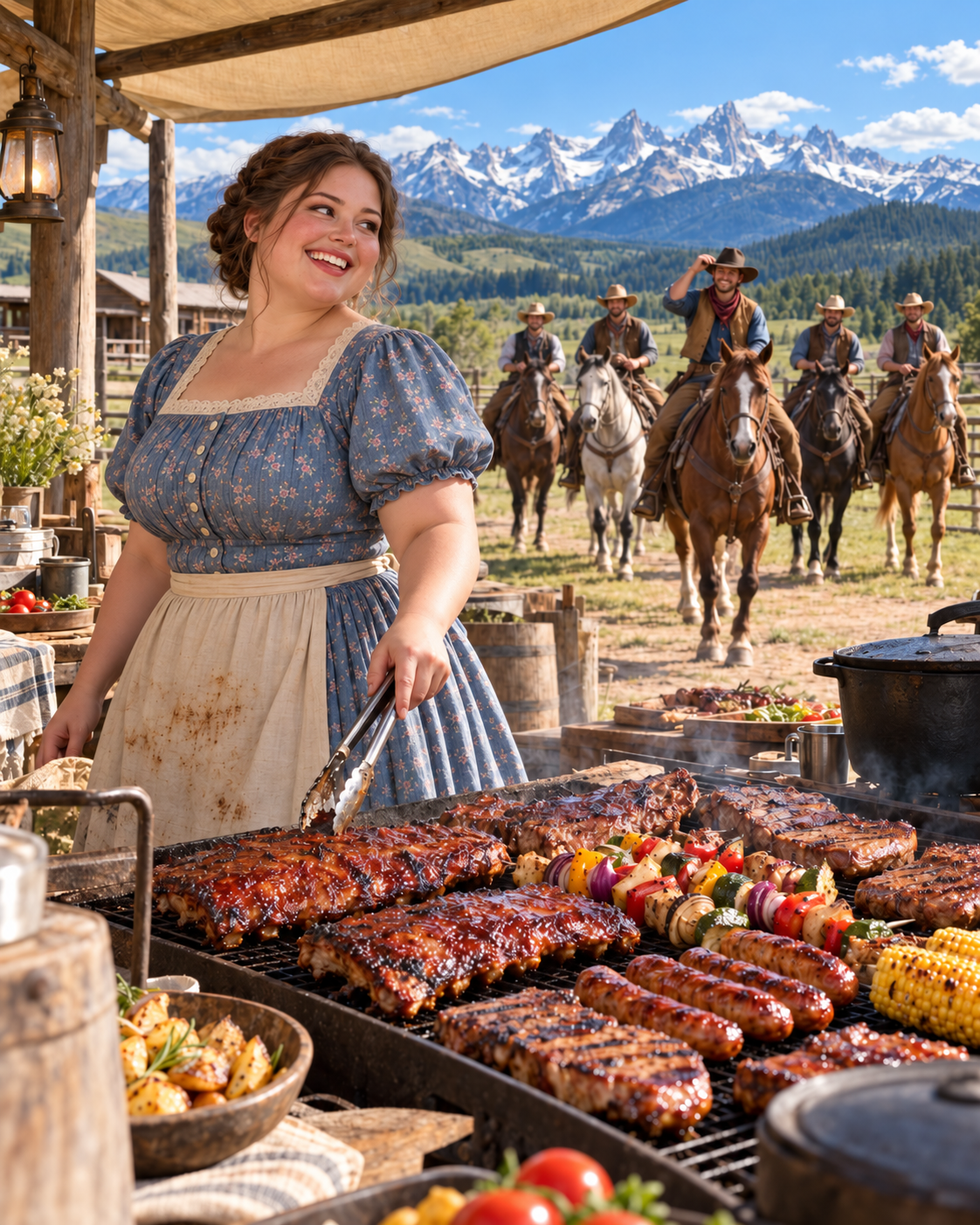
I watched Whitaker’s Barbecue House burn against the Montana sky.
The place I had built with blistered hands, sleepless nights, and every dollar I possessed was disappearing before my eyes.
Samuel tried to speak, but I shook my head.
“Save your strength.”
He looked toward the burning building.
“I’m sorry.”
I wanted to tell him that sorry couldn’t restore six months of grief or rebuild everything I’d lost.
Instead, I tightened the cloth against his wound.
“You can apologize when you’re well enough to work.”
We followed the creek until we reached Martha Ellis’s little house beyond the cottonwood trees.
She opened the door carrying a lantern and a kitchen knife.
When she saw Samuel, her mouth fell open.
“Good Lord, Eleanor.”
“I need hot water, clean cloth, and someone who knows how to remove a bullet.”
Martha recovered quickly.
“My brother was an army surgeon. He taught me enough to keep a man breathing.”
She laid Samuel on her kitchen table and examined the wound.
“The bullet passed through his shoulder. He’s lost blood, but it missed the lung.”
I gripped the back of a chair as relief weakened my knees.
While Martha worked, I unfolded the leather ledger Samuel had given me.
Its pages were filled with cattle brands, false land deeds, payment records, and names written in several different hands.
Silas Bennett appeared repeatedly.
So did Sheriff Walker.
But one name made my stomach tighten.
Daniel Whitaker.
Beside it was an entry dated seven years earlier.
“Blackwater shipment. Witness eliminated. Payment received.”
I read those words again and again.
My father had died seven years earlier, supposedly crushed beneath a wagon loaded with lumber.
I had been twenty-three when they brought his broken body home.
I remembered washing the dirt from his hands before the burial.
Those hands had taught me how to build a fire that could smoke meat for fourteen hours without burning it.
Could those same hands have belonged to a criminal?
I closed the ledger before the answer could swallow me.
Just before dawn, Samuel opened his eyes.
Martha was asleep beside the stove, and the house smelled of boiled coffee and blood.
“Tell me the truth,” I whispered.
He stared at the ceiling.
“Your father wasn’t born Daniel Whitaker.”
I sat beside him without speaking.
“His real name was Nathaniel Reed.”
The name meant nothing to me.
Samuel swallowed painfully.
“He worked for a cattle syndicate that stole livestock, forged ownership papers, and forced small ranchers from their land.”
“And my father helped them?”
“At first.”
I waited while Samuel gathered his strength.
“Then he discovered they were taking more than cattle.”
The room seemed to grow colder.
“Families were being driven from their homes. Men who refused to sell were accused of rustling. Some disappeared.”
I remembered my father’s nightmares.
He would sometimes wake shouting names I didn’t recognize.
My mother used to tell me the war had left terrible memories inside him.
Perhaps it hadn’t been the war at all.
“Your father began keeping copies of their records,” Samuel continued. “He intended to expose the entire operation.”
“Then why does his name appear beside a payment for an eliminated witness?”
Samuel turned his face away.
“That’s what Abigail Mercer can explain.”
I studied the man I had loved for nearly nine years.
He had hidden his survival from me, and now he was asking me to believe another secret.
“Why should I trust you?”
Samuel’s eyes filled with tears.
“You shouldn’t. Not because I’m your husband.”
He reached for my hand, but stopped before touching it.
“Trust what you can prove.”
That answer hurt more than another lie would have.
At sunrise, Martha returned from the village with terrible news.
The sheriff had announced that I had murdered my husband and burned my own business to conceal the crime.
A reward of two hundred dollars had been offered for my capture.
My name was nailed to the sheriff’s notice board beneath the word MURDERER.
I laughed once, a hollow sound that frightened even me.
Two hundred dollars.
Apparently, my freedom was worth more than my barbecue house had been.
Martha placed a hand on my shoulder.
“We need to get you out of Caldwell Creek.”
I looked at Samuel, pale and barely conscious beneath the blankets.
“I won’t leave him.”
“Then we’ll move him somewhere safe.”
Martha’s brother owned an abandoned hunting cabin in the mountains.
With the help of Danny, the young cowboy from Harlan’s roundup crew, we moved Samuel there beneath a wagonload of hay.
Danny had heard what the sheriff was saying about me.
He didn’t believe a word.
“You fed me when nobody else cared whether I ate,” he said. “That counts for something.”
I gave him the last money from my hidden emergency tin.
He refused it.
“Mrs. Whitaker, my mother always said a debt of kindness isn’t paid with coins.”
Before leaving, I asked him to watch Sheriff Walker and report anything unusual to Martha.
Then I saddled a borrowed horse and rode toward Blackwater Crossing.
The journey took nearly two days.
Wind tore across the prairie, and rain soaked my clothing until every movement hurt.
I slept beneath a rocky overhang, clutching the ledger against my chest.
During the second night, I dreamed of my father standing beside his barbecue pit.
He looked exactly as he had on summer evenings, his sleeves rolled up and smoke curling around his face.
“Watch the fire, Ellie,” he said.
I woke with tears freezing against my cheeks.
By late afternoon, Blackwater Crossing appeared beyond a stretch of yellow grass and crooked fences.
It was hardly a town.
A few cabins stood near an old bridge, and a shuttered trading post leaned toward the river.
I found Abigail Mercer living in a small house surrounded by dead sunflowers.
She was a thin woman with silver hair braided tightly behind her head.
When I introduced myself, she nearly dropped the bucket she was carrying.
“Eleanor Whitaker?”
“Yes, ma’am.”
Her eyes filled with tears.
“I have been waiting seven years for you.”
She invited me inside without another word.
On her mantel stood a faded photograph of my father.
Beside him was a woman I recognized from my earliest childhood memories.
My mother.
Abigail followed my gaze.
“Your parents were the bravest people I ever knew.”
I turned toward her.
“Samuel told me my father worked for cattle thieves.”
“He did,” she answered. “And he spent the rest of his life trying to undo what he’d helped them accomplish.”
She poured tea with trembling hands.
Then she told me a story that changed everything.
Years before Caldwell Creek became a prosperous cattle town, a powerful group of businessmen had organized a cattle operation built on forged titles and stolen herds.
Silas Bennett handled purchases and supplies.
Sheriff Walker, then a deputy, used his badge to frighten witnesses.
Several ranch owners financed the scheme.
My father had been their bookkeeper.
He recorded transactions, transferred money, and helped make stolen livestock appear legitimate.
For years, he convinced himself he was merely doing business.
Then a widowed rancher named Joseph Mercer refused to surrender his land.
Bennett arranged for Joseph to be arrested on false charges.
Days later, Joseph was found dead beside the river.
Abigail placed her teacup down.
“Joseph was my husband.”
My throat tightened.
“I’m sorry.”
She nodded quietly.
“Your father came to me the night Joseph died.”
She opened a wooden chest beneath her bed.
Inside were letters tied with blue ribbon, documents wrapped in oilcloth, and a small Bible.
“He confessed everything. Every forged deed, every stolen herd, every dollar.”
I stared at the papers.
“Then why wasn’t anyone arrested?”
“Because Walker controlled the local evidence, and the territorial officials your father approached were warned before they could investigate.”
She carefully untied the ribbon.
“Your father decided to gather enough proof to reach someone beyond their influence.”
But seven years earlier, the syndicate discovered what he was doing.
One of their men followed him to Abigail’s home.
My father escaped with most of his records, but the witness who had agreed to testify was murdered.
“Your father didn’t receive money for that killing,” Abigail explained. “The entry recorded a payment made to someone using his stolen identity.”
I remembered Samuel’s words about Nathaniel Reed.
Abigail showed me a signed statement describing how Bennett had forged my father’s signature on the transaction.
“Daniel was the name your father chose when he tried to leave his old life behind. When Bennett discovered he was collecting evidence, the men began using his former name to implicate him.”
I looked at the documents, desperate to believe her.
“How did he die?”
Abigail’s expression crumpled.
“He was going to Helena with the evidence. They stopped his wagon outside Caldwell Creek.”
I could barely speak.
“My mother told me it was an accident.”
“She knew he had been murdered. But Walker threatened both of you if she told anyone.”
I covered my mouth as old memories returned.
My mother sitting awake beside a dark window.
The strange men who attended my father’s funeral.
The way she trembled whenever someone mentioned Sheriff Walker.
She had died three years later, carrying a truth she believed would keep me safe.
Abigail reached into the chest and handed me a sealed envelope.
My name was written across the front.
I recognized my father’s handwriting.
For several moments, I couldn’t open it.
Then I broke the seal.
“My dearest Ellie,” the letter began.
“If you are reading this, I have failed to come home.”
My vision blurred.
“I have done things I cannot excuse. I helped cruel men take what belonged to honest families, and for years I told myself I was powerless to stop them.”
I pressed the paper against the table.
“But a man who profits from wrongdoing cannot call himself innocent simply because he later regrets it.”
Tears slipped down my cheeks.
“I want you to know that goodness is not something we inherit. It is something we choose, especially when choosing it costs us dearly.”
Below those words, my father had written one final instruction.
“Never surrender your own life trying to redeem mine. Build something honest, and let it stand where my mistakes once stood.”
I wept until Abigail moved beside me and held me like a daughter.
For seven years, I had mourned a man I believed was entirely good.
Now I understood that he had been something more difficult to love.
A flawed man who had finally chosen courage.
When I could speak again, I asked Abigail why she had kept the documents hidden.
“Because nobody would have believed one frightened widow against men who owned the town.”
She touched the ledger.
“But with Samuel’s records and these statements, there may finally be enough.”
I spent the night sorting the evidence.
By morning, I had identified seven fraudulent land transfers, payments to Walker, and records linking Bennett to the disappearance of three ranchers.
One transaction named the owner of Harlan’s ranch.
I stared at it in disbelief.
The man who had offered me a cooking contract had unknowingly purchased land stolen from the Mercer family.
Or perhaps he had known.
There was only one way to find out.
I returned to the hunting cabin under the cover of darkness.
Samuel was sitting upright when I arrived, his shoulder bound in clean linen.
He smiled weakly.
“You came back.”
I placed the documents before him.
“I found Abigail.”
His expression changed as he examined the papers.
“Then you know.”
“I know my father was involved in terrible things. I also know he tried to stop them.”
Samuel lowered his eyes.
“And you know I failed you.”
I sat opposite him.
“Why did you investigate Bennett without telling me?”
“Your father once asked me to protect you if anything happened to him.”
I felt my anger rise.
“I wasn’t a child when we married, Samuel.”
“I know.”
“Then why did you decide I couldn’t bear the truth?”
He remained silent for a long time.
“Because I was afraid of losing you.”
I looked at the bandages covering his wounded shoulder.
“You nearly lost me anyway.”
He nodded.
“I know that now.”
I took a slow breath.
“I don’t know whether I can forgive you.”
“I understand.”
“But I won’t let Walker kill you.”
For the first time, Samuel seemed to understand that these were two separate promises.
The following afternoon, Danny arrived at the cabin with urgent news.
Sheriff Walker was planning to transfer Bennett from the Caldwell Creek jail before a territorial investigator could question him.
According to Danny, Bennett had threatened to reveal the sheriff’s involvement unless he received safe passage out of Montana.
The transfer was scheduled for midnight.
If Bennett disappeared, the most important living witness might disappear with him.
I spread a map across the table.
There was one road suitable for a prison wagon traveling south.
It crossed the narrow wooden bridge beside Harlan’s ranch.
I knew those roads from hauling supplies.
I also knew Harlan owed me more than an apology.
That evening, I rode to his ranch while Danny watched over Samuel.
Harlan greeted me outside the stable.
When he saw my face, he removed his hat.
“Eleanor, I heard about the fire.”
“Your former employer tried to murder me.”
He looked away.
“I know.”
I handed him copies of the fraudulent deeds.
“Did you know where your rancher’s land came from?”
He studied the pages beneath the lantern.
The longer he read, the more deeply his jaw tightened.
“No.”
I watched his expression carefully.
He looked genuinely sick.
“My employer bought this property from Bennett twelve years ago. He believed the title was legitimate.”
“Then tell him.”
Harlan stared toward the dark pasture.
“He won’t want to hear it.”
“Neither did I when I learned what my father had done.”
He looked back at me.
“What do you need?”
“Twenty-two men willing to stand beside the truth.”
By sunset the next day, I had twenty-two.
Danny had persuaded the roundup crew to help after Harlan showed them the records.
Some had lost relatives to false rustling charges.
Others remembered families forced from their homesteads.
Not every man was eager to face the sheriff.
But none wanted another innocent person buried beneath a lie.
We didn’t prepare an ambush.
We prepared witnesses.
Harlan sent riders to notify the territorial marshal stationed north of Helena, while Martha delivered copies of the evidence to a traveling circuit judge.
Abigail agreed to testify.
Samuel insisted on attending despite his injury.
I told him he was a stubborn fool.
He smiled sadly.
“That makes two of us.”
Shortly before midnight, we gathered beside the bridge.
Lanterns burned along the road.
The ranch hands stood in plain view, unarmed except for a few rifles kept slung across their shoulders.
Harlan positioned himself at the front.
I stood beside him holding my father’s ledger.
When the prison wagon appeared, the horses slowed.
Sheriff Walker rode ahead, accompanied by two deputies.
Bennett sat inside the wagon with his wrists chained.
Walker pulled his horse to a stop.
“What is the meaning of this?”
Harlan stepped forward.
“We have evidence connecting you to stolen cattle, forged deeds, and murder.”
Walker laughed coldly.
“You’ve been listening to a wanted woman.”
I walked into the lantern light.
“Then arrest me.”
His smile faded.
“But you’ll have to explain why a supposedly dead man is standing behind me.”
Samuel emerged from the darkness.
Bennett made a strangled sound inside the wagon.
Walker drew his revolver.
“Nobody move.”
For one horrible second, I thought everything would end in blood.
Then Bennett shouted from the wagon.
“Walker, put it away!”
The sheriff glanced back.
Bennett leaned forward, his chains rattling.
“I’m not hanging for your crimes.”
Walker’s face twisted with fury.
“You think they’ll spare you?”
“No,” Bennett answered. “But I won’t die protecting you.”
Walker turned his revolver toward the wagon.
Samuel lunged forward, but his injured shoulder slowed him.
The shot cracked through the night.
A horse screamed and reared, jerking the wagon sideways.
Walker fired again.
This time Harlan struck his arm with the butt of a rifle.
The revolver fell into the dust.
Two ranch hands seized Walker before he could reach it.
He fought wildly, screaming that they were all traitors.
I stood frozen until Samuel touched my shoulder.
“It’s over.”
But it wasn’t.
Not yet.
Bennett stared at me through the wagon bars.
“You think your father was a hero?”
I looked at him steadily.
“No.”
He seemed startled.
“My father helped you hurt people, and then he tried to make things right.”
I stepped closer.
“You never tried.”
Bennett lowered his head.
At dawn, the territorial marshal arrived with two officers and took Walker into custody.
The evidence was transferred under signed witness statements.
Bennett agreed to testify against the remaining members of the syndicate in exchange for the possibility of a reduced sentence.
His cooperation did not erase what he had done.
Neither did my father’s final act of courage erase his earlier crimes.
Over the following months, investigators uncovered years of fraudulent land deals and stolen livestock.
Several wealthy ranch owners were charged.
Some families recovered portions of their property.
Others received compensation after the stolen land was sold under court supervision.
Abigail Mercer reclaimed the small riverside pasture where her husband had once grazed his cattle.
She stood beside the fence the day the papers were returned.
For a long time, she said nothing.
Then she knelt and pressed her palm against the soil.
“Joseph,” she whispered, “we came home.”
I turned away to give her privacy.
There are moments when another person’s joy is too sacred to witness closely.
Sheriff Walker was convicted of conspiracy, corruption, and his role in the murder of my father.
Bennett was sentenced for fraud, attempted arson, and his participation in the syndicate’s crimes.
I stood inside the courtroom when the verdicts were read.
I expected triumph.
Instead, I felt exhausted.
Justice had arrived, but it could not return the dead or restore the years stolen from the living.
Outside the courthouse, Samuel waited beside our wagon.
His shoulder had healed, though he still carried pain when the weather turned cold.
He offered me his hand.
I looked at it for a long moment.
“Samuel, I need you to understand something.”
He nodded.
“I loved you enough to mourn you. I loved you enough to search for the truth.”
My voice trembled.
“But I cannot spend the rest of my life wondering which parts of our marriage were real.”
His eyes glistened.
“Every moment I loved you was real.”
“Then you should have trusted me with the truth.”
He swallowed.
“You’re right.”
I watched the courthouse doors close behind the last spectators.
“I don’t know what happens to us now.”
Samuel took a slow breath.
“Then we’ll find out one honest day at a time.”
It wasn’t a grand promise.
Perhaps that was why I believed him.
We returned to Caldwell Creek as winter settled across the valley.
My barbecue house was gone.
Only the blackened brick smokehouse remained standing among the ashes.
For days, I walked past the ruins without stopping.
The sight still hurt too much.
Then one morning, I found Danny repairing the broken smokehouse door.
Harlan was unloading lumber nearby.
Martha stood beside a wagon filled with cooking supplies.
“What are you doing?” I asked.
Danny grinned.
“Building a barbecue house, ma’am.”
I stared at the lumber.
“I can’t afford this.”
Harlan shook his head.
“Your ranch contract was renewed, and several of the men have paid in advance.”
Martha handed me a thick envelope.
“There’s also a little money from customers who remember your cooking.”
Inside were coins, banknotes, and handwritten messages.
One came from a miner who said my biscuits had reminded him of his mother’s kitchen.
Another came from a widow whose children had eaten free during a difficult week.
I hadn’t realized how many people remembered those small kindnesses.
I covered my face and cried.
Not because I had lost everything.
Because I finally understood that I hadn’t.
By spring, Whitaker’s Barbecue House stood again.
This time, the dining room was larger, the kitchen had two smoking pits, and a painted sign hung above the entrance.
Beneath the name were four smaller words.
“Everyone Has A Place.”
I hired Danny to manage deliveries.
Martha became my business partner, with her name written beside mine on the ownership papers.
I trained two young women who had been told respectable girls shouldn’t work around fire and knives.
They became two of the finest cooks in the territory.
Some mornings, Samuel helped unload wood.
Other mornings, he repaired fences or swept the dining room.
He never asked me to surrender my business.
He never again made decisions in my name.
We learned to speak honestly, even when honesty was uncomfortable.
There were days when old anger returned without warning.
There were nights when I woke remembering the closed coffin.
Samuel never told me to forget.
He simply listened.
And slowly, something fragile began to grow between us again.
Not the marriage we’d had before.
Something different.
Something that might survive because it no longer depended on pretending.
One warm evening in June, I stood outside the smokehouse watching the sun fall behind the Montana mountains.
Samuel joined me carrying two cups of coffee.
“Your father would have loved seeing this place,” he said.
I watched smoke rise into the violet sky.
“I think he would have.”
Samuel handed me a cup.
“Do you ever wish you hadn’t learned the truth about him?”
I considered the question carefully.
For years, I had wanted to believe my father was a perfect man.
But perfect men belong to stories that leave no room for forgiveness or change.
“No,” I said at last.
“I wish he hadn’t made those mistakes. But I’m grateful he finally found the courage to face them.”
Samuel nodded.
We stood together in comfortable silence.
Then a wagon arrived carrying a family of six, weary from traveling across the territory.
The father climbed down first.
“Ma’am, we heard a woman here makes the finest barbecue in Montana.”
I smiled.
“Depends on who’s asking.”
He laughed.
“People say you stood up to the most powerful men in Caldwell Creek.”
I looked toward my kitchen, where Martha was helping the younger cooks prepare supper.
“I just wanted to sell good food.”
The man’s expression softened.
“Sometimes that’s how courage begins.”
His youngest daughter stepped forward and stared at my smokehouse.
“Did you really build all this yourself?”
I knelt beside her.
“Not by myself.”
I pointed toward the people working inside.
“But I started it myself, and I never let anyone tell me I couldn’t.”
The little girl considered this seriously.
“Can girls become barbecue cooks?”
I smiled.
“Girls can become anything they’re willing to work for.”
She looked at her father with shining eyes.
“Then I want to cook like her.”
I laughed, but something inside my chest ached with tenderness.
I remembered arriving in Caldwell Creek with forty-three dollars and a heart filled with grief.
I remembered Bennett’s laughter, Harlan’s contempt, and the flames swallowing everything I’d built.
I remembered my father’s final letter.
“Build something honest.”
For so long, I had believed independence meant never needing another person.
But the truth had proved more complicated.
Independence meant having the freedom to choose whom to trust, whom to love, and when to walk away.
It meant accepting help without surrendering ownership of my dreams.
It meant knowing that betrayal could wound me without deciding the rest of my life.
That evening, after the last customers departed, I placed my father’s battered iron skillet above the fireplace.
Its handle was blackened from years of use, and one side bore a small crack.
Some people might have thrown it away.
To me, it was proof that something damaged could still hold warmth.
Samuel stood beside the doorway.
“Are you happy, Eleanor?”
I looked around the dining room.
The tables were clean.
The accounts were paid.
The smokehouse was ready for another day’s work.
And the people I loved were alive.
I thought of my father, my mother, Abigail, Martha, Danny, and every stranger who had helped me rebuild.
Then I looked at Samuel.
“I’m not happy because everything turned out the way I wanted,” I told him.
“I’m happy because I finally know that even when life takes away what I love, it cannot take away who I choose to become.”
He reached for my hand.
This time, I took it.
Outside, the evening wind carried the scent of hickory smoke across Caldwell Creek.
For the first time in years, it didn’t smell like something burning down.
It smelled like something beginning.
And I finally understood the lesson my father had tried to teach me beside that old barbecue pit.
A good fire needs patience, care, and the courage to keep tending it when the night grows cold.
So does a good life.
I had survived betrayal, grief, injustice, and the destruction of everything I owned.
But I had learned that no person’s cruelty could turn my hard work into something worthless.
No man’s approval could make my dreams more legitimate.
And no terrible chapter, however painful, had the right to become the ending of my story.
My name is Eleanor Whitaker.
I came to Montana hoping to build a business.
Instead, I built a life that truly belonged to me.
And that was worth more than every dollar I ever earned.
THE END.