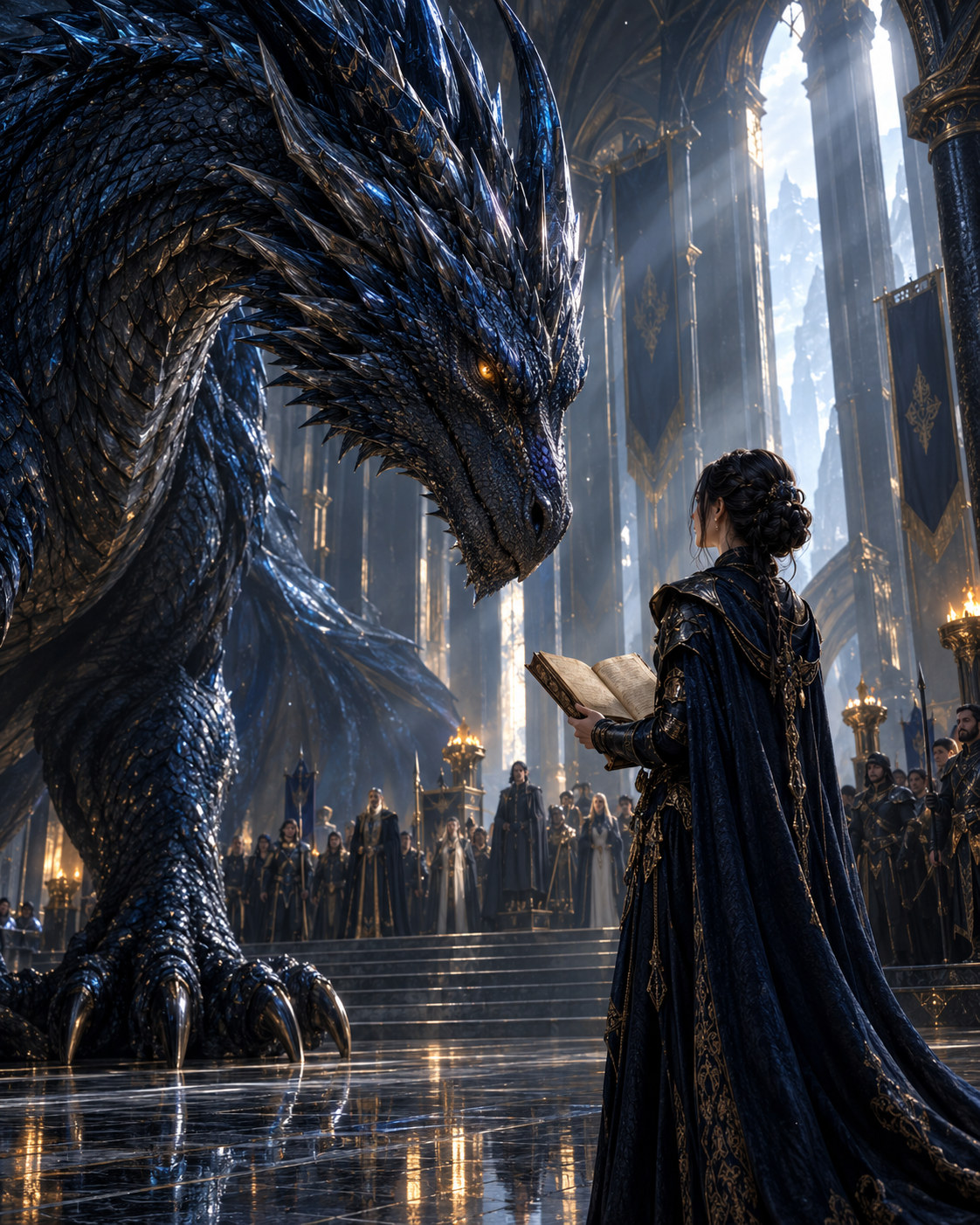
The oldest creature in the Obsidian Court had never bowed to anyone.
The question was one Valdrich had avoided for twenty years.
“What do you want?”
Vesper blinked.
The emperor stood beside her desk, his face unreadable, but there was something different in his voice. Not command. Not accusation.
Fear.
Vesper slowly closed her journal.
“I don’t know.”
Valdrich’s jaw tightened.
“Everyone wants something.”
“Then perhaps I’m not everyone.”
For a moment, the emperor simply stared at her.
Outside the window, Sorath’s golden eye remained open.
Valdrich glanced toward it.
“Do you know why he bowed?”
Vesper shook her head.
“No.”
“He has refused every emperor before me.”
“I know.”
“He refused my father when he was offered half the western provinces.”
Vesper looked toward the courtyard.
“Perhaps he didn’t want the provinces.”
A strange sound escaped Valdrich. It was almost a laugh, but there was no humor in it.
“No. Sorath wanted something much more dangerous.”
“What?”
“To be seen.”
Vesper frowned.
Valdrich walked to the window.
“Dragons do not forget. They remember voices, faces, promises. They remember every insult ever given to them. Sorath has watched this empire for three hundred years. He watched kings become legends and legends become dust.”
He paused.
“And he has watched every ruler make the same mistake.”
Vesper waited.
“They all believed power meant being feared.”
“And you?”
Valdrich’s reflection stared back at him from the glass.
“I believed it too.”
Before Vesper could answer, a bell rang somewhere deep beneath the palace.
Once.
Twice.
Three times.
Valdrich went completely still.
Vesper knew that bell.
Every servant did.
It was never rung for ceremonies.
It was the warning bell for the sealed archives.
“The eastern vault,” Valdrich whispered.
Another bell rang.
This time, the entire palace trembled.
Sorath lifted his head in the courtyard.
Then the dragon roared.
The sound shattered every window in the corridor.
Vesper stumbled backward, covering her ears.
Valdrich didn’t move.
His face had gone pale.
“What is in the eastern vault?” Vesper asked.
The emperor looked at her.
“The reason Sorath has never left this palace.”
Before she could ask another question, the doors burst open.
Captain Rovan entered with six armed guards.
“Your Majesty!”
Valdrich turned.
“Report.”
“The eastern vault has been breached.”
“By whom?”
“We don’t know.”
“Casualties?”
“None.”
“That isn’t possible.”
Rovan swallowed.
“There are no bodies.”
“Then why are you here?”
The captain hesitated.
“Because whoever entered left something behind.”
He held out a black cloth.
Vesper stared at it.
There was a symbol stitched into the fabric.
A silver crown split down the middle.
Valdrich’s expression changed.
“Who else has seen this?”
“No one.”
“Good.”
He took the cloth.
Then he looked at Vesper.
“You’re coming with us.”
Rovan immediately protested.
“Your Majesty, she’s a translator.”
“I know.”
“She has no military training.”
“I know.”
“She should remain here.”
Valdrich’s eyes hardened.
“If you wish to remain captain by sunrise, you will stop telling me what she should do.”
Rovan bowed.
“Yes, Your Majesty.”
Vesper grabbed her journal.
“Why me?”
Valdrich opened the door.
“Because whatever is inside that vault was written in a language no one has understood for two hundred years.”
Vesper stopped.
“And you think I can read it?”
“No.”
He looked toward Sorath.
“I think he believes you can.”
The eastern vault lay beneath the oldest wing of the palace.
No maps showed its location.
No servant was permitted within three corridors of it.
The walls changed as they descended.
Gold disappeared first.
Then marble.
Then even the polished black stone of the palace gave way to rough obsidian.
Vesper felt something pressing against her ears.
A vibration.
Almost like distant singing.
She touched the wall.
It was warm.
“This isn’t stone,” she whispered.
Valdrich looked at her.
“What?”
“It’s alive.”
Rovan’s hand moved toward his sword.
Vesper quickly pulled her fingers away.
At the bottom of the staircase stood a door made of solid black metal.
There was no handle.
Only a circular indentation in its center.
Valdrich approached.
The moment he touched it, the door opened.
No key.
No command.
It simply recognized him.
Beyond it lay a chamber filled with darkness.
Then torches ignited one by one.
Vesper stopped breathing.
Shelves covered the walls.
Thousands of them.
Ancient scrolls.
Broken tablets.
Metal plates.
Books bound in skins no living creature should have possessed.
At the center stood a stone pedestal.
Something rested upon it.
A small silver crown.
Vesper stared.
“That was my father’s.”
Valdrich nodded.
“I know.”
“Why is it here?”
“Because my father didn’t die in battle.”
Vesper turned sharply.
The emperor stared at the crown.
“He disappeared.”
“No,” Valdrich said quietly. “He was taken.”
A cold silence settled over the chamber.
“By whom?”
Valdrich did not answer.
A voice came from the darkness.
“By the people who believed they owned the throne.”
Everyone turned.
A figure stepped from behind the shelves.
An old man.
Thin.
Dressed in the black robes of a royal historian.
Vesper recognized him.
Master Oren.
He had served three emperors.
He had taught Valdrich history when the emperor was still a boy.
Yet Vesper had never seen him outside the archives.
Valdrich’s hand moved toward his sword.
“You.”
Oren smiled.
“I wondered how long it would take you.”
Rovan drew his blade.
The guards surrounded Oren.
But the old historian didn’t move.
“You broke into my vault,” Valdrich said.
“No.”
Oren’s smile disappeared.
“I opened your vault.”
The difference made the emperor hesitate.
“Why?”
“Because the time has come.”
“For what?”
Oren looked at Vesper.
“For her to remember.”
Vesper’s stomach tightened.
“I’ve never met you.”
“Oh, but you have.”
He pointed at her journal.
“You simply don’t remember.”
Vesper opened it instinctively.
Every page was filled with her handwriting.
Names.
Dates.
Small observations.
She had always believed the memories belonged to her.
But suddenly one entry caught her attention.
A sentence she had written seven years ago.
A sentence she had never understood.
I heard the dragon crying beneath the palace tonight.
Vesper’s fingers went cold.
She had no memory of writing it.
Another line appeared beneath it.
He called my name.
She stared at the page.
“I didn’t write this.”
Oren’s expression softened.
“Yes, you did.”
Valdrich stepped toward him.
“What did you do to her?”
“Nothing.”
“Then explain.”
Oren looked at the emperor for a long moment.
“Your Majesty, you have spent twenty years believing the throne made you powerful.”
He pointed toward the vault.
“It did not.”
Then he pointed toward Vesper.
“She did.”
The torches went out.
A roar shook the chamber.
Sorath.
But this time the sound was not outside.
It came from beneath them.
The floor cracked.
Rovan shouted for the guards to move.
Vesper lost her balance.
Valdrich caught her arm.
The stone beneath the pedestal split open.
A staircase appeared.
Descending into darkness.
Oren smiled sadly.
“Now you will see why he chose her.”
They descended.
No one spoke.
The deeper they went, the warmer the air became.
Vesper heard whispers.
At first she thought they were echoes.
Then she realized they were voices.
Hundreds of them.
Maybe thousands.
Kings.
Queens.
Children.
Soldiers.
Servants.
Dead people speaking from somewhere beneath the earth.
Vesper stopped.
“I can hear them.”
Valdrich looked at her.
“Hear what?”
“The names.”
She closed her eyes.
A hundred names rushed through her mind.
Then a thousand.
People erased from royal records.
People who had disappeared.
People who had been executed and declared traitors.
People who had simply been forgotten.
She gasped.
Valdrich grabbed her shoulders.
“What do you see?”
Vesper opened her eyes.
“The palace.”
“What about it?”
“It was built over them.”
Oren nodded.
“The first kings discovered something beneath this mountain.”
“What?”
“A heart.”
Vesper stared at him.
“A dragon’s heart?”
“No.”
Oren looked toward the darkness.
“The heart of the empire.”
The passage opened into a cavern so enormous that Vesper couldn’t see the ceiling.
At its center floated a sphere of black crystal.
Chains of silver light wrapped around it.
And behind the crystal stood Sorath.
Not the enormous creature she had seen in the courtyard.
Something older.
Something closer to a god.
His scales were scarred.
His wings were torn.
His horns were broken.
Three hundred years of chains had carved deep marks into his body.
Vesper covered her mouth.
“You’ve been hurting him.”
Valdrich said nothing.
Sorath looked at him.
Then at Vesper.
The dragon lowered his head.
The chains rattled.
Vesper stepped forward.
“Why did you choose me?”
Sorath opened his mouth.
No fire came.
Instead, a voice entered her mind.
Not choose.
Vesper’s breath caught.
Recognize.
She staggered.
Memories exploded through her.
A little girl running through palace corridors.
A woman carrying her through smoke.
A dragon lowering his head over a burning village.
A baby placed into someone’s arms.
A crown.
Blood.
And a promise.
Vesper fell to her knees.
“I remember.”
Valdrich stared at her.
“Remember what?”
She looked at him.
“My mother.”
The emperor’s face changed.
“My mother was a royal translator.”
“Yes,” Oren said.
“She translated the old dragon language.”
“Yes.”
“She discovered the truth.”
Oren nodded.
Vesper’s voice trembled.
“She wasn’t killed by rebels.”
“No.”
“Your father killed her.”
Valdrich closed his eyes.
Oren answered for him.
“Yes.”
The emperor’s silence was worse than an admission.
Vesper stood.
“Why?”
Valdrich finally spoke.
“Because she found out what the throne was built upon.”
He looked at the black crystal.
“The first emperor did not conquer this land.”
He swallowed.
“He made a pact.”
“With Sorath?”
“With the creatures beneath this mountain.”
Oren shook his head.
“Not a pact.”
Valdrich corrected himself.
“A theft.”
The black crystal pulsed.
Vesper suddenly understood.
The empire’s power.
Its endless wealth.
Its unusually fertile lands.
Its armies that had never known true defeat.
All of it had a source.
The heart beneath the mountain.
The stolen life of something ancient.
Every emperor had inherited the throne.
And every emperor had inherited the lie.
“Why didn’t you free him?” she asked.
Valdrich stared at Sorath.
“Because I was afraid.”
The answer was so simple that Vesper almost didn’t believe it.
“You?”
“Yes.”
“For twenty years, I told myself the chains protected the empire.”
He looked at the scars around Sorath’s legs.
“But the truth was uglier.”
“What truth?”
“If I freed him, everything I had built might collapse.”
Vesper looked at him.
“So you kept him imprisoned.”
“Yes.”
“Even knowing what your father did.”
“Yes.”
“Why?”
Valdrich’s voice broke.
“Because I thought saving a thousand people today justified condemning one creature forever.”
Sorath watched him.
Vesper looked at the emperor.
“And now?”
Valdrich took a long breath.
“Now I know I was wrong.”
The crystal suddenly cracked.
Everyone turned.
A thin line of light crossed its surface.
Then another.
Oren’s face drained of color.
“No.”
“What is it?” Rovan asked.
Oren looked at Valdrich.
“The seal is breaking.”
“How long?”
“Minutes.”
“What happens then?”
Oren looked at Vesper.
“The empire loses everything it stole.”
The cavern shook violently.
Above them, bells began ringing.
One after another.
The palace was awakening.
Rovan looked at the emperor.
“We need to evacuate.”
Valdrich nodded.
Then stopped.
“What about the people?”
Oren stared at him.
“The city?”
“The empire.”
“If the seal breaks, the eastern provinces may lose their harvests. The river could change course. The palace itself may collapse.”
Valdrich looked toward Sorath.
Then toward Vesper.
“How many people?”
Oren understood.
“Millions.”
Silence.
Vesper expected the emperor to order the dragon chained again.
Instead, Valdrich walked to Sorath.
He removed the imperial crown from his head.
Then placed it on the ground.
“I am not asking you to forgive me.”
Sorath watched him.
“I am not asking you to save us.”
Valdrich knelt.
Vesper had never seen him kneel before.
Not to kings.
Not to gods.
Not even to death.
“I am asking you to stop this from becoming another massacre.”
Sorath lowered his head.
The dragon’s eye met the emperor’s.
Then something extraordinary happened.
Sorath broke one of his own chains.
The cavern exploded with light.
Vesper screamed.
Valdrich covered his face.
Rovan fell to one knee.
The black crystal shattered.
But instead of destruction, a wave of silver light rushed upward.
Through the mountain.
Through the palace.
Across the city.
Everywhere it passed, the ancient magic that had sustained the empire began to disappear.
Golden towers cracked.
Royal banners fell.
The river changed.
Fields trembled.
But people remained alive.
The power was leaving.
Not killing.
Returning.
The stolen life was going home.
Sorath spread his wings.
For the first time in three hundred years, they were free.
He rose.
The cavern became filled with wind.
Vesper watched him ascend toward the broken ceiling.
Then he stopped.
He looked down at her.
A voice touched her mind.
Remember them.
“I will,” she whispered.
Then Sorath vanished into the night.
Three days later, the Obsidian Court no longer existed.
The palace still stood, but much of its gold had turned to ordinary stone.
The imperial treasury was nearly empty.
The eastern fields had lost one year’s harvest.
Several provinces declared independence.
The nobles demanded Valdrich’s resignation.
The generals demanded war.
The people demanded answers.
For the first time in two hundred years, the emperor gave them one.
He opened the royal archives.
Every sealed document.
Every execution order.
Every hidden treaty.
Every stolen name.
Every record of the dragon.
Everything was placed before the people.
Some called Valdrich a coward.
Some called him a traitor.
Some called him a murderer for waiting twenty years.
Others called him the first emperor who had finally told the truth.
He accepted every word.
He did not defend himself.
Instead, he ordered the names of the forgotten carved into the walls of the capital.
There were thousands.
Vesper supervised the work.
She became the keeper of the new archives.
Not because she wanted power.
Because she had learned what happened when history belonged only to those sitting on thrones.
Months passed.
The empire changed.
Not peacefully.
Nothing so large ever changed peacefully.
There were rebellions.
There were shortages.
There were arguments in every province.
The old nobles fought to restore the system that had made them rich.
The young demanded a government that could no longer hide behind ancient traditions.
And through it all, Vesper kept writing.
Not flattering stories.
Not heroic legends.
The truth.
One evening, nearly a year after the night Sorath disappeared, Vesper stood alone on the palace roof.
The city below was darker now.
Less magnificent.
But alive.
She heard wings.
She turned.
Sorath landed on the tower.
He looked older than before.
But lighter.
Free.
Vesper smiled.
“You came back.”
I promised.
“You never promised.”
The dragon tilted his head.
I promised you.
She laughed softly.
“That’s true.”
Sorath lowered his head.
Vesper placed her hand against his scales.
“Are you happy?”
The dragon looked over the city.
Then back at her.
I am free.
Vesper smiled.
“Is that the same thing?”
Sorath was silent for a long moment.
Then his voice entered her mind.
No.
She waited.
It is the beginning of it.
Vesper looked toward the horizon.
The sun was rising.
For centuries, the empire had taught its people that strength meant holding on.
Holding land.
Holding power.
Holding secrets.
Holding enemies.
Holding the throne.
But now Vesper understood something different.
Sometimes strength was knowing what had to be released.
Behind her, footsteps approached.
Valdrich.
He was no longer wearing the imperial crown.
He had kept his title temporarily, until the new council could determine what came next.
He stopped beside her.
“I thought you might be here.”
Vesper nodded.
“You always did.”
He smiled faintly.
“Do you still write about me?”
“Every day.”
“Am I going to like what you write?”
“No.”
Valdrich laughed.
It was the first genuine laugh she had ever heard from him.
“Good.”
He looked at Sorath.
“I never thanked you.”
The dragon stared at him.
“For what?”
Sorath’s answer came quietly.
I did not save you.
Valdrich nodded.
“I know.”
I saved what could still be saved.
Vesper looked between them.
Perhaps that was the difference.
A tyrant believed a kingdom existed to serve its ruler.
A wise ruler understood that a throne existed to serve the people.
And sometimes the first step toward becoming worthy of power was admitting that you had used it wrongly.
Valdrich turned toward the stairs.
“The council is waiting.”
Vesper closed her journal.
“Then we should go.”
She took one final look at the horizon.
For three hundred years, the Obsidian Court had been built on a stolen secret.
Now that secret was gone.
And in its place was something far more fragile.
Truth.
Truth did not promise prosperity.
It did not guarantee peace.
It did not make the people suddenly agree with one another.
But it gave them something the old empire had never allowed them to possess.
A choice.
Vesper began walking.
Then she stopped.
“Valdrich.”
He turned.
“Yes?”
She held up her journal.
“There is one last name I haven’t written on the wall.”
“Whose?”
She looked at him.
“Yours.”
He was silent.
“Why would you write mine?”
“Because history shouldn’t only remember the innocent.”
Valdrich lowered his eyes.
After a moment, he nodded.
“Then write it honestly.”
“I will.”
Vesper opened the journal.
She wrote one sentence.
Valdrich, Emperor of the Obsidian Court: a man who inherited a cruel world, helped preserve it, and eventually found the courage to break the chain he had once been too afraid to touch.
She closed the book.
It wasn’t forgiveness.
It wasn’t condemnation.
It was simply the truth.
And somewhere far beyond the palace, a dragon rose into the morning sky.
His shadow crossed the city.
Children pointed upward.
Old soldiers lowered their weapons.
Farmers stopped working to watch.
No one bowed.
No one ran.
For the first time, the people of the empire simply looked up.
And Sorath flew on.
Not as a god.
Not as a weapon.
Not as a servant of kings.
But as a living reminder that freedom could never truly belong to one person if it depended upon another creature’s chains.
Vesper watched until he disappeared beyond the mountains.
Then she whispered the lesson she had spent her entire life learning:
“The things we refuse to see do not disappear.”
She looked at the city.
“They wait.”
And sometimes, when the truth finally comes for us, the bravest thing we can do is not defeat it.
It is to open the door.
For three years, Vesper believed the worst was over.
She was wrong.
Peace, she learned, was not the absence of war.
It was what people did after the war had ended.
And the people of the former Obsidian Empire were still learning how to live without a throne telling them what to believe.
The first year had been chaos.
The second had been rebuilding.
By the third, the cities had begun to change.
The black banners were gone.
The imperial statues had been pulled down.
The old royal roads were renamed after people whose names had once been forbidden.
The archives were opened to everyone.
Children were taught that the empire had not always been glorious.
They were taught about the villages burned in the name of expansion.
They were taught about the prisoners whose names had been erased.
They were taught about Sorath.
And, most importantly, they were taught to ask questions.
Vesper had become the keeper of the National Archive, although she hated the title.
She preferred simply being called a translator.
Every morning, she arrived before sunrise.
Every evening, she left long after the lamps were lit.
Her office had grown larger, but she had refused to move into the former imperial chambers.
She still worked at the same wooden desk where Valdrich had once found her journal.
The journal itself remained locked inside a small iron box.
She had never allowed anyone to read it.
Not because it contained secrets.
Because it contained memories.
Some memories were not meant to become public property.
One autumn morning, Vesper was reading an ancient manuscript when she noticed something strange.
A sentence had appeared on the page.
She frowned.
The ink was fresh.
She touched it.
It was warm.
The sentence was written in the old dragon language.
She could read it now.
After everything that had happened, the language had become almost instinctive to her.
She translated the words silently.
When the stolen heart returns, the forgotten king will wake.
Vesper stopped breathing.
She read it again.
Then again.
The door burst open.
A young messenger stumbled inside.
“Archivist!”
Vesper looked up.
“What happened?”
“The northern watchtower.”
“What about it?”
“They saw something.”
“An army?”
“No.”
The boy was shaking.
“A dragon.”
Vesper stood.
“Which dragon?”
The messenger swallowed.
“They said it was black.”
Vesper’s heart sank.
“Not Sorath?”
The boy shook his head.
“No.”
“Then who?”
“We don’t know.”
Vesper grabbed her coat.
“Where?”
“The northern mountains.”
She was already moving.
By sunset, she had reached the old watchtower.
Snow covered the road.
The mountains stood like broken teeth against the red sky.
Three guards waited at the top of the tower.
All of them looked terrified.
One pointed toward the valley.
Vesper followed his finger.
At first she saw nothing.
Then the clouds moved.
Something enormous crossed the moon.
It was a dragon.
But unlike Sorath, this creature had no gold in its eyes.
Its scales were black.
Not obsidian.
Not dark gray.
Black like a hole where light had disappeared.
It landed on the mountain ridge.
The ground shook.
Vesper stepped forward.
The dragon opened its mouth.
No fire came.
Instead, every torch around the tower went out.
Then Vesper heard a voice.
Not in her mind.
In the air itself.
“Where is the thief?”
The guards drew their weapons.
Vesper raised a hand.
“Don’t.”
The dragon’s eyes focused on her.
“You are the translator.”
Vesper’s blood went cold.
“How do you know me?”
“I know the blood of the woman who betrayed us.”
Vesper’s heart stopped.
“My mother?”
The dragon lowered its head.
“Your mother was not a translator.”
“What?”
“She was a guardian.”
Vesper felt the world tilt beneath her.
The dragon continued.
“She was sent to protect the heart.”
“But she died.”
“She did not die.”
Silence.
Vesper stared at the creature.
“Then where is she?”
The dragon’s eyes narrowed.
“In the place where all guardians go when they fail.”
The mountain trembled.
A crack appeared beneath Vesper’s feet.
She stumbled backward.
The dragon spread its wings.
“Come.”
“Where?”
“To the beginning.”
The dragon jumped from the ridge.
For a moment, Vesper thought it had disappeared.
Then it circled back.
It landed directly in front of her.
“Climb.”
Vesper hesitated.
Every sensible part of her mind told her to run.
Instead, she climbed onto the dragon’s back.
The creature launched itself into the night.
The wind tore through her hair.
Below them, the mountains blurred into darkness.
They flew for nearly an hour.
Then the dragon descended into a valley hidden between enormous cliffs.
At its center stood a ruined city.
Vesper stared.
She knew that place.
Every historian did.
It was the city that supposedly had never existed.
The first capital.
The birthplace of the empire.
The place where the first emperor had disappeared from history.
They landed beside a broken stone gate.
Vesper climbed down.
“What is this?”
“The first kingdom.”
“But the records say it was destroyed.”
“They lied.”
The dragon walked through the ruins.
Vesper followed.
The buildings were ancient, but not abandoned.
There were footprints in the snow.
Human footprints.
She stopped.
“Someone lives here.”
“Yes.”
“Who?”
The dragon didn’t answer.
Instead, it stopped before a stone door.
There was no symbol.
No handle.
Only a single sentence carved into the stone.
Vesper translated it.
Only those who have lost the throne may enter.
The door opened.
Inside was a chamber.
A woman sat beside a dying fire.
Her hair was silver.
Her back was turned.
Vesper couldn’t breathe.
She knew that silhouette.
She had seen it in dreams since childhood.
“Mother?”
The woman slowly turned.
Her eyes filled with tears.
“Vesper.”
The world disappeared.
Vesper ran.
They collided in an embrace so desperate that neither spoke for several seconds.
“You’re alive.”
Her mother held her face.
“You grew up.”
“You watched me?”
“Every year.”
“Why didn’t you come back?”
Her mother’s expression broke.
“Because I was afraid.”
“Of what?”
“Of what would follow me.”
Vesper stepped back.
“Then tell me.”
Her mother looked toward the black dragon.
“The empire was never built to control Sorath.”
Vesper frowned.
“What?”
“It was built to protect the world from what lies beneath him.”
The room became silent.
Vesper shook her head.
“We broke the chains.”
“I know.”
“Sorath is free.”
“I know.”
“Then what did we unleash?”
Her mother closed her eyes.
“The truth.”
Outside, thunder rolled.
The black dragon entered the chamber.
“The first seal has opened.”
Vesper looked at him.
“How many seals are there?”
“Seven.”
Her blood turned cold.
“And the other six?”
“Still closed.”
Her mother stood.
“Not for long.”
Vesper suddenly understood.
The black dragon had not come to attack them.
It had come to warn them.
“What happens when they open?”
Her mother looked toward the distant mountains.
“The ancient creatures beneath this world wake.”
“And then?”
“They remember who imprisoned them.”
Vesper swallowed.
“The empire.”
Her mother nodded.
“Not only the empire.”
She looked directly at her daughter.
“Humanity.”
For the first time since Sorath had left the palace, Vesper felt genuine fear.
Not fear for herself.
Fear for everyone.
Three days later, the council received the message.
They refused to believe it.
The generals demanded proof.
The scholars demanded evidence.
The politicians accused Vesper of inventing another legend to increase the power of the archives.
Then the first mountain erupted.
Not with fire.
With light.
A column of silver light rose into the sky and remained there for seven hours.
Every dragon in the northern territories disappeared.
Birds fled south.
The rivers turned black.
And every person who had ever possessed a piece of the old imperial bloodline began dreaming the same dream.
A door.
A black door.
And something knocking from the other side.
Valdrich was among them.
When Vesper returned to the capital, she found him waiting at the archive.
He looked older.
Much older.
“I saw it,” he said.
“You know what it is?”
“Yes.”
“Then tell me.”
Valdrich closed the door.
“My father knew.”
Vesper stared at him.
“Knew what?”
“That the empire wasn’t created by the first emperor.”
He sat down.
“It existed before him.”
“How long?”
“Thousands of years.”
“Then why was everything erased?”
“Because the first emperor made a bargain.”
“With whom?”
Valdrich looked at the window.
“With the things beneath the world.”
Vesper’s stomach tightened.
“What did he promise?”
“Our bloodline.”
She stared at him.
“The emperors?”
“All descendants of the first king.”
Vesper suddenly understood why the ancient language had called him a thief.
The empire had not merely stolen magic.
It had stolen time.
Generation after generation, the royal bloodline had acted as a lock.
Until Valdrich broke the system.
When the throne disappeared, the lock weakened.
When Sorath was freed, another seal broke.
And now the creatures beneath the earth were waking.
Valdrich looked at her.
“The throne wasn’t a symbol of power.”
“What was it?”
“A prison.”
Silence filled the room.
Vesper slowly sat down.
“So destroying the empire opened the door.”
“Yes.”
“And if we rebuild it?”
Valdrich shook his head.
“Then millions will remain enslaved to keep the door closed.”
Vesper looked at him.
“Then what do we do?”
Valdrich gave her the same answer she had once given him.
“I don’t know.”
For some reason, that frightened her more than anything else.
That night, Vesper went to the highest tower.
She lit a single lantern.
Then she spoke into the darkness.
“Sorath.”
Nothing happened.
She tried again.
“Sorath, if you can hear me, I need you.”
The sky remained empty.
Then the clouds moved.
A golden shape descended.
Sorath landed on the tower.
He looked at Vesper.
You opened the door.
“We didn’t know.”
You were told.
“By whom?”
Your mother.
Vesper looked at him.
“She says there are seven seals.”
Sorath’s eyes darkened.
There were eight.
Vesper froze.
“What happened to the eighth?”
I destroyed it.
“Why?”
Because it was mine.
Vesper stepped closer.
“What was behind it?”
Sorath looked toward the mountains.
My kind.
She understood.
The ancient dragons had not been guardians.
They had been prisoners too.
Sorath had destroyed the final seal because he believed freedom mattered more than safety.
But now he had returned.
Not to take back his decision.
To help them survive it.
“How do we close the other seven?”
Sorath looked at her.
You cannot.
“Then what can we do?”
Choose who you become when they open.
Vesper frowned.
“That doesn’t sound like a plan.”
It is the only plan that has ever mattered.
Then Sorath lowered his head.
There is one way.
Vesper touched his scales.
“What?”
The heart must be returned.
“What heart?”
The one your people stole.
“The crystal?”
Sorath shook his head.
The living one.
Vesper’s face went pale.
“Where is it?”
Sorath looked at her.
Inside you.
Everything stopped.
Vesper pulled her hand away.
“No.”
Your mother carried it.
“But she gave birth to me.”
Yes.
“And then?”
The heart chose you.
Vesper staggered backward.
All the strange memories.
The voices.
The language.
The dreams.
The reason Sorath had bowed.
It had never been because she was powerful.
It was because she carried the final fragment of the ancient heart.
“What happens if I return it?”
Sorath was silent.
Vesper understood.
“I die.”
Yes.
She looked down at the city.
Thousands of lights flickered below.
People laughing.
Children sleeping.
Families eating.
Lives that had nothing to do with ancient kings.
“Is there another way?”
Sorath did not answer.
“Tell me.”
There is always another way.
Vesper looked at him.
“Then what is it?”
The heart can be divided.
“How?”
“Among everyone.”
Sorath nodded.
If every living person carries a fragment, no single life must bear the entire burden.
Vesper’s eyes widened.
“But that would mean magic becomes part of everyone.”
Yes.
“People would change.”
Yes.
“Some would abuse it.”
Yes.
“Some would become monsters.”
Yes.
Vesper looked at the dragon.
“Then why is that better?”
Sorath’s golden eyes softened.
Because no king could ever steal it again.
Vesper understood.
The first empire had failed because power belonged to one bloodline.
The second would fail if power belonged to another.
The answer was not finding a better ruler.
It was creating a world where no ruler could own the source of life itself.
But there was a problem.
“How do we do it?”
Sorath looked toward the horizon.
The seven seals must open at the same time.
“And then?”
The heart must choose humanity freely.
“How?”
You must ask them.
Vesper almost laughed.
“Ask everyone?”
Yes.
“That will take years.”
You have until tomorrow.
The first seal broke before sunrise.
The second broke at noon.
The third broke before sunset.
Across the world, mountains opened.
Ancient cities rose from beneath the earth.
Creatures older than kingdoms walked into human lands.
And for the first time in recorded history, humanity stood before something it could not conquer.
There were no armies large enough.
No walls strong enough.
No emperor powerful enough.
So Vesper did something no ruler had ever done.
She told the truth.
Every bell in every city rang.
Every surviving messenger carried the same message.
There was no promise of victory.
No claim that the government could protect everyone.
No heroic speech.
Only the truth.
The world is changing.
We cannot stop it.
But we can decide what we become together.
Millions gathered.
Farmers.
Merchants.
Soldiers.
Children.
Former nobles.
Former prisoners.
People who had never spoken to one another.
Vesper stood before them with Sorath behind her.
She held no weapon.
No crown.
Only her journal.
“I was taught that power belonged to those strong enough to take it,” she said.
Her voice carried across the square.
“I was taught that secrets protected kingdoms.”
She looked toward the mountains.
“I was wrong.”
The seventh seal opened.
The earth shook.
A darkness appeared in the sky.
People screamed.
Vesper raised her voice.
“The creatures beneath us are not our enemies.”
The darkness descended.
“They are the consequence of what we did.”
A massive shadow emerged.
Then another.
Then hundreds.
The sky became filled with ancient beings.
Some were beautiful.
Some were terrifying.
All were free.
Vesper lifted her journal.
“For centuries, we asked what a ruler deserved.”
She looked at the people.
“Today, we ask what we owe one another.”
Silence.
Then a child stepped forward.
A little boy.
He held a broken wooden toy.
“What do I have to do?”
Vesper looked at him.
“Choose.”
“Choose what?”
“To share.”
The boy looked confused.
Then he placed his hand on the ground.
A small silver light appeared.
Someone else stepped forward.
Then another.
Then thousands.
Millions.
The lights spread through the city like stars.
The heart beneath the world awakened.
Sorath roared.
Every dragon in the sky answered.
The ancient creatures stopped.
The darkness split apart.
Silver light poured through it.
Vesper felt something tear inside her chest.
She fell to her knees.
Her mother’s voice echoed in her mind.
You were never meant to carry it alone.
Vesper opened her hands.
The heart emerged.
Not as crystal.
Not as fire.
As light.
It rose above her.
For one terrible moment, she thought it would consume her.
Then Sorath touched it with one claw.
The heart shattered.
Not into pieces of destruction.
Into millions of sparks.
Every spark found a person.
A farmer.
A soldier.
A child.
An old woman.
A prisoner.
A king.
A stranger.
No one was left untouched.
The ancient creatures lowered their heads.
The mountains stopped shaking.
The rivers became clear.
The final darkness vanished.
And Vesper heard Sorath’s voice one last time.
Now it belongs to everyone.
She collapsed.
When she opened her eyes, she was lying beneath the old palace sky.
Valdrich sat beside her.
“You’re alive.”
Vesper smiled weakly.
“Apparently.”
He laughed.
Then he began to cry.
She had never seen him cry before.
Neither had anyone else.
“What happened?”
“The creatures left.”
“The seals?”
“Gone.”
“The magic?”
Valdrich looked at his hands.
“Everywhere.”
Vesper sat up.
Outside, children were making small lights dance between their fingers.
Farmers were healing broken plants.
Soldiers were lowering their weapons.
The world had changed.
Forever.
Not into paradise.
There were still wars.
Still greed.
Still hatred.
Still people who wanted more than their share.
But no one could ever again claim that power belonged to a throne.
It belonged to everyone.
And because it belonged to everyone, everyone became responsible for it.
Years later, Vesper’s mother died peacefully.
Valdrich never returned to the throne.
He became a teacher.
Rovan became the first commander of an army that was forbidden to obey an emperor.
The former imperial palace became a school.
The eastern vault became a museum.
And the walls of the old capital remained covered with names.
Thousands upon thousands.
The forgotten were forgotten no more.
Vesper continued to write.
Her final book was not about emperors.
It was not about dragons.
It was not even about magic.
It was about memory.
On the last page, she wrote:
The greatest danger was never the power beneath the earth.
It was the belief that someone had the right to own it.
She closed the book.
Outside, a familiar shadow crossed the window.
Vesper smiled.
She walked onto the balcony.
Sorath landed beside her.
He was older now.
His scales carried new scars.
But his wings remained strong.
“You came back.”
I always do.
Vesper leaned against him.
“Do you remember the first time you bowed to me?”
Sorath’s eye narrowed.
You thought I had hurt my leg.
“I was concerned.”
You were ridiculous.
Vesper laughed.
“You were terrifying.”
I was lonely.
She looked at him.
The dragon’s voice softened.
That was worse.
For a while, neither spoke.
Below them, the city glowed.
Not with imperial gold.
With thousands of small lights.
Human lights.
Shared lights.
The kind no emperor could collect into a treasury.
Vesper opened her journal.
“What should I write?”
Sorath looked toward the horizon.
The truth.
She smiled.
“I always do.”
And so she wrote.
Not that the world had been saved.
Not that evil had been defeated.
Not that humanity had finally become wise.
Those things were too simple.
She wrote that people had been given power.
And that power would always remain dangerous.
She wrote that freedom was not a gift that could be received once and kept forever.
It had to be chosen again and again.
She wrote that the past could not be changed.
But it could be remembered.
And remembered truth could prevent old chains from being rebuilt.
Finally, she wrote the sentence that became the first lesson taught in every school across the new world:
The moment you believe power belongs to you, ask yourself who is carrying the weight of your freedom.
Vesper closed the journal.
Sorath spread his wings.
The sun was rising beyond the mountains.
He looked at her.
Ready?
She smiled.
“Always.”
The dragon leapt.
Vesper watched him disappear into the golden sky.
Then she turned toward the city.
A thousand years from now, perhaps someone would build another palace.
Perhaps someone would find another source of power.
Perhaps someone would once again promise that absolute control was necessary for peace.
Perhaps someone would say that fear was easier than trust.
But if that happened, Vesper hoped they would find the archives.
She hoped they would read the names.
She hoped they would remember the chains.
And she hoped they would remember that once, beneath a palace built on stolen power, an ancient dragon bowed before a quiet translator.
Not because she was a queen.
Not because she was stronger than him.
But because she saw what everyone else had forgotten.
That every living thing deserved to be seen.
That every life carried a story.
And that no throne, no empire, and no ruler could ever own the right to decide whose story mattered.
The Obsidian Court was gone.
The empire was gone.
The old world was gone.
But the lesson remained.
Power could build a kingdom.
Fear could protect it.
Secrets could preserve it.
Yet only truth could set it free.
And somewhere beyond the mountains, beneath a sky that no longer belonged to kings, an ancient dragon flew toward the sunrise.
Free.
At last.
Forever.
THE END.