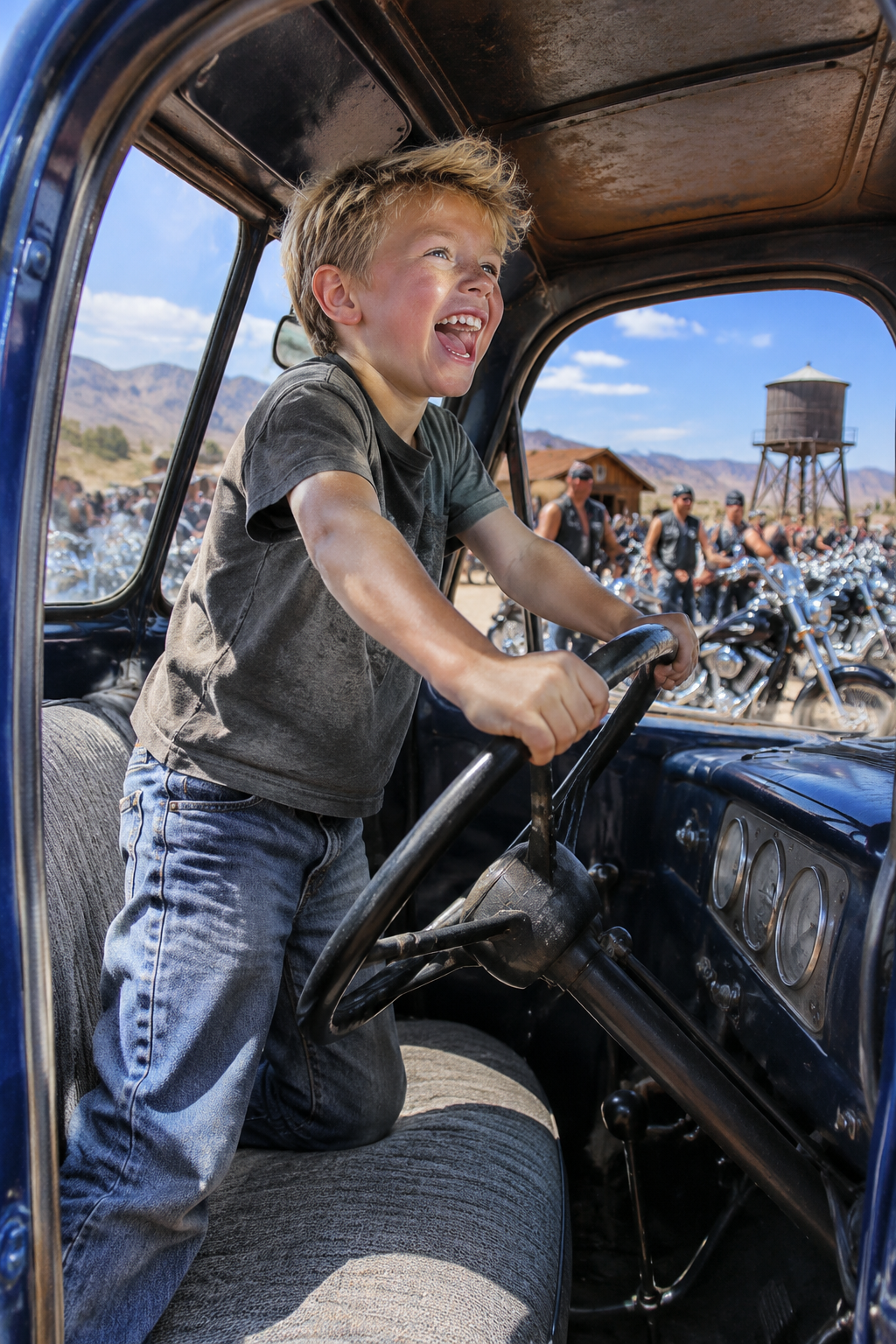
The nine-year-old boy climbed into his father’s semi-truck and pulled the air horn with both hands.
“If I do nothing, your father could die before that ambulance gets here.”
Sherman’s words fell over the truck stop like a heavy blanket.
Tanner stared at him, his small fingers still gripping the old biker’s leather vest.
“But if I give him the wrong treatment,” Sherman continued, “I could make things worse. That’s why I need everyone to listen carefully.”
The bikers exchanged nervous glances.
A broad-shouldered man named Bear stepped forward. “Doc, you’ve saved people before. Tell us what you need.”
Sherman looked at the orange prescription bottle in his hand. The label read hydrocortisone. Below it, in smaller letters, were instructions indicating that Mike had adrenal insufficiency and required emergency medical attention during a crisis.
“He’s been taking steroid replacement medication,” Sherman explained. “His body can’t produce enough cortisol on its own. Without it, his blood pressure can collapse.”
Tanner swallowed hard. “Is that because he forgot his pills?”
“Missing his medicine may have contributed, son. But something else could have triggered this.”
Sherman turned toward the truck.
“Has your dad been sick lately?”
Tanner nodded.
“He threw up yesterday. He said it was probably something he ate. And this morning, he was shaking, but he told me he was just tired.”
Sherman’s jaw tightened.
That changed everything.
He pulled out his phone and called the emergency dispatcher again, explaining Mike’s condition and reading the prescription label aloud. The dispatcher connected him with a medical supervisor.
For nearly two minutes, Sherman answered questions while Tanner stood beside his father, watching his chest rise and fall.
Then Sherman opened his medical kit.
Inside was an emergency hydrocortisone injection, carried under a prescription for his own adrenal condition.
“I have the medication,” Sherman told the supervisor. “But it’s prescribed to me.”
The supervisor gave instructions for keeping Mike stable and emphasized that the responding medical team needed to administer emergency treatment as quickly as possible.
Sherman closed his eyes for a moment.
He knew the risks of waiting.
He also knew the risks of acting outside medical authorization.
“Then get them here,” he said. “Because this man is running out of time.”
He ended the call and turned to Bear.
“Find out exactly where that ambulance is.”
Bear immediately reached for his phone.
Meanwhile, another biker named Rosa knelt beside Tanner.
She was a woman in her forties, with silver streaks in her dark hair and a faded patch reading DESERT GUARDIANS across her vest.
“Hey, little man,” she said gently. “What’s your name?”
“Tanner.”
“Well, Tanner, I’m Rosa. And right now, your dad needs you to be brave.”
“I’m trying.”
“I know you are.”
Tanner looked down at Mike’s pale face.
“My mom died when I was five,” he whispered. “Dad’s all I have.”
Rosa’s expression softened.
She reached for his hand.
“Then we’re going to do everything we can to help him.”
But across the parking lot, trouble was already approaching.
A white pickup truck pulled into the fuel station, followed by a dusty black SUV.
Three men climbed out.
The driver of the pickup was wearing a dark blue work shirt with a company logo over the pocket.
His name was Dale Mercer.
And the moment he spotted Mike’s semi-truck, his face changed.
“There it is,” he muttered.
The man beside him glanced toward the gathering of bikers.
“That’s a lot of witnesses.”
Dale didn’t answer.
He was staring at the trailer.
Specifically, at the numbered security seal hanging from its rear doors.
Because Mike wasn’t carrying ordinary freight.
And whatever had happened to him that morning might not have been an accident.
Back beside the truck, Sherman checked Mike’s pulse again.
It was frighteningly fast and weak.
“Come on, buddy,” he murmured. “Stay with us.”
Mike’s eyelids fluttered.
For a second, he seemed to recognize Tanner.
“Dad?”
Mike tried to speak.
His lips moved, but almost no sound came out.
Tanner leaned closer.
“What is it?”
Mike whispered something.
Sherman bent down.
“Say that again.”
Mike’s fingers twitched against the gravel.
“Don’t… let…”
His breathing became uneven.
“Don’t let them…”
Then his eyes rolled shut.
Tanner screamed.
“DAD!”
Sherman immediately checked his breathing and pulse.
“He’s still with us. Tanner, step back.”
Rosa gently pulled the boy away.
But Tanner had heard enough to understand that his father was trying to warn them.
He looked toward the trailer.
Then he noticed something strange.
Three unfamiliar men were standing near its rear doors.
One was holding a pair of bolt cutters.
“Hey!” Tanner shouted.
The men froze.
“What are you doing to my dad’s truck?”
Dale turned slowly.
He gave the boy a smile that didn’t reach his eyes.
“Relax, kid. We work with your father’s company.”
Tanner didn’t recognize him.
And Mike had spent years teaching him one important rule.
Never trust someone just because they claim to know you.
“Then why are you cutting the lock?”
Dale’s smile disappeared.
Bear heard the exchange and marched toward the trailer.
“Problem here?”
Dale straightened.
“Company business. Move along.”
Bear looked at the bolt cutters.
Then at the security seal.
“Funny. Your company business looks a lot like breaking into somebody else’s trailer.”
Dale stepped closer.
“You don’t know who you’re dealing with.”
Bear smiled.
“Neither do you.”
Within seconds, six more bikers had gathered behind him.
Dale glanced at them, calculating.
Then he lowered the bolt cutters.
“Fine. We’ll wait for the driver.”
He walked back toward his pickup, but his eyes never left the trailer.
Sherman noticed the confrontation.
“Bear! What’s going on?”
“Three guys trying to open the trailer.”
Sherman frowned.
“Keep them away from it. We have enough problems.”
Tanner tugged at Rosa’s sleeve.
“My dad said something before he passed out.”
“What did he say?”
“Don’t let them…”
Rosa looked toward the white pickup.
A cold feeling settled in her stomach.
“Did your dad seem worried about anything before you stopped?”
Tanner hesitated.
Then he remembered the phone call.
It had happened about an hour earlier, while they were crossing the desert.
Mike had answered through the truck’s Bluetooth system.
A man’s voice had demanded that he change his delivery destination.
Mike had refused.
The caller had become angry.
Tanner remembered his father’s exact words.
“I’m not taking that load anywhere except where the paperwork says.”
Then Mike had ended the call.
Rosa listened without interrupting.
“Did you hear the man’s name?”
“No. But Dad called him Mercer.”
Rosa slowly turned toward the pickup.
The driver’s shirt had a stitched name above the pocket.
MERCER.
She immediately called Bear over.
“We’ve got a problem.”
Before she could explain, a sharp electronic chirping came from the truck’s cab.
Tanner recognized it.
His father’s phone.
It was receiving another message.
Rosa climbed into the cab and found the phone resting beside the driver’s seat.
The screen lit up.
UNKNOWN NUMBER.
The message contained only eight words.
“Deliver the trailer, or your son disappears.”
Rosa felt her blood turn cold.
She looked out through the windshield.
Dale Mercer was staring directly at Tanner.
And he was smiling.
Rosa locked the truck doors and called Sherman.
“Doc, we need the police. Now.”
Sherman listened as she read the message aloud.
His expression darkened.
“Tell dispatch there’s a credible threat against a child. Give them the license plates.”
Rosa did exactly that.
But Dale had already noticed her using the phone.
He turned to the man beside him.
“They know.”
“What do we do?”
Dale looked at the motorcycles surrounding the truck.
Then at the highway.
“We improvise.”
At that moment, the distant sound of a siren drifted across the desert.
Everyone turned.
An ambulance appeared on the horizon.
For the first time in twenty minutes, Tanner felt a flicker of hope.
“They’re here!”
Sherman stood and waved both arms.
The ambulance raced into the parking lot, gravel spraying beneath its tires.
Two paramedics jumped out.
Sherman immediately gave them a detailed report, including Mike’s medical history, symptoms, prescription, and deteriorating condition.
One paramedic, a young woman named Elena, listened carefully.
“Suspected adrenal crisis?”
“Strong suspicion,” Sherman replied. “He’s hypotensive, confused, and getting worse.”
Elena opened her equipment bag.
Her partner connected Mike to a monitor while she established intravenous access and followed emergency treatment protocols.
Within moments, Mike was receiving the care he desperately needed.
Tanner stood beside Rosa, trembling.
“Is he going to wake up?”
Elena looked at him.
“We’re doing everything we can, sweetheart. We need to get him to the hospital.”
As they prepared to lift Mike onto the stretcher, Dale made his move.
A sudden crash came from the far side of the truck stop.
Someone had driven the black SUV straight into a row of empty metal trash containers.
The noise startled everyone.
At the same instant, Dale grabbed Tanner by the arm.
“Come with me, kid.”
Tanner screamed.
“LET GO!”
Rosa spun around.
“DON’T TOUCH HIM!”
Dale pulled the boy toward his pickup.
But he had underestimated one thing.
The Desert Guardians weren’t simply a group of motorcycle enthusiasts.
Many were military veterans.
Others were retired firefighters, mechanics, teachers, and emergency workers.
And every one of them had heard Tanner begging for his father’s life.
Bear moved first.
He stepped directly into Dale’s path.
“Let the boy go.”
Dale pulled a handgun from his waistband.
The entire parking lot went silent.
“Back off.”
Bear stopped.
Rosa raised her hands.
“Easy. Nobody needs to get hurt.”
Dale pressed the weapon toward Bear while tightening his grip on Tanner.
“Keys to the truck. Now.”
Tanner’s face was wet with tears.
“Please don’t hurt me.”
Dale leaned close.
“Then do what you’re told.”
Sherman stepped forward slowly.
“The keys are in the cab,” he said. “Let the boy go, and I’ll get them.”
Dale shook his head.
“You’re coming with me. Both of you.”
Behind him, Elena quietly instructed her partner to continue loading Mike into the ambulance.
They couldn’t abandon their patient.
Sherman looked at Tanner.
The boy was shaking so badly he could barely stand.
And suddenly, Sherman remembered another frightened child.
A boy from twenty-seven years earlier.
His own son, Daniel.
Daniel had been eleven when he died in a highway accident.
Sherman had been stationed overseas at the time.
He never got to say goodbye.
For years afterward, he had carried the terrible belief that he should have been there.
Now another child stood in front of him, terrified of losing his father.
And Sherman knew he couldn’t walk away.
“Dale,” he said calmly, “look at me.”
“Shut up.”
“You’re surrounded by witnesses. Police are already coming. Whatever’s inside that trailer isn’t worth destroying another life.”
Dale’s hand trembled.
“You don’t understand.”
“Then explain it.”
For a moment, something flickered across Dale’s face.
Fear.
Not anger.
Fear.
Then the black SUV’s driver shouted from across the lot.
“Mercer! We have to go!”
Dale glanced over his shoulder.
It was the opening Rosa needed.
She didn’t attack him.
Instead, she stepped closer to Tanner and spoke in the firm voice she had once used as a school counselor.
“Tanner, look at me.”
The boy turned.
“Remember what I told you? Be brave.”
Dale tightened his grip.
“Don’t talk to him!”
Rosa kept her eyes on Tanner.
“Your dad needs you alive. That’s all that matters.”
Tanner stopped struggling.
Dale seemed to relax slightly.
Then the sound of approaching police sirens filled the air.
Not one.
Several.
Dale looked toward the highway.
His escape route was disappearing.
He shoved Tanner away and sprinted toward the pickup.
Bear immediately pulled the boy behind a concrete barrier.
Dale jumped into his truck and slammed the accelerator.
The pickup roared forward, clipping a fuel pump barrier before swerving toward the highway.
Two police cruisers entered the truck stop.
Their lights flashed across the desert dust.
Dale tried to turn around them.
But his front tire struck a drainage ditch.
The pickup lurched violently, spun sideways, and crashed into a concrete retaining wall.
Officers surrounded the vehicle.
Within seconds, Dale Mercer was in handcuffs.
The two men from the SUV attempted to flee on foot.
They didn’t get far.
One was arrested behind the diner.
The other surrendered after discovering that a dozen bikers had formed a line across the service road.
Nobody cheered.
Nobody celebrated.
Because the most important battle was still being fought inside the ambulance.
Tanner climbed into the passenger compartment beside his father.
Sherman stood at the open doors.
Elena checked Mike’s blood pressure again.
It was still dangerously low, but treatment had begun.
“We need to move,” she said.
Tanner looked at Sherman.
“Are you coming?”
The old biker hesitated.
He had spent years avoiding hospitals.
The smell of disinfectant, the sound of monitors, the helplessness of waiting—all of it brought back memories he preferred to bury.
But Tanner reached for his hand.
“Please, Doc. I don’t want to be alone.”
Sherman climbed inside.
“Then you won’t be.”
The ambulance doors slammed shut.
As they sped toward the nearest hospital, Tanner watched his father’s face.
Mike still hadn’t opened his eyes.
“Doc?”
“Yeah, son?”
“Do you think God heard me when I blew the horn?”
Sherman looked at the little boy.
Outside, the desert rolled past in endless shades of gold.
“I don’t know exactly how God answers prayers,” he said. “But I know a whole lot of people heard you.”
Tanner nodded.
Then he whispered something that nearly broke Sherman’s heart.
“I was scared nobody would care.”
Sherman squeezed his shoulder.
“Sometimes the people who care most are the ones you least expect.”
At the hospital, doctors rushed Mike into the emergency department.
Tanner and Sherman were directed to a waiting room.
Minutes passed.
Then an hour.
Then another.
Bear and Rosa arrived with several members of the Desert Guardians.
They brought food, clean clothes, and Tanner’s backpack.
But Tanner refused to eat.
He sat beside Sherman, staring at the double doors.
Finally, a physician entered.
“Family of Michael Reynolds?”
Tanner jumped to his feet.
“That’s my dad!”
The doctor approached.
“I’m Dr. Patel. Your father experienced a severe adrenal crisis, likely triggered by illness and missed medication. His blood pressure dropped to a critically dangerous level.”
Tanner’s eyes widened.
“Is he dead?”
“No.”
The word seemed to lift the entire room.
“He’s alive,” Dr. Patel continued. “He’s responding to treatment, and we’re monitoring him closely. He’s not out of danger yet, but we’re cautiously optimistic.”
Tanner burst into tears.
Sherman wrapped both arms around him.
For several minutes, the boy couldn’t speak.
When he finally did, his voice was barely audible.
“Thank you.”
Sherman looked toward the ceiling, blinking rapidly.
“You’re welcome, son.”
But the story wasn’t finished.
That evening, two detectives arrived at the hospital.
They asked to speak with Sherman and Rosa.
The lead detective, a woman named Claire Bennett, carried a thick folder.
“We’ve been investigating Dale Mercer for months,” she explained.
Rosa folded her arms.
“For what?”
“Cargo theft, fraud, and suspected trafficking of stolen medical supplies.”
Sherman frowned.
“Medical supplies?”
Bennett nodded.
“Mike’s trailer contains temperature-controlled shipments of specialized hospital medications. The legitimate delivery was scheduled for a regional medical distribution center.”
She opened the folder.
“Mercer worked as a logistics coordinator for a subcontractor. He had access to route information and shipping schedules. We believe he intended to divert the trailer to an unauthorized warehouse.”
Sherman stared at her.
“And Mike refused?”
“Apparently.”
Bennett showed them a printed copy of a message recovered from Dale’s phone.
It instructed an associate to pressure Mike into changing the destination.
Another message contained a chilling sentence.
“Get him off the road before noon.”
Rosa felt her stomach tighten.
“Are you saying they poisoned him?”
“We don’t have evidence of that,” Bennett replied. “The doctors believe his medical crisis was caused by his underlying condition and illness. But we do know Mercer was threatening him and may have been planning to force him off the route.”
Sherman exhaled slowly.
“So the medical emergency happened before they could carry out their plan.”
“That’s our current understanding.”
Bennett closed the folder.
“Your quick response saved more than one person from a dangerous situation.”
Sherman shook his head.
“The boy saved his father. He sounded the horn.”
The detective smiled faintly.
“Then I’d like to thank him personally.”
But when they returned to the waiting room, Tanner was gone.
His backpack lay on the chair.
His shoes were still beneath it.
And on the table sat a folded piece of paper.
Rosa opened it.
The handwriting was crooked and uneven.
“Please don’t be mad. I went to find my dad. I heard someone say he might not wake up. I need to tell him something before it’s too late.”
Sherman’s face drained of color.
“Where’s the intensive care unit?”
They hurried down the corridor.
At the nurses’ station, a staff member told them a small boy had asked where Michael Reynolds was being treated.
She had directed him back toward the waiting area.
But Tanner hadn’t returned.
Sherman searched the hallways.
Rosa checked the elevators.
Bear headed toward the hospital entrance.
Then Sherman heard a familiar voice.
“Dad, please.”
It came from a room near the end of the corridor.
Sherman approached quietly.
Through the partially open door, he saw Tanner standing beside Mike’s hospital bed.
A nurse was nearby, watching him.
Mike lay beneath a white blanket, surrounded by monitors.
Tanner held his father’s hand in both of his.
“I’m sorry I complained about being in the truck,” he whispered.
Sherman stopped.
“I know I said I hated riding with you. But I didn’t mean it.”
Tanner wiped his nose with his sleeve.
“I just wanted you to come to my school sometimes. Like the other dads.”
The boy’s voice cracked.
“And I wanted you to see my science project. And my soccer games.”
He leaned closer.
“But I don’t care about any of that anymore. You can miss every game. You can drive forever. Just please don’t leave me.”
Sherman felt tears slide down his cheeks.
Then something extraordinary happened.
Mike’s fingers moved.
At first, Tanner didn’t notice.
Then the hand beneath his tightened slightly.
“Dad?”
Mike’s eyelids fluttered.
His lips parted.
And in a weak, raspy voice, he whispered, “No more… missing games.”
Tanner froze.
For one impossible second, he simply stared.
Then he shouted.
“DAD!”
The nurse immediately checked Mike’s monitors and called for the doctor.
Sherman stepped into the room.
Mike opened his eyes a little wider.
He looked at Tanner.
Then at the old biker standing in the doorway.
“Who…?”
Tanner laughed through his tears.
“That’s Doc! He’s a biker! He helped save you!”
Mike blinked.
“A biker?”
Sherman smiled.
“Afraid so.”
Mike tried to smile back.
“Guess… I owe you.”
“Not a thing,” Sherman replied. “Just get better.”
Mike turned toward his son.
“I’m sorry, buddy.”
Tanner shook his head.
“Don’t be.”
“No,” Mike whispered. “I need to say it.”
He struggled to find the words.
“I thought working harder meant being a better father. I thought if I kept the bills paid, you’d understand why I wasn’t home.”
Tanner squeezed his hand.
“I just missed you.”
Mike closed his eyes.
A tear slipped down his cheek.
“I know.”
Sherman quietly stepped into the hallway.
Some moments belonged only to a father and his son.
Over the following days, Mike’s condition improved steadily.
Doctors adjusted his treatment plan, reviewed his emergency medication needs, and taught him how to manage illness safely with adrenal insufficiency.
Meanwhile, police uncovered evidence connecting Mercer and his associates to a larger cargo theft operation.
The stolen shipments were recovered from a warehouse outside the city.
Investigators also discovered that Mike had documented several suspicious calls before his collapse.
His refusal to divert the shipment became important evidence in the case.
When Mike learned what had happened at the truck stop, he was stunned.
He remembered pulling in for fuel.
He remembered feeling dizzy.
After that, almost nothing.
But Tanner remembered everything.
He told his father about the air horn, the bikers, Sherman, the ambulance, and the man who tried to take him.
Mike listened in horrified silence.
When Tanner finished, Mike looked toward Sherman, who was sitting beside the window.
“All my life,” Mike said quietly, “I told my son to stay away from men who looked like you.”
Sherman raised an eyebrow.
“Well, I hope you at least told him to stay away from my ugly motorcycle.”
Mike shook his head.
“I’m serious.”
“So am I. That bike’s a disaster.”
Mike laughed, then winced.
Sherman leaned forward.
“Listen, Mike. You were trying to protect your boy. There’s nothing wrong with that.”
“But I judged people without knowing them.”
Sherman nodded slowly.
“Most people do, at one time or another.”
He glanced toward Tanner.
“The important thing is what you teach him now.”
Mike looked at his son.
Then he held out his hand.
Sherman took it.
And two men who might never have spoken under ordinary circumstances became friends.
Three weeks later, Mike was discharged from the hospital.
He was still recovering, but his doctors expected him to return to normal activities gradually.
His trucking company offered him a temporary office position while he regained his strength.
For the first time in years, Mike was home for dinner almost every night.
He attended Tanner’s soccer practices.
He helped with homework.
He even learned how to make pancakes without burning them.
But one Saturday morning, Tanner came downstairs carrying a cardboard box.
“Dad, I have something to show you.”
Mike looked up from the kitchen table.
“What’s in the box?”
“It’s for Doc.”
Inside was a handmade model of a semi-truck surrounded by motorcycles.
Tanner had constructed it from cardboard, bottle caps, and painted wooden sticks.
On the side of the truck, he had written:
“Heroes Don’t Always Wear Uniforms.”
Mike stared at it for a long moment.
Then he smiled.
“I think Doc’s going to love that.”
They drove to the Desert Guardians’ clubhouse that afternoon.
Mike had never visited a motorcycle club before.
The building stood beside an old repair shop, surrounded by rows of gleaming motorcycles.
As he stepped out of the car, he felt a familiar nervousness.
Then Bear appeared at the entrance.
“Well, look who’s still breathing!”
Mike laughed.
“Thanks to you guys.”
Bear pulled him into a careful hug.
Inside, the clubhouse was filled with laughter, music, and the smell of barbecue.
Rosa greeted Tanner with a huge smile.
“There’s my favorite little trucker!”
Tanner ran into her arms.
Then he spotted Sherman sitting near the back, polishing a motorcycle helmet.
“DOC!”
The old biker barely had time to stand before Tanner threw himself against him.
Sherman hugged him tightly.
“Easy there, partner. You’re getting bigger every time I see you.”
Tanner handed him the cardboard box.
“I made you something.”
Sherman opened it.
He studied the little truck and motorcycles.
Then he read the words painted on the side.
His smile slowly disappeared.
For a moment, he couldn’t speak.
“Do you like it?” Tanner asked nervously.
Sherman cleared his throat.
“Son, it’s the finest thing anybody’s given me in a very long time.”
He placed the model carefully on a shelf.
Right beside a framed photograph of a smiling eleven-year-old boy.
Tanner noticed the picture.
“Who’s that?”
Sherman looked at it.
“My son. Daniel.”
“Where is he?”
The room became quiet.
Sherman took a breath.
“He passed away a long time ago.”
Tanner looked at the photograph.
Then at Sherman.
“Do you miss him?”
“Every day.”
Tanner thought for a moment.
Then he slipped his hand into Sherman’s.
“You can come to my soccer games if you want.”
Sherman stared at him.
Tanner continued.
“My dad’s going to be there now. But there’s room for you too.”
Sherman’s eyes filled with tears.
He knelt beside the boy.
“I’d like that very much.”
And he kept his promise.
Over the next several months, Sherman became a familiar face at Tanner’s soccer games.
Sometimes he arrived alone.
Sometimes half the Desert Guardians showed up, parking their motorcycles along the fence and cheering louder than anyone else.
At first, the other parents stared.
Then they started bringing extra folding chairs.
Soon, the bikers were helping organize school fundraisers and collecting supplies for families in need.
What began as a frightening afternoon at a desert truck stop slowly became something nobody could have predicted.
A community.
A family built not by blood, but by kindness.
Nearly a year after the incident, Tanner’s school held an assembly about courage.
His teacher invited him to speak.
Tanner stood on the stage in front of hundreds of students and parents.
Mike sat in the front row.
Beside him were Sherman, Rosa, Bear, and several members of the Desert Guardians.
Tanner held a sheet of paper.
His hands trembled.
Then he looked at his father.
Mike gave him an encouraging nod.
Tanner lowered the paper.
“I used to think heroes were people who wore capes,” he began.
A few students laughed.
“Then I thought heroes were police officers or firefighters. And they are heroes. But I learned something else.”
He looked toward Sherman.
“Sometimes heroes wear leather vests. Sometimes they have long beards and loud motorcycles. Sometimes they look scary until you get to know them.”
The room fell silent.
“My dad told me not to talk to bikers. He thought they were dangerous. But when my dad fell down, they were the first people who came to help.”
Tanner paused.
“I was scared I was going to lose my dad. But those people didn’t know us, and they still stayed.”
His voice grew stronger.
“So I think being a hero isn’t about how you look. It’s about what you do when somebody needs you.”
Mike wiped his eyes.
Sherman lowered his head.
Tanner smiled.
“And I learned one more thing.”
He looked directly at his father.
“Sometimes you have to make a really loud noise to get people to listen. But sometimes all you have to do is tell someone you love them.”
The audience rose to its feet.
Applause filled the auditorium.
But Tanner wasn’t watching the crowd.
He was watching his father.
Mike stood with tears running down his face.
And for the first time in Tanner’s life, he wasn’t worried about whether his dad would be home for dinner.
He knew he would.
That evening, Mike and Tanner drove past the same desert truck stop where everything had happened.
The sun was setting, painting the mountains orange and red.
Mike slowed the car.
“Want to stop?”
Tanner looked at the rows of trucks parked beneath the glowing lights.
Then he smiled.
“Yeah.”
They parked near the fuel pumps.
The place looked almost exactly the same.
The diner.
The dusty parking lot.
The long stretch of highway disappearing into the desert.
Mike stood beside his son and stared at the spot where he had nearly died.
For a moment, neither spoke.
Then Tanner asked, “Dad, do you ever wish that day never happened?”
Mike considered the question.
“I wish you hadn’t been so frightened. I wish you hadn’t seen me like that.”
He knelt beside his son.
“But that day taught me something I should have learned a long time ago.”
“What’s that?”
Mike placed a hand over Tanner’s heart.
“That the most important things in life aren’t the things we carry in our trucks, or the money we make, or the miles we drive.”
Tanner waited.
“They’re the people waiting for us when we get home.”
A distant truck horn sounded across the desert.
Tanner smiled.
“That sounds like the horn I pulled.”
Mike laughed softly.
“Best noise I ever heard.”
They climbed back into the car.
Before starting the engine, Mike reached into the glove compartment and pulled out a small photograph.
It showed Tanner standing between Sherman and the Desert Guardians, all of them smiling beneath a bright desert sky.
Mike placed it on the dashboard.
Then he looked at his son.
“You know what, buddy?”
“What?”
“I spent years telling you to be careful around strangers.”
Tanner nodded.
“And I’ll still tell you to be careful,” Mike continued. “But I also want you to remember that kindness can come from people who look nothing like us.”
Tanner smiled.
“I already know that, Dad.”
Mike started the engine.
Together, they drove toward home.
Behind them, the truck stop grew smaller in the rearview mirror.
But the lesson of that day stayed with them forever.
Because courage isn’t always loud.
Sometimes it’s a frightened little boy refusing to give up.
Compassion isn’t always obvious.
Sometimes it arrives wearing dusty boots and a leather vest.
And family isn’t always defined by the people who share your name.
Sometimes it’s defined by the strangers who refuse to leave when your world is falling apart.
Mike had spent his life measuring success in miles traveled, deliveries completed, and paychecks earned.
But the day he nearly lost everything, he discovered that the greatest journey of his life wasn’t across the country.
It was the journey back to his son.
And Tanner learned that even when the world seems frightening, one brave act can bring unexpected kindness into the light.
Years later, whenever someone asked Tanner why he wanted to become an emergency medical technician, he would tell them about a desert highway, a fallen truck driver, and a group of bikers who stopped everything to help a stranger.
Then he would smile and say:
“My dad taught me how to be strong. But a man named Doc taught me what strength is for.”
And on the wall of the Desert Guardians’ clubhouse, the little cardboard truck remained on its shelf, carefully protected behind glass.
Beneath it, Sherman had placed a small brass plaque.
It contained just one sentence.
“Never judge a heart by the clothes that cover it.”
Because the world doesn’t become better when we find more people who look like us.
It becomes better when we choose to care for people who don’t.
And sometimes, all it takes to begin that change is one frightened child, one desperate cry for help, and a group of strangers willing to answer.