The night I was mocked beside a frozen Montana logging camp, the owner called me useless—but the debt papers hidden in his desk proved someone had planned my ruin.
The stranger was gone before we reached the fence.
Only a set of boot prints remained in the soft earth beneath the trees.
Ewan stood beside me, staring at them as though they were the tracks of a dead man.
“Who is he?”
He did not answer.
“Ewan.”
His shoulders rose and fell slowly.
Then he looked at me.
“My brother.”
The words struck harder than I expected.
“You told me you had no brothers.”
“I told you I had no family.”
“That isn’t the same thing.”
“No.”
His voice was barely audible.
“It isn’t.”
He turned toward the house.
For the first time since I had known him, I saw fear in his face.
Not the ordinary fear of losing money or timber.
This was older.
Deeper.
The kind of fear a man carries when he has spent years running from something and suddenly realizes it has found him.
I followed him inside.
He locked the door behind us.
Then he checked the windows.
Once.
Twice.
Three times.
“His name is Jonah,” he finally said.
“What happened to him?”
Ewan rubbed both hands over his face.
“He was supposed to have died twelve years ago.”
The room seemed to shrink around us.
“Supposed to?”
“There was a mine collapse in Idaho. Six men died. Jonah was listed among them.”
“But he didn’t.”
“I never saw a body.”
“Why didn’t you look?”
His eyes hardened.
“Because I was twenty-six, Hester. Because I had a dying father, a mountain of debt, and a man named Wallace Kums telling me Jonah had been killed because of something he had stolen.”
“What had he stolen?”
Ewan looked toward the kitchen.
“Records.”
My stomach tightened.
“The debt papers.”
He nodded.
“Not just mine. Kums had been lending money to timber camps, miners, ranchers, railway contractors. He would offer small loans, then alter the interest, change dates, add fees, and wait for people to miss one payment. By the time they realized what happened, he owned their land.”
“Then Jonah found proof.”
“Yes.”
“And Kums killed him?”
“I don’t know.”
The answer was honest enough to frighten me.
I remembered the letter on my kitchen table.
You found the wrong secret, Hester.
Not Ewan.
Me.
Someone had been watching us.
Someone knew what I had discovered.
“What does Jonah want?”
“I don’t know.”
“Then perhaps we should ask him.”
Ewan grabbed my wrist.
“No.”
His grip was so sudden that I froze.
He released me immediately.
“I’m sorry.”
I stared at him.
“He’s dangerous?”
“I don’t know that either.”
“Then what do you know?”
Ewan swallowed.
“I know that twelve years ago, Jonah told me something before he disappeared.”
“What?”
“He said, ‘If I ever come back, don’t trust anyone who knew the original contract.’”
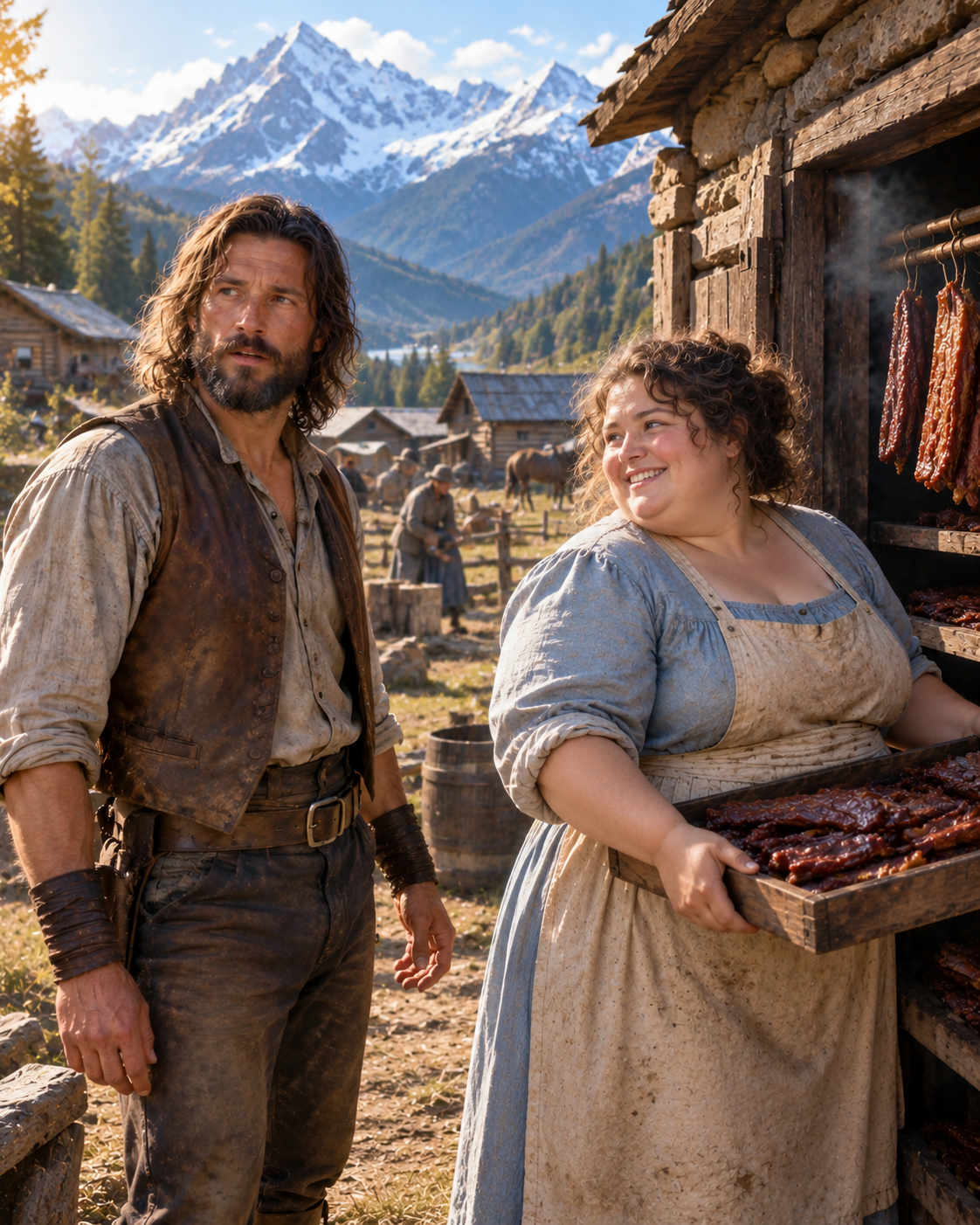
The following morning, we found something nailed to the smokehouse door.
A small envelope.
Inside was a torn piece of paper.
Three words had been written across it.
THE LEDGER IS ALIVE.
Cal Mercer found me holding it.
He read my expression before he saw the paper.
“Trouble?”
“Maybe.”
The old logger looked toward the tree line.
“Trouble usually doesn’t leave stationery.”
I almost smiled.
Almost.
Then I noticed something beneath the paper.
A symbol had been drawn in black ink.
A circle divided by a crooked line.
Cal’s face changed.
“You know it?”
He nodded slowly.
“I’ve seen that mark before.”
“Where?”
“On a wagon that belonged to Kums.”
That afternoon, we stopped work early.
I gathered the men in the dining room and told them the truth.
Not every detail.
Not the things I couldn’t prove.
But enough.
Kums had tried to steal the camp.
Someone connected to him was watching us.
And there might be records proving other people had been robbed the same way.
The room went silent.
Then Cal stood.
“I lost my brother to Kums.”
A younger logger beside him stared.
“My family lost our ranch.”
Another man spoke.
“My father died owing him money.”
One by one, the stories came.
Different towns.
Different years.
The same pattern.
Small loans.
Changed papers.
Impossible debts.
Land taken.
Families broken.
And suddenly I understood why the stranger’s warning had frightened Ewan so deeply.
This wasn’t about one camp.
It was an entire chain of stolen lives.
That night, Ewan and I searched his office.
We pulled out old ledgers, receipts, correspondence, maps, and contracts.
Nothing.
Then I remembered the words.
The ledger is alive.
“Ewan.”
He looked up.
“What if the ledger isn’t a book?”
“What else could it be?”
“The camp.”
He frowned.
I walked to his desk.
“The original contract disappeared because someone needed to hide it. If Jonah kept records, he would have needed somewhere Kums couldn’t search.”
We searched the walls.
The floorboards.
The attic.
The cellar.
Nothing.
Then I noticed the desk.
It was the same desk where I had first found the altered debt papers.
I ran my fingers along the underside.
A scratch caught my nail.
“Help me turn it over.”
Ewan stared at me.
“You think it’s hidden beneath the desk?”
“I think whoever built it knew people search drawers first.”
We overturned it.
Underneath, beneath a strip of wood, was a narrow compartment.
Inside lay a leather ledger wrapped in oilcloth.
Ewan stopped breathing.
I opened it.
Names.
Dates.
Amounts.
Signatures.
Land descriptions.
And beside nearly every loan was a second figure written in another column.
The true amount.
Someone had been recording the fraud.
But there was more.
At the back of the ledger was a list of names followed by a single word.
WITNESS.
Some were dead.
Some had vanished.
Three were still alive.
One name made Ewan stumble backward.
Jonah Sutter.
“He was keeping evidence,” I whispered.
“No.”
Ewan shook his head.
“He was trying to expose Kums.”
A floorboard creaked outside.
We both froze.
Then came another sound.
The back door opening.
Ewan reached for the rifle above the fireplace.
I grabbed the lamp.
Footsteps crossed the kitchen.
Slow.
Deliberate.
A shadow appeared beneath the office door.
Ewan raised the rifle.
“Jonah?”
The door opened.
A man stood there with a revolver in his hand.
He was older than Ewan, thinner, with a scar running from his left temple to his jaw.
But the eyes were unmistakable.
They were Sutter eyes.
He lowered the gun.
“Put yours down.”
Ewan did not move.
“You died.”
Jonah gave a bitter smile.
“I tried.”
For several seconds, the brothers stared at each other.
Then Ewan lowered the rifle.
Jonah closed the door.
“You shouldn’t have opened that ledger.”
“I didn’t know it existed.”
“I know.”
His gaze moved to me.
“Hester.”
“You know my name.”
“I’ve known your name for months.”
The room went cold.
“Why?”
“Because Kums hired someone to investigate the woman who found the altered contract.”
I felt my stomach turn.
“He knew about me?”
“He knew about you before you knew about him.”
Ewan stepped forward.
“Who hired him?”
“Kums.”
“He’s in prison.”
Jonah laughed without humor.
“Kums may have lost Ironwood Creek, but men like him don’t disappear because a judge signs a paper.”
“What do you mean?”
“I mean the money didn’t belong to Kums alone.”
Jonah pointed toward the ledger.
“That book contains the names of the men who financed him.”
I looked down at the pages.
“Who?”
“Bankers. Railway contractors. Land agents. Politicians.”
Ewan stiffened.
Jonah continued.
“They used Kums because he was willing to do the dirty work. When he was caught, they needed the evidence destroyed.”
“Then why leave it here?”
“I didn’t.”
He pointed toward the desk.
“I hid it twelve years ago.”
“Why come back now?”
Jonah’s expression changed.
“Because someone found the missing pages.”
My pulse quickened.
“What missing pages?”
“The final six.”
He looked at me.
“You found the original contract. That told them the ledger still existed. But they don’t know whether you’ve found the rest.”
“We haven’t.”
“You need to leave.”
“No.”
Ewan answered before I could.
Jonah looked at him.
“You don’t understand.”
“I understand enough.”
“No. You don’t.”
Jonah stepped closer.
“The people behind this don’t care about a timber camp. They care about what happens if those names become public.”
I closed the ledger.
“Then we make them public.”
Both brothers looked at me.
Ewan shook his head.
“Hester—”
“No.”
My voice surprised even me.
“For years, men have decided that women like me should be grateful for whatever place they’re given. I came here with one suitcase. I was called useless. I was laughed at. I was told I wouldn’t last a week.”
I looked at Jonah.
“I’m still here.”
Then at Ewan.
“And so are you.”
Jonah stared at me for a long moment.
Finally, he smiled.
“You really are the woman who changed this camp.”
The next three days became a race against time.
Jonah showed us where he had hidden copies of the evidence.
Inside a hollow tree.
Under a collapsed bridge.
Behind a loose stone in an abandoned church.
Piece by piece, the story emerged.
Kums had not invented the scheme.
He had merely operated it.
The altered contracts had been copied into a larger financial network.
Land was taken.
Timber rights were transferred.
Railway routes were manipulated.
Families who could not pay were forced out.
The missing pages contained the signatures of the men who profited.
And one of those men still had influence in Helena.
We couldn’t take the ledger to the authorities.
Not yet.
Jonah knew which officials could be trusted and which could not.
So we made copies.
Every page.
Every signature.
Every number.
Then Cal suggested something none of us had considered.
“Railway mail.”
I looked at him.
“What’s that?”
“Once the evidence is on the trains, it isn’t sitting in one drawer anymore.”
He was right.
We sent copies to newspapers in three cities.
We sent copies to lawyers.
We sent copies to families whose names appeared in the ledger.
We even sent one to a judge who had ruled against Kums years earlier.
But someone discovered what we were doing.
On the fourth night, the horses screamed.
I woke to the sound of gunfire.
Ewan was already out of bed.
“Stay here.”
“No.”
“Hester!”
I grabbed my coat.
We ran outside.
Flames were rising from the far end of the camp.
The storage shed was burning.
Men were shouting.
Cal was dragging barrels away from the fire.
Jonah stood near the tree line, firing toward two figures disappearing into the darkness.
Then I saw the smokehouse.
The fire had reached the roof.
“Our records!”
I ran.
Ewan caught my arm.
“You’ll die.”
“Then help me!”
Together we forced the door open.
Heat slammed into us.
The copies were stacked on a table.
Smoke filled the room.
I grabbed the box.
Ewan lifted the other.
A beam cracked overhead.
“Go!”
We stumbled outside just as part of the roof collapsed.
For a moment, I could not breathe.
Then I saw Ewan on his knees.
Blood was running down his forehead.
“Ewan.”
He looked up.
“I’m fine.”
He wasn’t.
But he smiled anyway.
Behind him, the smokehouse burned.
I thought of all the nights I had stood inside that building.
The first stew.
The first biscuits.
The first time those men stopped laughing.
It felt like watching part of our life disappear.
Then Cal placed a hand on my shoulder.
“Buildings can be rebuilt.”
He looked at the burning structure.
“People are harder.”
We rebuilt.
That was what we did.
We rebuilt the smokehouse.
We repaired the barn.
We replaced the burned boards.
And while we worked, letters began arriving.
A newspaper had published the first part of the ledger.
Then another.
Then another.
Families came forward.
Lawyers came forward.
Men who had once been afraid to speak began naming what had happened to them.
The network began to unravel.
Wallace Kums was questioned again.
Several men disappeared before they could be arrested.
Others turned on one another.
The names in the ledger became impossible to bury.
But Jonah was gone.
Three days after the fire, he disappeared without saying goodbye.
Ewan found a note beneath his pillow.
I did what I came back to do.
Don’t look for me.
Ewan read it twice.
Then folded it carefully.
“Will he come back?”
“I don’t know.”
He looked at the mountains.
“Neither do I.”
Spring returned.
Then summer.
Ironwood Creek grew beyond anything I had imagined.
We hired more workers.
We supplied railway camps farther south.
The dining room became larger.
The smokehouse became the heart of the operation.
And I stopped hearing the word “useless.”
But something inside me had changed.
I no longer needed to prove I was useful.
That was the lesson I understood slowly.
Worth was not something a person earned by exhausting themselves for other people’s approval.
I had spent most of my life believing that if I worked hard enough, cooked well enough, endured enough insults, I could convince people to let me belong.
Ironwood Creek taught me something different.
Belonging was not a reward.
It was something people built together.
One evening, nearly a year after the stranger first appeared, Ewan and I stood beneath the cottonwoods where we had married.
The river moved quietly behind us.
“You’re thinking too loudly,” he said.
I smiled.
“I didn’t know that was possible.”
“With you, everything is possible.”
I looked at him.
“Do you regret answering that advertisement?”
“Every day.”
I raised an eyebrow.
He laughed.
“Because I should have met you sooner.”
I leaned against him.
For a while, neither of us spoke.
Then a horse approached from the road.
Cal rode it.
He was carrying a letter.
He handed it to me.
“No return address.”
My heart tightened.
I opened it.
Inside was a single sheet of paper.
No threats.
No warnings.
Only a sentence.
You were right to make copies.
Below it was a name.
Jonah Sutter.
I looked toward the mountains.
Ewan read the letter over my shoulder.
“Is that all?”
I turned the page.
There was something else.
A small drawing.
The same crooked circle.
But this time, beneath it were four words.
THE LAST PAGE IS YOURS.
I stared at it.
Then I laughed.
Ewan looked at me as though I had lost my mind.
“What?”
“I thought the story was over.”
“So did I.”
We stood together in the fading light.
The mountains were turning gold.
For the first time, the symbol didn’t frighten me.
It reminded me of everything we had survived.
The altered papers.
The hidden ledger.
The fire.
The lies.
The men who had believed that money gave them the right to decide who deserved a home.
They had been wrong.
A year earlier, I had arrived at Ironwood Creek carrying one battered suitcase.
I had come because a lonely man needed a wife and a camp needed a cook.
I thought I was traveling toward a life someone else had designed for me.
Instead, I found a life I helped build.
I found a husband who learned that love was not ownership.
I found workers who became family.
I found courage in places I had mistaken for weakness.
And I discovered that sometimes the person everyone overlooks is the person who sees what everyone else refuses to see.
The last page of the ledger was eventually found.
It did not belong to Jonah.
It belonged to me.
Not because my name was written there.
Because I had become one of the people who could decide what happened next.
We sent the final evidence to every newspaper that had printed the first pages.
The remaining men behind the scheme were exposed.
Some were prosecuted.
Some lost everything.
Some escaped justice.
That part of the story was not as clean as I wanted it to be.
Life rarely is.
But the families who had been pushed from their land began fighting back.
Some recovered property.
Others received compensation.
Most importantly, people stopped believing that silence was the only way to survive.
Ironwood Creek became known not simply for timber, but for fair contracts.
Ewan insisted on it.
I insisted even harder.
Every agreement was read aloud before it was signed.
Every number was checked twice.
Every worker knew exactly what he was owed.
And whenever a frightened man came through our door carrying a paper he did not understand, we gave him a chair at our table.
Then we read it together.
Years later, when people asked me how Ironwood Creek survived, they expected me to talk about the smokehouse, the railway contracts, or the court case.
Sometimes I told them about those things.
But the truth was simpler.
Ironwood Creek survived because people who had once been taught to stand alone finally learned to stand together.
That winter, the snow came early.
One morning, I stood outside the kitchen watching it fall over the roofs.
A young girl was carrying flour toward the pantry.
She was perhaps ten years old.
Her mother worked in the kitchen.
The girl stopped when she saw me.
“Mrs. Sutter?”
“Yes?”
“My mother says you were the first woman here.”
I smiled.
“I suppose I was.”
“Were you scared?”
I looked across the camp.
At the smoke rising from the chimney.
At the men repairing a wagon.
At Ewan splitting wood.
At the mountains beyond all of it.
“Yes,” I told her.
“I was terrified.”
The girl frowned.
“But you came anyway.”
“Yes.”
“Why?”
I thought about the woman I had been when I stepped off that train.
A woman who believed being unwanted meant being unworthy.
A woman who thought usefulness was the price of being loved.
A woman who had spent years apologizing for taking up space.
Then I looked at the life standing in front of me.
“No one gets to tell you what your life is worth,” I said.
“You have to decide that yourself.”
The girl nodded solemnly, as though I had handed her something precious.
Then she carried the flour inside.
I remained beneath the falling snow.
Ewan came up behind me and wrapped his arms around my waist.
“What did you tell her?”
“The truth.”
He kissed my temple.
“Good.”
I leaned back against him.
For a moment, I listened to the camp.
Hammers.
Horses.
Laughter.
The kitchen bell.
Life.
All the sounds I once thought I would never have.
Then, far beyond the trees, a train whistle echoed through the mountains.
I smiled.
Ironwood Creek had begun with a lie written on a piece of paper.
A woman had been called useless.
A man had been trapped by a fraudulent debt.
A family had been torn apart by secrets.
But in the end, the paper did not decide our lives.
We did.
And perhaps that was the greatest secret of all.
People can steal your money.
They can forge your name.
They can burn your house.
They can convince you, for a while, that you are powerless.
But they cannot decide who you become after you discover the truth.
I had arrived at Ironwood Creek thinking I needed someone to choose me.
I left that old belief somewhere in the Montana snow.
Because I had finally understood something no advertisement could ever promise.
I was never waiting to be chosen.
I had been choosing all along.
And that was how the woman everyone had called useless became the woman who helped build a home no one could take away.
I was never waiting to be chosen.
I had been choosing all along.
And that was how the woman everyone had called useless became the woman who helped build a home no one could take away.
But there was still one thing I had never understood.
Why had Jonah written, “The last page is yours”?
For three years, I carried that question with me.
I never told anyone how often I thought about it.
Not even Ewan.
Life had become busy enough to bury old mysteries.
Ironwood Creek expanded.
The railway contracts grew.
We built a second smokehouse and hired six more workers.
The men who had once laughed when I arrived now argued over who made the best biscuits under my supervision.
Cal became the unofficial grandfather of every child born within twenty miles.
Ewan spent his days managing timber and his evenings helping me count supplies.
We were not rich.
Not by Montana standards.
But we had something better.
We had no creditors waiting outside the door.
No altered contracts hidden in drawers.
No man could walk into our office and tell us that a number on a piece of paper mattered more than the people who had worked for it.
Still, every autumn, when the first snow appeared on the mountains, I remembered Jonah.
Then, one November evening, he came back.
I was alone in the kitchen when I heard three knocks on the back door.
Not two.
Not four.
Three.
I froze.
The camp was quiet.
Most of the men had already gone to bed.
Ewan was in Helena attending a meeting with the railway company.
I reached beneath the counter and took hold of the heavy iron poker.
Another three knocks.
“Who is it?”
No answer.
I moved toward the door.
“Who?”
A man’s voice came through the wood.
“Hester.”
My heart stopped.
I opened the door only a few inches.
Jonah stood in the snow.
He looked older.
Thinner.
There was gray in his beard now.
One sleeve of his coat was torn, and blood had dried along the cuff.
His eyes were the same.
Sharp.
Tired.
Alive.
“You shouldn’t have come here,” I whispered.
“I know.”
“Are you hurt?”
“Not badly.”
“That means you are hurt.”
He gave me a faint smile.
“You still ask questions like a cook checking a spoiled potato.”
“Come inside before I decide to test whether the poker still works.”
He stepped into the kitchen.
I locked the door.
Jonah removed his coat.
There was a bullet wound along his upper arm.
I cleaned it while he sat at the table.
“You’ve been followed?”
“Not tonight.”
“That isn’t an answer.”
“Yes.”
I stopped wrapping the bandage.
“Who?”
“The men who inherited Kums’s operation.”
I stared at him.
“Kums is dead.”
“So are some of the men who worked for him.”
“And the others?”
“They learned.”
“What did they learn?”
“That the old system was too obvious.”
I sat across from him.
“What do they want?”
Jonah reached inside his coat.
He removed a small envelope.
Then he placed it on the table.
I recognized the handwriting immediately.
My stomach tightened.
“You kept it?”
“No.”
“I received it yesterday.”
He pushed the envelope toward me.
I opened it.
Inside was a single sheet.
The last page was never in the ledger.
It was hidden in the place where the first debt was created.
Below that sentence was a location.
Black Pine Station.
I looked at Jonah.
“What is Black Pine Station?”
“An abandoned railway station north of here.”
“Why would the last page be there?”
“Because that’s where the first contract was altered.”
“The first contract?”
“The first one Kums ever used.”
I thought of all the names in the ledger.
All the families.
All the farms.
All the camps.
“How do you know?”
“Because I was there.”
My mouth went dry.
“You were there?”
“Twelve years ago.”
Jonah leaned forward.
“I wasn’t investigating Kums because I was brave. I was investigating him because our father had lost nearly everything to him.”
Ewan had never told me that.
“Our father borrowed money?”
“To keep the mill open.”
“What happened?”
“Kums changed the contract.”
Jonah looked toward the dark window.
“My father believed the debt was legitimate. He worked himself sick trying to pay it. When he realized the numbers had been changed, he confronted Kums.”
“And?”
“Kums offered him another loan.”
I understood.
“He trapped him deeper.”
“Yes.”
Jonah’s fingers tightened around the edge of the table.
“When our father died, Ewan blamed himself.”
“Why?”
“Because he had signed as guarantor.”
The words settled heavily between us.
“That was why Ewan borrowed from Kums.”
“To keep the property.”
“To keep what was left of our family.”
I closed my eyes.
Suddenly, things I had once considered strange began fitting together.
Ewan’s hatred of debt.
His fear of contracts.
His refusal to control me.
His obsession with letting me make my own decisions.
He had spent years terrified that someone would own him again.
“And the first contract?”
Jonah looked at me.
“Our father’s.”
Silence filled the kitchen.
“You said the last page is mine.”
“Yes.”
“Why?”
“Because Ewan destroyed the original after our father died.”
I stared at him.
“He destroyed it?”
“He thought it was worthless.”
“But it wasn’t.”
“No.”
Jonah’s eyes hardened.
“It contained something Kums never realized mattered.”
“What?”
“The signature of the man who gave him the money.”
I looked toward the fireplace.
“Who?”
Jonah didn’t answer.
Instead, he stood.
“We have until morning.”
“Why?”
“Because they’re coming.”
“For the page?”
“For you.”
My blood turned cold.
“Why me?”
“Because you understand numbers.”
“That doesn’t make sense.”
“It does if the last page contains a cipher.”
I stared at him.
“A cipher?”
“The debt amounts were never random.”
“What do you mean?”
“Kums used altered numbers to disguise transfers.”
He pointed toward the envelope.
“The original figures form a code.”
I remembered the ledger.
The columns.
The repeated amounts.
The strange fees.
Numbers I had thought were evidence of greed.
Maybe they were something else.
“Where is Ewan?”
“On the road from Helena.”
“Then we wait.”
Jonah shook his head.
“No.”
He walked toward the door.
“You stay here.”
“I am not staying here while men come looking for me.”
“You have a husband.”
“And you have a brother.”
He stopped.
I could see the argument forming in his eyes.
I smiled.
“Ewan made the same mistake when he first met me.”
“What mistake?”
“He thought telling me to stay behind would work.”
For the first time that night, Jonah laughed.
“Then perhaps he deserved you.”
We left before midnight.
The snow had begun falling heavily.
We took two horses and followed an old logging trail north.
Black Pine Station was nearly two hours away.
The abandoned railway line disappeared beneath snowdrifts.
The station itself looked like a forgotten coffin.
One wooden building.
One broken platform.
A rusted sign hanging crookedly from two chains.
BLACK PINE.
Jonah dismounted.
“Inside.”
We entered.
The room smelled of dust and frozen timber.
There was an old ticket counter.
A broken stove.
A timetable from twelve years ago.
Jonah walked directly to the far wall.
“You’ve been here before.”
“Yes.”
He pulled away a loose board.
Behind it was a narrow cavity.
Empty.
His face changed.
“Someone got here first.”
A noise came from outside.
Snow crunching under boots.
Jonah extinguished our lantern.
We stood in darkness.
One voice spoke outside.
“They’re inside.”
Another answered.
“Search the station.”
Jonah leaned close to me.
“There’s a tunnel beneath the platform.”
“How do you know?”
“I built it.”
“You built a tunnel?”
“We were younger.”
“Remind me never to complain about my childhood again.”
He almost smiled.
Then the door burst open.
A gunshot shattered the silence.
Wood splintered above my head.
Jonah pulled me toward the floor.
Three men entered.
Then a fourth.
I couldn’t see their faces clearly.
But one voice sounded familiar.
“Find the woman.”
I knew that voice.
I had heard it once in Helena.
It belonged to the railway clerk who had delivered one of our first contracts.
A man named Silas Vane.
I whispered Jonah’s name.
He understood.
We crawled toward the platform.
Underneath it, Jonah found a trapdoor.
We dropped into darkness.
The tunnel smelled of earth and coal.
Behind us, men were shouting.
Jonah closed the trapdoor.
“Where does this go?”
“Half a mile east.”
“Why build it?”
“Smugglers.”
“You were a smuggler?”
“No.”
“Good.”
“I was fourteen.”
“That’s not much better.”
Despite everything, I nearly laughed.
We moved through the tunnel.
Then Jonah stopped.
He touched the wall.
“Wait.”
A section of brick had been disturbed.
He removed three bricks.
Inside was a metal box.
His hands shook.
“This is it.”
We opened it.
Inside was a single page.
Yellowed.
Folded.
Covered in handwriting.
And beneath it was a signature.
I knew it instantly.
Not because I had seen it before.
Because I had seen its copy.
On the original debt papers.
The signature belonged to Wallace Kums.
But beneath it was another.
A man’s name.
A name that had appeared again and again in the ledger.
Silas Vane.
The railway clerk.
Not a clerk at all.
A financier.
A partner.
And the person who had altered the contracts.
But there was something else.
At the bottom of the page was a final notation.
ACCOUNT TRANSFERS TO BLACKSTONE TRUST.
I stared at it.
“What is Blackstone Trust?”
Jonah’s face went pale.
“The bank.”
“What bank?”
“The bank that now owns half the railway contracts in this territory.”
I understood why they wanted the page.
It did not merely expose Kums.
It connected the entire operation to a financial institution still doing business.
“This could destroy them.”
“Yes.”
Footsteps echoed through the tunnel.
Jonah folded the page.
“We move.”
We reached the other end.
The tunnel opened behind an abandoned freight warehouse.
Snow had become a blizzard.
We mounted the horses.
Then gunfire erupted behind us.
Jonah’s horse collapsed.
He fell hard.
“Jonah!”
“I’m hit.”
I jumped down.
He pushed me away.
“Go.”
“No.”
“They’ll catch you.”
“I said no.”
A lantern appeared through the snow.
Then another.
The men were coming.
I looked at the warehouse.
Then at the horses.
Then at the railroad line.
An idea came.
“Can you walk?”
“Yes.”
“Can you shoot?”
“Yes.”
“Then follow me.”
We ran into the warehouse.
Inside were barrels of lamp oil, stacks of timber, and old railway equipment.
I remembered something Ewan had once taught me.
Timber burns.
Oil burns faster.
And fear makes men careless.
We hid behind a stack of crates.
The men entered.
“Spread out.”
I waited.
One man moved toward us.
I kicked a barrel.
It rolled across the floor.
He turned.
Jonah fired.
The man dropped.
Another shot struck the wall.
I grabbed a lantern and threw it toward the oil barrels.
Flames erupted.
“Run!”
We escaped through the rear door as the warehouse caught fire.
Behind us, men shouted.
The roof began collapsing.
We rode south until dawn.
By sunrise, Ironwood Creek appeared through the snow.
And Ewan was standing outside the main gate with a rifle.
He saw Jonah first.
Then me.
Then the blood.
His face changed.
“Hester!”
He ran toward us.
I slid from the horse.
“I’m fine.”
“You’re bleeding.”
“Not mine.”
He looked at Jonah.
Then the brothers stared at each other.
“You came back,” Ewan said.
Jonah nodded.
“I needed to.”
Ewan looked at the page in my hand.
“What is that?”
“The reason they came.”
We went inside.
For three hours, we read every line.
By noon, we knew what had to happen.
We would not hide the page.
We would not negotiate.
We would not let fear convince us to destroy evidence simply because powerful men wanted it gone.
We sent copies to every lawyer and newspaper who had helped us before.
Then we sent the original to a federal investigator in Washington.
Not by ordinary mail.
By three separate routes.
If one disappeared, another would survive.
For weeks, nothing happened.
Then the arrests began.
Silas Vane was taken in Helena.
Two bankers disappeared before they could be questioned.
Several railway officials resigned.
The Blackstone Trust denied involvement.
Its lawyers claimed the documents were fabricated.
Then the original page was examined.
The ink matched.
The signatures matched.
The financial records matched.
And the accounts began to speak for themselves.
The case lasted almost two years.
There were appeals.
Threats.
Arguments.
Newspapers filled pages with names.
Some men were convicted.
Others were cleared.
Some escaped entirely.
But the system they had built was broken.
Not because one man had become a hero.
Not because one woman had discovered a magical piece of paper.
It broke because thousands of ordinary people finally refused to remain silent at the same time.
Jonah stayed with us during the trial.
At first, he slept in the spare room.
Then he helped rebuild the north barn.
Then he began teaching the younger workers how to read contracts.
Ewan and Jonah did not suddenly become the brothers they might have been if their family had never been broken.
They argued.
They remembered old wounds.
Sometimes they went days without speaking.
But they stayed.
That mattered.
One spring morning, I found them sitting together beside the river.
Neither was talking.
They were simply watching the water.
I stood behind them.
“You two look almost civilized.”
Ewan turned.
“Don’t ruin it.”
Jonah smiled.
“We’re trying.”
I sat beside them.
For a while, we listened to the river.
Then Jonah reached into his coat.
He handed me a small envelope.
“What now?”
He shook his head.
“No more secrets.”
I opened it.
Inside was the original note he had written years earlier.
The one that said:
The last page is yours.
But beneath the old words, he had written something new.
You were never meant to carry this alone.
I looked at him.
“I don’t understand.”
“You thought the last page meant the evidence.”
“Didn’t it?”
“It meant the choice.”
“What choice?”
Jonah looked toward Ironwood Creek.
“Whether you let the truth destroy you, or whether you use it to build something better.”
I folded the paper.
That evening, I placed it inside the desk.
Not hidden.
Not locked away.
Just placed there.
Years passed.
The camp became a settlement.
The settlement became a town.
People came because they knew contracts signed at Ironwood Creek would be honest.
Women came looking for work.
Widows came seeking a new beginning.
Men arrived carrying papers they did not understand.
We gave them coffee.
We gave them chairs.
We read their contracts together.
And if someone was being cheated, we helped them find a lawyer.
I eventually stopped calling myself the camp cook.
I became the woman who ran the business.
Ewan never introduced me as his wife first.
He introduced me as his partner.
That small distinction meant more to me than he ever knew.
Jonah eventually left again.
This time, he did not disappear.
He said goodbye.
He traveled east to testify in another case involving stolen land.
Before he left, he hugged Ewan.
It was awkward.
Brief.
But real.
Then he hugged me.
“Take care of my brother.”
I laughed.
“He’s capable of taking care of himself.”
Jonah glanced at Ewan.
“That’s debatable.”
Ewan threw a glove at him.
For the first time, the three of us laughed without fear hanging behind it.
Years later, I sometimes wondered what would have happened if I had never answered that advertisement.
If I had stayed in the city.
If I had believed the voices that told me a woman like me should be grateful for scraps.
If I had decided that being mocked meant I did not belong.
Perhaps Ironwood Creek would have survived anyway.
Perhaps Ewan would have found another wife.
Perhaps Jonah would have remained a ghost in the mountains.
Perhaps the ledger would have been burned.
Perhaps the truth would have disappeared.
We can never know.
What I do know is this:
My life changed because, on one freezing morning, I chose to walk through a door that had not been designed with someone like me in mind.
I was too broad.
Too plain.
Too old for some people’s expectations.
Too stubborn for others.
But none of those things prevented me from becoming exactly who I needed to be.
The world had called me useless because it could only measure usefulness by appearance.
Ironwood Creek taught me another measurement.
Courage is not always a man riding into town with a gun.
Sometimes it is a woman standing in a kitchen before sunrise, sharpening a knife while nineteen men laugh at her.
Sometimes it is reading a contract when everyone else is too afraid to question it.
Sometimes it is making copies when someone powerful tells you to destroy the original.
Sometimes it is forgiving a brother who disappeared.
Sometimes it is admitting you were wrong.
And sometimes courage is simply refusing to leave.
One winter, long after the trials were over, I stood outside the smokehouse.
Snow covered the mountains.
Ewan came up beside me.
“You’re thinking again.”
“I’ve been accused of that.”
He smiled.
“What are you thinking about?”
“The first day.”
“The day you arrived?”
“Yes.”
“What do you remember?”
I looked at the old road disappearing into the trees.
“I remember you looking at my suitcase.”
“I remember.”
“You thought I was too big.”
“I was an idiot.”
“You were.”
He laughed.
Then I looked at the smoke rising from the chimney.
“I remember thinking I had made the biggest mistake of my life.”
Ewan took my hand.
“And now?”
I squeezed his fingers.
“Now I think it was the first right decision I ever made for myself.”
He kissed my forehead.
The bell from the kitchen rang in the distance.
Someone was calling for supper.
We started walking back.
Halfway there, I stopped.
“Ewan.”
“Yes?”
“Do you remember what you said when I first arrived?”
He thought for a moment.
“I said I expected someone smaller.”
I smiled.
“And I told you to order a different woman.”
“You did.”
“I think that was the moment everything changed.”
He looked at me.
“No.”
His voice was quiet.
“It was the moment I realized you would never let anyone else decide who you were.”
We walked home beneath the falling snow.
Behind us stood the smokehouse.
The cabins.
The office.
The river.
The trees.
The place that had once been a dying logging camp and had become a home.
On the desk inside that office was a drawer.
Inside that drawer was a copy of the old ledger.
And on top of it lay Jonah’s final note.
The last page is yours.
I used to think those words were about secrets.
They weren’t.
They were about choice.
Every person eventually reaches a page in life that no one else can write.
Some people surrender the pen because they are frightened.
Some allow shame to write for them.
Some let poverty, betrayal, rejection, or fear decide what the next chapter will be.
I had done that for years.
Until Montana.
Until Ironwood Creek.
Until the night someone called me useless and I discovered that being underestimated could become its own kind of freedom.
Because when people decide you are insignificant, they stop watching.
They stop listening.
They stop expecting anything from you.
And sometimes that gives you the space to see the truth they are desperate to hide.
But the greatest lesson was not that I had uncovered a conspiracy.
It was not that we defeated Kums.
It was not even that Ironwood Creek survived.
It was that survival alone was not enough.
We had to decide what kind of people we would become after surviving.
We could have become bitter.
We could have built our own walls.
We could have used our new power to treat weaker people the way powerful men had treated us.
Instead, we built a table.
And we kept adding chairs.
That was our answer.
Not revenge.
Not perfection.
Just a place where nobody had to sign something they did not understand.
A place where a frightened person could sit down and ask for help.
A place where a woman could arrive with one battered suitcase and not be asked whether she was beautiful enough to deserve a future.
Many years later, the children of Ironwood Creek would ask why the old desk in our office had a strange mark carved beneath it.
A crooked circle divided by a line.
They would invent stories about it.
Some said it belonged to smugglers.
Some said it marked buried gold.
Some said it was a warning from ghosts.
I never corrected them.
There are some mysteries that deserve to remain stories.
But whenever one of those children asked me what the mark really meant, I gave them the same answer.
“It means someone tried to hide the truth.”
“And did they succeed?”
I would smile.
“No.”
“Why not?”
“Because someone kept looking.”
And that was the truth of Ironwood Creek.
Not that I was special.
Not that Ewan was fearless.
Not that Jonah was invincible.
We were ordinary people who were frightened, wounded, stubborn, and sometimes wrong.
But we kept looking.
We kept asking.
We kept standing beside one another.
And eventually, the lies had nowhere left to hide.
The final winter of my life came quietly.
I was old enough that the mountains looked different from my kitchen window.
The trees were taller.
The cabins had multiplied.
The railroad passed through town every morning.
Children who had been born in Ironwood Creek now brought their own children to visit.
Ewan’s hair had turned white.
Mine had too.
One evening, he sat beside the fire while I sorted letters.
He looked at me for a long time.
“What?”
“You know what.”
“I don’t.”
“You’re still the most stubborn woman I’ve ever met.”
I smiled.
“And you still haven’t found a different one.”
“No.”
He reached for my hand.
“I never wanted one.”
Outside, snow began falling.
Soft.
Silent.
The same snow that had greeted me when I first arrived.
I looked toward the window.
For a moment, I could almost see myself standing there again.
A younger woman.
A battered suitcase.
A ridiculous advertisement.
A man staring at her and wondering what on earth he had agreed to.
I wished I could speak to that woman.
I wished I could tell her that the shame in her chest would not last forever.
That the laughter behind her would become distant.
That the hands she thought were ugly would one day build something beautiful.
That she would be loved without having to earn it.
That she would discover the difference between being useful and being valued.
But perhaps she had to learn it herself.
Perhaps we all do.
I closed the letter in my hand.
Then I looked at Ewan.
“Do you think people ever really get a second chance?”
He smiled.
“I think people get hundreds.”
I leaned back in my chair.
Outside, Ironwood Creek glowed beneath the snow.
The smokehouse chimney sent a thin ribbon of smoke into the darkening sky.
Somewhere beyond the mountains, trains were carrying timber, food, letters, and people toward places neither of us would ever see.
Life was moving.
It always had.
And I finally understood something.
A second chance does not always arrive looking like a second chance.
Sometimes it arrives as an insulting advertisement.
Sometimes it comes disguised as a terrible decision.
Sometimes it wears a coat two sizes too large and carries a battered suitcase.
Sometimes it begins with someone saying,
“You won’t last a week.”
And sometimes the most important thing you can do is stay long enough to prove that they were wrong.
I never became the beautiful woman people expected.
I became something better.
I became myself.
And when my story finally reached its last page, I did not feel afraid.
Because I knew exactly what to write there.
Not revenge.
Not regret.
Not the names of the people who had once called me useless.
Only one sentence.
I was here.
I was enough.
And I chose what came next.
Then I closed the book.
And for the first time, there was nothing left to fear.
THE END.