The night Arabella stopped waiting for her husband, she was wearing the dress he once loved.
Sebastian stared at the sealed letter as though it were a weapon.
“Annulment?”
The word left his mouth quietly.
Arabella did not answer.
He picked up the letter.
It was heavier than it should have been.
Or perhaps his hand had simply forgotten how to hold something that could change the shape of his entire life.
“On what grounds?”
Her expression remained calm.
“Does it matter?”
“It matters to me.”
“Now?”
Something in her voice made him look at her.
She was not crying.
That was worse.
He had always known what to do with tears. He knew how to dismiss them, soothe them, avoid them.
But this quietness was unfamiliar.
This was a woman who had already suffered everything she intended to suffer.
“You cannot simply decide this without speaking to me,” he said.
Arabella gave a faint smile.
“I have been speaking to you for four years, Sebastian.”
He flinched.
“Perhaps you simply never heard me.”
She walked toward the door.
“Arabella.”
She stopped.
For one foolish second, hope rose in him.
Then she turned.
“If you had asked me six months ago to stay, I would have.”
His throat tightened.
“But you did not.”
She opened the door.
“And I have finally learned that love should not require a woman to beg to be noticed.”
The door closed behind her.
Sebastian remained alone.
The letter lay open in his hand.
At the bottom, beneath her signature, was another sentence.
I release you from every promise you have forgotten making.
He read it twice.
Then a third time.
And for the first time in years, the Duke of Ravensmere felt something dangerously close to fear.
Not fear of scandal.
Not fear of losing his title.
Not fear of gossip.
He was afraid of losing the only person who had ever loved him without asking what his name was worth.
By evening, the household had noticed.
Arabella had ordered her personal trunks brought down from the west wing.
The servants moved quietly through the corridors, carrying dresses, books, letters, and small wooden boxes.
Sebastian stood at the end of the gallery, watching.
“Where is she going?”
The butler lowered his eyes.
“Her Grace has not said, Your Grace.”
“Who authorized the removal of her belongings?”
The butler hesitated.
“Her Grace.”
Sebastian almost laughed.
Almost.
Of course.
He turned away.
“Tell them to stop.”
The butler looked surprised.
“Your Grace?”
“Stop everything.”
“Yes, Your Grace.”
The old man bowed.
But before he could leave, Sebastian spoke again.
“No.”
A pause.
“Let them continue.”
The butler nodded and disappeared.
Sebastian remained in the corridor.
He could hear drawers opening.
Trunks closing.
Footsteps.
The slow dismantling of a life.
Their life.
Or what he had allowed it to become.
That night, he did something he had not done since their wedding.
He went to Arabella’s sitting room.
She was standing beside the fireplace, reading a letter.
She did not look up.
“I thought you would come eventually.”
Sebastian stopped.
“You expected me?”
“I expected you to become curious once I stopped chasing you.”
His jaw tightened.
“Is that what this is?”
“What?”
“Punishment.”
Arabella folded the letter.
“No.”
“Then why?”
“Because I am leaving.”
“You are my wife.”
Her eyes met his.
“Were you my husband when I waited alone at supper?”
Silence.
“Were you my husband when I became ill and you sent your secretary instead of coming home?”
His face hardened.
“I was away on business.”
“You were three miles away.”
He said nothing.
“Were you my husband when your mother told me I was only useful because I had given you an heir?”
“Arabella—”
“Were you my husband when I spent Christmas alone while you entertained guests at Blackmere?”
“That was not—”
“Was I your wife when you looked through me every morning as though I were part of the furniture?”
Her voice never rose.
That made every word strike harder.
Sebastian looked away.
“I did not know you felt this strongly.”
A strange sadness crossed her face.
“That is exactly the problem.”
He stepped closer.
“Then tell me what you want.”
“I wanted you.”
His breath caught.
“Not your title. Not Ravensmere. Not your name.”
She swallowed.
“I wanted my husband.”
Sebastian had no answer.
Arabella walked toward the window.
Outside, rain fell over the dark gardens.
“I waited for you to choose me,” she whispered.
“I thought if I were patient enough, kind enough, quiet enough, you would eventually see me.”
She turned.
“And then I realized I had spent four years making myself smaller so that your absence would feel less obvious.”
Sebastian stared at her.
“What can I do?”
It was the first honest question he had asked her in years.
Arabella looked at him for a long time.
“Nothing tonight.”
“Why?”
“Because if I tell you how to win me back, you will do it because I gave you instructions.”
He frowned.
“And what should I do instead?”
“Decide whether you actually want me.”
She walked past him.
At the door, she stopped.
“And Sebastian?”
“Yes?”
“If you discover that you do not, do not come after me simply because another man might.”
Then she left.
Sebastian stood alone again.
But this time, he did not feel anger.
He felt shame.
The following morning, Arabella departed Ravensmere.
There was no dramatic farewell.
No gathering of servants.
No tears on the steps.
Only a black carriage waiting beneath the dripping trees.
Sebastian watched from an upper window.
Arabella entered without looking back.
The carriage rolled through the gates.
He remained there until it vanished beyond the hill.
Only then did he notice someone standing behind him.
His mother.
The Dowager Duchess had been silent for several minutes.
“She has gone,” Sebastian said.
“Yes.”
“You knew.”
“I knew she would eventually.”
He turned.
“You knew?”
His mother sighed.
“I watched her become lonely.”
“And you said nothing?”
“I tried.”
He stared at her.
“When?”
“Every time I told you that a wife cannot live on gratitude alone.”
Sebastian remembered.
A thousand conversations he had dismissed.
A thousand warnings he had called interference.
His mother walked toward the window.
“You thought Arabella would always be there.”
“She was.”
“No,” the older woman said.
“She was always waiting.”
That distinction stayed with him.
For the next three weeks, Sebastian did not send Arabella flowers.
He did not send letters.
He did not appear at her family’s estate.
He did not demand that she return.
Instead, he did something far more difficult.
He remained at Ravensmere and began to see what he had ignored.
The breakfast room felt enormous.
The library felt empty.
The gardens had gone wild around the paths Arabella used to walk.
Her books were missing from the sitting room.
The little vase of winter roses she always kept beside the piano was gone.
He began finding traces of her everywhere.
A note tucked inside an old ledger.
A pressed flower between the pages of a book.
A ribbon caught beneath a drawer.
A list of household expenses written in her neat hand.
Evidence that she had been living beside him all those years.
Not merely occupying space.
Living.
Giving.
Trying.
And he had mistaken her patience for permanence.
One evening, Sebastian entered his study and found a sealed envelope on his desk.
It had not been there that morning.
His mother’s handwriting was on the front.
Inside was a single sheet.
Your father once told me something I never understood until much later.
A marriage does not die when two people stop loving each other.
It dies when one of them becomes certain the other will never leave.
Sebastian sat down.
At the bottom was another line.
If you love her, do not ask her to come home.
Become the man she would not regret coming home to.
He read it until the candle burned low.
The next morning, he signed the annulment papers.
Then he did something no one expected.
He sent them to Arabella.
Without a demand.
Without conditions.
Without asking her to return.
Alongside them, he wrote only:
You were right to leave.
I was wrong to make you wait.
If freedom is what you want, I will give it to you.
If one day you wish to speak to me again, I will listen.
But I will not ask you to return to the man I was.
Arabella received the letter at her father’s estate.
She read it once.
Then again.
Her fingers trembled slightly.
Her mother watched from across the room.
“Well?”
Arabella folded the paper.
“He signed.”
Her mother looked relieved.
“Then it is finished.”
Arabella stared toward the window.
“I don’t know.”
“What don’t you know?”
She looked down at the letter.
“I don’t know whether I am relieved.”
Meanwhile, Ravensmere changed.
Sebastian dismissed the private secretary who had handled most of the household correspondence.
He began attending council meetings himself.
He visited tenants.
He listened to servants.
He repaired the eastern wing instead of leaving it closed for years.
He stopped hosting glittering dinners simply because tradition demanded them.
Most importantly, he stopped speaking about Arabella as though she were an absent possession.
When people asked about her, he answered simply.
“She is free to decide her own future.”
Rumors spread.
Some said he had lost his mind.
Others said Arabella had bewitched him.
A few said the marriage had never been real.
Sebastian answered none of them.
Then, in the middle of winter, disaster struck.
A fire began in the west stables just after midnight.
The wind carried sparks toward the servants’ cottages.
Sebastian woke to shouting.
He ran outside without a coat.
By the time he reached the courtyard, flames had already climbed the roof.
“Get the horses out!”
Men rushed toward the stable.
Smoke covered the yard.
Then someone screamed.
“Children!”
Two young stable boys were trapped in the loft.
Sebastian did not hesitate.
He ran inside.
Heat struck him like a wall.
The wooden stairs were already burning.
He climbed anyway.
One boy was crying beneath a beam.
The other had fainted.
Sebastian lifted the unconscious child and shouted for the other to follow.
A section of the ceiling collapsed behind them.
He pushed the boy toward the doorway.
“Run!”
The child escaped.
Sebastian turned back for the second.
The smoke thickened.
For a moment, he could not see.
Then he heard coughing.
He found the boy beneath the beam and dragged him free.
They reached the doorway just as the roof gave way.
Sebastian stumbled into the snow with the child in his arms.
The servants surrounded them.
Someone shouted for the physician.
Sebastian barely heard.
His hand was bleeding.
His shoulder was burned.
But the boy was alive.
Hours later, as the fire finally died, Sebastian sat alone in the empty courtyard.
Snow fell over the blackened beams.
And suddenly he remembered Arabella.
She would have come running.
She would have wrapped his injured hand.
She would have scolded him for risking himself.
She would have stayed awake until morning.
The thought hurt more than the burn.
Because now he understood what he had lost.
Not a wife who had served him.
A woman who had loved him.
And love, he finally understood, was not measured by how much someone could endure.
It was measured by how carefully you treated the heart that had trusted you.
Spring came slowly.
By April, the annulment was nearly complete.
Arabella had built a life of her own.
She had begun working with the estate’s tenant families.
She opened a small school for girls in the village.
She spent mornings reading accounts, afternoons teaching, and evenings walking through the orchard.
For the first time in years, her days belonged entirely to her.
Then one afternoon, a carriage arrived.
Arabella looked up from a ledger.
Her heart stopped.
Sebastian stepped down.
He wore no formal coat.
No medals.
No sign of the duke except the quiet authority he could never completely shed.
Her hands went cold.
He approached the garden gate but did not enter.
Arabella walked toward him.
“You came.”
“Yes.”
“Why?”
He glanced at the schoolhouse behind her.
“I wanted to see what you built.”
She smiled faintly.
“You could have written.”
“I have written enough.”
That answer surprised her.
He looked at her.
“I am not here to ask you to come back.”
She said nothing.
“I am not here to tell you I have changed.”
His voice was steady.
“That is something you should decide for yourself.”
He reached into his coat.
For a moment, Arabella thought it might be another letter.
Instead, he produced a small wooden box.
He opened it.
Inside lay the embroidered handkerchief from the ballroom.
Her initials were still there.
The thread had faded.
“I found this in my desk,” he said.
“You kept it?”
“I kept many things.”
He looked at her.
“I simply failed to understand what they meant.”
Arabella’s eyes softened despite herself.
Sebastian closed the box.
“I brought it back.”
“Why?”
“Because it was yours.”
She looked at him for a long moment.
“And the annulment?”
“Completed.”
The words landed strangely.
Final.
Real.
She was no longer his wife.
He was no longer obligated to her.
Whatever happened next could not be demanded by law or duty.
That frightened her more than she expected.
Sebastian took a breath.
“I loved you badly.”
Arabella’s eyes filled.
He continued.
“I thought love was something that could wait until everything else was finished.”
His voice broke slightly.
“Work. Duty. Expectations. Pride.”
He looked down.
“Then you stopped waiting, and I discovered there was nothing left to postpone.”
Arabella wiped one tear from her cheek.
“You hurt me.”
“I know.”
“You made me feel invisible.”
“I know.”
“You cannot undo that.”
“No.”
His honesty disarmed her.
“I cannot promise I will never disappoint you again,” he said.
“But I can promise I will never again mistake your patience for permission to neglect you.”
Silence stretched between them.
Then Arabella asked the question she had feared asking herself.
“Why did you come now?”
Sebastian looked at her.
“Because I finally learned that loving someone does not give you the right to possess them.”
His eyes moved toward the schoolhouse.
“And because I wanted you to know that whatever you choose, I am grateful you left.”
She stared at him.
No grand declaration.
No demand.
No attempt to make her responsible for his happiness.
For the first time, Sebastian had come to her without asking her to carry anything for him.
Arabella looked at the wooden box in his hand.
Then at the man standing before her.
“You may come in,” she said.
Sebastian froze.
“Are you sure?”
“No.”
A small smile appeared.
“But I am willing to talk.”
He nodded.
“That is enough.”
They walked toward the house together.
Not as husband and wife.
Not yet.
Perhaps not ever.
But as two people meeting again after finally learning how much damage silence could cause.
Months passed.
They wrote letters.
They argued.
They apologized.
They learned things about each other they should have known years before.
Sebastian began visiting the school once a week.
At first, the children were terrified of him.
Eventually, they discovered he was terrible at arithmetic and began laughing whenever he tried to help.
Arabella watched from the doorway one afternoon as Sebastian attempted to explain fractions to six stubborn girls.
He looked defeated.
She laughed.
He looked toward her.
For the first time, she saw something in his eyes that had not been there before.
Not possession.
Not expectation.
Joy.
Real joy.
He walked toward her after the lesson.
“I believe I have been defeated by children.”
“You have.”
“They are ruthless.”
“You deserved it.”
He smiled.
She smiled back.
It was not forgiveness.
Not yet.
But it was the beginning of something neither of them dared to name.
Two years later, Arabella stood beneath the same kind of autumn chandeliers at a different house, wearing a simple ivory gown.
There was music.
There were candles.
There were flowers.
And Sebastian stood across the room.
He did not come toward her until she nodded.
Only then did he cross the floor.
He stopped a respectful distance away.
“Arabella.”
“Sebastian.”
He held out his hand.
“May I?”
She looked at it.
Then at him.
“You know I can still say no.”
“I know.”
“And if I do?”
“I will still be grateful you answered honestly.”
She placed her hand in his.
“I think,” she whispered, “that is the first time I have ever believed you.”
They did not marry that night.
They did not need to.
They danced once.
Then they walked outside beneath the autumn sky.
Years later, people would say the Duke and Duchess of Ravensmere had found their way back to each other.
That was not quite true.
They had not found their way back.
They had built a new road.
One where neither walked ahead expecting the other to follow.
One where silence was not mistaken for peace.
One where love was not measured by endurance.
And on the anniversary of the night Arabella had stopped waiting, Sebastian gave her a new handkerchief.
This one bore no initials.
Only a single embroidered sentence.
Never make someone you love wait for proof that they matter.
Arabella read it.
Then looked at him.
“You finally learned.”
Sebastian smiled.
“No.”
He took her hand.
“I finally listened.”
Outside, autumn rain began to fall against the windows of Ravensmere Court.
But this time, Arabella was not standing beneath the chandeliers alone.
And this time, when the music ended, neither of them walked away without saying where they were going.
Because sometimes the greatest act of love is not staying.
Sometimes it is having the courage to leave.
And sometimes, if two people are willing to change rather than merely promise, leaving is not the end of the story.
It is the moment the truth finally begins.
For a while, Arabella believed that happiness had finally become something simple.
Not effortless.
Not perfect.
But simple.
There were mornings when Sebastian left his study before sunrise and found her already in the garden with a book in her hands.
There were evenings when they argued over estate accounts, only to discover that neither could remember what the argument had been about by supper.
There were afternoons when Sebastian returned from the village with mud on his boots and a ridiculous story about one of the schoolchildren, and Arabella would laugh before he had even finished telling it.
Their life was not the grand romance people imagined.
It was quieter than that.
And perhaps that was why it lasted.
But happiness, Arabella learned, was not the absence of storms.
It was knowing who would stand beside you when one arrived.
Three years after they had begun again, the first letter came.
It was delivered on a cold November morning.
Arabella was sitting in the library, sorting correspondence for the school, when the butler entered with a silver tray.
“There is a letter for Your Grace.”
She took it.
The seal was black.
Her smile disappeared.
She knew the crest.
House Valemont.
Sebastian’s mother’s family.
The Valemonts had always been powerful, proud, and ruthless when their interests were threatened.
Arabella opened the letter.
Her eyes moved slowly across the page.
Then stopped.
Her hand trembled.
Sebastian noticed immediately when he entered the room.
“What is it?”
She handed him the letter.
He read it.
His expression changed.
“What happened?”
“My mother has been taken ill,” he said.
Arabella stood.
“Seriously?”
He nodded.
“She has requested that we come to Valemont.”
There was something else in his face.
Something he was not saying.
Arabella knew him well enough now to wait.
Finally, he looked at her.
“My uncle is trying to take control of the family trust.”
“And your mother?”
“She has named me as her successor.”
Arabella understood.
“If she dies before the transfer is completed, your uncle could challenge it.”
“Yes.”
“Then we go.”
Sebastian stared at her.
“You don’t have to.”
Arabella gave him a quiet look.
“I know.”
It was the same answer she had given him years ago.
Only this time, there was no fear behind it.
She was choosing.
They left the following morning.
Valemont House stood on a cliff overlooking the sea.
The place was colder than Arabella remembered.
Its stone walls seemed to hold every secret ever spoken inside them.
Sebastian’s mother lay in a dark bedroom upstairs.
She looked smaller than Arabella remembered.
But her eyes were sharp.
When she saw Arabella, she smiled.
“You came.”
“Of course.”
The older woman reached for her hand.
“I hoped you would.”
Sebastian stood beside the bed.
His mother looked at him.
“You brought her back.”
Sebastian shook his head.
“She came because she wanted to.”
The Duchess smiled faintly.
“Good answer.”
That evening, the family gathered in the great dining hall.
Sebastian’s uncle, Lord Edmund Valemont, sat at the head of the table.
His expression was courteous.
Too courteous.
“Arabella,” he said, lifting his wineglass.
“It has been some time.”
“Yes.”
“I heard you and Sebastian were reunited.”
“We are not reunited.”
Edmund raised an eyebrow.
“No?”
Arabella smiled.
“We are together because we choose to be.”
A few people at the table exchanged glances.
Edmund’s smile tightened.
“How modern.”
Sebastian’s hand moved beneath the table.
Arabella felt it.
He did not squeeze.
He simply rested his fingers against hers.
A silent reminder.
I am here.
After dinner, Sebastian pulled Arabella aside.
“He is going to challenge the trust.”
“On what grounds?”
“He claims my mother is too ill to make decisions.”
Arabella frowned.
“Is she?”
“No.”
“Then what does he have?”
Sebastian hesitated.
“A physician’s statement.”
Her expression hardened.
“From whom?”
“Dr. Halbrook.”
“The physician who treats your uncle?”
“Yes.”
Arabella looked toward the dark corridor.
“Then we need another physician.”
“We already have one.”
“Who?”
“Dr. Ellison.”
“Will he testify?”
“If he agrees.”
“Then we find him.”
The next morning, Dr. Ellison was summoned.
He arrived at noon.
He examined the Duchess for nearly an hour.
When he emerged, his face was grave.
“She is ill,” he said.
“But she is fully capable of understanding what she is doing.”
Sebastian exhaled.
“Will you testify?”
“I will.”
The matter seemed settled.
Until Dr. Ellison disappeared.
No one saw him leave Valemont.
His carriage was found abandoned on the coastal road.
The horse had returned to the stables by itself.
Arabella stood beside the empty carriage, staring at the rain.
“This is not a family dispute anymore.”
“No,” Sebastian said.
“It isn’t.”
That night, Arabella discovered something.
She was searching through old family papers in the library when she found a hidden compartment beneath a drawer.
Inside was a bundle of letters.
All addressed to Sebastian’s father.
The earliest was dated twenty-five years earlier.
She opened one.
Her face went pale.
“Sebastian.”
He came quickly.
“What?”
She handed him the letter.
He read it.
Then another.
Then another.
They contained payments.
Large sums.
Made by Lord Edmund to a private solicitor.
And beside the final payment was a note.
Ensure the succession passes to Edmund should the Duke’s heir be unable to inherit.
Sebastian stared.
“What does this mean?”
Arabella looked at the date.
“It was written before you were born.”
He read the next page.
Then his face changed.
There was a name.
His father’s name.
And beneath it, a sentence that made his blood run cold.
The boy is not the Duke’s son.
Silence filled the room.
Arabella looked at Sebastian.
He looked back.
For the first time in years, she saw genuine fear in his eyes.
“You’re saying—”
“I don’t know.”
“We need to know.”
Before they could continue, footsteps sounded outside.
Someone was coming.
Sebastian closed the drawer.
The door opened.
His uncle stood there.
“What are you doing?”
Arabella stepped forward.
“Looking for the truth.”
Edmund’s face hardened.
“You should be careful, Duchess.”
“Why?”
“Because truth has a habit of destroying the people who seek it.”
Sebastian moved between them.
“Leave.”
Edmund smiled.
“You have no idea what you are protecting.”
Then he walked away.
That night, Sebastian could not sleep.
Arabella found him standing at the window.
“If the letters are true,” he said, “then everything I have inherited belongs to someone else.”
“Perhaps.”
“And if I am not my father’s son?”
“You would still be yourself.”
He laughed bitterly.
“You make it sound simple.”
“It isn’t.”
She moved beside him.
“But titles are not blood. Blood is not love. And inheritance is not identity.”
He looked at her.
“What if everything I believed about myself is false?”
“Then you will have to decide who you are without it.”
His eyes softened.
“You always know what to say.”
“No.”
She touched his hand.
“I just know what it feels like to discover that the life you built was based on something you never chose.”
He understood.
She had once discovered that her marriage was not the love story she believed it was.
Now he was discovering that his entire identity might have been constructed around a lie.
The next morning, they searched the old chapel.
The family records had been stored there for generations.
After hours of searching, they found a baptismal register.
Sebastian’s name was there.
So was his father’s signature.
And beneath it was another signature.
The priest who had baptized him.
Arabella stared at it.
“Where is he now?”
Sebastian’s expression changed.
“He retired years ago.”
“Where?”
“An abbey in the north.”
They left immediately.
The journey took two days.
When they finally found the old priest, he was nearly ninety.
He listened silently as Sebastian explained the letters.
Then he closed his eyes.
“I wondered when you would come.”
Sebastian froze.
“You knew?”
“I knew your father had doubts.”
“About me?”
“Not about you.”
The priest looked at Arabella.
“About your uncle.”
He reached for a box.
Inside was a single sealed document.
“Your father gave me this shortly before his death.”
Sebastian opened it.
It was a statement.
A confession.
His father had discovered Edmund’s attempt to manipulate the inheritance.
He had also discovered that Edmund had bribed the physician who attended Sebastian’s birth.
But the final paragraph held the truth.
Sebastian was his biological son.
His father had known.
Edmund had forged documents to create doubt and planned to use them after the Duke’s death.
Sebastian closed his eyes.
A strange relief passed through him.
Then anger.
Then exhaustion.
The priest touched his shoulder.
“Your father loved you.”
Sebastian looked down.
“I spent years believing my worth came from being his heir.”
“No,” the priest said.
“He made you his heir because he believed you were worthy of carrying his name.”
Sebastian looked at Arabella.
She smiled through tears.
The truth had not changed who he was.
It had only removed the fear that had been haunting him.
They returned to Valemont.
By then, Lord Edmund had already begun the legal proceedings.
He expected Sebastian to be weakened.
Instead, Sebastian entered the courtroom with the priest’s statement, the financial records, and the confession.
Edmund’s confidence disappeared.
The hearing lasted three days.
On the final morning, the judge read the evidence aloud.
Edmund was exposed.
The forged documents were dismissed.
The trust remained with Sebastian’s mother and then passed to him according to the original terms.
But Sebastian did not celebrate.
He walked out of the courtroom and found Arabella waiting beneath the stone archway.
“It is over,” she said.
“Yes.”
“How do you feel?”
He looked at her.
“Free.”
She smiled.
“Good.”
He took her hand.
Then something unexpected happened.
Sebastian removed the family signet ring from his finger.
He looked at it for a moment.
Then he placed it in Arabella’s palm.
“What are you doing?”
“I don’t need it to remind me who I am.”
She looked at him.
“And what will you do with it?”
“Keep it.”
He closed her fingers around it.
“But I want you to know something.”
“What?”
“If tomorrow Ravensmere burned to the ground, if I lost every title, every acre, every privilege—”
He paused.
“I would still know who I am.”
Arabella’s eyes filled.
“Who?”
He smiled.
“The man who was lucky enough to be loved by you.”
She shook her head.
“No.”
He frowned.
“No?”
“You are not defined by being loved by me.”
She placed the ring back into his hand.
“You are defined by the man you choose to become.”
Sebastian stared at her.
Then he smiled.
“You are right.”
“I usually am.”
He laughed.
She laughed with him.
And for the first time, the future felt entirely theirs.
Months later, Sebastian’s mother died peacefully.
Before her final breath, she asked Arabella to sit beside her.
“I made mistakes,” the Duchess whispered.
“So did I.”
“No.”
She smiled.
“Your mistake was believing you had to earn love.”
Arabella’s eyes filled.
“Perhaps.”
The old woman squeezed her hand.
“Never teach yourself that lesson again.”
She died that evening.
The funeral was quiet.
No grand procession.
No unnecessary speeches.
Only family, servants, villagers, and the people whose lives she had touched.
Afterward, Sebastian and Arabella stood alone beside her grave.
The first snow of winter had begun to fall.
“She would have liked this,” Arabella said.
“The snow?”
“The quiet.”
Sebastian looked at the grave.
“She spent her life surrounded by noise.”
“Then perhaps she deserved the quiet at the end.”
He took Arabella’s hand.
They stood together until the snow covered their footprints.
That winter, Arabella expanded the school.
Sebastian gave part of the estate land to the village.
They built cottages for widows, repaired the old mill, and established a small fund for children who could not afford books.
People began to speak of Ravensmere differently.
Not as a place of wealth.
But as a place where people were heard.
Years later, a young girl once asked Arabella why she had not simply stayed with Sebastian from the beginning.
Arabella smiled.
“Because sometimes you must leave a place before you can decide whether you truly wish to return.”
The girl frowned.
“Were you angry with him?”
“Yes.”
“Did you stop loving him?”
Arabella thought for a moment.
“No.”
“Then why did you leave?”
“Because loving someone should never require you to abandon yourself.”
The girl nodded solemnly.
“And did he change?”
Arabella looked across the garden.
Sebastian was attempting to repair a wooden bench.
He had been attempting for nearly an hour.
He looked up and caught her watching.
“What?”
“You are destroying it.”
“I am repairing it.”
“You have made it worse.”
He frowned at the bench.
“That is impossible.”
She laughed.
The young girl giggled.
Arabella turned back to her.
“He changed because he finally understood that love is not proven by promises.”
“Then how is it proven?”
“By what you do when no one is watching.”
The girl considered this.
Then she smiled.
Arabella watched her run toward the schoolhouse.
Sebastian approached.
“She asked about us?”
“Yes.”
“What did you tell her?”
“The truth.”
He sat beside her.
“And what is the truth?”
Arabella leaned against his shoulder.
“That we nearly lost everything because we were too proud to speak honestly.”
He looked at her.
“And that we found it again?”
She smiled.
“No.”
His eyebrow rose.
“We built something better.”
Sebastian kissed her forehead.
The sun was setting behind Ravensmere.
The same windows that had once reflected lonely evenings now glowed with warmth.
Children’s voices drifted from the school.
Servants laughed in the courtyard.
The gardens were full of winter roses.
Arabella looked toward the house.
Once, she had believed that home was a place someone else had the power to give or take away.
She no longer believed that.
Home was not a title.
Not a surname.
Not a grand estate.
Not even another person’s love.
Home was the place inside yourself where you no longer had to beg to be seen.
Sebastian stood.
“Come inside.”
“In a moment.”
He waited.
He no longer pulled her.
No longer assumed.
No longer mistook silence for agreement.
So she reached for his hand herself.
“Now.”
He smiled.
They walked toward the house together.
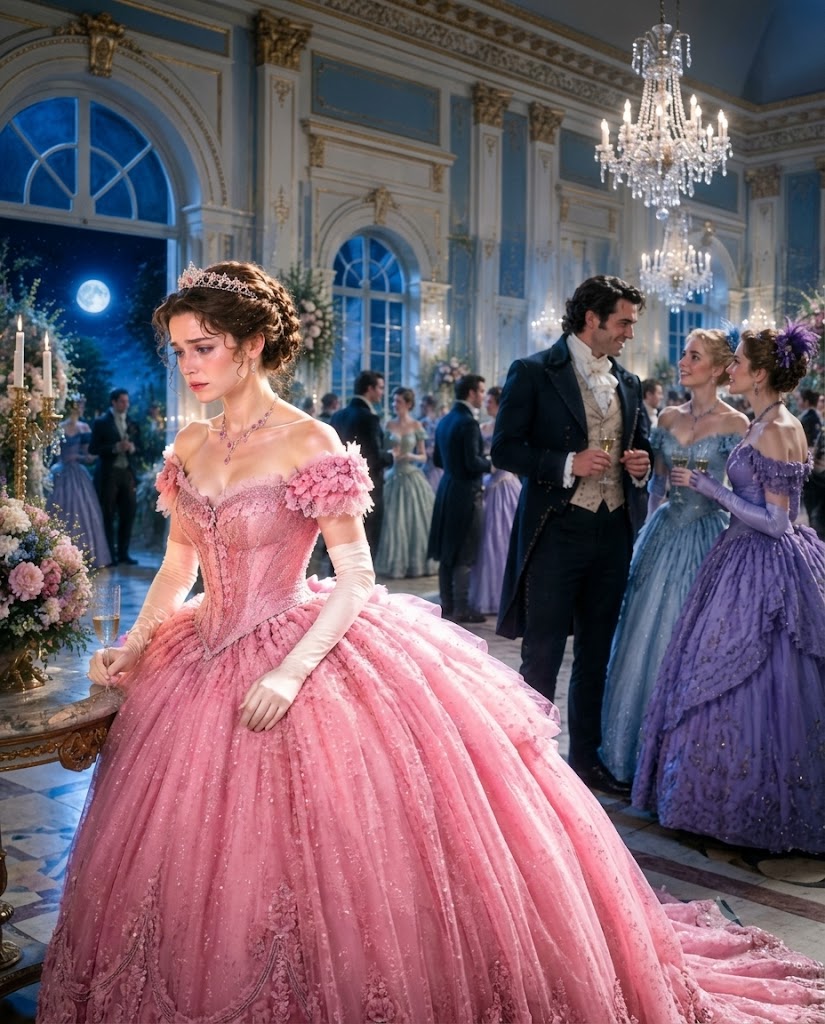
Years afterward, when Arabella was an old woman, she would sometimes stand by the tall ballroom windows and remember that first autumn night.
The candles.
The music.
The woman across the room.
The man who had laughed with someone else.
And the moment she had finally understood that waiting was not the same as loving.
She remembered the letter.
The three words.
Request for annulment.
She remembered believing that night was the end of her marriage.
In some ways, it was.
The woman who had entered that ballroom had died there.
The woman who left had learned something far more valuable than how to save a marriage.
She had learned how to save herself.
And because she had done so, Sebastian had been forced to learn something too.
That love could not be demanded.
It could not be inherited.
It could not survive on duty alone.
Love had to be chosen.
Again and again.
In small moments.
In difficult moments.
Especially when no one was watching.
One autumn evening, many years after their second beginning, Arabella found Sebastian asleep in the library.
A book rested against his chest.
The fire had burned low.
She smiled.
She took the book from his hands and placed a blanket over him.
His eyes opened.
“Arabella?”
“Yes?”
“Are you leaving?”
She paused.
Then smiled.
“No.”
He closed his eyes again.
“Good.”
She sat beside him.
Outside, rain began tapping softly against the windows.
Once, that sound had meant loneliness.
Now it sounded like a lullaby.
Arabella rested her head against his shoulder.
Sebastian reached for her hand without opening his eyes.
Their fingers intertwined.
Neither spoke.
They did not need to.
They had spent too many years learning what silence could destroy.
Now they knew what silence could also mean.
Peace.
Trust.
Presence.
And the quiet certainty that neither of them was waiting anymore.
They had chosen each other.
Not because they were trapped by vows.
Not because society expected it.
Not because leaving was impossible.
But because, every morning, they were free to walk away—and every morning, they chose to stay.
That was the promise that finally mattered.
Not the one written in a marriage contract.
Not the one spoken before witnesses.
But the one made silently, through years of small acts:
I see you.
I hear you.
I will not take your love for granted.
And if one day you must leave, I will love you enough to let you go.
Perhaps that was the greatest lesson Arabella ever learned.
Sometimes, the person who walks away is not giving up on love.
Sometimes, she is finally refusing to give up on herself.
And sometimes, when two people have the courage to become better than the people they once were, love finds its way back—not to the place where it was broken, but to a new place where it can finally breathe.
At Ravensmere, the autumn rain continued to fall.
The candles continued to burn.
The great ballroom still filled with music each year.
But Arabella never again sat beside an untouched glass of wine, waiting for someone to notice her.
Because she had learned that her life was never meant to begin when someone finally chose her.
It had begun the moment she chose herself.
And everything that came afterward was not a rescue.
It was a gift.
A gift she could accept freely.
A gift Sebastian could offer freely.
And a love that, at last, neither of them had to fear losing.
Because they had finally understood the difference between holding on and holding someone gently.
The first was possession.
The second was love.
And that was how the story of Arabella and Sebastian truly ended.
Not with a grand declaration.
Not with a perfect promise.
But with two people sitting together beside a quiet fire, older, wiser, and still choosing one another.
Outside, the rain fell.
Inside, neither of them was waiting.
THE END.