The motorcycle was seconds from starting when Hannah Mitchell heard a sound that didn’t belong.
“My name is Daniel Mercer,” the stranger said, forcing a smile that didn’t reach his eyes. “And I think there’s been a misunderstanding.”
Michael Sullivan stared at him without blinking.
“Funny,” Michael replied. “You seemed pretty certain about that motorcycle five minutes ago. Now you’re telling me you don’t know anything?”
Daniel straightened his expensive jacket. “I’m a businessman. I stopped for coffee. That’s all.”
Robert Hayes stepped forward, his face pale beneath the afternoon sun.
“Then explain why you were outside my garage last night.”
The question landed like a hammer.
Daniel’s expression changed for barely a second, but Hannah noticed. His jaw tightened, and his eyes darted toward the black sedan parked near the highway.
“I don’t know what you’re talking about.”
Robert shook his head. “My security camera caught your car. Same license plate. Same broken left taillight.”
A murmur spread through the bikers.
Daniel raised both hands. “You can’t prove I stole anything.”
“I never said you stole it,” Robert answered quietly.
The parking lot went silent.
Hannah felt a chill run down her spine. Daniel had just revealed something nobody had accused him of directly.
Michael took another step toward him.
“Looks like we’ve got plenty to discuss.”
Before Daniel could respond, a sharp voice called from the cafe entrance.
“Everybody get away from that motorcycle!”
A woman in a waitress uniform stood in the doorway, holding a phone against her ear. Her name was Clara Bennett, and she had worked at the Sidewinder Cafe for nearly twenty years.
“I called the sheriff,” she announced. “They’re sending deputies and the bomb squad. Nobody touches anything.”
Michael immediately turned toward his men.
“Move the customers inside. Keep everyone away from the bikes.”
The riders obeyed without hesitation.
Hannah watched in surprise as men who looked frightening enough to empty a bar calmly helped elderly travelers, families, and frightened children move to safety.
One biker lifted a little boy who had fallen while running. Another guided an elderly couple toward the rear exit.
Michael stayed beside Hannah and Robert.
“You did the right thing, kid,” he told her.
But Hannah wasn’t looking at him.
She was watching Daniel.
He had slipped behind a parked pickup truck and was speaking urgently into his phone.
Then he looked directly at her.
And smiled.
It wasn’t the nervous smile of a man caught in a lie.
It was the smile of someone who had just made another decision.
Hannah’s stomach tightened.
“Michael,” she whispered. “He’s planning something.”
Before Michael could turn, Daniel sprinted toward his sedan.
“Stop!” Robert shouted.
The engine roared to life.
Daniel reversed violently, striking a trash can before accelerating toward the highway.
Two bikers instinctively moved toward their motorcycles.
“Leave him!” Michael thundered. “Nobody starts an engine until we know they’re safe!”
The sedan disappeared around a bend, leaving dust swirling over the pavement.
Michael watched it go.
“He’ll be found,” he said.
But Robert looked deeply troubled.
“No,” he murmured. “You don’t understand. If Mercer is involved, this is bigger than one motorcycle.”
Hannah turned toward him.
“Who is he?”
Robert hesitated.
For a moment, he looked twenty years older.
Then he said something that made Hannah forget the danger surrounding them.
“He’s the reason your father died.”
The words seemed to drain every sound from the world.
Hannah stared at Robert.
Her father, Thomas Mitchell, had died eighteen months earlier in what police called a highway accident. His pickup had gone off a mountain road during a storm. Investigators said he must have lost control.
Hannah had believed them.
She had spent countless nights imagining his final moments, wondering whether he had been frightened, whether he had called her name.
Now Robert was telling her there was another explanation.
“What do you mean?” she whispered.
Robert looked toward the highway.
“Your father discovered something he wasn’t supposed to find.”
Michael’s expression hardened.
“Robert. Tell her everything.”
Robert lowered his head.
“Thomas was helping me investigate a company called Westbridge Development. Mercer works for them. They were buying properties along Route 66, forcing small businesses to sell, and using threats when people refused.”
Hannah struggled to breathe.
“My dad was a mechanic.”
“He was more than that,” Robert replied. “He was a good man who couldn’t ignore people being hurt.”
Michael crossed his arms.
“Westbridge has been trying to buy our clubhouse for months.”
Robert nodded.
“And your charity ride this weekend is bringing hundreds of riders into town. People who could draw attention to what Westbridge has been doing.”
Hannah looked toward the disabled motorcycle.
“So somebody wanted Michael dead?”
“Or wanted an incident terrible enough to destroy the club’s reputation,” Robert said. “Maybe both.”
Michael’s face darkened.
For years, the Iron Wolves Motorcycle Club had been treated with suspicion by strangers who judged their leather vests and tattoos. Yet the club raised money for injured veterans, helped families after house fires, and delivered supplies to isolated communities.
Their annual charity ride funded medical transportation for children whose families couldn’t afford long journeys to specialist hospitals.
This weekend’s event was supposed to be their biggest.
Now someone had tried to turn it into a tragedy.
Hannah looked at Robert.
“Why didn’t you tell me about Dad?”
Robert’s eyes filled with regret.
“Because he made me promise to keep you safe.”
“And you thought lying to me would do that?”
He had no answer.
Before she could say anything else, sirens echoed down the highway.
Three sheriff’s vehicles entered the parking lot, followed by an emergency response truck.
Sheriff Elena Ramirez stepped out first.
She was a compact woman with silver streaks in her dark hair and the steady expression of someone who had spent years separating truth from panic.
Michael explained what had happened.
Robert identified the stolen component.
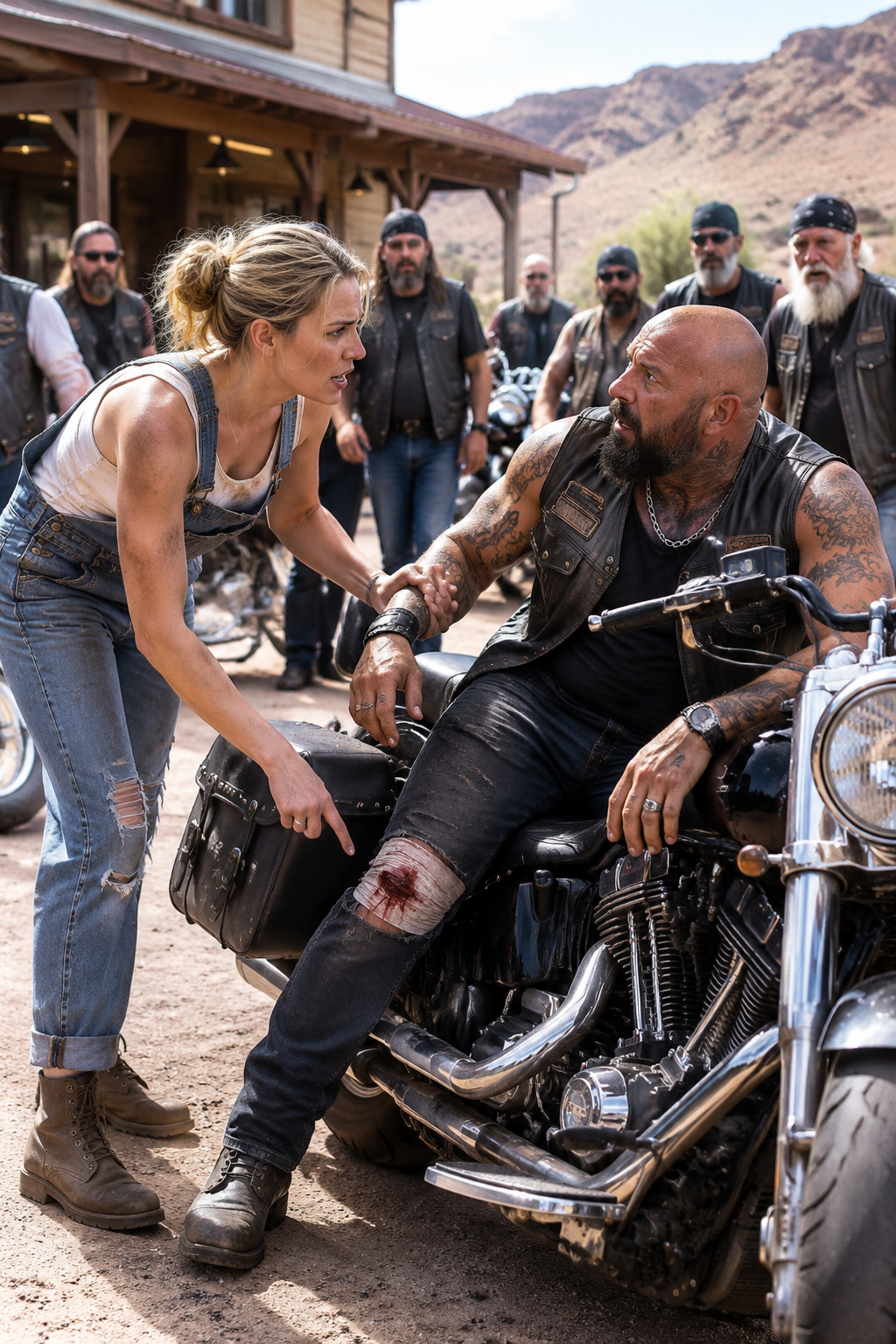
Hannah described the clicking sound and the hidden wire.
Ramirez listened carefully, then ordered everyone to remain inside the cafe while specialists examined the motorcycle.
For nearly two hours, nobody knew whether the danger had passed.
Hannah sat in a booth beside the window, staring at her father’s old silver wristwatch.
She wore it every day.
The glass was scratched, and the second hand occasionally hesitated, but she had never considered repairing it.
Her father had worn that watch throughout her childhood.
She remembered him saying, “A machine always tells you when something’s wrong, sweetheart. The trick is learning to listen before it breaks.”
She had heard something wrong today.
But she hadn’t heard the truth about his death.
Michael sat across from her.
“Robert told me your dad was a good mechanic.”
Hannah nodded.
“He could fix almost anything.”
Michael looked at the watch.
“I knew Thomas.”
She raised her eyes.
“He never told me.”
“We met years ago. My bike broke down outside town. I didn’t have enough money for repairs, and he fixed it anyway.”
A faint smile touched Michael’s face.
“When I tried to pay him later, he told me to help someone else instead.”
Hannah swallowed hard.
“That sounds like him.”
Michael leaned forward.
“Your father helped me when I was a stranger. Today you helped me when you had every reason to be afraid.”
Hannah looked down.
“I was terrified.”
“Courage doesn’t mean you aren’t scared,” Michael said. “It means you refuse to let fear make your decisions.”
For the first time that afternoon, Hannah felt something besides anger and grief.
She felt proud.
Then the cafe door opened.
Sheriff Ramirez entered, her expression grim.
“The device has been secured,” she announced. “Our specialists confirmed it was deliberately installed and posed a serious danger.”
Relief swept through the room.
But Ramirez wasn’t finished.
“We also found something hidden beneath the motorcycle’s seat.”
She placed a sealed evidence bag on the table.
Inside was a small photograph.
Hannah leaned closer.
Her blood turned cold.
It showed her standing outside Robert’s garage three days earlier.
Across the bottom, someone had written four words in black ink.
SHE KNOWS TOO MUCH.
Robert gripped the edge of the table.
Michael stood so abruptly his chair scraped against the floor.
Ramirez looked at Hannah.
“Has anyone been following you?”
Hannah remembered a black sedan parked across from her house the previous evening.
At the time, she had thought nothing of it.
Now she remembered its broken taillight.
“Yes,” she whispered.
Ramirez immediately assigned a deputy to stay with her.
But the photograph raised a question nobody could answer.
If Daniel Mercer believed Hannah knew too much, what exactly did he think she knew?
That evening, Robert brought Hannah to his garage under police escort.
The building smelled of motor oil, old leather, and the coffee he always forgot to finish.
He locked the office door and opened a battered metal cabinet.
From its lowest drawer, he removed a wooden box.
“This belonged to your father.”
Hannah recognized it instantly.
Thomas had kept his most important tools inside that box.
Robert set it on the workbench.
“He gave it to me a week before he died. Told me to keep it until you were ready.”
Hannah opened the lid.
Inside were several worn tools, a photograph of her parents, and a folded letter.
Her name was written across the envelope.
With trembling fingers, she unfolded it.
“My beautiful Hannah,
If you’re reading this, I may not have had the chance to explain everything. There are things in this world that powerful people believe they can hide. But truth has a way of surviving, especially when ordinary people refuse to look away.
I don’t want you to spend your life chasing my mistakes. I want you to live bravely, love generously, and remember that doing the right thing matters even when nobody applauds.
And if you ever feel lost, remember our little rule: when something doesn’t fit, look beneath the surface.
Love always,
Dad.”
Tears blurred the words.
Hannah pressed the letter against her chest.
Robert stood silently beside her.
Then she noticed something unusual.
One of the tools in the box was a small brass measuring gauge.
Her father had always kept it attached to his workbench.
Now it was loose, and its wooden handle seemed slightly heavier than she remembered.
She turned it over.
A tiny seam ran around the base.
“Robert, did Dad ever modify this?”
Robert frowned.
“Not that I know of.”
Hannah twisted the handle.
Nothing happened.
She remembered her father’s habit of making little mechanical puzzles for her birthdays.
Instead of forcing it, she pressed a nearly invisible metal pin.
The base clicked open.
Inside was a tiny memory card.
Robert stared at it.
“My God.”
They called Sheriff Ramirez immediately.
Within an hour, a forensic technician had made a protected copy of the card’s contents.
There were photographs, financial records, recorded conversations, and documents connecting Westbridge Development to illegal dumping operations and fraudulent property purchases.
Several files suggested that company executives had paid intermediaries to intimidate business owners.
But one recording was different.
It had been made eleven days before Thomas Mitchell died.
Daniel Mercer’s voice was unmistakable.
“Mitchell needs to stop asking questions.”
Another man responded.
“He won’t.”
“Then make sure he doesn’t get another chance.”
Hannah felt physically sick.
Ramirez paused the recording.
“Who is the second man?” Michael asked.
Robert stared at the computer screen.
“I’ve heard that voice before.”
He looked toward the sheriff.
“That’s Victor Lang.”
Ramirez’s expression changed.
Victor Lang was Westbridge Development’s regional director, a wealthy businessman who sponsored community events, appeared in newspaper photographs with politicians, and publicly promised to revitalize struggling towns.
He had even donated money to the local police department.
“Are you certain?” Ramirez asked.
Robert nodded.
“Absolutely.”
But the sheriff looked troubled.
“The recording is significant, but we’ll need to establish its authenticity and context. And we still don’t know exactly what happened to Thomas.”
Hannah wiped her tears.
“Then we find out.”
Ramirez studied her.
“That’s our job, Hannah. Yours is staying alive.”
She ordered the evidence secured and requested assistance from state investigators.
By midnight, deputies were watching Hannah’s house, Robert’s garage, and the Iron Wolves clubhouse.
It should have been enough.
But at 2:17 in the morning, Hannah’s phone vibrated.
An unknown number had sent a message.
YOUR FATHER TRUSTED THE WRONG MAN.
A second message followed.
ASK ROBERT WHAT HAPPENED ON THE MOUNTAIN ROAD.
Hannah sat upright in bed.
Outside, a deputy’s patrol car remained parked beneath the streetlight.
She stared at the messages.
Then she called Robert.
He answered on the fourth ring.
“Hannah?”
“What happened on the mountain road?”
Silence.
“Who told you to ask that?”
“Answer me.”
Robert exhaled shakily.
“I was supposed to meet your father that night.”
Hannah closed her eyes.
“Where?”
“At the old Red Canyon overlook. He said he’d found proof that Westbridge was moving hazardous waste through abandoned mining tunnels.”
“Did you go?”
“Yes.”
“And?”
Robert’s voice broke.
“I was late. When I arrived, his truck was already gone. I saw another vehicle leaving the overlook.”
“Whose?”
“I couldn’t identify it. It was dark.”
Hannah’s heart pounded.
“Why didn’t you tell the police?”
“I did. They said the vehicle could have belonged to anyone.”
She remembered the message.
YOUR FATHER TRUSTED THE WRONG MAN.
“Robert, is there something else?”
He hesitated.
Then a crash sounded through the phone.
“Robert?”
A muffled shout.
Footsteps.
Then the line went dead.
Hannah immediately called 911.
Within minutes, deputies surrounded Robert’s garage.
But when they entered, the office had been ransacked.
Robert was gone.
On the workbench lay his broken phone.
And beside it, written in thick black marker, were three words.
BRING THE ORIGINAL.
Hannah understood.
Someone wanted the memory card.
The following morning, Sheriff Ramirez organized a search.
Security footage from a nearby gas station showed a dark utility van traveling toward Red Canyon shortly after Robert disappeared.
The license plate was obscured.
Michael arrived at the sheriff’s office with six Iron Wolves riders.
“We know those roads better than anyone,” he said. “Let us help.”
Ramirez considered him.
“No vigilante justice. No confrontations. You report anything you find.”
Michael nodded.
“We’re looking for Robert, not a fight.”
Hannah stood beside the sheriff.
“I’m coming.”
“No,” Ramirez said immediately.
“Robert was taken because of my father.”
“And the people responsible may be willing to kill.”
Hannah looked at Michael.
“Robert knows the old mining roads. So do I. Dad took me there when I was little.”
Ramirez shook her head.
“We have maps.”
“But not everything is on those maps.”
Hannah described an old maintenance tunnel her father had once shown her, hidden behind a collapsed roadside service station.
Robert had helped seal its entrance years earlier.
Ramirez became interested.
“Why isn’t it on the county records?”
“Because the mine closed before the roads were officially surveyed.”
Michael studied the map.
“That tunnel runs beneath land Westbridge bought last year.”
The sheriff immediately dispatched investigators to the area.
Hannah wasn’t allowed to accompany them.
Instead, she remained at the sheriff’s office, watching the clock and fighting the urge to scream.
At noon, a deputy brought terrible news.
The search team had found Robert’s truck abandoned near the canyon.
There were signs of a struggle.
But no Robert.
Then Hannah received another message.
COME ALONE TO THE OLD SERVICE STATION AT SUNSET.
BRING THE CARD.
OR ROBERT DIES.
She showed it to Ramirez without hesitation.
The sheriff read it twice.
“Good. You did exactly the right thing.”
Hannah looked at her.
“Can we use it?”
Ramirez nodded slowly.
“We can. But you’re not going alone.”
By late afternoon, a carefully coordinated operation was underway.
State investigators positioned themselves along the canyon roads. Unmarked vehicles waited beyond the ridgeline. Officers prepared to intercept anyone attempting to escape.
Michael and his riders stayed at a designated checkpoint, ready to help block access to the area if requested.
Hannah waited in a patrol vehicle several miles away.
She hated every second.
At 6:43 p.m., a voice crackled over the police radio.
“Movement at the service station. Two suspects visible.”
A pause.
“Possible hostage.”
Hannah gripped the seat.
Then another voice came through.
“Hostage identified. Male, approximately sixty. Appears injured.”
Robert.
He was alive.
But the next transmission sent fear racing through her.
“Suspects are moving the hostage into the tunnel. We may lose visual contact.”
Ramirez gave orders over the radio.
Officers advanced carefully.
Then gunfire echoed across the canyon.
Hannah flinched.
The radio erupted with overlapping voices.
“Shots fired!”
“Officer down behind cover!”
“Suspects retreating underground!”
For several terrible minutes, nobody could tell her what was happening.
Then a deputy shouted through the radio.
“We have the hostage! Repeat, we have Robert Hayes!”
Hannah covered her mouth.
But the operation wasn’t over.
Daniel Mercer had escaped deeper into the mine with another man.
And investigators had discovered that the tunnel contained dozens of sealed industrial drums, many marked with hazardous-material warnings.
The illegal dumping operation was real.
So was the danger.
Sheriff Ramirez ordered everyone away from the tunnel entrance until specialized teams could assess the site.
Robert was carried to an ambulance.
He had a concussion, bruised ribs, and a broken wrist, but he was conscious.
Hannah rushed to him when the ambulance reached the checkpoint.
“Robert!”
He opened his eyes.
“Hey, kid.”
She took his uninjured hand.
“I thought I’d lost you.”
He managed a weak smile.
“I’m harder to get rid of than an old carburetor.”
She laughed through her tears.
Then Robert’s expression became serious.
“There’s something you need to know.”
“About Dad?”
He nodded.
“Mercer talked while they were holding me. He said Victor Lang ordered your father’s truck forced off the road.”
Hannah went still.
“Did he admit it?”
“Not everything. But he said enough.”
Robert squeezed her hand.
“Your father didn’t die because he was careless. He died because he refused to abandon people who couldn’t protect themselves.”
Hannah bowed her head.
For eighteen months, she had carried questions that never let her sleep.
Now the truth was beginning to emerge.
And it hurt more than she had imagined.
That night, Daniel Mercer was captured after emerging from an abandoned ventilation shaft several miles from the mine.
His companion surrendered shortly afterward.
Investigators seized documents, communication devices, and business records from Westbridge’s regional offices.
Victor Lang was arrested the following morning.
He denied every allegation.
His attorneys called the investigation politically motivated.
But as the evidence accumulated, his carefully constructed public image began to collapse.
Former employees came forward.
Property owners described threats and suspicious fires.
A truck driver admitted he had transported industrial waste under falsified paperwork.
And a former Westbridge security contractor provided investigators with information about the night Thomas Mitchell died.
According to his statement, Lang had ordered two men to intercept Thomas before he could deliver evidence to state authorities.
One of those men had been Daniel Mercer.
The investigation ultimately established that Thomas’s truck had been deliberately forced from the road.
Hannah received the news in Sheriff Ramirez’s office.
She listened without interrupting.
When Ramirez finished, Hannah stared at the floor.
For so long, she had imagined her father alone in the storm, making one terrible mistake.
Now she knew he had been trying to do something brave.
But knowing the truth didn’t bring him back.
“Will they go to prison?” she asked.
“The evidence will be presented in court,” Ramirez replied. “I won’t promise you an outcome before a jury hears it. But I can promise we won’t stop because these men have money or influence.”
Hannah nodded.
It wasn’t the perfect answer.
It was an honest one.
And she had learned how much honesty mattered.
Three days later, the Iron Wolves gathered outside the Sidewinder Cafe.
Their charity ride had been postponed, not canceled.
Michael stood before nearly two hundred riders, his motorcycle finally cleared by investigators and repaired by Robert’s mechanics.
Hannah stood beside him.
She felt awkward beneath the attention.
Michael raised a hand, and the crowd fell silent.
“Last week, a young woman heard something the rest of us missed.”
He looked at Hannah.
“She didn’t have a badge. She didn’t have years of experience. She didn’t even know most of us.”
A few riders smiled.
“But she had something that matters more than looking tough. She had the courage to speak when everyone else was ready to dismiss her.”
Applause rose around the parking lot.
Hannah’s cheeks warmed.
Michael continued.
“Because she spoke up, people are alive today. Because she refused to look away, a terrible injustice is finally being investigated.”
He reached into his vest and removed a small embroidered patch.
It showed a silver wolf beneath the words HONOR IS EARNED.
“This isn’t a membership patch,” he explained. “It’s something we give to people who remind us what our club is supposed to stand for.”
He placed it in Hannah’s hand.
“You earned it.”
Hannah looked at the patch.
Then at the men and women watching her.
Many had tattoos, scars, weathered faces, and stories strangers would never know.
Yet they were applauding a young woman who had simply listened to a sound nobody else noticed.
She thought about her father.
And suddenly she understood something.
He had never taught her to fix machines merely so she could earn a living.
He had taught her to pay attention.
To question what didn’t seem right.
To believe that small details mattered.
And above all, to help people even when helping was inconvenient.
Hannah stepped toward the microphone.
“I don’t really know what to say.”
A rider near the front called, “Just tell us how you knew!”
Laughter spread through the crowd.
Hannah smiled.
“My dad used to say that every machine has a voice. Most people only hear it when something breaks.”
She paused.
“But he also believed people have voices. Sometimes they’re quiet. Sometimes they’re frightened. Sometimes nobody wants to listen.”
Her eyes filled with tears.
“I think the important thing is not deciding someone has nothing worth saying just because they don’t look like the person you expected.”
The crowd grew silent.
She looked at Michael.
“You listened to me when someone else told you not to.”
Then she looked at Robert, who stood nearby with his arm in a sling.
“And Robert listened when I wanted to learn something people said wasn’t for girls.”
Her voice steadied.
“I guess that’s what saved us. Not just what I knew. The fact that somebody was willing to listen.”
Michael nodded slowly.
Then he began clapping.
Within seconds, the entire parking lot joined him.
The charity ride raised more money than any previous event.
Local businesses donated food, fuel, and supplies.
Families lined the highway waving homemade signs.
And for the first time in years, the Iron Wolves rode through town without feeling like unwanted outsiders.
But Hannah’s story didn’t end there.
Over the following months, she spent nearly every afternoon at Robert’s garage.
She learned to rebuild engines, diagnose electrical faults, and understand the complicated relationship between patience and precision.
Robert made her redo work whenever she rushed.
“Good enough isn’t good enough when somebody’s life depends on it,” he reminded her.
She never argued.
Not anymore.
The investigation into Westbridge continued, uncovering additional victims and years of environmental violations.
The contaminated mining site was placed under state supervision, and plans were developed to protect nearby water supplies.
Eventually, Daniel Mercer agreed to cooperate with prosecutors.
His testimony helped establish the chain of orders behind Thomas Mitchell’s death.
Victor Lang was convicted on multiple charges, including conspiracy and offenses connected to the illegal dumping operation and Thomas’s killing.
The courtroom was packed on the day of sentencing.
Hannah sat in the front row beside Robert and Michael.
When Lang was given a lengthy prison sentence, she expected to feel triumphant.
Instead, she felt strangely quiet.
There was no celebration.
No sudden relief powerful enough to erase eighteen months of grief.
Justice had finally reached the men responsible.
But it couldn’t return the ordinary mornings when her father made pancakes, or the evenings when they worked together beneath the hood of his truck.
Outside the courthouse, a reporter approached her.
“Do you feel like you’ve finally won?”
Hannah considered the question.
Then she answered carefully.
“I don’t think losing someone you love is something you ever win.”
The reporter lowered her microphone slightly.
“But I think the truth matters. And I think what we do with it matters even more.”
A year later, Robert’s garage had a new sign.
MITCHELL & HAYES AUTO REPAIR.
Beneath it, in smaller letters, were the words:
HONEST WORK. OPEN DOORS.
Hannah had insisted on the second line.
The garage now offered free weekend workshops for teenagers interested in learning mechanical skills.
Girls and boys worked side by side, taking apart old engines, learning safety procedures, and discovering the satisfaction of fixing something with their own hands.
Michael and the Iron Wolves helped fund the program.
They also donated tools and organized scholarships for students pursuing technical education.
One Saturday afternoon, a thirteen-year-old girl named Lily arrived with her mother.
Lily barely spoke.
She stood near the doorway, staring at the motorcycles parked outside.
Hannah approached her.
“Want to learn how an engine works?”
Lily shrugged.
“My brother says girls aren’t good at this stuff.”
Hannah smiled gently.
“People used to tell me that too.”
“Were they right?”
Hannah looked across the garage.
Robert was helping two students inspect a transmission.
Michael was showing another group how to check a motorcycle safely before riding.
Sunlight streamed through the open doors.
And above the workbench hung a photograph of Thomas Mitchell, smiling beneath his faded baseball cap.
“No,” Hannah said. “They were just wrong about what I could become.”
She handed Lily a pair of safety glasses.
“Come on. I’ll show you something.”
By late afternoon, Lily had successfully identified a loose connection in a practice electrical circuit.
Her face lit up.
“I found it!”
Hannah grinned.
“You sure did.”
Lily looked at the small training engine.
“What if I hadn’t noticed?”
“Then we’d keep looking.”
“What if everyone said I was wrong?”
Hannah crouched beside her.
“Then you’d check your work, listen to anyone who has good advice, and trust the evidence. Being brave doesn’t mean you’re always right. It means you’re willing to speak up when something matters.”
Lily considered that.
Then she nodded.
Outside, Michael started his motorcycle.
The familiar rumble filled the afternoon air.
Hannah looked toward the open garage doors.
For a brief moment, she remembered the day at the Sidewinder Cafe.
The clicking sound.
The stranger’s dismissive laughter.
The fear in her stomach.
And the enormous man who had stepped away from his motorcycle because a young woman asked him to listen.
One small decision had changed everything.
It had saved lives, exposed a terrible crime, restored her father’s reputation, and brought together people who might otherwise have remained strangers.
Yet the most important change was something no newspaper headline could capture.
Hannah no longer believed courage belonged only to the strongest, the loudest, or the most powerful.
Sometimes courage belonged to the person whose hands were shaking.
Sometimes it belonged to someone who admitted they needed help.
And sometimes it belonged to the person willing to stop, listen, and believe that even the quietest warning deserved attention.
As the sun lowered over Route 66, Hannah closed the garage doors and touched her father’s old wristwatch.
It had finally been repaired.
The second hand moved smoothly now.
She smiled at the steady ticking.
Her father was gone, but the things he had taught her were still moving forward, one person at a time.
And Hannah understood that this was how goodness survived.
Not because the world was always fair.
Not because brave people never suffered.
But because every act of kindness, every honest decision, and every moment of courage could become something larger than the person who began it.
That evening, Lily left the garage holding a small certificate from her first workshop.
Before climbing into her mother’s car, she turned around.
“Hannah?”
“Yeah?”
“Do you think I could become a mechanic someday?”
Hannah looked at the girl’s hopeful face.
Then she thought of Thomas Mitchell, of Robert Hayes, of Michael Sullivan, and of all the people who had chosen to believe in someone when it would have been easier to walk away.
She smiled.
“I think you can become whatever you’re willing to work for.”
Lily beamed and waved goodbye.
Hannah watched the car disappear down the highway.
Somewhere beyond the horizon, motorcycles rumbled toward home.
The evening wind carried the scent of desert sage and warm asphalt.
And inside the little garage, beneath a photograph of a father who had believed in doing what was right, a new generation was learning the same lesson.
Never mistake a quiet voice for a weak one.
Never judge someone’s worth by their appearance.
And never underestimate what can happen when one person has the courage to speak—and another has the wisdom to listen.
Because sometimes, saving a life begins with nothing more than three simple words.
“Please, don’t start.”
THE END.