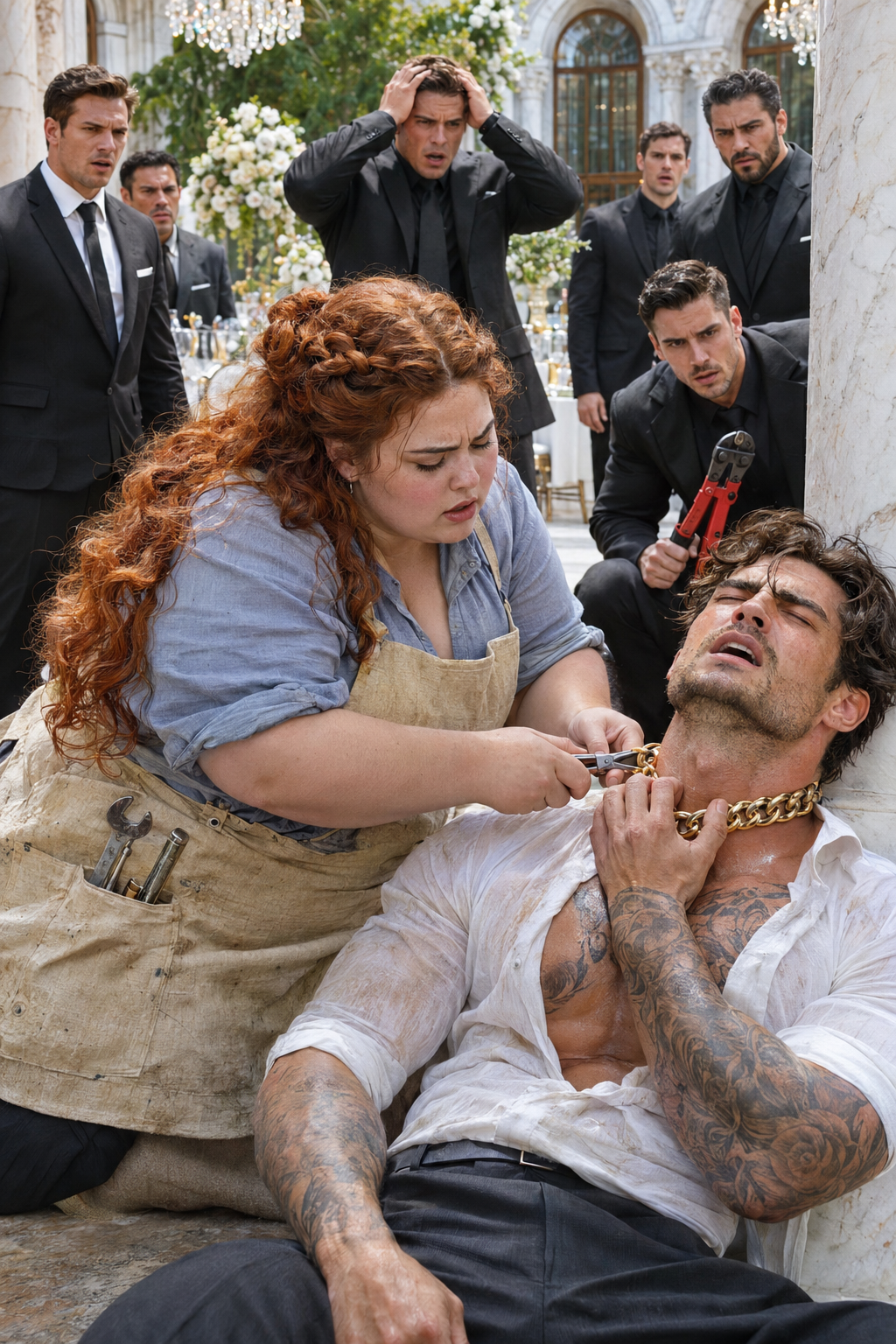
The most feared mafia boss in the city was dying in front of two hundred guests, and his own doctor couldn’t save him.
The security guards moved toward a young man standing near the grand staircase. He wore a dark blue suit, and his resemblance to Marcello was impossible to miss. Clara had seen him greeting guests earlier that evening, smiling warmly and shaking hands with powerful businessmen.
“Uncle Marcello?” the young man said as the guards approached him. “What’s going on?”
Marcello’s expression hardened.
“Adrian, did you authorize the replacement of my doctor’s medical supplies?”
Adrian Vitti stopped walking.
For a moment, he looked genuinely confused.
“Yes, but only because someone told me the old supplies had expired.”
“Who told you that?”
Adrian glanced toward the crowd.
“Victor.”
A heavy silence settled over the ballroom.
Victor Romano was Marcello’s closest adviser. He had worked for the Vitti family for nearly thirty years. He knew their business arrangements, their enemies, and their most carefully guarded secrets.
He was also standing less than ten feet away.
Victor stepped forward, adjusting his jacket.
“Surely we’re not suggesting I had something to do with this.”
Marcello didn’t answer.
Clara watched Victor’s face. Unlike Adrian, he didn’t appear surprised. He seemed irritated, as though the evening had taken an inconvenient turn.
“The medical supplies were replaced as part of a routine procedure,” Victor explained. “If something was defective, we should investigate the manufacturer.”
Clara picked up the damaged epinephrine pen with a clean napkin.
“This doesn’t look like a manufacturing defect.”
Victor turned toward her.
“And you are?”
“The woman who opened his bracelet.”
“Then perhaps you should stick to jewelry.”
Clara felt every eye in the ballroom settle on her.
She wanted nothing more than to collect her belongings and disappear. She had a small jewelry shop, overdue bills, and a mother who depended on her. Getting involved in a mafia family’s internal affairs was the last thing she needed.
But she remembered Marcello’s desperate struggle for air.
Someone had intended for him to die.
And whoever had arranged it was probably still in the room.
“The bracelet was altered, too,” she said.
Victor’s smile disappeared.
Before he could respond, paramedics entered the ballroom. They immediately began examining Marcello and preparing him for transportation.
Marcello caught his security chief’s sleeve.
“Gabriel, preserve everything. The bracelet, the medical kit, the security recordings. Nobody destroys anything.”
Gabriel nodded.
Then Marcello looked at Clara.
“Miss Higgins, I need to speak with you when this is over.”
Clara wasn’t sure whether that was an invitation or an order.
As the paramedics wheeled him toward the exit, Victor quietly approached her.
“You’ve done your good deed for the evening,” he said. “Go home.”
His voice was pleasant, but his eyes weren’t.
“Some things are better left alone.”
Clara held his gaze.
“Especially when someone nearly dies?”
Victor leaned closer.
“Especially then.”
Twenty minutes later, the police arrived. Clara gave a statement, surrendered the bracelet and damaged medical device as evidence, and answered every question she could.
By the time she reached her little apartment, it was nearly three in the morning.
She locked the door, checked it twice, and sat on the edge of her bed.
Her phone rang.
The caller was Gabriel.
“Mr. Vitti is stable,” he said. “He asked me to thank you.”
Clara released a breath she hadn’t realized she was holding.
“I’m glad he’s okay.”
“There’s something else. Did you examine that bracelet before tonight?”
“No. Why?”
“Because we found a receipt in his personal records. The bracelet was serviced three weeks ago.”
Clara waited.
“The receipt has your shop’s name on it.”
Her stomach dropped.
“That’s impossible.”
“I thought you should know.”
After the call ended, Clara opened her laptop and searched her business records. She checked every repair appointment from the past two months.
There was nothing involving Marcello Vitti.
Then she noticed an email buried in her inbox. Three weeks earlier, a customer had requested an estimate for repairing an antique Italian bracelet.
Attached was a photograph.
Clara opened it.
It was Marcello’s bracelet.
She had responded that the piece required specialized work and invited the customer to bring it into her shop. They never came.
Someone had apparently used her business information to create a false repair receipt.
Clara suddenly understood that the attack hadn’t simply been planned.
Someone had prepared another person to take the blame.
And that person was her.
The following morning, Clara arrived at Higgins Antique Jewelry shortly after eight. The shop had belonged to her father, who had taught her everything she knew about restoring old jewelry.
She unlocked the front door and immediately noticed something wrong.
A display cabinet stood open.
Papers covered the floor behind the counter. Drawers had been emptied, and her father’s old workbench had been damaged.
Someone had broken in.
Strangely, the most valuable jewelry remained untouched.
Clara called the police and waited outside.
While examining the damage, an officer asked whether anything important was missing.
Clara checked her records, tools, and repair inventory.
Then she noticed the empty space beneath her desk.
Her old appointment books were gone.
Whoever had entered the shop wanted her business records.
As the officers finished their report, a black sedan pulled up outside.
Gabriel stepped out.
“Mr. Vitti would like to see you.”
Clara folded her arms.
“Someone broke into my shop last night. I think your employer’s problems have become mine.”
Gabriel looked through the damaged doorway.
“That’s exactly why he wants to see you.”
At the hospital, Clara found Marcello sitting upright beside a window. His face was still swollen, and his wrist was wrapped in a soft bandage.
Without his expensive suit and armed guards surrounding him, he looked less like a powerful criminal and more like an exhausted older man.
“I owe you my life,” he said.
“The doctor and paramedics saved your life. I just helped.”
“You noticed what others didn’t.”
Clara placed her laptop on the table.
“Someone forged a receipt from my shop. And last night, someone broke in and stole my appointment books.”
Marcello’s expression changed.
She showed him the email and the attached photograph.
“Whoever contacted me wanted information about my business. They never intended to have me repair anything.”
Marcello studied the photograph.
“That picture was taken in my study.”
“You’re sure?”
“That’s my desk.”
Clara enlarged the image.
A corner of a framed family photograph was visible beside the bracelet.
Marcello stared at it for several seconds.
“Only a handful of people have access to that room.”
“Victor?”
“Yes.”
“Adrian?”
“Yes.”
Marcello looked away.
Clara could see how much the possibility troubled him.
“Adrian is my brother’s only son,” he said. “I raised him after his parents died. I paid for his education. I gave him everything.”
“That doesn’t mean he did this.”
“It doesn’t mean he didn’t.”
Marcello reached into a drawer and removed an envelope.
Inside was a check for one hundred thousand dollars.
Clara stared at the amount.
“What’s this?”
“Compensation. For saving me and for the damage to your business.”
She slid it back.
“I don’t want money that comes with conditions.”
“There are no conditions.”
“Then help me clear my name.”
Marcello looked at her with unexpected respect.
“Very well.”
That afternoon, Adrian arrived at the hospital.
He looked as though he hadn’t slept.
“Uncle, I swear I didn’t know anything about the medical supplies.”
Marcello pointed toward a chair.
“Sit.”
Adrian obeyed.
“Tell me everything Victor said.”
Adrian explained that Victor had contacted him two days before the gala. He claimed the doctor’s emergency kit needed replacement and asked Adrian to approve the purchase through the family office.
“He said you were too busy to handle it yourself.”
“And the bracelet?”
Adrian frowned.
“What about it?”
Clara showed him the photograph.
“Did you take this?”
He shook his head.
Then his eyes widened.
“Wait. Victor borrowed that bracelet last month.”
Marcello leaned forward.
“Why?”
“He said he wanted to have it cleaned before the gala. I remember because he asked me where you kept the original box.”
Clara and Marcello exchanged a look.
The evidence was beginning to point in one direction.
But Adrian wasn’t finished.
“There’s something else,” he admitted.
His voice became quieter.
“Victor asked me to sign some documents last week.”
“What documents?”
“Business transfer agreements. He said they were part of your retirement plan.”
Marcello’s face went pale.
“I have no retirement plan involving Victor.”
Adrian reached into his jacket and produced several folded pages.
“I didn’t sign them. I wanted to ask you first.”
Marcello examined the documents.
With each page, his anger became more visible.
Victor had prepared agreements that would transfer control of several valuable family companies after Marcello’s death. Adrian would have received a generous payment, but Victor would have gained the real power.
The attempted murder suddenly had a clear financial motive.
Marcello pressed the call button beside his bed.
“Get Gabriel in here.”
When Gabriel arrived, Marcello handed him the documents.
“Contact our attorney. And give copies to the detectives.”
Gabriel nodded.
“There’s another problem, sir. Victor hasn’t been seen since last night.”
Marcello closed his eyes.
For thirty years, he had trusted a man who had apparently been waiting for the right moment to destroy him.
Clara thought the worst was finally behind them.
She was wrong.
That evening, she received a call from her mother.
“Clara, a very nice gentleman came by my house today.”
Clara froze.
“What gentleman?”
“He said he worked with you. He brought flowers.”
“What was his name?”
“Victor, I think.”
Clara’s hands went cold.
“Mom, listen carefully. Lock your doors. Don’t let anyone inside. I’m coming over.”
Before she could leave, another call appeared on her phone.
An unfamiliar number.
She answered.
Victor’s voice was calm.
“Your mother is a lovely woman.”
Clara struggled to speak.
“Stay away from her.”
“Then stop involving yourself in matters that don’t concern you.”
“You tried to kill someone.”
“That’s a serious accusation.”
“The police have evidence.”
Victor laughed softly.
“Evidence can disappear. People can change their stories.”
Clara ended the call and immediately contacted the detectives handling the case. She also called Gabriel, who arranged for her mother to stay somewhere secure with her consent.
For the first time since the gala, Clara allowed herself to cry.
She had spent her entire life avoiding dangerous people. Her father had always told her that honest work and a clear conscience were worth more than any fortune.
Now her decision to help a stranger had placed her family in danger.
When Marcello learned about the threat, he was furious.
“I’ll deal with Victor.”
Clara knew exactly what those words meant.
“No.”
Marcello stared at her.
“Excuse me?”
“If you kill him, you’re no better than he is.”
“You don’t understand my world.”
“Maybe not. But I understand what happens when powerful men decide that other people’s lives don’t matter.”
Marcello’s jaw tightened.
“He threatened your mother.”
“And I want him arrested. I want him to face what he’s done.”
For a long moment, neither spoke.
Finally, Marcello turned toward Gabriel.
“Continue cooperating with the police.”
Gabriel appeared surprised.
But he nodded.
Two days later, investigators discovered that Victor had been secretly moving company funds for years. Marcello’s accountants had recently begun questioning several transactions.
Victor had known that an internal audit was approaching.
If Marcello discovered the missing money, Victor would lose everything.
His plan had been to kill Marcello, manipulate Adrian into signing the transfer documents, and take control before anyone uncovered the theft.
The forged jewelry receipt would have helped direct suspicion toward Clara if the altered bracelet attracted attention.
But there was still one unanswered question.
How had Victor triggered Marcello’s allergic reaction?
The answer came from an unexpected source.
A young catering employee named Sophie contacted the detectives.
She had worked at the gala and remembered Victor personally delivering a special dessert to the kitchen.
He claimed it had been prepared according to Marcello’s strict dietary requirements.
The staff had trusted him.
Sophie had noticed that Victor insisted on serving the dessert himself.
Investigators recovered a sample from the catering company’s retained food supplies. Testing confirmed the presence of an ingredient Marcello was severely allergic to.
The case against Victor was becoming overwhelming.
Then, on Friday morning, Clara received an email.
There was no subject line.
Inside was a photograph of her father standing beside a much younger Marcello Vitti.
Clara stared at the screen.
Her father had died seven years earlier. He had never mentioned knowing Marcello.
Beneath the photograph was a message.
“Ask him what happened to your father. Then decide whose life you saved.”
Clara drove straight to Marcello’s residence.
He had been discharged from the hospital and was recovering at home.
She found him in his study.
Without greeting him, she placed her phone on his desk.
“Explain this.”
Marcello looked at the photograph.
The color drained from his face.
“Where did you get that?”
“Victor sent it.”
Marcello slowly sat down.
Clara’s heart pounded.
“You knew my father?”
“Yes.”
“Why didn’t you tell me?”
Marcello rubbed his forehead.
“Because I recognized your last name at the hospital, and I wasn’t sure whether you were his daughter.”
“Tell me the truth.”
Marcello looked toward the window.
“Your father repaired jewelry for my family many years ago. He was one of the few people I trusted.”
Clara remembered her father working late into the night, carefully restoring pieces he never discussed.
“One day,” Marcello continued, “he discovered that Victor was using valuable jewelry to hide illegal financial transactions.”
Clara felt sick.
“He told me what he suspected. I promised to investigate.”
“And?”
“I believed Victor when he denied it.”
Marcello’s voice broke slightly.
“Your father refused to work for us after that. He said he wouldn’t be part of anything dishonest.”
Clara clenched her fists.
“What does that have to do with his death?”
Marcello lowered his head.
“Victor pressured him. Threatened his business. I knew about some of it, and I failed to stop it.”
“My father died of a heart attack.”
“I know. I attended his funeral from a distance.”
Clara stepped backward.
She remembered the financial problems that had consumed her father’s final years. The sleepless nights. The customers who suddenly stopped coming. The fear he had tried to hide from his family.
“You could have helped him.”
“Yes.”
“But you didn’t.”
Marcello didn’t defend himself.
“No.”
Tears filled Clara’s eyes.
She had saved the life of a man who had failed to protect her father.
For several seconds, she couldn’t bear to look at him.
Then she turned and walked out.
Marcello called her name.
She didn’t stop.
That night, Clara sat alone in her father’s damaged workshop. She held an old photograph of him teaching her how to repair a pocket watch.
She felt betrayed, angry, and confused.
Part of her wished she had never attended the gala.
Her phone rang.
It was her mother.
Clara told her everything.
When she finished, her mother remained quiet for a moment.
Then she said something Clara would remember for the rest of her life.
“Your father wouldn’t have wanted you to let a man die because of something that happened years ago.”
“But he hurt Dad.”
“Yes. And he should answer for that. But saving someone doesn’t mean forgiving everything they’ve done.”
Clara wiped her eyes.
“You did what your father taught you to do,” her mother continued. “You saw someone who needed help, and you helped him. Don’t let those men take that goodness away from you.”
The next morning, Clara returned to Marcello’s house.
He looked surprised to see her.
“I haven’t forgiven you,” she said.
“I understand.”
“But I want the truth about everything Victor did to my father. And everyone else.”
Marcello opened a locked drawer and removed several thick folders.
“These contain records of transactions going back twenty years.”
Clara stared at them.
“Why are you showing me?”
“Because I’ve spent my life protecting the wrong people.”
He placed the folders on the desk.
“These will help the authorities. They’ll also implicate me.”
Clara studied his face.
“You’re willing to go to prison?”
Marcello gave a tired smile.
“I nearly died protecting an empire that was already destroying everything around me.”
He called his attorney.
By noon, federal investigators had arranged to receive the documents.
Victor was arrested the following evening while attempting to leave the country.
When detectives searched his belongings, they recovered financial records, false identification documents, and messages connecting him to the attempted murder.
He had expected fear to keep everyone silent.
Instead, the people he had threatened began speaking.
Adrian cooperated with investigators. Sophie testified about the dessert. The doctor provided detailed evidence about the sabotaged medical kit. Clara explained the altered bracelet and forged receipt.
Months later, Victor was convicted of attempted murder and several financial crimes.
He received a lengthy prison sentence.
Marcello also pleaded guilty to criminal offenses connected to his business operations. His cooperation helped investigators uncover additional wrongdoing, but it didn’t erase his responsibility.
Before he began serving his sentence, he visited Clara’s shop one final time.
The broken cabinets had been replaced. Her father’s workbench had been restored.
Marcello stood quietly near the counter.
“I wanted to give you something.”
He placed a small velvet box before her.
Inside was her silver hairpin, which investigators had returned after completing their examination.
Clara picked it up.
Marcello smiled.
“An entire room filled with wealthy, powerful people couldn’t help me. And you walked forward with that little thing.”
Clara carefully closed the box.
“I was just doing what I knew how to do.”
“That’s what made the difference.”
He glanced at the photograph of her father hanging behind the counter.
“I wish I’d listened to him.”
Clara looked at the photograph.
“So do I.”
Marcello nodded, accepting the weight of her words.
Then he left.
Over the following year, Clara’s business grew. News of her courage brought new customers, but she never used the attempted murder to advertise her shop.
Instead, she started an apprenticeship program for young people who couldn’t afford professional training.
She taught them how to repair watches, restore jewelry, and recognize the difference between something valuable and something merely expensive.
Adrian occasionally visited. He had left the family’s criminal business behind and found legitimate work managing a small construction company.
One afternoon, he brought Clara an old watch that had belonged to his father.
As she examined it, Adrian noticed the silver hairpin displayed in a simple glass frame beside her workbench.
“Why keep that?” he asked.
Clara smiled.
“To remind myself.”
“Of what?”
She considered the question.
“That you don’t need to be powerful to make a difference. You just need to be willing to do the right thing when it matters.”
Years later, people still told the story of the jeweler who had saved a mafia boss with a silver hairpin.
But Clara never believed that was the most important part.
To her, the real story was about a room full of people who had been too afraid to act, a powerful man who finally accepted responsibility, and an ordinary woman who refused to let someone else’s cruelty determine who she would become.
She had learned that courage wasn’t the absence of fear. It was choosing to act despite it.
And forgiveness, if it ever came, didn’t require forgetting the truth or abandoning justice.
Her father had spent his life repairing broken things.
Clara had discovered that some things could never be restored to their original condition.
But with honesty, courage, and a willingness to change, even the most damaged lives could become something better than they had been before.
Seven years after the gala, Clara was teaching a seventeen-year-old apprentice how to repair an antique necklace when the bell above her shop door rang.
An older man stepped inside, carrying a small wooden box.
Clara recognized him immediately.
Marcello Vitti.
His hair had turned almost completely white. He wore an ordinary gray coat, and there were no security guards waiting outside.
“Hello, Clara.”
She set down her tools.
“Marcello.”
He smiled nervously.
“I wasn’t sure you’d want to see me.”
“I heard you were released last month.”
He nodded.
“I’m trying to figure out what comes next.”
Clara invited him to sit.
Marcello looked around the shop, noticing the young apprentices working at their benches.
“Your father would be proud of you.”
“Thank you.”
He placed the wooden box on the counter.
“I found something among my belongings before I went to prison. My attorney kept it safe for me.”
Clara opened the box.
Inside was a beautiful pocket watch with a familiar engraving.
Her father’s initials.
She picked it up with trembling fingers.
“Where did you get this?”
“Your father left it with me shortly before we stopped speaking. He was repairing another watch of mine, and he brought this one to show me his work.”
Marcello swallowed.
“I never returned it.”
Clara opened the watch. Inside the cover was a tiny photograph of herself as a little girl, sitting on her father’s shoulders.
She remembered that photograph.
Her mother had taken it during a summer picnic.
For years, Clara had wondered what happened to the watch.
“I should have returned it a long time ago,” Marcello said.
Clara wiped away a tear.
“Yes, you should have.”
He accepted her answer without argument.
Then he reached into his coat and produced an envelope.
“There’s something else.”
Inside was a letter written in her father’s handwriting.
Marcello explained that her father had sent it after their final disagreement.
Clara unfolded the yellowed paper.
The letter was brief.
Marcello,
A man’s worth is not measured by how many people fear him. It is measured by how many people are safer because he exists. I hope someday you understand the difference.
Thomas Higgins.
Clara pressed the letter against her chest.
Marcello looked down at his hands.
“I spent seven years thinking about those words.”
“And do you understand them now?”
“I’m beginning to.”
He told her that he had started volunteering with an organization that helped young people leave criminal gangs. He spoke honestly about his past, including the mistakes that had cost him his freedom and damaged countless lives.
He no longer wanted anyone to admire him for the wrong reasons.
“I can’t change what happened to your father,” he said. “But perhaps I can prevent someone else’s father from suffering because of men like me.”
Clara studied him.
For the first time, she saw a man who wasn’t asking to be excused.
He was simply trying to become better.
“That’s a good place to start,” she replied.
Before leaving, Marcello glanced at the silver hairpin displayed beside her workbench.
“You still have it.”
“I do.”
“Sometimes I wonder what would have happened if you hadn’t been there that night.”
Clara smiled gently.
“Then someone else might have had the opportunity to do something brave.”
Marcello shook his head.
“Not everyone would have.”
“No,” she admitted. “But everyone can choose to.”
He thanked her and walked toward the door.
“Marcello?”
He turned.
“I hope you make the most of your second chance.”
His eyes filled with tears.
“I intend to.”
After he left, Clara returned to her workbench.
Her young apprentice, Emily, had been watching quietly.
“Was that really the man from the newspaper stories?”
“Yes.”
“The one you saved?”
Clara nodded.
Emily hesitated.
“After everything he did, are you still glad you saved him?”
Clara looked at her father’s pocket watch.
For years, she had struggled with that very question.
Now the answer seemed clear.
“Yes.”
“Why?”
“Because doing the right thing isn’t a reward we give to people who deserve it. It’s a decision about the kind of person we want to be.”
Emily thought about that.
Then she picked up her tools and returned to work.
That evening, Clara visited her father’s grave.
She placed fresh flowers beside his headstone and sat quietly in the fading sunlight.
“I got your watch back, Dad.”
She opened it and listened to its gentle ticking.
“I think you’d be happy with how things turned out.”
A soft breeze moved through the trees.
Clara closed her eyes, remembering her father’s patient voice, his worn hands, and the countless afternoons they had spent together in his workshop.
She finally understood that his greatest gift hadn’t been teaching her how to repair jewelry.
It had been teaching her how to live.
Years passed, and Higgins Antique Jewelry became one of the most respected restoration shops in the city.
Emily eventually became Clara’s business partner. Together, they expanded the apprenticeship program, giving dozens of young people opportunities they might never have received otherwise.
Marcello continued his volunteer work until his health began to decline.
When he passed away peacefully several years later, Adrian called Clara.
“He wanted you to have something.”
A package arrived the following week.
Inside was a handwritten letter and a photograph of Marcello surrounded by young men and women he had helped through his volunteer program.
The letter contained only a few sentences.
Dear Clara,
You gave me more than another day to live. You gave me the chance to discover what living should mean. I cannot undo my past, but because of you, I was able to spend my remaining years building something instead of destroying it.
Thank you for saving a man you had every reason to hate.
Marcello.
Clara read the letter twice.
Then she placed it beside her father’s letter in the wooden box.
Two men.
Two very different lives.
One lesson that had taken decades to understand.
That afternoon, Clara stood before a new group of apprentices and held up an old gold bracelet.
It was damaged, scratched, and missing part of its clasp.
“Can this be saved?” she asked.
Several students examined it.
One shook his head.
“It looks pretty hopeless.”
Clara smiled.
“Most things look hopeless when you only see the damage.”
She placed the bracelet beneath her work lamp.
“But if you’re willing to look closer, be patient, and do the work, you might discover something worth saving.”
Outside, the city continued its busy afternoon.
Inside the little jewelry shop, another generation learned that broken things deserved careful attention, that mistakes required responsibility, and that true value was rarely found on a price tag.
And beside Clara’s workbench, a simple silver hairpin remained inside its glass frame.
It had never been worth much money.
Yet it had changed more lives than the most expensive diamond in the world.
Because sometimes the smallest act of courage can begin a change that lasts for generations.
And sometimes saving another person’s life is only the beginning of teaching them how to live it.
THE END.