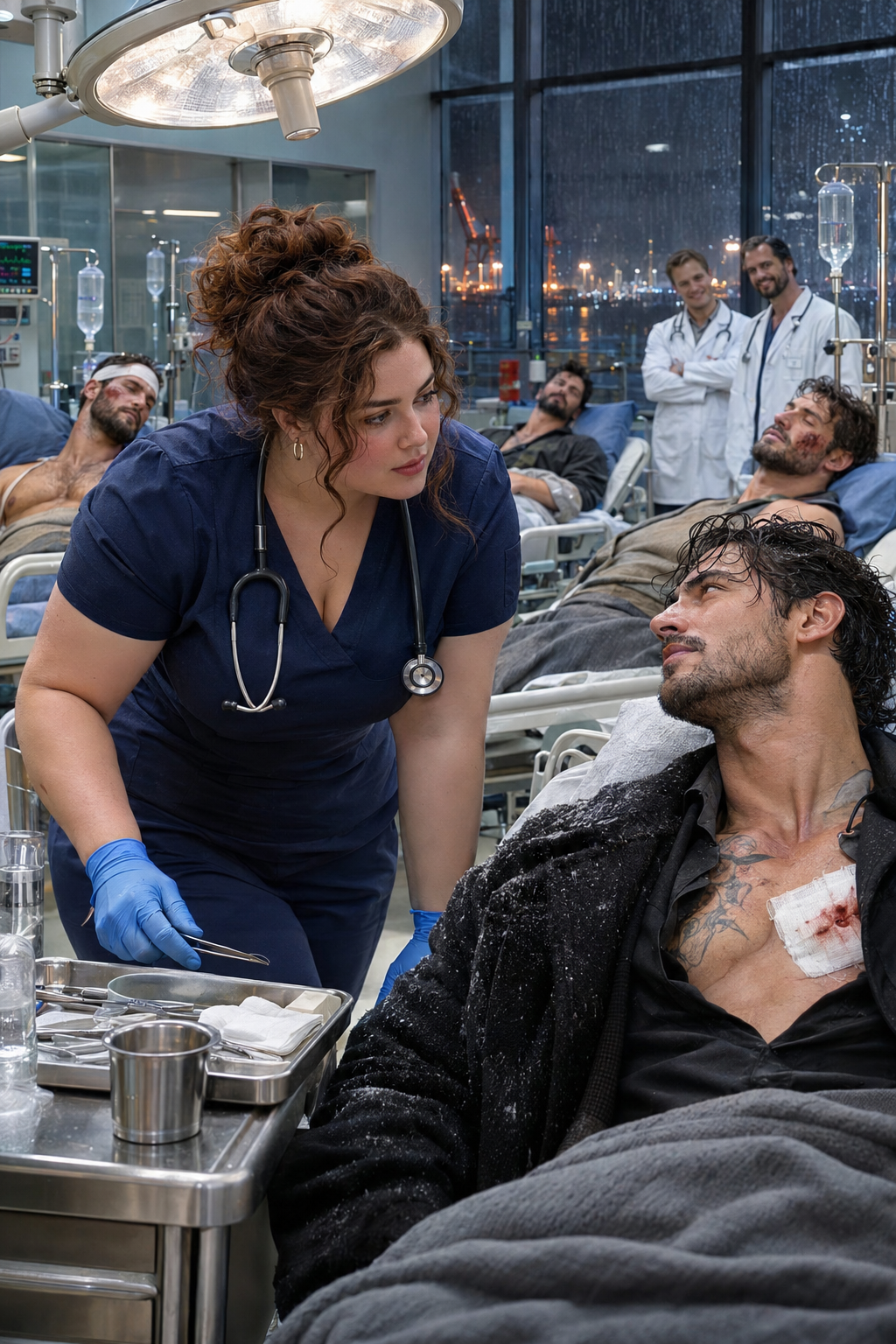
The moment six bleeding men stumbled into the trauma annex, both doctors grabbed their coats and ran.
“The bullets were contaminated,” Bridget said. “I believe there’s something on them that’s preventing your blood from clotting.”
Bastion stared at her, his face growing even paler beneath the harsh emergency lights.
“You’re saying we were poisoned?”
“That’s what I suspect. Whatever entered your bodies is making it extremely difficult to stop the bleeding. Some of you are reacting faster than others.”
The room fell silent except for the steady beeping of the heart monitors and the rain pounding against the windows.
A heavily built man named Victor turned toward Bastion. His left shoulder was wrapped in a bloodstained dressing, and his breathing was shallow.
“They knew we’d try to get medical help,” Victor whispered.
Bastion closed his eyes.
The realization was worse than the ambush itself. Whoever had attacked them hadn’t simply intended to wound them. They had wanted to make sure none of them survived.
Even reaching a hospital might not have been enough.
“Can you fix it?” Bastion asked.
Bridget looked directly into his eyes.
“I’m going to do everything I can.”
“That’s not what I asked.”
“And I’m not going to make promises I can’t keep.”
For a man accustomed to receiving immediate answers and unquestioning obedience, Bastion found her response strangely unsettling. Yet there was something reassuring about it, too.
She wasn’t trying to impress him. She wasn’t afraid of disappointing him. She was telling him the truth.
Bridget moved toward the laboratory station and contacted the regional medical center through the emergency communication system. The connection broke twice before she finally reached a specialist.
She described the patients’ symptoms, the unusual bleeding, and her suspicions about the contaminated ammunition.
The specialist agreed that exposure to anticoagulant substances was a serious possibility. Laboratory confirmation would take time, but the men needed immediate treatment.
Time was precisely what Bridget didn’t have.
She returned to the treatment area and checked the remaining supplies. The annex had been designed to stabilize emergency patients before transferring them to larger hospitals. It had never been intended to manage six critically wounded men during a complete transportation shutdown.
She counted the available blood products, medications, warming equipment, and emergency supplies.
There was enough to begin.
Whether there would be enough to finish was another question entirely.
“Victor,” she called.
The large man lifted his head.
“Can you walk?”
“If I have to.”
“Then I need your help. Slowly. Don’t try to prove anything.”
Under her direction, Victor helped bring supplies within reach. Another wounded man, whose condition was temporarily more stable, assisted from his bed.
These were men who had spent their lives taking orders from Bastion Corvino.
Tonight, every one of them answered to Bridget Monahan.
The youngest patient was named Danny. He was twenty-three, with dark hair, frightened brown eyes, and a photograph of a little girl tucked inside his wallet.
Bridget had noticed the picture while searching for identification.
“Your daughter?” she asked while checking his condition.
Danny nodded.
“She’s four. Her name’s Sophie.”
“Pretty name.”
“Her birthday’s next week.”
“Then you’ve got something important to look forward to.”
Danny tried to smile, but his lips trembled.
“I told her I’d take her to the aquarium.”
Bridget adjusted his blanket.
“Tell me what she’s like.”
For the next several minutes, Danny talked about his daughter. He described her obsession with sea animals, her purple rain boots, and the way she insisted on sleeping with a stuffed whale.
His voice became weaker as he spoke.
Bridget kept encouraging him while carefully monitoring his condition.
Then, without warning, Danny stopped answering.
His eyes rolled closed.
The monitor sounded an alarm.
“Danny?”
Bridget immediately moved into action.
Victor attempted to stand, but she ordered him back onto his bed.
“Stay where you are!”
Bastion struggled to lift his head.
“What’s happening?”
Bridget didn’t respond. Her attention was entirely focused on Danny.
For several terrifying moments, the other five men watched helplessly as she fought to stabilize him.
Bastion had seen men face death before. He had witnessed fear, desperation, and the terrible silence that followed violence.
But watching someone fight so fiercely to preserve a life was different.
There was no anger in Bridget’s movements. No hesitation. No judgment.
Only determination.
Finally, Danny’s condition began responding to her efforts.
The alarms quieted.
Bridget remained beside him until she was satisfied that he was stable enough for her to move away.
“He’s still with us,” she announced.
Victor lowered his head and covered his face with his uninjured hand.
Bastion released a breath he hadn’t realized he was holding.
Bridget checked the clock.
Nearly forty minutes had passed since the men arrived.
It felt like an entire night.
She continued administering blood products and medications intended to counter the suspected clotting problem, while using warming equipment to address the dangerous effects of blood loss and falling body temperatures.
Every patient required constant reassessment.
Every improvement could be temporary.
And every new alarm sent her rushing across the room.
Then the lights went out.
The entire annex disappeared into darkness.
Someone cursed.
Another man shouted Bridget’s name.
For several seconds, only the battery-powered monitors illuminated the treatment area.
“Nobody move!” Bridget called.
She knew the emergency generator should activate automatically.
She waited.
One second.
Two seconds.
Three.
Finally, the emergency lighting flickered on, casting a dim yellow glow across the room.
The equipment gradually returned to operation.
Bridget hurried to check each patient.
Everything essential was still functioning.
For now.
Outside, the storm was growing stronger. Wind shook the building, and water collected beneath the entrance doors.
Bastion looked toward the ceiling.
“Of all the nights for this to happen.”
Bridget gave him a tired glance.
“Emergencies rarely check the weather forecast.”
Despite everything, Victor let out a brief laugh.
It was the first genuine laugh anyone had heard since arriving.
Bridget returned to Bastion’s bedside and examined his dressing.
His condition remained concerning, although the treatment appeared to be slowing the bleeding.
“You need to stop moving,” she told him.
“I have people who need to know what happened.”
“They can wait.”
“You don’t understand.”
“You’re right. I don’t understand why someone who can barely keep his eyes open thinks he needs to run an organization from a hospital bed.”
Bastion looked at her with disbelief.
Victor turned away, attempting to hide a smile.
Nobody spoke to Bastion Corvino like that.
Nobody who worked for him would have dared.
Yet Bastion didn’t argue.
He settled back against the pillow.
A few minutes later, he spoke again.
“What’s your name?”
“Bridget Monahan.”
“How long were you in the Navy?”
“Long enough.”
“You’ve done this before?”
“I’ve treated people in difficult circumstances.”
“People like us?”
Bridget paused.
“Wounded people.”
Her answer stayed with him.
She moved away before he could respond.
As the night continued, the men’s conversations became quieter. Without their expensive coats, confident expressions, and usual authority, they seemed remarkably ordinary.
One worried about his elderly mother.
Another asked whether he would regain full use of his hand.
Victor admitted that he hadn’t spoken to his brother in nearly three years.
Danny, drifting in and out of sleep, occasionally whispered his daughter’s name.
Bridget listened whenever she could.
She had learned during her military service that fear often became more manageable when patients had someone willing to hear them.
Sometimes people needed medicine.
Sometimes they needed reassurance.
Usually, they needed both.
Then another complication emerged.
A patient named Marcus began experiencing renewed bleeding. His blood pressure dropped, and his skin became cold and damp.
Bridget checked the remaining supplies.
They were running dangerously low.
She contacted the regional medical center again.
“Any chance of getting additional blood products here?”
The answer was discouraging.
Flooded roads and storm damage were preventing emergency vehicles from reaching the annex. Authorities were working to restore access, but nobody could provide a reliable arrival time.
Bridget stared at the supply cabinet after ending the call.
For the first time that night, she allowed herself a few seconds to acknowledge how exhausted she was.
Her shoulders ached. Her feet hurt. Her hands felt stiff.
She wanted another medical professional beside her.
She wanted someone to share the responsibility.
Instead, she had six patients depending on her and a storm that refused to end.
She took a drink of water, washed her hands, and returned to work.
Bastion noticed her expression.
“Something’s wrong.”
“We’re running low on supplies.”
“How much do you need?”
“This isn’t something you can solve with money.”
“I can get people here.”
“Not through those roads, you can’t.”
Bastion reached for his phone.
Bridget stopped him.
“Don’t send anyone into that storm. I already have six patients. I don’t need six more.”
He looked at the phone, then placed it beside his pillow.
The decision seemed small, but Victor recognized its significance.
Bastion was surrendering control to someone else.
And he was doing it willingly.
Bridget continued working with the resources available, following the specialist’s guidance whenever communication permitted.
The next half hour was the hardest of the night.
Marcus remained unstable. Danny’s condition required close attention. Bastion was still weak, and two other patients showed troubling signs of continued bleeding.
At one point, three monitors sounded within seconds of one another.
Bridget moved between them, responding to the most urgent problems first.
Victor watched her with growing amazement.
“How does she remember everything?” he whispered.
Bastion didn’t answer.
He was watching her, too.
Bridget had organized the treatment area so that supplies and equipment were accessible from the central station. The wheel-shaped layout allowed her to observe all six patients while moving quickly between beds.
She recorded important changes whenever she could.
Nothing about her work looked effortless.
She was tired, frightened, and under enormous pressure.
But she refused to allow those feelings to make decisions for her.
Then, almost two hours after she began addressing the clotting problem, the first encouraging laboratory results arrived.
Bridget studied them carefully.
Marcus was improving.
She checked his dressing.
The bleeding had slowed considerably.
She moved to Danny.
His condition was becoming more stable.
One by one, the other patients began showing signs that the treatment was working.
Bridget didn’t celebrate immediately. She continued monitoring them, knowing that improvement wasn’t the same as recovery.
But something had changed.
For the first time since discovering the unusual bleeding, she felt that the danger might finally be receding.
“Well?” Bastion asked.
Bridget looked around the room.
“You’re responding to treatment.”
Victor raised his eyebrows.
“All of us?”
“All six.”
Danny opened his eyes.
“Does that mean I’m going home?”
“It means you’ve earned yourself a chance to complain about hospital food.”
He smiled weakly.
Victor laughed again.
This time, Bastion joined him.
Bridget allowed herself a small smile before returning to her notes.
Outside, the rain began to soften.
The wind was still strong, but the building no longer shook with every gust.
A faint gray light appeared beyond the windows.
Morning was coming.
Bridget checked each patient again before walking into the staff kitchen.
She found several containers of beef broth, warmed them, and poured small servings for the patients who were medically cleared to drink.
When she returned, Victor stared at his paper cup.
“What’s this?”
“Breakfast.”
“I was expecting coffee.”
“You can expect whatever you want. You’re getting broth.”
He accepted it without another word.
Bridget then opened a cabinet containing supplies normally reserved for younger patients.
The annex was running low on ordinary adhesive bandages for minor puncture sites and small injuries.
What remained was a box decorated with smiling blue whales.
She took it to Danny first.
He looked down at the cheerful little whale on his hand.
For several seconds, he said nothing.
Then his eyes filled with tears.
“Sophie would love that.”
Bridget smiled.
“Then make sure you show her.”
Danny carefully lifted his hand and took a picture with his phone.
He sent it to his daughter’s mother with a short message.
Tell Sophie Daddy’s coming home.
Bridget continued around the room.
Victor received a blue whale bandage.
Marcus received one.
So did the remaining men.
When she reached Bastion, he looked at the bandage in her hand.
“You’re not serious.”
“Completely serious.”
“Do you have anything less ridiculous?”
“No.”
He sighed and extended his hand.
Bridget applied the bandage.
Victor burst out laughing.
The others followed.
There sat Bastion Corvino, one of the most feared men associated with Baltimore’s waterfront, drinking beef broth from a paper cup with a smiling blue whale stuck to his hand.
Nobody outside that room would have believed it.
For a brief moment, the six men weren’t thinking about their enemies, their reputations, or the violence that had brought them there.
They were simply grateful to be alive.
Shortly after sunrise, the emergency communication system delivered the news Bridget had been waiting for.
Road access was being restored, and medical transport teams were on their way.
She closed her eyes for a moment.
The relief was almost overwhelming.
When the first ambulance crews arrived, they found six surviving patients, carefully organized medical records, and a nurse practitioner who looked as though she hadn’t slept in days.
The lead paramedic surveyed the room.
“Where’s the rest of your team?”
Bridget glanced toward the empty doctors’ station.
“You’re looking at it.”
He stared at her.
“You managed all six?”
“With remote specialist guidance and some help from the patients.”
The paramedic examined the records and shook his head in amazement.
“That’s incredible.”
Bridget simply began explaining the patients’ conditions and treatment histories.
There was still work to do.
As the men were prepared for transfer, Bastion asked to speak with her privately.
She approached his stretcher.
“What is it?”
He reached toward his belongings.
“I want to compensate you.”
“No.”
“You haven’t heard what I’m offering.”
“I don’t need to.”
“Name an amount.”
Bridget folded her arms.
“Mr. Corvino, saving your life wasn’t a business transaction.”
Bastion studied her.
“Everyone wants something.”
“Then here’s what I want. Follow your doctors’ instructions. Give yourself time to recover. And think carefully about why you ended up here.”
His expression changed.
She continued.
“Six men nearly died tonight. One of them has a little girl waiting for him. Whatever happened on that bridge, whatever business brought you there, those families deserve better than another night like this.”
Bastion looked toward Danny, who was being transferred into another ambulance.
For once, he had no clever response.
Bridget placed a hand on the side of his stretcher.
“Don’t waste the second chance you’ve been given.”
He nodded slowly.
“I won’t forget this.”
“I hope you don’t.”
The paramedics wheeled him outside.
Victor was the last patient to leave.
Before his stretcher reached the entrance, he called Bridget over.
“I’ve spent twenty years working with men who talk about courage,” he said. “Most of them wouldn’t have stayed in this building last night.”
Bridget looked at him.
“Courage doesn’t mean you’re never scared.”
“Were you scared?”
“Absolutely.”
Victor seemed surprised.
“Then how did you keep going?”
“Being scared didn’t change what needed to be done.”
He considered her answer before extending his uninjured hand.
She shook it.
“Thank you, Bridget.”
After the ambulances disappeared, the annex became strangely quiet.
Bridget stood among empty beds, discarded packaging, abandoned blankets, and equipment that needed cleaning.
The adrenaline that had carried her through the night finally faded.
She sat down.
Her hands began trembling.
She pressed them together and stared at the floor.
Only now, when nobody needed her immediate attention, did she allow herself to cry.
She cried from exhaustion, relief, and the knowledge of how close she had come to losing patients she had never met before that night.
Then she wiped her eyes and called the hospital administrator.
In the weeks that followed, an investigation confirmed her suspicions about the contaminated ammunition. The findings became part of a criminal investigation into the bridge ambush.
The hospital also reviewed the actions of the two doctors who had abandoned the annex. Both faced formal disciplinary proceedings.
Bridget’s conduct, meanwhile, earned recognition from hospital leadership and emergency medical officials.
She appreciated the acknowledgment, but she insisted that the annex needed more than praise.
It needed better emergency staffing, improved backup resources, and enough supplies to handle another disaster.
Eventually, several of those improvements were approved.
Nearly three months later, Bridget was working an afternoon shift when a familiar face appeared at the entrance.
It was Danny.
Beside him stood a little girl wearing purple rain boots and carrying a stuffed blue whale.
“That’s her, Sophie,” Danny said softly. “That’s the lady who helped Daddy.”
The little girl walked toward Bridget and handed her a folded piece of paper.
Inside was a colorful drawing of six people lying in hospital beds. A woman stood in the middle, surrounded by smiling blue whales.
Across the top, in uneven handwriting, were the words:
THANK YOU FOR SAVING MY DADDY.
Bridget swallowed hard.
“This is beautiful.”
Sophie smiled.
“Daddy took me to the aquarium.”
“He did?”
Danny nodded.
“Best day of my life.”
He explained that he had stepped away from his former work. Recovery had given him time to reconsider the choices he had been making.
He didn’t want his daughter growing up wondering whether her father would return home.
“I’m starting over,” he said. “It’s not easy, but I’m trying.”
Bridget looked at Sophie, then back at him.
“That’s a good reason to keep trying.”
Before leaving, Danny handed her an envelope from Bastion.
Inside was a handwritten letter.
There was no money, no expensive gift, and no offer of favors.
Just a few sentences.
You treated us like human beings when you had every reason to be afraid of us. I have spent much of my life demanding loyalty and respect. That night, you showed me that neither can be demanded. They must be earned. Whatever becomes of me, I will remember what you did.
Bridget read the letter twice.
She didn’t know whether Bastion would change his life. A single night couldn’t erase years of choices, and gratitude couldn’t excuse wrongdoing.
But she hoped he understood the value of the opportunity he had received.
She placed Sophie’s drawing on the wall beside her desk.
Over the years, Bridget would receive other letters, awards, and expressions of appreciation.
Yet that simple drawing remained her favorite.
It reminded her that behind every patient was a life extending far beyond the hospital walls. There were children waiting for their parents, families hoping for another conversation, and people who still had time to make better choices.
Bridget had never believed that saving someone meant approving of everything they had done.
It meant recognizing that a human life still mattered.
On that terrible November night, two doctors had allowed fear to decide who deserved their care.
One exhausted nurse practitioner had made a different choice.
She had stayed.
And because she stayed, six men saw another sunrise, a little girl visited the aquarium with her father, and six cheerful blue whales became an unexpected reminder of something far more powerful than fear.
True strength isn’t measured by how many people are afraid of you, how much money you possess, or how much authority you command.
It is measured by what you choose to do when someone vulnerable depends on you, when walking away would be easier, and when nobody can force you to stay.
Bridget Monahan had made that choice without expecting anything in return.
And that was why, among six men who had spent their lives believing power was the greatest thing a person could possess, none of them would ever forget the extraordinary strength of a woman whose greatest weapon was compassion.
Six months after the storm, Bridget received a phone call that brought the memories of that November night rushing back.
“Ms. Monahan? This is Bastion Corvino.”
She recognized his voice immediately.
“How are you feeling?”
“Better than I deserve, probably.”
“That’s something your doctor should decide.”
He laughed quietly, but there was a heaviness in his voice that Bridget couldn’t ignore.
“I was wondering if you had a few minutes. There’s something I’d like to tell you in person.”
Two days later, Bastion arrived at the trauma annex alone. He wore a simple gray coat instead of his usual expensive suit. He walked with a slight limp, and the confidence that once surrounded him seemed different now.
Bridget invited him into the staff break room.
He sat across from her and placed a small envelope on the table.
“I’m turning myself in tomorrow,” he said.
Bridget stopped stirring her coffee.
Bastion explained that he had spent months cooperating with his attorneys and preparing to provide information to federal investigators. He knew that accepting responsibility for his past could cost him years of freedom.
Several people had warned him against doing it.
But he had made his decision.
“I used to think surviving meant winning,” he said. “After that night, I started wondering what exactly I’d been winning.”
He looked through the window toward the treatment area.
“Danny sends me pictures of his daughter sometimes. Victor finally made peace with his brother. Marcus is spending more time with his family. They’re trying to build different lives.”
“And you?” Bridget asked.
“I’m trying to become someone who doesn’t keep putting people in hospital beds.”
Bridget remained quiet.
She understood that his decision wouldn’t undo the harm he had caused. There were people whose suffering could never be erased by an apology or a prison sentence.
But accepting responsibility was a beginning.
“I’m not asking you to forgive me,” Bastion continued. “You don’t owe me anything. I just wanted you to know that your work that night wasn’t wasted.”
He pushed the envelope toward her.
Inside was a photograph of six men standing together outside a restaurant. Danny was holding Sophie in his arms, while Victor stood beside his brother.
Each man wore a small blue whale sticker on his jacket.
Bridget laughed.
“You’re never going to let those bandages go, are you?”
“Probably not.”
Bastion stood and extended his hand.
“Thank you for giving me enough time to make a better decision.”
Bridget shook it.
“Make sure you keep making those decisions.”
The following morning, Bastion surrendered to federal authorities.
His cooperation became part of a lengthy investigation. Eventually, he was sentenced to prison for his involvement in criminal activities connected to the waterfront.
For the first time in decades, he could no longer rely on his wealth or reputation to escape the consequences of his actions.
He accepted them.
Meanwhile, life at the trauma annex continued.
The hospital hired additional emergency staff, expanded its medical supply reserves, and introduced new procedures to prevent patients from being abandoned during dangerous situations.
Bridget helped train younger medical professionals.
Whenever someone asked her about the night she saved six members of a criminal organization, she corrected them gently.
“I saved six patients.”
That distinction mattered to her.
Years passed.
One afternoon, a teenage girl entered the annex carrying a small gift bag.
Bridget didn’t recognize her until she saw the familiar stuffed blue whale tucked beneath her arm.
“Sophie?”
The girl grinned.
“Hi, Bridget.”
Danny followed her through the entrance. He looked healthier, happier, and considerably older than the frightened young man Bridget remembered.
He had found steady work repairing marine engines and had built a quiet life with his family.
Sophie handed Bridget the gift bag.
Inside was a blue whale pin and a handwritten note.
I’m going to study nursing when I finish school. Dad says there are people who make the world better just by refusing to walk away. I want to be one of them.
Bridget pressed the note against her chest.
For a moment, she couldn’t speak.
Danny smiled.
“She’s been talking about becoming a nurse for years.”
Sophie looked around the annex.
“Do you think I could work somewhere like this someday?”
Bridget pinned the little blue whale to her uniform.
“I think the world could use someone like you.”
After they left, Bridget returned to her desk and placed Sophie’s new note beside the childhood drawing she had kept all those years.
She looked at the two pieces of paper and thought about the storm, the darkness, the empty doctors’ station, and the six men who had arrived with almost no hope of surviving.
At the time, she had believed her responsibility ended with keeping their hearts beating until morning.
She hadn’t known that saving one life could influence another.
She hadn’t known that a frightened young father would leave behind a dangerous existence, that a powerful criminal would finally face his responsibilities, or that a little girl with purple rain boots would grow up wanting to care for strangers.
Compassion didn’t guarantee that everyone would change.
It couldn’t erase the past, repair every broken relationship, or undo every terrible mistake.
But it could give people an opportunity to become better than they had been yesterday.
And sometimes, that opportunity was enough to change the future of an entire family.
Bridget heard the emergency entrance open.
Another patient needed her.
She stood, adjusted the little blue whale on her uniform, and walked toward the treatment room.
She never knew who would come through those doors next.
She never knew what mistakes they had made, what burdens they carried, or what kind of life they had lived.
But she knew exactly what she would do when they arrived.
She would stay.
Because kindness is not a reward reserved for perfect people. It is a choice we make about the kind of person we want to be.
And sometimes, the greatest legacy we leave behind isn’t our wealth, our achievements, or even our name.
It’s the goodness that continues to grow in other people’s lives because, when they needed someone most, we chose not to turn away.
THE END.