The moment Martha Bell lifted the lid off the pork barrel, she knew someone at Pine Hollow Ranch was trying to starve them. Winter was approaching, and twenty-three men were depending on her to keep them fed.
“I’m saying someone at your table has been helping Edwin Crowley destroy this ranch from the inside.”
Jonathan Hale stared at Martha Bell as though her words had struck him harder than a fist.
Outside, the twenty-three ranch hands were filing into the bunkhouse, hungry after another long day repairing fences and gathering cattle before winter. These were men Jonathan had worked beside for years. Some had ridden with his father. Others had followed him through blizzards, droughts, and dangerous cattle drives.
“You’re accusing one of my men of stealing?” he asked quietly.
“I’m accusing someone of making sure those men don’t have enough food to survive the winter.”
Jonathan looked down at her inventory notebook.
“That’s a serious accusation, Martha.”
“I know. That’s why I’m not making it without evidence.”
She turned another page, revealing a series of carefully drawn columns.
“Look here. The first missing flour was discovered the morning after the north pasture crew returned. The salt disappeared when the men were repairing the eastern fence. And yesterday, someone entered the storeroom while I was helping Mrs. Perkins deliver her baby.”
Jonathan studied the dates.
“Different men were working those days.”
“Exactly. But someone was here every single time.”
She placed her finger beside one name.
“Silas Mercer.”
Jonathan’s jaw tightened.
Silas was his foreman, a broad-shouldered man of forty-five who had worked at Pine Hollow for nearly twelve years. He managed the livestock, supervised the ranch hands, and possessed keys to almost every building on the property.
“He’s been with me since my father died,” Jonathan said.
“That doesn’t mean he’s guilty. But it does mean he had the opportunity.”
Jonathan closed the notebook.
“I won’t ruin a man’s reputation over suspicion.”
“Neither will I,” Martha answered. “That’s why we’re going to catch whoever’s doing this.”
Something in her voice made Jonathan look at her differently.
She wasn’t frightened.
She was angry.
And beneath that anger was a determination he had rarely encountered in anyone.
“What do you propose?”
Martha reached into her apron pocket and produced a small cloth bag.
“First, we’re going to make whoever’s stealing our food believe there’s something worth stealing tomorrow night.”
Jonathan raised an eyebrow.
“And then?”
She smiled.
“We’ll see whether our thief is as clever as he thinks.”
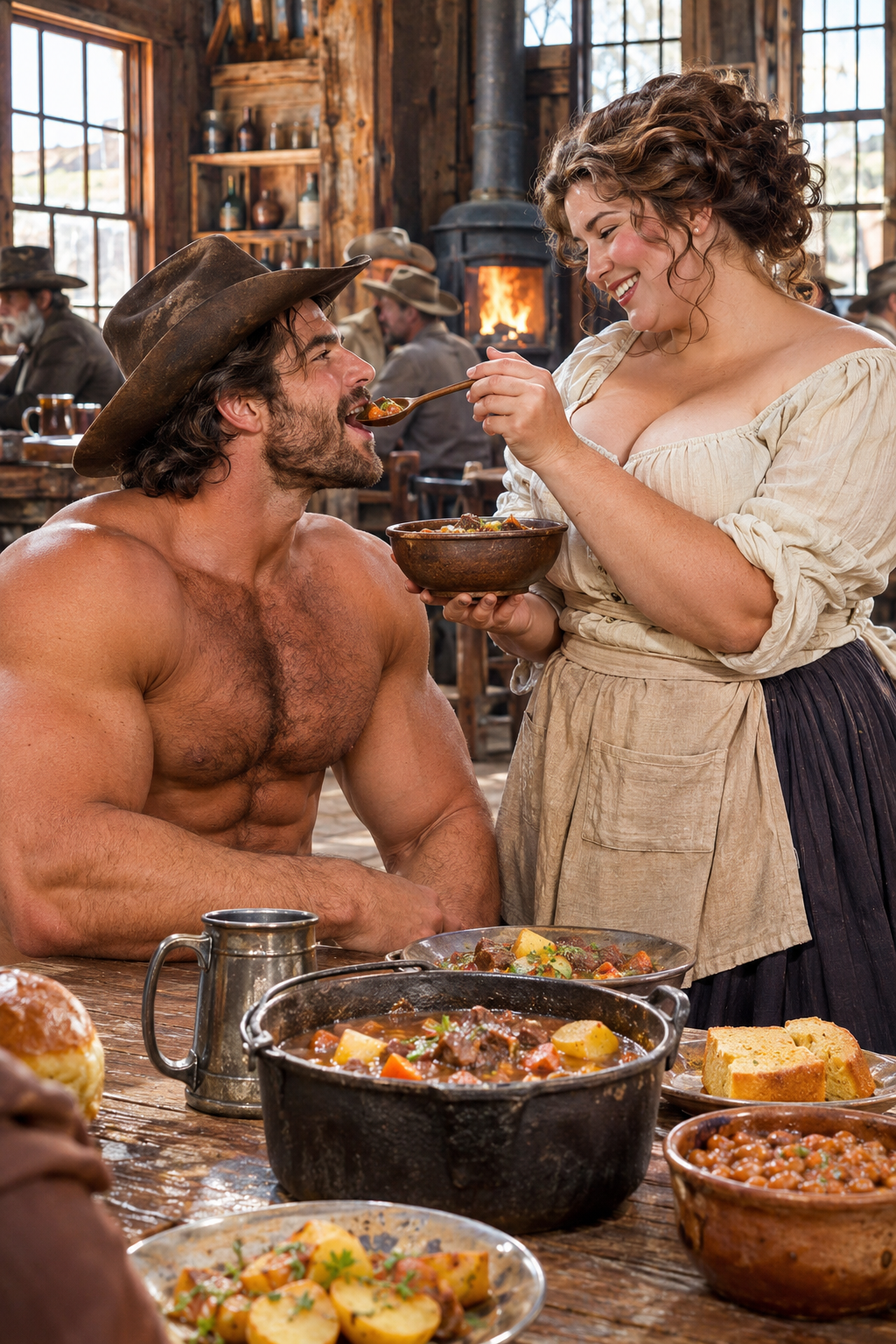
That evening, Martha served beef stew, fresh biscuits, and the last apple pie she could make without dipping into her carefully protected emergency supplies.
The men ate enthusiastically, though several complained about the approaching winter.
“Snow’s already falling in the northern passes,” said young Tommy Reed, barely nineteen and still learning how to handle a horse.
“Another week and the supply wagons won’t get through,” added Gus Wheeler.
Silas Mercer sat at the head of the long table, directly beneath the hanging lantern.
“We’ll manage,” he said. “Mr. Hale always finds a way.”
Martha watched him carefully.
His words sounded reassuring.
His eyes, however, kept drifting toward Jonathan.
When supper ended, Martha casually announced that a supply wagon would arrive the following afternoon.
“Found a merchant willing to bring us several sacks of flour and two barrels of salt,” she said. “The goods will stay in the storeroom until I can inventory everything.”
Silas looked up sharply.
“Which merchant?”
“Fellow from Laramie.”
“What’s his name?”
Martha shrugged.
“Jonathan handled the arrangements.”
Across the room, Jonathan continued drinking his coffee without looking up.
Silas nodded slowly.
But Martha noticed his fingers tightening around his spoon.
Later that night, Jonathan found her kneading bread dough in the kitchen.
“You lied to them.”
“I gave our thief a reason to show himself.”
“There isn’t any wagon coming.”
“No,” Martha replied. “But tomorrow afternoon, you and I are going to fill three empty flour sacks with sawdust and put them where everyone can see.”
Jonathan leaned against the doorway.
“And what happens when someone opens them?”
“They’ll discover they’re worthless. But by then, we’ll know who touched them.”
He watched her work for a moment.
“You’ve done something like this before?”
Martha’s hands stopped.
For the first time since arriving at Pine Hollow, the confident cook seemed uncertain.
“My father owned a general store in Missouri,” she said. “When I was twenty-two, his business partner began stealing from him.”
Jonathan waited.
“Father trusted that man more than anyone. Even when the accounts stopped balancing, he refused to believe something was wrong.”
“What happened?”
“He lost the store. Then he lost our home. He died six months later, still blaming himself.”
Martha pressed her palms into the dough.
“I learned something from watching him suffer. Trust is a wonderful thing, Jonathan. But trust without judgment can destroy everything a person has built.”
Jonathan stepped closer.
“Is that why you left Missouri?”
“Partly.”
“And the rest?”
She looked at him.
“Because people there remembered me as the daughter of a ruined man. I wanted to become someone who could stand on her own.”
Jonathan studied her face, the flour dusting her cheek, the loose strands of brown hair escaping her braid.
“You already are.”
The words were simple.
But Martha felt them settle somewhere deep inside her.
For several seconds, neither moved.
Then footsteps sounded on the porch.
Jonathan immediately stepped away.
Silas appeared in the doorway.
“Mr. Hale, the southern gate needs repairing. I figured we’d handle it at first light.”
Jonathan nodded.
“Fine.”
Silas glanced at Martha.
“Working late, Miss Bell?”
“Bread doesn’t rise according to a cowboy’s schedule.”
Silas gave a thin smile.
“Suppose not.”
When he disappeared, Martha whispered, “Did you notice?”
“What?”
“He wasn’t wearing his work boots.”
Jonathan frowned.
Silas had been wearing soft leather shoes.
The kind a man might choose when he wanted to move quietly.
The following afternoon, Martha and Jonathan carried three heavy sacks into the storeroom.
They made certain several ranch hands witnessed the delivery.
Each sack contained sawdust mixed with enough flour to appear convincing if someone examined the top.
Martha tied the openings with ordinary twine.
But beneath each knot, she secured a nearly invisible strand of red sewing thread.
“If someone opens these, the thread will break,” she explained.
Jonathan inspected her work.
“Clever.”
“Not clever enough if our thief simply carries the whole sack away.”
“That’s why I’ll be watching.”
Martha shook her head.
“No. You’ll be in the bunkhouse playing cards.”
He looked offended.
“Playing cards?”
“Loudly. With witnesses.”
“And where will you be?”
“Somewhere our thief won’t expect.”
Jonathan stared at her.
“Martha, absolutely not.”
She folded her arms.
“Jonathan Hale, I’ve crossed two states alone, handled drunk cattle buyers, and once chased a thief out of my father’s store with a cast-iron skillet. I can sit in a dark pantry.”
“That’s not what worries me.”
“Then what does?”
His expression changed.
For a moment, the stern ranch owner looked almost vulnerable.
“The thought of someone hurting you.”
Martha’s heart gave an unexpected flutter.
She softened her voice.
“Then make sure you’re close enough to help.”
That night, the wind howled across Pine Hollow.
Clouds swallowed the moon, and the temperature dropped sharply.
Jonathan joined five ranch hands around a card table while Martha supposedly retired to her room.
Instead, she slipped into a narrow storage alcove behind the kitchen chimney, carrying a lantern with its wick turned low.
From there, she could see the storeroom door through a narrow gap in the boards.
For nearly two hours, nothing happened.
The house creaked.
Wind rattled the shutters.
Somewhere outside, a horse whinnied.
Then, shortly after midnight, Martha heard footsteps.
Slow.
Careful.
A shadow crossed the kitchen floor.
Someone approached the storeroom carrying a small oil lamp.
Martha held her breath.
The figure opened the door.
Silas Mercer stepped inside.
He went directly to the flour sacks.
But instead of opening one, he reached into his coat and withdrew a folded piece of paper.
Martha watched him examine the room.
Then he knelt beside the lowest shelf and removed a loose floorboard.
Her stomach tightened.
Silas pulled out a small wooden box.
He opened it.
Even in the dim light, Martha recognized several silver coins and a bundle of documents.
Silas tucked the papers inside his coat.
Then he reached for the nearest flour sack.
Martha moved.
The floorboard beneath her foot gave a sharp creak.
Silas froze.
“Who’s there?”
She remained silent.
He lifted the lamp.
“Come out.”
Martha knew hiding was useless.
She stepped into the doorway.
“Evening, Mr. Mercer.”
Silas stared at her.
Then his expression hardened.
“You shouldn’t be here.”
“Neither should you.”
He took one step toward her.
“Go back to bed, Martha.”
“After you explain what’s in your coat.”
For several seconds, they faced each other.
Then Silas lunged forward.
Martha grabbed the cast-iron skillet she had placed beside the doorway and swung it toward his reaching hand.
The skillet struck his wrist.
He cried out, dropping his lamp.
Oil splashed across the floor.
Flames erupted.
Martha stumbled backward.
Silas seized her arm and shoved her against the shelving.
A jar shattered beside her head.
“Stay out of this!” he snarled.
Before he could strike again, Jonathan burst through the kitchen door.
“Get your hands off her!”
He crossed the room in three strides and slammed Silas against the wall.
The foreman struggled, but Jonathan’s grip held firm.
“Put that fire out!” Jonathan shouted.
Two ranch hands rushed in with blankets and buckets.
Within moments, the flames were smothered.
Silas stood pinned against the wall, breathing heavily.
Jonathan looked at Martha.
“Are you hurt?”
“Just bruised.”
His eyes darkened.
He turned toward Silas.
“Give me one reason I shouldn’t drag you to the sheriff tonight.”
Silas swallowed.
“You don’t understand.”
“Then explain.”
The foreman looked toward the papers scattered across the floor.
“Crowley owns me.”
Silence fell.
Martha stepped forward.
“What does that mean?”
Silas closed his eyes.
“Last spring, my boy Daniel got sick. Fever took hold of him. The doctor in Cheyenne said he needed medicine we couldn’t afford.”
Jonathan’s expression shifted.
“You told me Daniel was recovering.”
“He was. But I borrowed money to pay the doctor. Crowley offered it.”
“How much?”
“Three hundred dollars.”
Jonathan stared.
“That was all?”
“It became eight hundred by August. He kept adding interest. Then he threatened to take our house.”
Silas’s voice broke.
“He said if I helped him weaken Pine Hollow, he’d forgive the debt.”
Martha looked down at the documents.
“So you stole our supplies.”
Silas nodded miserably.
“I took the flour and salt. Crowley’s men collected them beyond the eastern ridge.”
“And the pork?”
“I drained the brine. He told me to.”
Jonathan released him slowly.
“Twenty-three men depend on this ranch, Silas. Some have families. You were willing to let them go hungry?”
“I didn’t think it would get this far.”
“But it did,” Martha said.
Silas covered his face.
“He promised nobody would get hurt.”
Jonathan picked up the papers.
One was a loan agreement.
Another contained a list of planned deliveries.
The third made his blood run cold.
It was a handwritten instruction from Crowley.
Make certain Hale cannot feed his men through December. The property will be mine before Christmas.
Jonathan read it twice.
Then he looked at Silas.
“Why would Crowley believe starving us would give him my ranch?”
Silas hesitated.
“Because your bank note comes due in six weeks.”
Martha turned toward Jonathan.
“You have a bank note?”
Jonathan’s face tightened.
His father had borrowed money years earlier to purchase additional grazing land.
Jonathan had been paying down the debt ever since.
He had never discussed it with Martha.
“Crowley bought the note from the bank last month,” Silas whispered.
Jonathan went perfectly still.
“He what?”
“He owns the debt now. And if you miss the December payment, he intends to demand the entire remaining balance under the agreement.”
The kitchen seemed to grow colder.
Jonathan had spent fifteen years building Pine Hollow into one of the strongest ranches in the territory.
Now Crowley was trying to take it without firing a single shot.
Martha looked at the documents again.
“How much does Jonathan owe?”
“Four thousand dollars,” Silas answered.
Jonathan shook his head.
“Thirty-eight hundred.”
“Not anymore,” Silas said. “Crowley added charges.”
Martha studied the note.
Something about the handwriting troubled her.
She held it closer to the lantern.
“Jonathan, who witnessed your father’s original loan?”
“Bank manager named Albert Finch.”
“Is he still alive?”
“Lives in Cheyenne. Retired two years ago.”
Martha examined the signature.
Then she asked a strange question.
“Did your father always write his name with a middle initial?”
Jonathan frowned.
“Yes. Samuel T. Hale. Why?”
“Because this copied note says Samuel J. Hale.”
Silence.
Jonathan snatched the paper from her hand.
His eyes widened.
“That isn’t right.”
Martha looked at Silas.
“Where did Crowley get this?”
“I don’t know.”
“Did he show you the original?”
“No.”
Martha turned to Jonathan.
“Then before we worry about paying Crowley, we need to find out whether he actually owns what he claims.”
Jonathan studied her with astonishment.
“You think the paper is forged?”
“I think a man willing to destroy food may also be willing to lie about a debt.”
They sent Silas to the bunkhouse under guard.
Jonathan wanted him dismissed immediately, but Martha urged patience.
“He knows where Crowley’s men collect the stolen provisions. And he may know more than he’s told us.”
“You’re asking me to trust him again?”
“No. I’m asking you to use the truth he can provide.”
At dawn, Pine Hollow awakened beneath a thin blanket of snow.
Martha was making breakfast when Jonathan entered the kitchen carrying a sealed leather pouch.
“I’m riding to Cheyenne.”
She stopped stirring the porridge.
“Alone?”
“Taking Gus and two others.”
“Then I’m coming.”
“No.”
“Jonathan—”
“Crowley already knows you’re watching him. Last night proved you’re in danger.”
Martha put down her spoon.
“And what happens if you reach Cheyenne and the bank tells you something you don’t understand?”
“I can read a contract.”
“I know. But I spent eight years keeping accounts for my father’s store. I know how debts can be altered, how numbers can be hidden, and how desperate people can be tricked.”
Jonathan hesitated.
She stepped closer.
“This isn’t just your fight anymore.”
He looked at her for a long moment.
Then he nodded.
“Pack warm clothes.”
They left Pine Hollow after breakfast.
The trip to Cheyenne took two days through increasingly dangerous weather.
On the first evening, they sheltered in an abandoned line cabin.
Gus and the others slept near the horses while Martha and Jonathan sat beside a small fire.
For a while, neither spoke.
Then Jonathan said, “I owe you an apology.”
“For what?”
“For keeping the loan from you.”
“You don’t owe me details about your finances.”
“Maybe not. But you trusted me enough to tell me about your father. I should have trusted you with my troubles.”
Martha studied the flames.
“Why didn’t you?”
Jonathan rubbed his hands together.
“Because everyone expects me to be strong. My men. The neighboring ranchers. The bank. I suppose I got used to pretending I could handle everything alone.”
Martha smiled sadly.
“My father was the same.”
Jonathan looked toward her.
“Did he ever ask anyone for help?”
“Too late.”
The wind battered the cabin.
Jonathan reached for her hand.
“Martha, when you came to Pine Hollow, I thought I was hiring a cook.”
“And what do you think now?”
His thumb brushed gently across her knuckles.
“I think you’ve given that place something it’s been missing for years.”
“What?”
“A reason to feel like home.”
Martha’s eyes filled unexpectedly.
She had spent so many years being useful that she had almost forgotten what it felt like to be wanted.
“Jonathan—”
He leaned closer.
But a sudden shout outside interrupted them.
“Riders!”
Jonathan sprang to his feet.
Three mounted figures approached through the darkness.
They wore scarves over their faces.
One shouted, “Hale! Come outside!”
Jonathan reached for his rifle.
Martha caught his arm.
“Wait.”
A shot cracked through the night.
The cabin window shattered.
Glass scattered across the floor.
Jonathan pulled Martha behind the stove.
“Stay down!”
Outside, Gus returned fire.
A horse screamed.
Then the riders scattered into the trees.
The entire attack lasted less than a minute.
When silence returned, Jonathan stepped outside cautiously.
One of the attackers had dropped a saddlebag.
Inside was a folded letter.
Martha opened it beside the fire.
There were only seven words.
Turn back, or the woman dies first.
Jonathan’s face drained of color.
He immediately began gathering their belongings.
“We’re going home.”
Martha stood.
“No.”
“Martha, they threatened you.”
“And if we turn back, Crowley wins.”
“I won’t gamble with your life.”
She stepped directly in front of him.
“Then don’t. Protect me by finishing what we started.”
Jonathan stared at her.
“What kind of woman refuses to be frightened?”
“One who’s been frightened before and knows it doesn’t solve anything.”
He lowered his head.
Then, slowly, he pulled her into his arms.
It wasn’t a romantic embrace born of convenience.
It was the desperate hold of a man discovering how much another person had come to mean to him.
They continued toward Cheyenne at first light.
By noon the following day, they reached the bank.
The current manager, Harold Bennett, received them with visible discomfort.
When Jonathan presented Crowley’s document, Bennett grew pale.
“Where did you get this?”
“Edwin Crowley.”
Bennett examined the signature.
Then he opened a locked cabinet and removed a thick ledger.
After several minutes, he looked up.
“Mr. Hale, your father’s original note was never sold to Crowley.”
Jonathan gripped the edge of the desk.
“Then who owns it?”
“The bank. The balance is thirty-eight hundred dollars, exactly as you said. And your next scheduled payment isn’t due until March.”
Martha felt relief rush through her.
But Bennett wasn’t finished.
“Someone requested copies of your father’s documents three weeks ago.”
“Who?”
Bennett hesitated.
“My former assistant, Lewis Grant.”
Jonathan frowned.
“Where is he?”
“Dismissed last month after an audit uncovered irregularities.”
Martha leaned forward.
“Was he working with Crowley?”
Bennett closed the ledger.
“We suspected it. But we couldn’t prove anything.”
Jonathan placed the threatening letter on the desk.
“Perhaps this will help.”
Within an hour, the sheriff had been summoned.
By evening, Lewis Grant was found at a boardinghouse preparing to leave town.
When officers searched his belongings, they discovered forged loan documents, altered bank seals, and correspondence from Edwin Crowley.
One letter outlined Crowley’s entire scheme.
He would force Pine Hollow into financial distress, present a fraudulent demand for immediate payment, and use the confusion to pressure Jonathan into signing over the ranch.
But another discovery proved even more disturbing.
Crowley had arranged for a shipment of emergency provisions to be intercepted on its way to Pine Hollow.
The wagon was supposed to arrive the following week.
Instead, his men planned to seize it and abandon the driver in the mountains.
Jonathan read the letter.
Then he looked at Martha.
“We have to get home.”
The sheriff agreed to send deputies after Crowley.
But a snowstorm was already moving across the territory.
By the time Martha and Jonathan reached Pine Hollow, the ranch lay beneath nearly eighteen inches of snow.
And something was terribly wrong.
The main gate stood open.
Smoke rose from the direction of the barn.
Jonathan spurred his horse forward.
Martha followed.
When they reached the yard, they found men rushing with water buckets.
The hay barn was burning.
Tommy Reed stumbled toward them, his face blackened with soot.
“Mr. Hale! Crowley’s men came before dawn!”
Jonathan dismounted.
“Is everyone safe?”
“Most of us. But Silas went into the barn after two trapped horses. The roof came down.”
Martha looked toward the flames.
“Where is he?”
Tommy pointed.
A figure lay beside the water trough.
Silas Mercer was barely conscious.
His left arm hung at an unnatural angle, and burns covered his hands.
Jonathan knelt beside him.
“Silas.”
The foreman opened his eyes.
“I’m sorry, Mr. Hale.”
“Save your strength.”
“Crowley came looking for the papers. Said he’d burn everything if we didn’t give them back.”
Jonathan glanced toward the barn.
“Did he get them?”
Silas shook his head.
“Couldn’t find them.”
Martha reached into her coat.
“The papers are with us.”
Silas managed a faint smile.
“Good.”
His eyes closed.
For one terrible moment, Martha thought he had died.
Then she felt a weak pulse.
“He’s alive. Get him inside.”
The next several hours passed in frantic activity.
The ranch hands managed to save the main stable and most of the stored hay.
Martha cleaned Silas’s burns, splinted his arm, and made him drink warm broth.
Jonathan organized armed watches around the property.
But the greatest danger remained.
The ranch had lost nearly half its winter feed.
Several supply barrels were gone.
And a blizzard was closing the mountain roads.
That evening, Jonathan gathered all twenty-three men in the bunkhouse.
He told them everything.
The stolen provisions.
Silas’s betrayal.
Crowley’s fraudulent debt.
The attack on the cabin.
And the discovery that Crowley intended to destroy Pine Hollow.
When he finished, the room fell silent.
Then Gus Wheeler stood.
“What happens if the snow keeps coming?”
Jonathan hesitated.
“We’ll have to stretch what remains.”
“How long?”
Martha answered from the doorway.
“Seventeen days if everyone eats normal portions. Twenty-six if we’re careful.”
The men exchanged uneasy looks.
Tommy swallowed.
“Winter’s going to last longer than that.”
Martha stepped into the room.
“I know.”
She carried her inventory notebook.
“But there’s something else you should know. I’ve already divided everything we have into daily rations. We can make the supplies last longer if we stop wasting food and use every edible thing available.”
One ranch hand frowned.
“You planning to feed us boiled leather?”
“Not unless you insist on complaining about my cooking.”
A few men laughed nervously.
Martha continued.
“We have dried beans, oats, potatoes, turnips, and enough beef to make broth. The bones will be boiled twice. Bread will be smaller, but nobody will go without supper.”
Jonathan watched the men’s expressions change.
Fear didn’t disappear.
But it became manageable.
Then Gus spoke.
“My brother runs a small farm west of here. Might have grain.”
Another man raised his hand.
“My cousin stores potatoes near the river.”
Tommy stood.
“My mother has dried apples and preserves. She’d send them if she knew.”
Within minutes, the men were offering every connection they possessed.
Martha closed her notebook.
“Then perhaps Pine Hollow isn’t as alone as Crowley thinks.”
Three days later, an unexpected visitor arrived.
It was Mrs. Eleanor Perkins, the woman Martha had helped during childbirth.
She came riding in a wagon driven by her husband, bringing sacks of potatoes, smoked venison, and jars of preserved fruit.
Behind them followed two more wagons.
Then another.
Word of Crowley’s cruelty had spread across the valley.
Families who had received help from Jonathan over the years were returning the favor.
An elderly farmer brought cornmeal.
A widow arrived with dried beans.
A neighboring rancher offered twenty bales of hay.
By sunset, Pine Hollow’s yard was crowded with wagons.
Jonathan stood beside Martha, visibly overwhelmed.
“I don’t understand.”
Mrs. Perkins smiled.
“Last spring, when our barn collapsed, you sent your men to rebuild it.”
The elderly farmer stepped forward.
“When my cattle got sick, you lent me medicine and never asked for payment.”
The widow added, “Your father helped my husband during the drought of ’68. Some debts are worth remembering.”
Jonathan looked at the supplies.
Then at the people gathered around him.
For years, he had believed survival depended entirely on his own strength.
Now he understood how wrong he’d been.
But the confrontation with Crowley was not yet finished.
The following morning, five riders appeared along the eastern ridge.
Edwin Crowley rode at their center.
He carried a folded document and wore the confident smile of a man who believed victory was inevitable.
Jonathan met him outside the gate.
Martha stood beside him.
Crowley glanced at the wagons parked near the barn.
“Looks like you’ve been begging your neighbors for scraps.”
Jonathan said nothing.
Crowley unfolded his paper.
“I’ve come to collect what you owe.”
“You don’t own my father’s debt.”
Crowley’s smile faltered.
“According to this document—”
“According to the bank’s original ledger,” Martha interrupted, “your document is a forgery.”
Crowley turned toward her.
“You meddling woman.”
“Careful,” Jonathan said.
Crowley sneered.
“Still hiding behind your cook, Hale?”
Jonathan stepped forward.
“No. I’m standing beside her.”
Before Crowley could respond, hoofbeats thundered behind him.
Six riders emerged through the snow.
At their head was Sheriff Daniel Whitcomb.
Crowley wheeled his horse.
“What is the meaning of this?”
The sheriff dismounted.
“Edwin Crowley, you’re under arrest for conspiracy, fraud, theft, and ordering attacks on Pine Hollow Ranch.”
Crowley laughed.
“You can’t prove a thing.”
The sheriff held up a leather folder.
“Lewis Grant gave us your correspondence. Your hired men are already in custody. And Silas Mercer has agreed to testify.”
Crowley’s face changed.
For the first time, the arrogant rancher looked frightened.
Then he jerked his reins.
His horse lunged sideways.
A deputy grabbed the bridle, but Crowley drew a pistol.
“Get away from me!”
Jonathan moved instinctively in front of Martha.
The sheriff raised his rifle.
“Drop it, Crowley!”
For several seconds, nobody breathed.
Snow drifted between the horses.
Crowley’s hand trembled.
Then Silas Mercer appeared on the porch, his injured arm bound tightly against his chest.
“It’s over, Edwin.”
Crowley stared at him.
“You worthless fool.”
Silas descended the steps slowly.
“You told me helping you was the only way to save my family.”
“It was.”
“No,” Silas answered. “You made me believe I had no choice.”
Crowley aimed the pistol toward him.
A shot rang out.
Martha screamed.
But the bullet struck the fence post beside Silas.
At the same instant, the sheriff fired into the snow near Crowley’s horse, startling the animal.
Crowley lost his balance and fell hard to the frozen ground.
Deputies rushed forward.
Within moments, he was disarmed and handcuffed.
Jonathan stood motionless, one arm still shielding Martha.
Only when the sheriff led Crowley away did he finally turn toward her.
“Are you all right?”
She nodded.
Then she began to shake.
Jonathan drew her close.
This time, neither cared who was watching.
The trial took place six weeks later.
Lewis Grant testified about the forged bank documents.
Crowley’s hired men described the attacks.
Silas admitted his role in stealing the supplies and ruining the pork, explaining how Crowley had exploited his son’s illness and threatened his family.
The jury found Crowley guilty of multiple crimes.
He was sentenced to prison, and his assets became subject to claims for restitution.
Silas received a lesser sentence because of his cooperation, though the judge made clear that desperation did not excuse endangering innocent people.
Before he left for the county jail, Jonathan visited him.
Silas sat on a narrow cot, his injured arm still healing.
“I don’t expect forgiveness,” he said.
Jonathan remained by the door.
“You betrayed my trust.”
“I know.”
“You nearly destroyed the ranch.”
Silas lowered his head.
Jonathan sighed.
“But you also saved those horses. And you told the truth when it mattered.”
Silas looked up.
“My wife and boy?”
“They’ll have food and firewood this winter. Martha and the men are making certain of it.”
Tears filled Silas’s eyes.
“Why would you help them after what I did?”
“Because your family didn’t steal from me.”
Silas covered his face.
Jonathan waited until the man regained control of himself.
“When you’ve served your sentence, you can ask me for work. I won’t promise to hire you. Trust has to be earned again.”
Silas nodded.
“That’s more than I deserve.”
Jonathan shook his head.
“It’s an opportunity. What you do with it will be your decision.”
By the time spring arrived, Pine Hollow had survived the harshest winter anyone could remember.
Not one ranch hand had gone hungry.
Not one family connected to the ranch had been abandoned.
Martha’s meals had become simpler, but somehow the men claimed they tasted better than ever.
Perhaps hunger made them grateful.
Or perhaps knowing that everyone was sharing the same hardship made each supper feel different.
The barn was rebuilt with help from neighboring ranchers.
Jonathan repaid the bank according to the original terms, and the forged claim was officially dismissed.
But the greatest change at Pine Hollow had nothing to do with money.
It began one quiet evening in April.
Martha stood in the kitchen preparing bread when Jonathan entered carrying a small wooden box.
“Do you have a moment?”
She looked over her shoulder.
“For you? Depends. Have you broken another plate?”
He smiled.
“No.”
“Burned your supper?”
“No.”
“Then what terrible thing have you done?”
Jonathan placed the box on the table.
“I’ve been trying to find the right words for weeks.”
Martha wiped her hands on her apron.
“That sounds serious.”
“It is.”
He opened the box.
Inside lay a simple gold ring.
Martha stopped breathing.
“I had it made in Cheyenne,” Jonathan said. “It’s not particularly fancy.”
She stared at the ring.
“Jonathan…”
He took her hands.
“When you first arrived, I thought Pine Hollow needed someone to cook for twenty-three hungry men.”
Martha laughed softly through sudden tears.
“And I thought I’d found a job with a stubborn rancher who didn’t know how to ask for help.”
“You weren’t wrong.”
“No,” she whispered. “I wasn’t.”
Jonathan smiled.
“You taught me that a home isn’t built from timber and land alone. It’s built by the people willing to stand together when everything goes wrong.”
He lowered himself onto one knee.
“Martha Bell, I don’t need someone to save me. I need someone I can build a life beside. Would you marry me?”
For several seconds, Martha couldn’t speak.
She thought of Missouri.
Her father’s ruined store.
The years she’d spent moving from one place to another, always feeling temporary.
She thought of the freezing nights at Pine Hollow, the frightened men around the supper table, and the neighbors arriving with wagons full of food.
Then she looked at Jonathan.
The man who had first admired her cooking.
Then respected her judgment.
And finally learned to love her courage.
“Yes,” she whispered.
Jonathan blinked.
“Yes?”
She laughed.
“Yes, you impossible man.”
He rose and wrapped his arms around her.
When he kissed her, the bread dough sat forgotten on the table.
Outside, the spring wind moved gently through the cottonwoods.
For the first time in years, Martha no longer wondered where she belonged.
Their wedding took place beneath those same trees in June.
All twenty-three ranch hands attended.
So did the neighbors who had helped save Pine Hollow.
Mrs. Perkins brought flowers.
Gus Wheeler played a fiddle.
Tommy Reed, now considerably more confident than the boy who had arrived the previous autumn, nearly dropped the wedding cake while carrying it across the yard.
Martha laughed so hard she had to hold Jonathan’s arm.
During the celebration, Jonathan surprised everyone by standing to make a speech.
He wasn’t a man who enjoyed public attention.
But that afternoon, he wanted the words to be heard.
“Last winter,” he began, “I thought I was about to lose everything my father built.”
The guests grew quiet.
“I believed a good rancher was supposed to solve every problem himself. I was wrong.”
He looked toward Martha.
“This woman found something rotten in a barrel of pork. Most people would have thrown it away and carried on. But she refused to ignore what didn’t make sense.”
A ripple of laughter passed through the crowd.
“She uncovered a thief, exposed a fraud, and reminded me that protecting people sometimes means having the courage to question what we think we know.”
He paused.
“But the most important thing she taught me was that strength isn’t measured by how much a man carries alone.”
He looked around at the ranch hands, neighbors, and families gathered beneath the trees.
“It’s measured by how willing we are to carry one another.”
Martha reached for his hand.
Jonathan squeezed it.
Years later, people throughout the valley still told the story of the winter Pine Hollow nearly fell.
Some remembered Edwin Crowley’s arrest.
Others remembered the fire, the blizzard, and the wagons arriving through the snow.
But the ranch hands remembered something smaller.
They remembered a woman standing in a freezing kitchen, carefully counting their remaining food, refusing to let fear turn them against one another.
And they remembered the day Jonathan Hale placed a new wooden sign above the kitchen door.
It read:
AT THIS TABLE, NO ONE STANDS ALONE.
Martha kept that sign hanging there for the rest of her life.
Every winter, when the snow began falling across the Wyoming plains, she made extra bread and sent it to neighbors who needed help.
Jonathan never again laughed at her inventory notebooks.
And whenever a new ranch hand asked why the kitchen was considered the heart of Pine Hollow, the older men told him about the woman who had saved an entire ranch with a sharp eye, a brave heart, and the stubborn belief that every person deserved a place at the table.
Because in the end, Martha had discovered something far more valuable than security, wealth, or even the ranch she helped preserve.
She had found a family that chose her.
And Jonathan had learned that the richest man in Wyoming wasn’t the one who owned the most land.
It was the one who had people willing to ride through a blizzard when he needed them.
The winter had nearly destroyed Pine Hollow.
Instead, it taught everyone who survived it a truth they would carry for generations:
A house can be bought. A ranch can be inherited. But a home is created when people choose honesty over convenience, courage over fear, and kindness over the temptation to turn away.
The years that followed brought new challenges to Pine Hollow, but none could erase what Martha and Jonathan had built together.
Their marriage was not without disagreements. Jonathan remained stubborn, and Martha never learned to keep her opinions to herself when something needed fixing. Yet they discovered that love was not the absence of arguments. It was the willingness to listen, apologize, and choose each other when pride made walking away seem easier.
Two years after their wedding, their first daughter, Grace, was born during a fierce February snowstorm.
Jonathan had faced stampeding cattle, armed thieves, and dangerous mountain crossings without trembling. But when the doctor placed his tiny daughter in his arms, his hands shook so badly that Martha laughed through her exhaustion.
“She’s not made of glass, Jonathan.”
“She looks smaller than a loaf of your bread.”
“And considerably more expensive to raise.”
He kissed Martha’s forehead.
“Then I’d better get back to work.”
They welcomed a son, Samuel, three years later, naming him after Jonathan’s father.
As the children grew, the ranch changed around them. New barns rose beside the old buildings. The cattle herds expanded, and several ranch hands eventually established farms of their own with Jonathan’s assistance.
But Martha refused to let prosperity change the way Pine Hollow treated people.
Whenever a traveler arrived hungry, she found another plate.
Whenever a neighbor suffered a poor harvest, she quietly sent provisions.
And whenever Jonathan complained that she was giving away too much food, she reminded him of the winter when their neighbors had saved them.
“Everything we have today,” she would say, “exists partly because someone else refused to let us fall.”
Jonathan never argued with that.
One autumn afternoon, nearly twelve years after Edwin Crowley’s arrest, a thin, weathered man appeared at the ranch gate.
Martha recognized him before Jonathan did.
Silas Mercer.
His hair had turned gray, and his shoulders carried the unmistakable weight of a difficult life.
He removed his hat.
“Mrs. Hale. I don’t expect you to remember me kindly.”
Martha studied him.
“I remember what you did, Silas. I also remember that you told the truth when it mattered.”
He lowered his eyes.
“I’ve spent years trying to become a better man.”
“How is Daniel?”
Silas looked up in surprise.
“He’s grown. Married now. Works as a carpenter in Cheyenne.”
“And your wife?”
“Still beside me, though I gave her plenty of reasons not to be.”
Martha nodded toward the house.
“Then come inside. Jonathan’s finishing supper.”
Silas hesitated.
“After everything?”
She opened the door.
“Hunger isn’t a punishment I believe in, Silas.”
Jonathan was standing beside the fireplace when the former foreman entered.
For a long moment, neither man spoke.
Then Silas removed his hat.
“I came to repay what I could.”
He placed a small leather pouch on the table.
Inside were silver coins and several folded banknotes.
Jonathan frowned.
“What’s this?”
“The money you spent helping my family while I was serving my sentence. It took me years to save it.”
Jonathan looked at the pouch, then at the man standing before him.
“You don’t owe me for feeding your wife and son.”
“I know you don’t consider it a debt. But I needed to make it right.”
Jonathan was silent for several seconds.
Then he pushed the pouch back toward Silas.
“Take this to Daniel. Tell him to buy the tools he needs for his business.”
Silas’s eyes filled.
“Mr. Hale, I can’t—”
“You can. And you will.”
Jonathan offered his hand.
Silas stared at it before accepting.
It was not an erasure of the past.
Both men understood that.
But it was proof that a man’s worst decision did not always have to become the final chapter of his life.
That evening, Silas stayed for supper.
Grace and Samuel listened as their parents told them the story of the winter Pine Hollow had almost been lost.
They heard about the stolen flour, the ruined pork, the forged documents, and the neighbors who had arrived with wagons when hope seemed gone.
When the story ended, Grace looked toward the old wooden sign above the kitchen door.
“At this table, no one stands alone,” she read.
Then she turned to her mother.
“Does that mean we have to forgive everyone?”
Martha considered the question carefully.
“No, sweetheart. Forgiveness is a choice, and trust must be earned. But we should never become cruel simply because someone else once treated us cruelly.”
Samuel frowned.
“What about Mr. Crowley?”
Jonathan answered.
“Mr. Crowley had many chances to do what was right. He chose to hurt people instead. Every choice has consequences.”
Martha brushed a strand of hair from her daughter’s face.
“Remember this, Grace. Kindness doesn’t mean allowing people to harm you. Sometimes kindness means offering someone a second chance. Other times, it means standing firmly between the people you love and those who would hurt them.”
Grace thought about that before nodding.
Outside, snow began falling across the valley.
Inside, the kitchen glowed with firelight.
Silas sat among the family he had once betrayed, quietly eating the meal Martha had prepared.
And Jonathan watched his children laugh beneath the wooden sign that had become the heart of their home.
Many years later, when Martha and Jonathan were old and their grandchildren filled Pine Hollow with noise, the story of that terrible winter remained a favorite around the supper table.
The grandchildren always wanted to hear about the cast-iron skillet.
They laughed when Jonathan admitted that Martha had frightened the thief more than he had.
But Martha always made certain they understood the part that mattered most.
“The skillet didn’t save this ranch,” she told them. “Neither did the sheriff, the bank, or even your grandfather’s courage.”
“What saved it, Grandma?” the youngest would ask.
Martha would glance around the crowded table.
“People who refused to give up on one another.”
And Jonathan, sitting beside her with his silver hair and weathered hands, would smile.
“Your grandmother’s right. She usually is.”
Martha would squeeze his hand beneath the table.
The children would laugh.
And beyond the windows, the Wyoming mountains stood beneath their winter blankets, just as they had on the day Martha Bell first arrived with a worn suitcase and a collection of handwritten recipes.
She had come looking for work.
She had found love, family, and a home worth protecting.
Most importantly, she had helped build something that neither betrayal, greed, nor the harshest winter could take away.
For long after the original buildings were replaced and the people who remembered Edwin Crowley had passed away, Pine Hollow remained a place where hungry travelers were welcomed, honest work was valued, and those in need were never forgotten.
Because Martha and Jonathan had learned that the greatest legacy anyone could leave was not the land they owned or the fortune they accumulated.
It was the goodness they planted in other people’s lives.
And like the wheat returning each spring after the snow melted, that goodness continued to grow long after their own footsteps had faded from the ranch.
THE END.