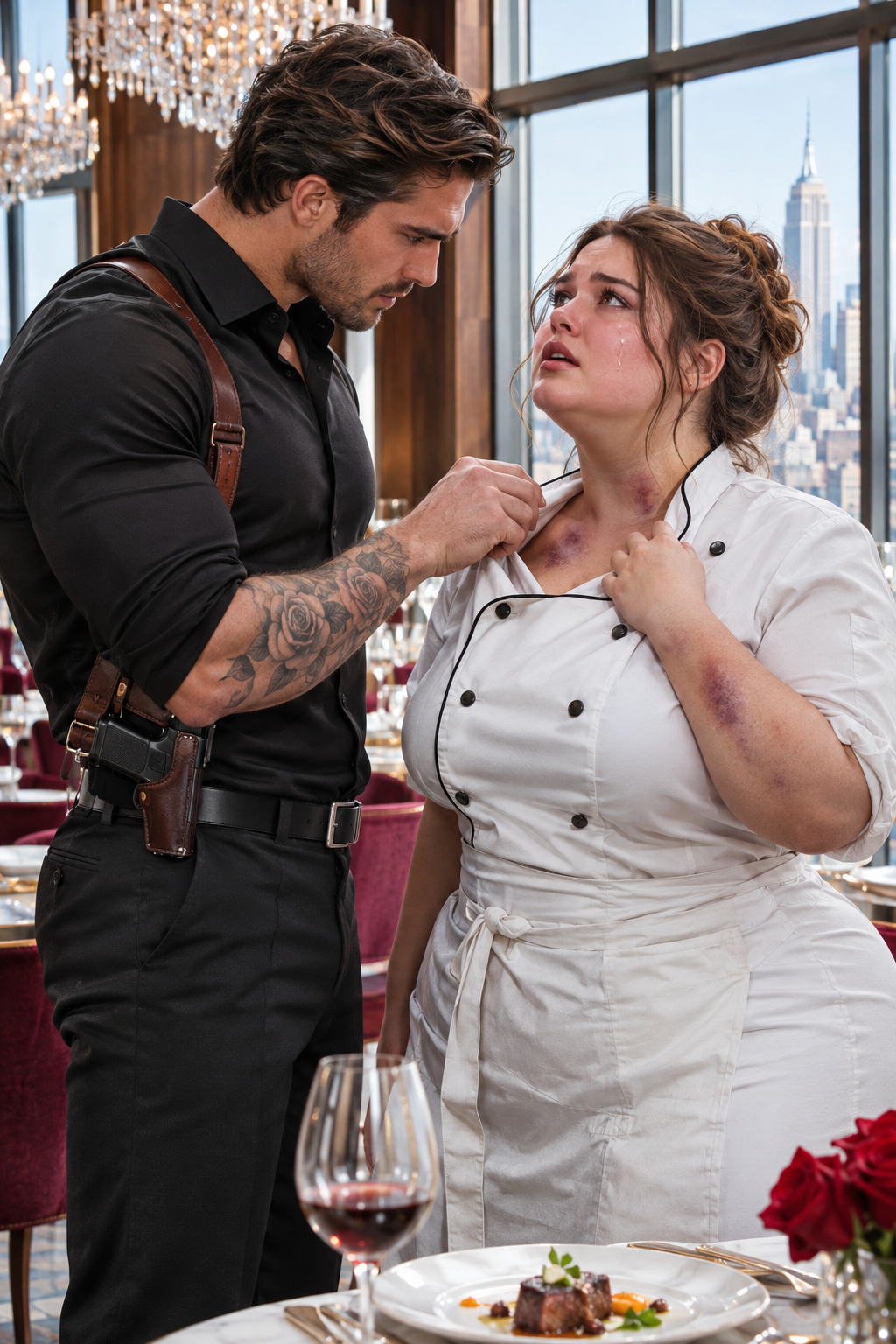
The moment Beatrice Gallagher handed her resignation to Chicago’s most feared mafia boss, he noticed the bruises around her wrist.
Gabriel Russo had barely reached the elevator when Beatrice Gallagher called his name.
“Mr. Russo, please wait.”
He turned and found her standing in the hallway, one hand gripping the doorframe. Her face was pale, and her oversized sweater hung loosely over her shoulders.
“You don’t understand what David is capable of,” she whispered. “If he finds out I told you anything, he’ll make me pay.”
Gabriel studied her for a moment.
“Bea, look at me.”
She hesitated before raising her eyes.
“David Caldwell will never touch you again.”
“You can’t promise that.”
“No,” Gabriel admitted. “But I can make sure he understands what happens if he tries.”
Something about his calm voice frightened her almost as much as David’s threats.
She knew who Gabriel Russo was.
Everyone in Chicago knew.
He owned luxury hotels, restaurants, and several successful businesses. But behind those respectable companies stood an underground empire that powerful people preferred not to discuss.
And the man standing in front of her controlled all of it.
“Are you going to kill him?” she asked.
Gabriel’s expression didn’t change.
“Would that make you feel safer?”
Bea stared at him.
“No,” she answered immediately. “I don’t want anyone dying because of me.”
Gabriel nodded slowly.
“Then that’s something I need to remember.”
He stepped closer, but stopped when she instinctively moved backward.
“There’s a doctor coming. My security team will stay downstairs. Nobody enters this penthouse without your permission.”
“Except you?”
The question surprised him.
For the first time that evening, Gabriel almost smiled.
“Especially me.”
Then he walked into the elevator.
As the doors closed, Bea realized something unsettling.
For the first time in almost two years, a man had listened when she said no.
And she had no idea what to do with that feeling.
Across the city, David Caldwell was having a very different evening.
He sat at a private blackjack table inside the Russo Grand Casino, sweating through his expensive blue shirt.
Three empty whiskey glasses stood beside him.
His phone lay on the table, displaying twelve unanswered calls to Beatrice.
“Come on,” he muttered as the dealer turned another card. “Just one good hand.”
He lost again.
David slammed his fist against the table.
“This place is rigged!”
The dealer remained calm.
“Sir, perhaps you’d like to take a break.”
“I’ll take a break when I get my money back.”
A large man in a charcoal suit approached.
“Mr. Caldwell?”
David looked up.
“What?”
“Mr. Russo would like a word.”
David’s stomach tightened.
He had been avoiding Gabriel’s people for weeks.
The seventy thousand dollars he owed the casino had become impossible to ignore.
But David forced a smile.
“Tell him I’m working on it.”
The man didn’t smile back.
“He’s waiting upstairs.”
David glanced toward the exit.
Two more security guards were standing beside it.
For the first time that night, he understood that leaving wasn’t an option.
Upstairs, Gabriel entered a private office overlooking the casino floor.
He removed his coat, rolled up his sleeves, and placed his phone on the desk.
His security chief, Marcus Hale, followed him inside.
“Caldwell is on his way,” Marcus said.
“Did you get the financial records?”
“Yes.”
Marcus handed him a folder.
Gabriel opened it.
Inside were bank transfers, casino records, and photographs of David entering expensive hotels with different women.
Gabriel barely glanced at the photographs.
He stopped at one particular transaction.
Fifty thousand dollars.
Transferred from Beatrice Gallagher’s savings account into an account controlled by David Caldwell.
Three days later, most of that money had disappeared into gambling losses.
Gabriel’s jaw tightened.
“Did she authorize the transfer?”
“According to the bank records, yes. But Caldwell was using her phone and knew her passwords.”
“Anything else?”
Marcus hesitated.
“There’s something unusual.”
He placed another document on the desk.
“Caldwell recently applied for a personal loan using Miss Gallagher’s information.”
Gabriel looked up.
“How much?”
“Thirty thousand dollars.”
“Was it approved?”
“Not yet. The lender requested additional verification.”
Gabriel slowly closed the folder.
David hadn’t simply stolen Bea’s dream.
He was still trying to use her name to cover his debts.
A knock interrupted them.
“Bring him in,” Gabriel said.
David entered with an awkward smile.
“Mr. Russo. Great to see you.”
Gabriel remained seated.
“Sit down, David.”
David lowered himself into the chair.
“I know what this is about. The money. Listen, I’ve got something coming together.”
Gabriel opened the folder.
“Fifty thousand dollars.”
David blinked.
“What?”
“That’s how much Beatrice Gallagher saved for her bakery.”
David’s smile disappeared.
Gabriel watched him carefully.
“Interesting coincidence, isn’t it? You lost almost the same amount at my casino.”
David shifted in his chair.
“Bea gave me that money.”
“Did she?”
“We were together. Couples share things.”
“Then why did you tell her she owed you for wasting your time?”
David went still.
Gabriel leaned forward.
“Why did you threaten her?”
“I don’t know what she’s been telling you, but she’s emotional. She exaggerates.”
Gabriel’s eyes hardened.
“Careful.”
David swallowed.
“Look, Bea’s a sweet girl, but she’s insecure. Always has been. She gets upset over little things.”
Gabriel said nothing.
David mistook the silence for permission to continue.
“She should be grateful I stayed with her as long as I did. You know how hard it is dating a woman her size?”
The room became painfully quiet.
Marcus looked away.
Gabriel slowly stood.
“Say that again.”
David laughed nervously.
“I’m just saying she isn’t exactly—”
Gabriel struck the desk with his palm.
David jumped.
“You stole from a woman who worked twelve-hour days to build something for herself. You used her money, threatened her, and put your hands on her.”
David’s face drained of color.
“I never—”
“Don’t lie to me.”
Gabriel walked around the desk.
“You owe my casino seventy thousand dollars. You tried to borrow another thirty thousand using her identity. And tonight, you threatened her again.”
David suddenly looked toward Marcus.
“Please. I can pay.”
“That’s not the problem anymore.”
Gabriel stopped directly in front of him.
“The problem is that you believe people exist for you to use.”
David’s voice cracked.
“What do you want?”
Gabriel glanced at Marcus.
“Take him downstairs.”
David stood so quickly that his chair fell backward.
“Wait! Mr. Russo, please!”
Gabriel didn’t raise his voice.
“You had plenty of chances to walk away from Beatrice.”
Marcus took David by the arm.
David struggled.
“She’s lying! Whatever she told you, she’s lying!”
Gabriel stepped closer.
“Then explain the bruises.”
David stopped struggling.
For one terrible second, his silence answered everything.
Gabriel looked at Marcus.
“Make sure he understands he will never threaten her again.”
The security chief nodded.
David began begging as the guards escorted him through the door.
Gabriel remained in the office.
He could hear David shouting from the hallway until the elevator doors closed.
He looked down at the financial records.
Then he noticed something he hadn’t expected.
A photograph was tucked between the pages.
It showed Bea standing in front of a small bakery storefront, smiling so widely that her eyes were nearly closed.
She was holding a notebook covered with handwritten recipes.
Gabriel picked up the photograph.
On the back, someone had written:
“Someday, this will be mine.”
He stared at those words for a long time.
Then he reached for his phone.
“Marcus,” he said when the call connected, “after you’re finished, I need you to find me a commercial property.”
“What kind?”
“A bakery.”
Back at the penthouse, Bea sat on the edge of her bed while Dr. Evelyn Harris examined her injuries.
The doctor was a woman in her fifties with gentle eyes and a voice that made Bea feel strangely comfortable.
“Some of these bruises are older,” Dr. Harris observed.
Bea looked down.
“Yes.”
“How long has this been happening?”
Bea didn’t answer immediately.
“A while.”
The doctor put down her medical bag.
“Beatrice, I need to ask you something important. Are you safe here?”
Bea glanced toward the bedroom door.
“I think so.”
“Do you want to stay?”
The question caught her off guard.
Nobody had asked what she wanted in a very long time.
David had decided where they lived, how much money she could spend, what clothes she should wear, and which friends she was allowed to see.
Even after their breakup, he had somehow continued controlling her life.
Now she was sitting in a beautiful penthouse, surrounded by security guards, with a powerful man promising protection.
And she still didn’t know whether she had traded one kind of control for another.
“I don’t know,” she admitted.
Dr. Harris nodded.
“Then don’t make that decision tonight.”
She handed Bea a small card.
“This is my private number. You can call me directly, whether Mr. Russo is involved or not.”
Bea accepted it with trembling fingers.
“Thank you.”
After the doctor left, Bea wandered into the kitchen.
The counters were spotless.
Copper pans hung above the island.
Fresh herbs grew beside the windows.
For eight months, this kitchen had been her favorite place in Chicago.
Here, she could turn ordinary ingredients into something beautiful.
Here, nobody criticized the size of her body or told her she was lucky anyone wanted her.
She opened the refrigerator and found a container of strawberries.
Without thinking, she began preparing a small batch of pastry cream.
Cooking had always helped her quiet her thoughts.
But halfway through measuring the sugar, she started crying.
Not because of the bruises.
Not because of the stolen money.
Because she suddenly remembered the person she had been before David.
The woman who danced while baking.
The woman who laughed loudly.
The woman who believed she deserved a beautiful future.
She pressed her palms against the counter and cried until her shoulders hurt.
At three in the morning, her phone rang.
An unfamiliar number appeared.
Bea froze.
She almost ignored it.
Then a message followed.
“David Caldwell has been admitted to a private medical facility. He will not be contacting you.”
Her stomach dropped.
She called Gabriel immediately.
He answered on the second ring.
“Bea?”
“What did you do?”
There was a pause.
“Where are you?”
“In the kitchen. Answer me.”
Gabriel exhaled.
“David won’t be coming after you.”
“That isn’t what I asked.”
“I know.”
“Is he alive?”
“Yes.”
She closed her eyes.
“What happened to him?”
Gabriel looked through the office window at the empty casino floor.
“His hands were broken. He’s receiving medical treatment.”
Bea gripped the phone.
For several seconds, neither spoke.
Finally, she whispered, “I told you I didn’t want anyone hurt because of me.”
Gabriel lowered his head.
“You did.”
“Then why didn’t you listen?”
He could have explained the rules of his world.
He could have told her that men like David understood consequences better than warnings.
He could have reminded her how badly she had been treated.
But none of those explanations changed the truth.
“I made that decision,” he said. “Not you. And you shouldn’t have to carry responsibility for it.”
Tears slid down Bea’s cheeks.
“I don’t want to be afraid of you, Gabriel.”
It was the first time she had used his first name.
And somehow, hearing it in that frightened voice hurt more than any threat he had ever received.
“I understand.”
“Do you?”
He didn’t answer right away.
Then he said, “I’m beginning to.”
Bea ended the call.
Gabriel remained sitting in the dark office, staring at the silent phone.
For years, people had obeyed him because they feared what would happen if they didn’t.
He had built an empire on that fear.
But for the first time, he wanted someone to stay because she felt safe enough to choose him.
And he was beginning to understand that those were two very different things.
At seven the next morning, Marcus returned.
“Caldwell has been treated,” he reported. “His travel documents are being arranged. He’s agreed to leave the country permanently and never contact Miss Gallagher again.”
Gabriel nodded.
“And the financial documents?”
“We have copies of everything. His attempted loan application has been flagged, and the bank has been notified of the suspected fraud.”
“Good.”
Marcus placed another folder on the desk.
“The property you requested.”
Gabriel opened it.
The building was a small brick storefront on a quiet Chicago street.
Large windows faced the sidewalk.
There was room for a commercial kitchen, a display counter, and several tables.
It needed fresh paint and some repairs, but the structure was sound.
“How soon can we close?”
“The seller is ready. Our attorneys can complete the paperwork this morning.”
Gabriel studied the photographs.
“Do it.”
Marcus hesitated.
“Boss, can I ask something?”
Gabriel looked up.
“You’ve spent years avoiding relationships. Why her?”
Gabriel glanced at the photograph of Bea holding her recipe notebook.
“Because she makes people feel like they matter.”
Marcus waited.
“Every morning, she remembers how everyone takes their coffee. She sends extra food home with the cleaning staff. When my driver was sick, she cooked soup for his entire family.”
Gabriel paused.
“She does all of that while believing she’s worth almost nothing.”
Marcus nodded thoughtfully.
“And you want to change that?”
Gabriel shook his head.
“No. I want her to discover she was wrong.”
By nine o’clock, Bea had packed the rest of her belongings.
She had barely slept.
Her suitcase stood beside the kitchen island, and her resignation letter remained on Gabriel’s desk.
When the elevator opened, she expected another security guard.
Instead, Gabriel stepped inside carrying two envelopes and a small white bakery box.
He looked exhausted.
There were shadows beneath his eyes, and his dark hair was slightly disheveled.
“Good morning,” he said.
Bea folded her arms.
“Is David gone?”
“Not yet. He’s receiving medical care, and arrangements are being made for him to leave the country. My attorneys are also helping document what he did to you.”
She watched him carefully.
“You look like you haven’t slept.”
“I haven’t.”
“That makes two of us.”
Gabriel set the bakery box on the counter.
“I brought breakfast.”
Bea glanced at it.
“From a bakery?”
“Yes.”
She raised an eyebrow.
“You know I could have made breakfast.”
“I know.”
“Then why buy pastries?”
Gabriel hesitated.
“Because I thought you might appreciate having someone make something for you.”
Bea stared at him.
Then, despite everything, she laughed.
It was a small laugh, but it surprised them both.
Gabriel smiled.
“There it is.”
“What?”
“Your laugh.”
Her smile faded, and she looked away.
He didn’t push.
Instead, he placed the first envelope in front of her.
“This is yours.”
Bea opened it.
Inside was a cashier’s check for one hundred thousand dollars.
She read the amount three times.
Then she looked at him.
“What is this?”
“Fifty thousand to replace what David stole. The rest is to help you get back on your feet.”
Bea immediately pushed it away.
“I can’t take this.”
“Why not?”
“Because it’s too much.”
Gabriel leaned against the counter.
“Bea, you’ve spent eight months making sure everyone in this building is fed, comfortable, and cared for. You worked holidays. You stayed late. You never once asked for anything beyond your salary.”
“That was my job.”
“And you did it exceptionally well.”
She shook her head.
“Gabriel, I don’t want to owe you.”
His expression softened.
“You won’t.”
“People always say that.”
He absorbed the words without arguing.
Then he reached for the second envelope.
“There’s something else.”
Bea looked almost frightened.
“Please tell me you didn’t buy me a car.”
“No.”
“A house?”
“Not exactly.”
She opened the envelope.
Inside was a property deed.
Her name appeared in bold letters.
BEATRICE GALLAGHER.
Below it was the address of a commercial storefront.
She stared at the document.
Then at Gabriel.
Then back at the document.
“What is this?”
“A bakery.”
Her breath caught.
“What?”
“A commercial space. It has a kitchen, a storefront, and enough room for customers. It needs some work, but I think you’ll like it.”
Bea stood so quickly that her chair scraped the floor.
“You bought me a bakery?”
“Yes.”
“Why?”
“Because you told me once that you wanted to open one.”
She shook her head.
“I mentioned that months ago.”
“I remember.”
“Gabriel, you can’t just hand someone a business!”
“I know.”
“Then why are you doing this?”
He became serious.
“Because David took something from you that mattered. I can’t undo what happened, but I can help you get another chance.”
Bea looked down at the deed.
Her hands were trembling.
For years, she had imagined opening a bakery.
She had designed menus, tested recipes, and saved every dollar she could.
But after David stole her money, the dream had begun to feel childish.
Something she should stop wanting.
And now the deed was sitting in front of her.
Real.
Terrifying.
Possible.
She looked up.
“What do you expect in return?”
Gabriel’s face changed.
“Nothing.”
“Nothing?”
“Nothing.”
She searched his expression.
“Then why does this feel like you’re trying to buy me?”
Gabriel went quiet.
The question landed harder than she intended.
Finally, he nodded.
“Because I handled this badly.”
Bea blinked.
He continued.
“I thought giving you back what was taken would make everything better. But I should have asked what you wanted first.”
She looked at the check again.
“And what about my resignation?”
“It stands.”
“You’re not going to ask me to stay?”
“Not as my employee.”
Her heart began beating faster.
Gabriel took a careful breath.
“Beatrice, I’d like to take you to dinner someday.”
She stared at him.
“What?”
“Not because you work for me. Not because you owe me anything. Because I would like to know you outside this kitchen.”
Her cheeks warmed.
“Gabriel…”
“I know the timing is terrible.”
She almost smiled.
“That’s one way to describe it.”
He nodded.
“And I know you’ve been through more than anyone should have to endure.”
Bea looked down.
“I’m not exactly the kind of woman men like you usually date.”
Gabriel frowned.
“What does that mean?”
She gave a bitter little laugh.
“Come on. Look at me.”
“I am.”
“I’m not thin. I’m not glamorous. I don’t look like the women you bring to charity events.”
Gabriel stepped closer, then stopped at a respectful distance.
“Bea, I’ve noticed you since the day you walked into my kitchen.”
She looked up sharply.
“You have?”
“Yes.”
“Why didn’t you say anything?”
“Because you worked for me. And because you deserved a choice that wasn’t complicated by my position.”
Her eyes filled.
Gabriel continued quietly.
“I like your smile. I like the way you argue with recipes until they’re perfect. I like how you sing when you think nobody’s listening.”
Bea covered her face.
“Oh, God. You’ve heard that?”
“Every terrible note.”
She laughed through her tears.
“And for the record,” he added, “I think you’re beautiful exactly as you are.”
She lowered her hands.
For a moment, she wanted desperately to believe him.
But years of insults didn’t disappear because one man said something kind.
“What if I don’t believe that yet?” she whispered.
“Then I’ll respect that.”
“And what if I say no to dinner?”
“Then I’ll wish you well and hope your bakery becomes the most successful one in Chicago.”
Bea studied him.
“You’d really let me walk away?”
“Yes.”
She looked toward the elevator.
Then at the deed.
Then at the man standing in front of her.
“I need time,” she said.
Gabriel nodded.
“Take all the time you need.”
Over the next two weeks, Bea made several decisions that surprised everyone.
First, she moved out of the penthouse.
Gabriel offered to arrange a private apartment with security, but she insisted on choosing her own place.
She found a modest apartment near the bakery, with sunny windows and a tiny balcony.
Second, she hired an independent attorney.
She wanted every document reviewed before accepting anything.
Gabriel didn’t object.
In fact, he seemed relieved.
The attorney confirmed that the property deed and financial gift were legally structured without conditions requiring Bea to work for Gabriel or maintain a relationship with him.
Bea still hesitated.
But after several long conversations, she accepted the help as a fresh start, not a debt.
She also began seeing a counselor.
At first, she hated talking about David.
She hated admitting how many times she had believed his apologies.
She hated remembering how she had slowly stopped recognizing herself.
One afternoon, her counselor asked, “What would you tell a friend who had lived through the same thing?”
Bea thought for a long time.
“I’d tell her she deserved better.”
“And why doesn’t that apply to you?”
Bea had no answer.
But she carried the question home.
Meanwhile, Gabriel kept his distance.
He sent no expensive jewelry.
No surprise flowers.
No dramatic declarations.
Once a week, he sent a short message.
“Hope you’re doing well. No need to reply.”
Sometimes Bea answered.
Sometimes she didn’t.
And every time she chose not to, nothing bad happened.
That small freedom meant more than she expected.
Three weeks later, she visited the bakery with a contractor.
The storefront smelled like fresh paint and sawdust.
Sunlight poured through the windows.
The walls were unfinished, and the kitchen still needed equipment.
But Bea could already imagine everything.
A glass display filled with pastries.
Warm cinnamon rolls in the morning.
Fresh bread cooling on wooden racks.
A little table near the window where people could sit with coffee and feel welcome.
She walked into the center of the room and began crying.
The contractor looked alarmed.
“Ma’am, is something wrong?”
Bea shook her head, laughing.
“No. For once, something is right.”
That evening, she called Gabriel.
He answered immediately.
“Bea?”
“I saw the bakery today.”
“What did you think?”
She smiled.
“It needs a lot of work.”
“I know.”
“And the kitchen layout is terrible.”
“I suspected you’d say that.”
“And whoever picked the wall color should never be allowed near paint again.”
Gabriel laughed.
“Noted.”
She hesitated.
“Thank you.”
“You’re welcome.”
There was a comfortable silence.
Then Bea took a breath.
“Gabriel?”
“Yes?”
“Would you still like to take me to dinner?”
He went completely quiet.
“Gabriel?”
“I’m here.”
“Did I break you?”
He laughed softly.
“Possibly.”
She smiled.
“Friday?”
“Friday.”
Their first dinner was surprisingly ordinary.
Gabriel chose a quiet Italian restaurant, but Bea insisted they split the bill.
He argued once.
She raised an eyebrow.
He surrendered.
They talked about food, music, childhood memories, and terrible television shows.
For the first time, Bea discovered that Gabriel hated olives, loved old jazz records, and had absolutely no idea how to bake.
“You own restaurants,” she said, laughing. “How can you not bake?”
“I hire talented people.”
“That’s cheating.”
“It’s efficient.”
She laughed so hard that nearby diners turned to look.
Gabriel didn’t care.
But halfway through dessert, Bea became quiet.
“Can I ask you something serious?”
“Of course.”
“Do you ever regret what happened to David?”
Gabriel set down his fork.
He considered his answer carefully.
“I regret that I didn’t listen when you told me what you wanted.”
Bea watched him.
“And?”
“And I regret that I made a decision that frightened you.”
She nodded.
“I’m still trying to understand how someone can be gentle with me and dangerous to other people.”
Gabriel looked down.
“That’s a fair question.”
“I don’t want to spend my life wondering whether the man beside me will hurt someone whenever he’s angry.”
He met her eyes.
“Then I have work to do.”
She didn’t ask him to promise an overnight transformation.
He didn’t offer one.
Instead, they agreed to keep getting to know each other slowly.
Months passed.
Bea’s bakery took shape.
She named it Second Rise.
The name came to her while kneading bread one morning.
Dough could collapse and still rise again with the right care and time.
She liked the thought that people could, too.
On opening day, a line formed outside before sunrise.
The windows glowed warmly.
Fresh pastries filled the display.
And above the counter hung a simple wooden sign.
“Everyone deserves something sweet.”
Bea stood behind the register wearing a flour-covered apron.
Her hair was tied back, and her cheeks were pink from the heat of the ovens.
She was nervous.
She was exhausted.
She was happier than she had been in years.
At eight o’clock, Gabriel arrived.
He wore a dark suit and carried a small bouquet of daisies.
Bea smiled when she saw him.
“You’re late.”
“There’s a line outside.”
“You could have called.”
“I wanted to wait like everyone else.”
She laughed.
“What can I get you?”
Gabriel looked at the display.
“One cinnamon roll.”
“Anything else?”
He leaned closer.
“And perhaps dinner with the owner, if she’s available.”
Bea pretended to think.
“She’s very busy.”
“I understand.”
“But she might be free Sunday.”
Gabriel smiled.
“I’ll make a reservation.”
Later that afternoon, when the last rush of customers had passed, Bea found an envelope beneath the register.
Inside was a handwritten note from Gabriel.
“Bea, you built this dream long before I ever knew you. I may have helped open the door, but you’re the one who walked through it. Never forget that.”
She read it twice.
Then she folded it carefully and placed it in her recipe notebook.
That evening, after the bakery closed, Bea stood alone in the quiet storefront.
She looked at the empty pastry trays, the flour on the counters, and the chairs waiting for tomorrow’s customers.
Her phone buzzed.
A message from Gabriel.
“How does it feel to own the best bakery in Chicago?”
Bea smiled and typed back.
“Ask me again after I’ve survived my first week.”
A second message appeared.
“I’m proud of you.”
She stared at those four words.
For years, she had measured her worth by whether someone else approved of her.
Now, standing in the business she had dreamed of, she realized something important.
She was proud of herself.
And that mattered more.
Six months later, Gabriel asked Bea to join him for a walk beside Lake Michigan.
The evening air was cool, and the city lights reflected across the water.
They had been dating slowly, learning each other’s habits and boundaries.
Gabriel had begun changing how he handled conflicts in his businesses, relying more on legal agreements and professional management instead of intimidation.
He wasn’t pretending his past had disappeared.
But he was making choices he could stand behind.
As they walked, he reached for Bea’s hand.
She took it.
“Can I tell you something?” he asked.
“Of course.”
“When you first came to work for me, I thought I understood strength.”
Bea glanced at him.
“Did you?”
“No. I thought strength meant being the person everyone feared.”
“And now?”
Gabriel looked at her.
“Now I think it means having power and choosing not to use it against someone.”
Bea smiled softly.
“That’s a better definition.”
They stopped near the water.
Gabriel turned toward her.
“I love you, Beatrice.”
Her heart skipped.
He had never said it before.
She looked at the man who had once terrified her, the man who had made mistakes, listened to difficult truths, and slowly learned how to give her room to choose.
Then she smiled.
“I love you too.”
He kissed her gently.
And for once, Bea didn’t wonder whether she was beautiful enough, thin enough, or worthy enough.
She simply let herself be loved.
But the most important moment came the following morning.
A young woman entered Second Rise just before closing.
She wore an oversized jacket despite the warm weather.
Her eyes were swollen, and she kept checking the street through the window.
“Are you still open?” she asked.
Bea smiled.
“For a few more minutes.”
The woman looked at the nearly empty display.
“I don’t have much money.”
Bea noticed the trembling hands.
The nervous glance toward the door.
The familiar fear.
She quietly placed two fresh cinnamon rolls in a bag.
“On the house.”
The woman stared.
“Why?”
Bea thought about the person she had been months earlier.
The woman standing in Gabriel’s office with one suitcase, convinced she had nothing left.
Then she looked at the stranger.
“Because everybody deserves a little kindness.”
The woman’s eyes filled with tears.
“Thank you.”
Bea handed her the bag.
“And if you need help finding somewhere safe tonight, I know people who can help. No pressure.”
The young woman hesitated.
Then she whispered, “Actually, I think I do.”
Bea came around the counter and pulled out a chair.
“Then let’s talk.”
Outside, Chicago continued rushing past.
Cars honked.
People hurried home.
The world moved on.
But inside that small bakery, one woman who had survived her darkest days was helping another believe that tomorrow could be different.
And that became the greatest success of Beatrice Gallagher’s life.
Not the bakery.
Not the money.
Not even falling in love with a powerful man.
It was discovering that her value had never depended on anyone’s approval.
David had stolen her savings, but he hadn’t stolen her talent.
He had damaged her confidence, but he hadn’t destroyed her future.
And although Gabriel had helped her rebuild, he hadn’t created her worth.
It had been there all along.
Sometimes life gives us a second chance through an unexpected person.
But the real miracle begins when we finally believe we deserve that chance.
Because love should never make you feel small, afraid, or grateful for being tolerated.
Real love gives you room to grow.
And sometimes, the bravest thing a person can do is stop asking whether they’re enough and start living as though they already are.
A year after Second Rise opened, Beatrice Gallagher stood behind the counter of her bakery, watching the morning sunlight spill across the wooden tables.
The little shop had become one of the most loved bakeries in Chicago. Customers arrived before sunrise for her cinnamon rolls, and families came every weekend for her homemade cakes.
But Bea’s favorite part of the business wasn’t the money or the glowing reviews.
It was the small sign beside the entrance.
“If you need a meal and can’t afford one, just ask. Everyone is welcome here.”
She remembered too clearly what it felt like to have nothing.
One Saturday morning, Gabriel Russo walked through the door carrying a small velvet box.
Bea narrowed her eyes.
“Gabriel, what did you buy?”
He smiled.
“Something I’ve been thinking about for a long time.”
Her heart began racing.
He stepped closer, took her flour-covered hand, and lowered himself onto one knee.
The bakery fell silent.
“Beatrice Gallagher, you changed my life without ever trying to. You taught me that love isn’t about control, fear, or power. It’s about choosing someone every day and making sure they remain free to choose you.”
Tears filled her eyes.
“I can’t promise I’ll always be perfect,” he continued. “But I promise I’ll keep listening, keep learning, and never stop treating your happiness as something that matters.”
He opened the box.
Inside was a simple diamond ring.
“Will you marry me?”
Bea covered her mouth.
For a moment, she remembered the frightened woman who had once tried to escape Chicago with a single suitcase.
That woman would never have believed this day was possible.
Then Bea laughed through her tears.
“Yes, Gabriel. I will.”
The bakery erupted in applause.
Gabriel slipped the ring onto her finger and stood to embrace her.
But Bea pulled back just enough to whisper something in his ear.
“One condition.”
He raised an eyebrow.
“Anything.”
“You’re learning how to bake before the wedding.”
Gabriel laughed.
“Now that’s a serious demand.”
Six months later, they married in a small garden ceremony surrounded by close friends and the people who had helped Bea rebuild her life.
There were no grand displays of wealth.
No hundreds of powerful guests.
Just flowers, laughter, homemade desserts, and two people who understood how precious a peaceful life could be.
Bea wore a beautiful ivory dress that fit her exactly as she was.
She didn’t try to hide her curves.
She didn’t apologize for taking up space.
When she walked down the aisle, Gabriel looked at her as though she were the only person in the world.
And for the first time in her life, Bea believed she deserved to be looked at that way.
During their vows, she took Gabriel’s hands and smiled.
“You helped me when I was afraid I had lost everything. But the greatest gift you gave me wasn’t money or a bakery. It was learning to respect my choices, even when they weren’t the choices you wanted me to make.”
Gabriel’s eyes shone.
“You reminded me that I was still capable of becoming someone better,” he answered.
Years later, Second Rise expanded to three locations.
Bea hired women rebuilding their lives after difficult relationships and helped them learn professional baking skills.
She also partnered with local organizations to provide meals and job opportunities for people who needed a fresh start.
One evening, while closing the original bakery, Bea noticed a young employee staring at the framed photograph hanging near the register.
It showed Bea standing outside the unfinished storefront, holding her first set of keys.
“Mrs. Russo?” the young woman asked.
“Yes, sweetheart?”
“Were you ever afraid you wouldn’t make it?”
Bea smiled gently.
“Every single day.”
“What changed?”
Bea looked around the bakery.
At the ovens.
At the tables.
At the life she had built.
Then she answered.
“I stopped believing that being hurt meant I was worthless.”
The young woman nodded slowly.
Bea placed a warm cinnamon roll in her hand.
“And I learned something else. Someone can help you open a door, but you still have to believe you’re allowed to walk through it.”
That night, Gabriel arrived to take Bea home.
He found her standing outside the bakery, looking up at the glowing sign.
“Everything okay?” he asked.
She slipped her hand into his.
“More than okay.”
He kissed her forehead.
“Ready to go home?”
Bea looked at the bakery one last time.
Then she smiled.
“Yes. I am.”
They walked together beneath the Chicago streetlights, no longer the feared employer and the frightened woman who had once worked in his kitchen.
They were simply Gabriel and Bea.
Two imperfect people who had learned that a meaningful future couldn’t be built on fear.
It had to be built on trust, accountability, patience, and the freedom to choose.
And Beatrice Gallagher never again allowed anyone to convince her that she was too much of one thing or not enough of another.
Because the greatest lesson of her journey was simple:
Your worth does not decrease because someone fails to recognize it. And the right kind of love will never require you to become smaller to deserve it.
THE END.