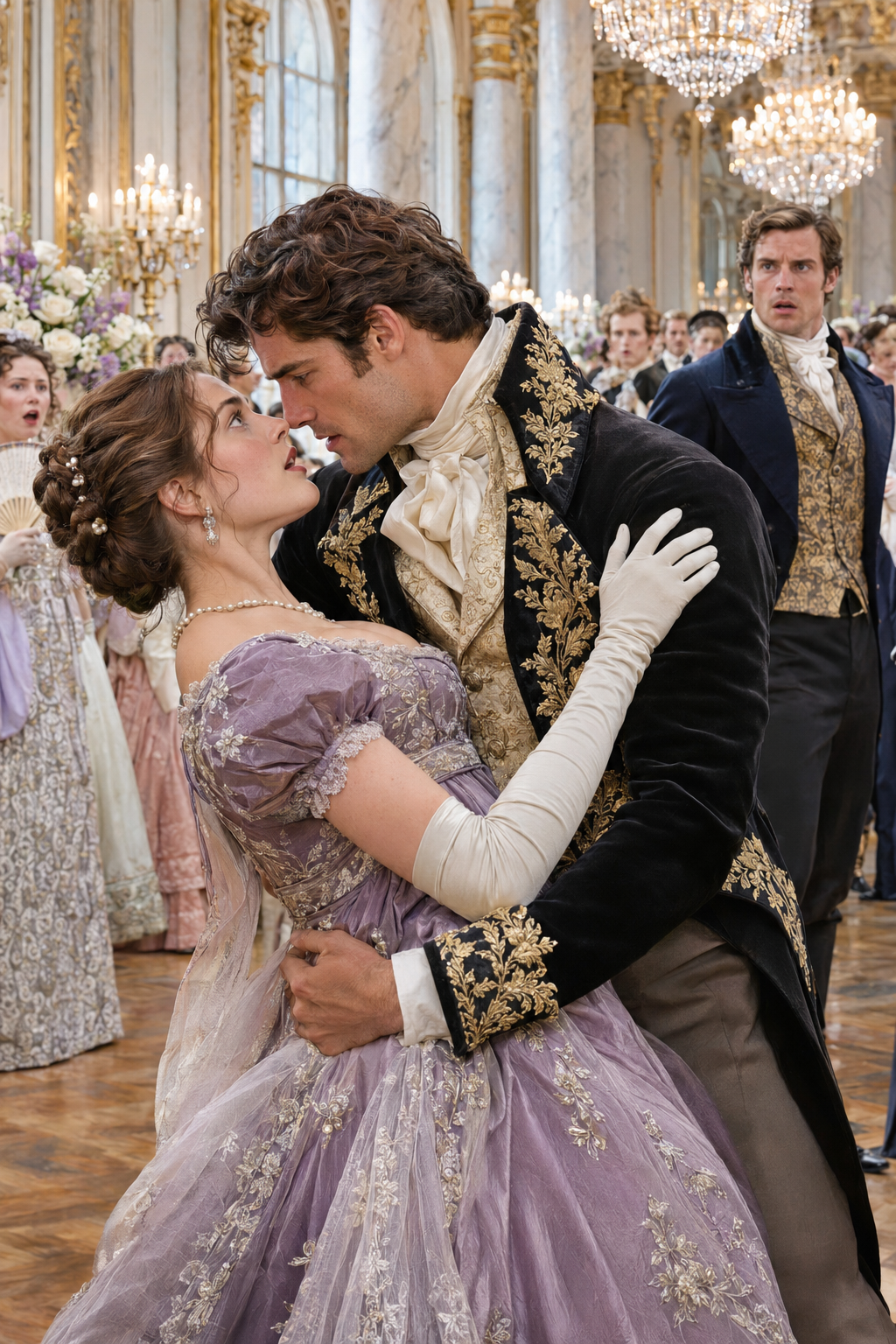
The man who promised to marry Diana Waverly had just announced his engagement to another woman.
The duke’s expression changed, becoming colder and more guarded.
“My condition is this, Miss Waverly. You must understand that I am not offering you a love match. I will not promise affection, nor will I pretend to be a husband who spends his days whispering sweet words. Our marriage would begin as an agreement between two people who need something from one another.”
Diana studied him carefully.
“And what is it that you need so desperately that you would ask a woman you have known for less than an hour to become your wife?”
“An heir.”
The word hung between them.
“My father died three months ago,” he continued. “He left me the title, the estate, and a family burden that has followed the Rothwells for generations. My mother is convinced that unless I marry and produce an heir soon, the family name will disappear into uncertainty. There are also several relatives who would be delighted to see me fail.”
“And you believe marrying me would silence them?”
“I believe it would remove one of their strongest arguments.”
Diana almost laughed.
“So you require a wife to satisfy your relatives, while I require a husband to restore my reputation. How wonderfully practical.”
“Precisely.”
“And what happens if I refuse to provide you with an heir?”
The duke’s eyes narrowed slightly.
“Then you will not be punished for it. I will not force you into anything you do not wish to do.”
His answer surprised her.
Diana had expected arrogance, perhaps even an order disguised as a proposal. Instead, he had given her a choice.
But there was something else in his expression. Something he was deliberately keeping from her.
“Is that truly the only condition?” she asked.
For a moment, the music seemed distant.
“No,” he replied. “There is one more thing. My late father’s will contains a clause that could make our marriage considerably more complicated.”
“What clause?”
“My wife must never enter the west wing of Pelburn Castle.”
Diana blinked.
“Never?”
“Never.”
“May I ask why?”
“You may. But I will not answer.”
She looked at him for several seconds.
“That is an extraordinary request.”
“It is.”
“And you expect me to agree to it without explanation?”
“I expect you to consider whether the rest of the arrangement is worth accepting that limitation.”
Diana turned her gaze toward the ballroom. The guests were still watching them, and her former fiancé, Lord Edmund Ashford, had begun whispering urgently to the heiress beside him.
For months, Edmund had made her believe that she was fortunate to have his attention. He had criticized her dresses, dismissed her opinions, and repeatedly reminded her that her family’s reduced fortune made her less desirable than other young ladies.
Yet she had loved him.
Or perhaps she had simply loved the future she imagined beside him.
She looked back at the duke.
“When would you require an answer?”
“Tomorrow morning.”
“Very well, Your Grace. You shall have one.”
The duke released her hand as the music ended.
“Whatever you decide, Miss Waverly, do not allow tonight’s humiliation to make the decision for you.”
For the first time that evening, Diana felt that someone had spoken to her as though her judgment mattered.
And that made the decision far more difficult.
Diana barely slept that night.
By morning, she had received three letters, two invitations withdrawn by their authors, and one particularly cruel note from a woman who had once called herself her friend.
Society moved quickly when it smelled misfortune.
Her mother found her sitting beside the window, holding the duke’s calling card.
“Have you lost your mind?” Lady Waverly asked after hearing the proposal.
Diana looked up.
“I have not decided.”
“Marriage to a man whose reputation is built on secrecy? A man who lives in a castle nobody visits and refuses to explain why?”
“He is a duke, Mother.”
“So was your father before his investments failed. A title does not guarantee happiness.”
Diana smiled faintly.
“No. But it might guarantee that we do not have to sell the last of our furniture.”
Her mother sat beside her, her expression softening.
“Darling, I would rather live in a small cottage with you than see you trapped in an unhappy marriage.”
Diana reached for her mother’s hand.
“And I would rather spend my life making my own choices than spend another year waiting for society to forgive me for a man’s betrayal.”
Lady Waverly sighed.
“You are more like your father than you know.”
At eleven o’clock, the Duke of Rothwell arrived.
He wore a dark morning coat and carried a leather folder. His presence seemed to make the modest drawing room smaller.
“Lady Waverly,” he greeted Diana’s mother with impeccable courtesy. “I hope you will forgive my unexpected visit.”
“Your Grace.”
He placed the folder on the table.
“These are the terms I mentioned. I thought it best that Miss Waverly should see everything in writing.”
Diana opened it.
The agreement was surprisingly generous. She would receive her own allowance, retain control of any personal inheritance, and have full authority over the household staff and domestic accounts. She could invite her mother to stay at Pelburn Castle whenever she wished.
Most importantly, there was a clause stating that neither party could demand physical affection from the other.
Diana read it twice.
“You have made rather certain that I shall not be your prisoner.”
“I have no interest in keeping a prisoner.”
“Then why do you seem so determined to marry me?”
His expression became unreadable.
“Because I believe you are the right person.”
“That sounds dangerously close to a compliment.”
“Do not become accustomed to it.”
Despite herself, Diana laughed.
The duke looked faintly surprised, as though he had not expected to hear laughter in his presence.
She signed the agreement.
And with one stroke of her pen, Diana Waverly became the future Duchess of Rothwell.
The wedding took place twelve days later in a small chapel outside London.
There were no elaborate celebrations, no grand procession, and no crowd of admirers. Only Diana’s mother, the duke’s elderly solicitor, and a handful of witnesses attended.
When the priest pronounced them husband and wife, Alexander Rothwell offered Diana his arm.
She accepted it.
His hand was warm, his grip steady.
“You may call me Alexander when we are alone,” he said as they stepped outside.
“And what shall I call you in public?”
“Your Grace, unless you wish to give the servants something to discuss.”
“I would hate to deprive them of entertainment.”
A brief smile crossed his face.
It was the first time Diana had seen him smile without reservation.
Their journey north took two days.
The countryside grew increasingly wild as the carriage approached Pelburn Castle. Dark hills rose in the distance, and the road wound through ancient forests and villages where people stopped to watch the duke’s carriage pass.
When the castle finally appeared, Diana understood why Alexander had described it as remote.
Pelburn stood on a rocky hill overlooking a wide valley. Its grey stone towers seemed to rise directly from the earth, while ivy climbed the older walls. It was beautiful, imposing, and slightly unsettling.
A line of servants waited at the entrance.
At their head stood a thin woman in her late fifties, dressed in black.
“Welcome home, Your Grace,” she said.
Alexander stepped down.
“Mrs. Whitmore. This is my wife, the Duchess of Rothwell.”
The housekeeper’s eyes moved over Diana’s travelling dress.
“Your Grace,” she said, offering a curtsy.
There was no warmth in her voice.
Diana noticed that several servants exchanged glances.
It was clear that the castle had expected a duchess.
It had not necessarily wanted one.
Inside, the entrance hall was enormous. Portraits of previous Rothwell dukes lined the walls, their stern faces following Diana as she crossed the marble floor.
“Your rooms are in the eastern wing,” Alexander told her. “They connect to the library and overlook the gardens.”
“And where are your rooms?”
“The northern wing.”
Diana stopped.
“Then we shall barely see one another.”
“That is generally considered a benefit of a peaceful marriage.”
She raised an eyebrow.
“I see.”
He turned toward Mrs. Whitmore.
“Ensure that Her Grace has everything she requires.”
“Of course, Your Grace.”
Alexander disappeared down a corridor without another word.
Diana watched him go.
She had been married for less than an hour, and already she was beginning to suspect that her new husband had more secrets than the castle had rooms.
The first weeks at Pelburn were difficult.
The servants were polite, but distant. Mrs. Whitmore seemed determined to remind Diana that the household had functioned perfectly well before her arrival.
When Diana suggested improvements to the kitchen accounts, the housekeeper informed her that the late Duchess had never interfered with such matters.
When Diana requested fresh flowers for the dining room, she was told that flowers were unnecessary expenses during the winter months.
And whenever she asked about the west wing, every conversation ended abruptly.
One afternoon, Diana found an old servant struggling to carry a heavy basket of firewood.
She immediately went to help him.
“Your Grace! Please!”
The man nearly dropped the basket.
“It’s quite all right,” Diana said. “What is your name?”
“Thomas, Your Grace. I’ve served this family for forty years.”
“Then you know this castle better than anyone.”
Thomas looked toward the staircase before lowering his voice.
“Not all of it, Your Grace.”
Diana followed his gaze.
At the end of the corridor stood a tall wooden door with a brass handle. Unlike the other doors, it had been secured with a heavy iron lock.
The west wing.
Before she could ask another question, Mrs. Whitmore appeared.
“Thomas, the kitchen requires you.”
The old man hurried away.
The housekeeper turned to Diana.
“Your Grace, may I suggest that you avoid that corridor?”
“Why?”
“Because His Grace has forbidden it.”
“Has he forbidden the corridor, or only the rooms beyond that door?”
Mrs. Whitmore’s face tightened.
“Both.”
Diana looked at her.
“You seem frightened of that door.”
“I am frightened of nothing, Your Grace.”
“Then perhaps you should not look so pale whenever you see it.”
The housekeeper lowered her eyes.
“Some things are better left undisturbed.”
That evening, Diana asked Alexander about the west wing during dinner.
He put down his fork.
“I believe we discussed this.”
“You told me you would not explain. You did not tell me I could not ask.”
His eyes met hers.
“Is there something you wish to find there?”
“Only an explanation.”
“You have been here three weeks. Have I not given you enough freedom to make yourself comfortable?”
“Freedom is not the same as trust, Alexander.”
For a moment, neither spoke.
Then he stood.
“Good night, Diana.”
She watched him leave.
It was the first time he had used her name without a title.
And strangely, it hurt more than his silence.
Two days later, a letter arrived from London.
It was from Lord Edmund Ashford.
Diana stared at the handwriting for a long time before opening it.
My dear Diana,
I hope you will forgive my silence. Circumstances forced me to make a difficult decision. I never intended to hurt you, and I believe you know that my feelings were genuine.
I have recently learned that your marriage to the Duke of Rothwell was arranged under rather unusual circumstances. If you ever wish to discuss the matter privately, I would be pleased to visit.
Diana read the letter twice.
Then she placed it in the fireplace.
She had no intention of allowing Edmund to enter her new life.
But she did not notice the small folded paper that slipped from the envelope and landed beneath the writing desk.
It contained a single sentence.
Ask your husband what happened to his first wife.
That night, Diana could not sleep.
The words haunted her.
Alexander had never mentioned a previous marriage. Yet she had seen no portrait of a former duchess, no family photographs, and no signs that another woman had ever occupied the eastern wing.
At breakfast, she finally asked.
“Were you married before?”
Alexander’s spoon stopped halfway to his mouth.
“No.”
“Then why did someone write to me suggesting that you had a first wife?”
His expression changed immediately.
“Who?”
“Edmund Ashford.”
Alexander’s eyes darkened.
“Have you been corresponding with him?”
“He wrote to me. I burned the letter.”
“Good.”
“Alexander, I asked you a question.”
He leaned back.
“My brother was married. His wife died twelve years ago.”
“Your brother?”
“Yes. His name was Henry.”
Diana waited.
“He was the heir before me. When he died, I inherited the title.”
“How did he die?”
Alexander’s face became distant.
“An accident.”
“And his wife?”
“She died six months later.”
Diana felt a chill.
“What happened?”
He looked at her for a long moment.
“That is why the west wing remains closed.”
Before she could ask anything further, he stood and left.
But this time, Diana noticed something she had not noticed before.
His hand was trembling.
That afternoon, a violent storm swept across the estate.
Diana was returning from the gardens when she heard a faint sound coming from the western corridor.
A woman’s voice.
She stopped.
At first, she thought the wind had carried a sound through the old walls. Then she heard it again.
A soft, desperate cry.
“Please… someone…”
Diana approached the locked door.
The sound came from beyond it.
Her heart began to pound.
She knocked.
“Is anyone there?”
Silence.
Then a whisper.
“Who are you?”
Diana stepped back.
It was a woman’s voice.
Before she could answer, Mrs. Whitmore appeared behind her.
“Your Grace! What are you doing?”
“I heard someone.”
“You heard the wind.”
“I know what I heard.”
The housekeeper seized Diana’s wrist.
“Please. You must leave.”
Diana looked down at the woman’s hand.
“Remove it.”
Mrs. Whitmore immediately released her.
For the first time, the housekeeper’s composure collapsed.
“You do not understand what you are risking.”
“Then explain it to me.”
Mrs. Whitmore looked toward the staircase.
“His Grace would never forgive me.”
“Perhaps he should be given the opportunity to decide that himself.”
The housekeeper shook her head.
“Not tonight, Your Grace.”
Then she hurried away.
Diana remained before the locked door, certain of one thing.
Someone was inside.
And her husband knew.
Alexander returned shortly before midnight.
Diana was waiting in his study.
He looked at her damp dress and the fire burning in the grate.
“What happened?”
“There is someone in the west wing.”
His expression hardened.
“You went there.”
“I heard a woman calling for help.”
“Diana—”
“Do not tell me I imagined it. I know what I heard.”
He closed the door.
For several seconds, he said nothing.
Then he removed a small key from his pocket.
“I had hoped you would never have to discover this.”
He walked past her.
Diana followed him through the dark corridor.
When they reached the west wing, he unlocked the door.
The hinges groaned as it opened.
Inside, the air smelled of dust and medicine. Covered furniture stood beneath white sheets. At the far end of the corridor, a narrow staircase led to a room with a faint light beneath its door.
Alexander knocked twice.
“Clara?”
A moment later, the door opened.
A young woman stood there.
She was pale and thin, with dark hair falling loosely over her shoulders. Her eyes moved from Alexander to Diana.
“Who is she?”
“My wife,” Alexander answered.
The woman stared at Diana.
Then she laughed bitterly.
“Another one?”
Diana looked at her husband.
“Who is she?”
Alexander lowered his head.
“My brother’s widow.”
Clara stepped forward.
“Do not let him deceive you, Duchess. He has been keeping me here for twelve years.”
Diana felt the ground shift beneath her feet.
“Twelve years?”
Alexander closed his eyes.
“It is not what you think.”
Clara laughed again.
“Then tell her the truth.”
The duke said nothing.
And for the first time since their marriage, Diana realized that the man who had promised her protection might be the very person she needed protection from.
Clara was not mad, as the servants had quietly suggested.
She was not dangerous, nor was she incapable of understanding what was happening around her.
She was simply a woman who had been silenced for twelve years.
The truth emerged slowly.
Henry Rothwell had died in a riding accident. But Clara had not been with him when it happened. She had been in London, where she had discovered that Henry had been secretly embezzling money from the estate.
When she threatened to expose him, Henry had accused her of being unstable.
He died before he could defend himself.
After his death, the family solicitor discovered evidence that Henry had been stealing from the estate for years. Alexander, who had always believed his brother to be an honorable man, was devastated.
But the family feared scandal.
Clara knew too much.
Rather than allow her to speak publicly, the late Duke had declared her mentally unwell and confined her to the west wing.
Alexander had inherited the title shortly afterward.
He had been twenty-six.
“You knew she was innocent?” Diana asked.
Alexander stood beside the window.
“I knew she was not mad.”
“That was not my question.”
He looked at Clara.
“My father insisted that releasing her would destroy the family. He said she would be sent to an institution if she left the castle. I believed keeping her here was the lesser evil.”
“For twelve years?”
“I provided her with everything she needed.”
“Except her freedom.”
His silence was answer enough.
Clara folded her arms.
“He always tells himself that he is saving me. It is easier than admitting that he is afraid.”
Diana turned toward her husband.
“Why did you never tell me?”
“Because I did not want you involved.”
“You married me into this family. You made me mistress of this household. Yet you expected me to live beside a prisoner without asking questions?”
“I intended to tell you eventually.”
“When? After another twelve years?”
His face tightened.
“I made a mistake.”
“No, Alexander. You made a choice. And then you continued making it every morning you woke up and left her here.”
Clara looked at Diana with something approaching surprise.
Perhaps nobody had spoken to the duke like that in years.
Diana stepped toward her.
“You will come with me.”
Clara hesitated.
“What?”
“You will leave this room. You will have proper medical care, fresh air, and the freedom to decide where you wish to live.”
Alexander moved forward.
“Diana, wait.”
She turned.
“Do not ask me to accept this.”
“I am not asking you to accept it. I am asking you to understand what will happen if she leaves. My father kept records. There are people who would use her testimony to challenge the inheritance.”
“And if the truth challenges your inheritance, perhaps the truth deserves to be heard.”
The words struck him harder than she expected.
He looked at Clara, then at Diana.
Finally, he stepped aside.
“Very well.”
Clara walked past him.
For the first time in twelve years, she crossed the threshold of the west wing without asking permission.
The following morning, Pelburn Castle was in uproar.
Mrs. Whitmore protested that Clara’s presence in the main household would upset the servants. The solicitor arrived before noon, having been summoned by Alexander.
Diana sat beside Clara in the library while the men argued.
“You must understand, Your Grace,” the solicitor said, “that these matters are delicate. If Mrs. Henry Rothwell makes public allegations against the late duke, the family could face a considerable scandal.”
Diana remained calm.
“Then perhaps the family should have considered that before imprisoning an innocent woman.”
“Your Grace, I would advise caution.”
“And I would advise that you remember who now oversees this household.”
The solicitor glanced at Alexander.
To Diana’s surprise, her husband did not interrupt.
Instead, he said, “My wife is correct.”
Everyone turned toward him.
“The restrictions on Mrs. Henry Rothwell are lifted. Arrange an independent physician and provide her with every document she requests.”
The solicitor looked stunned.
“Your Grace—”
“That is an order.”
Clara’s eyes filled with tears.
For the first time, she seemed unable to find words.
But the greatest shock came that evening.
While sorting through the papers in the old library, Diana discovered a sealed envelope hidden inside a leather-bound account book.
It bore her father-in-law’s handwriting.
On the outside were four words:
To my son Alexander.
Diana hesitated before opening it.
Inside was a letter.
It revealed that the late duke had known about Henry’s financial crimes. He had also known that Clara possessed documents proving the thefts.
But the letter contained something even more disturbing.
Henry’s accident had not been entirely accidental.
The old duke had discovered that Henry intended to flee England with a substantial sum of money. On the night of his death, two estate workers had been instructed to follow him and recover the stolen funds.
A confrontation had taken place near the northern bridge.
Henry’s horse had fallen.
The duke had never admitted what happened afterward.
Diana read the letter twice.
Then she carried it to Alexander.
He was in his study, reviewing estate accounts.
“What is this?” she asked.
He took the envelope.
As he read, the color drained from his face.
“My father knew.”
“Yes.”
“He knew Henry’s death was connected to the theft.”
“And he allowed Clara to suffer for twelve years rather than reveal the truth.”
Alexander sank into his chair.
For a long time, he stared at the letter.
Then he covered his face with both hands.
“My entire life,” he whispered, “I have been protecting a lie.”
Diana sat opposite him.
“Then stop protecting it.”
He looked at her.
“What would you have me do?”
“Tell the truth. All of it.”
“And destroy my family’s name?”
Diana’s voice softened.
“Alexander, a family name is not destroyed by the truth. It is destroyed by the cruelty committed in its defense.”
He looked at her for a long time.
Then he nodded.
Three weeks later, the truth became public.
Alexander submitted the letter and the estate records to the proper authorities. An investigation followed, and the two surviving workers who had witnessed the confrontation were questioned.
The investigation established that Henry had died during the struggle to recover the stolen money. There was insufficient evidence to prove that the late duke had intended his death, but his role in concealing the circumstances could no longer be denied.
The scandal was enormous.
Several London families distanced themselves from the Rothwells.
Others praised Alexander for exposing his father’s wrongdoing.
But the greatest change happened inside Pelburn Castle.
Clara was no longer confined.
She began spending her mornings in the gardens and her afternoons reading in the library. With time, her health improved, and she decided to move to a quiet country house near the coast.
Before leaving, she embraced Diana.
“You gave me back my life,” she whispered.
Diana shook her head.
“You survived long enough to reclaim it. I merely opened a door.”
Clara smiled through her tears.
Then she turned to Alexander.
“I hope you learn to live differently from your father.”
He bowed his head.
“So do I.”
As winter turned to spring, Pelburn Castle slowly changed.
Diana reorganized the household accounts, dismissed two dishonest stewards, and established a small school for children from the surrounding villages.
Alexander began spending more time with the tenants, listening to complaints he had previously ignored. He discovered that several farms had been neglected for years and that the workers were struggling under debts imposed by the previous administration.
Diana encouraged him to make changes.
Sometimes they disagreed.
Sometimes they argued.
But gradually, their conversations became longer, warmer, and less guarded.
One evening, Alexander found Diana in the greenhouse, arranging flowers.
“You have changed this place,” he said.
She did not look up.
“I thought you wanted a capable mistress of the household.”
“I did.”
“Then I have fulfilled my contract.”
He smiled.
“Is that all you intend to give me?”
Diana placed a flower into a vase.
“What else were you expecting?”
He stood quietly beside her.
“I have been thinking about our marriage.”
“That sounds dangerous.”
“It is.”
She finally looked at him.
“I am listening.”
“I know we began with an agreement. I know I told you I could not offer affection.”
“And you were very clear about it.”
“I was also wrong.”
Diana’s fingers stilled.
Alexander took a breath.
“I thought that if I kept everything controlled, if I never allowed anyone close enough to hurt me, I could prevent the mistakes of my family from happening again.”
He looked down at his hands.
“But I confused control with responsibility. I thought protecting people meant deciding what was best for them without giving them a choice.”
Diana remembered the locked door.
“And what do you think now?”
“I think I have a great deal to learn.”
For a moment, neither moved.
Then he said something she had not expected.
“I would like to court you.”
Diana blinked.
“Court me?”
“Properly. As though we were strangers who had just met.”
“We are already married.”
“I am aware.”
“And you are a duke.”
“I am also aware of that.”
She laughed.
Alexander smiled, but his eyes remained serious.
“I do not want you to remain my wife merely because you signed a piece of paper. I want you to choose me again, knowing everything you now know.”
Diana looked at him.
She thought of the man who had first offered her marriage in a crowded ballroom. The man who had seemed cold, distant, and impossible to understand.
She also thought of his mistakes.
Of Clara’s suffering.
Of the truth he had been afraid to reveal.
She could not pretend that none of it had happened.
But she could see that he was trying to become someone different.
“Then you should begin by asking me to dinner,” she said.
Alexander straightened.
“Would Your Grace care to dine with me tomorrow evening?”
“Your Grace?” she repeated, raising an eyebrow.
He corrected himself.
“Diana, would you do me the honor?”
She considered him for a moment.
“I shall think about it.”
He looked genuinely alarmed.
Then she laughed and placed her hand in his.
“Yes, Alexander. I would.”
Their relationship did not transform overnight.
There were still difficult days.
Alexander sometimes retreated into silence when matters became uncomfortable. Diana occasionally struggled to trust him completely. They had to learn how to disagree without turning every argument into a battle.
But something important had changed.
They were no longer two people bound together by necessity.
They were two people choosing to remain together.
By the following autumn, Pelburn Castle had become a very different place.
The gardens were full of flowers. The school had grown to accommodate nearly forty children. The servants no longer whispered when the duchess entered a room, and Mrs. Whitmore, after several months of determined resistance, eventually admitted that Diana had improved the household considerably.
One afternoon, a carriage arrived carrying an unexpected visitor.
Lord Edmund Ashford.
Diana was in the entrance hall when he stepped inside.
He looked older, though only a few months had passed. His fashionable coat was expensive, but his smile seemed strained.
“Diana.”
She did not curtsy.
“Lord Ashford.”
“I hope you have been well.”
“I have.”
His eyes moved toward the grand staircase.
“I must say, you seem to have settled into your new position.”
“I have.”
“I was wondering whether we might speak privately.”
Diana almost smiled.
“Whatever you have to say, you may say it here.”
Edmund hesitated.
“I owe you an apology.”
“You certainly do.”
“I made a mistake. I was under considerable pressure at the time. My family needed money, and Lady Charlotte’s father offered to settle our debts.”
“So you married his daughter.”
“Yes.”
“And now?”
Edmund looked away.
“Things have not been as I expected.”
Diana folded her hands.
“I am sorry to hear that.”
He stepped closer.
“I sometimes think about what might have happened if I had not made that decision.”
“Then you should stop.”
He looked at her in surprise.
“Diana, surely you cannot deny that what we had was real.”
She regarded him calmly.
“What we had was a promise that you abandoned the moment something more profitable appeared.”
“I loved you.”
“Perhaps. But you loved the comfort of being admired more.”
Edmund’s face reddened.
“You have become rather proud.”
“No, Lord Ashford. I have simply learned the difference between being valued and being convenient.”
At that moment, Alexander entered the hall.
He stopped beside his wife.
“Is everything quite all right?”
Diana smiled.
“Perfectly.”
Edmund glanced between them.
“I was merely offering my congratulations.”
“Then you have delivered them,” Alexander replied.
There was no threat in his voice, no need to raise it.
Edmund bowed stiffly and left.
Diana watched the carriage disappear through the gates.
Alexander turned toward her.
“Would you have preferred me to throw him out?”
She shook her head.
“No. I believe he has already received everything he deserves.”
“What is that?”
“To live with the knowledge that he traded something genuine for something temporary.”
Alexander considered this.
Then he offered her his arm.
“Shall we?”
She accepted.
Two years after their wedding, Diana gave birth to a daughter.
Alexander held the child with an expression of wonder that Diana had never seen on his face before.
“She has your eyes,” he whispered.
“And your stubbornness, I suspect.”
He laughed softly.
“What shall we call her?”
Diana looked down at the tiny face.
“Clara.”
Alexander’s eyes filled.
“After my brother’s wife?”
“After a woman who refused to let the world convince her that she deserved a smaller life.”
He kissed Diana’s forehead.
“Then Clara she shall be.”
Their daughter grew up in a house where questions were welcomed rather than punished, where servants were treated with dignity, and where no room was forbidden simply because someone powerful wished to hide what lay behind its door.
The west wing was eventually restored.
Its windows were opened, the dust removed, and the old furniture replaced with bookshelves and comfortable chairs. It became a library and reading room, accessible to everyone in the household.
On the wall above the entrance, Alexander placed a small inscription:
A house built upon silence cannot become a home.
Years later, when Clara was old enough to understand the story of her parents’ marriage, she once asked Diana how she had found the courage to marry a man she barely knew.
Diana smiled.
“I was not certain that I was brave. I was simply tired of allowing other people to decide what my life should become.”
“And did you love Father from the beginning?”
“No,” Diana answered honestly. “But I respected him enough to give him the chance to become someone worthy of my love.”
Her daughter thought about this.
“Was that why you stayed?”
Diana looked across the garden.
Alexander was there, teaching their little boy how to ride a pony. He turned, noticed her watching, and smiled.
“No,” she said. “I stayed because, eventually, he stopped asking me to accept the man he had been and began showing me the man he was willing to become.”
She paused, then added, “Never mistake a grand promise for genuine love, darling. Anyone can make a promise when it costs them nothing. What matters is what they do when telling the truth becomes difficult, when admitting a mistake threatens their pride, and when choosing what is right requires sacrifice.”
Her daughter nodded thoughtfully.
Diana kissed her forehead.
“Remember this: the person who truly loves you will never ask you to become smaller so that they can feel bigger. And you should never make yourself smaller just to be chosen.”
That evening, as the sun disappeared behind the hills, Diana stood beside Alexander on the terrace of Pelburn Castle.
He slipped his hand into hers.
“Do you ever regret that first dance?” he asked.
She pretended to consider it.
“The music was dreadful.”
He laughed.
“And the gentleman?”
“Rather arrogant. Terribly mysterious. Not particularly skilled at conversation.”
“An unfortunate combination.”
“Indeed.”
He leaned closer.
“Would you dance with him again?”
Diana looked at the man who had once offered her a marriage without love, only to discover that love required something far more difficult than a wedding vow.
She placed her hand in his.
“Only if he asks properly.”
Alexander bowed with exaggerated formality.
“May I have this dance, Duchess?”
She smiled.
“You may, Your Grace.”
And as the music drifted from the open windows, they danced beneath the same stars that had watched them begin their unusual marriage.
Diana had once entered a ballroom believing that her life had ended because one man had chosen someone wealthier.
Instead, she had discovered that losing the wrong person could sometimes be the beginning of finding herself.
She had gained a title, a home, and a family. But those were not the greatest gifts her marriage had given her.
The greatest gift was learning that love was not a bargain in which one person surrendered their freedom to receive another’s protection.
It was a partnership built on truth, respect, and the courage to change.
And perhaps that was the most important lesson of all: A person’s worth is never determined by who chooses them, but by whether they have the courage to choose a life in which they are respected, valued, and free.