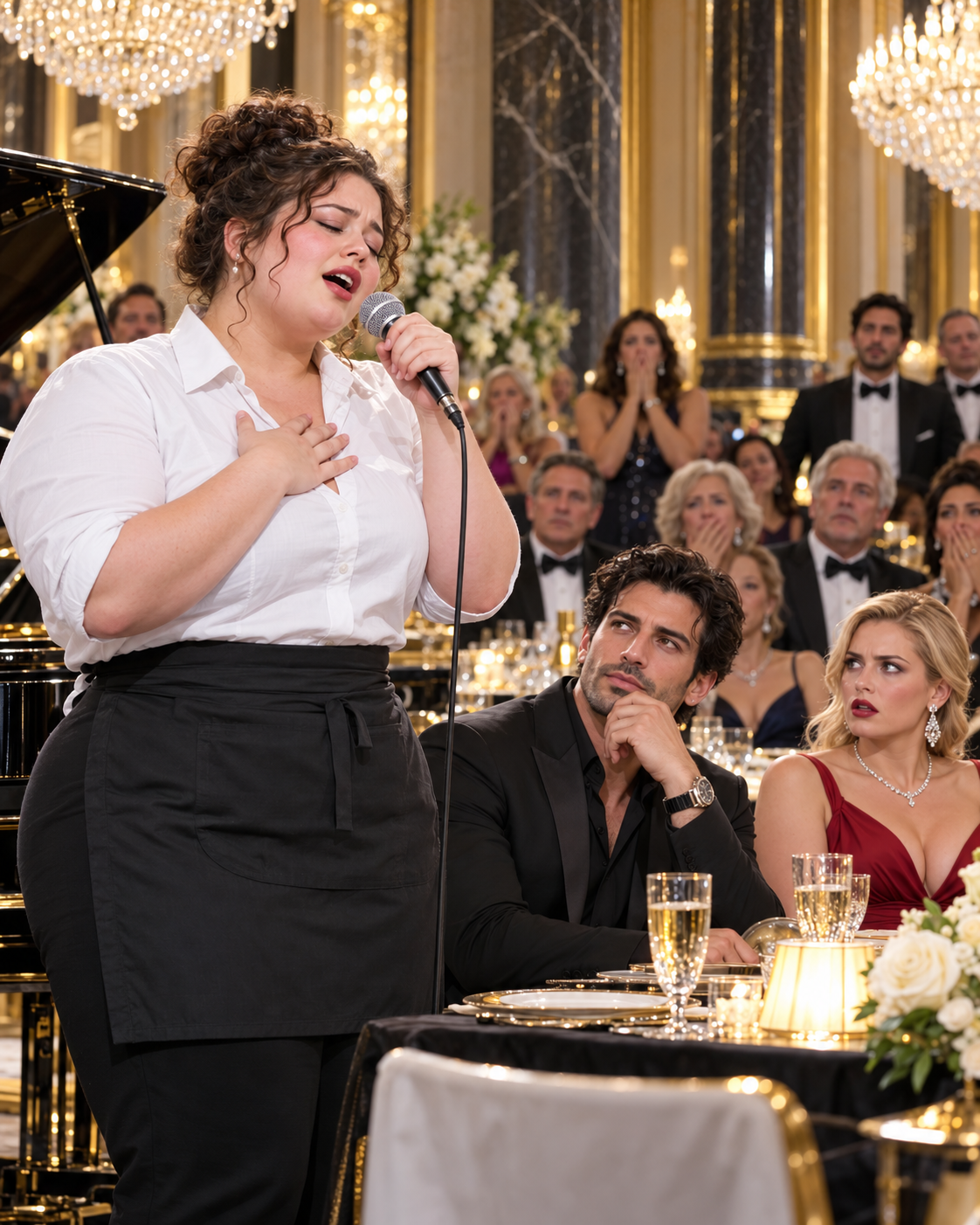
The Mafia Boss Ordered a Plus-Size Waitress to Sing in Front of New York’s Elite—But the Moment She Opened Her Mouth, His Girlfriend Turned Pale…
“Julian,” Isabella whispered, her voice suddenly stripped of its usual confidence, “what exactly did that woman tell you about me?”
Julian stood motionless beside the towering windows of his Manhattan penthouse, watching the city lights shimmer against the darkness.
“Nothing,” he replied calmly. “Elena Vance hasn’t told me a single thing.”
For a moment, the only sound was Isabella’s uneven breathing through the phone.
“Then why are you asking questions about something that happened eight years ago?”
Julian’s eyes narrowed.
He had never mentioned eight years.
“That’s interesting, Isabella,” he said softly. “I don’t remember telling you when Elena’s career ended.”
The line went silent.
Then Isabella laughed, but the sound was brittle and unconvincing.
“Darling, you’re being ridiculous. Everyone knows that woman was involved in some scandal.”
“Everyone?” Julian asked. “Or just the people your family wanted to believe it?”
“Be careful, Julian.”
The warning escaped before Isabella could disguise it.
Julian looked toward Marcus, who was standing near the desk, listening without expression.
“Goodnight, Isabella,” Julian said.
He ended the call before she could answer.
For several seconds, the room remained still.
Then Marcus approached with a second document.
“There’s something else, sir. The judge who tried to defend Elena was a professor named Samuel Harrison. He disappeared from the New York music scene shortly after the scandal.”
“Disappeared?”
“Retired early. Moved to Vermont. Refused interviews. But according to a former colleague, he kept copies of everything.”
Julian placed Elena’s photograph carefully on the desk.
“Find him.”
Marcus hesitated.
“Sir, the Whitmores have powerful friends. If we start digging into their affairs, they won’t stay quiet.”
Julian turned toward him.
“Then perhaps it’s time someone reminded them that power doesn’t make the truth disappear.”
Across the East River, Elena Vance was sitting at her tiny kitchen table, counting the money in her worn leather wallet.
Forty-three dollars.
That was all she had left after paying for Leo’s latest prescriptions.
The refrigerator hummed behind her, almost empty except for milk, eggs, and a container of soup she had brought home from work.
She rubbed her tired eyes, trying to calculate how many additional shifts she could accept without leaving her brother alone too often.
Then her phone vibrated.
An unfamiliar number appeared on the screen.
She almost ignored it.
But a message followed.
“Miss Vance, this is Julian Brookfield. I would like to speak with you about tonight.”
Elena’s stomach tightened.
She stared at the words until the screen dimmed.
The same man who had ordered her to sing in front of wealthy strangers was now contacting her after midnight.
She typed a reply, deleted it, and finally wrote:
“I did what you asked. Please don’t make me do it again.”
Julian read the message twice.
Something about its simplicity struck him harder than any accusation could have.
He had expected anger, perhaps demands, perhaps even gratitude for the attention.
Instead, Elena sounded like someone begging the world to leave her alone.
He answered carefully.
“You have my word that I won’t put you in that position again. I owe you an apology.”
Elena did not respond.
Julian placed the phone down.
For the first time in years, he found himself wondering whether an apology from a powerful man meant anything to someone who had learned to fear powerful people.
The following morning, rain swept across New York City, turning Manhattan’s streets into rivers of reflected headlights.
Elena arrived at the restaurant just before eleven.
Her manager, Mr. Collins, was waiting beside the entrance with an expression she immediately recognized.
Something was wrong.
“Elena, we need to talk.”
Her heart sank.
“Is it about last night?”
He looked away.
“Miss Whitmore’s family contacted the owners.”
Elena felt the air leave her lungs.
“They said you disrupted an important private dinner and behaved unprofessionally.”
“But Mr. Brookfield asked me to sing.”
“I know.”
Mr. Collins lowered his voice.
“I’m sorry, Elena. They’ve decided to terminate your employment.”
For a moment, she could only stare at him.
Eight years earlier, another door had closed in almost exactly the same way.
No hearing.
No explanation.
No opportunity to defend herself.
Just another decision made by people whose wealth gave them the privilege of never questioning the damage they caused.
“Please,” Elena whispered. “My brother needs medication. I can’t lose this job.”
Mr. Collins looked genuinely ashamed.
“I tried.”
Elena slowly untied her apron.
She folded it neatly and placed it on the counter.
Then she walked out into the rain.
She didn’t cry until she reached the subway station.
Standing among commuters rushing toward their offices, she covered her mouth with one hand and allowed the tears to fall.
She had survived humiliation before.
She had survived losing her dream.
But she didn’t know how much longer she could survive watching Leo suffer while she struggled to keep their little world together.
At that exact moment, Julian’s phone rang.
Marcus spoke before Julian could greet him.
“Isabella had Elena fired.”
Julian’s expression hardened.
“When?”
“Twenty minutes ago.”
“Where is Elena now?”
“We don’t know yet.”
Julian grabbed his coat.
“Then find out.”
By afternoon, Elena was sitting in the waiting room of a community health clinic in Queens.
Leo had developed a fever, and she had brought him in despite knowing another medical bill would push them further into debt.
Her brother rested his head against her shoulder.
“You look sad,” he murmured.
“I’m just tired, sweetheart.”
“Did something happen at work?”
Elena swallowed.
“Nothing we can’t handle.”
Leo studied her face with the quiet understanding of a child who had grown up around too many hospital visits.
“You always say that when something bad happens.”
She forced a smile.
“And somehow, we always find a way through.”
A nurse called Leo’s name.
As Elena helped him stand, a familiar male voice spoke behind her.
“Miss Vance?”
She turned.
Julian Brookfield stood near the clinic entrance, wearing a dark coat that looked impossibly expensive against the faded blue walls.
Elena froze.
“What are you doing here?”
“I came to apologize.”
“You already did.”
“I know. But I learned what happened at the restaurant.”
Her face changed.
“Then you know I don’t have a job anymore.”
Julian nodded.
“I intend to correct that.”
Elena’s eyes flashed.
“Correct it?”
Several people nearby glanced toward them.
She lowered her voice, but the hurt remained.
“You don’t understand, Mr. Brookfield. People like you can make a phone call and change someone’s entire life. People like me spend years trying to recover from that phone call.”
Julian had no answer.
“And now you want to fix everything because you feel guilty?”
“No,” he said quietly. “Because I was wrong.”
Elena looked surprised by the admission.
He continued.
“I used you to make a point to Isabella. I didn’t think about what it would cost you. I should have.”
Leo tugged gently at Elena’s sleeve.
“Is he the man who heard you sing?”
Julian glanced down.
The boy’s face was pale, but his eyes were bright with curiosity.
“Yes,” Julian answered.
Leo smiled.
“My sister sings better than anyone in the world.”
Elena looked away, suddenly fighting tears again.
Julian crouched slightly so he could meet the boy’s eyes.
“I think you might be right.”
The nurse called Leo’s name again, and Elena guided him toward the examination room.
Before disappearing down the hallway, she turned back.
“Mr. Brookfield, if you really want to help me, please don’t make any more decisions about my life without asking me first.”
Julian nodded.
“I won’t.”
He watched them go, realizing that Elena had just demanded something almost nobody in his world ever requested.
Respect.
Not money.
Not protection.
Not influence.
Just the right to decide what happened to her own life.
That evening, Julian received news from Vermont.
Professor Samuel Harrison had agreed to speak with him.
But only after hearing that Elena Vance was involved.
The following day, Julian and Marcus drove north through the autumn countryside.
They found Harrison living in a small farmhouse surrounded by maple trees, their leaves turning crimson and gold.
The retired professor was seventy-two, with silver hair and tired eyes that sharpened when Julian mentioned Elena.
“Is she all right?” Harrison asked immediately.
“She’s surviving,” Julian replied. “But someone destroyed her career, and I believe you know who.”
Harrison closed his eyes.
“I’ve waited eight years for someone to ask the right question.”
He led them into a modest study lined with books and old recordings.
From a locked cabinet, he removed a thick folder and a silver USB drive.
“Elena was extraordinary,” he began. “Not simply talented. Extraordinary. She had a voice that could make an entire concert hall forget to breathe.”
He handed Julian a photograph taken during a scholarship competition rehearsal.
Standing beside Elena was a younger Isabella Whitmore.
Both women were smiling.
But Isabella’s expression seemed carefully arranged, while Elena looked genuinely happy.
“They were friends,” Harrison said.
Julian looked up sharply.
“Friends?”
“Very close ones. Elena trusted Isabella. She shared her auditions, her fears, even her financial struggles with her.”
Harrison’s voice grew bitter.
“When Elena was selected as the leading candidate for the national fellowship, Isabella couldn’t accept it.”
According to Harrison, Isabella’s father, Richard Whitmore, had financed several influential arts programs.
When Elena refused to withdraw from the final competition, anonymous accusations suddenly appeared.
A forged email suggested that Elena had obtained confidential judging information.
Another document claimed she had violated scholarship eligibility rules.
“The committee panicked,” Harrison continued. “Sponsors threatened to withdraw. Nobody wanted a scandal.”
“And you challenged the evidence?”
“I did.”
Harrison placed a letter on the table.
“My career ended three weeks later.”
Julian examined the document.
It was an official notice informing Harrison that his contract would not be renewed.
Attached was a handwritten note.
Stop interfering in matters beyond your position.
Julian’s jaw tightened.
“Why didn’t you go public?”
Harrison stared toward the window.
“My wife was undergoing cancer treatment. Someone made it clear that our health insurance and finances could become complicated if I continued.”
The room fell silent.
“I was afraid,” Harrison admitted. “And because I was afraid, an innocent young woman lost everything.”
He pushed the USB drive toward Julian.
“These are recordings of committee meetings, copies of the altered documents, and my correspondence with the scholarship administrators.”
“Why keep them?”
“Because I knew that one day I would have to choose between living with my shame and doing something about it.”
Julian picked up the drive.
Harrison stopped him.
“If you use this, promise me something.”
“What?”
“Don’t turn Elena into another spectacle. She’s already been humiliated enough.”
Julian looked at the old professor for a long moment.
Then he nodded.
“You have my word.”
When Julian returned to New York, Isabella was waiting inside his penthouse.
She stood beside the fireplace wearing a cream-colored designer dress, a diamond necklace sparkling at her throat.
“Where have you been?” she demanded.
“Vermont.”
Her smile disappeared.
“Why?”
Julian placed Harrison’s folder on the table.
“Do you recognize this?”
For the first time since he had known her, Isabella seemed genuinely frightened.
She approached slowly, then stopped when she saw the photograph of herself standing beside Elena.
“That was years ago.”
“Yes.”
“It doesn’t matter anymore.”
Julian looked directly at her.
“It matters to Elena.”
Isabella folded her arms.
“Oh, please. Are we really going to pretend that waitress was destined for greatness?”
“She was your friend.”
Isabella’s lips parted.
Then she laughed bitterly.
“Friends? Elena was always the girl everyone admired. Teachers adored her. Judges praised her. Even when she had nothing, people treated her like she was special.”
Julian remained silent.
“My father paid for lessons, tutors, private coaching, everything,” Isabella continued, her voice rising. “And somehow she walked into every room with her secondhand dresses and made me invisible.”
“So you destroyed her career?”
“I didn’t destroy anything!”
Her voice cracked.
“I just wanted her to lose one competition.”
Julian stared at her.
Isabella realized what she had said.
She stepped backward.
“Julian, listen to me.”
“You knew the allegations were false.”
“I didn’t know my father would take it so far.”
“But you knew.”
Tears appeared in Isabella’s eyes.
“For years, everyone compared me to her. My father said I needed to be the best. I was desperate.”
Julian’s expression softened slightly, but his voice remained firm.
“Being desperate doesn’t give you the right to ruin another person’s life.”
Isabella looked toward the documents.
“Are you going to expose my family?”
“I’m going to give Elena the information she deserves. What happens next will be her decision.”
She rushed toward him.
“Julian, please. My father will destroy you.”
Julian stepped away.
“Then perhaps he should understand what it’s like to face consequences.”
That night, Elena received another message from Julian.
“I have information about what happened eight years ago. You deserve to see it. If you’re willing, we can meet somewhere you choose.”
She sat staring at her phone until Leo fell asleep.
Then she replied.
“Tomorrow. The public library on Fifth Avenue. Noon.”
The following afternoon, Julian arrived at the New York Public Library without bodyguards.
Elena was waiting near a tall window, wearing a simple navy sweater.
He placed Harrison’s folder on the table between them.
She opened it slowly.
As she read, her expression changed from confusion to disbelief.
Then she reached the photograph of herself and Isabella.
Her fingers began to tremble.
“I remember this day,” she whispered.
Julian said nothing.
“She told me we would always be sisters, no matter who won.”
A tear slid down her cheek.
“I believed her.”
She continued reading.
When she reached Harrison’s signed statement, she covered her mouth.
For eight years, Elena had wondered whether some mistake she made had somehow caused her downfall.
She had replayed every conversation, every audition, every decision.
She had blamed herself for being too trusting, too inexperienced, too hopeful.
Now the truth sat directly in front of her.
It had not been failure.
It had been betrayal.
Julian waited until she finished.
“What do you want to do?” he asked.
Elena looked up.
“What would you do?”
He considered the question.
“A few years ago, I would have tried to destroy everyone responsible.”
“And now?”
“Now I’m asking what you want.”
Elena closed the folder.
“I want my name back.”
Julian nodded.
“Then that’s where we start.”
Over the next several weeks, everything began to change.
With Elena’s permission, an independent attorney reviewed Harrison’s evidence.
A forensic document specialist identified inconsistencies in the emails used against her.
Former committee members agreed to speak after learning that the original files still existed.
The investigation uncovered financial pressure exerted through a foundation connected to Richard Whitmore.
When confronted by journalists, the Whitmore family denied wrongdoing.
But the documents told a different story.
The scandal spread across New York’s cultural circles.
Former classmates contacted Elena with apologies.
Music organizations that had once ignored her suddenly requested interviews.
One prominent conservatory announced an independent review of its scholarship procedures.
Yet Elena refused to become a symbol in someone else’s publicity campaign.
She declined television appearances.
She refused exclusive interviews.
And when a wealthy producer offered to sponsor her comeback in exchange for controlling her story, she politely walked away.
Julian watched from a distance, increasingly impressed by the strength of a woman who had every reason to seek revenge but chose dignity instead.
One evening, he invited Elena to visit an empty concert hall at Lincoln Center.
She hesitated before agreeing.
When they entered, the enormous auditorium was silent.
Rows of red velvet seats stretched toward a stage illuminated by a single spotlight.
Elena stopped walking.
“I haven’t been inside a place like this in eight years.”
Julian stood beside her.
“Does it hurt?”
She gave a sad smile.
“A little.”
Then she stepped onto the stage.
Her footsteps echoed through the hall.
For a moment, she stood exactly where her younger self had once dreamed of standing.
Julian remained in the audience.
“Would you sing something?” he asked gently.
Elena looked toward the empty seats.
“I don’t know if I can.”
“You don’t have to.”
She closed her eyes.
Then, slowly, she began.
The first notes were hesitant.
But as the melody unfolded, her voice filled the auditorium with a richness that seemed to awaken the very walls.
She sang of loss.
Of longing.
Of a heart that had been wounded but had never truly surrendered.
Julian listened without moving.
When the final note faded, Elena opened her eyes and found him standing in the front row.
He was applauding.
Not loudly.
Not theatrically.
Just one man acknowledging something extraordinary.
Elena began to cry.
For the first time in eight years, the tears were not entirely about what she had lost.
They were about what might still be possible.
But their fragile happiness was interrupted three days later.
Marcus arrived at Julian’s office with urgent news.
Richard Whitmore had hired a legal team and was threatening a massive defamation lawsuit against Elena.
More troubling, someone had leaked her home address online.
Elena began receiving unwanted visitors and threatening messages.
Julian’s anger returned with frightening intensity.
He immediately ordered Marcus to arrange protection.
Then he stopped.
He remembered Elena’s words at the clinic.
Don’t make decisions about my life without asking me first.
Instead, he called her.
“Someone has released your address,” he said. “I can help arrange security, but only if you want it.”
Elena was quiet for a moment.
“Leo is frightened.”
“Then we’ll make sure he feels safe.”
She accepted the offer.
But she also made another decision.
She would not hide.
With her attorney, Elena prepared a public statement supported by the verified documents.
She agreed to speak at a special hearing convened by the arts foundation whose fellowship had been taken from her.
The hearing was scheduled for a Thursday morning in Manhattan.
By then, national media had begun following the story.
Outside the building, cameras crowded the sidewalk.
Elena arrived wearing a modest black dress, with Leo walking beside her and Julian a few steps behind.
Reporters shouted questions.
“Miss Vance, do you blame Isabella Whitmore?”
“Are you seeking financial compensation?”
“Will you return to opera?”
Elena did not answer.
She held Leo’s hand and walked inside.
In the hearing room, Richard Whitmore sat surrounded by attorneys.
Isabella was beside him, her face pale beneath carefully applied makeup.
When Elena entered, Isabella looked down.
The proceedings began with formal statements.
Then Professor Harrison took the stand.
He described the forged documents, the pressure placed on committee members, and the threats that had silenced him.
A former administrator confirmed that the Whitmore foundation had threatened to withdraw financial support unless Elena’s candidacy was disqualified.
Finally, an independent expert presented findings showing that key evidence against Elena had been altered.
Richard Whitmore’s lawyer objected repeatedly.
But the facts remained.
When Elena was invited to speak, the room became completely silent.
She walked to the microphone, her hands trembling just as they had in Julian’s restaurant.
For a moment, she looked at Isabella.
Then she looked at Leo.
And finally, she began.
“Eight years ago, I believed that if I worked hard enough, talent and honesty would be enough.”
Her voice was quiet, but every word carried clearly.
“When I lost my scholarship, I thought my dreams had ended because I wasn’t good enough.”
She paused.
“I spent years feeling ashamed of something I didn’t do.”
Julian watched from the back of the room.
Elena continued.
“I worked as a waitress. I cleaned tables. I carried heavy trays until my feet hurt. And I learned something important.”
She looked around the room.
“There is no shame in honest work. The shame belongs to people who use their advantages to take away opportunities others have earned.”
Several people lowered their eyes.
“I am not here because I want someone’s life destroyed. I know what that feels like.”
Her voice strengthened.
“I am here because no young artist should lose a future simply because someone powerful cannot bear to see them succeed.”
Then Elena turned toward the foundation’s board.
“I don’t want special treatment. I want the truth acknowledged, my record corrected, and the rules changed so this cannot happen to another student.”
When she finished, nobody spoke for several seconds.
Then an elderly woman in the audience began applauding.
Others joined her.
Soon the room filled with applause.
Elena stepped away from the microphone, tears shining in her eyes.
Across the aisle, Isabella sat completely motionless.
For the first time, there was no clever remark to make.
No wealthy father who could erase what had happened.
No audience willing to laugh at someone else’s pain.
Only the truth.
The foundation formally withdrew the allegations against Elena and issued a public apology.
It also announced an independent scholarship oversight program, including financial protections for applicants from low-income families.
Further legal proceedings concerning the forged evidence and improper influence would continue separately.
Richard Whitmore left the building without speaking to reporters.
Isabella remained seated long after most people had gone.
When she finally approached Elena, Julian instinctively stepped closer.
But Elena raised one hand.
“It’s all right.”
Isabella stood before her, looking smaller than Elena remembered.
“I never thought things would go this far,” Isabella whispered.
Elena studied her face.
“You knew how much singing meant to me.”
Isabella nodded, tears beginning to fall.
“I was jealous.”
“I know.”
“I wanted one victory that belonged to me.”
Elena’s voice remained steady.
“And you took away eight years of my life trying to get it.”
Isabella covered her mouth.
“I’m sorry.”
Elena looked at her for a long moment.
Then she answered.
“I hope one day you become someone who understands what those words really mean.”
“Can you forgive me?”
Elena drew a slow breath.
“Maybe someday. But forgiveness doesn’t mean pretending nothing happened.”
She took Leo’s hand.
“And I don’t need to hate you to move forward.”
Then she walked away.
Outside, the autumn sunshine fell across the steps of the building.
Leo looked up at his sister.
“Does this mean you can sing again?”
Elena smiled through her tears.
“I never actually stopped being able to sing, sweetheart.”
“Then why did you stop?”
She knelt beside him.
“Because sometimes people can make us forget who we are.”
Leo wrapped his arms around her neck.
“Well, I never forgot.”
Three months later, New York experienced one of its coldest December evenings.
Snow drifted past the windows of Carnegie Hall, where hundreds of guests were gathering for a special charity concert supporting young musicians from disadvantaged backgrounds.
The featured soprano was Elena Vance.
Her name appeared in golden letters on the program.
But the person most excited about the evening was Leo.
After months of more stable treatment and support from a community medical assistance program, he was well enough to attend.
He sat in the front row wearing a tiny navy suit and a bow tie that Elena had helped him choose.
Beside him sat Professor Harrison, who had traveled from Vermont for the occasion.
And two seats away sat Julian Brookfield.
He wore a black tuxedo, looking unusually nervous for a man who had spent his life confronting dangerous situations without hesitation.
Marcus leaned toward him.
“You’ve checked your watch six times, sir.”
Julian frowned.
“Have I?”
“Seven, now.”
For once, Julian laughed.
Backstage, Elena stood before a mirror.
She wore a deep emerald-green gown that complemented her figure, her hair arranged in elegant waves.
But her hands were trembling.
Not because she feared the audience.
Because this time, the moment mattered in an entirely different way.
Nobody had forced her onto the stage.
Nobody was waiting for her to fail.
She was there because she had chosen to return.
A soft knock sounded at the door.
“Come in.”
Julian entered, carrying a small velvet box.
Elena raised an eyebrow.
“If that’s another expensive gift, we’re going to have the same argument again.”
He smiled.
“It’s not jewelry.”
Inside the box was a silver pendant shaped like a tiny musical note.
On the back were three engraved words.
Your Voice Matters.
Elena touched it gently.
“Julian…”
“It belonged to my mother,” he said quietly. “She was a music teacher. She used to tell me that the world changes whenever someone finds the courage to speak or sing honestly.”
Elena looked up.
“You’ve never told me much about her.”
“There’s a lot I haven’t told you.”
He paused.
“And a lot I still need to change about my life.”
Elena knew what he meant.
Julian had begun distancing himself from the criminal networks that had once defined his reputation, placing legitimate businesses under independent management and cooperating with legal advisers to untangle his affairs.
The process was difficult, and his past would not disappear simply because he wanted a different future.
But for the first time, his choices were moving toward something better.
“I don’t expect you to overlook who I’ve been,” he continued.
“Good,” Elena replied gently. “Because I wouldn’t.”
Julian smiled faintly.
She stepped closer.
“But I do believe people can become better when they’re willing to take responsibility for what they’ve done.”
He looked at her with an expression she had never seen on his face before.
Not authority.
Not certainty.
Hope.
A stage manager appeared at the door.
“Miss Vance, we’re ready for you.”
Elena turned toward the mirror one final time.
For a heartbeat, she remembered the exhausted waitress who had stood beneath the chandeliers of a Manhattan restaurant while strangers waited for her embarrassment.
She remembered Isabella’s laughter.
The humiliation.
The fear of losing her job.
And the desperate need to get home to Leo.
Then she remembered the young woman in the old photographs, the one who had believed anything was possible.
For eight years, Elena had thought that young woman was gone.
Now she understood something extraordinary.
She had been there all along.
Waiting.
Enduring.
Growing stronger in silence.
Elena placed the pendant around her neck.
Then she walked toward the stage.
The lights dimmed.
A hush swept through Carnegie Hall.
When the curtain rose, Elena stood alone beneath a golden spotlight.
In the front row, Leo leaned forward eagerly.
Julian held his breath.
And Elena began to sing.
Her voice soared through the magnificent hall, filling every corner with warmth, power, and aching beauty.
The audience sat spellbound.
Some closed their eyes.
Others wiped away tears.
Professor Harrison lowered his head, overcome by the realization that the voice he had once feared was lost had returned more magnificent than ever.
When the final note faded, silence held the room for one extraordinary second.
Then the audience rose to its feet.
The applause thundered like a wave.
Leo jumped from his seat, clapping so enthusiastically that his bow tie slipped sideways.
“That’s my sister!” he shouted.
Laughter and cheers rippled through the hall.
Elena saw him.
Then she saw Julian standing beside him, applauding with tears in his eyes.
She bowed, smiling through her own tears.
For the first time, the applause did not feel like proof that she was worthy.
It felt like a celebration of everything she had survived.
Later that evening, after the guests had departed and the concert hall had grown quiet, Elena and Julian stepped outside into the falling snow.
Fifth Avenue shimmered beneath the streetlights.
Yellow taxis passed slowly, their tires whispering across the wet pavement.
Julian offered Elena his arm.
She accepted it.
“Do you know something?” she asked.
“What?”
“If you hadn’t made me sing that night, I might never have found my way back here.”
Julian looked troubled.
“I still wish I’d handled it differently.”
“So do I,” Elena said.
Then she smiled.
“But what matters is what we did afterward.”
He stopped walking.
“Elena, I can’t promise you a perfect life.”
She laughed softly.
“I’ve never needed perfect.”
“Then what do you need?”
She considered the question.
“Honesty. Kindness. Someone who sees me as a person, not a project to rescue.”
Julian took her hand.
“I want to be that person, if you’ll let me earn the chance.”
Elena studied him for a moment.
Then she squeezed his hand gently.
“One day at a time, Julian.”
He smiled.
“One day at a time.”
Several months later, Elena established the Vance Foundation for Young Artists, offering scholarships, mentorship, and emergency assistance to talented students whose financial circumstances threatened their dreams.
Professor Harrison became one of its first advisers.
Julian contributed funding without demanding recognition or control.
And Elena continued performing, not because she needed to prove anything to Isabella, to the Whitmore family, or to the people who had once doubted her.
She sang because music had always belonged to her.
One afternoon, while visiting a community arts center in Queens, Elena met a shy teenage girl who had been told she didn’t look like a professional singer.
The girl stood near the piano, avoiding Elena’s eyes.
“People say I don’t belong onstage,” she whispered.
Elena knelt beside her.
“Do you love singing?”
The girl nodded.
“Then don’t let their opinions become the limits of your life.”
“But what if they laugh at me?”
Elena smiled, remembering a glittering restaurant, a cruel woman’s laughter, and a single note that had changed everything.
“Sometimes they will,” she said. “And sometimes you’ll make mistakes. But none of that means your voice doesn’t deserve to be heard.”
The girl looked toward the piano.
“Will you listen if I sing?”
Elena pulled up a chair.
“With all my heart.”
As the first uncertain notes filled the little room, Elena understood that her greatest victory had never been the applause at Carnegie Hall.
It wasn’t the exposure of Isabella’s betrayal.
It wasn’t the return of her reputation, the admiration of New York’s elite, or even the affection of a powerful man who had learned to treat her with respect.
Her greatest victory was discovering that the people who had stolen her opportunities had never truly possessed the power to define her worth.
And now, through the young artists she helped, she could make sure that someone else’s dream would not be silenced so easily.
Because real strength is not measured by wealth, beauty, influence, or the ability to command a crowded room.
It is measured by the courage to stand again after life has brought you to your knees.
And sometimes, the voice the world tries hardest to silence is the very voice that will one day teach it how to listen.
THE END.