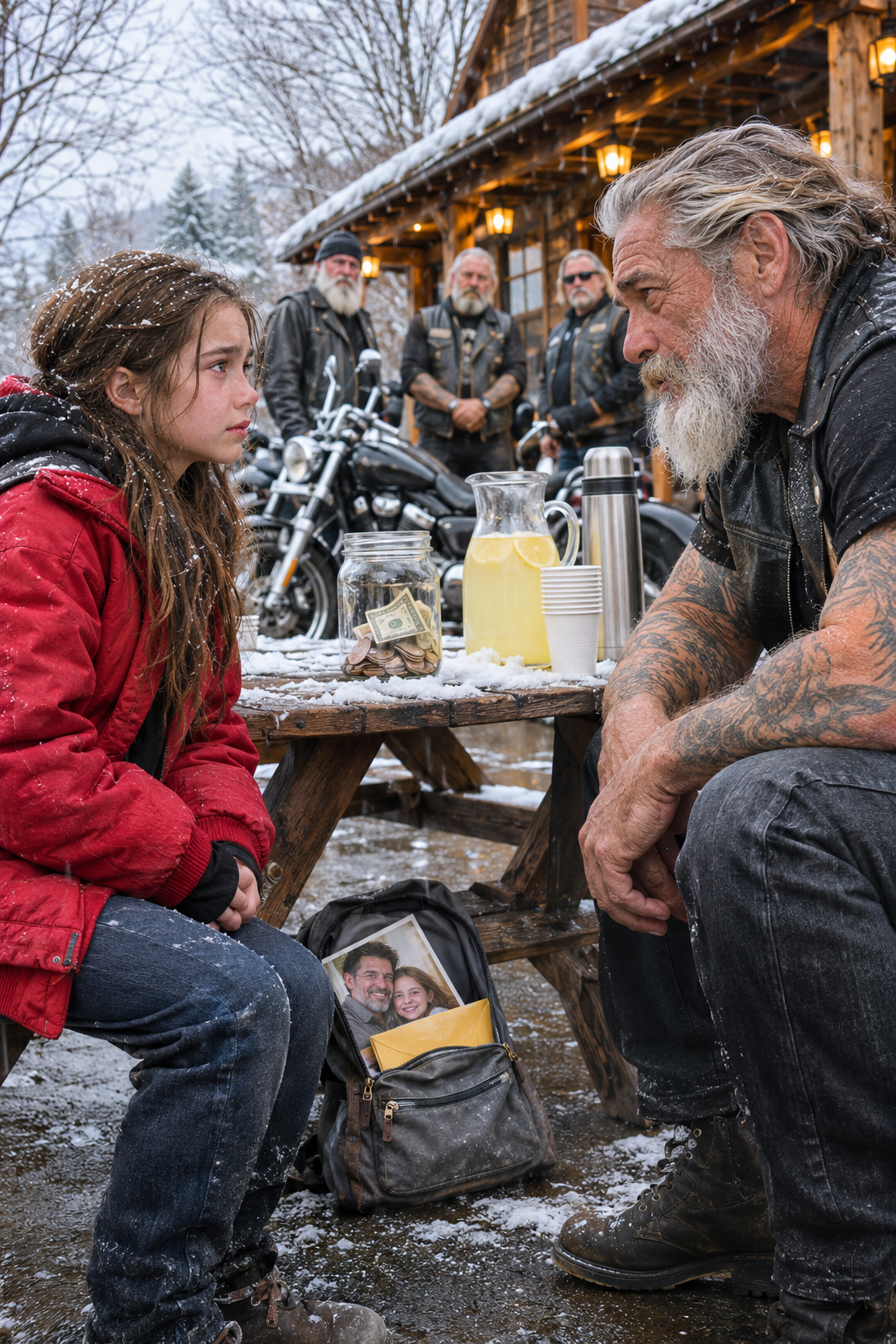
The little girl was still selling lemonade outside the motorcycle clubhouse when the sky turned black. But when a biker offered to buy every cup, she shook her head and whispered, “I have to earn it.”
Romeo had spent twenty-three years riding motorcycles, and in that time, he had seen broken bones, terrible accidents, and men who never made it home. But nothing prepared him for the expression on Shannon’s face.
“How much time?” he asked.
Shannon glanced toward the clubhouse, where Lacy sat wrapped in Valerie’s blanket, carefully drying the dollar bills she had rescued from the rain.
“Renee’s condition is worse than Lacy realizes,” Shannon said. “Her heart is struggling, and she’s been stretching her medication by skipping doses. She needs a doctor to reassess her treatment immediately.”
Romeo swallowed. “Are we talking weeks?”
“I’m saying she could have a serious cardiac event at any moment. She’s already experiencing symptoms that should have sent her to the emergency room.”
“Then why the hell isn’t she there?”
“Because she’s terrified of another hospital bill.”
Romeo looked through the window again.
Lacy was arranging her damp money into little piles, smoothing each bill with the concentration of someone performing a life-saving operation.
“How much has she saved?” he asked.
“Forty-seven dollars and eighty cents.”
Romeo closed his eyes.
A little girl had spent weeks standing beneath the burning sun, believing forty-seven dollars could stand between her mother and death.
When he opened his eyes, something had changed.
“Get Steve,” he said. “And tell the boys the charity ride starts tomorrow. Not next month. Tomorrow.”
Shannon caught his arm.
“Romeo, listen to me. A fundraiser is wonderful, but Renee cannot wait for a fundraiser.”
“Then she won’t.”
Twenty minutes later, six motorcycles rolled through the rain toward a small apartment building on the east side of town.
Romeo rode at the front, with Steve and Shannon following in Valerie’s truck.
Lacy sat beside Valerie, clutching her money jar.
She had insisted on bringing it.
When they reached the apartment, Lacy hesitated outside the door.
“Mom doesn’t like people knowing we need help,” she whispered.
Romeo crouched beside her.
“Then we’re not here because she needs charity. We’re here because she has neighbors.”
Lacy considered that.
“Are bikers neighbors?”
Romeo smiled.
“The loudest kind.”
Inside, the apartment was painfully clean.
There were no decorations except a school photograph of Lacy and a faded picture of a younger Renee holding a baby.
Renee sat on the couch beneath a thin blanket, her skin pale and her breathing shallow.
She looked startled when the strangers entered.
“Lacy? Honey, what’s going on?”
“Mom,” Lacy whispered, “I told them.”
Renee’s eyes filled immediately.
“Oh, baby. What did you tell them?”
“About your medicine.”
Renee pressed a trembling hand to her mouth.
Romeo stepped forward.
“Ma’am, my name is Romeo. Your daughter has been selling lemonade outside our clubhouse.”
“I know,” Renee said quietly. “She told me she was saving for a bicycle.”
Nobody answered.
Renee looked at Lacy.
“A bicycle?”
Lacy’s face crumpled.
“I’m sorry, Mommy.”
Renee tried to stand, but a sudden wave of dizziness forced her back onto the couch.
Shannon moved quickly to her side.
“Renee, I need you to stay seated. Are you having chest pain?”
“A little pressure,” Renee admitted.
“How long?”
“Since this morning.”
Shannon exchanged a look with Steve.
Then she reached for her phone.
“We’re calling an ambulance.”
Renee shook her head violently.
“No. Please. I can’t afford—”
“Renee,” Shannon interrupted gently, “right now, the cost is not the emergency. Your heart is.”
Lacy began crying.
“Mommy, please go.”
Those four words broke through Renee’s resistance.
She reached for her daughter.
“Oh, sweetheart.”
“I don’t care about the bicycle,” Lacy sobbed. “I just want you to stay.”
Renee held her as tightly as her weakened body allowed.
And Romeo, standing in the doorway, turned his face away.
Because he had just remembered another little girl saying almost the same thing.
Twenty-six years earlier.
To a woman who never came home.
By midnight, Renee was in the cardiac unit at St. Catherine’s Hospital.
The doctors stabilized her condition, adjusted her treatment, and ordered additional tests. They explained that her heart failure had worsened and that the interruptions in medication had placed her at serious risk.
Lacy sat in the waiting room with Valerie, refusing to sleep.
Every time a nurse passed, she lifted her head.
“Is that my mom?”
And every time Valerie answered, “Not yet, sweetheart,” something inside Romeo tightened.
At 2:17 in the morning, a cardiologist named Dr. Bennett emerged.
“Renee is stable for now,” he said.
Lacy jumped to her feet.
“Can I see her?”
“Soon. She needs rest.”
Romeo stepped closer.
“What happens next?”
“She needs consistent medication, close monitoring, and a treatment plan she can actually maintain. We’re also evaluating whether she needs more advanced care.”
“Can she get better?”
Dr. Bennett paused.
“We can improve her chances. But there are no guarantees.”
Romeo nodded.
He understood those words.
He hated them.
When the doctor left, Lacy tugged at his leather vest.
“Mr. Romeo?”
“Yeah, kiddo?”
“Did I wait too long?”
The question struck him harder than any fist ever had.
He knelt until they were eye to eye.
“Listen carefully. You did something brave because you love your mom. But keeping her healthy was never supposed to be your job.”
Lacy stared at him.
“Then whose job is it?”
Romeo looked toward the hospital corridor.
“The grown-ups should have helped you sooner.”
She lowered her eyes.
“Grown-ups usually say they’re busy.”
Romeo had no answer.
Because sometimes the truth was too ugly to soften.
The next morning, the Ironwood Riders clubhouse became something nobody in town had ever seen before.
Motorcycles filled the parking lot.
Volunteers carried folding chairs, coolers, and boxes of donated food.
A local printing company delivered banners reading:
RIDE FOR RENEE — EVERY HEART DESERVES A CHANCE.
Valerie organized the food station while Steve coordinated with the hospital social worker.
Shannon contacted patient-assistance programs, charitable foundations, and the manufacturer of Renee’s medication.
Romeo handled the riders.
By ten o’clock, more than eighty motorcycles had arrived.
By eleven, there were nearly two hundred.
But the real surprise came when a black pickup truck pulled into the parking lot.
A man in an expensive suit stepped out.
His name was Douglas Mercer.
He owned Mercer Development, the company that had purchased several apartment buildings in the neighborhood, including Renee’s.
Romeo recognized him immediately.
“What are you doing here?”
Mercer smiled.
“I heard about your little charity event.”
“Then you heard enough.”
Mercer ignored the warning and glanced at the banner.
“Renee Carter. Interesting.”
Romeo’s eyes narrowed.
“You know her?”
“Of course. She rents one of my properties. Three months behind, unfortunately.”
The atmosphere shifted.
Mercer reached into his jacket and produced a folded document.
“I’m here to discuss an eviction proceeding. My office has been trying to contact her.”
Romeo stared at the paper.
“You came to a fundraiser for a sick woman to talk about throwing her out?”
“Business doesn’t stop because someone gets emotional.”
Several bikers moved closer.
Romeo raised one hand, keeping them back.
“Get in your truck, Mercer.”
Mercer’s smile disappeared.
“You people think leather jackets make you heroes. But somebody has to pay the bills.”
He placed the document on a nearby table.
“Tell Mrs. Carter she has a hearing next week.”
Then he drove away.
For several seconds, nobody spoke.
Valerie picked up the paper.
Her expression darkened as she read.
“Romeo,” she said, “there’s something else.”
The notice claimed Renee owed more than six thousand dollars in rent, fees, and penalties.
But attached to it was a payment history.
And several payments Renee had made were missing.
Steve examined the dates.
“That doesn’t look right.”
Romeo looked toward the hospital.
“Then we find out what’s right.”
The charity ride began at noon.
Two hundred and thirty-seven motorcycles roared through the streets, escorted by volunteers and followed by families carrying handmade signs.
People emerged from shops and houses to watch.
Some waved.
Some cheered.
Others stood silently as the long procession passed.
At the center rode Romeo, carrying a small yellow ribbon tied to his handlebars.
Lacy had given it to him that morning.
“For luck,” she had whispered.
The livestream began with Valerie standing beside the lemonade table.
She held up Lacy’s weather-damaged sign.
“This little girl spent weeks trying to earn eighteen hundred dollars for her mother’s medicine,” Valerie told the camera. “She didn’t ask anyone to rescue her. She thought she had to do it all herself.”
Her voice cracked.
“But a child should never have to choose between homework and keeping her mother alive.”
Within an hour, donations reached twelve thousand dollars.
By midafternoon, they passed thirty thousand.
Then a video of Lacy counting her rain-soaked dollar bills began spreading across social media.
Thousands of strangers shared it.
A teacher in Oregon donated twenty dollars.
A retired firefighter in Texas sent five hundred.
A woman who had survived heart failure wrote, “Tell that little girl her mother isn’t fighting alone.”
By sunset, the total had reached seventy-four thousand dollars.
Romeo stood in the clubhouse, staring at the screen.
He had expected generosity.
He had not expected an entire country to answer.
Then his phone rang.
It was Shannon.
“Romeo, get to the hospital.”
His stomach dropped.
“What happened?”
“Renee’s condition has changed.”
He was already reaching for his keys.
“Is she alive?”
There was a pause.
“Yes. But you need to come now.”
The ride to St. Catherine’s took twelve minutes.
Romeo remembered none of them.
When he reached the cardiac unit, Lacy was standing outside her mother’s room, crying so hard she could barely breathe.
Valerie held her shoulders.
“What happened?” Romeo demanded.
Shannon stepped forward.
“Renee developed a dangerous heart rhythm. The team treated it, but she’s been moved to intensive care.”
Romeo looked through the glass.
Renee lay surrounded by monitors.
Her eyes were closed.
Lacy pressed her hands against the window.
“I thought you said she was getting better.”
Romeo felt the weight of every promise he had wanted to make.
He knelt beside her.
“I said we were going to help her fight.”
“But what if fighting doesn’t work?”
He swallowed.
“Then we keep loving her through every minute we have.”
Lacy turned toward him.
“Did you ever lose somebody?”
Romeo went still.
For years, the men at the clubhouse had known that he avoided talking about his family.
They knew he had once been married.
They knew he kept an old photograph inside his wallet.
But they did not know the whole story.
“Yes,” he said.
“My daughter.”
Lacy stopped crying for a moment.
“What was her name?”
“Emma.”
“How old was she?”
“Eight.”
Lacy’s eyes widened.
“What happened?”
Romeo sat down beside her.
“She had a heart condition. Different from your mom’s. We knew she was sick, but I kept thinking there would be more time.”
His voice grew rough.
“I worked long hours. Took extra shifts. Told myself everything I was doing was for her.”
He stared at his hands.
“One night, she asked me to stay home and watch a movie. I told her we’d do it tomorrow.”
Lacy waited.
Romeo looked away.
“There wasn’t a tomorrow.”
The corridor became very quiet.
“For a long time,” he continued, “I thought if I worked hard enough, helped enough people, maybe I could make up for that night.”
“Can you?”
He shook his head.
“No, sweetheart. You can’t buy back time. You can only decide what to do with the time you still have.”
Lacy leaned against him.
And for the first time in twenty-six years, Romeo allowed himself to cry in front of someone.
The following morning brought an unexpected breakthrough.
Shannon had reached a hospital financial counselor who identified an emergency medication-assistance option for Renee. The team also began an appeal of the insurance denial, supported by detailed medical documentation.
Meanwhile, a volunteer attorney named Grace Holloway arrived at the clubhouse.
She had seen the fundraiser online.
“My father rode with the Ironwood Riders thirty years ago,” she told Romeo. “You helped him after his accident. I figured it was time to return the favor.”
Grace reviewed Renee’s rental records.
Within an hour, she discovered something troubling.
Renee had paid rent through a payment portal, but the property company had credited several transactions incorrectly.
The late fees had then accumulated on balances that should not have existed.
Grace also found that the eviction notice contained charges not supported by the lease.
“This isn’t proof of intentional fraud,” she cautioned, “but it gives us strong grounds to dispute the amount and challenge the eviction.”
Romeo leaned forward.
“Can you stop it?”
“I can represent her. And I can ask the court for emergency relief.”
“Then do it.”
Grace smiled faintly.
“You bikers really don’t waste words.”
“Not when a kid’s home is on the line.”
By Friday afternoon, Mercer’s attorney had received a formal demand for corrected records.
By Monday, the company had agreed to withdraw the eviction filing while the disputed charges were reviewed.
When Romeo told Lacy, she looked confused.
“So we don’t have to move?”
“Not because of that notice,” he said. “Grace is making sure your mom’s rights are protected.”
Lacy hugged him.
It was such a sudden, fierce embrace that he nearly lost his balance.
But the greatest battle was still happening behind the hospital doors.
Renee remained dangerously ill.
Her doctors discussed advanced treatment options and warned that her recovery could be long and uncertain.
One evening, Renee asked to speak to Romeo alone.
He entered her room and found her sitting upright, looking exhausted.
“Lacy trusts you,” she said.
Romeo pulled up a chair.
“She’s a good kid.”
“She’s the best thing I ever did.”
Renee stared toward the window.
“Her father left when she was four. I worked two jobs until my heart got worse. Then I lost one job, and the insurance problems started.”
She pressed her fingers together.
“I thought if I could just hold everything together for another month, she wouldn’t notice.”
“She noticed,” Romeo said gently.
“I know.”
Tears rolled down her cheeks.
“I found a notebook under her pillow yesterday. She’d written down how many cups of lemonade she needed to sell.”
Renee struggled to continue.
“She calculated it would take eighteen hundred cups. Then she wrote, ‘If I sell sixty every day, Mommy can be okay in thirty days.’”
Romeo looked down.
“She thought love was something she had to earn,” Renee whispered.
“No,” Romeo replied. “She thought money was the only way anyone would help.”
Renee covered her face.
“I failed her.”
Romeo shook his head.
“You got sick. That’s not failure.”
“But I should have asked for help.”
“Maybe. And the people around you should have made asking easier.”
Renee looked at him.
“Why are you doing all this?”
Romeo reached into his wallet.
He removed a worn photograph of a smiling little girl with dark curls.
“This is Emma.”
Renee studied it.
“She’s beautiful.”
“She was.”
He returned the photograph to his wallet.
“I spent years thinking I could have saved her if I’d done something differently. Maybe I could have. Maybe I couldn’t. But I know one thing.”
He leaned forward.
“When your daughter showed up outside our clubhouse, I almost walked past her like everybody else.”
Renee shook her head.
“But you didn’t.”
“No,” Romeo said softly. “This time, I stopped.”
Three days later, Renee underwent a major procedure to address her worsening condition.
The doctors had explained the risks carefully.
There was no certainty it would succeed.
Lacy waited in the hospital chapel with Valerie and the riders.
She held her money jar in her lap.
The forty-seven dollars and eighty cents were still inside.
Romeo sat beside her.
“Kiddo, why are you still carrying that thing?”
Lacy ran her finger along the glass.
“Because it was the first money I made for Mom.”
“You know the fundraiser raised enough to help with a lot more than one month of medicine.”
“I know.”
She looked at him.
“But this is different.”
“How?”
“This money is how I found you.”
Romeo felt his throat tighten.
Before he could answer, Dr. Bennett appeared in the doorway.
Everyone stood.
The doctor removed his surgical cap.
“The procedure is finished.”
Lacy gripped Romeo’s hand.
“Is she okay?”
Dr. Bennett’s expression softened.
“She made it through. There were complications, and she’ll need close monitoring, but we’re encouraged by how she responded.”
Lacy stared at him.
“Does that mean she gets to come home?”
“Not today,” he answered. “But that’s what we’re working toward.”
Lacy began to cry.
Not the frightened, silent tears she had cried before.
These were loud, relieved sobs that seemed to come from somewhere deep inside her.
Romeo lifted her into his arms.
Around them, hardened bikers embraced one another.
Steve wiped his eyes with the back of his hand.
Valerie whispered a prayer.
For the first time since the storm, hope felt stronger than fear.
Recovery, however, did not happen overnight.
Renee spent weeks in the hospital, followed by rehabilitation and regular appointments.
There were difficult days.
Days when she could barely walk across a room.
Days when her medications needed adjusting.
Days when Lacy watched her mother sleep and wondered whether every breath would be followed by another.
But there were good days too.
The first time Renee walked down the hospital corridor without stopping, Lacy cheered so loudly that two nurses came running.
The first time she laughed at one of Romeo’s terrible jokes, Valerie nearly dropped her coffee.
And the day Renee finally returned home, forty-three motorcycles lined the street outside her apartment.
There were no roaring engines.
No dramatic speeches.
Just men and women standing quietly as Renee stepped from Valerie’s truck.
Lacy ran ahead and opened the apartment door.
“Welcome home, Mommy.”
Renee stood on the threshold, tears gathering in her eyes.
Inside, the apartment looked different.
The broken kitchen light had been repaired.
The refrigerator was stocked.
A comfortable chair stood beside the window.
On the table sat a folder containing information about medication assistance, follow-up appointments, and community resources.
Grace had helped Renee secure a corrected rental account and a written agreement resolving the disputed fees.
A hospital social worker had connected her with longer-term support.
The fundraiser money had been placed in a properly administered assistance fund, with transparent records and safeguards for Renee’s medical and household needs.
Romeo wanted to make sure this family would not have to depend on another viral video to survive.
Renee looked around the room.
“I don’t know how to repay any of you.”
Steve grinned.
“You could stop apologizing every five minutes.”
Valerie laughed.
“And maybe let us bring dinner once in a while.”
Romeo stepped forward.
“You don’t owe us a thing.”
Renee shook her head.
“Everybody says that. But people always expect something.”
Romeo glanced at Lacy.
“Then here’s what I expect.”
Renee waited.
“When you need help, you ask. And when you’re strong enough, you help somebody else.”
Renee smiled through her tears.
“That,” she said, “I can promise.”
Summer turned into autumn.
The lemonade table disappeared from outside the clubhouse.
At first, Romeo missed seeing it.
He missed the crooked sign, the little paper cups, and Lacy’s serious expression as she counted her change.
But one Saturday morning, he arrived at the clubhouse and found the table back in its usual place.
Only this time, the sign was different.
LEMONADE — PAY WHAT YOU CAN.
ALL MONEY HELPS FAMILIES IN NEED.
Lacy stood behind it wearing a bright yellow T-shirt.
Her gray hoodie was nowhere in sight.
Romeo approached slowly.
“Well, look who’s back in business.”
Lacy beamed.
“Morning, Mr. Romeo.”
He examined the sign.
“What happened to the one-dollar price?”
“Some people don’t have a dollar.”
Romeo nodded thoughtfully.
“That’s true.”
“And some people have more than a dollar.”
“That’s also true.”
She poured him a cup.
“So everybody can give what they can.”
Romeo reached for his wallet.
Lacy shook her head.
“Your lemonade is free.”
“Free? That’s terrible business.”
She giggled.
“You helped my mom.”
Romeo placed a twenty-dollar bill in the jar anyway.
Lacy frowned.
“Mr. Romeo!”
“What?”
“You don’t have to.”
He smiled.
“I know.”
That afternoon, Renee arrived carrying a tray of homemade cookies.
She looked healthier, though she still moved carefully and needed plenty of rest.
Her doctors had warned that she would require ongoing treatment, but her condition had improved enough for her to rebuild a routine.
She was also beginning part-time work from home, with support from a local employment program.
Nothing about their future was guaranteed.
But it belonged to them again.
As the sun began to set, Lacy approached Romeo with a small envelope.
“I made something for you.”
Inside was a drawing.
It showed a huge motorcycle, a little lemonade stand, and three stick figures holding hands.
Above them, in uneven purple letters, Lacy had written:
SOMETIMES HEROES WEAR LEATHER.
Romeo stared at the picture for a long time.
Then he noticed something.
There was a fourth figure standing beside the motorcycle.
A little girl with curly hair and a blue dress.
“Who’s that?” he asked quietly.
Lacy smiled.
“That’s Emma.”
Romeo stopped breathing for a moment.
“How did you know what she looked like?”
“You showed Mommy her picture. Mommy told me about her.”
He swallowed.
“Why did you draw her?”
Lacy looked surprised by the question.
“Because she’s part of your family.”
Romeo’s eyes filled.
He had spent twenty-six years believing that losing Emma meant losing the only chance he would ever have to be a father.
Yet here stood a little girl who had somehow found room for his daughter inside her own picture of happiness.
He pulled Lacy into a hug.
“Thank you, sweetheart.”
She wrapped her arms around his neck.
“You’re welcome.”
A year later, the Ironwood Riders held their second annual charity ride.
But it was no longer called Ride for Renee.
They renamed it the Emma and Lacy Community Ride, dedicated to helping families facing medical and financial emergencies.
Renee helped coordinate assistance requests.
Valerie organized volunteers.
Shannon worked with local clinics and social workers to connect families with reliable resources.
Grace offered legal guidance to people facing housing problems.
And Romeo made sure every new rider understood the club’s most important rule.
“Anybody can wear our patch,” he told them. “But it means nothing if you can’t recognize somebody who needs a hand.”
That year, the ride raised enough to support dozens of families.
Among them was a single father whose daughter needed specialized medical equipment.
An elderly woman who had been rationing her prescriptions.
And a young mother who had been sleeping in her car while recovering from surgery.
Each received help without being required to tell their story publicly.
Because the riders had learned something from Lacy.
Dignity mattered just as much as generosity.
On the anniversary of the storm, Romeo found Lacy sitting outside the clubhouse after everyone had gone home.
She was eleven now.
A little taller.
A little louder.
And no longer afraid to ask questions.
“Mr. Romeo?”
“Yeah, kiddo?”
“Do you think Emma would have liked lemonade?”
He smiled.
“She loved anything sweet.”
Lacy considered that.
“Then maybe we should save her a cup.”
Romeo sat beside her.
“I think she would have liked that.”
They watched the sunset together.
After a while, Lacy spoke again.
“Mom says you saved our lives.”
Romeo shook his head.
“Your mom had some very good doctors. And a lot of people helped.”
“But you started it.”
He looked at the empty sidewalk where her little table had once stood in the rain.
“No,” he said. “You did.”
Lacy frowned.
“But I only sold lemonade.”
Romeo smiled.
“Sometimes the smallest thing is what brings everybody together.”
She leaned against his shoulder.
For a while, neither spoke.
Then Lacy asked one last question.
“Mr. Romeo, do you think I earned enough?”
He looked at her, remembering the frightened child who had counted every dollar twice, believing her mother’s life depended on how hard she worked.
He remembered the rain, the hospital, the terrifying nights, and the strangers who had answered a call for help.
Then he gently took the money jar from her hands.
“You earned something worth more than money, sweetheart.”
“What?”
“You learned that you don’t have to carry the whole world by yourself.”
Lacy thought about that.
Then she smiled.
“Neither do you.”
Romeo laughed softly.
Because she was right.
For years, he had carried his grief like a punishment, convinced that loving someone meant being able to save them.
But Emma’s death had taught him how helpless love could feel.
And Lacy had taught him something else.
Love was not measured by how much suffering one person could endure alone.
It was measured by how many hands were willing to reach out when another person began to fall.
As evening settled over the clubhouse, Renee called from the doorway.
“Lacy! Dinner’s ready!”
Lacy jumped up.
“Coming, Mom!”
She took three steps, then turned back.
“Mr. Romeo?”
“Yeah?”
“You’re coming too, right?”
He looked at the clubhouse, at the motorcycles gleaming beneath the fading light, and at the small yellow ribbon still tied to his handlebars.
For twenty-six years, he had lived with the memory of a little girl asking him to stay.
This time, there was no shift to work.
No road he needed to ride.
No tomorrow he had to promise.
He stood, took Lacy’s hand, and walked toward the warm light spilling from the doorway.
“Yeah, kiddo,” he said. “I’m coming.”
And somewhere between the laughter inside the house and the sound of a little girl calling her mother, Romeo finally understood something he had spent half his life trying to learn.
You cannot always save the people you love.
You cannot undo yesterday, and you cannot guarantee tomorrow.
But you can notice the child standing alone in the rain.
You can listen when someone whispers that they are running out of time.
You can offer help without making another person feel small.
And sometimes, when enough ordinary people choose compassion over indifference, a broken little lemonade stand can become the beginning of something extraordinary.
Because the greatest miracles do not always arrive with thunder or flashing lights.
Sometimes they begin with a single dollar, a frightened child, and a stranger who decides not to walk away.
And sometimes, the person you stop to save becomes the very person who teaches you how to live again.
The following spring, the Ironwood Riders clubhouse received a letter that nobody expected.
It came from St. Catherine’s Hospital, addressed to Romeo personally.
Inside was an invitation to attend a ceremony honoring community volunteers who had made an extraordinary difference in the lives of local families.
Romeo read it twice, then tossed it onto the table.
“Not interested.”
Valerie picked it up.
“Romeo, they want to recognize what you’ve done.”
“What we’ve done,” he corrected.
“Then we should all go.”
He shook his head.
“I didn’t do any of this for a medal.”
From the doorway, Lacy crossed her arms.
“Neither did I.”
Romeo turned.
She stood beside Renee, wearing a yellow dress and the same determined expression she had worn behind her lemonade stand.
“But Mom says when somebody says thank you, you should let them.”
Steve burst out laughing.
“She’s got you there, boss.”
Romeo looked around the room.
Every rider was smiling.
He sighed.
“Fine. But nobody’s making me wear a tie.”
Two weeks later, the hospital auditorium was filled with doctors, nurses, volunteers, and families whose lives had been changed by the community fund.
Romeo sat in the back row, uncomfortable in his clean black shirt.
Lacy sat beside him, swinging her feet.
When the hospital director called his name, Romeo remained seated.
But Lacy grabbed his hand.
“Come on. I’m going with you.”
Together, they walked onto the stage.
The director spoke about the money raised, the families supported, and the countless hours donated by the Ironwood Riders.
Then she invited Lacy to say a few words.
Romeo looked startled.
“You planned this?”
Lacy grinned.
“Maybe.”
She stepped toward the microphone, holding a folded sheet of paper.
At first, her hands trembled.
Then she looked at her mother sitting in the front row.
“My name is Lacy Carter,” she began. “Last year, I thought I had to earn enough money to keep my mom alive.”
The auditorium fell silent.
“I was scared all the time. I thought if I didn’t sell enough lemonade, something bad would happen, and it would be because I didn’t work hard enough.”
Renee wiped her eyes.
“But then some people stopped to help me. They didn’t laugh at my little table. They didn’t tell me to go away. They listened.”
Lacy turned toward Romeo.
“And they taught me something important.”
She unfolded the last page.
“Kids shouldn’t have to save their parents all by themselves. Sick people shouldn’t have to be ashamed of needing help. And being strong doesn’t mean never asking anybody for anything.”
Romeo lowered his head.
Lacy smiled.
“I used to think forty-seven dollars and eighty cents wasn’t enough to change anything.”
She paused.
“But it was enough to start a conversation. And that conversation changed my whole life.”
The audience rose to its feet.
Applause filled the auditorium.
Yet Romeo barely heard it.
Because Lacy had reached for his hand.
And in that moment, he realized he was no longer standing in the shadow of everything he had lost.
He was standing beside someone whose future he could still help protect.
After the ceremony, Renee approached him in the hospital garden.
“I have something to ask you,” she said.
Romeo smiled.
“That sounds dangerous.”
She laughed.
“Lacy’s school is having a father-daughter dance next month.”
His smile faded slightly.
Renee continued gently.
“She knows you’re not her father. She’s never confused about that. But she says you’re the person she wants to take.”
Romeo stared at her.
For a long moment, he couldn’t speak.
“I haven’t been to one of those since Emma,” he finally whispered.
“I know.”
“What if I can’t do it?”
Renee placed a hand on his arm.
“Then tell her the truth. She’ll understand.”
That evening, Romeo found Lacy at the clubhouse, helping Valerie wash lemonade pitchers.
“Hey, kiddo.”
“Hi!”
“Your mom told me about the dance.”
Lacy’s smile disappeared.
“Oh.”
He noticed how quickly she looked down.
“You don’t have to come,” she said. “I know you’re busy.”
Romeo felt a familiar ache in his chest.
Twenty-six years earlier, he had heard almost those exact words.
He crouched beside her.
“Lacy, look at me.”
She lifted her eyes.
“I would be honored to take you.”
Her mouth fell open.
“Really?”
“Really.”
She threw her arms around him.
And when the night of the dance arrived, Romeo appeared at Renee’s apartment wearing a dark suit, polished shoes, and a yellow tie.
Lacy opened the door.
For several seconds, she simply stared.
Then she burst into laughter.
“You said you’d never wear a tie!”
Romeo grinned.
“Some promises are worth breaking.”
He handed her a tiny bouquet of yellow flowers.
Renee stood behind her daughter, smiling through tears.
Before they left, Lacy reached into her pocket and pulled out something small.
It was a yellow ribbon.
The same ribbon she had once tied to Romeo’s motorcycle.
“I fixed it,” she said. “It was getting old.”
Romeo let her tie it around his wrist.
“Looks perfect.”
At the school gymnasium, music played beneath strings of paper stars.
Fathers danced with daughters.
Grandfathers danced with granddaughters.
Uncles, brothers, and family friends filled the room.
When a slow song began, Lacy took Romeo’s hand.
“Do you know how to dance?”
“Not even a little.”
“That’s okay,” she said. “I’ll teach you.”
And so the big, intimidating biker who had once frightened strangers with a single look found himself following the instructions of an eleven-year-old girl.
“One step left,” she whispered.
He stepped right.
“No! Your other left!”
They laughed until their sides hurt.
Then the music softened.
Lacy rested her head against his chest.
“Mr. Romeo?”
“Yeah, sweetheart?”
“Do you think Emma would be happy you’re here?”
Romeo closed his eyes.
For years, that question would have broken him.
But tonight, surrounded by laughter and music, it felt different.
“I think she’d be happy that I finally learned how to dance.”
Lacy smiled.
“Then we should keep practicing.”
And they did.
Not because the past had stopped hurting.
Not because every wound had healed.
But because life had given Romeo another chance to show up, and this time, he understood what mattered.
Years later, when people asked how the Emma and Lacy Community Fund began, they expected a story about a generous motorcycle club, a successful fundraiser, or an extraordinary act of kindness.
But Romeo always gave them the same answer.
“It started with a little girl who wouldn’t give up on her mother.”
Then he would smile and add, “And a bunch of stubborn bikers who finally learned to pay attention.”
The old lemonade table remained inside the clubhouse, carefully restored but never repainted.
Its scratches, stains, and crooked legs were left exactly as they had been.
Above it hung Lacy’s original cardboard sign.
LEMONADE — $1.
Beneath the sign, Romeo had placed a small wooden plaque.
It carried just thirteen words:
“No one should have to earn the right to be helped.”
And that became the lesson the Ironwood Riders carried wherever they went.
That kindness is not a reward reserved for those who have suffered enough.
That dignity belongs to everyone, especially those struggling silently.
And that sometimes the most important thing we can give another person is not money, advice, or a promise that everything will be all right.
Sometimes it is simply our presence.
A chair beside a hospital bed.
A hand held during a frightening night.
A meal delivered without being asked.
A dance with someone who thought nobody would come.
Because not every story ends with a miracle that makes all the pain disappear.
Some end with something quieter, and perhaps even more meaningful.
A mother gets to watch her daughter grow.
A little girl gets to be a child again.
And a grieving man discovers that opening his heart to someone new does not mean closing it to the person he lost.
It means love has found another place to live.
And on warm summer afternoons, whenever the sound of motorcycles rolled through town, people sometimes noticed a yellow ribbon fluttering from Romeo’s handlebars.
He never replaced it with anything newer or brighter.
Because to everyone else, it was only a ribbon.
But to Romeo, it was a reminder of the day a frightened little girl stood in the rain, trying to earn enough money to save her mother.
And of the moment he finally understood that while we cannot change every tragedy, we can choose not to leave someone facing theirs alone.
The End.