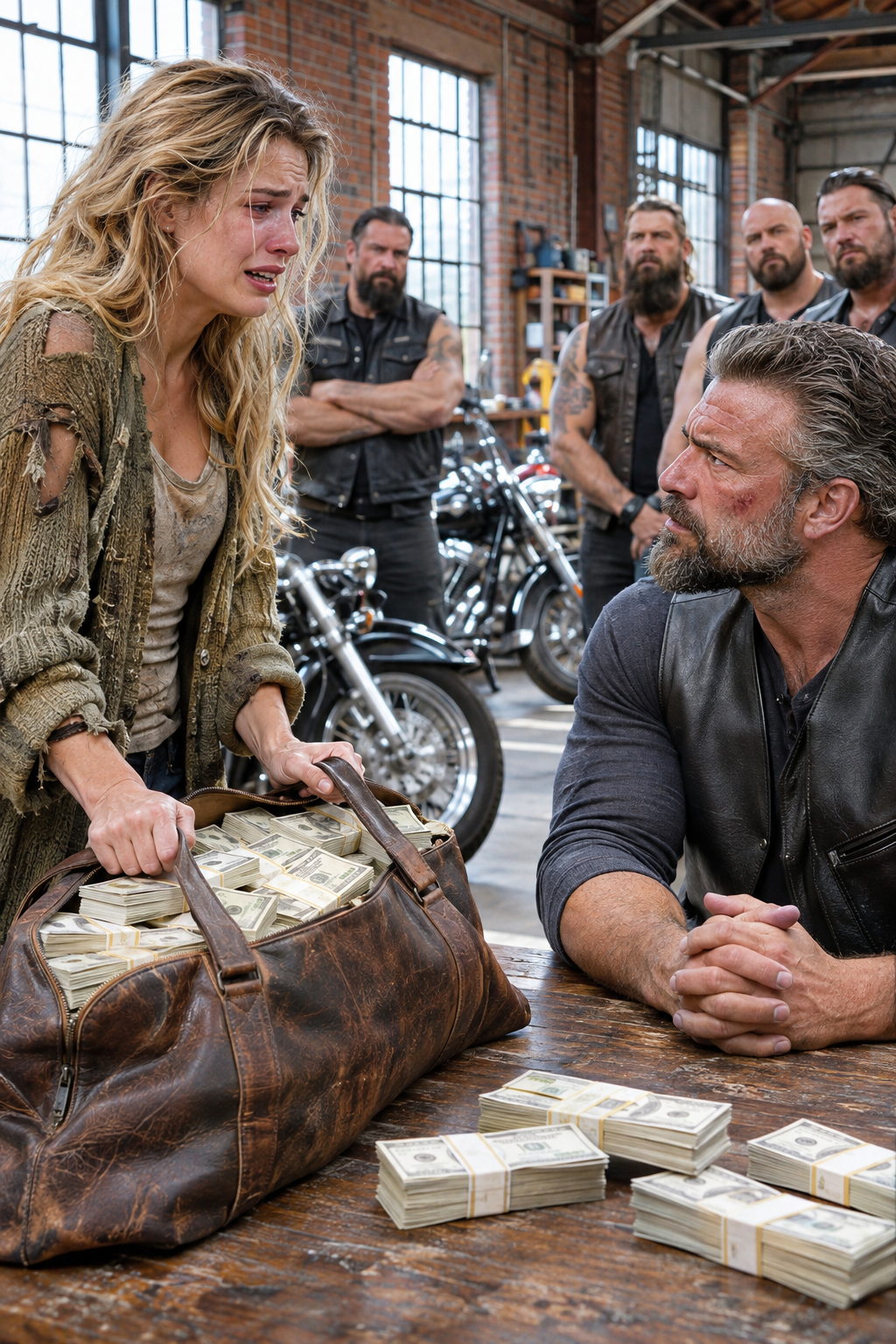
The leather bag held more than $50,000 in cash. Emily Carter found it in a rain-soaked alley while her six-year-old son struggled to breathe in the back seat of their car.
The man who entered the clubhouse looked like someone who had spent the entire night running from his own shadow.
His leather jacket was torn at the shoulder. Dried blood marked his temple, and his left arm hung awkwardly against his ribs. Rainwater dripped from his boots onto the wooden floor.
But it wasn’t his injuries that made Jackson Walker’s expression turn cold.
It was the way the man stopped breathing when he saw Emily Carter.
“Victor,” Jackson said quietly. “You’re late.”
Victor Hayes, a longtime member of the club, stared at the leather bag sitting on the table.
“Where did you get that?”
Jackson didn’t answer.
Victor’s eyes moved toward Emily, then toward six-year-old Noah, who was sitting beside her with his blanket wrapped around his shoulders.
Something ugly flickered across Victor’s face.
“Who is she?”
“The woman who found what you lost.”
Victor took one step backward.
Emily felt an immediate urge to grab Noah and run.
Jackson noticed.
“Nobody’s going anywhere,” he said.
Victor forced a laugh.
“Come on, Jack. You know how things get after a wreck. I was going to bring it straight here.”
“Then why did you tell Marcus the bag was destroyed?”
The room went silent.
Victor’s jaw tightened.
Jackson opened the hidden compartment and removed the sealed envelope.
“Better question,” he continued. “Why were you carrying documents from my brother’s company?”
Victor’s face changed.
Emily saw it happen.
One moment, he looked like a wounded man trying to explain an accident. The next, he looked like a cornered animal calculating the distance to the nearest exit.
“Those papers aren’t what you think.”
“Then tell me what they are.”
Victor glanced at the bikers standing behind him.
“Not in front of strangers.”
Jackson leaned forward.
“That woman returned fifty thousand dollars she could’ve used to save herself and her child. Right now, she’s earned more trust than you.”
Victor’s eyes narrowed.
“You have no idea what you’ve done, lady.”
Emily pulled Noah closer.
Jackson stood so quickly his chair scraped across the floor.
“Watch your mouth.”
Before Victor could respond, Noah began coughing.
It started as a small, dry sound.
Then came another.
And another.
Emily immediately recognized the frightening change in his breathing.
“Noah?”
Her son tried to answer, but his chest tightened.
His little fingers clutched her sleeve.
“Mommy… can’t…”
Emily dropped to her knees.
“Sweetheart, look at me. Slow breaths.”
She reached for the nearly empty inhaler in her purse.
One weak puff.
Nothing.
Noah’s breathing grew more strained.
Jackson turned toward the nearest biker.
“Call 911. Tell them we’ve got a child having a severe asthma attack.”
Emily’s hands trembled as she held Noah upright.
“Please,” she whispered. “Please, baby.”
The next several minutes blurred into terrified fragments.
A biker named Marcus opened the door for the arriving paramedics.
Another moved furniture out of their way.
Jackson knelt beside Emily while the paramedics administered oxygen and breathing treatment.
“He’s going to the hospital,” one paramedic said. “We need to move now.”
Emily stood, clutching Noah’s blanket.
“I don’t have insurance.”
The paramedic looked directly at her.
“That doesn’t change what he needs.”
Jackson grabbed his keys.
“I’m following.”
Emily shook her head.
“You don’t have to.”
“Yes,” he said. “I do.”
Behind them, Victor slipped toward the side entrance.
Jackson didn’t even turn around.
“Marcus, keep him here until the police arrive.”
Victor froze.
“The police?”
Jackson held up the envelope.
“You wanted secrets, Victor. Now you’re going to explain them to people who know how to investigate.”
At the hospital, Emily sat in a plastic chair outside the pediatric emergency room, staring at her hands.
For three weeks, she had been telling Noah everything would be okay.
She had said it when their landlord changed the locks after the eviction deadline.
She had said it when they ate crackers for dinner.
She had said it when freezing rain hammered the roof of their old Chevrolet.
But watching her son struggle for air had shattered something inside her.
She could endure hunger.
She could endure humiliation.
She could sleep sitting upright with her shoes on.
What she couldn’t endure was the possibility of losing her child because she couldn’t afford to keep him healthy.
Jackson appeared carrying two paper cups.
“Coffee?”
Emily shook her head.
He set one beside her anyway.
“The doctor says he’s responding to treatment.”
She covered her face.
“I should’ve taken the money.”
The words escaped before she could stop them.
Jackson said nothing.
Emily looked up, ashamed.
“Just enough for his medicine. I could’ve put it back somehow.”
“You were desperate.”
“I was his mother.”
“Those things aren’t opposites.”
Tears slipped down her cheeks.
“I’ve worked since I was sixteen. I’ve cleaned houses, waited tables, stocked shelves. I never thought I’d end up sleeping in a car with my little boy.”
Jackson sat beside her.
For a long moment, he studied the hospital corridor.
“My wife died eight years ago,” he said.
Emily looked at him.
“Her name was Rebecca. She was a school nurse.”
His voice grew quieter.
“She used to tell me the hardest thing about helping people wasn’t finding the ones who needed it. It was convincing them they deserved it.”
Emily swallowed.
“I’m not asking for charity.”
“I know.”
“Then why are you doing this?”
Jackson looked at the pediatric doors.
“Because someone should’ve helped you before things got this bad.”
A doctor emerged twenty minutes later.
Noah was stable.
He would need monitoring, a reliable supply of medication, and follow-up care.
Emily nearly collapsed with relief.
But when the doctor mentioned prescriptions and appointments, her anxiety returned.
Jackson noticed.
He didn’t make a speech.
He simply asked the hospital social worker to come speak with Emily about emergency assistance, Medicaid eligibility, and housing resources.
Then he quietly arranged to cover the immediate expenses that assistance wouldn’t.
By afternoon, Noah was sleeping peacefully in a hospital bed.
Emily sat beside him when Jackson’s phone rang.
His expression hardened as he listened.
“Are you sure?”
A pause.
“Don’t touch anything. I’m coming.”
He ended the call.
Emily watched him.
“Something happened?”
Jackson hesitated.
“Victor’s gone.”
She stared at him.
“I thought your men were keeping him there.”
“They were. He slipped out during the ambulance chaos. Police have been notified.”
“Does he know where I am?”
Jackson didn’t answer quickly enough.
Emily felt cold.
“What was in that envelope?”
Jackson pulled a chair closer.
“My younger brother, Daniel, owned a construction company. Six months ago, he died in what police initially believed was a highway accident.”
“I’m sorry.”
“Daniel was investigating missing money from a charitable housing project. Our club helped raise funds to renovate abandoned properties for veterans and struggling families.”
Emily listened.
“The project was supposed to provide twenty affordable homes. Instead, money disappeared, contractors weren’t paid, and Daniel started asking questions.”
Jackson removed a folded photograph from his jacket.
It showed two smiling men standing beside a newly renovated house.
One was Jackson.
The other looked like a younger version of him.
“Daniel kept telling me somebody was using our charity as a front for something crooked.”
Emily studied the picture.
“And Victor?”
“He handled transportation and security for the project. Daniel trusted him.”
Jackson’s voice became heavy.
“Two days before he died, my brother called and said he’d found proof. He wanted to show me in person.”
“But he never did.”
Jackson shook his head.
“The documents in that bag include invoices, bank records, and property transfers. Some point to Victor. Others point to a developer named Richard Voss.”
Emily recognized the name.
Voss Development owned several apartment complexes across the county.
Including the building where she and Noah had lived.
Her stomach twisted.
“Richard Voss?”
Jackson noticed her expression.
“You know him?”
“His company bought our building last year.”
Emily remembered the notices taped to apartment doors.
The sudden maintenance charges.
The rent increases.
The warnings that tenants who complained would face legal consequences.
“When Noah got sick, I missed work. Then I fell behind. They added fees I couldn’t possibly pay.”
Jackson listened carefully.
“Did they give you a chance to challenge the charges?”
“I tried. The property manager told me the company didn’t negotiate with people who couldn’t afford to live there.”
She looked down.
“They changed the locks after the eviction was finalized. I lost almost everything.”
Jackson’s jaw tightened.
“Do you still have your paperwork?”
“In the car.”
“Keep it.”
Emily looked confused.
“Why?”
“Because Daniel’s records mention several apartment buildings owned by Voss. Yours might be one of them.”
For the first time, Emily understood that finding the bag might have connected her to something much larger than a motorcycle accident.
That evening, Detective Laura Bennett arrived at the hospital.
She was in her early forties, with tired eyes and the careful manner of someone who had learned not to trust easy explanations.
Jackson introduced them.
Detective Bennett took Emily’s statement, asking her to describe the alley, the damaged motorcycle, and the exact location of the bag.
Emily answered every question.
When Bennett asked whether anyone had seen her retrieve it, Emily remembered something.
“A black SUV drove past the alley twice.”
The detective stopped writing.
“Did you see the driver?”
“No. The windows were tinted.”
“Anything else?”
Emily closed her eyes.
“There was a silver bird on the front grille. Not the manufacturer’s symbol. Something attached above it.”
Bennett exchanged a glance with Jackson.
“What kind of bird?”
“An eagle, I think.”
Jackson leaned back.
Richard Voss was known for driving a black luxury SUV with a custom silver eagle ornament.
Bennett noticed his reaction.
“Don’t jump to conclusions,” she warned.
“I’m not.”
But Emily could tell he was.
Before leaving, the detective gave Emily her card.
“If anyone contacts you about that bag, call me immediately.”
Emily nodded.
Then Bennett added something that made her stomach drop.
“We recovered Victor’s motorcycle. The brake line showed signs of deliberate tampering.”
Jackson went completely still.
“You’re saying someone tried to kill him?”
“I’m saying we’re investigating that possibility.”
Emily remembered the wreckage.
The rain.
The bag lying near the curb.
Whoever had sabotaged that motorcycle might have been looking for the documents.
And now they knew Emily had found them.
Two days later, Noah was discharged.
Emily expected to return to the Chevrolet.
Instead, Jackson drove them to a modest two-bedroom apartment above a bakery.
Sunlight streamed through clean windows.
There was a small kitchen, a living room with a blue sofa, and a bedroom containing a bed covered with dinosaur sheets.
Noah stared.
“Mommy?”
Emily couldn’t speak.
Jackson handed her a key.
“The owner is a friend. The apartment’s available for a month while you work with the housing counselor.”
Emily shook her head.
“I can’t pay for this.”
“The first month is covered.”
“Jackson—”
“No strings, Emily. No favors owed. The housing counselor can help you figure out what comes next.”
Noah ran toward the bedroom.
“Mommy! There’s a real bed!”
Emily followed him.
He climbed onto the mattress and bounced once, laughing.
Then he looked at her with sudden seriousness.
“Are we allowed to stay?”
Emily pressed her lips together.
“Yes, sweetheart.”
“For tonight?”
She knelt beside him.
“For more than tonight.”
Noah wrapped his arms around her neck.
For the first time in weeks, Emily cried without trying to hide it.
Jackson quietly stepped into the hallway.
He gave them privacy.
The next morning, Emily found a note beneath the apartment door.
It contained only seven words.
“You should have kept the money, Emily.”
Her blood turned cold.
She called Detective Bennett immediately.
Within an hour, officers had photographed the note and collected nearby security footage.
The bakery’s camera showed a man in a dark hooded jacket approaching the building shortly before dawn.
His face was hidden.
But his limp was unmistakable.
Victor.
Jackson arrived looking furious.
“He came here?”
Emily handed him the note.
“How did he find us?”
Jackson didn’t answer.
Instead, he called Marcus.
“Find out who knew about the apartment.”
Emily stared at him.
“You think somebody told him?”
“I think I’ve trusted the wrong people before.”
That afternoon, Detective Bennett called with another discovery.
The sealed envelope contained a handwritten letter from Daniel Walker.
It had been addressed to Jackson but never delivered.
In the letter, Daniel described a scheme involving fraudulent renovation invoices, inflated construction expenses, and transfers of charitable funds into companies controlled by Richard Voss.
He also described evidence that several rental properties had been deliberately allowed to deteriorate before tenants were pushed out through aggressive fee increases and redevelopment plans.
The documents didn’t establish every allegation.
But they gave investigators names, dates, and financial trails worth pursuing.
One sentence in Daniel’s letter stood out.
“If anything happens to me, look at the people who profit when ordinary families lose their homes.”
Jackson read those words three times.
Then he folded the letter carefully.
“My brother knew.”
Emily stood beside the apartment window.
“Why would Victor carry that evidence?”
“Maybe he was trying to sell it. Maybe he was trying to keep it from me.”
“Or maybe he was bringing it to you.”
Jackson looked at her.
Emily continued.
“Someone damaged his motorcycle. What if he was running from the same people you’re looking for?”
For the first time, Jackson considered the possibility.
Victor had been dishonest.
He had threatened Emily.
But that didn’t necessarily mean he was responsible for Daniel’s death.
And if someone had tried to kill him, he might know exactly why.
Three nights later, Emily received a phone call from an unknown number.
She almost ignored it.
Then she answered.
A man’s voice whispered, “Don’t hang up.”
Victor.
Emily’s heart hammered.
“How did you get my number?”
“Doesn’t matter. Listen carefully.”
“I’m calling the police.”
“Good. You should. But first, tell Jackson the truth about Daniel’s accident.”
Emily froze.
“What truth?”
Victor coughed.
“I didn’t kill his brother.”
“Then why did you steal those documents?”
“I didn’t steal them. Daniel gave me copies before he died. I hid them because I was scared.”
“Scared of whom?”
Silence.
Then Victor whispered a name.
“Richard Voss.”
Emily gripped the phone.
“He knows about the bag,” Victor continued. “And he knows you returned it.”
“Where are you?”
“I can’t tell you.”
“Victor—”
“There’s something else. Daniel wasn’t alone the night he died.”
Emily stopped breathing.
“What?”
“Someone followed him onto the highway. I saw the vehicle on security footage before it disappeared.”
“What vehicle?”
“A black SUV.”
Emily remembered the silver eagle.
“Where’s the footage?”
Victor’s breathing became ragged.
“Storage unit seventeen. Riverside Road. The key is taped beneath the third shelf in my garage.”
A noise sounded in the background.
Victor stopped speaking.
Then came a muffled shout.
The phone disconnected.
Emily immediately called Detective Bennett.
Within minutes, officers were dispatched to Victor’s last known location.
Jackson arrived at the apartment twenty minutes later.
Emily told him everything.
He listened without interrupting.
When she finished, he sat down heavily.
“Daniel trusted Victor,” he murmured.
“Maybe he had a reason.”
Jackson rubbed his face.
“Or maybe Victor is telling us what we want to hear.”
Emily looked toward Noah’s bedroom.
“Then let the police find out.”
Jackson nodded.
“That’s exactly what we’re going to do.”
The next morning, Detective Bennett obtained the necessary authorization to search Victor’s garage.
The key was exactly where he said it would be.
Inside storage unit seventeen, investigators found a small locked case containing a flash drive, financial ledgers, and a second letter written by Daniel.
The footage on the drive showed a black SUV following Daniel’s pickup truck through an industrial intersection shortly before his fatal crash.
Its license plate was partially visible.
The video alone couldn’t prove what caused the crash.
But combined with other records, it gave detectives a significant lead.
More importantly, the financial documents identified a series of payments to a private security company.
One payment had been made just forty-eight hours before Daniel died.
Another had been made the morning Victor’s motorcycle crashed.
Both were authorized through an account connected to Voss Development.
The investigation expanded.
State financial investigators became involved.
Search warrants were issued.
And Richard Voss began to panic.
Emily learned that when her phone rang again.
This time, the caller didn’t hide his identity.
“Mrs. Carter,” a polished voice said. “Richard Voss.”
Emily stood motionless in her kitchen.
“I believe you’ve become involved in an unfortunate misunderstanding.”
She said nothing.
“I’d like to resolve this privately.”
“Talk to my lawyer.”
A pause.
“You’re a struggling mother, Emily. I understand that.”
Her fingers tightened around the phone.
“Don’t talk about my son.”
“I’m offering you an opportunity. Fifty thousand dollars. A fresh start. All you need to do is explain that you never actually saw the contents of that bag.”
Emily felt sick.
He was offering her almost exactly what she had found in the alley.
“What happens if I refuse?”
Voss sighed.
“People who involve themselves in matters they don’t understand sometimes regret it.”
Emily ended the call.
Then she forwarded the recording she’d made to Detective Bennett.
The detective called back immediately.
“You did the right thing. Don’t respond to him again.”
Emily sat on the kitchen floor, trembling.
She had been brave when she returned the money.
She had been brave when she faced Victor.
But this was different.
Richard Voss was wealthy.
Connected.
Powerful.
He owned buildings, businesses, and enough influence to make ordinary people afraid of saying his name.
Emily had twelve dollars when she found the bag.
Now she had a safe apartment, medication for Noah, and a chance to rebuild.
She could stop.
She could disappear.
She could protect the little peace they had finally found.
That evening, Jackson visited.
Emily showed him the recording.
He listened, his face unreadable.
When it ended, he said, “You don’t owe anybody another ounce of courage.”
Emily looked at him.
“What about the families he pushed out?”
Jackson remained silent.
“What about the people who donated money because they thought veterans were getting homes?”
“Emily—”
“What about Daniel?”
Jackson’s eyes filled.
She continued quietly.
“I spent three weeks believing I was invisible. That nobody cared whether my son and I lived in a car.”
Her voice steadied.
“If people like Voss can buy silence from everyone they hurt, nothing ever changes.”
Jackson looked down.
Then he nodded.
“All right.”
Emily took a breath.
“But we’re doing this the legal way. No threats. No revenge.”
Jackson gave a sad smile.
“Rebecca would’ve liked you.”
Over the following week, investigators interviewed former tenants, contractors, and charity volunteers.
Emily helped connect them with several families who had lived in her old apartment building.
One was a retired Army mechanic named Thomas Reed.
Another was a single father whose children had been forced to change schools twice.
Their stories differed, but their documents revealed similar patterns.
Unexpected fees.
Questionable repair charges.
Pressure to leave.
Promises that affordable housing would be available after renovations.
Promises that never materialized.
A legal aid attorney reviewed Emily’s eviction paperwork and identified several charges that warranted further investigation.
Emily also began working part-time at the bakery beneath her apartment.
The owner, Mrs. Alvarez, had noticed her helping Noah practice reading at a corner table.
“You ever worked a register?” she’d asked.
“Yes, ma’am.”
“Good. Mine needs somebody who can count change and show up on time.”
Emily nearly laughed.
“I can do both.”
“Then start Monday.”
For the first time in months, Emily received a paycheck that wasn’t already swallowed by an impossible emergency.
Noah began attending school again.
He made a friend named Oliver.
He drew pictures of motorcycles and taped them to the refrigerator.
And every night, he slept in his own bed.
But the danger hadn’t disappeared.
On a Thursday afternoon, Detective Bennett called Jackson.
They had found Victor.
He was alive.
He had been discovered hiding in an abandoned maintenance building outside town, suffering from untreated injuries and severe dehydration.
After receiving medical care, he agreed to cooperate.
His statement changed everything.
Victor admitted he had helped move suspicious payments for Voss Development.
At first, he claimed, he believed the transactions were legitimate business expenses.
Later, when Daniel questioned them, Victor realized the money was being diverted from the housing project.
He had accepted cash to keep quiet.
That decision haunted him.
When Daniel died, Victor became convinced the crash hadn’t been accidental.
He collected copies of the documents, hoping to use them as protection.
But someone discovered what he had.
The fifty thousand dollars in the leather bag had been a payment intended to purchase his silence.
Victor had planned to meet Jackson after deciding he could no longer live with what he knew.
He never reached the clubhouse.
His motorcycle crashed before dawn.
“I was afraid,” Victor told investigators. “I let them use me. Then I got scared they’d kill me too.”
Jackson listened to the recording of Victor’s statement without speaking.
Finally, he whispered, “You should’ve come to me sooner.”
But regret couldn’t change the past.
And Victor’s cooperation didn’t erase his wrongdoing.
He would still face consequences for his involvement.
Two weeks later, authorities arrested Richard Voss and two associates on charges related to financial fraud and obstruction.
Additional charges remained under investigation.
The arrests made local headlines.
Reporters gathered outside the courthouse.
Former tenants began coming forward.
Contractors produced unpaid invoices.
And several families who had lost housing learned that their cases were being reviewed.
The investigation into Daniel Walker’s death was reopened.
Months later, forensic analysis, witness testimony, and newly recovered communications supported charges against one of Voss’s security contractors for deliberately causing the highway collision that killed Daniel.
Voss was also charged with conspiring to obstruct the investigation and conceal evidence.
The legal proceedings took time.
There were hearings, delays, disputed documents, and nights when Jackson wondered whether justice would ever arrive.
But eventually, the evidence held.
Voss was convicted on multiple financial fraud and obstruction counts.
The contractor responsible for Daniel’s death was convicted separately.
Victor entered a guilty plea for his role in the financial scheme and received a reduced sentence after cooperating with investigators.
For Jackson, the verdict brought no celebration.
He stood outside the courthouse holding Daniel’s photograph.
Emily approached quietly.
“You okay?”
Jackson stared at the picture.
“I spent months thinking I should’ve answered his last call.”
Emily stood beside him.
“You couldn’t have known.”
“He was my little brother.”
“I know.”
Jackson swallowed.
“I was supposed to protect him.”
Emily looked at the courthouse steps.
“Maybe protecting him now means finishing what he started.”
Jackson turned toward her.
She continued.
“Those twenty homes. The families who were supposed to live there. That was what mattered to him, wasn’t it?”
Jackson looked at Daniel’s photograph.
Then, for the first time that day, he smiled.
“Yeah,” he whispered. “It was.”
Six months after Emily found the leather bag, the abandoned housing project reopened under independent nonprofit oversight.
A new board was appointed.
The finances were audited.
Recovered funds and additional donations helped complete the first eight homes.
The remaining properties were scheduled for renovation as funding became available.
Jackson insisted that the project be named the Daniel Walker Community Housing Initiative.
Emily attended the opening ceremony with Noah.
Her son wore a tiny blue button-down shirt and carried a handmade card.
On the front, he’d drawn a motorcycle beside a yellow house.
Inside, he’d written three words in crooked letters.
“Thank you, Jackson.”
When Jackson read it, his eyes filled with tears.
He crouched beside Noah.
“You know what, buddy? I think your mom’s the one who deserves thanking.”
Noah shook his head.
“Mommy says you helped us.”
“She helped me too.”
Noah considered this.
Then he wrapped his arms around Jackson’s neck.
The enormous biker closed his eyes and hugged him gently.
Emily watched from a few feet away.
She remembered the first morning at the clubhouse.
The frightened men.
The heavy wooden door.
The way Jackson had asked whether she understood what she’d walked into.
She hadn’t.
Not even close.
She had walked into a mystery that exposed corruption, reopened a death investigation, and changed dozens of lives.
But more importantly, she’d walked into a room where somebody finally saw her.
Not as a homeless woman.
Not as a burden.
Not as a mother who had failed.
As a person who had made a difficult choice when nobody was watching.
A few days after the ceremony, Jackson asked Emily to meet him at the clubhouse.
She arrived expecting another discussion about the housing initiative.
Instead, she found Marcus, Mrs. Alvarez, several volunteers, and a small gathering of families waiting.
On the table sat the same leather bag.
Emily stopped.
“What’s going on?”
Jackson smiled.
“Open it.”
She hesitated.
“Jackson…”
“Trust me.”
Emily unfastened the clasp.
Inside was a check.
She stared at the amount.
Fifty thousand dollars.
Her knees weakened.
“No.”
Jackson laughed softly.
“That’s what I said you’d say.”
“I can’t accept this.”
“Before you decide, listen.”
He pulled out a chair.
“The original cash was turned over as evidence. Once the investigation was finished, the lawful funds were accounted for and handled through the proper process.”
Emily looked confused.
“This isn’t that money,” Jackson explained. “It’s a gift raised by people who wanted to help you. Club members, local businesses, families from the housing project.”
Emily shook her head.
“That’s too much.”
“There’s no obligation attached. The money is being held through an attorney, and you can decide whether to accept it.”
Tears gathered in her eyes.
Jackson continued.
“You returned something that wasn’t yours when you needed it more than anybody could’ve imagined.”
Emily covered her mouth.
“You could’ve taken that bag and disappeared,” he said. “Instead, you brought it back. Because of that, we found evidence my brother died trying to protect.”
His voice broke.
“You gave me the truth about Daniel.”
Emily began crying.
Jackson placed the check on the table.
“Let us give you a chance to build something permanent.”
For several minutes, Emily couldn’t speak.
Then she looked at the people around her.
Marcus, who had helped carry Noah to the ambulance.
Mrs. Alvarez, who had offered her a job.
Families whose names she hadn’t known six months earlier.
People who had once been strangers.
She finally whispered, “Thank you.”
But Emily didn’t rush to spend the money.
She met with the attorney.
She asked questions.
She made a budget.
She put most of it into savings and set aside enough for reliable transportation, medical expenses, and a deposit on a modest apartment she could afford long-term.
She also enrolled in evening classes to complete the bookkeeping certification she’d abandoned years earlier.
When Jackson asked why she wanted to study accounting, she smiled.
“Because I spent too long being afraid of numbers on bills. I’d like to make numbers work for me for once.”
A year later, Emily had a steady position helping manage accounts for a local nonprofit.
She had moved into a small rented house with a fenced backyard.
Noah had a bedroom painted pale green.
There was a bookshelf beside his bed, a bicycle in the garage, and a calendar on the refrigerator filled with school events.
His asthma was managed with regular medical care and a dependable treatment plan.
Sometimes, Emily still woke before dawn expecting to hear rain striking the Chevrolet’s roof.
Sometimes, she reached instinctively toward the passenger seat, checking for Noah.
Then she’d remember.
They were home.
They were safe.
They had made it.
One Saturday morning, Emily was preparing breakfast when Noah came into the kitchen carrying his old dinosaur blanket.
“Mommy?”
“Yes, sweetheart?”
“Do you remember when we lived in the car?”
Emily stopped stirring the eggs.
“Of course.”
“Was that because we were bad?”
Her heart tightened.
She turned off the stove and knelt beside him.
“No, baby. Never.”
“Then why didn’t we have a house?”
Emily considered how to explain poverty to a child who had already experienced too much of it.
“Sometimes people work very hard and still don’t have enough. Sometimes bad things happen close together. And sometimes the systems that are supposed to help don’t work the way they should.”
Noah frowned.
“But we have a house now.”
“Yes.”
“Because you found the money?”
Emily smiled sadly.
“Not exactly.”
“Because you gave it back?”
“That was part of it.”
Noah thought for a moment.
“Then what made everything better?”
Emily brushed the hair from his forehead.
“People helped us. And when they did, we kept trying.”
He nodded slowly.
Then he asked a question that stayed with her for years.
“If we see somebody sleeping in a car, can we help them too?”
Emily pulled him into her arms.
“Yes, sweetheart.”
She kissed his head.
“We absolutely can.”
That winter, Emily helped organize a small emergency assistance program through the housing initiative.
It provided temporary lodging referrals, transportation vouchers, grocery cards, and help accessing medical and housing services for families facing sudden hardship.
The program began with just five volunteers.
Within months, it had helped twenty-three families.
Emily insisted on one rule.
Nobody seeking assistance would be treated as though their hardship was a personal failure.
No humiliating speeches.
No demands for public gratitude.
No photographs of struggling parents holding donation checks.
Just practical help, offered with respect.
One freezing evening, a volunteer called Emily about a mother and daughter sleeping in an old sedan behind a grocery store.
Emily drove there herself.
The woman was young, exhausted, and visibly frightened when Emily approached.
“I’m not here to bother you,” Emily said gently.
The woman lowered her window an inch.
“What do you want?”
“My name is Emily. I work with a local family assistance program.”
“We don’t need trouble.”
“I understand.”
The little girl in the passenger seat was wrapped in a pink blanket.
Emily recognized the way the mother kept one hand resting protectively on her daughter’s shoulder.
She had done exactly the same thing with Noah.
Emily offered a card.
“We may be able to help you find somewhere warm tonight.”
The woman stared at her suspiciously.
“What’s the catch?”
Emily felt tears gathering.
There it was.
The same question she’d silently asked Jackson.
The same fear that kindness always came with a hidden price.
“There’s no catch,” Emily said.
The woman looked down.
“I don’t have anything to give you.”
Emily shook her head.
“You don’t owe me anything.”
For a moment, neither spoke.
Then the woman whispered, “Why would you help us?”
Emily looked at the little girl.
And she remembered a rain-soaked alley.
A leather bag.
Fifty thousand dollars.
A dying inhaler.
A clubhouse full of strangers.
A man with gray in his beard who had chosen compassion when he could have chosen suspicion.
“Because someone helped me once,” Emily answered.
The woman began to cry.
Emily stayed with them until arrangements were made for a safe place to sleep that night.
When she returned home, Noah was waiting at the kitchen table with Jackson, who had stopped by to help him finish a school project.
Jackson looked up.
“Long night?”
Emily smiled.
“A good one.”
He studied her expression.
“You helped somebody.”
“Yeah.”
Jackson nodded.
“Daniel would’ve liked that.”
Emily sat beside Noah.
Her son proudly held up a drawing of a house surrounded by motorcycles.
At the top, in uneven handwriting, he’d written:
“HOME IS WHERE PEOPLE CARE.”
Emily stared at those words.
For a long moment, she couldn’t speak.
Then she pulled Noah close and kissed his forehead.
Years earlier, her mother had taught her that poverty didn’t have to steal a person’s honor.
Now Emily understood something more.
Honor wasn’t simply refusing to take what didn’t belong to you.
It was refusing to let hardship turn your heart against the world.
It was choosing decency when desperation offered easier answers.
And it was remembering the people still standing in the rain after you’d finally found shelter.
Jackson stood to leave.
At the doorway, he paused.
“Emily?”
She looked up.
“Do you ever wish you’d kept that money?”
Emily thought about the question.
She remembered the freezing nights, the empty gas tank, and Noah’s frightened voice asking whether they could buy his medicine.
She remembered how close she’d come to opening that bag and taking what she needed.
Then she looked around her kitchen.
At her healthy son.
At the warm lights.
At the photographs on the refrigerator.
At the life she’d rebuilt through determination, community, and the kindness of people who had expected nothing in return.
“No,” she answered softly.
“Not anymore.”
Jackson smiled.
“Goodnight, Emily.”
“Goodnight, Jackson.”
After he left, Emily stood at the window watching his motorcycle disappear down the quiet street.
For a moment, she saw her reflection in the glass.
The woman looking back was older than the one who had found that bag.
There were faint lines around her eyes and a few strands of gray in her hair.
But she no longer looked defeated.
She looked like someone who had survived.
Someone who had learned that accepting help wasn’t weakness.
Someone who understood that a person’s worth could never be measured by the money in their pocket, the address on their mail, or the judgment of strangers.
Behind her, Noah called from the kitchen.
“Mommy! The pancakes are getting cold!”
Emily laughed.
“I’m coming, sweetheart!”
She turned away from the window.
And as she walked toward the warm kitchen, she thought about the strange way life sometimes changes.
A single choice in a dark alley had brought her into the lives of people she never would have met.
That choice had uncovered painful truths.
It had demanded courage she didn’t know she possessed.
And it had opened a door she had almost stopped believing existed.
But the money itself had never been the miracle.
The miracle was that kindness had survived in places where fear, grief, and desperation might have destroyed it.
Emily hadn’t become wealthy.
She hadn’t been rescued by some magical promise that good people always receive good fortune.
She had still needed to work, rebuild her credit, attend classes, manage Noah’s health, and make difficult decisions.
And she knew that many honest people remained trapped in hardship through no failure of their own.
What changed her life was that somebody saw her struggle and decided it mattered.
Then other people did the same.
And eventually, Emily became one of those people herself.
That was the legacy Daniel Walker had tried to protect.
That was the lesson Jackson had learned through grief.
And that was the truth Noah would carry into adulthood.
Years later, when Noah was old enough to understand the entire story, Emily finally showed him a photograph taken outside the clubhouse on the day the housing initiative reopened.
In it, a little boy stood between his mother and a towering biker with a gray beard.
All three were smiling.
Noah studied the picture.
“Mom,” he asked, “were you really scared when you returned that bag?”
Emily nodded.
“Terrified.”
“Then why did you do it?”
She considered her answer.
“Because I wanted to be the kind of person you could be proud of, even when life was unfair.”
Noah looked at the photograph again.
Then he smiled.
“I already was proud of you.”
Emily’s eyes filled with tears.
She hugged him tightly.
And in that quiet moment, she realized that the most valuable thing she’d carried out of that rain-soaked alley had never been inside the leather bag.
It was the example she had given her son.
An example of integrity.
Of courage.
Of compassion.
And of the simple belief that even when the world treats you unfairly, you still have a choice about how you treat others.
Because sometimes the greatest treasure you can give your children isn’t money, a beautiful home, or a life without struggle.
It’s showing them that circumstances may take away your comfort, your security, and almost everything you own.
But they never have to take away your humanity.
And when kindness is passed from one person to another, its value can grow far beyond anything money could ever buy.
But Emily Carter’s story did not truly end with the photograph, the new house, or the money that had helped her rebuild her life.
The most important chapter began seven years later, on a cold November morning, when thirteen-year-old Noah came home from school carrying a letter that would bring his mother face-to-face with the past.
Emily was preparing dinner when he walked into the kitchen.
“Mom, can I ask you something?”
“Of course, sweetheart.”
Noah placed the letter on the table.
It was an invitation to speak at a community ceremony honoring people who had made extraordinary contributions to families experiencing homelessness.
Emily recognized the organization immediately.
The Daniel Walker Community Housing Initiative.
“They want me to tell our story,” Noah explained.
Emily smiled.
“That’s wonderful.”
But Noah wasn’t smiling.
“There’s something I need to know first.”
Emily turned toward him.
“What is it?”
“Did you ever hate the people who made us lose our apartment?”
The question caught her off guard.
For years, Emily had taught her son about forgiveness, compassion, and integrity.
But she had never told him how much anger she had carried after their eviction.
She sat down across from him.
“Yes,” she admitted. “For a while, I did.”
Noah looked surprised.
“Even after everything got better?”
“Especially then. Sometimes, when you finally feel safe, you begin to understand just how badly someone hurt you.”
“Did you forgive them?”
Emily looked toward the window.
“I stopped letting what they did control the rest of my life. But forgiveness didn’t mean pretending they hadn’t done anything wrong.”
Noah considered her words.
Then he reached into his backpack and removed another envelope.
“This came with the invitation.”
Emily opened it.
Inside was a handwritten letter.
The return address belonged to a correctional facility.
Richard Voss.
Her fingers went cold.
She had not heard his name spoken in years.
The man whose company had helped destroy her family’s stability was requesting permission to write to her.
He claimed he wanted to apologize.
Emily stared at the page.
For a moment, she was back in the Chevrolet, listening to Noah struggle to breathe while rain struck the windshield.
She remembered counting twelve dollars.
She remembered feeling invisible.
And she remembered the telephone call in which Voss had offered her fifty thousand dollars to remain silent.
“Mom?”
Emily folded the letter.
“I’m okay.”
But that night, long after Noah had gone to bed, she called Jackson Walker.
His voice was older now, roughened by time.
“Emily? Everything all right?”
“Richard Voss wrote to me.”
Silence filled the line.
Then Jackson asked, “What does he want?”
“He says he’s sorry.”
Jackson exhaled slowly.
“Are you thinking about answering?”
“I don’t know.”
“Then don’t decide tonight.”
Emily looked at the photograph of Daniel Walker hanging beside her bookshelf.
“Do you think people like him can change?”
Jackson was quiet for a long moment.
“I think people can regret what they’ve done. Whether they’ve changed is something their actions have to prove.”
Emily nodded.
“That’s what I thought.”
“And Emily?”
“Yes?”
“You don’t owe him forgiveness just because he’s asking for it.”
Three weeks later, Emily finally wrote back.
Her letter was short.
She told Voss that his actions had harmed real families, including hers.
She explained that an apology could not restore the years people had lost or erase the fear their children had experienced.
But she also told him that if his remorse was genuine, he could demonstrate it by cooperating with lawful efforts to identify remaining victims and recover any assets still available for restitution.
She did not promise forgiveness.
She did not offer friendship.
She simply left him with a choice.
Several months later, Voss provided investigators with information about previously undisclosed accounts connected to the fraudulent housing scheme.
The disclosures were independently verified and led to additional funds being recovered.
Some of that money eventually reached families who had suffered financial losses.
Emily received a modest restitution payment.
She stared at the check for a long time.
Then she placed it in a savings account for Noah’s education.
It wasn’t enough to erase the past.
Nothing could do that.
But it was one more small piece of accountability.
On the morning of the community ceremony, Emily stood in front of her bedroom mirror, adjusting the collar of her blue dress.
Noah appeared in the doorway wearing a dark jacket and neatly pressed trousers.
He had grown tall, with the same thoughtful blue eyes he’d had as a little boy.
“Ready, Mom?”
Emily smiled.
“Are you?”
He nodded.
“I think so.”
Jackson was waiting outside beside his motorcycle.
His beard had turned almost completely white.
He no longer rode as often as he once had, but he had insisted on bringing the motorcycle that morning.
“Special occasion,” he said when Emily raised an eyebrow.
Noah laughed.
“You say that every time you ride.”
Jackson grinned.
“Then every ride must be special.”
At the community center, more than two hundred people had gathered.
There were former residents of the housing initiative, local volunteers, social workers, teachers, and families who had received emergency assistance.
Emily recognized several faces.
A young mother she had helped on a freezing night years earlier stood near the entrance.
Her daughter, now a teenager, was beside her.
The woman approached Emily and hugged her.
“You probably don’t remember us.”
Emily smiled.
“Of course I do.”
The woman wiped her eyes.
“My daughter graduates next spring. She wants to become a nurse.”
Emily looked at the girl.
“That’s wonderful.”
The teenager smiled shyly.
“My mom told me what you did for us.”
Emily shook her head gently.
“Your mother did the hardest part. She kept going.”
The girl hugged her.
And Emily realized that the kindness Jackson had shown her had traveled much farther than any of them could have imagined.
When the ceremony began, Noah walked onto the stage carrying a folded sheet of paper.
Emily sat in the front row beside Jackson.
Her heart pounded harder than it had during any speech she’d ever given.
Noah adjusted the microphone.
“My name is Noah Carter,” he began. “And when I was six years old, my mother and I lived in a car.”
The room grew quiet.
“I don’t remember everything about those weeks. But I remember being cold. I remember being hungry. And I remember my mom telling me stories at night so I wouldn’t be scared.”
Emily pressed a hand against her mouth.
Noah continued.
“One night, my mom found a bag filled with more money than we’d ever seen. She could’ve used it to get us out of trouble. Nobody would’ve known.”
He paused.
“But she returned it.”
Several people turned toward Jackson.
Noah smiled.
“The man who owned that bag was sitting right there.”
Jackson lowered his head.
“My mom always says he saved us. But Mr. Walker says she saved him too.”
Noah looked toward his mother.
“I used to think the lesson was that if you do something good, something good will happen to you.”
He shook his head.
“But that’s not always true. Good people still struggle. Sometimes they do the right thing and nobody rewards them.”
Emily felt tears running down her cheeks.
Noah’s voice grew stronger.
“The real lesson is that doing the right thing matters even when nobody is watching. And when someone needs help, we shouldn’t wait for them to prove they deserve it.”
The audience remained completely silent.
Then Noah unfolded the last page.
“My mom taught me that being poor doesn’t make someone less valuable. Mr. Walker taught me that being strong means protecting people who need help. And everyone who helped us taught me that a family can be bigger than the people who share your last name.”
Jackson wiped his eyes.
Noah looked directly at him.
“So today, I want to thank the man who helped me breathe when I couldn’t, who gave me my first real bed after weeks in a car, and who never made my mother feel ashamed for needing help.”
He swallowed.
“Thank you, Grandpa Jackson.”
For a moment, Jackson didn’t move.
Then the entire room rose to its feet.
Applause filled the community center.
Jackson stood slowly, his face wet with tears.
Emily reached for his hand.
He squeezed it.
Onstage, Noah smiled through his own tears.
When the ceremony ended, Jackson walked toward the boy.
“Grandpa Jackson, huh?”
Noah looked nervous.
“Is that okay?”
Jackson pulled him into a fierce embrace.
“Kid, that’s the greatest honor anybody’s ever given me.”
Emily watched them, remembering the frightened little boy who had once asked whether they were allowed to sleep in a real bed.
That boy had grown into someone who understood the difference between wealth and worth.
Later that evening, after the guests had gone home, Emily returned to the community center to collect a forgotten coat.
The building was nearly empty.
She found Jackson standing alone beside a photograph of Daniel.
“Everything okay?” she asked.
Jackson nodded.
“Just thinking.”
“About Daniel?”
“About all of it.”
He looked at the photograph.
“My brother wanted to build twenty homes. I thought finishing those homes would be the end of his story.”
Emily stood beside him.
Jackson smiled faintly.
“But now there are families helping other families. Kids going to college. People finding jobs. Volunteers who used to need help themselves.”
He looked toward Emily.
“Daniel’s work kept going because you refused to let fear stop you.”
Emily shook her head.
“And because you opened the door when I knocked.”
Jackson laughed softly.
“Guess we both made a pretty good decision.”
They stood together for a moment.
Then Emily asked, “Do you remember what you said when I first brought you that bag?”
Jackson smiled.
“Lady, do you have any idea what you’ve just walked into?”
Emily laughed.
“Exactly.”
“And?”
She looked around the community center.
At the photographs of families who had found homes.
At the names of volunteers engraved on a wooden plaque.
At the image of Daniel Walker smiling beside his brother.
Then she answered.
“I walked into the beginning of my life.”
Jackson’s eyes softened.
“No,” he said gently. “You walked in carrying the person you already were. You just needed a chance to live the life you deserved.”
Outside, the first snow of the season began falling.
Emily and Jackson walked toward the parking lot together.
Before getting into her car, Emily looked back at the illuminated building.
Seven years earlier, she had believed that having nothing meant she was worth nothing.
Now she understood how terribly wrong that belief had been.
Money could buy medicine, shelter, food, and the stability every family deserved.
Those things mattered enormously.
But money could never determine whether a person deserved dignity.
And generosity meant more when it restored someone’s ability to choose their own future.
Emily drove home through the falling snow.
When she entered the house, Noah was sitting at the kitchen table doing homework.
He looked up.
“Hey, Mom.”
“Hey, sweetheart.”
“Did you have a good night?”
Emily smiled.
“The best.”
Noah returned to his homework.
Emily hung up her coat and looked around the warm kitchen.
There were dishes in the sink.
A grocery list on the refrigerator.
Shoes beside the back door.
Ordinary things.
Beautifully ordinary things.
She thought about the woman she had been in that rain-soaked alley, holding a leather bag while her little boy struggled to breathe.
If she could speak to that frightened woman now, she wouldn’t promise that everything would suddenly become easy.
She wouldn’t tell her that every good deed would be rewarded.
She would tell her something far more important.
That she was worthy of help before she ever did anything extraordinary.
That her son deserved safety simply because he was a child.
That asking for help was not shameful.
And that one person’s kindness, when joined with the courage and compassion of others, could begin a chain of change that reached far beyond a single life.
Emily switched off the kitchen light.
Before going upstairs, she paused beside the framed photograph of herself, Noah, and Jackson.
Beneath it was a small handwritten message.
Her mother’s words.
“Being poor doesn’t mean you have to lose your honor.”
Emily had added one more sentence underneath.
“And having enough means remembering those who still don’t.”
She smiled, turned off the final light, and went upstairs to say goodnight to her son.
Outside, the snow continued falling.
Inside, a mother and her child slept peacefully beneath a roof they no longer feared losing.
And somewhere across town, an old biker sat beside a photograph of his younger brother, knowing that the dream Daniel had died trying to protect was still alive.
The leather bag had once held more than fifty thousand dollars.
But the choice Emily made when she found it had become something no amount of money could measure.
It had become a legacy.
Not because one good deed magically solved every problem, but because people chose to answer honesty with compassion, suffering with practical help, and injustice with courage.
And that legacy would continue long after the bag, the money, and the people who first carried the story were gone.
THE END.