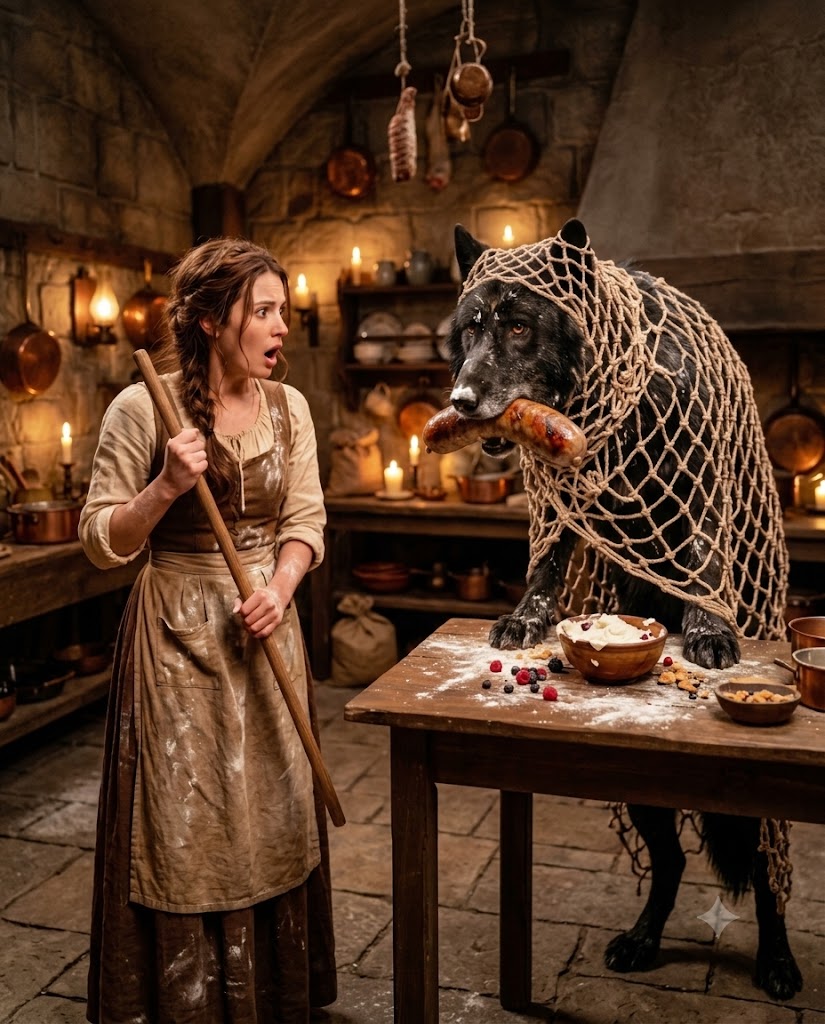
The king’s wolf was stealing food from the palace kitchen every night—and Roslin was the only person who noticed it wasn’t hungry.
The king’s voice was barely louder than the dying fire.
“You were never supposed to see that letter.”
Roslin looked at him, then at the wolf beneath the table.
The animal had gone completely still.
“What letter?”
Roven did not answer.
Instead, he stood.
Three more knocks sounded from the corridor.
Slow.
Deliberate.
The wolf’s lips lifted, revealing its teeth.
Roslin felt the air in the kitchen change.
Roven crossed the room and placed one hand against the pantry door.
“Stay here.”
“Why?”
“Because if I am wrong, you will be safer not knowing.”
Roslin folded her arms.
“And if you’re right?”
The king looked at her for a long moment.
“Then you are already in danger.”
Before she could respond, the knocking came again.
This time, Roslin recognized the rhythm.
Three knocks.
A pause.
Two knocks.
One knock.
Roven’s expression hardened.
He reached beneath his sleeve and pulled out a small silver key.
The wolf stood beside him.
“Come,” he whispered.
Roslin followed.
They left the kitchen through a narrow servants’ passage she had never noticed before. The stone walls were damp and cold, and the only light came from a handful of blue flames burning inside iron sconces.
They descended.
One flight.
Then another.
At the bottom stood a black iron door.
Roven inserted the key.
The lock clicked.
Beyond it was a chamber filled with letters.
Hundreds of them.
Perhaps thousands.
They covered the floor, were stacked on tables, tied with ribbons, sealed with wax, or hidden inside wooden boxes.
Roslin stared.
“What is this?”
“The reason I stopped sleeping.”
Roven picked up one envelope.
The seal had been broken.
“My father built this room.”
Roslin looked at him.
“Your father?”
“He was king before me.”
Roven’s voice had become quiet.
“He died believing the kingdom was surrounded by enemies. He trusted almost no one. He kept reports on every noble family, every commander, every village leader.”
He placed the letter back.
“When I inherited the crown, I destroyed most of his records.”
“Most?”
Roven’s eyes moved toward the far corner.
“I found this room three months ago.”
Roslin slowly walked closer.
There, beneath a layer of dust, was a wooden chest.
Its lid had been scratched deeply.
Four parallel marks.
Claw marks.
The same kind she had seen on the pantry door.
“The wolf found this room before you did,” she whispered.
Roven nodded.
“His name is Veyr.”
The enormous wolf lowered his head.
“He belonged to my father.”
Roslin stared at the animal.
“Then why was he stealing food?”
“Because he was trying to lead me here.”
A cold feeling moved through Roslin’s chest.
She remembered the bread.
The untouched plates.
The eyes always fixed on the palace doors.
Veyr had never been hungry.
He had been trying to get someone’s attention.
Roven walked toward the chest.
“I thought he was simply restless after my father’s death. Then, two weeks ago, I found this.”
He lifted the lid.
Inside lay a single letter.
Its paper was yellowed.
Its seal had been broken long ago.
Roslin read the first line.
“If you are reading this, then the crown has already begun to consume you.”
She looked at Roven.
“Your father wrote that?”
“Yes.”
“Why would he say that?”
“Because he knew what was coming.”
Roven handed her the letter.
She continued reading.
The handwriting was hurried.
“The greatest threat to a king is not the enemy beyond his walls. It is the voice beside him that tells him what he wants to hear.”
Roslin swallowed.
“Who wrote the letters?”
Roven looked toward the hundreds of documents.
“I don’t know.”
A sudden growl came from Veyr.
The wolf was staring at the ceiling.
Roven immediately extinguished the nearest lamp.
“Someone is above us.”
Roslin held her breath.
Footsteps.
Very faint.
Crossing the floor directly above their heads.
Then stopping.
A scrape.
Something heavy was dragged across the stone.
Roven motioned for Roslin to stay behind him.
Veyr moved ahead.
The wolf pressed his nose against a section of wall.
He scratched once.
Roven touched the stone.
Nothing happened.
Veyr scratched again.
This time, a hidden panel shifted.
Behind it was a narrow passage leading upward.
Roven looked at Roslin.
“Your wolf is smarter than both of us.”
“He’s not mine.”
Veyr looked back at her.
For the first time, Roslin understood why the animal had always seemed to know where she was.
He had chosen her too.
They climbed the passage.
At the top was a small opening behind a tapestry in the council hall.
Roslin recognized the room immediately.
It was where the king met his advisers every morning.
But now it was empty.
Except for one man.
Lord Caelen.
The king’s most trusted adviser.
He stood beside the long council table, holding a letter over a candle.
Roven’s face changed.
Not anger.
Not surprise.
Something worse.
Recognition.
Caelen turned.
The letter slipped from his fingers.
For several seconds, nobody spoke.
Then the adviser smiled.
“You finally found the room.”
Roven stepped from behind the tapestry.
“How long?”
Caelen’s smile disappeared.
“Long enough.”
“How long have you been reading my father’s letters?”
“I didn’t need to read all of them.”
Caelen reached inside his coat.
Veyr growled.
Roven drew his sword.
“Don’t.”
Caelen stopped.
“I could have killed you a dozen times.”
“Then why didn’t you?”
“Because a dead king creates a martyr.”
Caelen looked at Roslin.
“But a frightened king creates obedience.”
Roslin felt sick.
The letters.
The sleepless nights.
The border disputes.
The constant warnings.
The reports about enemies.
Someone had been feeding Roven fear.
Not to destroy him.
To control him.
“You created the threats,” Roslin whispered.
Caelen’s eyes narrowed.
“Not all of them.”
“That’s why the letters kept coming,” Roven said.
Caelen laughed softly.
“Your kingdom was already unstable. I only gave its fears a direction.”
Roven stepped forward.
“You manipulated me.”
“I protected the throne.”
“You poisoned it.”
Caelen’s expression hardened.
“You think ruling is about kindness? About tea and bread at midnight?”
He pointed toward Roslin.
“You have been sitting in a kitchen while men outside these walls sharpen knives. You don’t understand what a kingdom costs.”
Roslin surprised herself by answering.
“No. But I understand what fear does to a hungry animal.”
Caelen looked at Veyr.
The wolf’s eyes never left him.
“You saw him stealing food and thought he was hungry,” Roslin continued.
“But he wasn’t asking for food.”
She looked at Roven.
“He was asking to be heard.”
Silence filled the chamber.
Caelen shook his head.
“Words from a kitchen girl.”
Roven’s sword lowered slightly.
“She noticed what all of us missed.”
Caelen stepped backward.
“You cannot arrest me.”
“Why?”
“Because half the council serves me.”
Roven stared at him.
“Then half the council will answer for itself.”
Caelen suddenly pulled a small blade from his sleeve.
Veyr lunged.
The wolf struck his wrist before he could reach the king.
The knife clattered across the floor.
Guards stormed into the chamber.
Roslin had not heard them approach.
They seized Caelen.
But the adviser only smiled.
“You still don’t understand, Roven.”
The king turned.
“What?”
“The letters weren’t the plan.”
Caelen looked toward the eastern windows.
“The letters were the warning.”
Then the palace bells began to ring.
Once.
Twice.
Three times.
Roven froze.
A guard ran into the hall.
“Your Majesty!”
“What happened?”
“The eastern gate has fallen.”
The world seemed to stop.
Caelen’s smile vanished.
For the first time, genuine fear crossed his face.
Roven turned toward the windows.
Far beyond the palace walls, orange light climbed into the night.
Fire.
Roslin felt Veyr press against her leg.
“The letters,” she whispered.
Roven looked at her.
“Your father wasn’t trying to control you.”
“No.”
“He was trying to warn you about an invasion.”
Roven’s eyes widened.
Caelen looked toward the burning horizon.
“I told you,” he said quietly.
“Not all of the threats were mine.”
The palace erupted into chaos.
Servants ran through corridors.
Soldiers shouted orders.
The bells screamed overhead.
Roven grabbed his sword.
“Roslin, go to the lower kitchens. Take the servants and hide in the wine cellar.”
“No.”
His expression hardened.
“That was not a request.”
She stepped closer.
“Then stop treating me like someone who cannot understand danger.”
Roven stared at her.
The king who had once frightened entire rooms with a glance suddenly looked like the man who had fallen asleep over a cup of tea.
“I don’t want you to die,” he said.
Roslin’s voice softened.
“Then don’t send me somewhere you can’t protect.”
Veyr suddenly barked.
They both looked down.
The wolf was staring toward the western corridor.
Then he ran.
Roven followed.
Roslin followed Roven.
They reached the armory.
Veyr stopped before a rack of old weapons.
He scratched the stone floor.
Roven moved the rack aside.
A trapdoor appeared.
Beneath it was a tunnel.
“Another secret,” Roslin whispered.
“My father loved secrets.”
They descended.
The tunnel led beneath the palace walls and emerged near the western gate.
There, hidden among the trees, stood dozens of soldiers.
Not invaders.
Royal guards.
But they were kneeling.
Their weapons were lowered.
At their center stood the captain of the palace guard.
Roven stared at him.
“Captain?”
The man looked up.
“I am sorry, Your Majesty.”
Then he raised his sword.
“I cannot obey you anymore.”
Behind him, another figure stepped from the darkness.
Caelen’s son.
Lord Aric.
He held a bloodied royal seal.
“The eastern gate was only the beginning.”
Roven’s face became pale.
“You were working with them.”
Aric shook his head.
“I was working with whoever would keep my family alive.”
He looked toward the burning palace.
“They promised to spare the capital.”
“And you believed them?”
Aric’s jaw tightened.
“They have my wife and daughter.”
The answer struck the silence like a stone.
Roslin understood then.
This was bigger than betrayal.
Fear had spread through the palace like fire because everyone had something they were afraid to lose.
Roven lowered his sword.
“Where are they?”
Aric hesitated.
“The old monastery.”
Roven nodded.
“Then we bring them home.”
The captain stared.
“You would negotiate?”
“I would rather bring back a family than bury another one.”
Aric lowered his weapon.
But before anyone could move, an arrow flew from the trees.
It struck the captain.
He collapsed.
Everything exploded into motion.
“Shields!”
Roven pulled Roslin behind a stone wall.
Veyr vanished into the darkness.
Arrows rained across the clearing.
Soldiers shouted.
Horses screamed.
Then Veyr attacked.
The wolf tore through the first line of hidden archers, giving the royal guards enough time to advance.
Roven fought beside his men.
Not from behind.
Not from a throne.
Beside them.
Roslin stayed near the wounded.
She tore strips from her apron and pressed them against bleeding arms.
For hours, the battle moved around them.
By dawn, the eastern fire had been contained.
The palace still stood.
Barely.
Caelen was imprisoned.
Aric surrendered.
The invaders retreated beyond the forest when they realized the gates had been defended.
But victory did not feel like victory.
Too many stones were blackened.
Too many people were missing.
Roven stood in the ruined council chamber.
The table was split in two.
The walls were scorched.
The thousands of letters from his father’s hidden chamber had been brought upstairs.
He looked at them for a long time.
Then he ordered the doors opened.
“Bring the council.”
One by one, the nobles entered.
Some were afraid.
Some were ashamed.
Some were angry.
Roven placed his father’s letter in the center of the table.
“My father spent his final years believing fear was the only thing strong enough to protect a kingdom.”
He looked at Caelen.
“And you believed the same.”
Caelen said nothing.
Roven continued.
“You were wrong.”
He turned to the council.
“A kingdom cannot be protected by making its people afraid of one another.”
No one spoke.
“From this day forward, every royal decree concerning war, taxes, and imprisonment will be recorded and made available to the people.”
Several nobles exchanged uneasy glances.
“And the secret archives will be opened.”
Caelen finally raised his head.
“You would expose everything?”
“Not everything,” Roven said.
“The truth that protects the kingdom will be shared. The secrets that only protect powerful men will not.”
Roslin stood at the back of the room.
She expected the speech to end there.
Instead, Roven looked directly at her.
“And one more thing.”
The room turned.
“The person who first warned me that something was wrong was not a commander.”
His eyes softened.
“She was a kitchen worker who noticed a wolf was frightened.”
Roslin felt heat rise to her face.
The council murmured.
Roven ignored them.
“She did not have a title.”
“She did not have political power.”
“She simply paid attention.”
The room became quiet.
“And sometimes,” Roven said, “that is where wisdom begins.”
Weeks passed.
The palace slowly healed.
The eastern gate was rebuilt.
The kitchens received new tables.
The servants received better rooms.
The council changed.
Some resigned.
Some were arrested.
Others remained and were forced to speak openly instead of whispering behind closed doors.
Caelen was sentenced after a public trial.
Aric’s family was returned safely from the monastery.
The captain survived.
And the kingdom learned that many of the rumors that had haunted it for years had begun with one simple idea:
Keep people afraid, and they will accept almost anything.
Roven changed too.
He still had difficult nights.
He still carried decisions into his room.
But he no longer carried them alone.
Sometimes he would walk to the kitchen after midnight.
Roslin would be there, kneading dough or checking the ovens.
He would sit at the old wooden table.
She would pour tea.
Neither needed to speak immediately.
And Veyr always slept beneath the table.
One winter evening, months after the attack, Roslin found Roven staring at the wolf.
“He hasn’t stolen anything in weeks,” she said.
Roven smiled.
“He finally trusts the palace.”
Roslin shook her head.
“No.”
She sat across from him.
“He trusts that someone will notice if he is afraid.”
Roven looked at her.
For a moment, neither spoke.
Then he reached into his coat and placed a small object on the table.
A silver key.
Roslin recognized it.
“The hidden archives?”
“All of them.”
He pushed it toward her.
“You should keep it.”
“Why me?”
“Because you were the first person who understood what the key was worth.”
Roslin looked down at the silver in her palm.
“I don’t think I belong in a room full of royal secrets.”
Roven smiled.
“Neither did the person who built it.”
Outside, snow began falling over the palace roofs.
Veyr lifted his head.
For a moment, he listened.
Then he lowered it again.
No footsteps.
No knocking.
No danger.
Only winter.
Roslin returned the key.
“You keep it.”
Roven raised an eyebrow.
“Why?”
“Because rulers should never forget that a key can open a door both ways.”
He understood.
A key could reveal truth.
But it could also lock truth away.
He closed his fingers around it.
“I won’t forget.”
That night, Roven slept.
Not because the kingdom was finally safe.
It wasn’t.
There would always be wars, betrayals, mistakes, and people who wanted power.
He slept because he had finally learned something his father never had.
A ruler could not protect a kingdom by carrying every fear alone.
Fear grew in silence.
So did lies.
But when someone was brave enough to speak, and someone else was humble enough to listen, even the darkest room could find a door.
Years later, people would tell stories about the night the palace nearly fell.
They would talk about the invasion.
The traitors.
The secret chamber beneath the council hall.
They would remember the king who fought beside his soldiers.
They would remember the adviser who tried to rule through fear.
But Roslin remembered something much smaller.
A loaf of bread.
A trembling paw.
And a wolf who had been trying to say something long before anyone thought to listen.
That was the lesson she carried for the rest of her life:
Not every cry for help sounds like a cry.
Sometimes it arrives as anger.
Sometimes as silence.
Sometimes as a broken routine no one bothers to question.
And sometimes, in the dead of night, it arrives on four paws carrying a loaf of bread.
The wise do not always notice the loudest voice.
They notice what everyone else has learned to ignore.
And that was how a kitchen girl helped save a kingdom—not by becoming a queen, not by wielding a sword, and not by knowing every secret.
She simply paid attention.
And because she did, the king finally learned to listen.
Three years passed after the night the palace nearly fell.
The scars were still there.
Some had faded beneath new stone and fresh paint.
Others remained in places no mason could reach.
Roven had learned that kingdoms did not heal simply because the fighting stopped.
People remembered.
Soldiers remembered.
Families remembered empty chairs at dinner tables.
And rulers remembered the names of those they had failed to protect.
The kingdom became quieter, but never careless.
The council chambers were no longer places where decisions disappeared behind closed doors.
Every month, citizens were allowed to send written petitions directly to the palace.
The royal archives were opened to scholars, judges, and representatives from the villages.
And the servants who had once been invisible inside the palace were given something almost unheard of in those days.
A voice.
Roslin had become the keeper of the royal kitchens.
She still woke before sunrise.
She still complained when the flour arrived late.
She still threatened the kitchen boys with a wooden spoon whenever they burned the bread.
And she still refused to sit at the head table during royal celebrations.
But there was one difference.
People listened when she spoke.
Not because she had married the king.
She had not.
Not because she had been given a noble title.
She had refused one.
People listened because Roven had made one rule very clear:
If Roslin said something was wrong, someone had better look into it.
And Roslin had become very good at noticing when something was wrong.
A servant who stopped singing.
A guard who suddenly avoided a certain corridor.
A messenger whose hands shook while delivering a letter.
A child who stopped asking questions.
She had learned that trouble rarely arrived wearing a black cloak.
More often, it arrived quietly.
That winter, trouble came as a missing bell.
It was an old silver bell from the northern monastery.
It had been given to the royal family generations ago and was used only during times of mourning.
One morning, the abbot arrived at the palace carrying an empty velvet box.
“The bell is gone,” he said.
Roven frowned.
“When?”
“Three nights ago.”
“Who had access?”
The abbot named six people.
Roslin listened from the side of the room.
She noticed something strange.
The abbot kept looking at the empty box.
Not angrily.
Fearfully.
“Why are you afraid of a bell?” Roslin asked.
The abbot looked at her.
“Because it was never only a bell.”
Roven leaned forward.
“What does that mean?”
The old man hesitated.
Then he sighed.
“The bell belonged to your grandfather. Before he died, he ordered that it should never be rung unless the kingdom faced a danger greater than war.”
Silence filled the room.
Roven stood.
“Greater than war?”
The abbot nodded.
“The bell does not warn of armies.”
“What does it warn of?”
The old man’s eyes moved toward the windows.
“Something already inside.”
Roven immediately ordered the palace sealed.
But Roslin remembered something.
The old letters.
The hidden chamber.
The warning that had begun everything.
Something already inside.
That night, she returned to the archives.
Veyr followed her.
The wolf was older now.
Silver had appeared around his muzzle.
His movements were slower, but his eyes remained sharp.
Roslin opened the old chest.
She searched through her father’s records.
Nothing.
Then she remembered the smallest letter.
The one no one had noticed because it had been folded inside another.
She opened it.
There was only one sentence.
“Never search for the enemy where everyone is looking.”
Roslin stared at the words.
Then she understood.
She ran.
Not toward the council chamber.
Not toward the gates.
Toward the kitchens.
The kitchens were nearly empty at midnight.
She walked past the ovens.
Past the pantry.
Past the old wooden table where Roven had once fallen asleep.
She stopped in front of the flour cellar.
Something was wrong.
One of the barrels had been moved.
Roslin touched it.
It was warm.
She stepped back.
Then the floor opened.
A hand grabbed her ankle.
Roslin screamed.
She fell hard.
A figure emerged from beneath the cellar.
Before he could cover her mouth, Veyr attacked.
The man rolled away.
Roslin scrambled backward.
The wolf stood between them.
The stranger wore a palace guard’s uniform.
But Roslin had never seen him before.
“Who are you?”
The man said nothing.
He reached for a knife.
Veyr growled.
Then Roven arrived with six guards.
The stranger froze.
Roven stared at him.
“Take off the helmet.”
The man slowly removed it.
Roven recognized him.
His face went pale.
“Commander Edran.”
The commander of the northern watch.
A man believed to have died two years earlier.
Roslin looked at Roven.
“He wasn’t dead?”
“No.”
Roven’s voice was barely audible.
“He disappeared.”
Edran laughed.
“You believed what I wanted you to believe.”
Roven stepped closer.
“Why?”
“Because the old king was right.”
Roven’s expression hardened.
“No.”
“He knew the kingdom would collapse unless someone controlled it.”
“You murdered people to prove his theory.”
“I removed weakness.”
“You murdered people.”
Edran’s eyes moved toward Roslin.
“And she is the weakness.”
Veyr lunged.
Roven raised his hand.
The wolf stopped.
That single command took all the strength from him.
Edran smiled.
“You see?”
He pointed at Veyr.
“Even the beast obeys when fear is strong enough.”
Roslin shook her head.
“No.”
Edran looked at her.
“He doesn’t obey because he is afraid.”
Veyr stood beside her.
“He obeys because he trusts him.”
For the first time, Edran had no answer.
Roven ordered the guards to take him away.
But before they did, Edran laughed.
“You think this ends with me?”
Roven stopped.
“How many?”
Edran smiled.
“Enough.”
The words followed them long after he was taken away.
There were more.
More hidden enemies.
More people who had believed that fear was the easiest way to control a kingdom.
The next six months were filled with investigations.
Some conspirators were arrested.
Others confessed.
A few fled.
But something unexpected happened.
The people did not panic.
They did not turn against one another.
They asked questions.
They demanded evidence.
They waited for facts.
And Roven gave them the truth, even when the truth made him look weak.
That was what finally broke the cycle.
Years earlier, fear had spread because everyone had believed silence was safer.
Now silence was no longer the only choice.
One spring morning, Roven walked into the kitchen carrying something wrapped in cloth.
Roslin looked up from a tray of bread.
“What have you broken?”
“Nothing.”
“Then why do you look guilty?”
Roven smiled.
He placed the bundle on the table.
Roslin opened it.
Inside was a small silver bell.
Her expression changed.
“The monastery bell.”
Roven nodded.
“We found it.”
“Where?”
“In the old northern barracks.”
Roslin touched it.
It was cold.
Heavy.
Older than the kingdom itself.
“Did anyone ring it?”
“No.”
“Good.”
Roven looked toward the window.
“The abbot says we should return it immediately.”
Roslin frowned.
“You don’t look convinced.”
“I want to ask you something first.”
She raised an eyebrow.
“What?”
“If the bell was meant to warn us about danger, why was it hidden?”
Roslin considered the question.
Then she smiled.
“Maybe it wasn’t hidden.”
Roven waited.
“Maybe someone simply forgot where they put it.”
He laughed.
It was a small laugh.
But it filled the kitchen.
Veyr, lying near the oven, lifted his head.
Then he stood.
Roslin looked at him.
“What is it?”
The wolf walked toward the door.
He stopped.
Three knocks came from the corridor.
Everyone froze.
Three slow knocks.
Roslin’s smile disappeared.
Roven reached for his sword.
Veyr growled.
The door opened.
No one stood outside.
Only a young boy.
Perhaps eight years old.
He was holding a folded piece of paper.
He looked terrified.
Roven knelt.
“Who are you?”
The boy swallowed.
“My mother told me to bring this.”
He handed the paper to Roslin.
She opened it.
There were only four words.
“Please listen this time.”
Roslin looked at Roven.
The king read the message.
His expression changed.
“Where is your mother?”
The boy pointed toward the eastern road.
“She said someone was following her.”
Roven immediately called the guards.
But Roslin stopped him.
“Wait.”
Everyone turned.
She looked at the boy.
“What did she tell you before you came here?”
The child hesitated.
“She said not to trust anyone who tells me there is nothing to be afraid of.”
Roven slowly stood.
His eyes met Roslin’s.
The old lesson had returned.
Not every warning was a lie.
And not every warning was true.
The difference was what you did next.
They did not send soldiers blindly into the eastern road.
They investigated.
They questioned witnesses.
They followed evidence.
They discovered that the boy’s mother had uncovered a smuggling network operating along the border.
It was dangerous.
But it was not an invasion.
It was not another secret war.
It was simply a group of criminals taking advantage of villages that had been ignored for years.
The network was dismantled.
The stolen goods were returned.
The villages were given protection.
And the boy and his mother were given a home inside the capital.
That evening, Roslin stood alone outside the palace.
Snow had disappeared.
The gardens were green again.
Veyr lay beside her.
Roven joined them.
“You were right,” he said.
Roslin looked at him.
“About what?”
“The boy.”
She smiled.
“I usually am.”
Roven laughed.
Then he became quiet.
“Do you ever wonder what would have happened if you hadn’t noticed Veyr?”
Roslin looked at the old wolf.
“Yes.”
“And?”
“I don’t know.”
Roven looked toward the palace.
“I think I would still be sitting in that council chamber.”
“Probably.”
“I might have become exactly what my father feared.”
Roslin shook her head.
“No.”
He looked at her.
“You don’t know that.”
“I do.”
“How?”
“Because you listened.”
Roven was silent.
Roslin continued.
“A cruel man doesn’t become kind because someone gives him good advice.”
She placed a hand on Veyr’s head.
“A frightened man can become brave when someone gives him permission to stop pretending he isn’t afraid.”
Roven looked away.
His eyes had become wet.
“I was very afraid.”
“I know.”
“I still am sometimes.”
“So am I.”
The king smiled.
“That’s comforting.”
“It should be.”
“Why?”
“Because it means we’re paying attention.”
Veyr slowly stood.
He looked toward the palace.
Then toward the forest.
For a moment, Roslin wondered whether another danger had come.
But the wolf simply stretched.
His old bones cracked.
Then he walked back toward the kitchen.
Roslin laughed.
“Hungry?”
Veyr looked over his shoulder.
Roven smiled.
“He hasn’t changed.”
“He has.”
“How?”
“He no longer steals bread.”
They followed him inside.
The kitchen was warm.
The ovens glowed.
Fresh bread filled the room with its familiar smell.
Roslin placed a small piece beside Veyr.
He looked at it.
Then looked at her.
Then, very deliberately, he pushed it back toward her.
Roven laughed.
“What’s that supposed to mean?”
Roslin smiled.
“It means he learned to ask.”
She broke the bread in half.
One piece for herself.
One for the wolf.
Outside, the kingdom continued moving.
People argued.
Merchants shouted in the streets.
Children ran through the courtyards.
Farmers complained about taxes.
Soldiers trained.
Kings made mistakes.
Life continued.
It was never perfectly safe.
It never would be.
But perhaps safety had never meant living without fear.
Perhaps it meant knowing that fear did not have to make every decision for you.
Years later, when Roven’s hair had turned gray and Veyr was remembered only through old paintings, people still told the story.
Some said the king’s wolf had saved the kingdom.
Others said it was Roslin.
Some believed it was Roven’s decision to open the royal archives.
Others believed it was the soldiers who defended the eastern gate.
All of them were partly right.
But Roslin knew the truth was smaller.
The kingdom had not been saved by one heroic act.
It had been saved by a thousand moments when someone chose to listen instead of assume.
Someone chose to ask instead of accuse.
Someone chose truth instead of comfort.
And someone noticed when another creature was afraid.
That was why, whenever young servants entered the palace kitchens, Roslin taught them the same lesson.
“Pay attention.”
They would laugh.
“Pay attention to what?”
She would point toward the door.
“To everything.”
And if they asked why, she would tell them about the wolf who once stole bread every night.
She would tell them how everyone thought he was hungry.
Everyone except one kitchen girl.
And she would always end the story with the same words:
“Sometimes the thing that looks like a problem is actually a message.”
Then she would smile.
“And sometimes the person everyone overlooks is the only person who notices it.”
On the final winter of her life, Roslin sat beside the palace fire with an old blanket around her shoulders.
Roven had been gone for many years.
The kingdom had passed to a new generation.
The old secret chamber had become a public library.
The council hall had windows where there had once been hidden doors.
And on the wall above the library entrance hung a simple inscription:
LISTEN BEFORE YOU JUDGE.
Roslin closed her eyes.
For a moment, she could almost hear the old kitchen again.
The crackle of dying firewood.
The soft scrape of claws.
The cautious footsteps of a frightened wolf.
She smiled.
Then she heard something beside her.
A tiny sound.
A paw against stone.
Roslin opened her eyes.
A young black wolf stood in the doorway.
It carried a loaf of bread in its mouth.
She stared at it.
The wolf stared back.
For several seconds, neither moved.
Then Roslin laughed.
“Oh,” she whispered.
“Not again.”
The young wolf dropped the bread.
It did not run.
Instead, it walked toward her and sat at her feet.
Roslin looked at the loaf.
Then at the animal.
She understood.
It wasn’t hungry.
It wanted someone to notice.
Roslin reached down and touched its head.
“Come on,” she said softly.
“Let’s see what you’re trying to tell us.”
And somewhere beyond the old palace walls, the bells began to ring.
Not because war had arrived.
Not because the kingdom was falling.
But because life, as it always had, was reminding them that there would always be something new to hear.
And someone would always need to listen.
THE END.