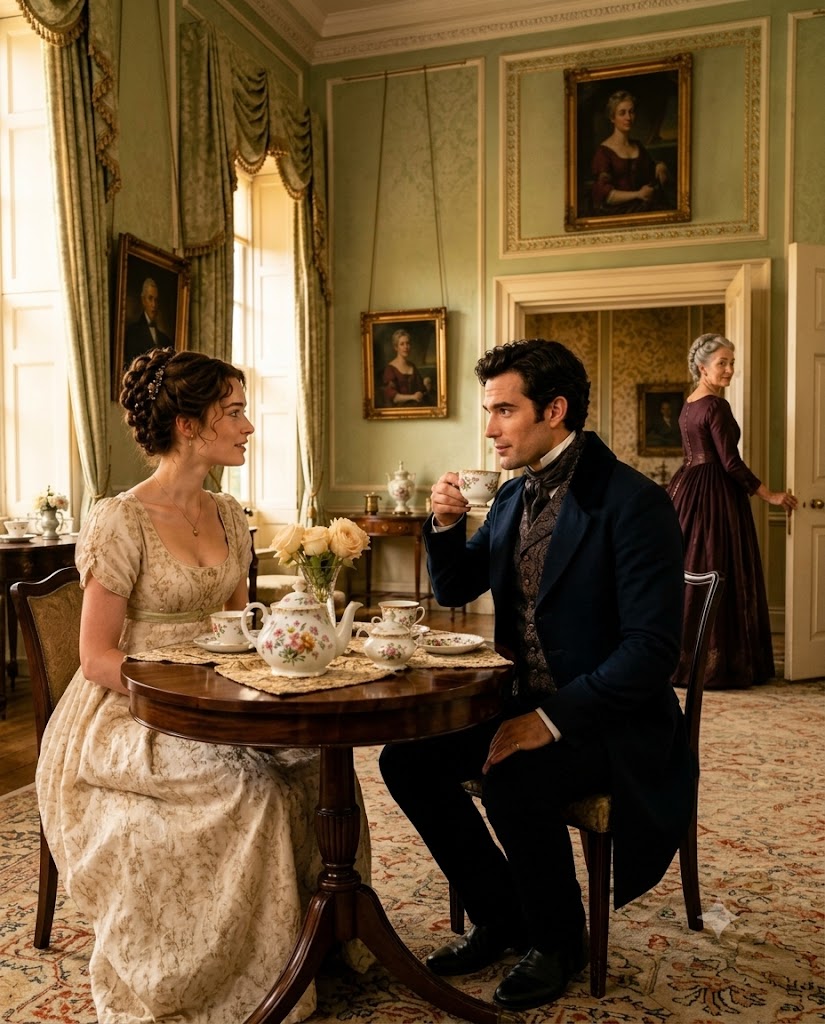
The invitation was meant to trap a duke into marriage—but by the end of the afternoon, he was the one quietly asking for another cup of tea.
“Who gave you this?”
Theodore’s voice was so quiet that it was more unsettling than anger.
Evelyn held his gaze.
“I don’t know.”
He looked down at the note again.
For the first time since she had known him, something unguarded crossed his face.
Not irritation.
Not embarrassment.
Fear.
It vanished almost immediately.
He folded the paper once, carefully, as though it might cut him if handled carelessly.
“Come with me.”
Evelyn did not move.
“Theodore—”
“Not here.”
His eyes flicked toward the crowded drawing room.
Lady Arabella was laughing with two other guests near the fireplace, but her attention was unmistakably fixed on them.
Theodore noticed.
“So did I,” he murmured.
He extended his hand.
Evelyn hesitated for only a second before placing hers in it.
He led her through a side door and down a quiet corridor, away from the music and the murmuring voices.
Only when they reached the library did he close the door behind them.
Rain tapped softly against the windows.
The room smelled of old leather, cedar, and extinguished fire.
Evelyn stood near the desk.
“You owe me an explanation.”
“I know.”
“And if you tell me this is nothing—”
“It is not nothing.”
The answer came so quickly that she stopped.
Theodore removed his coat and placed it over the back of a chair.
Then he stood with both hands resting against the edge of the desk.
“The woman in that note was named Clara Ashford.”
Evelyn said nothing.
“She was the daughter of a baronet. We met when I was twenty-seven. I thought I loved her.”
“You thought?”
His eyes lowered.
“I was young enough to confuse love with certainty.”
Evelyn’s expression softened despite herself.
“What happened?”
“Everything society expected to happen.”
A bitter smile touched his mouth.
“Our families approved. An announcement was made. A wedding date was discussed. Everyone congratulated us.”
“And then?”
“She disappeared.”
Evelyn frowned.
“Disappeared?”
“Three weeks before the wedding.”
The silence that followed felt heavier than the rain.
“No explanation?”
“None.”
“Did you look for her?”
“For months.”
Theodore walked toward the window.
“I sent letters. I went to London. I spoke with her brother. I even searched the places she used to visit.”
He paused.
“Nothing.”
“Did you believe she had left willingly?”
“I had no choice but to believe it.”
Evelyn watched his reflection in the glass.
“And that is why you never married.”
He did not answer.
She understood anyway.
“You waited for her.”
“No.”
The word was firm.
Then, after a moment, softer:
“I waited for an answer.”
Evelyn looked down.
“Did you ever receive one?”
“No.”
“Until now?”
Theodore turned.
“I don’t know.”
A strange chill passed through her.
“What do you mean?”
He unfolded the note again.
“Because this is not the first time someone has tried to bring Clara back into my life.”
Evelyn’s heart tightened.
“Who?”
“Three months ago, I received a letter.”
“From Clara?”
“No.”
“Then from whom?”
Theodore hesitated.
“Someone claiming to know what happened to her.”
“And you kept this from me?”
“I did not know you.”
The words were reasonable.
Yet Evelyn felt their weight.
“Not when you received the letter,” she said quietly. “But now you do.”
Theodore’s expression changed.
“Yes.”
It was the simplest answer.
And somehow the most dangerous.
He walked to a locked cabinet and took out a small key.
From inside, he removed an envelope.
The paper was old.
The seal had been broken.
He handed it to Evelyn.
She read the first line.
Your Grace, if you wish to know why Clara Ashford left you, come alone to Blackthorn Chapel on the twelfth night of November.
Evelyn looked up.
“That date is tomorrow.”
“Yes.”
“And you were going to go?”
“Yes.”
“Alone?”
“Yes.”
She stared at him.
“You cannot possibly think that is sensible.”
“I never said it was.”
“You could be walking into a trap.”
“I know.”
“Then why would you go?”
Theodore looked at her for a long moment.
“Because for seven years I have wondered whether I failed someone who trusted me.”
Evelyn’s anger faded.
There was something unbearably lonely in his voice.
“You did not fail her simply because she disappeared.”
“I might have.”
“How?”
“I never asked why she was afraid.”
Evelyn went still.
Theodore looked away.
“Clara was frightened in the weeks before our wedding. I saw it. I thought she was merely nervous.”
His jaw tightened.
“I was so certain that everything would be fine that I never asked the right question.”
Evelyn stepped closer.
“And now you believe someone is offering you the chance to ask it.”
“Yes.”
She looked at the letter.
“Then I am coming with you.”
His head snapped toward her.
“No.”
“You said yourself it might be a trap.”
“Exactly.”
“That is precisely why you should not go alone.”
“Evelyn.”
She raised her chin.
“You may be a duke, Theodore, but you are not my guardian.”
For one suspended moment, neither spoke.
Then, unexpectedly, he laughed.
It was quiet and almost disbelieving.
“What?”
“I have been trying to decide whether you are remarkably brave or remarkably impossible.”
“Perhaps both.”
“I am beginning to suspect that is the problem.”
“What problem?”
He looked at her.
“The one I am not supposed to have.”
Her heart stumbled.
Before she could answer, footsteps sounded outside.
Theodore immediately stepped back.
The door opened.
Lady Constance entered.
Her eyes moved from her son to Evelyn.
Then to the letter in Evelyn’s hand.
Her face went pale.
“You know.”
Theodore turned.
“You knew about Clara?”
Lady Constance closed the door behind her.
“I knew she was in danger.”
The room seemed to shrink.
Evelyn looked between them.
“Then why did you say nothing?”
“Because I promised.”
“To whom?”
“Clara.”
Theodore stared at his mother.
“What did she ask you to promise?”
Lady Constance took a slow breath.
“That if she ever disappeared, I was not to tell you where she had gone unless I was certain you were no longer being watched.”
“Watched by whom?”
Lady Constance’s eyes moved toward the window.
“The Ashford family had debts. Serious ones. Clara discovered that her father had borrowed money from a man named Victor Harcourt.”
Theodore’s expression hardened.
“Harcourt?”
“Yes.”
“I know that name.”
“He was once a friend of your uncle.”
“Before he was expelled from several houses for fraud.”
Lady Constance nodded.
“Harcourt had influence. He knew how to use secrets. Clara discovered that her father had signed documents giving Harcourt control over part of the Ashford estate.”
“And the wedding?”
“Harcourt wanted the marriage stopped.”
“Why?”
“Because your marriage would have given Clara protection.”
Evelyn understood.
“He wanted control of the Ashford estate.”
“Yes.”
“And Clara disappeared to protect her family.”
Lady Constance nodded slowly.
“She believed that if she vanished, Harcourt would have no reason to interfere with the Langfords.”
Theodore’s face had gone completely still.
“Where did she go?”
Lady Constance closed her eyes.
“I don’t know.”
“You said you promised her.”
“I promised not to tell you anything unless I knew it was safe.”
“And now?”
“Now I believe someone is trying to force you to uncover what should have remained buried.”
Theodore looked at Evelyn.
The meaning was immediate.
The note had not been an invitation.
It had been bait.
And someone knew exactly how to use Evelyn to pull the duke toward it.
“Then we do not go to Blackthorn Chapel,” Evelyn said.
Theodore shook his head.
“No.”
He picked up the letter.
“We go.”
His mother stared at him.
“Why?”
“Because whoever sent this expects me to come alone.”
He looked at Evelyn.
“They do not know she will be with me.”
Lady Constance’s expression changed.
For the first time, she smiled faintly.
“Then perhaps my little tea party accomplished more than I intended.”
The next evening, the rain returned.
Blackthorn Chapel stood beyond the eastern woods, abandoned for nearly twenty years.
Its stone walls were dark with moisture, and ivy crawled over the broken bell tower.
Theodore and Evelyn arrived just before midnight.
They left their carriage hidden among the trees.
The chapel door stood open.
Evelyn whispered, “Someone is expecting us.”
Theodore nodded.
Inside, the air was cold.
Moonlight entered through shattered windows, laying pale patterns across the floor.
There was no one there.
Then a candle flickered near the altar.
A figure stepped from the shadows.
A woman.
She wore a dark cloak.
Her face was hidden.
Theodore stopped breathing.
The woman slowly lowered her hood.
Evelyn looked at Theodore.
He had gone white.
“Clara.”
The woman’s eyes filled with tears.
“Theodore.”
For seven years, he had imagined this moment in countless different ways.
He had imagined anger.
Relief.
Accusation.
He had imagined asking why.
Instead, he simply stared.
“You’re alive.”
Clara nodded.
“I am sorry.”
Theodore closed his eyes for a moment.
Then he asked the question he had carried for seven years.
“Why did you leave?”
Clara looked at Evelyn.
“Because I believed I was saving you.”
“And did you?”
“No.”
Her voice broke.
“I only hurt you differently.”
She told them everything.
Her father’s debts.
Harcourt’s threats.
The forged documents.
The threats against Theodore’s younger sister.
The night Clara had been told that if she married Theodore, someone in the Langford household would pay the price.
She had believed Harcourt.
She had been twenty-six.
Frightened.
Alone.
And convinced that disappearing was the only way to keep everyone safe.
“I went to France,” she said. “I lived under another name. I waited for things to become safe.”
“Why did you return?”
“Because they never became safe.”
She reached into her cloak and produced a small leather book.
“Harcourt kept records.”
Theodore took it.
“What is this?”
“Proof.”
The book contained names, payments, dates, forged signatures, and details of the men Harcourt had bribed.
Including one name Theodore recognized immediately.
A senior official who had recently been appointed to a powerful position.
Evelyn looked at the final page.
There was another name.
Lady Arabella Vane.
Her breath caught.
“Arabella?”
Clara nodded.
“She is Harcourt’s niece.”
Theodore’s eyes narrowed.
“So the note—”
“Was hers.”
A sound came from the chapel entrance.
Everyone turned.
Applause echoed through the darkness.
Slow.
Deliberate.
Victor Harcourt stepped inside.
Two men followed him.
“Very touching,” he said.
Evelyn felt Theodore move in front of her.
Harcourt smiled.
“You have always been sentimental, Aldwick.”
“You should have stayed in the shadows.”
“And you should have married Clara when you had the chance.”
Clara stepped forward.
“You will not touch him.”
Harcourt laughed.
“You still believe bravery is the same thing as power.”
Theodore handed the ledger to Evelyn.
“Run.”
She stared at him.
“No.”
“Evelyn.”
“I said no.”
Harcourt’s men moved forward.
Then a gunshot cracked through the chapel.
Everyone froze.
Theodore looked toward the doorway.
Lady Constance stood there.
Behind her were two constables and the local magistrate.
Harcourt’s smile disappeared.
“You?”
Lady Constance raised her chin.
“You should never have underestimated a woman who has spent twenty years listening to men explain what they think she cannot understand.”
The constables seized Harcourt.
His men surrendered almost immediately.
But Harcourt did not look defeated.
He looked at Evelyn.
“You think this ends tonight?”
Evelyn held his gaze.
“No.”
She closed the ledger.
“I think tonight is when it begins.”
Harcourt was taken away.
The chapel fell silent.
Clara began to cry.
Theodore turned toward her.
For a long moment, they stood facing each other.
Then Clara whispered, “I am sorry.”
He nodded.
“I know.”
“I loved you.”
“I know.”
She looked at Evelyn.
“And now?”
Theodore followed her gaze.
Evelyn’s heart began to beat faster.
“I don’t know what comes next,” he said.
Clara smiled sadly.
“That is the first honest answer you have given me.”
She touched his hand once.
Then stepped away.
Some endings did not require hatred.
Some people were not meant to remain in each other’s lives simply because they had once loved one another.
Clara had been part of Theodore’s past.
But Evelyn was standing in his present.
And for the first time, he understood the difference.
Three weeks later, the truth about Harcourt became public.
The Ashford debts were settled.
The forged documents were exposed.
Several influential men resigned rather than face investigation.
Lady Arabella left London without saying goodbye.
Society, naturally, invented dozens of explanations.
Some said Theodore had rescued Clara.
Others said Evelyn had exposed a scandal.
A few insisted the entire affair had been arranged by Lady Constance from the beginning.
Lady Constance denied everything with such convincing innocence that Evelyn almost believed her.
Winter settled over the Langford estate.
One afternoon, Evelyn found Theodore in the library.
The door was open.
It always was now.
He was reading beside the fire.
She entered.
“You left the door open.”
“I did.”
“Why?”
He looked up.
“Perhaps I was hoping you would come in.”
She smiled.
“You have become terribly obvious.”
“I blame you.”
“That seems unfair.”
“I am a duke. I am permitted to blame people occasionally.”
Evelyn laughed.
He closed the book.
Then he stood.
“There is something I want to ask you.”
Her smile faded.
“What?”
He walked toward her.
“I have spent most of my life believing that certainty was necessary before making a decision.”
“And now?”
“Now I think certainty is sometimes just fear wearing a respectable coat.”
She looked at him.
“Theodore.”
“I don’t know what the future will look like.”
He took her hand.
“I don’t know whether we will always agree. I don’t know whether I will always understand you. I don’t know whether society will approve.”
She waited.
“But I know that every room feels different when you are not in it.”
Her eyes filled with tears.
“That is a very dangerous thing to say to a woman.”
“Why?”
“Because she might believe you.”
“I hope you do.”
He reached into his pocket.
There was no extravagant ring.
No audience.
No orchestra.
Only a simple gold band.
“I don’t want to ask you because my mother arranged a tea party.”
Evelyn smiled through her tears.
“I should hope not.”
“I don’t want to ask because society expects it.”
He took a breath.
“I want to ask because when everything I thought I knew about love was taken away, you were the person who remained.”
He lowered himself to one knee.
“Evelyn Pembroke, will you marry me?”
She stared at him.
For a moment, she said nothing.
Then she knelt too.
Theodore blinked.
“What are you doing?”
“Making this easier.”
“You are supposed to let me remain dramatically on one knee.”
“I have never been very good at following society’s rules.”
He laughed.
Then she held out her hand.
“Yes.”
The word was quiet.
But it changed everything.
Months later, they returned to the same tea room where they had first met.
The same tall windows.
The same silver tea service.
The same garden beyond the glass.
Lady Constance sat opposite them, watching with obvious satisfaction.
“I knew it,” she announced.
Theodore sighed.
“Mother.”
“I knew from the first afternoon.”
Evelyn raised an eyebrow.
“You knew we would marry?”
“No.”
Lady Constance smiled.
“I knew you would make each other honest.”
Theodore looked at Evelyn.
She looked back.
There were still questions ahead.
There would be arguments.
Mistakes.
Days when love would feel effortless and days when it would require patience.
But neither of them wanted the perfect story anymore.
They wanted a real one.
Theodore poured Evelyn another cup of tea.
She noticed.
“You remembered how I take it.”
“I remember everything about you.”
“That sounds dangerous.”
“It is.”
She smiled.
Outside, the first snow began to fall.
The world beyond the windows looked quiet and untouched.
But Evelyn knew better.
Life was not made beautiful because nothing went wrong.
It was made beautiful because people could choose what to do after everything went wrong.
Theodore had spent seven years waiting for an answer from the past.
When the answer finally came, it did not give him the future he had once imagined.
It gave him something better.
The freedom to stop waiting.
And Evelyn learned that love was not the absence of secrets, fear, or uncertainty.
It was the courage to ask questions.
The courage to listen to difficult answers.
And, perhaps most importantly, the courage to choose someone not because they fit perfectly into the life society had designed for them, but because together they were brave enough to design a life of their own.
Lady Constance lifted her teacup.
“To unexpected invitations.”
Evelyn laughed.
“To inconvenient truths.”
Theodore raised his cup.
“To second chances.”
Their cups touched softly.
And this time, the tea did not grow cold.
The cups touched softly.
And this time, the tea did not grow cold.
For a while, none of them spoke.
Outside, snow continued to fall over the Langford estate, covering the gardens in a quiet white veil.
It should have been the end of the story.
The scandal was over.
Harcourt was in custody.
Clara had finally been given the chance to return home.
Theodore had asked Evelyn to marry him.
And Evelyn had said yes.
Yet happiness, Evelyn would later discover, did not always arrive with music.
Sometimes it arrived quietly.
Sometimes it sat beside you by the fire.
Sometimes it looked like a cup of tea poured exactly the way you liked it.
And sometimes, just when you believed the storm had passed, the past knocked once more.
It happened three days before Christmas.
Evelyn was walking through the library when she noticed an envelope lying on Theodore’s desk.
There was no seal.
No name.
Only a single sentence written across the front.
For the Duke of Aldwick.
She did not touch it.
Instead, she waited until Theodore returned.
He entered a few minutes later, carrying a stack of papers.
“You look troubled.”
“There is a letter on your desk.”
His expression changed.
He crossed the room.
The moment he saw the envelope, the color drained from his face.
Evelyn stepped closer.
“What is it?”
“I don’t know.”
He opened it.
Inside was a single sheet.
He read it silently.
Then he handed it to her.
Evelyn’s eyes moved across the page.
You believe Harcourt acted alone. He did not. Ask who benefited when Clara disappeared.
She looked up.
“Theodore.”
He was already walking toward the door.
“No.”
She caught his sleeve.
“You said no more secrets.”
He stopped.
She held his gaze.
“If we are going to build a life together, you cannot protect me by shutting me out.”
His jaw tightened.
“I am not trying to protect you.”
“You are.”
“I am trying to make sure this ends.”
“Then let me help you.”
For several seconds, he said nothing.
Finally, he nodded.
Together, they began searching through the documents recovered from Harcourt.
At first, they found nothing.
Then Evelyn noticed something Theodore had overlooked.
A signature.
Not Harcourt’s.
Someone else’s.
A name written on a document concerning the Ashford estate seven years earlier.
Lord Sebastian Vale.
Theodore stared at it.
“I know him.”
“Who is he?”
“My father’s former solicitor.”
Evelyn’s heart sank.
“Is he still alive?”
“Yes.”
“Then we should speak to him.”
They found Lord Vale at his country house two days later.
He was an elderly man with trembling hands and a memory that seemed to disappear whenever certain questions were asked.
But when Theodore placed the document before him, something changed.
Vale closed his eyes.
“I wondered when you would find that.”
Theodore leaned forward.
“You knew.”
“Yes.”
“Tell me everything.”
Vale swallowed.
“Harcourt was not the mastermind.”
“Who was?”
The old man looked at Evelyn.
“Your father.”
Theodore froze.
“My father?”
“Not willingly.”
Vale explained that years earlier, the late Duke of Aldwick had discovered that several prominent families were using Harcourt to move money secretly through property transactions.
He had threatened to expose them.
Harcourt responded by creating a web of forged contracts designed to ruin anyone who challenged him.
Theodore’s father became one of his targets.
But there had been one problem.
Clara had discovered the truth.
She knew that if she married Theodore, the investigation would become public.
So Harcourt threatened her family.
And when that failed, he threatened the Langfords.
“He wanted the wedding to collapse,” Vale said.
“Because your marriage would have united two families powerful enough to expose him.”
Evelyn frowned.
“Then who benefited from Clara disappearing?”
Vale looked at her.
“The same people who benefited from the scandal remaining hidden.”
Theodore’s face hardened.
“How many?”
“Enough.”
Silence filled the room.
Evelyn suddenly understood something.
“This was never about one woman.”
“No,” Vale whispered.
“It was about control.”
Theodore stood.
“And the ledger?”
“Only the beginning.”
They returned to Aldwick that evening.
The snow had stopped.
The moon illuminated the estate, making it look peaceful.
But Theodore knew better now.
There were shadows in every corner of old power.
And some secrets survived because people became too tired to keep searching for the truth.
He placed the documents on the library table.
“I thought the worst thing that happened to me was losing Clara.”
Evelyn stood beside him.
“It wasn’t.”
“No.”
He looked at her.
“The worst thing was believing I had no choice.”
She reached for his hand.
“You do now.”
He squeezed her fingers.
“Yes.”
For the next several weeks, they worked quietly.
They did not accuse anyone without evidence.
They did not rush to the newspapers.
They gathered documents.
Witness statements.
Financial records.
Letters.
Names.
One by one, the hidden structure began to collapse.
Several men fled the country.
Others confessed.
Lord Vale gave a full statement.
And eventually, the truth became impossible to bury.
Harcourt had been only one part of a much larger scheme.
When the final hearing ended, Theodore returned home exhausted.
Evelyn found him sitting alone in the library.
The fire had burned low.
“You won.”
He shook his head.
“No.”
She sat beside him.
“I exposed the truth.”
“That is not the same thing.”
“What is?”
He looked into the fire.
“Winning would mean none of it ever happened.”
Evelyn was quiet.
Then she said softly,
“Perhaps healing is learning that something can have happened without owning the rest of your life.”
He looked at her.
She continued.
“You lost seven years.”
“Yes.”
“You lost someone you once loved.”
“Yes.”
“You were betrayed.”
“Yes.”
“But you are still here.”
Theodore smiled faintly.
“With you.”
“With me.”
He reached for her hand.
“Do you ever regret saying yes?”
She pretended to consider it.
“Occasionally.”
His eyebrows rose.
“Occasionally?”
“When you become unbearably serious.”
“I see.”
“And when you leave books everywhere.”
“I thought you liked my books.”
“I like the books.”
“And not the man who leaves them?”
She smiled.
“I am still deciding.”
He laughed.
It was the same laugh Evelyn had first heard in the library months before.
But now it came easily.
Without restraint.
Without fear.
A week later, Clara came to visit.
She looked different.
Not because she had changed completely, but because she no longer carried herself like someone waiting for permission to breathe.
She told Evelyn she was returning to France.
“There is work there,” she said.
“Work?”
“A school for girls.”
Evelyn smiled.
“You will be a teacher?”
“I think so.”
“That sounds like you.”
Clara glanced toward Theodore.
He was speaking with Lady Constance near the window.
“I once thought my life ended when I left him.”
Evelyn said nothing.
Clara continued.
“Now I think it began.”
Evelyn understood.
Some people were meant to be chapters.
Not because they were unimportant.
But because their purpose was to teach us something before the story moved forward.
When Clara left, she embraced Evelyn.
“Take care of him.”
Evelyn smiled.
“He is quite capable of taking care of himself.”
“I know.”
Clara looked toward Theodore.
“That is why I am not worried.”
She paused.
“Make him laugh.”
“I do.”
“Then you have already done more for him than I ever could.”
After she left, Theodore came to stand beside Evelyn.
“What did she say?”
“That I should make you laugh.”
He looked suspicious.
“Why?”
“Apparently you need it.”
“I have always been capable of laughter.”
“Only under extreme circumstances.”
He smiled.
“I suppose I shall have to prove you wrong.”
“Then begin.”
He leaned closer.
“Lady Pembroke, would you care to dance?”
“There is no music.”
“There doesn’t need to be.”
He took her hand.
They danced slowly in the empty drawing room.
No guests.
No orchestra.
No society watching.
Just the two of them.
And for the first time, Evelyn realized how far they had come.
Their first meeting had been a trap.
A carefully arranged tea intended to push a reluctant duke toward marriage.
Neither of them had wanted it.
Neither had trusted the other.
Yet somehow, from that awkward beginning, something real had grown.
Not because their lives were perfect.
Because they had stopped pretending they were.
Several months later, on a warm spring morning, the wedding took place.
It was smaller than society expected.
Lady Constance had wanted a grand celebration.
Evelyn had wanted something quieter.
Theodore, for once, had refused to choose.
So they compromised.
There were flowers.
There was music.
There were guests.
There was laughter.
But there were no political speeches.
No carefully calculated alliances.
No marriage arranged for convenience.
When Evelyn walked toward him, Theodore forgot everyone else was there.
She reached him.
He whispered,
“You came.”
She smiled.
“You asked me to.”
“I was afraid you might change your mind.”
“I nearly did.”
His eyes widened.
She laughed.
“About the flowers.”
He exhaled.
“You are cruel.”
“I know.”
The ceremony began.
And when they exchanged vows, neither promised perfection.
They promised honesty.
Patience.
Courage.
And the willingness to speak when silence would be easier.
Years later, people would remember their wedding as one of the happiest events of the season.
But Evelyn remembered something else.
After the ceremony, she and Theodore had escaped to the library.
He had loosened his cravat.
She had removed one of her gloves.
Two untouched cups of tea sat on the table.
Theodore poured hers first.
She looked at him.
“You remembered.”
“I always will.”
They sat beside the window.
Outside, the garden was alive with spring.
“I wonder,” Evelyn said, “what would have happened if your mother had never invited me to tea.”
Theodore smiled.
“I would probably still be unmarried.”
“And miserable?”
“Possibly.”
“Impossible.”
“Very possible.”
She leaned against his shoulder.
“Then I suppose I owe Lady Constance a great deal.”
“So do I.”
“Do you think she knew?”
“That we would fall in love?”
“Yes.”
He looked toward the drawing room, where his mother was undoubtedly telling someone how clever she had been.
“She will say she knew.”
“And did she?”
Theodore thought for a moment.
“No.”
He looked down at Evelyn.
“I think she simply gave us an opportunity.”
Evelyn smiled.
“And we chose what to do with it.”
“Yes.”
That was the truth of it.
The tea had not created their love.
The invitation had not created their courage.
The past had not determined their future.
They had.
Years later, when people asked Evelyn how she had become a duchess, she never mentioned the scandal.
She never mentioned Harcourt.
She never mentioned the mysterious letter.
She simply smiled and said,
“It began with a cup of tea.”
And whenever someone laughed and asked whether the tea had truly been that extraordinary, she would glance toward Theodore.
He would understand immediately.
Then he would pour her another cup.
Because some stories are not changed by grand gestures.
They are changed by small choices.
A person chooses to ask instead of assume.
To listen instead of judge.
To tell the truth instead of hide behind silence.
To forgive without forgetting.
To love without demanding certainty about tomorrow.
And sometimes, the smallest invitation can open the door to a life neither person expected.
Theodore had once believed that his past had stolen his future.
Evelyn taught him otherwise.
The past could explain a person’s scars.
It could shape them.
It could even frighten them.
But it did not have to decide where they went next.
On a quiet summer evening, many years after their wedding, Theodore and Evelyn sat together on the terrace.
Their children were laughing somewhere in the gardens.
Lady Constance had long since retired to bed.
The estate was peaceful.
Evelyn lifted her cup.
“To unexpected invitations.”
Theodore smiled.
“To inconvenient truths.”
She looked at him.
“And to second chances.”
He touched his cup gently against hers.
“No.”
She raised an eyebrow.
“No?”
He shook his head.
“To the courage to take them.”
She smiled.
Then they drank.
And somewhere inside the old house, a clock began to strike the hour.
The sound traveled through the open windows and across the garden.
Life continued.
Not perfectly.
Not without loss.
Not without uncertainty.
But together.
And perhaps that was the greatest lesson of all.
A happy ending was never the promise that nothing painful would happen again.
It was the discovery that after pain, there could still be laughter.
After betrayal, trust could be rebuilt.
After goodbye, there could be another beginning.
And after years spent waiting for the past to give back what it had taken, a person could finally stop looking behind them.
They could turn toward the person beside them.
Toward the life still waiting.
Toward tomorrow.
And choose it.
Evelyn reached across the table.
Theodore took her hand.
Neither needed to say anything.
For once, silence did not hide a secret.
It held a promise.
The tea remained warm.
The night remained gentle.
And the story, at last, was complete.
THE END.