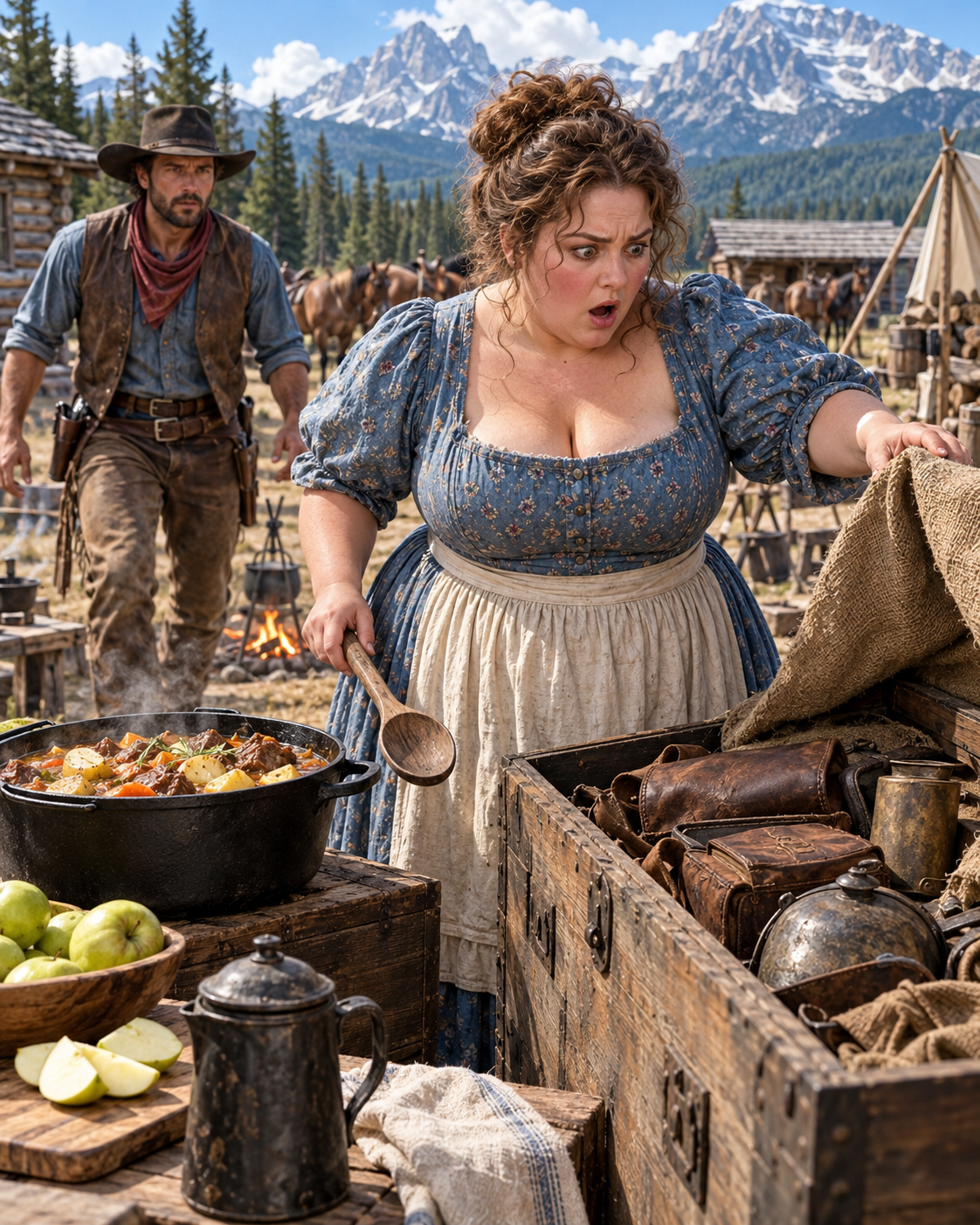
The foreman slapped my supper onto the muddy floor of Ironwood Ranch, and the rancher watched coldly, unaware I was about to uncover his deadliest betrayal.
The voice outside the sheriff’s office whispered my childhood nickname again, and for one terrible moment, I forgot how to breathe.
“Little Sparrow, open the door.”
Nobody had called me that since my father disappeared fifteen years ago.
Nathaniel tightened his grip around the revolver he’d taken from the sheriff’s desk.
“Abigail, stay behind me,” he whispered.
But I couldn’t move because something about that voice pulled me backward through time.
I remembered warm summer evenings, my father’s rough hands lifting me onto his shoulders, and the way he always called me his little sparrow because I refused to stay still.
Yet the voice outside wasn’t his.
It belonged to a woman.
“Who are you?” I demanded, struggling to keep my voice steady.
A moment of silence followed.
Then came an answer that made my blood run cold.
“Someone who promised your mother I’d keep you alive.”
Nathaniel glanced toward the broken window, where moonlight spilled across the sheriff’s motionless body.
We had no reason to trust anyone anymore.
“Tell us your name,” Nathaniel ordered.
“Margaret Ellis.”
My knees almost gave way.
Margaret Ellis had been my mother’s closest friend, a quiet seamstress who disappeared shortly after my father’s funeral.
My mother told me she’d moved east to care for her sick sister.
But now she stood outside a sheriff’s office where someone had just tried to murder us.
“How do we know you’re telling the truth?” I asked.
The woman hesitated.
Then she softly began singing a lullaby.
It was the song my mother sang whenever thunderstorms frightened me as a little girl.
I hadn’t heard it in years.
Tears burned my eyes before I could stop them.
Nathaniel carefully unlocked the door, keeping his revolver raised.
A silver-haired woman in a dark traveling cloak slipped inside.
Her face was lined with age, but I recognized those gentle brown eyes immediately.
“Abigail,” she breathed.
Before I could answer, she looked at the wounded sheriff and rushed toward him.
“He’s still breathing.”
Nathaniel knelt beside the desk and pressed a folded cloth against the sheriff’s wound.
The bullet had struck high in his shoulder, leaving him unconscious but alive.
“Can you help him?” I asked.
Margaret examined the injury.
“If we stop the bleeding and get him to a doctor, he has a chance.”
Nathaniel tore a strip from his wedding shirt and helped secure the bandage.
Only hours earlier, that shirt had been spotless beneath the Montana summer sun.
Now it was soaked with another man’s blood.
I wondered whether happiness always demanded a terrible price.
Margaret opened a narrow cabinet behind the sheriff’s desk and removed a medical satchel.
“He kept supplies here for emergencies,” she explained.
“How do you know that?” Nathaniel asked suspiciously.
“Because Sheriff Thomas Bell has been helping your father for fourteen years.”
I stared at her.
“Helping him do what?”
Margaret looked toward the window.
“Stay hidden from the people who wanted him dead.”
A distant horse whinnied.
Then came the heavy sound of boots on the wooden sidewalk.
Margaret blew out the lantern.
“We have to leave.”
Nathaniel lifted the injured sheriff while Margaret opened a narrow door behind a dusty filing cabinet.
It led into an alley bordered by the back walls of neighboring buildings.
We slipped into the darkness just as the office’s front door crashed open.
“Search every room!” someone shouted.
I recognized the voice.
It belonged to Charles Whitcomb, a banker who had attended our wedding and congratulated Nathaniel with tears in his eyes.
He had even given us a silver serving tray.
Now he was ordering armed men to hunt us down.
I pressed a hand over my mouth.
Nathaniel’s expression hardened.
“Whitcomb arranged the loans that nearly destroyed Ironwood.”
Margaret nodded.
“And he arranged much worse.”
We reached a small stable behind the church, where Margaret had prepared a wagon beneath a canvas covering.
Nathaniel settled the sheriff onto a bed of blankets.
I climbed beside him, holding my father’s letter against my chest.
As the wagon rolled away, the church bells began striking midnight.
My wedding day was officially over.
But the nightmare was only beginning.
For nearly an hour, we traveled through moonlit valleys without speaking.
The wheels rattled over stones, and the injured sheriff groaned whenever the wagon struck a rut.
Finally, I turned toward Margaret.
“I buried my father.”
My voice broke.
“I stood beside his grave, Margaret, and watched them lower his coffin.”
She stared ahead at the road.
“The coffin was empty.”
Those four words hurt more than I expected.
“Did my mother know?”
Margaret’s eyes filled with tears.
“Yes.”
I felt something inside me crack.
“My mother died believing I knew nothing about the danger surrounding us.”
“She died protecting you from it,” Margaret replied.
I shook my head.
“She could have trusted me.”
“Abigail, you were sixteen years old.”
“I was old enough to grieve.”
Margaret fell silent.
Nathaniel reached for my hand beneath the blanket.
He didn’t tell me to forgive anyone.
He simply held on while I struggled to understand how love and deception could live inside the same heart.
Eventually, Margaret spoke again.
“Your father was a surveyor for the Blackstone Copper Syndicate.”
I looked up.
“He worked at a small mining office.”
“That’s what he wanted you to believe.”
According to Margaret, my father had discovered that Blackstone’s founder, Augustus Blackstone, was secretly stealing ranch land through forged debts and fraudulent mineral claims.
Families who refused to sell were threatened.
Workers who discovered the scheme disappeared.
And when a group of miners uncovered evidence of murder, my father helped them collect documents proving everything.
“He thought he could take the evidence to federal investigators,” Margaret explained.
“But someone warned Blackstone before he could leave Montana.”
I thought about the photograph showing my father beside Silas Crowley.
“Was Silas involved?”
“He was one of the men sent to stop your father.”
My stomach twisted.
Silas had stood in Nathaniel’s barn, eaten food from my kitchen, and watched me search for the missing workers.
All that time, he knew who I was.
“Why didn’t he kill me when I arrived at Ironwood?”
Margaret glanced at me.
“Because Blackstone believed your father might contact you.”
Suddenly, I understood.
Silas hadn’t merely been watching the ranch.
He had been watching me.
The thought made my skin crawl.
We reached Ironwood shortly before dawn.
The ranch stood quiet beneath a pale sky, its windows dark except for the kitchen lantern.
Nathaniel helped Margaret carry the sheriff inside while I heated water and prepared clean bandages.
I had spent years believing cooking was the only skill anyone valued in me.
Yet that morning, as I steadied my trembling hands and kept the fire burning, I realized something important.
Survival often depended on ordinary people doing necessary things when fear told them to run.
The doctor arrived after sunrise.
He removed the bullet from Sheriff Bell’s shoulder and assured us he would survive if infection didn’t set in.
Only then did I allow myself to sit down.
Nathaniel found me alone at the kitchen table, staring at my untouched wedding cake.
The white frosting had begun to dry around the edges.
A tiny sugar flower had fallen onto the wooden boards.
“I ruined our wedding,” I whispered.
Nathaniel sat beside me.
“No, Abigail.”
He gently lifted my chin.
“The men who brought guns to our celebration ruined it.”
I looked into his exhausted eyes.
“Are you sorry you married me?”
Pain crossed his face.
“Never ask me that again.”
A tear slipped down my cheek.
“I brought danger into your home.”
He took my hand and pressed it against his heart.
“You brought life back into this home long before the danger found us.”
Then he kissed my forehead.
And for one quiet moment, the world stopped threatening to fall apart.
But peace didn’t last.
That afternoon, Margaret spread a weathered map across the dining table.
Its corners were brittle, and several locations had been marked with red ink.
One symbol stood directly beneath the old Ironwood chapel.
“Your father left instructions,” she said.
“He said to bring Abigail here only when Blackstone’s men began searching for the notebook.”
Nathaniel studied the markings.
“The chapel hasn’t been used in nearly twenty years.”
“There’s something beneath it,” Margaret replied.
I remembered Sheriff Bell’s final warning before he lost consciousness.
“Your father is waiting beneath the old Ironwood chapel.”
My heart began racing.
“Is he really there?”
Margaret’s face changed.
She looked suddenly older.
“I don’t know what we’ll find.”
We waited until evening before leaving for the chapel.
Nathaniel brought a lantern, a rifle, and a shovel.
I carried my father’s notebook and a small kitchen knife tucked inside my boot.
The chapel stood on a lonely hill beyond the northern pasture.
Its wooden walls leaned against the wind, and weeds pushed through the steps.
Once, ranch families had gathered there for weddings and funerals.
Now the building looked like a forgotten grave.
Inside, dust covered the pews.
A faded cross hung crookedly above the altar.
Margaret pointed toward the floorboards beneath the pulpit.
“Your father said the answer was beneath the third stone.”
Nathaniel pulled aside the rotten boards, revealing a narrow staircase descending into darkness.
A strange smell drifted upward.
Oil.
Damp earth.
And something that reminded me of my father’s old workshop.
We descended carefully.
At the bottom stood an iron door secured by a heavy bolt.
Nathaniel pushed it open.
The lantern illuminated a small underground chamber filled with wooden crates, shelves of documents, and surveying instruments.
Then someone moved in the shadows.
“Don’t come any closer.”
The voice was deep, rough, and painfully familiar.
My breath caught.
A man stepped into the lantern light, holding a revolver with a trembling hand.
His beard was streaked with gray.
A long scar crossed his left cheek.
But his eyes were unmistakable.
They were my eyes.
“Papa?”
His revolver fell from his hand.
For several seconds, neither of us moved.
Then he whispered the words I’d dreamed of hearing since childhood.
“My little sparrow.”
I ran toward him.
He caught me with both arms, and suddenly I was sixteen again, clinging to the man I thought death had stolen.
I buried my face against his chest and sobbed.
He smelled of leather, tobacco, and the same pine soap he used when I was small.
He was real.
Warm.
Alive.
But beneath my relief, another feeling slowly rose.
Anger.
I pulled away.
“Where were you when Mama died?”
His expression collapsed.
“Abigail…”
“Where were you when we couldn’t pay for medicine?”
He closed his eyes.
“I watched from a distance.”
The answer struck like a slap.
“You watched?”
“I couldn’t come home.”
“You could have tried.”
My father leaned against the table, suddenly looking very old.
“I did, once.”
Margaret lowered her eyes.
He explained that after faking his death, he’d secretly returned to our house during a winter storm.
Blackstone’s men followed him.
They burned our barn and threatened to kill my mother if he ever approached us again.
“After that, I stayed away,” he whispered.
I remembered the fire.
I remembered my mother telling me lightning had struck the barn.
Another lie.
Another memory turned upside down.
“I thought staying hidden would keep you safe,” he said.
I stared at the scar across his face.
“Did it?”
He couldn’t answer.
And somehow, his silence was the first honest thing he’d given me.
Nathaniel stepped forward and introduced himself.
My father studied him carefully.
“So you’re the man who married my daughter.”
“Yes, sir.”
“Do you love her?”
Nathaniel didn’t hesitate.
“More than this ranch, more than my own safety, and enough to tell her the truth even when it hurts.”
My father looked down.
“Then you’re already a better husband than I was a father.”
I wanted to comfort him.
Instead, I stood still.
Some wounds needed truth before they could begin healing.
My father opened a large wooden chest beneath the table.
Inside were ledgers, letters, photographs, and documents bearing Blackstone’s signature.
“This is everything,” he said.
“Every stolen claim, every payment to corrupt officials, and every worker who disappeared.”
I turned through the pages.
Hundreds of names filled the records.
Some belonged to ranchers.
Others belonged to miners who had vanished without explanation.
Then I found Daniel’s name.
Beside it was a date and a single word.
“Eliminated.”
My throat tightened.
“His daughter is six years old.”
My father looked away.
“I know.”
I thought about the little girl clutching Daniel’s silver watch after we returned it to her.
She deserved more than a grave and a memory.
She deserved the truth.
“We have to bring all of this into the daylight,” I said.
My father shook his head.
“Blackstone controls judges, bankers, and men who carry badges.”
“Not all of them.”
“He’ll kill us before we reach the authorities.”
I looked at Nathaniel.
He was already thinking.
“The newspaper editor in Helena helped expose the syndicate before.”
“Then we’ll make sure the evidence reaches more than one newspaper,” I said.
My father stared at me.
“You don’t understand how dangerous this is.”
I stepped closer.
“No, Papa, I understand exactly how dangerous silence has been.”
Before he could answer, a gunshot exploded above us.
Dust fell from the ceiling.
Nathaniel extinguished the lantern.
“Someone followed us.”
Boots thundered across the chapel floor.
Then Charles Whitcomb shouted from above.
“Samuel Mayweather, your hiding days are over!”
My father grabbed his revolver.
Margaret began gathering the documents.
Nathaniel pulled me toward a narrow passage behind the shelves.
“There’s an old drainage tunnel,” my father whispered.
“It leads toward the creek.”
We crawled through the darkness while gunfire echoed behind us.
The tunnel was narrow and wet.
Sharp stones cut my palms.
Somewhere overhead, men were tearing apart the chamber.
Then a muffled explosion shook the ground.
The tunnel ceiling cracked.
Nathaniel threw himself over me as stones rained down.
For one awful second, I thought we were buried alive.
But the dust settled, and we could still breathe.
“Everyone alive?” Nathaniel called.
Margaret answered first.
Then my father.
I reached for Nathaniel’s face.
“I’m here.”
We continued crawling until cold night air finally brushed my cheeks.
The tunnel opened behind a cluster of willows beside the creek.
But when we emerged, our escape was blocked.
Charles Whitcomb stood beneath the trees with three armed men.
His revolver pointed directly at my father’s chest.
“Samuel,” he said with a cruel smile.
“Fifteen years, and you still haven’t learned when to surrender.”
My father raised his hands.
“Let my family go.”
Whitcomb laughed.
“Family is exactly why you’re here.”
He turned toward me.
“You’ve caused a great deal of trouble, Mrs. Rawlings.”
I remembered the generous banker smiling beside our wedding cake.
“You shook my husband’s hand.”
“Business requires manners.”
“You helped murder innocent men.”
His smile disappeared.
“Men die when they stand in the way of progress.”
Nathaniel moved slightly in front of me.
Whitcomb noticed.
“Careful, rancher.”
One of the gunmen struck Nathaniel across the head with a rifle.
He fell to his knees.
I screamed and rushed toward him, but another man seized my arms.
Whitcomb approached my father.
“Where are the original ledgers?”
My father remained silent.
Whitcomb pressed his revolver against Nathaniel’s temple.
“Answer me, or your daughter becomes a widow before her wedding flowers wilt.”
My entire body went cold.
Then I noticed something.
Whitcomb’s men were standing beside a fallen tree, directly beneath a slope of loose stones.
Behind them, Margaret was slowly edging toward the creek.
Her eyes met mine.
I understood her plan before she moved.
I looked at Whitcomb and forced my voice to shake.
“The documents are in my father’s coat.”
Whitcomb turned toward me.
“Show me.”
I took one step forward.
Then another.
“My father can’t reach them with his hands raised.”
Whitcomb hesitated.
“Fine.”
He lowered his weapon just enough.
That was when Margaret fired a warning shot from the revolver she’d concealed beneath her cloak.
The gunmen spun toward the sound.
Nathaniel lunged upward, driving his shoulder into Whitcomb’s stomach.
At the same instant, I kicked loose a wooden brace holding a pile of stones at the slope’s edge.
The rocks crashed downward.
Men shouted.
Horses screamed.
I grabbed Nathaniel’s arm and pulled him toward the creek while my father covered our retreat.
But before we reached the trees, another shot rang out.
My father staggered.
A dark stain spread across his shirt.
“Papa!”
He collapsed against me.
I caught him, nearly falling beneath his weight.
Nathaniel fired toward the remaining gunmen, forcing them behind the rocks.
Margaret rushed forward to help.
Together, we dragged my father into the darkness.
His breathing came in terrible, broken gasps.
I pressed my hands against his wound.
“Stay with me.”
He tried to smile.
“Still giving orders, little sparrow.”
“Don’t you dare leave me again.”
His eyes filled with tears.
“I’m sorry.”
I shook my head fiercely.
“Then live long enough to prove it.”
We escaped through the woods and reached Ironwood shortly before sunrise.
The doctor returned and worked over my father for nearly two hours.
The bullet had passed through his side without striking a vital organ.
He would survive if fever and infection didn’t claim him.
I sat beside his bed while he slept.
For fifteen years, I’d imagined our reunion a thousand different ways.
I thought I’d forgive him immediately.
I thought the pain would disappear once I held him again.
But love was never that simple.
I was grateful he was alive.
I was furious he’d stayed away.
And I didn’t yet know how to hold both feelings without breaking.
Nathaniel found me there after midnight.
He placed a warm bowl of broth beside the bed.
“You haven’t eaten.”
I looked up.
“That’s usually my line.”
He smiled faintly.
Then he sat beside me.
“Your father may have made terrible choices, Abigail, but he came back when it mattered.”
I studied the sleeping man.
“He didn’t come back.”
“No,” Nathaniel admitted.
“You found him.”
His honesty made me love him even more.
The next morning, Sheriff Bell regained consciousness.
When he learned what happened at the chapel, his face turned grim.
“Whitcomb won’t stop.”
My father, weak but awake, asked him to send a message to a federal investigator named Eleanor Price.
“She was assigned to the Blackstone case years ago,” he explained.
“She never believed the evidence had been destroyed.”
Sheriff Bell nodded.
“I know where to find her.”
Within two days, Eleanor Price arrived at Ironwood accompanied by federal marshals.
She was a stern woman with silver-rimmed spectacles and a voice that made even Nathaniel stand straighter.
She listened as we explained everything.
Then she examined the documents Margaret had managed to save from the underground chamber.
Her expression slowly changed.
“These records could bring down the entire syndicate.”
My father leaned forward.
“If you can keep the witnesses alive.”
Eleanor looked at me.
“Mrs. Rawlings, are you willing to testify?”
I thought of Daniel’s daughter.
I thought of my mother.
I thought of every family whose grief had been dismissed as an unfortunate mining accident.
“Yes,” I answered.
“Even if they threaten you?”
“They already have.”
She studied me for a moment.
Then she nodded.
“Good.”
But bringing down Blackstone required more than courage.
The syndicate had lawyers, money, and powerful friends.
Our evidence needed protection.
So Eleanor devised a plan.
Copies of the ledgers would travel separately to federal prosecutors, the territorial newspapers, and investigators in Washington.
Meanwhile, she would announce that Samuel Mayweather had surrendered and that the documents remained hidden.
It was a dangerous gamble.
Blackstone would believe he still had time to silence my father.
But the evidence would already be moving beyond his reach.
Three days later, the newspapers published the first story.
The headlines spread across Montana like wildfire.
MURDERED MINERS LINKED TO COPPER SYNDICATE.
STOLEN RANCHES EXPOSED IN LAND FRAUD SCANDAL.
FEDERAL INVESTIGATORS SEEK NEW WITNESSES.
Families began traveling to Ironwood.
Some came carrying photographs.
Others brought letters from missing sons and husbands.
One elderly woman arrived clutching a child’s wooden toy.
“My boy made this before he went to work in the mines,” she whispered.
“He promised he’d come home for Christmas.”
I invited her into the kitchen.
She sat beside the stove while I poured her coffee.
There was nothing I could say that would return her son.
So I listened.
Sometimes that was the only kindness left to give.
As more families arrived, Ironwood became something different from the struggling ranch I’d first entered.
It became a place where forgotten people were finally heard.
Nathaniel opened the bunkhouse to visitors.
Margaret organized meals.
The ranch hands repaired wagons and helped elderly families travel safely.
And I cooked until my hands ached.
For once, nobody dismissed me as merely the cook.
But the man who controlled the copper empire had not yet surrendered.
On a cold morning in early autumn, Eleanor received an urgent telegram.
Augustus Blackstone had fled his mansion.
Charles Whitcomb had disappeared with him.
And two federal witnesses had been found murdered along the railroad.
That evening, a stranger arrived at Ironwood carrying a sealed letter.
It was addressed to me.
Inside were only two sentences.
“Bring Samuel Mayweather to the abandoned Red Creek Mine before midnight.”
“Come alone, or Nathaniel Rawlings dies.”
My heart stopped.
I looked toward the yard.
Nathaniel’s horse was standing beside the stable.
But Nathaniel was nowhere to be seen.
I ran through the house calling his name.
Nobody answered.
Then I found his wedding ring lying on the kitchen table.
A small spot of blood stained the wood beneath it.
I wanted to scream.
Instead, I reached for the revolver Nathaniel kept in the cupboard.
Margaret appeared in the doorway.
“Abigail, don’t.”
I showed her the letter.
Her face drained of color.
“We have to tell Eleanor.”
“If we do, they might kill him.”
“And if you go alone, they’ll kill you both.”
I stared at Nathaniel’s ring.
The gold still held the warmth of his skin.
Then I remembered something he’d told me before our wedding.
“Courage doesn’t mean walking into danger alone.”
“It means knowing who deserves to stand beside you.”
I lowered the revolver.
“Get Eleanor.”
Within an hour, we had a plan.
My father insisted on coming despite his injury.
Eleanor argued with him until he finally agreed to remain behind the marshals.
I dressed in Nathaniel’s old coat and tucked his wedding ring into my pocket.
Then I climbed into the wagon.
The road to Red Creek Mine wound through dark hills beneath a sky heavy with approaching snow.
I could barely feel my fingers.
Not from the cold.
From fear.
When the mine appeared, its entrance glowed with lantern light.
Three armed men waited beside the tracks.
And there, tied to a wooden support beam, was Nathaniel.
His face was bruised.
Blood stained his collar.
But when he saw me, he struggled against the ropes.
“Abigail, run!”
Before I could answer, Augustus Blackstone emerged from the darkness.
He was a tall man with perfectly combed silver hair and a polished black coat.
He looked more like a respectable businessman than a man responsible for so many graves.
“Mrs. Rawlings,” he said pleasantly.
“I’ve heard remarkable things about you.”
I stared at him.
“Then you’ve heard I’m difficult to frighten.”
He smiled.
“Everyone is frightened of something.”
He gestured toward Nathaniel.
“Your husband, for example.”
I fought the urge to rush toward him.
“What do you want?”
“Your father’s remaining evidence.”
“It’s already with the federal authorities.”
Blackstone’s smile tightened.
“Not all of it.”
He removed a small leather notebook from his pocket.
“Your father kept one final record.”
I recognized its cover.
It matched the notebook Daniel had carried.
Blackstone opened it.
“Names, dates, payments, witnesses.”
He looked directly into my eyes.
“And one name your father never wanted you to see.”
I refused to react.
But Blackstone noticed my hesitation.
“Your mother.”
My breath caught.
He smiled again.
“Now we understand each other.”
He claimed my mother had helped hide stolen mining profits before my father’s disappearance.
He said she had accepted money while innocent men died.
I shook my head.
“You’re lying.”
“Perhaps.”
He held out the notebook.
“Come closer and discover the truth.”
I took one step.
Then another.
Behind him, I saw Charles Whitcomb standing beside a pile of dynamite crates.
He was preparing the fuse.
They intended to destroy the mine.
And everyone inside it.
I looked toward Nathaniel.
His eyes flickered toward the upper ridge.
A faint lantern light appeared between the rocks.
Eleanor’s signal.
Help was close.
I only needed to keep Blackstone talking.
“If my mother helped you,” I asked, “why did you threaten her?”
Blackstone frowned.
“She became sentimental.”
“What does that mean?”
“She discovered your father’s documents and decided her conscience mattered more than our agreement.”
My throat tightened.
“So she turned against you.”
Blackstone’s expression darkened.
“She betrayed us.”
For the first time, I saw the truth beneath his polished manners.
He wasn’t a powerful man protecting an empire.
He was a frightened criminal desperate to keep his past buried.
“My mother didn’t betray anyone,” I whispered.
“She finally chose what was right.”
Blackstone raised his revolver.
“Enough.”
At that instant, Nathaniel kicked the wooden support beneath him.
A stack of timber crashed between us.
Gunfire erupted from the ridge.
Federal marshals surged toward the mine entrance.
Whitcomb lunged for the fuse.
I ran after him.
He struck a match.
I grabbed his wrist.
The flame dropped onto the ground.
He shoved me against a wooden cart.
Pain exploded through my shoulder.
Then my fingers closed around a heavy iron tool.
I swung it into his arm.
He screamed and stumbled backward.
The match went out in the dirt.
But another fuse was already burning.
I saw its orange glow racing toward the dynamite.
“Everybody out!” I shouted.
Nathaniel broke free and rushed toward me.
Together, we dragged the nearest crate away from the others.
My hands burned against the rough wood.
Then Nathaniel seized a water bucket beside the tracks.
He threw its contents over the fuse.
Steam hissed.
The glowing cord went dark.
For one heartbeat, silence swallowed the mine.
Then Blackstone fired.
The bullet struck my father’s shoulder as he emerged behind the marshals.
He collapsed against a support beam.
I screamed.
Nathaniel pulled me down before another bullet could strike.
Eleanor stepped forward with her pistol raised.
“Augustus Blackstone, drop your weapon!”
Blackstone backed toward the mine shaft.
His polished boots slipped against the loose gravel.
“You have no idea what this land is worth!” he shouted.
Eleanor didn’t move.
“I know exactly what the lives you destroyed were worth.”
Blackstone raised his revolver one final time.
Before he could fire, Charles Whitcomb grabbed his arm.
“Stop! It’s over!”
The weapon discharged into the ceiling.
Rocks thundered down.
Both men fell beneath a shower of dust.
When the air cleared, Whitcomb was pinned beneath a broken beam.
Blackstone lay unconscious beside the tracks.
The marshals rushed forward and secured them.
I barely noticed.
I was already kneeling beside my father.
His blood soaked through my sleeves.
“Papa, please.”
He opened his eyes.
“Little sparrow.”
“Don’t speak.”
He smiled faintly.
“You always were stubborn.”
Tears streamed down my face.
“I learned from you.”
His fingers closed weakly around mine.
“I spent fifteen years thinking hiding was the same as protecting you.”
I shook my head.
“You’re here now.”
“I should have been there every day.”
“Then don’t leave again.”
The doctor who accompanied the marshals hurried toward us.
He pressed fresh bandages against the wound.
My father cried out.
But he was breathing.
And this time, I refused to let fear write the ending.
The following months changed Montana forever.
Augustus Blackstone and Charles Whitcomb stood trial for conspiracy, fraud, bribery, and their involvement in the murders.
Dozens of witnesses testified.
Former miners described threats.
Ranchers presented forged loan agreements.
Families finally learned what had happened to their missing loved ones.
My father testified for three exhausting days.
He admitted he’d helped record fraudulent land transactions before discovering how the syndicate obtained them.
He admitted he’d been afraid.
And he admitted that his silence had allowed innocent people to suffer.
The courtroom grew quiet when the prosecutor asked why he had finally come forward.
My father looked toward me.
“Because my daughter reminded me that protecting your own life means nothing if you abandon everyone else’s.”
I cried openly.
Not because he was perfect.
But because he had stopped hiding from the truth.
When the verdict was announced, Blackstone and Whitcomb were convicted on the principal charges.
Federal authorities seized records and assets connected to the fraudulent land scheme.
Many stolen properties were returned to their rightful owners.
Other families received compensation from recovered funds.
Nothing could replace the dead.
But their names were no longer buried beneath lies.
Sheriff Bell recovered from his injury and helped establish a memorial for the murdered workers.
Daniel’s daughter placed her father’s silver watch beneath his engraved name during the dedication.
I stood beside her while the autumn wind moved gently through the trees.
“Do you think Daddy knows we found him?” she asked.
I knelt beside her.
“I think he’d be proud that you never stopped loving him.”
She considered my answer.
Then she placed her small hand inside mine.
“I think he’d like you.”
I couldn’t speak.
I simply held her close.
That evening, Nathaniel found me beside the wild pear tree.
Its branches were heavy with fruit.
The same tree had led me toward the terrible secret that nearly destroyed us.
He slipped his arms around my waist.
“Do you ever wish you’d never come to Ironwood?”
I looked toward the house.
Warm light spilled from the kitchen windows.
Margaret was laughing with the ranch hands.
My father sat near the fireplace, slowly regaining his strength.
The people I’d nearly lost were alive.
The families we’d helped were beginning to heal.
And the ranch that had once been dying was filled with life.
“Sometimes,” I admitted.
Nathaniel turned me gently toward him.
“Really?”
I smiled through my tears.
“Only when you leave muddy boots in my kitchen.”
He laughed.
It was the kind of laughter I’d wanted to hear since the day we met.
Then he took my hand and led me toward the chapel.
The old building had been repaired.
Fresh white paint covered its walls.
Wildflowers decorated the windows.
Inside, a small gathering of friends waited beneath the candlelight.
Margaret stood beside my father.
Sheriff Bell wore his finest coat.
Daniel’s widow held her daughter’s hand.
And at the altar stood the minister who had married us before our wedding day turned into a nightmare.
I looked at Nathaniel in confusion.
He smiled.
“Our first wedding was interrupted.”
“Nathaniel…”
“I thought we deserved one peaceful evening.”
I began crying before he finished speaking.
He took both my hands.
“Abigail Mayweather Rawlings, I loved you when you brought warmth into a cold house.”
His voice trembled.
“I loved you when you challenged every lie that threatened us.”
“And I’ll love you when we’re old and arguing over whether you’ve burned the biscuits.”
Everyone laughed.
I wiped my tears.
“I have never burned a biscuit in my life.”
“Then I suppose I’ll have to give you another reason to argue with me.”
I stepped closer.
“You already give me plenty.”
He kissed me beneath the chapel’s restored wooden beams.
This time, no gunshots interrupted us.
No threatening letters arrived.
No stranger waited outside with a terrible secret.
There was only music, candlelight, and the quiet sound of people celebrating a love that had survived the worst of human cruelty.
Later that night, my father approached me while Nathaniel was speaking with the ranch hands.
He held a small wooden box.
“I wanted you to have this.”
Inside was my mother’s wedding ring.
I recognized the tiny blue stone immediately.
She had worn it every day until her death.
My hands trembled as I lifted it.
“Where did you find this?”
“Margaret kept it safe.”
He hesitated.
“Your mother asked her to give it to you when you were ready to hear the truth.”
I looked at him.
“There’s something else, isn’t there?”
He nodded.
“Your mother knew about the stolen mining money.”
A familiar fear tightened around my chest.
“Blackstone said she helped him.”
“She worked briefly as a bookkeeper for the syndicate.”
My father swallowed.
“At first, she believed the payments were legitimate.”
“And when she discovered the truth?”
“She copied the records and helped the miners’ families escape.”
He opened the box again.
Beneath the velvet lining lay a folded letter.
I recognized my mother’s handwriting.
My father stepped away, giving me privacy.
I unfolded the paper slowly.
“My darling Abigail,” it began.
“If you are reading this, there are things I never found the courage to tell you.”
I sat beneath the chapel window and continued reading.
She wrote about fear.
About the nights she stayed awake listening for horses outside our home.
About the terrible guilt she carried for not recognizing Blackstone’s crimes sooner.
But she also wrote about hope.
She hoped I would grow into a woman who refused to mistake obedience for goodness.
She hoped I would recognize the difference between kindness and weakness.
And most of all, she hoped I would never believe that love required me to surrender my own voice.
The final words blurred beneath my tears.
“Some people will tell you that being strong means never being afraid.”
“But courage is choosing to do what is right while your heart is trembling.”
“Never allow cruel people to convince you that your kindness makes you powerless.”
“Your kindness, my darling girl, may become the strongest thing you ever possess.”
I pressed the letter against my chest.
For years, I thought my mother had been a frightened woman trapped by circumstances beyond her control.
Now I understood.
She had been brave in quiet ways.
She had protected strangers.
She had raised me while carrying secrets that would have broken many people.
And she had taught me to love without becoming blind.
My father approached when I finally stood.
“I don’t expect you to forgive me for everything,” he said.
I looked at the man I’d once believed could do no wrong.
He was older now.
More fragile.
More human.
“I can’t give you back those fifteen years,” I whispered.
He nodded.
“I know.”
“And I can’t pretend your choices didn’t hurt us.”
Tears filled his eyes.
“I know that too.”
I took his hand.
“But we still have tomorrow.”
His face crumpled.
For the first time since our reunion, he allowed himself to cry without hiding his shame.
I embraced him.
Not because the past had disappeared.
But because I finally understood that forgiveness wasn’t pretending someone had never hurt you.
Sometimes it was simply deciding that pain would not be the only thing left between you.
One year later, Ironwood Ranch was thriving.
Nathaniel had rebuilt the northern fences and expanded the cattle herd.
Margaret opened a small schoolhouse for the children of ranch workers.
Sheriff Bell continued investigating the missing-person cases, determined that every family would receive an answer.
My father spent his days helping the workers restore land damaged by abandoned mines.
And I established a kitchen that fed hungry travelers, struggling families, and anyone who arrived with nowhere else to go.
We called it Sparrow House.
Above the doorway hung a wooden sign Nathaniel carved himself.
“No one leaves hungry.”
One crisp autumn morning, I stood in that kitchen kneading bread while sunlight warmed the windows.
Nathaniel entered carrying a basket of wild pears.
“Found these near the northern creek,” he said.
I looked at the fruit and smiled.
Those pears had once led me toward graves, betrayal, and terrible suffering.
Now they would become warm pies for children coming home from school.
Nathaniel placed his hands around my waist.
“Anything else you need?”
I considered the question.
Once, I’d wanted nothing more than a safe place to belong.
Now I had a home filled with people who loved me.
A husband who respected me.
A father learning to become the man I’d needed.
And a purpose greater than anything I’d imagined when I first arrived with my worn suitcase and stubborn pride.
“Just one thing,” I whispered.
Nathaniel raised an eyebrow.
“What’s that?”
I took his hand and placed it gently against my stomach.
His expression changed.
For several seconds, he couldn’t speak.
“Abigail…”
I nodded, smiling through sudden tears.
“We’re going to have a baby.”
Nathaniel dropped the basket.
Pears rolled across the kitchen floor.
Then he lifted me into his arms and laughed with such happiness that Margaret came running from the hallway.
My father appeared behind her.
And when they understood what had happened, the entire house erupted with joy.
Nathaniel kissed my forehead.
“What if I’m not a good father?”
I looked into his eyes.
“Then we’ll learn together.”
He rested his hand against my stomach again.
And I realized how far we’d come.
We had survived powerful men who believed money could purchase anything.
We had faced graves, guns, betrayal, and secrets buried for generations.
We had learned that silence could protect cruelty, while truth could free those who had suffered.
But the greatest lesson wasn’t about defeating villains or winning battles.
It was about the kind of people we chose to become after surviving them.
We could have allowed bitterness to consume our lives.
We could have closed our doors and trusted no one.
Instead, we chose to build something good from what remained.
That evening, I walked beneath the pear tree with Nathaniel’s hand wrapped around mine.
The Montana sky glowed gold above the mountains.
Somewhere beyond the pastures, children laughed.
The kitchen windows shone warmly against the approaching darkness.
And for the first time in my life, I no longer feared the sound of footsteps coming home.
I thought of Daniel’s daughter, of the families who had found answers, and of my mother whose courage had lived quietly beneath so much sorrow.
Then I looked at the man beside me.
“You know,” I said softly, “Silas once told me women belonged in kitchens.”
Nathaniel chuckled.
“And what would you tell him now?”
I glanced toward Sparrow House, where the smell of fresh bread drifted into the evening air.
“I’d tell him he was right about one thing.”
Nathaniel looked surprised.
“What’s that?”
I smiled.
“Great things can begin in a kitchen.”
He laughed and pulled me close.
“But they don’t have to end there.”
I rested my head against his shoulder, listening to the steady beating of his heart.
I had arrived at Ironwood as a woman nobody expected to matter.
I had discovered that even the smallest act of courage could change the lives of people who had been forgotten.
And I had learned that love wasn’t proved by beautiful promises made when life was easy.
It was proved by the hands that reached for yours when everything was falling apart.
As the first stars appeared above our ranch, Nathaniel whispered, “Welcome home, Abigail.”
I kissed him gently and answered with the truth that had taken me so many years to understand.
“Home isn’t the place where nothing bad can happen.”
“It’s the place where we face whatever happens together.”
And when our daughter was born the following spring, we named her Grace Mayweather Rawlings.
Not because our lives had been filled with mercy.
But because we wanted her to remember that even after the darkest winter, something beautiful could still grow.
Years later, when Grace asked why we kept an old silver pocket watch beside the photographs in Sparrow House, I told her about a brave father named Daniel who never made it home.
I told her about the people who refused to forget him.
And I told her that every name on the memorial belonged to someone whose life mattered.
Grace listened quietly before asking one final question.
“Mama, can ordinary people really change the world?”
I looked toward Nathaniel, now standing beneath the pear tree with my father, both men laughing as they watched the evening sky.
Then I took my daughter’s small hands in mine.
“Yes, sweetheart.”
“Sometimes all it takes is one ordinary person who refuses to look away.”
And that was the legacy I hoped to leave behind.
Not wealth.
Not fame.
Not even the ranch that had nearly been stolen from us.
But the knowledge that courage is contagious, kindness is never wasted, and the truth deserves defending even when the world would rather keep it buried.
Because the darkest secrets may be hidden beneath the earth, but the strongest love will always find a way to bring them into the light.
THE END.