The first thing Abby Higgins heard that morning was a man outside screaming for firewood.
Caleb stared at the cellar door as if the wood itself had spoken.
Abby tightened her grip on the iron poker.
“Open it,” she said.
Caleb did not move.
The voice beneath them came again, weaker this time.
“Caleb… please.”
Jeb stumbled backward.
“No.”
Everyone turned toward him.
His face had gone gray.
“No, no, no. We can’t open it.”
Caleb grabbed his coat.
“Jeb, what do you know?”
“Nothing.”
“You’re lying.”
“I said I know nothing!”
Abby stepped between them.
“Then we have even more reason to go down.”
Caleb looked at her burned arm.
“You’re staying here.”
She almost laughed.
“Someone is trapped beneath my floor, someone has been opening my pantry, and somebody just tried to burn down the house. You think I’m staying upstairs?”
Caleb’s jaw tightened.
For several seconds, neither moved.
Then he took the lantern.
“I go first.”
Abby followed.
Three cowboys came behind them.
Jeb remained near the stove, shaking.
The cellar door groaned when Caleb lifted it.
A breath of freezing air rushed upward.
Abby raised the lantern.
The wooden stairs disappeared into darkness.
They descended slowly.
The smell hit them first.
Damp earth.
Old blood.
And something metallic.
At the bottom stood rows of shelves filled with empty jars and broken tools.
But the cellar was much larger than Abby remembered.
Caleb moved the lantern toward the far wall.
“There.”
Behind several barrels stood a section of fresh timber.
New timber.
Someone had built a false wall.
Abby approached it.
“Help me move these.”
They rolled the barrels aside.
Behind them was a narrow door.
There was no handle.
Only a small iron latch.
Caleb touched it.
“Wait.”
A voice came from the other side.
“Don’t.”
Abby looked at him.
“That’s the man who called your name.”
Caleb swallowed.
Then he opened it.
The door swung inward.
The lantern light revealed a cramped hidden room.
A man lay against the wall, his wrists tied with rope.
His beard was frozen with moisture.
His face was bruised.
But Abby recognized him.
“Thomas?”
Caleb dropped the lantern.
It nearly went out.
Thomas Reed had been Iron Creek Ranch’s former bookkeeper.
Three months earlier, everyone had been told he stole money and disappeared.
Abby had never believed it.
Thomas lifted his head.
“Caleb.”
Caleb knelt beside him.
“Who did this?”
Thomas looked past him.
His eyes landed on Abby.
“Her.”
Abby froze.
“What?”
Thomas coughed.
“Not Abby.”
He pointed toward the ceiling.
“The woman who owned this place before her.”
Silence filled the room.
Caleb stared at him.
“What are you talking about?”
Thomas closed his eyes.
“I found the ledgers.”
“What ledgers?”
“The real ones.”
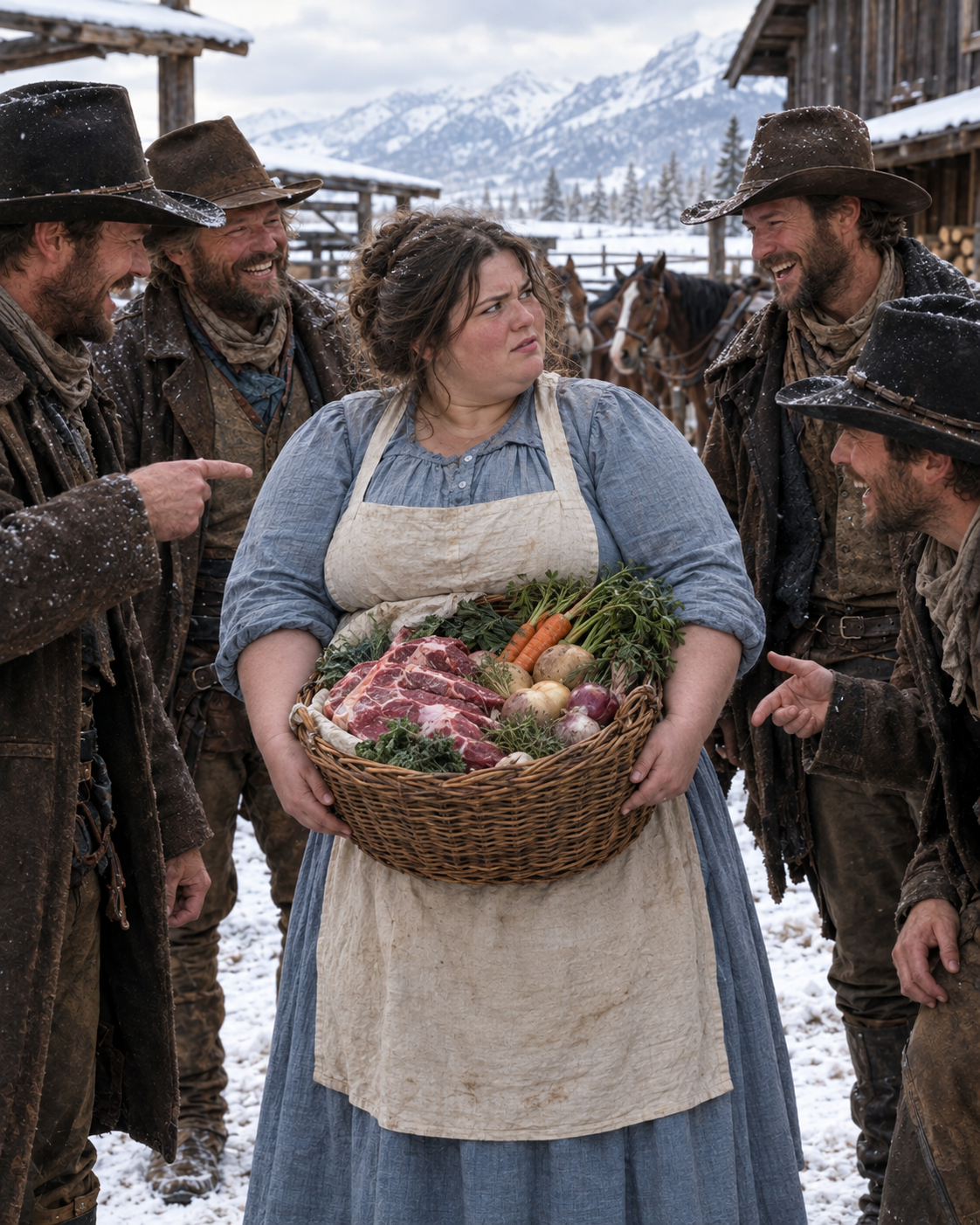
He looked at Abby.
“The ranch was never losing money.”
Caleb’s expression changed.
Thomas continued.
“Someone was stealing from the workers. Wages. Supplies. Cattle money. Everything. Then they changed the books so it looked like the ranch was drowning.”
Abby felt cold despite the fire burning upstairs.
“Who?”
Thomas looked at Caleb.
Then at the door.
“Silas Higgins.”
The name struck Abby harder than the wind outside.
Her father.
Dead for six years.
“No.”
Thomas nodded weakly.
“He used Iron Creek as a front. Cattle went missing because they were being sold secretly. The money was hidden here.”
Caleb’s eyes narrowed.
“My father worked for Silas.”
“I know.”
“Then why didn’t you tell me?”
“Because I found out too late.”
Thomas pulled at the rope around his wrists.
“He caught me reading the books.”
“Who?”
Thomas whispered one name.
“Jeb.”
Abby turned.
The cellar behind them was empty.
Jeb was gone.
Caleb stood immediately.
“Damn it.”
A gunshot exploded above them.
The sound shook dust from the ceiling.
Everyone reached for their weapons.
Another shot.
Then screaming.
Caleb ran up the stairs.
Abby followed.
When they reached the kitchen, the window beside the stove was shattered.
One cowboy lay on the floor clutching his shoulder.
The pantry door stood wide open.
And Jeb was nowhere.
Caleb rushed to the window.
Outside, through the white storm, a dark horse disappeared toward the eastern ridge.
“He took the horses.”
Abby looked at the pantry.
Something had changed.
The sack of flour was gone.
So was the last barrel of beans.
She suddenly understood.
“He wasn’t stealing food.”
Caleb looked at her.
“What?”
“He was preparing to leave.”
She pointed toward the floor.
“There are tracks.”
Wet boot marks crossed the kitchen.
They led directly to the cellar.
Caleb’s face hardened.
“He knew about Thomas.”
“And he knew about the money.”
They returned to the hidden room.
Thomas had regained enough strength to speak.
“The money isn’t here.”
Caleb frowned.
“Then where?”
Thomas smiled bitterly.
“Under the chapel.”
Abby stared at him.
“There hasn’t been a chapel here for years.”
“There was.”
Thomas coughed.
“Silas had it torn down. But he never moved the foundation.”
Caleb looked toward the eastern ridge.
“The old mission.”
Thomas nodded.
“Jeb will go there.”
Abby picked up a rifle.
Caleb grabbed her wrist.
“No.”
She pulled free.
“You can either take me with you or waste time trying to stop me.”
He stared at her.
Finally, he sighed.
“Fine.”
Outside, the storm was worse.
The world had become white.
They saddled four horses.
Thomas stayed behind with two injured cowboys.
Caleb checked Abby’s burned arm.
“You shouldn’t ride.”
“I shouldn’t have survived the kitchen fire either.”
He looked at her.
“You’re stubborn.”
“I’ve been called worse.”
For the first time that day, he almost smiled.
Then they rode into the storm.
The trail vanished within minutes.
Abby leaned forward against the wind.
Caleb rode beside her.
Behind them came two cowboys.
For nearly an hour they saw nothing but snow.
Then Caleb raised his hand.
Everyone stopped.
A faint orange glow flickered ahead.
The old mission chapel.
Or what remained of it.
Its roof had collapsed years ago.
Only the stone foundation and one standing wall remained.
A horse was tied beneath it.
Jeb’s horse.
Caleb dismounted.
Abby followed.
“Stay behind me.”
She ignored him.
They entered the ruins.
The snow had covered most of the ground.
But one patch near the old altar looked disturbed.
Caleb knelt.
Fresh shovel marks.
“He’s here.”
A noise came from beneath the stones.
Scrape.
Scrape.
Scrape.
Abby looked at Caleb.
Then someone shouted from the darkness.
“Drop your weapons!”
Jeb stepped from behind the broken wall.
He held a revolver.
His face was no longer frightened.
It was cold.
Two other men stood behind him.
Men Abby had never seen before.
Caleb raised his hands.
“Jeb.”
“Don’t move.”
Abby stared at him.
“You tried to burn the ranch.”
Jeb’s eyes flicked toward her burned arm.
“I didn’t mean for you to get hurt.”
“But you knew it could happen.”
He said nothing.
Caleb’s voice was quiet.
“You’ve been working for them.”
Jeb laughed.
“Working?”
He shook his head.
“I’m trying to survive.”
One of the strangers kicked snow away from the disturbed ground.
A wooden box appeared beneath the stones.
Abby’s heart sank.
Jeb smiled.
“Six years.”
He looked at the box.
“Six years I’ve been waiting for this.”
Caleb stepped forward.
“Money doesn’t belong to you.”
Jeb aimed the revolver at him.
“Everything belongs to whoever can take it.”
Abby watched him carefully.
“You’re wrong.”
Jeb’s eyes shifted toward her.
“My father believed that.”
“No.”
She took one step forward.
“My father believed people were things.”
Jeb’s expression hardened.
“And look where it got him.”
Abby stopped.
“You knew him.”
“I knew what he did.”
For the first time, Jeb’s voice cracked.
“My family worked this ranch.”
He swallowed.
“Your father took our wages. When my mother complained, he had my father fired. We lost our home before winter.”
Abby said nothing.
Jeb continued.
“Then your father told everyone we had left Wyoming.”
Caleb lowered his eyes.
“I was twelve.”
Jeb’s hand shook around the revolver.
“I watched my father die in a snowstorm because he couldn’t afford a doctor.”
Abby finally understood the rage behind his eyes.
“You’ve hated this place ever since.”
“I hated what it represented.”
“Then why hurt innocent people?”
Jeb stared at the ground.
“I didn’t know how to separate the guilty from the innocent anymore.”
A gust of wind tore through the ruins.
One of the strangers shouted.
“Enough talking.”
He opened the box.
Inside were stacks of money, gold coins, and several old ledgers wrapped in oilcloth.
Abby recognized her father’s handwriting.
The proof was all there.
Names.
Payments.
Bribes.
Stolen wages.
Even signatures.
Caleb looked at the ledgers.
“This can expose everyone.”
The stranger laughed.
“That’s why nobody gets to leave.”
He raised his rifle.
The first shot came from behind them.
One of Caleb’s men fired.
The stranger fell.
Chaos exploded.
Jeb fired wildly.
Caleb tackled the second man.
Abby dropped behind the stone wall.
Bullets tore through the old wood.
Snow flew around her.
She saw Jeb running toward the box.
“Jeb!”
He stopped.
Abby pointed her rifle.
“Don’t.”
He looked back.
For a second, she could have shot him.
Instead, she lowered the barrel.
“Take the money if you want.”
Caleb shouted from behind the wall.
“Abby!”
She didn’t look away from Jeb.
“But you’ll spend the rest of your life knowing you became exactly what you hated.”
Jeb froze.
The words reached somewhere the gunfire hadn’t.
The second outlaw charged.
Jeb turned and fired.
The man fell.
Silence followed.
Only the storm remained.
Caleb slowly stood.
His rifle aimed at Jeb.
“Put it down.”
Jeb looked at the money.
Then at the gun.
Then at Abby.
His revolver dropped into the snow.
Caleb approached and took it.
Jeb did not resist.
They opened the ledgers.
There were enough records to destroy the reputations of half a dozen wealthy men in the territory.
But there was something else.
A final page.
Abby read it slowly.
Her father’s signature was at the bottom.
Above it were the names of every ranch worker whose wages had been stolen.
Including Caleb’s father.
Abby looked at Caleb.
He stared at the page for a long time.
“My father knew.”
Abby nodded.
“He knew.”
Caleb closed his eyes.
For years, he had believed his father died because of bad luck.
It had not been luck.
It had been greed.
They returned to Iron Creek before dawn.
The storm finally broke as the sun rose.
For the first time in days, light touched the mountains.
Thomas was waiting by the stove.
When he saw the ledgers, he began to cry.
Not loudly.
Just one long breath leaving his body as if he had been holding it for years.
The truth spread through the valley within weeks.
The stolen money was recovered.
The surviving families received what they were owed.
The names in the ledgers were taken to court.
Some men fled.
Some were arrested.
Others lost everything.
But Iron Creek Ranch remained.
Abby refused to sell it.
Instead, she changed it.
She opened the locked pantry.
She tore down the hidden cellar wall.
She turned the old secret room into a storage space for medicine and emergency supplies.
No one would ever be hidden there again.
Jeb was sentenced for his crimes.
Abby visited him once.
He looked smaller behind the bars.
“I thought you hated me,” he said.
“I did.”
He looked surprised.
“But I don’t anymore.”
“Why?”
“Because hatred is expensive.”
He stared at her.
“It takes something from you every day.”
Jeb lowered his eyes.
“I don’t know what to do now.”
“Start by telling the truth.”
He nodded.
It was not forgiveness.
Not yet.
But it was a beginning.
Winter eventually ended.
Grass returned to the valley.
The ranch hands repaired the barn, rebuilt the pantry, and replaced every broken window in the house.
One evening, Abby stood outside watching the sunset.
Caleb joined her.
“You kept the place alive,” he said.
“We all did.”
He shook his head.
“No.”
He looked toward the house.
“You were the one who counted the flour. You were the one who locked the pantry. You were the one who walked into that cellar when everyone else was afraid.”
Abby smiled faintly.
“I was afraid.”
“I know.”
He looked at her.
“That was the point.”
She turned.
“What?”
“Courage isn’t not being afraid.”
He paused.
“It’s deciding something matters more.”
Abby looked across Iron Creek.
The ranch was scarred.
The house was older.
The people were changed.
But smoke rose peacefully from the chimney.
There was enough wood now.
Enough food.
Enough light.
And nobody was hiding beneath the floor.
Caleb reached into his coat and handed her a small object.
It was an old brass key.
Abby frowned.
“What is this?”
“The cellar.”
“I thought we destroyed the lock.”
“We did.”
“Then why keep the key?”
Caleb smiled.
“So you remember.”
“Remember what?”
He looked toward the mountains.
“That secrets grow in darkness.”
Abby closed her fingers around the key.
“And truth?”
“Truth needs someone brave enough to open the door.”
For a moment, neither spoke.
Then Abby walked toward the house.
At the doorway, she stopped and looked back.
The last sunlight rested on the snow-covered peaks.
Iron Creek had survived the winter.
But Abby knew survival alone was not enough.
A place could have food and fire.
It could have horses, money, land, and strong walls.
Yet none of those things could make it good.
People did that.
Choices did that.
And sometimes, one person had to make the first choice when everyone else was too frightened to move.
Abby placed the brass key on the kitchen table.
She never locked the cellar again.
Years later, people would still tell stories about the winter when Iron Creek nearly disappeared.
They would talk about the blizzard.
The fire.
The hidden room.
The stolen fortune.
The man who nearly chose revenge over his own soul.
But Abby remembered something different.
She remembered a handful of beans measured into bowls.
A pair of frozen hands beneath a blanket.
A frightened boy standing too close to a stove.
A voice beneath the floor begging not to be heard.
And the moment when she could have answered violence with violence, but chose to open a door instead.
Because the greatest danger was never the storm outside.
It was what fear and anger could turn people into when they were left alone in the dark.
Iron Creek taught them that a secret could survive for years, but it could never become innocent simply because nobody spoke about it.
It taught them that justice could be delayed, buried, hidden beneath floors and forgotten behind locked doors, but truth had a way of knocking until someone finally answered.
And Abby Higgins learned the hardest lesson of all.
Sometimes saving a home does not mean protecting its walls.
Sometimes it means tearing them open, exposing what happened inside, and rebuilding everything from the truth.
That spring, when the first wildflowers appeared along the fence line, Abby planted a small wooden sign beside the ranch road.
There were no names on it.
No accusations.
Only four simple words.
“Leave the door open.”
And every person who passed Iron Creek understood what it meant.
No more secrets.
No more stolen lives.
No more suffering in silence.
The winter had taken much from them.
But it had also given them something no amount of money could buy.
The courage to become different from the people who came before them.
And from that year onward, whenever the Wyoming wind rose hard across the valley, the people of Iron Creek no longer listened to it with fear.
They listened to it as a reminder.
Storms always come.
Darkness always returns.
But there will always be a choice between closing the door and opening it.
And sometimes, the smallest act of courage is enough to let the light in.
One year later, the first snow came early to Iron Creek.
It arrived quietly this time.
No screaming wind.
No horses breaking through fences.
No men running from house to house searching for firewood.
Just soft white flakes falling over the valley, settling on the roofs and wooden fences like a blanket.
Abby stood on the porch before sunrise, holding a cup of coffee between both hands.
She watched the ranch wake slowly.
A horse stamped its hoof in the stable.
Someone laughed inside the bunkhouse.
The kitchen chimney released a thin line of smoke into the pale morning sky.
Everything looked ordinary.
That was what she loved most about it.
Ordinary had once seemed impossible.
Behind her, Caleb opened the door.
“You’re going to freeze.”
Abby smiled.
“I survived worse.”
He stepped onto the porch and handed her a thick coat.
“You say that every time.”
“Because it’s true every time.”
Caleb looked toward the valley.
“Snow reminds me of that winter.”
“So does everything.”
He nodded.
Neither of them spoke for a while.
They had both changed since then.
Caleb no longer carried his father’s anger like a stone in his chest.
Abby no longer believed she had to carry the entire ranch alone.
And the men who worked at Iron Creek had learned something they had never understood before.
A ranch was not its buildings.
It was not its cattle.
It was not the amount of money written in a ledger.
A ranch was the people who refused to abandon one another when the weather turned cruel.
A rider came galloping from the eastern road.
Caleb straightened.
“Who’s that?”
Abby watched the horse approach.
The rider pulled up beside the fence.
It was the sheriff.
He removed his hat.
“Morning.”
Caleb walked down the steps.
“What happened?”
The sheriff hesitated.
“Jeb’s coming back.”
Abby stepped outside.
“When?”
“Today.”
The words carried more weight than they should have.
Jeb had spent almost a year in prison.
He had confessed to everything.
The fire.
The theft.
The men he had worked with.
And, most importantly, he had given investigators information about several wealthy ranchers who had helped hide Silas Higgins’s crimes.
Some people had called him a coward.
Others called him a traitor.
Abby had never called him either.
She knew there was no simple word for a man who had been hurt so badly that he eventually decided hurting others would make him whole.
The sheriff looked at her.
“He asked if he could come here.”
Caleb’s face hardened.
“This isn’t a prison.”
“I know.”
“And he isn’t welcome.”
Abby looked at him.
“Maybe he doesn’t need to be welcome.”
Caleb frowned.
“Then what?”
“Maybe he just needs somewhere to start.”
The sheriff watched her carefully.
“You’re sure?”
Abby nodded.
“I am.”
Hours later, a wagon appeared on the road.
Jeb sat alone on the driver’s bench.
He looked older.
Thinner.
There was no anger in his eyes now.
Only exhaustion.
He stopped outside the ranch gate.
For several seconds, he didn’t move.
Then he climbed down.
Abby walked toward him.
Caleb remained behind her.
Jeb looked at the ranch house.
“I didn’t think you’d let me come back.”
“I didn’t say you could live here.”
He almost smiled.
“I figured.”
“You’ll work for your meals.”
“I expected that.”
“You’ll answer questions if the sheriff needs them.”
“I will.”
“And you’ll never touch the pantry key.”
Jeb lowered his head.
“I understand.”
Abby looked at him.
“Then you can stay.”
He stared at her.
“Why?”
She took a breath.
“Because punishment already taught you what happens when you choose the wrong road.”
She glanced toward the ranch.
“Now you need to learn how to choose a different one.”
Jeb’s eyes filled with tears.
He turned away quickly.
Abby pretended not to notice.
Some wounds needed privacy.
Some apologies were too small for the damage they followed.
But small things mattered.
A repaired fence.
A bowl of food.
A hand offered without expecting anything in return.
Sometimes a life was rebuilt that way.
Not in one grand moment.
But piece by piece.
Day after day.
Winter after winter.
Years passed.
Iron Creek grew.
The ranch became known across Wyoming for treating its workers fairly.
Every man was paid on time.
Every family had emergency supplies.
No one was turned away during a storm.
Abby kept the old ledgers locked in a safe.
Not because she feared them anymore.
She kept them as a warning.
Whenever a young ranch hand asked why she refused to let anyone alter the books, she would simply say,
“Because numbers can lie when people are too afraid to tell the truth.”
Caleb eventually became a partner in the ranch.
He and Abby never had a grand wedding.
There was no church packed with wealthy guests.
No expensive celebration.
Just a warm summer evening, a handful of friends, and a small gathering beneath the cottonwood trees.
When Caleb took her hand, he whispered,
“You know you’re still the most stubborn woman I’ve ever met.”
Abby smiled.
“And you’re still alive, so you must like it.”
They laughed.
For once, there was no shadow behind it.
No secret.
No fear.
Only happiness.
Jeb stayed too.
He never became the man he had once imagined becoming.
But he became something better.
A decent man.
He worked with the horses.
He repaired fences.
He taught younger boys how to survive winter without wasting supplies.
And every year, when the first snow arrived, he was the first person to check the firewood.
Nobody ever forgot what he had done.
He didn’t ask them to.
He simply spent the rest of his life proving that a person’s worst mistake did not have to become their entire identity.
Years later, an old traveler stopped at Iron Creek during a blizzard.
His horse was exhausted.
His coat was soaked.
He knocked on the ranch door after dark.
Abby was older then.
Silver had begun to appear in her hair.
But she still opened the door herself.
“Come in.”
The traveler hesitated.
“I can pay.”
Abby shook her head.
“You can eat.”
“I don’t want to trouble you.”
“You’re already standing in the cold.”
The man stepped inside.
A young ranch hand took his coat.
Someone brought him coffee.
Someone else brought him a bowl of stew.
The traveler stared around the warm kitchen.
“Why do you do this?”
Abby looked at the snow beyond the window.
“Because once, someone knocked on our door.”
The traveler smiled.
“And you opened it?”
Abby thought about the cellar.
The fire.
The ledgers.
The frightened men.
The buried truth.
Then she smiled.
“Yes.”
She looked toward the kitchen table.
The old brass key still sat there.
Rust had begun to stain its edges.
But she had never thrown it away.
“Sometimes,” she said, “opening a door doesn’t just let someone in.”
She touched the key gently.
“Sometimes it lets the truth out.”
The traveler listened quietly.
Outside, the wind rose against the house.
For a moment, it sounded exactly like the storm from years ago.
But nobody panicked.
Nobody counted the remaining wood with fear.
Nobody wondered who would survive until morning.
The fire burned steadily.
The pantry was full.
The cellar door stood open.
And upstairs, children laughed.
Abby looked around the room.
This was what survival had become.
Not merely breathing after the storm.
Not merely keeping the ranch standing.
But building something stronger than what had been there before.
She finally understood that the greatest victory had never been exposing Silas Higgins.
It had never been recovering the money.
It had never been defeating Jeb or bringing criminals to justice.
The greatest victory was that the people of Iron Creek had refused to become prisoners of the past.
They had chosen to remember without living inside the memory.
They had chosen justice without surrendering themselves to hatred.
They had chosen truth even when the truth hurt.
And they had chosen kindness without pretending that evil had never existed.
That night, after everyone had gone to sleep, Abby stepped outside alone.
Snow covered the valley.
The stars were bright above the mountains.
She looked toward the old cellar.
The door stood slightly open.
A warm line of light escaped from inside.
She smiled.
Once, darkness had lived beneath that house.
Now there was light.
Not because the darkness had never existed.
But because someone had finally been brave enough to open the door.
Abby turned toward the ranch house.
Behind the windows, people were safe.
People were laughing.
People were living.
She realized then that this was what courage truly meant.
It was not the absence of fear.
It was not the ability to win every fight.
It was not standing untouched while the world fell apart.
Courage was being afraid and still choosing what was right.
It was forgiving without forgetting.
It was telling the truth when a lie would be easier.
It was refusing to pass yesterday’s pain on to tomorrow’s children.
And sometimes, courage was nothing more complicated than opening a door.
Abby walked back inside.
She closed the door behind her.
The storm continued outside.
But inside Iron Creek Ranch, the fire kept burning.
And it would burn for generations.
Not because the winter had become gentler.
Not because storms had stopped coming.
But because the people inside had finally learned something the old owners never understood.
A home is not protected by locked doors.
A home is protected by the people who are willing to open them when someone needs help.
And that was how Iron Creek survived.
Not by defeating the storm.
But by refusing to let the storm change who they were.
The snow continued falling until morning.
When the sun finally rose, it touched the white valley with gold.
And for the first time, there was nothing left beneath the floorboards.
No stolen money.
No hidden prisoner.
No secret waiting to be discovered.
Only earth.
Only silence.
Only the foundation of an old life that had finally been buried for good.
Above it, Iron Creek Ranch stood strong.
And on its front gate, beneath the weathered wooden sign, four simple words remained:
Leave the door open.
Those words became more than a reminder.
They became a promise.
A promise that no one would ever again suffer alone in the darkness if someone inside had the courage to turn the key.
And whenever the Wyoming wind came screaming across the mountains, the people of Iron Creek remembered the winter that almost destroyed them.
They remembered the fire.
They remembered the cellar.
They remembered the truth.
But most of all, they remembered that even in the coldest storm, one small flame could survive.
And sometimes, that was all a person needed.
Not enough to defeat the darkness all at once.
Just enough to find the door.
Just enough courage to open it.
And just enough hope to step through.
THE END