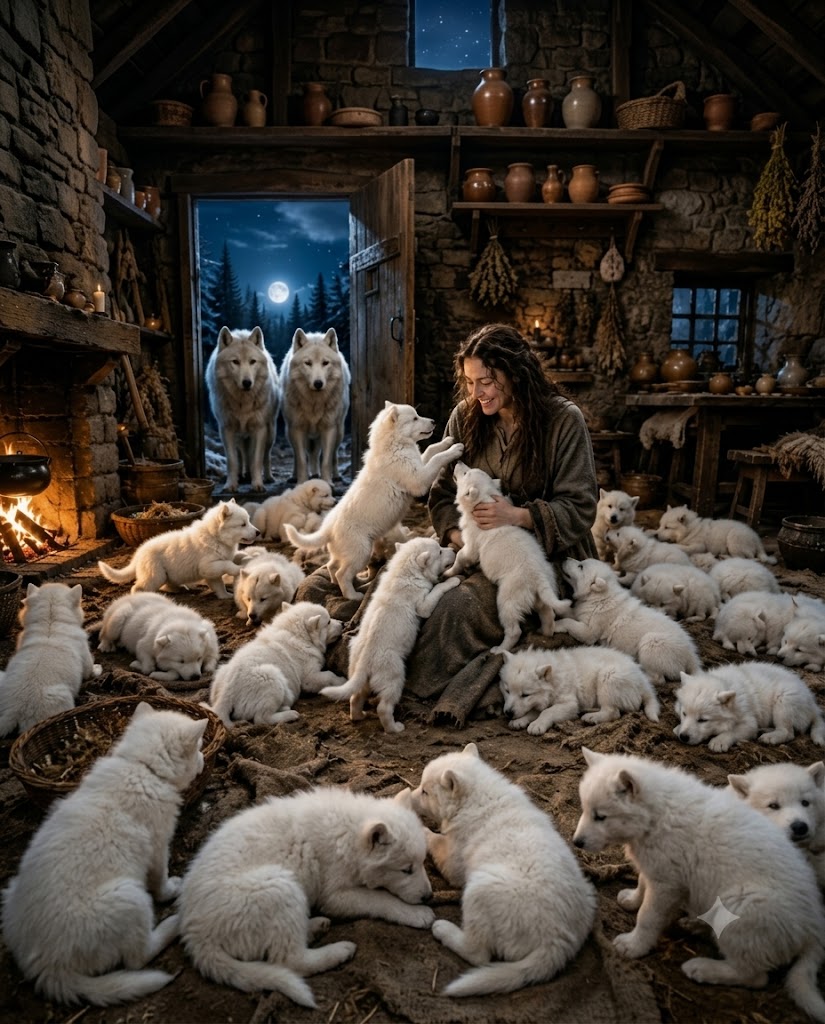
The first pup arrived at midnight with blood on his paw and another wolf’s tooth caught in the fur around his neck
The first enemy crossed the border just after sunrise.
He stepped over the line of white stones without hesitation.
For three seconds, nothing happened.
The forest remained silent.
Then the man looked down.
A thin red thread had appeared across his boot.
He frowned and lifted his foot.
A wire, almost invisible beneath the snow, tightened around his ankle.
From the trees came the sound of a bell.
One clear note.
The man froze.
Another bell answered from somewhere behind him.
Then another.
Within moments, bells were ringing all around the forest.
Not loudly.
Not wildly.
Precisely.
The invaders looked at one another.
They had expected walls.
They had expected guards.
They had expected frightened villagers hiding behind locked doors.
Instead, they heard bells.
The first arrow struck the ground between the enemy captain’s boots.
He stared at it.
A strip of cloth was tied beneath the arrowhead.
Written on it were four words.
TURN BACK WHILE YOU CAN.
The captain laughed.
He pulled the arrow from the earth.
“Tell your mistress,” he shouted into the forest, “that the northern lords have come for what belongs to them.”
A voice answered from the trees.
“She has no mistress.”
The captain’s smile faded.
The voice continued.
“And nothing here belongs to you.”
The scarred young man stepped into view.
He was no longer the frightened boy who had once slept beneath a table.
He wore a dark leather coat, a sword at his hip, and a silver wolf clasp at his shoulder.
Behind him appeared six hunters.
Then twelve.
Then twenty.
The captain looked past them.
More shapes moved between the trees.
He suddenly understood.
The sanctuary had not built a wall.
It had built eyes.
Every path was watched.
Every stream was guarded.
Every ridge had a signal fire.
Every child had grown up knowing exactly where to stand when danger came.
Still, the captain did not retreat.
“You think numbers make you strong?”
The scarred man smiled without humor.
“No.”
He pointed toward the forest.
“We think knowing this land does.”
The first clash lasted less than ten minutes.
The sanctuary did not try to destroy the invaders.
It separated them.
A fallen tree blocked one path.
Smoke covered another.
Hidden pits forced riders from their horses.
Archers struck weapons from hands instead of aiming for hearts.
Every time the enemy regrouped, another horn sounded somewhere in the forest, and another group of defenders appeared.
By noon, the invading force had retreated beyond the boundary.
The villagers cheered.
The young hunters laughed.
Someone began ringing the bells in celebration.
But she did not smile.
She stood on the northern watchtower, staring toward the distant mountains.
The battle had been too easy.
Far too easy.
She had spent twenty years learning how powerful men behaved when they wanted something.
They did not send their strongest soldiers first.
They sent someone disposable.
They wanted to measure the fence.
They wanted to discover where it broke.
That evening, she gathered the council in the old cabin.
The cabin was almost unrecognizable now.
The same kitchen table remained, scarred by years of knives and meals.
The same iron stove stood beside the wall.
But maps covered every surface.
The children had become adults.
The adults had become leaders.
And she sat at the head of the table without ever having asked for the seat.
The scarred young man stood beside the door.
His name was Rowan.
The little boy who had once arrived with a wolf’s tooth tangled in his fur was now twenty-seven years old.
“They’ll return,” he said.
“Yes.”
“With more men.”
“Yes.”
“With soldiers from all three territories.”
She looked at him.
“Probably.”
A young woman named Mara leaned over the map.
“We should evacuate the children.”
“No.”
Several faces turned toward her.
She continued quietly.
“If we run now, they’ll follow us.”
“Then we defend the sanctuary.”
“No.”
Rowan frowned.
“Then what do we do?”
She placed one finger on the map.
“We find out why they came.”
No one spoke.
She tapped the northern mountains.
“The rival lords have fought each other for twenty years. They have never united. They have never cared enough about this place to risk their armies.”
She looked at the others.
“Something changed.”
Rowan’s expression hardened.
“The king.”
She nodded.
The room became silent.
The missing king had become a story people told children.
A ghost.
A dead ruler.
A forgotten name.
But the scarred boy had never forgotten him.
He had been the one who woke whenever someone whispered the king’s name.
He had remembered something no one else did.
On the night he arrived, before sleep took him, he had whispered three words.
“He wasn’t dead.”
For twenty years, she had never asked him to explain.
Now she did.
“Rowan.”
He looked at her.
“What did you see that night?”
His jaw tightened.
“I saw the king.”
Every person in the room went still.
“He was wounded,” Rowan continued. “There was snow everywhere. Men were chasing him. He handed me to my mother and told her to take me north.”
“Why did you never say this?”
“Because I thought I was dreaming.”
She waited.
“And now?”
Rowan looked toward the window.
“Now I think he was trying to save something.”
“What?”
Rowan’s hand closed around the silver clasp on his shoulder.
“Not the throne.”
The next morning, three horses arrived at the southern gate.
Their riders carried white flags.
The eldest was a woman with silver hair and a scar beneath one eye.
She gave her name as Lady Elara of the Eastern Territory.
Behind her stood two men in black armor.
“We come to speak,” she said.
The guards did not lower their weapons.
“You came with soldiers.”
“So did you.”
“This is our land.”
“And that,” Elara replied, “is precisely what I have come to discuss.”
She was brought to the council room.
She looked around slowly.
At the children eating breakfast.
At the shelves filled with books.
At the maps.
At the weapons hanging beside farming tools.
Then she looked at the woman who had built it all.
“You have something the other lords fear.”
“What?”
“Proof.”
“Of what?”
Elara sat down.
“That the king did not abandon the kingdom.”
The room went cold.
She continued.
“Three weeks ago, a messenger was found dead near the western pass. He carried half of an old royal seal.”
Rowan stepped forward.
“What did the other half look like?”
Elara studied him.
“A wolf’s head surrounded by eleven stars.”
Every face turned toward the eleven oldest children in the room.
The first eleven.
The ones who had arrived before dawn on that terrible night.
She remembered the bundle at her feet.
The blood.
The tooth.
The frightened eyes.
Eleven children.
Eleven stars.
Her hand slowly moved toward the old wooden chest beneath the table.
She had never opened it in twenty years.
Inside were the belongings the children had arrived with.
Small pieces of cloth.
Broken pendants.
Old family tokens.
And one object she had never understood.
A black metal disk.
It was cold even in summer.
On its surface were eleven tiny stars surrounding a wolf’s head.
Rowan stared at it.
“That was with me.”
She looked at him.
“You never told me.”
“I didn’t remember.”
Elara stood.
“Then you need to remember now.”
Before anyone could ask what she meant, a horn exploded outside.
Not the warning horn.
The battle horn.
Then came another.
And another.
A messenger burst through the door.
“They’re attacking the southern road.”
“How many?”
The messenger swallowed.
“Thousands.”
Elara closed her eyes.
“They found us.”
The battle began before sunset.
This time, the enemy did not test the sanctuary.
They came to break it.
The southern fields filled with smoke.
Fire climbed the watchtowers.
Arrows darkened the sky.
The sanctuary’s defenders fought from the walls, the forest, the rooftops.
Farmers became archers.
Blacksmiths became shield-bearers.
Healers moved through the chaos with blood on their hands.
And in the center of it all stood the woman who had once been called too soft to survive among wolves.
She carried no royal sword.
She wore no crown.
She simply stood beside the old gate and directed people where they were needed.
“Open the western passage.”
“Bring the wounded to the mill.”
“Do not chase them.”
“Protect the children.”
Her voice never rose.
Yet everyone heard it.
Then the southern gate exploded.
The enemy poured through.
Rowan ran toward her.
“Go!”
She shook her head.
“I’m not leaving.”
“You built this place.”
“And you are part of it.”
“They’re coming for you.”
“No,” she said.
“They’re coming for what they think I have.”
Rowan looked at the black disk in her hand.
The royal seal.
Understanding flashed across his face.
“The king hid the proof here.”
“Perhaps.”
“Then give it to me.”
She stared at him.
“For what?”
“To take it away.”
“And leave you here?”
“I can protect it.”
She stepped closer.
“No.”
Rowan looked furious.
“For once, let me decide what I can do.”
She placed a hand against his shoulder.
“You have spent your whole life protecting people because you believed that was what made you valuable.”
His anger faltered.
“It isn’t.”
She pointed toward the burning village.
“Protection is not dying for something.”
She looked into his eyes.
“It is making sure there is something left alive after you are gone.”
A horn sounded from the eastern ridge.
Then another.
The enemy had reached the inner fields.
Rowan drew his sword.
“Then what do we do?”
She looked toward the forest.
“We stop fighting where they expect.”
The sanctuary’s defenders began retreating.
The enemy followed.
They believed they had finally broken the villagers.
They did not see the gates closing behind them.
They did not notice that the bells had stopped.
They did not hear the silence.
The invaders marched deeper into the valley.
Then every light went out.
Darkness swallowed the sanctuary.
A wolf howled.
Another answered.
Then hundreds.
The sound rolled through the valley like thunder.
The enemy horses panicked.
Their formation collapsed.
Archers appeared on rooftops.
Hunters emerged from hidden tunnels.
The sanctuary’s people had spent twenty years preparing for this exact night.
They knew every stone.
Every tree.
Every ditch.
Every roof.
The invaders knew none of them.
Within an hour, the southern army was trapped.
Its commander ordered a retreat.
The eastern road was blocked.
The western road was flooded.
The northern pass had been sealed by fallen timber.
The only remaining path led directly toward the old mine.
The commander sent fifty men ahead.
None returned.
Then he heard footsteps behind him.
He turned.
She stood alone in the road.
The firelight illuminated her face.
“You have lost,” he said.
She shook her head.
“No.”
She looked at the burning fields.
“We have survived.”
The commander raised his sword.
“You think this ends here?”
“No.”
She looked beyond him.
“I think this is where you finally understand.”
“What?”
“That there was never an army here.”
The commander frowned.
She stepped aside.
Behind her stood farmers, children, hunters, healers, blacksmiths, and wolves.
Not soldiers.
People.
Families.
Everyone she had fed.
Everyone she had taught.
Everyone who had grown because someone had refused to abandon them.
She said quietly,
“You came looking for children.”
The commander stared.
“You found people.”
He lowered his sword.
For the first time that night, he looked afraid.
But the war did not end with his surrender.
At dawn, a second force appeared on the northern ridge.
Not enemies.
Wolves.
Hundreds of them.
At their center walked an old man wearing a torn royal cloak.
Rowan dropped his sword.
The black disk fell from his hand.
The old man stopped.
His eyes moved across the sanctuary.
Then they found her.
He whispered one word.
“Eleven.”
She did not move.
“Who are you?”
The old man laughed softly.
“I was afraid you’d ask.”
He pulled back his hood.
Age had carved deep lines across his face.
His hair was almost completely white.
But the eyes were unmistakable.
Rowan knew them.
The children knew them.
Even the oldest wolves lowered their heads.
The missing Alpha King had returned.
No one spoke for several seconds.
Then the king walked toward the cabin.
He stopped before the woman who had protected his kingdom for twenty years.
“You kept them alive.”
She looked at him.
“I fed them.”
“You gave them a home.”
“They built it.”
“You protected them.”
“They protected one another.”
The king looked around.
At the fields.
At the houses.
At the people.
Then he removed the broken royal crown from beneath his cloak.
It was blackened by fire.
Bent on one side.
He held it out to her.
She did not take it.
“You came too late,” she said.
The king lowered his hand.
“I know.”
“You left them.”
“I had no choice.”
“There is always a choice.”
His expression changed.
Pain crossed his face.
“You are right.”
The words surprised everyone.
A king admitting he had been wrong was rarer than a king losing a war.
He continued.
“I believed I could save the kingdom by reclaiming the throne. I spent twenty years gathering allies, searching for the men who betrayed me, waiting for the moment to return.”
He looked at the sanctuary.
“And all that time, you were doing what I should have done.”
“What?”
“Building something worth returning to.”
The king turned toward Rowan.
“My son.”
Rowan froze.
The scar on his throat seemed suddenly brighter in the morning light.
“You knew?”
“I knew the moment I saw you.”
Rowan’s voice shook.
“Why didn’t you come?”
The king looked down.
“Because I was ashamed.”
No one interrupted him.
“I sent you north because I believed the sanctuary would protect you. Then I disappeared into the mountains. I told myself it was sacrifice.”
He looked at the people around him.
“But sometimes we call something sacrifice when it is simply fear.”
Rowan lowered his head.
The king reached for him.
For a moment, the son did not move.
Then he stepped forward.
They embraced.
Not like king and prince.
Not like Alpha and heir.
Like a father and son who had lost twenty years and could not get them back.
Behind them, the woman watched silently.
Lady Elara approached her.
“What will you do now?”
She looked at the broken crown.
“Nothing.”
Elara smiled faintly.
“You built a kingdom without wanting one.”
“I built a home.”
“Sometimes,” Elara said, “those are the same thing.”
The rival lords surrendered one by one over the following months.
Some were imprisoned.
Some fled.
Some came to the sanctuary expecting revenge and found food waiting instead.
That surprised them more than any army could have.
She insisted that captured soldiers be treated.
She ordered that children taken from enemy territories be returned to their families.
She refused to allow the sanctuary to become another place where power was measured by cruelty.
When the council asked what law should govern the new territories, she gave them only three rules.
No child would be abandoned because their parents were defeated.
No person would be punished for asking for shelter.
And no leader would be permitted to forget the people who depended on them.
The king offered her a title.
She refused.
He offered her land.
She already had land.
He offered her a place beside him in the royal court.
She laughed.
“I have a kitchen to run.”
The king laughed too.
But when he returned south to rebuild the kingdom, he carried one lesson with him.
He stopped calling himself the savior of the wolves.
Instead, he began calling himself their servant.
Years later, travelers would tell strange stories about the northern sanctuary.
They said wolves walked beside children without chains.
They said former enemies shared tables.
They said the woman who ruled the valley had never worn a crown.
Some called her the Mother of Wolves.
Others called her the Northern Alpha.
She disliked both names.
Whenever someone asked what she had really done, she would point toward the fields.
“Nothing extraordinary.”
Then she would point toward the houses.
“We planted.”
Toward the school.
“We taught.”
Toward the children running between the trees.
“We stayed.”
That was the truth.
She had not defeated an empire with one brilliant plan.
She had not changed the world with a sword.
She had simply refused to let frightened children believe that being abandoned meant being worthless.
And that small decision, repeated every morning for twenty years, had become stronger than any throne.
One autumn evening, long after the war had ended, a knock came at the cabin door.
She opened it.
A young girl stood outside.
Her coat was torn.
Her face was dirty.
Behind her were two wolves.
One had blood on its paw.
The woman looked at the girl.
The girl looked at her.
“Can I stay?”
The woman stepped aside.
“Yes.”
The girl hesitated.
“Even if I have nothing?”
The woman smiled.
“You brought yourself.”
The girl entered.
Behind her, the wolves followed.
From the kitchen came the sound of bowls being placed on the table.
From the courtyard came laughter.
Someone shouted for more firewood.
Someone else complained that the potatoes were burning.
She closed the door against the cold.
For a moment, she stood there listening.
Twenty years earlier, eleven frightened children had hidden beneath her table.
Now hundreds of lights burned across the valley.
The sanctuary had become a town.
The town had become a nation.
And still, every night, there was a place at the table for one more.
She walked toward the kitchen.
The girl followed.
Outside, the wolves raised their heads toward the moon.
One howled.
Then another.
Then the whole valley answered.
The sound was no longer a warning.
It was not a cry of fear.
It was not a call to war.
It was the sound of a family that had finally learned it did not need a crown to belong to one another.
And perhaps that was the greatest lesson the old kingdom ever learned:
A kingdom is not made powerful by how many people obey its ruler.
It is made strong by how many people believe they will still have a home when everything else is taken away.
She had once been told that she was too soft to survive among wolves.
They had mistaken gentleness for weakness.
They had never understood that gentleness, when chosen every day and defended with courage, could become a kind of strength that fear could not command.
She never became the Alpha they expected.
She became something more difficult to defeat.
A place people could return to.
A hand that did not let go.
A light left burning in the window.
And whenever the wolves of the northern valley howled beneath the winter moon, the oldest among them remembered the first night.
The blood on the paw.
The tooth caught in the fur.
The eleven frightened faces beneath a kitchen table.
And the woman who had looked at them all, counted the empty bowls, and said only,
“We’ll need more potatoes.”
They had needed potatoes.
They had needed blankets.
They had needed walls.
But more than anything, they had needed someone to open the door.
She did.
And because she did, an entire kingdom found its way home.
The first enemy crossed the border at dawn.
He did not know he had already lost.
His boot came down between two white stones buried beneath the snow.
For a heartbeat, nothing happened.
Then a bell rang.
Once.
The soldier looked around.
Another bell answered from the trees.
Then another.
And another.
Within seconds, the entire forest seemed to awaken.
The enemy commander raised his fist.
“Hold.”
No one moved.
Mist drifted between the pines.
There were no arrows.
No shouting.
No visible defenders.
Only bells.
The commander frowned.
“This is a village,” one of his officers whispered.
“No,” the commander replied.
He had just noticed the tracks.
Hundreds of them.
Wolf.
Human.
Some fresh.
Some deliberately crossed over older tracks to hide their direction.
Someone had spent years preparing this ground.
He raised his voice.
“By order of the Northern Council, this territory is now under the protection of the united alphas. All fugitives are to be surrendered.”
A voice came from the trees.
“There are no fugitives here.”
The commander turned.
The scarred young man stepped from behind a pine.
He was twenty-seven now.
Tall.
Broad-shouldered.
A sword hung at his side, but his hand was nowhere near it.
Behind him stood a dozen hunters.
Their bows were already drawn.
The commander smiled.
“You’re the boy who was brought here years ago.”
The young man said nothing.
“I remember hearing about you.”
The commander took another step.
“They said you were weak. A half-starved pup who couldn’t even speak without trembling.”
The young man’s eyes remained calm.
“They were wrong.”
The commander laughed.
“About what?”
“You were told I was alone.”
The forest erupted.
Arrows struck the ground around the soldiers.
Not one hit a man.
Every arrow landed precisely in front of a boot.
The message was clear.
One more step.
The commander looked toward the ridge.
Shapes were appearing between the trees.
Dozens.
Then hundreds.
Some carried bows.
Some axes.
Some farming tools.
Some nothing at all.
Behind them stood wolves.
Not chained.
Not trained for war.
Simply standing.
Watching.
The commander slowly lowered his hand.
“What is this place?”
The scarred young man answered.
“A home.”
Then the woman appeared.
She walked down the stone steps of the sanctuary as if nothing unusual were happening.
Her sleeves were rolled up.
There was flour on one wrist.
A knife hung at her belt.
She looked at the enemy commander.
Then at the soldiers.
Then at the untouched forest behind them.
“Why are you here?”
The commander straightened.
“We were ordered to collect the children.”
Her face changed.
Only slightly.
But every person behind her noticed.
The quiet woman who had spent twenty years feeding abandoned pups had just become very still.
“Which children?”
“All of them.”
Silence fell.
Then someone behind her laughed.
It was not a happy sound.
The scarred young man stepped forward.
“You heard him.”
The hunters raised their bows.
The woman lifted one hand.
They stopped.
She looked at the commander.
“Who gave the order?”
“The three northern alphas.”
“Why?”
The commander hesitated.
“Because the children belong to their bloodlines.”
The woman looked over the army.
“Do they?”
No one answered.
She pointed toward the sanctuary.
“Go inside.”
The commander blinked.
“To whom are you speaking?”
“To the children.”
He laughed.
“You think they’ll obey you?”
Behind him, a young woman stepped forward.
She was one of the three brothers who had arrived years ago.
Only she was no longer a child.
She carried a hammer in one hand.
“I will.”
Another stepped beside her.
Then another.
One by one, the children who had once hidden beneath the kitchen table came forward.
Hunters.
Healers.
Smiths.
Scouts.
Farmers.
Teachers.
They formed a line.
The commander stared at them.
He finally understood why the reports had terrified the northern lords.
These were not abandoned children anymore.
They were the people who had built the sanctuary.
And the sanctuary was no longer a cabin in the woods.
It was a living kingdom.
“Take them,” the commander ordered.
His soldiers did not move.
“Take them!”
Still nothing.
One soldier finally whispered,
“Commander…”
“What?”
“There are wolves behind us.”
The commander turned.
The road they had entered through was filled with them.
Hundreds of pale eyes watched from the darkness.
The wolves did not attack.
They simply waited.
The commander swallowed.
The woman stepped closer.
“You came for children.”
She looked toward the sanctuary.
“They are adults now.”
She looked back at him.
“And they have chosen where they belong.”
The commander lowered his sword.
That should have ended it.
But the next horn came from the northern ridge.
Three long blasts.
Everyone turned.
A rider was racing toward the sanctuary.
He nearly fell from his horse when he reached the gate.
“The eastern army is coming.”
The scarred young man cursed.
“How many?”
“Too many.”
“How many?”
The rider looked at the woman.
“Five thousand.”
The sanctuary went silent.
The commander smiled again.
“This time, you cannot hide behind a forest.”
She looked at him.
“We never intended to hide.”
That night, every fire in the sanctuary was extinguished.
Every door was locked.
Every child was brought inside.
The defenders took positions along the ridges.
But the woman did something no military commander expected.
She ordered the gates opened.
Rowan stared at her.
“You want them inside?”
“No.”
“Then why open the gates?”
“So they can see what they came to destroy.”
At midnight, the eastern army reached the valley.
They expected darkness.
Instead, they saw lights.
Hundreds of lanterns suddenly appeared across the fields.
Then thousands.
Every house.
Every barn.
Every workshop.
The entire sanctuary glowed beneath the winter sky.
At the center stood the old cabin.
The woman stood before its door.
Beside her were the eleven oldest children.
The first eleven.
The ones who had arrived on the first night.
The eastern commander rode forward.
“You have one chance.”
The woman waited.
“Surrender the children, and no one dies.”
Rowan stepped forward.
“They are not children.”
The commander laughed.
“You think changing their age changes their blood?”
“No.”
Rowan looked at the people behind him.
“It changes what they can choose.”
The commander raised his sword.
“Attack.”
The army charged.
The valley exploded.
Arrows filled the night.
Horses screamed.
Men crashed against barricades.
The sanctuary’s defenders fought with everything they had.
But the eastern army was too large.
One barricade fell.
Then another.
A watchtower burned.
The western gate cracked.
The defenders retreated.
For the first time in twenty years, fear entered the sanctuary.
Not panic.
Not cowardice.
The deeper kind of fear.
The fear that comes when people realize that courage may not be enough.
Rowan found the woman beside the burning mill.
“We’re losing.”
She looked at the flames.
“Yes.”
“We have to retreat.”
“Yes.”
“To where?”
She pointed toward the mountain.
“The old tunnels.”
Rowan shook his head.
“There are hundreds of families.”
“I know.”
“We can’t move them all.”
She looked at him.
“Then don’t move them.”
He stared.
“What?”
“Move the enemy.”
She turned toward the northern ridge.
“Do you remember what I taught you when you were eight?”
Rowan frowned.
“Never fight the wolf where the wolf wants to fight.”
She nodded.
“Exactly.”
Within minutes, bells rang throughout the sanctuary.
Not the warning bells.
The old bells.
The ones the first children had learned to follow.
Doors opened.
People disappeared.
Families entered barns, cellars, tunnels, workshops.
The sanctuary seemed to empty.
The eastern soldiers rushed through the streets.
They found no resistance.
The commander smiled.
“They’re running.”
“No,” said one of his officers.
“They’re inviting us in.”
The commander turned.
“What?”
Before he could answer, the ground beneath the central square collapsed.
Not completely.
Just enough.
Dozens of soldiers fell into an old storage trench.
The defenders struck from the rooftops.
Smoke filled the street.
The eastern army lost its formation.
Then the wolves came.
Not charging.
Driving.
Howling from one street.
Then another.
The soldiers panicked and ran toward the only open road.
The road led directly into the narrow mountain pass.
The commander realized the trap too late.
The sanctuary had never intended to defeat five thousand men in an open field.
It intended to make five thousand men believe they had already won.
At the mouth of the pass, Rowan waited.
Behind him stood every hunter in the sanctuary.
He looked toward the commander.
“Put down your weapons.”
The commander raised his sword.
“You think you can imprison an army?”
“No.”
Rowan looked beyond him.
“I think you can imprison yourself.”
The commander turned.
The pass behind him was blocked.
The cliffs rose on both sides.
The wolves stood above.
The villagers stood behind them.
There was nowhere to go.
The commander dropped his sword.
One by one, his soldiers followed.
By sunrise, the eastern army had surrendered.
But victory brought no celebration.
Because before noon, a messenger arrived with news that changed everything.
The three northern alphas had not sent the army to claim the children.
They had sent it because they had discovered something hidden beneath the sanctuary.
Something the woman herself had never known existed.
An ancient chamber.
Buried beneath the original cabin.
The messenger handed her a sealed letter.
The seal was broken.
Inside was a single page.
She read it once.
Then again.
Her hands trembled.
Rowan noticed.
“What is it?”
She gave him the letter.
He read the first line.
Then his face went pale.
The king is alive.
For twenty years, the kingdom had believed the Alpha King was dead.
But the letter claimed otherwise.
He had escaped the massacre.
He had been wounded.
He had hidden among the northern mountains.
And before disappearing, he had sent his youngest children away.
Not because he had abandoned them.
Because he knew his enemies would kill them if they remained in the royal territory.
The eleven children were not random.
They were the heirs of the royal bloodline.
Eleven branches of one broken family.
The sanctuary was not merely protecting abandoned children.
It had unknowingly protected the future of the entire kingdom.
Rowan looked up.
“I’m one of them.”
“Yes.”
“So are the others.”
She nodded.
“Why did no one tell us?”
“Because no one knew where you were.”
A voice came from the doorway.
“I knew.”
Everyone turned.
Lady Elara stood there.
She had arrived during the night with only three riders.
The silver-haired woman looked at Rowan.
Then at the eleven.
“The king sent me.”
Rowan stepped toward her.
“Where is he?”
Elara looked toward the mountains.
“Alive.”
“Where?”
“Three days north.”
Rowan’s face hardened.
“Then we go.”
The woman shook her head.
“No.”
He turned angrily.
“Why?”
“Because you are not going to meet him as a child begging for his father.”
Rowan stared at her.
“You’re going to meet him as the man you became.”
Three days later, the eleven traveled north.
The woman went with them.
They crossed frozen rivers.
Climbed narrow passes.
Slept beneath trees.
On the third evening, they found an old stone house hidden between the mountains.
A man stood outside.
He was older than Rowan had imagined.
His hair was white.
One shoulder was bent from an old injury.
But his eyes were sharp.
When he saw the eleven, he stopped breathing.
The oldest among them stepped forward.
“Are you our father?”
The old man looked at them.
Tears filled his eyes.
“I am.”
No one moved.
Then the smallest of the eleven, now a grown woman, walked toward him.
“Why didn’t you come?”
The king closed his eyes.
“I was afraid.”
“Of what?”
“That I would bring death with me.”
She looked at him for a long time.
Then she said,
“You brought silence instead.”
The king lowered his head.
“I know.”
The woman watched from a distance.
She knew this moment did not belong to her.
The king looked toward her.
“You saved them.”
She shook her head.
“They saved themselves.”
“No.”
He walked closer.
“You gave them the chance.”
She smiled.
“That is what everyone needs.”
The king looked toward the valley.
“I want you to come back with us.”
“Where?”
“To the capital.”
She laughed softly.
“I don’t belong in palaces.”
“You belong wherever people need you.”
She looked at him.
“Then rebuild the kingdom.”
He frowned.
“Without you?”
She pointed toward the eleven.
“You have heirs.”
Then toward Rowan.
“You have a son.”
Then toward the mountains.
“You have people who need a future.”
She stepped back.
“My work is here.”
The king finally understood.
She had never wanted power.
That was why power trusted her.
When the kingdom was rebuilt the following year, Rowan refused the crown.
So did the other ten.
Instead, they divided the kingdom into territories governed by councils.
No single alpha would ever again hold absolute authority.
The sanctuary became the northern seat of the council.
The old cabin was preserved.
Not as a palace.
Not as a monument.
As a kitchen.
The table remained.
The same table beneath which eleven frightened children had once hidden.
Every year, on the first night of winter, the kingdom gathered there.
They brought bread.
Potatoes.
Soup.
Candles.
And stories.
They told children about the war.
But they never told them that the greatest victory had been winning a battle.
They told them about a woman who had opened a door.
A woman who had fed strangers.
A woman who had refused to let fear decide who deserved a home.
Many years later, when she became old, Rowan visited her at the cabin.
She was sitting beside the window.
Snow covered the fields.
“Mother.”
She looked up.
“You’re late.”
He smiled.
“I am king now.”
“I know.”
“You didn’t come to the ceremony.”
“I had potatoes to peel.”
He laughed.
Then he sat beside her.
For a while, neither spoke.
Finally, Rowan asked,
“Do you ever regret it?”
“Regret what?”
“Opening the door that night.”
She looked at him.
Outside, children were running through the snow.
Some were wolves.
Some were human.
Some were both.
She smiled.
“No.”
Rowan nodded.
“I don’t either.”
She looked toward the kitchen.
“Are there enough bowls?”
He smiled.
“Always.”
That night, another knock came at the door.
Rowan opened it.
A frightened boy stood outside.
His clothes were torn.
His hands were shaking.
Behind him stood a wolf with blood on its paw.
The boy looked at the old woman.
“Can I stay?”
She smiled.
“You don’t need to ask.”
He stepped inside.
The wolf followed.
Rowan closed the door.
The fire crackled.
Someone brought a blanket.
Someone filled a bowl.
Someone put another chair at the table.
And for the first time, the boy smiled.
Outside, wolves gathered beneath the moon.
Their howls rose into the winter sky.
But there was no fear in them anymore.
No warning.
No desperation.
Only belonging.
The old woman listened from her chair.
She knew that one day she would no longer be there to open the door.
That was all right.
Because twenty years ago, she had opened it for eleven children.
They had grown.
They had learned.
They had built.
And now they were opening doors for others.
That was how the sanctuary survived.
Not because its walls were strong.
Not because its people were fearless.
But because every generation understood the same simple truth.
A home is not something you inherit.
It is something you choose to build for someone else.
And sometimes the smallest act of kindness, repeated long enough, becomes stronger than an army.
The woman had never worn a crown.
She had never called herself an Alpha.
She had never asked anyone to kneel.
Yet kings had come to her door.
Armies had fallen before her fields.
And an entire kingdom had been rebuilt around the simple principles she had taught frightened children at a kitchen table.
Share what you have.
Protect those who cannot protect themselves.
Do not waste what others may need tomorrow.
And when someone knocks on your door in the cold, do not ask first what they can give you.
Ask whether they are warm.
The northern kingdom remembered many heroes after the war.
Warriors.
Kings.
Generals.
Names were carved into stone.
Songs were written about battles.
But the oldest people told a different story.
They said the kingdom had not been saved by a sword.
It had been saved by a door.
A door that opened at midnight.
A bowl that was never left empty.
And a woman who was told she was too soft for the world.
She proved that the world did not always need harder hearts.
Sometimes it needed someone strong enough to remain gentle.
And so, long after the last battlefield became a field of wheat, the northern wolves still gathered beneath the moon.
Children still ran through the old sanctuary.
The bells still hung between the trees.
And in the window of the first cabin, a small light was always left burning.
Not because anyone was expected.
But because somewhere, someday, someone might be lost.
And they would need to know where home was.
THE END.