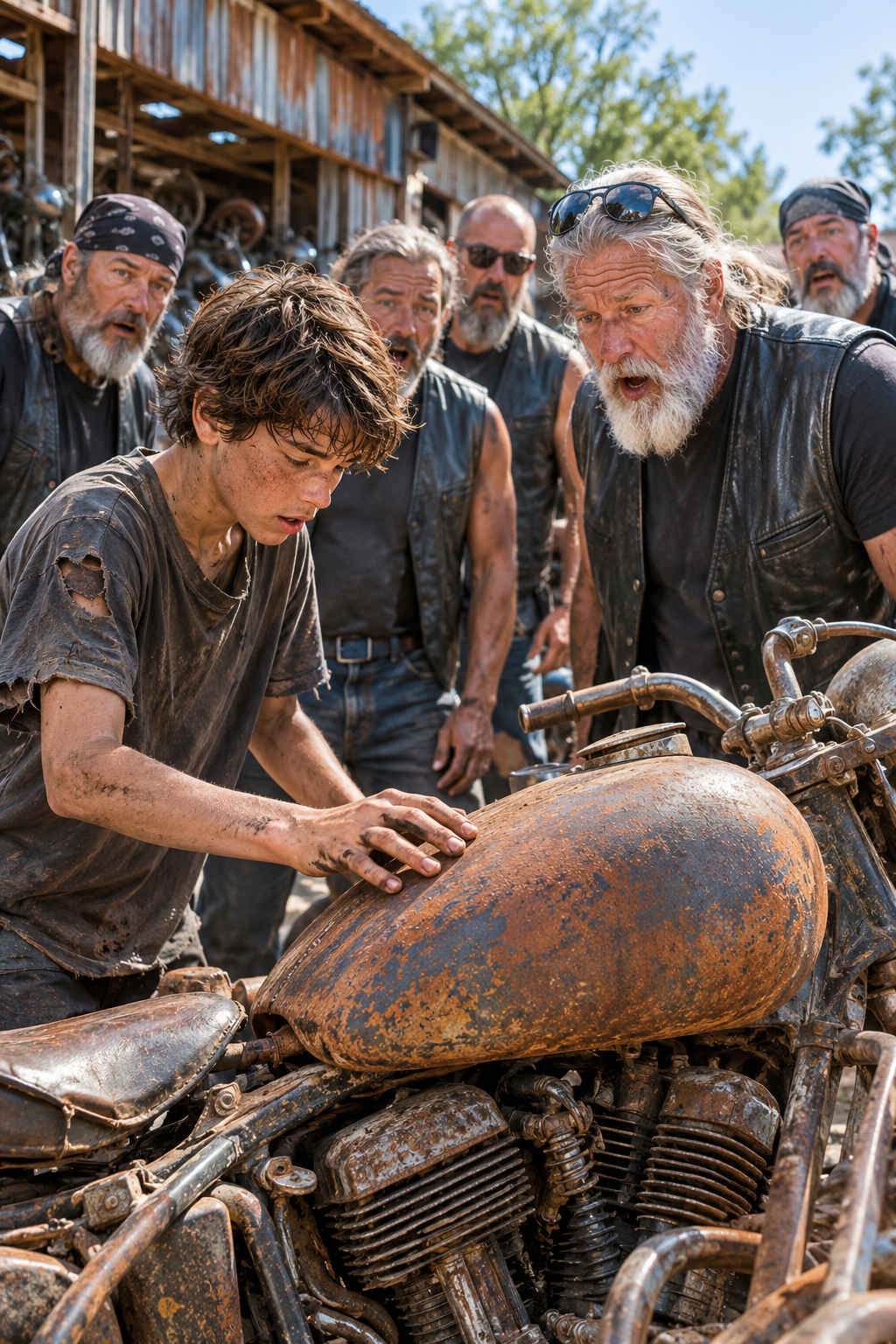
The first biker who saw the photos of 14-year-old Eli Brooks’s $8 junkyard purchase called him and said, “Kid, don’t sell a single piece.” Then he told Eli something that made his hands shake.
“Get me a flashlight,” Preacher said quietly.
The mechanic reached for a bottle of rust remover and began working on the damaged section of the frame. Everyone gathered around the workbench as the scratches slowly became clearer.
Two letters appeared first.
D and B.
Then, beneath them, another letter emerged.
An E.
Beside the letters was a small, uneven heart.
Eli stopped breathing for a moment.
He grabbed the photograph and turned it over. On the back, in his father’s handwriting, were three names.
Daniel. Denise. Eli.
The same initials.
“My dad used to carve our initials into things,” Eli whispered. “He did it on our kitchen table, too.”
Preacher took the photograph and studied the motorcycle more carefully. There was a distinctive repair near the bottom of the frame, where a small metal plate had been welded into place.
He looked down at the frame on the workbench.
The same repair was there.
“Good Lord,” he muttered.
Nobody spoke.
Eli looked from one man to another, desperately searching their faces for an answer.
“Is it his?”
Preacher placed both hands on the workbench.
“I don’t want to promise you something until we’re absolutely certain. But there’s a very good chance you just bought what remains of your father’s motorcycle.”
Eli’s knees suddenly felt weak.
He sat down on an overturned bucket, staring at the pieces he had dragged home in his wagon.
For four years, he had wondered where his father’s motorcycle had gone. Sometimes, when he heard a Harley passing their house, he would run to the window, imagining that familiar black motorcycle coming around the corner.
Now, somehow, it might have been sitting beneath his feet.
“Why would somebody tear it apart?” he asked.
That was a question nobody could answer.
The following morning, Preacher and two other riders accompanied Eli back to the junkyard.
The owner, a heavyset man named Curtis, looked surprised when he saw three motorcycles pulling into his property.
When Eli explained why they had come, Curtis scratched his beard.
“That old pile? Came in about six months ago. Bought a truckload of scrap from a storage facility that was clearing out abandoned units.”
“Do you have any paperwork?” Preacher asked.
Curtis disappeared into his office and returned twenty minutes later carrying a dusty cardboard box filled with receipts.
They searched through dozens of documents until they found the right one.
The storage unit had belonged to a man named Raymond Keller.
Eli immediately recognized the name.
He had heard his mother mention it once during a conversation with his grandmother.
Raymond was the man who had purchased his father’s motorcycle.
Preacher wrote down the information.
Before they left, Curtis called Eli back.
“Hey, kid.”
He reached into his pocket and pulled out eight dollars.
“Take it.”
Eli shook his head.
“But I bought the parts.”
“And you can keep them,” Curtis replied. “Consider this my contribution.”
Eli accepted the money reluctantly.
Curtis glanced toward the mountains of discarded metal behind him.
“Funny thing about this place. People bring me things they don’t want anymore. Sometimes I forget those things meant something to somebody once.”
Two days later, Preacher located Raymond Keller.
He was living in a nursing facility nearly ninety miles away.
Raymond had suffered a stroke the previous year. His nephew had been responsible for handling his belongings, including the contents of several storage units.
When Preacher explained the situation over the phone, Raymond became unusually emotional.
“Bring the boy here,” he said. “There’s something he needs to know.”
That Saturday, Eli climbed into Preacher’s pickup truck with the photograph tucked inside his jacket.
Raymond was waiting beside a window when they arrived. He was seventy-three years old, with thin white hair and a trembling left hand.
The moment Eli introduced himself, the old man’s eyes filled with tears.
“You’ve got Daniel’s face.”
Eli sat beside him.
“You knew my dad?”
Raymond nodded slowly.
“Your father used to repair motorcycles for me. Never charged me what the work was worth. Sometimes he wouldn’t take anything at all.”
He explained that after Daniel’s death, Denise had contacted him about selling the Harley.
She was facing overdue mortgage payments, medical bills, and funeral expenses.
Raymond had purchased the motorcycle for considerably more than she had asked.
But what he told Eli next changed everything.
“I wasn’t planning to keep it.”
Eli looked confused.
“Then why did you buy it?”
“Because your mother needed money, and she was too proud to accept charity. I figured I’d hold onto the bike until you were old enough to have it.”
Raymond lowered his head.
“I even started restoring the engine. Took everything apart, labeled what I could, and ordered replacement pieces. Then I got sick.”
His nephew, unaware of the arrangement, had stopped paying for the storage unit.
By the time Raymond recovered enough to ask about the motorcycle, everything was gone.
“I thought I’d failed your father,” he whispered.
Eli reached into his jacket and handed him the photograph.
“We found most of it.”
Raymond pressed the picture against his chest and cried.
Preacher turned toward the window, pretending to examine the parking lot.
After a few minutes, Raymond asked a nurse to retrieve a small wooden box from his bedside cabinet.
Inside were several documents, an old ignition key, and a sealed envelope.
The documents included the motorcycle’s title and a handwritten record of its identifying numbers.
The envelope had Daniel Brooks’s name written across the front.
“Your father gave me that years ago,” Raymond explained. “He asked me to hold onto it in case anything ever happened to him. I was supposed to give it to you when you were old enough.”
Eli stared at the envelope.
“Can I open it?”
“It’s yours, son.”
With shaking fingers, Eli unfolded the letter.
It was dated three months before his father’s death.
Dear Eli,
If you’re reading this, there’s a chance I’m not around to teach you some of the things I wanted to teach you.
I hope you learn how to change a tire, apologize when you’re wrong, and keep your promises even when nobody is watching.
I hope you find something you love doing with your hands.
But more than anything, I hope you never believe that being a man means carrying every burden alone.
Take care of your mother, but remember that you’re her son, not her husband. You deserve to be a kid.
And if life ever breaks something you love, don’t be afraid to ask someone to help you put it back together.
Love always,
Dad.
Eli read the letter twice.
Then he folded it carefully and held it against his chest.
For years, he had been trying to become the man of the house. He had stopped asking for birthday presents. He rarely invited friends over because he knew his mother couldn’t afford extra food.
Whenever Denise cried behind her bedroom door, he pretended not to hear.
He thought being strong meant never giving her another reason to worry.
But his father had apparently wanted something different for him.
On the drive home, Eli barely spoke.
When they reached his house, Preacher noticed Denise’s car parked outside.
“Your mom’s home early.”
Eli looked toward the garage.
The door was open.
Denise was standing inside, surrounded by motorcycle parts.
She was holding the photograph that normally hung above Daniel’s toolbox.
“Eli,” she said when he approached. “What is all this?”
He had imagined revealing the finished motorcycle to her a hundred different ways.
He had never imagined this.
“I wanted to surprise you.”
Denise looked around the garage.
“Where did you get the money for all these parts?”
“They only cost eight dollars.”
“And these men coming here? Your neighbor told me you’ve had strangers working in our garage.”
Preacher stepped forward and introduced himself.
He explained everything, from the online photographs to their visit with Raymond.
When he showed Denise the initials carved into the frame, she covered her mouth.
Daniel had carved them the night they brought Eli home from the hospital.
She remembered standing beside him, laughing because the heart he had attempted to draw looked more like a crooked potato.
Her fingers moved across the familiar marks.
Then, unexpectedly, she became angry.
“Put it away.”
Eli blinked.
“Mom?”
“I can’t do this right now.”
She walked into the house and closed the door.
Eli stood motionless.
After everything he had done, after finding the motorcycle and his father’s letter, he had somehow made things worse.
Preacher placed a hand on his shoulder.
“Give her some time.”
“But I thought she’d be happy.”
“Sometimes the things that make us happiest are also the things that hurt the most when we lose them.”
That night, Denise entered Eli’s bedroom.
He was sitting on his bed, reading his father’s letter.
She sat beside him and asked if she could see it.
By the time she finished reading, tears were running down her face.
“Your dad and I were supposed to grow old together,” she said. “We had plans to ride across the country when you finished school.”
Eli listened quietly.
“The day I sold that motorcycle, I felt like I was saying goodbye to him all over again.”
“I’m sorry, Mom.”
Denise pulled him into her arms.
“You don’t have to fix me, sweetheart. That’s not your job.”
“I just wanted you to smile again.”
She kissed the top of his head.
“Then promise me you’ll give yourself permission to smile, too.”
The following morning, Denise walked into the garage carrying two cups of coffee and a glass of orange juice.
Preacher and Eli were examining the engine.
She set the drinks down.
“If you’re going to rebuild Daniel’s motorcycle,” she said, “you should know he hated shiny chrome. He liked everything to look original.”
Preacher grinned.
“Yes, ma’am.”
For the first time in months, Eli heard his mother laugh.
The restoration became a community project.
A retired machinist named Walter volunteered to repair damaged components. A motorcycle painter offered his services without charging a penny. Members of several riding clubs organized deliveries of replacement parts.
One rider drove nearly six hundred miles to bring an original fuel tank he had kept in his basement for twenty years.
Another donated a set of wheels that had belonged to his late brother.
Every Saturday, the Brooks family’s driveway filled with motorcycles.
Denise began cooking large pots of chili for the volunteers. She learned their names, listened to their stories, and occasionally corrected their memories of Daniel.
For a while, everything seemed to be going perfectly.
Then, on a cold Tuesday morning, a man wearing an expensive leather jacket arrived at the house.
His name was Victor Harlan.
He was a collector who specialized in rare American motorcycles.
Someone had shown him Eli’s photographs.
Victor examined the parts and offered Denise fifty thousand dollars.
Cash.
Eli looked at his mother.
Fifty thousand dollars could change their lives.
Victor noticed her hesitation.
“You could pay off your debts, take some time away from work, maybe put something aside for the boy’s education.”
Denise asked him to leave his business card.
That evening, Eli overheard his mother talking on the phone.
Their mortgage was three months behind.
The bank had given her a final deadline to make a payment arrangement.
She had also received another medical bill connected to Daniel’s final hospitalization.
Eli sat on the staircase, listening until his mother began crying.
The next morning, he called Victor.
“I’ll sell you the motorcycle,” he said.
Victor arrived less than an hour later.
He brought a purchase agreement and a cashier’s check.
But before anything could be signed, Denise returned home.
“What are you doing?” she demanded.
Eli looked down.
“We need the money.”
Denise stared at the check.
For several seconds, the temptation was almost unbearable.
Then she looked at her son.
He was fourteen years old, and once again, he was trying to sacrifice something he loved to protect her.
She handed the agreement back to Victor.
“Thank you for your offer. But my son isn’t responsible for solving my financial problems.”
Victor left without the motorcycle.
When Preacher heard what had happened, he called a meeting with the riders.
Denise insisted she didn’t want anyone paying her bills.
So they came up with another idea.
Several local businesses had been searching for an experienced office manager. Denise had worked in bookkeeping before Daniel became ill, but she had taken whatever jobs she could find after his death.
One of the riders owned a transportation company.
He arranged an interview.
Denise got the position on her own qualifications, with better pay, regular hours, and health insurance.
A retired financial counselor helped her negotiate a repayment plan with the bank.
For the first time in years, she could see a way forward.
But the motorcycle still had one enormous problem.
Its original engine was badly damaged.
Walter discovered a crack that had been hidden beneath layers of grime.
Repairing it properly would require specialized work beyond anything they could perform in the garage.
A replacement would cost thousands of dollars.
The men stood around the engine in silence.
After nearly five months of work, they had reached a point where enthusiasm alone wasn’t enough.
Preacher called every specialist he knew.
Nobody could promise a successful repair.
Finally, Walter suggested contacting a restoration expert named Frank Mercer, who had retired several years earlier.
Frank refused immediately.
“I’m done rebuilding engines.”
Preacher explained the circumstances.
There was a long silence on the other end.
“What did you say the father’s name was?”
“Daniel Brooks.”
Frank asked for the address.
He arrived the following afternoon.
He was a thin man in his late sixties who walked with a cane.
Without introducing himself, he examined the engine, inspected the frame, and looked at Daniel’s photograph.
Then he sat down.
“Your father saved my business once,” he told Eli.
Years earlier, Frank’s workshop had nearly closed after his wife became seriously ill.
Daniel had spent weeks helping him complete overdue restoration jobs, refusing payment for his time.
Frank had never forgotten it.
“I kept telling myself I’d repay him someday,” he said. “Then I heard he’d passed away.”
He looked toward the damaged engine.
“I can’t promise it’ll run. But I’ll give it everything I’ve got.”
Frank took the engine home.
For seven weeks, nobody knew whether the repair would succeed.
Eli checked his phone every afternoon after school.
Then, one Friday evening, Preacher received a video.
It showed Frank standing beside a test stand.
A familiar engine rested in front of him.
Frank reached down.
A deep mechanical rumble filled the recording.
Eli jumped out of his chair.
“That’s it!”
Denise came running from the kitchen.
When she heard the sound, her expression changed.
She recognized that uneven, unmistakable rhythm.
It was the sound she used to hear when Daniel came home from work.
She sat down and listened until the video ended.
“Play it again,” she whispered.
Three weeks later, the motorcycle was complete.
The black fuel tank gleamed beneath the garage lights. The leather seat had been restored, the wheels polished, and every salvaged component carefully fitted into place.
Even the crooked little heart remained untouched.
Preacher arranged the unveiling for Daniel’s birthday.
More than a hundred riders gathered outside the Brooks home.
Raymond arrived in a wheelchair, accompanied by a nurse. Curtis closed his junkyard for the afternoon. Frank stood beside Walter, both men pretending they weren’t emotional.
Eli rolled the motorcycle out of the garage.
Denise stared at it.
For a moment, she seemed unable to move.
Then she walked forward and rested her hand on the fuel tank.
“Oh, Daniel,” she whispered.
Eli handed her the original ignition key.
“Happy birthday, Dad.”
Denise had earned her motorcycle license years earlier, although she hadn’t ridden since losing her husband. In the weeks leading up to the unveiling, she had quietly taken a refresher course with one of the volunteers.
Now she put on her helmet and gloves.
Preacher helped her start the engine.
The Harley came alive.
The crowd erupted into applause.
Denise looked at Eli and gestured toward the passenger seat.
“Coming with me?”
He nodded, too emotional to answer.
Together, they rode slowly down the street, accompanied by dozens of motorcycles.
They followed the familiar road toward the cemetery.
At Daniel’s grave, Denise removed her helmet.
Eli placed a small photograph of the restored motorcycle beside the headstone.
“We got it back, Dad.”
Denise wrapped her arm around him.
For the first time, visiting the cemetery didn’t feel entirely like saying goodbye.
It felt like bringing something home.
In the years that followed, Eli never forgot the people who had helped him.
At eighteen, he earned his motorcycle license and began training as a mechanic.
At twenty-two, he opened a small restoration workshop with Preacher’s guidance.
Above the entrance hung a wooden sign that read:
THE EIGHT DOLLAR GARAGE.
Every year, the workshop selected one family facing difficult circumstances and repaired something meaningful to them without charging for labor.
Sometimes it was a motorcycle. Sometimes an old car. Once, it was a rusty bicycle belonging to a little girl whose grandfather had passed away.
Eli kept his father’s letter framed beside his workbench.
One afternoon, a young apprentice asked him why he refused to sell the old Harley, even though collectors continued making generous offers.
Eli smiled and looked toward the motorcycle.
“Because I bought eighty-five pieces of rusty metal for eight dollars,” he said. “But what I got back was worth a whole lot more.”
He had recovered his father’s motorcycle, watched his mother rebuild her life, and discovered a family among people who had once been complete strangers.
Most importantly, he had learned that love wasn’t measured by how much pain someone could endure alone.
It was measured by the willingness to show up when another person needed help.
The motorcycle still carried three initials and a crooked heart beneath its steering neck.
Eli never allowed anyone to polish those marks away.
They reminded him that broken things didn’t always need to become perfect again.
Sometimes, their scars were the most beautiful part of them.
And sometimes, when people came together to restore something that seemed beyond saving, they ended up restoring something far more valuable than they had ever imagined.
But Eli’s greatest test would come eleven years after the day he first walked into that junkyard.
By then, the Eight Dollar Garage had become one of the most respected motorcycle restoration shops in the county. Customers came from neighboring states, and photographs of Eli’s work appeared in several motorcycle magazines.
Denise had purchased a smaller house with a beautiful garden. She no longer worked weekends, and every Sunday morning, she and Eli had breakfast together.
For the first time in a long time, life seemed peaceful.
Then, one November afternoon, Eli received a telephone call that brought everything to a sudden stop.
It was Preacher’s daughter.
“Eli, Dad’s in the hospital.”
He immediately put down his tools.
“What happened?”
“His heart. The doctors say he needs surgery.”
Eli closed the garage early and drove straight to the hospital.
He found Preacher lying beneath a thin white blanket, looking considerably smaller than the man who had once filled his childhood garage with laughter.
Preacher smiled weakly.
“Don’t look at me like that, kid. I’m not going anywhere just yet.”
Eli pulled a chair beside the bed.
“How long have you known something was wrong?”
Preacher looked away.
“A few months.”
“And you didn’t tell anybody?”
“Didn’t want to be a burden.”
Those words struck Eli harder than he expected.
He remembered being fourteen years old, sitting on an overturned bucket, wondering how he could save his mother from a life of sadness.
He remembered his father’s letter.
“You were the one who taught me that nobody has to carry everything alone,” Eli said. “You don’t get to forget that just because you’re the one who needs help now.”
Preacher stared at him.
Then he laughed softly.
“Guess I raised you too well.”
The surgery was successful, but Preacher’s recovery would take months. He could no longer work, and his small motorcycle repair business was struggling beneath unpaid expenses.
His daughter eventually admitted that he was considering selling his beloved motorcycle to keep the business from closing.
It was a motorcycle he had owned for thirty-eight years.
Eli knew what he needed to do.
He contacted the riders who had helped restore his father’s Harley. Some had moved away. Others had retired. A few had passed on, but their children answered the telephone.
Within a week, dozens of volunteers arrived at Preacher’s workshop.
They completed unfinished repairs, contacted customers, organized the accounts, and cleaned every corner of the building.
Eli arranged for his own employees to help keep the business operating until Preacher recovered.
Nobody asked for payment.
When Preacher finally returned home, he found his motorcycle parked outside his workshop, freshly serviced and polished.
Above the entrance hung a banner.
WELCOME HOME, BROTHER.
He stood beside his daughter, staring at the crowd.
“What did you people do?”
Eli stepped forward.
“Paid back eight dollars’ worth of kindness.”
Preacher covered his face with both hands.
For the first time since Eli had known him, the old biker cried openly in front of everyone.
Three months later, a young boy appeared outside the Eight Dollar Garage.
He was thirteen, wearing worn-out sneakers and a jacket several sizes too large.
Beside him was an old bicycle with a broken chain, bent handlebars, and two flat tires.
“Can you fix this?” he asked.
Eli crouched beside the bicycle.
“Probably. What happened to it?”
“It belonged to my brother.”
The boy explained that his older brother had died the previous summer. His mother wanted to throw the bicycle away because seeing it made her sad.
But he couldn’t bear to lose it.
He reached into his pocket and pulled out a handful of coins.
“I’ve got four dollars and seventy cents.”
Eli looked at the money.
For a moment, he saw himself standing in a junkyard, offering everything he had for something nobody else believed was worth saving.
He gently closed the boy’s fingers around the coins.
“Keep your money.”
The boy’s expression fell.
“Is it too broken?”
Eli smiled.
“No. I think we’ve got everything we need.”
Over the following two weekends, Eli taught the boy how to repair the bicycle himself. They replaced the damaged parts, straightened the handlebars, and carefully preserved a small sticker his brother had placed beneath the seat.
When the bicycle was finished, the boy’s mother came to collect him.
She stood in the doorway, looking at something she had once been unable to face.
Her son explained how he had repaired it.
Instead of crying, she smiled.
Then she asked if she could take a photograph of him sitting on it.
Eli watched them leave together.
That evening, he walked over to his father’s Harley and ran his fingers across the three initials carved into the frame.
He finally understood something that had taken him years to learn.
His father hadn’t returned to him through a motorcycle.
He had returned through the lessons Daniel had left behind, through the people Daniel had helped, and through every act of kindness that continued long after his death.
Years later, when Preacher passed away peacefully at the age of eighty-one, more than three hundred motorcyclists attended his funeral.
Eli rode at the front of the procession on the restored 1941 Knucklehead.
After the service, Preacher’s daughter handed him a small envelope.
Inside was a photograph of fourteen-year-old Eli standing beside a pile of rusted motorcycle parts.
On the back, Preacher had written a message.
“Some people spend their entire lives searching for treasure. This kid found his for eight dollars. The rest of us were lucky enough to find ours in him.”
Eli stood beside the cemetery gates for a long time, holding the photograph.
Then he placed it inside his jacket, started the motorcycle, and headed home.
The following morning, he opened the garage earlier than usual.
He hung Preacher’s photograph beside his father’s letter and unlocked the front door.
Outside, another customer was waiting with something broken.
Eli welcomed him inside.
There would always be another damaged engine, another forgotten bicycle, another person who believed that something precious was beyond saving.
And as long as Eli had the strength to turn a wrench, he intended to help.
Because the true value of those eighty-five pieces of rusted metal had never been forty thousand dollars.
Their value was found in the strangers who became family, the grieving mother who learned to laugh again, and the frightened little boy who grew into a man without losing the kindness in his heart.
Daniel Brooks had left this world believing that his son would someday understand what it meant to live a meaningful life.
And Eli had.
Not by becoming wealthy.
Not by owning one of the rarest motorcycles in America.
But by making sure that the kindness he had received never ended with him.
An eight-dollar purchase had changed his life.
What he chose to do afterward changed countless others.
And that was a legacy no amount of money could ever buy.
THE END.