The evening Helen Parker arrived in Montana to marry a man she had never met, she discovered that his ranch hands were already planning to leave.
“Owen,” Helen said, keeping her voice steady, “I need you to give me control of the kitchen, the pantry, and every dollar spent feeding this household.”
The room fell silent. Leonard stared at her as though she had insulted him in front of the entire town.
“You can’t be serious,” he said. “I’ve worked on this ranch for six years.”
“And these men have worked all day in the freezing rain,” Helen replied. “Look at what you’ve given them.”
Owen glanced at the bowls scattered across the table. For the first time, he seemed to notice how little food they contained.
Leonard folded his arms. “If she takes over my kitchen, I’m leaving.”
Helen didn’t look away from her husband.
Owen remained silent for several uncomfortable seconds. Then he pulled the pantry keys from his pocket and placed them in her hand.
“It’s yours.”
Leonard ripped off his apron and threw it onto the table.
“You’ll regret this, Barrett. Both of you.”
He stormed outside, slamming the door so hard that Maggie jumped.
Helen turned toward the ranch hands.
“One hour, gentlemen. That’s all I’m asking.”
An older ranch hand named Thomas looked at the others before sitting down again.
“One hour, Mrs. Barrett.”
Helen hurried into the kitchen. What she found made her stomach sink. The fire was nearly dead, the counters were filthy, and several cooking pots hadn’t been washed properly.
But she had no time to complain.
She found a piece of smoked beef, some onions, a handful of carrots, and several potatoes that hadn’t spoiled. In a sealed container beneath the counter, she discovered enough good flour to make biscuits.
She rolled up her sleeves.
“Maggie, would you like to help me?”
The little girl appeared in the doorway.
“I’m allowed?”
“Of course. Wash your hands and come here.”
Charlie followed reluctantly.
Helen handed him a basket.
“I need more firewood. Think you can manage that?”
He nodded and disappeared outside.
A moment later, Owen entered the kitchen.
“What can I do?”
Helen looked up in surprise. She hadn’t expected the enormous rancher to offer his help.
“Peel those potatoes.”
Owen removed his coat, sat beside the counter, and picked up a knife.
His first potato came out half its original size.
Helen stared at it.
“Are you peeling it or trying to make it disappear?”
For a moment, Owen looked embarrassed. Then something unexpected happened.
He laughed.
Charlie returned just in time to hear it. The boy stopped in the doorway, staring at his uncle.
Helen wondered how long it had been since anyone in that house had heard Owen laugh.
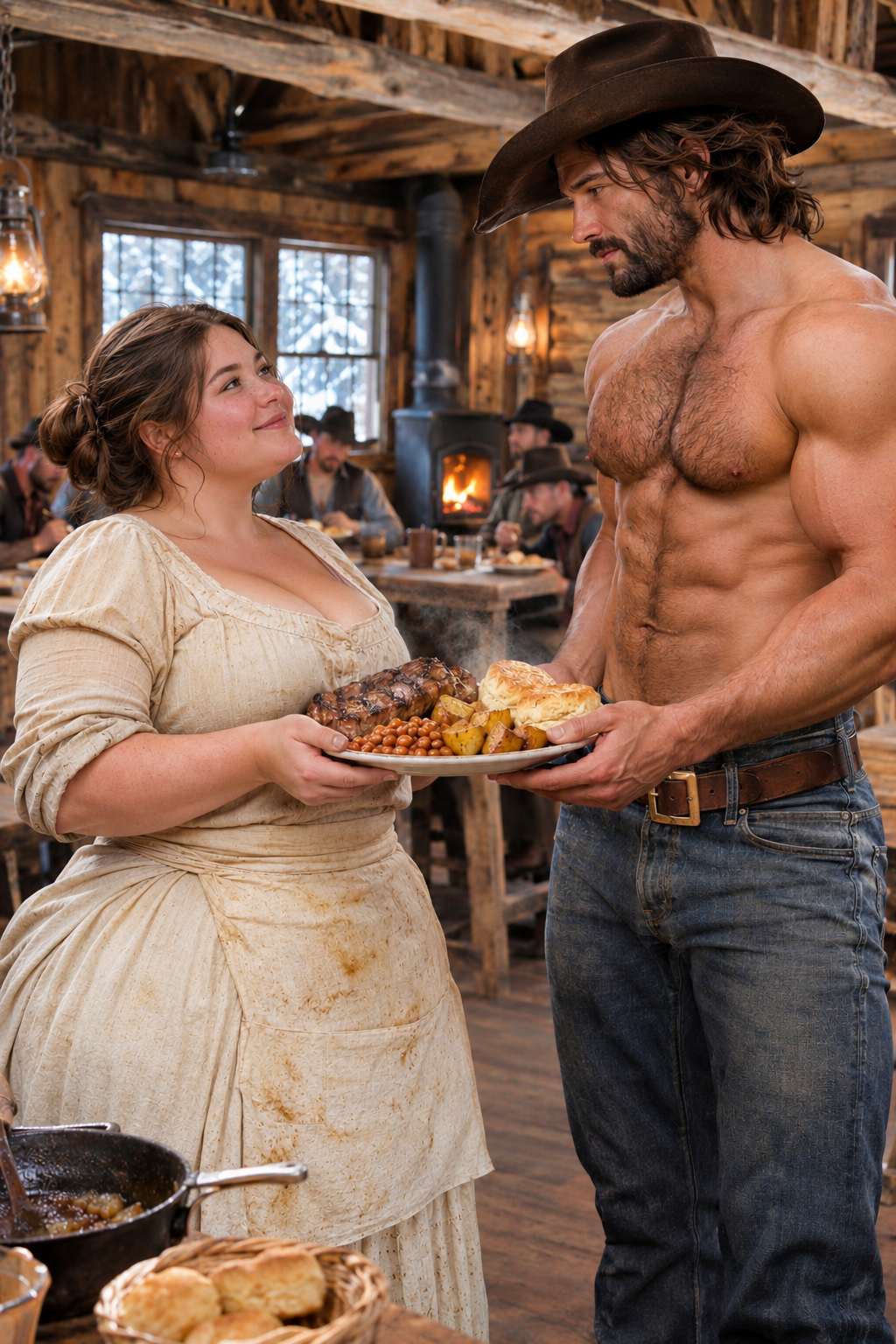
Within forty minutes, the kitchen smelled completely different. Beef simmered with vegetables in a rich broth. Fresh biscuits rose inside the oven, and Helen prepared a simple apple dessert using dried fruit from the pantry.
The men began glancing toward the kitchen.
Thomas took a deep breath.
“Smells like my mother’s house.”
When Helen finally carried the food into the dining room, nobody spoke.
She placed a generous bowl before each man, followed by warm biscuits and butter.
“There’s more in the kitchen,” she announced. “Nobody needs to leave this table hungry.”
Thomas took the first bite.
He lowered his spoon, looked at Helen, and then continued eating.
Within minutes, the only sounds were spoons scraping bowls and men asking for more bread.
Maggie ate two biscuits. Charlie finished his entire supper and asked for another serving.
Owen watched them quietly.
When Thomas finally leaned back, he rubbed his stomach and smiled.
“Mrs. Barrett, that’s the first supper I’ve enjoyed in nearly a year.”
Several men nodded.
Helen sat down across from them.
“I know a good meal won’t fix everything that’s wrong here. But I can promise you that as long as I’m responsible for this kitchen, you’ll be properly fed.”
A younger ranch hand named Ben exchanged a glance with Thomas.
“What about tomorrow?”
“Breakfast will be ready before you leave.”
Thomas looked toward Owen.
“I reckon we can stay another week and see how things go.”
One by one, the other men agreed.
Owen released a long breath.
Helen hadn’t saved the ranch. Not yet. But she had bought them something they desperately needed.
Time.
Later that evening, after the children were asleep, Owen found Helen scrubbing the kitchen counter.
“You shouldn’t have to do all this,” he said.
“Then hand me that clean cloth.”
He did.
For several minutes, they worked together without speaking.
Finally, Helen asked the question that had troubled her since arriving.
“How did things get this bad?”
Owen stopped wiping the table.
“My brother, Samuel, used to manage the household accounts. His wife, Rebecca, looked after the children and helped oversee the supplies. They knew how to keep everything running.”
He swallowed.
“When they died in a wagon accident, I thought keeping the cattle alive and putting money into the household would be enough.”
Helen listened without interrupting.
“I didn’t know how to raise children,” he continued. “Didn’t know how to comfort them. Every time Maggie cried for her mother, I found another reason to go outside.”
“And Leonard?”
“He told me everything was under control. I wanted to believe him.”
Owen lowered his head.
“I thought working harder would make me a better man.”
Helen placed her cloth on the counter.
“Working hard matters, Owen. But knowing what the people around you need matters just as much.”
He looked at her.
“Are you sorry you came?”
The question caught her off guard.
She considered the neglected house, the frightened children, the unhappy workers, and the quiet stranger she had married.
“Ask me again when we’ve cleaned that pantry.”
Owen smiled faintly.
Before sunrise the following morning, Helen was already preparing breakfast. She served oatmeal, eggs, fresh bread, and hot coffee.
The men arrived expecting another disappointment.
Instead, they found a warm dining room and enough food for everyone.
Ben stared at his plate.
“Is this going to happen every morning?”
“Unless you plan on cooking for yourselves.”
The men laughed.
Over the following days, Helen established a routine. She planned meals, recorded every purchase, repaired torn curtains, and taught the children small household tasks.
Charlie became responsible for collecting eggs. Maggie helped set the table.
Owen began coming home earlier.
Sometimes he carried firewood. Sometimes he helped wash dishes. And every evening, he made an effort to sit beside the children and ask about their day.
The ranch slowly began to feel different.
But Helen’s growing understanding of the household accounts revealed a problem far more serious than spoiled food.
One afternoon, she spread several months of receipts across the dining table.
According to Leonard’s records, the ranch had purchased enough supplies to feed nearly twice the number of people living there.
Yet the pantry had been almost empty.
Some receipts listed deliveries Helen couldn’t find any evidence of.
She took the account book to Owen.
“Do you remember receiving twelve sacks of flour last month?”
He shook his head.
“Leonard handled the deliveries.”
“And four barrels of salted pork?”
“I wouldn’t know.”
Helen pointed to the figures.
“Owen, either these records are wrong, or somebody has been taking supplies that belong to this ranch.”
His expression hardened.
The following morning, they rode into town together and visited the general store.
The owner, Mr. Collins, greeted Owen warmly.
“Good to see you, Barrett. Heard you got married.”
Helen introduced herself before placing several receipts on the counter.
“I was hoping you could help me understand these.”
Mr. Collins adjusted his spectacles.
He examined the first receipt, then the second.
His friendly expression disappeared.
“Where did you get these?”
“Our household account book.”
He reached beneath the counter and produced his own ledger.
“Mr. Barrett, I never sold you these quantities.”
Owen leaned forward.
“What?”
Mr. Collins showed them his records.
The amounts Leonard had reported were considerably higher than the actual purchases.
Even worse, several receipts had been altered.
Helen felt a cold anger rising inside her.
For months, Owen had been paying for food that never reached his household.
“How much?” Owen asked.
Mr. Collins spent several minutes calculating the difference.
When he finally announced the total, Owen sat down heavily.
It was enough money to cover several months of wages for the ranch hands.
Helen suddenly understood why Leonard had reacted so strongly when she demanded control of the kitchen.
He hadn’t merely been protecting his position.
He had been protecting his secret.
Owen wanted to find Leonard immediately, but Mr. Collins advised him to take the evidence to the sheriff.
As they stepped outside, a well-dressed man approached them.
“Barrett. I hear you’ve been having trouble keeping your men.”
Owen’s jaw tightened.
“Clayton.”
Walter Clayton owned the neighboring ranch. He was wealthy, ambitious, and had been trying to purchase Barrett Creek’s best grazing land for years.
His eyes moved toward Helen.
“And this must be your new bride.”
Helen offered a polite nod.
Clayton smiled.
“I made your husband a generous offer recently. Perhaps you can convince him to accept it.”
“What offer?”
“To purchase Barrett Creek Ranch.”
Helen turned toward Owen.
He hadn’t mentioned anything about selling.
Clayton continued.
“Running a ranch isn’t easy, especially with debts, unreliable workers, and two children to support.”
“We’re managing,” Owen said.
Clayton chuckled.
“For now.”
He tipped his hat and walked away.
On the ride home, Helen waited until they were alone on the open road.
“How serious are the debts?”
Owen held the reins tightly.
“Serious enough.”
“Why didn’t you tell me?”
“Because you came here expecting a husband who could provide for you.”
“I came here expecting a husband who would be truthful with me.”
Owen looked at her, unable to answer.
That evening, he showed her the ranch’s financial records.
A poor cattle season, rising expenses, and Leonard’s dishonesty had drained most of his savings.
A large bank payment was due in six weeks.
If Owen couldn’t make it, he risked losing the ranch.
Helen studied the figures until her eyes ached.
Then she noticed something.
“You’re selling cattle to Clayton?”
“Through his buyer.”
“At these prices?”
Owen nodded.
Helen remembered seeing higher cattle prices posted outside a business in town.
“Have you spoken to other buyers?”
“Not recently. Clayton’s arrangement was convenient.”
Helen closed the ledger.
“Convenience has been costing you a great deal of money.”
The next morning, Owen gathered the ranch hands and told them the truth.
He explained the financial difficulties, Leonard’s theft, and the approaching bank payment.
“I should have spoken to you sooner,” he admitted. “You’ve given me honest work, and I haven’t given you the leadership you deserved.”
Thomas studied him carefully.
“What are you planning to do?”
“Find a better buyer. Cut unnecessary expenses. Get the herd ready for market.”
Thomas nodded.
“Then we’d better get moving.”
Nobody resigned that morning.
Instead, the men returned to work with a determination Owen hadn’t seen in months.
Helen began stretching every dollar without reducing the quality of their meals. She baked bread, preserved vegetables, and arranged to trade eggs and butter for supplies in town.
Owen contacted several independent cattle buyers.
For the first time in years, the ranch appeared to have a chance.
Then disaster struck.
Three weeks before the bank payment was due, a violent storm swept across the valley.
Rain hammered the windows throughout the night. By morning, Barrett Creek had risen dangerously high.
Thomas rushed into the house.
“North pasture fence is down. Cattle are getting out.”
Owen grabbed his coat.
Helen immediately began preparing food and blankets for the men.
Charlie stood beside the window, watching the riders disappear.
Hours passed.
The rain continued.
Near midday, Helen realized Charlie was missing.
She searched his bedroom, the barn, and the storage shed.
“Maggie, have you seen your brother?”
The little girl’s face turned pale.
“He said Uncle Owen needed help.”
Helen’s heart nearly stopped.
She grabbed her coat and ran outside.
Near the creek, she found Thomas and Ben trying to move cattle away from the flooded pasture.
“Have you seen Charlie?” she shouted.
Thomas shook his head.
Then Ben pointed toward the old wooden bridge.
A small figure stood near the far end.
Charlie had apparently tried to bring back a frightened calf. Now the rising water had cut off his safest route home.
“Charlie!” Helen screamed.
The boy turned.
A section of the bridge shifted beneath him.
Owen appeared on horseback from the opposite pasture. The moment he saw Charlie, he dismounted and rushed toward the bank.
“Don’t move, son!”
Charlie was crying.
“I was trying to help!”
“I know. Stay where you are.”
Thomas and Ben hurried to assist Owen.
Helen stood helplessly as the men worked together to reach the terrified child.
The damaged bridge creaked again.
For one horrible moment, Charlie lost his footing.
Owen caught him before he fell into the rushing water.
With Thomas and Ben’s help, he carried the boy back to solid ground.
Helen ran toward them.
Charlie was shaking so badly that he couldn’t speak.
Owen dropped to his knees and pulled him against his chest.
“What were you thinking?”
“I didn’t want us to lose the ranch,” Charlie sobbed. “I heard you talking. I thought if I helped, maybe Helen wouldn’t leave.”
Helen felt tears fill her eyes.
She knelt beside him.
“Charlie, look at me.”
He slowly raised his head.
“A ranch is land, fences, and cattle. You’re a child. You’re worth more than every acre of this place.”
“But everybody leaves when things get bad.”
Owen tightened his arms around the boy.
“Your parents didn’t choose to leave you, Charlie. And neither will we.”
Helen placed her hand against his wet cheek.
“You don’t have to earn your place in this family.”
Charlie buried his face against her shoulder.
That afternoon, the men recovered most of the scattered cattle. Several fences were destroyed, and the damage would cost money they couldn’t afford.
But Charlie was safe.
For Helen, nothing else mattered nearly as much.
The following morning brought another unexpected visitor.
Walter Clayton rode into the yard carrying a leather folder.
“Heard about the flood,” he said. “Terrible business.”
Owen stepped onto the porch.
“What do you want?”
Clayton opened the folder.
“My offer still stands. Sign today, and I’ll settle your outstanding bank debt.”
Helen joined Owen.
“And where would we go?”
Clayton shrugged.
“That’s for you to decide.”
Owen looked across the damaged pasture.
Helen could see the temptation in his face. Selling would end the uncertainty. No more sleepless nights wondering whether he could pay his workers or protect his family.
Then Thomas approached with several ranch hands behind him.
“Mr. Barrett, the men and I have been talking.”
Clayton smiled confidently.
“Looking for work, gentlemen?”
Thomas ignored him.
“We’ll help rebuild the fences. We’ve already arranged to borrow some equipment from another ranch.”
Ben stepped forward.
“And my brother knows a cattle buyer who’s coming through the valley next week. He’s willing to look at our herd.”
Clayton’s smile disappeared.
Owen stared at the men.
“You’d do that?”
Thomas glanced toward Helen.
“A few weeks ago, we were ready to walk away. Things are different now.”
Helen watched Owen straighten his shoulders.
He turned back to Clayton.
“I’m not selling.”
Clayton snapped his folder shut.
“You’re making a mistake.”
“Perhaps,” Owen replied. “But it’ll be mine to make.”
Clayton left without another word.
The following week was the hardest Helen had experienced since arriving in Montana.
The men repaired fences from sunrise until dark. Owen prepared the healthiest cattle for inspection. Helen kept the kitchen running and carefully tracked every expense.
Meanwhile, the sheriff located Leonard in another town.
Faced with the altered receipts and the store owner’s records, Leonard admitted to keeping money intended for household supplies. Some of the stolen money was recovered, although much of it had already been spent.
It wasn’t enough to save the ranch by itself.
But it helped.
When the independent cattle buyer finally arrived, Owen spent nearly an entire day showing him the herd.
Helen waited inside with the children.
She tried sewing, but her hands wouldn’t remain steady.
At sunset, Owen entered the house carrying a folded agreement.
His expression was unreadable.
“Well?” Helen asked.
He placed the paper before her.
The buyer had agreed to purchase the cattle at a considerably better price than Clayton’s buyer had offered.
Helen quickly calculated the figures.
There was enough to make the bank payment, cover the necessary repairs, and pay the men.
Not much would remain afterward, but they would keep their home.
She looked up.
“Owen, we did it.”
He nodded, his eyes unusually bright.
Then he reached for her hand.
“No, Helen. We all did.”
That evening, the dining room filled with laughter.
Helen prepared roasted beef, mashed potatoes, vegetables, fresh rolls, and two large apple pies.
Thomas raised his coffee cup.
“To Mrs. Barrett, who taught a bunch of stubborn men that a ranch runs better when somebody remembers we’re human.”
Everyone laughed.
Owen stood beside Helen.
“And to the men who stayed when they had every reason to leave.”
Charlie and Maggie clapped.
For the first time since Helen’s arrival, nobody at that table was worried about tomorrow.
Several months passed.
The ranch became profitable again. Owen hired additional help, repaired the house, and established fair agreements with reliable suppliers.
He also made sure Helen never had to manage the entire household alone.
Charlie returned to his studies and spent his afternoons helping with age-appropriate chores. Maggie grew into a cheerful little girl who sang while setting the table.
One spring evening, Helen found Owen repairing a loose board on the porch.
He set down his hammer when she approached.
“Do you remember what I asked you that first night in the kitchen?”
Helen smiled.
“You asked whether I regretted coming here.”
“I’ve been waiting for an answer.”
She sat beside him.
“When I arrived, I thought I was coming here to marry a rancher and care for two children. I didn’t expect to find a whole household that had forgotten how to take care of one another.”
Owen lowered his eyes.
“I wasn’t much of a husband.”
“You were a man carrying more grief than you knew how to handle.”
He reached for her hand.
“And now?”
Helen rested her head against his shoulder.
“Now I’m exactly where I want to be.”
From inside the house, Maggie called for her mother.
Helen had never asked the children to call her that. The first time Maggie did, she had cried quietly afterward.
Charlie appeared at the doorway.
“Mom, Uncle Owen, supper’s ready!”
Owen looked at Helen and smiled.
Together, they went inside.
Years later, travelers passing through Barrett Creek Ranch would often hear stories about its generous meals, loyal workers, and welcoming household.
Few knew how close the ranch had once come to disappearing.
Helen had arrived with one suitcase, a marriage agreement, and the hope of finding a place where she belonged.
She had discovered that money could purchase land, cattle, and supplies, but it couldn’t purchase loyalty, trust, or love.
Those things had to be earned through honesty, kindness, and the willingness to care for others.
Owen had spent years believing that providing for his family meant working until he had nothing left to give. Helen helped him understand that sometimes the most important thing a person could offer was simply their presence.
And the two children who once feared everyone would eventually abandon them grew up knowing that they were loved, not because of what they could contribute, but because of who they were.
Barrett Creek Ranch survived because its people learned to stop facing their troubles alone.
It began with a hungry household, a neglected kitchen, and a woman who asked for one hour to prove that things could be different.
In the end, Helen didn’t simply save a struggling ranch.
She helped turn a house full of lonely people into a family.
And that family became the greatest fortune Owen Barrett would ever possess.
Twenty years later, on a cold November evening, a young woman arrived at Barrett Creek Ranch carrying a battered suitcase and holding the hand of a little boy.
Helen was sitting near the kitchen stove when she heard a knock.
Owen opened the door and found the woman standing beneath the porch light, her thin coat covered in snow.
“I’m sorry to bother you,” she whispered. “Someone in town said you might have work.”
Owen glanced at the child, whose lips were trembling from the cold.
“Come inside first.”
The woman hesitated.
“I don’t have any money.”
“Didn’t ask if you did.”
Helen immediately brought two bowls of hot soup and several slices of fresh bread. The little boy ate so quickly that his mother gently reminded him to slow down.
As Helen watched them, she remembered another hungry child sitting at that same table many years earlier.
Charlie was now a grown man with a wife and children of his own. He managed much of the ranch alongside Owen. Maggie had become a schoolteacher, known throughout the valley for helping children whose families couldn’t afford books or warm clothing.
Thomas had retired, but he still lived in a comfortable cottage on the property. Ben had become the ranch foreman.
Much had changed, yet Helen had never forgotten those difficult first weeks.
“What brought you here?” she asked the young woman.
“My husband died last winter. I’ve been looking for work ever since. Nobody wants to hire a woman with a child.”
She lowered her head.
“I can cook, clean, sew, anything you need. Please don’t send us away.”
Helen reached across the table and took her hand.
“You can stay tonight. Tomorrow we’ll figure something out together.”
The woman began to cry.
Owen quietly carried her suitcase upstairs while Helen prepared a bedroom.
The following morning, Charlie arrived and learned what had happened.
“We could use another person helping with the household accounts,” he suggested. “And her boy can attend Maggie’s school.”
Helen smiled.
Her children had learned the lesson she had hoped to teach them without ever needing to put it into words.
Several weeks later, the young woman was working at the ranch, earning an honest wage, and watching her son make friends for the first time in months.
One evening, she approached Helen with tears in her eyes.
“I don’t know how I’ll ever repay you.”
Helen shook her head.
“Someday, when you meet someone who needs help, remember how you felt standing outside our door. That’s enough.”
Years continued to pass, and Helen and Owen grew old together.
Owen’s hair turned silver. His once powerful hands became stiff, and Helen’s steps grew slower. Still, every morning, they shared coffee beside the kitchen window.
On their fortieth wedding anniversary, Charlie and Maggie organized a gathering at the ranch.
Former employees, neighbors, grandchildren, and families Helen had helped over the years filled the yard.
Maggie stood before everyone holding a small, worn book.
“Mother, do you recognize this?”
Helen adjusted her spectacles.
It was the original household account book Owen had given her shortly after their wedding.
“I thought we’d thrown that away,” Helen said, laughing.
Maggie opened it.
“Uncle Owen kept it.”
Inside the back cover, beneath the old financial records, Owen had written a message many years earlier.
Maggie read it aloud.
“The day Helen arrived, I owned thousands of acres and believed I was a poor man. Today, I understand that wealth is measured by the people who are glad to see you come home.”
Helen turned toward Owen.
He smiled, embarrassed by the attention.
“You wrote that?”
“Long time ago.”
“Why didn’t you ever show me?”
“Figured you’d already know.”
Helen laughed through her tears.
That evening, after the guests had gone home, the couple sat together on the porch overlooking the valley.
The sun disappeared behind the mountains, and the familiar sound of cattle drifted across the fields.
Owen reached for Helen’s hand.
“I was afraid of you when you first arrived.”
Helen raised an eyebrow.
“Afraid of me?”
“You walked into my house, looked at everything I’d been doing wrong, and refused to pretend it was right.”
“Well, somebody had to.”
He chuckled.
“Best thing that ever happened to me.”
Helen leaned against his shoulder.
Neither of them spoke for a while. They didn’t need to.
Two winters later, Owen passed away peacefully in his sleep, with Helen beside him.
The entire valley mourned.
At his funeral, Charlie stood before the people gathered near the little family cemetery.
“My uncle taught me how to work hard,” he said. “But my mother taught him that being strong doesn’t mean carrying everything alone. Together, they taught me what it means to be a good man.”
Helen placed a single wildflower on Owen’s grave.
“Rest now, sweetheart,” she whispered. “We’ll take care of things.”
She lived several more years, surrounded by children, grandchildren, and the people who had become her extended family.
Even when she could no longer stand long enough to bake bread, she insisted on sitting in the kitchen while others prepared supper.
She loved hearing the laughter.
On her final evening, Charlie and Maggie sat beside her bed.
Maggie held her mother’s hand.
“Is there anything you need?”
Helen looked at her two children, remembering the frightened little faces that had greeted her when she first entered the ranch.
“Have you eaten?”
Charlie laughed softly, wiping his eyes.
“Yes, Mom.”
“Good.”
She smiled and closed her eyes.
Helen Parker Barrett passed away peacefully that night.
She was buried beside Owen beneath a cottonwood tree overlooking the land they had worked so hard to preserve.
Years afterward, Charlie placed a wooden sign above the entrance to the ranch dining room.
It read:
“There is always room for one more at our table.”
The sign became a family tradition, passed down through generations.
Whenever a hungry traveler appeared, a struggling neighbor needed help, or a frightened child needed somewhere safe to stay, the Barrett family opened its doors.
They remembered the woman who had arrived in Montana with almost nothing and given them something more valuable than any fortune.
She had taught them that kindness was not weakness, that love was more than a promise, and that the greatest legacy a person could leave was the goodness they inspired in others.
Barrett Creek Ranch remained in the family for generations.
Its fences were rebuilt many times. Its buildings changed. Its cattle came and went.
But its kitchen remained warm, its table remained welcoming, and nobody who entered hungry was deliberately turned away.
Because long ago, a woman named Helen had understood something that others had forgotten.
You cannot always change the hardships people face, but you can change whether they have to face them alone.
And sometimes, the smallest act of kindness can become the beginning of a legacy that lasts a hundred years.
More than a century after Helen first stepped onto the railway platform in Montana, her great-great-granddaughter, Emily Barrett, faced a difficult decision.
The ranch was struggling again. Rising expenses and several years of poor weather had left the family with mounting debts. A development company offered to purchase the property for a sum that would allow Emily to live comfortably for the rest of her life.
She nearly accepted.
While sorting through old family belongings, however, Emily discovered a wooden chest containing photographs, letters, and a faded household account book.
Inside was a letter Helen had written shortly before her death.
“To whoever inherits this home,” it began, “never believe that keeping this land is more important than protecting the people who live upon it. A home is not something you own. It is something you build together.”
Emily read the letter twice.
For weeks, she had been trying to solve the ranch’s problems without telling anyone how serious they had become.
The following morning, she gathered her family and employees around the dining table and explained everything.
Instead of blaming her, they offered ideas.
Some suggested opening part of the ranch to visitors. Others proposed selling homemade products and working with neighboring farms.
Emily listened.
Over the next two years, they transformed Barrett Creek into a successful working ranch that also welcomed families seeking a quiet escape from city life.
The original farmhouse was restored, and Helen’s kitchen became the heart of the entire property.
Guests often asked about the framed photograph of a serious-looking rancher standing beside a smiling woman and two children.
Emily always enjoyed telling their story.
One afternoon, a little girl studying the photograph asked, “Was Helen a hero?”
Emily smiled.
“She didn’t think she was.”
“Then what made her special?”
“She noticed when people were hurting, and she decided to do something about it.”
The little girl considered this before running outside to join her family.
That evening, Emily carried fresh flowers to the old family cemetery.
She placed them between Helen and Owen’s headstones.
“We’re still here,” she whispered. “And we’re still taking care of each other.”
As she returned to the farmhouse, she could hear laughter coming through the open windows.
Dinner was ready. Children were playing. Someone was pulling another chair toward the crowded table.
Emily stopped beneath the wooden sign that Charlie had placed above the dining room entrance so many years earlier.
Its words had faded, but their meaning had never changed.
There was always room for one more.
Helen never lived to see how far her kindness would reach. She never knew how many strangers would find comfort beneath that roof or how many generations would learn from her courage.
She had simply chosen to care when walking away would have been easier.
And perhaps that was the greatest lesson of her life.
You don’t need extraordinary wealth or power to change the world. Sometimes, changing the world begins with feeding someone who is hungry, listening to someone who is lonely, or standing beside someone who has lost hope.
Helen arrived at Barrett Creek as a stranger looking for a home.
She left behind a home where strangers could become family.
And long after her footsteps disappeared from the Montana soil, the love she had planted continued to grow.
THE END.