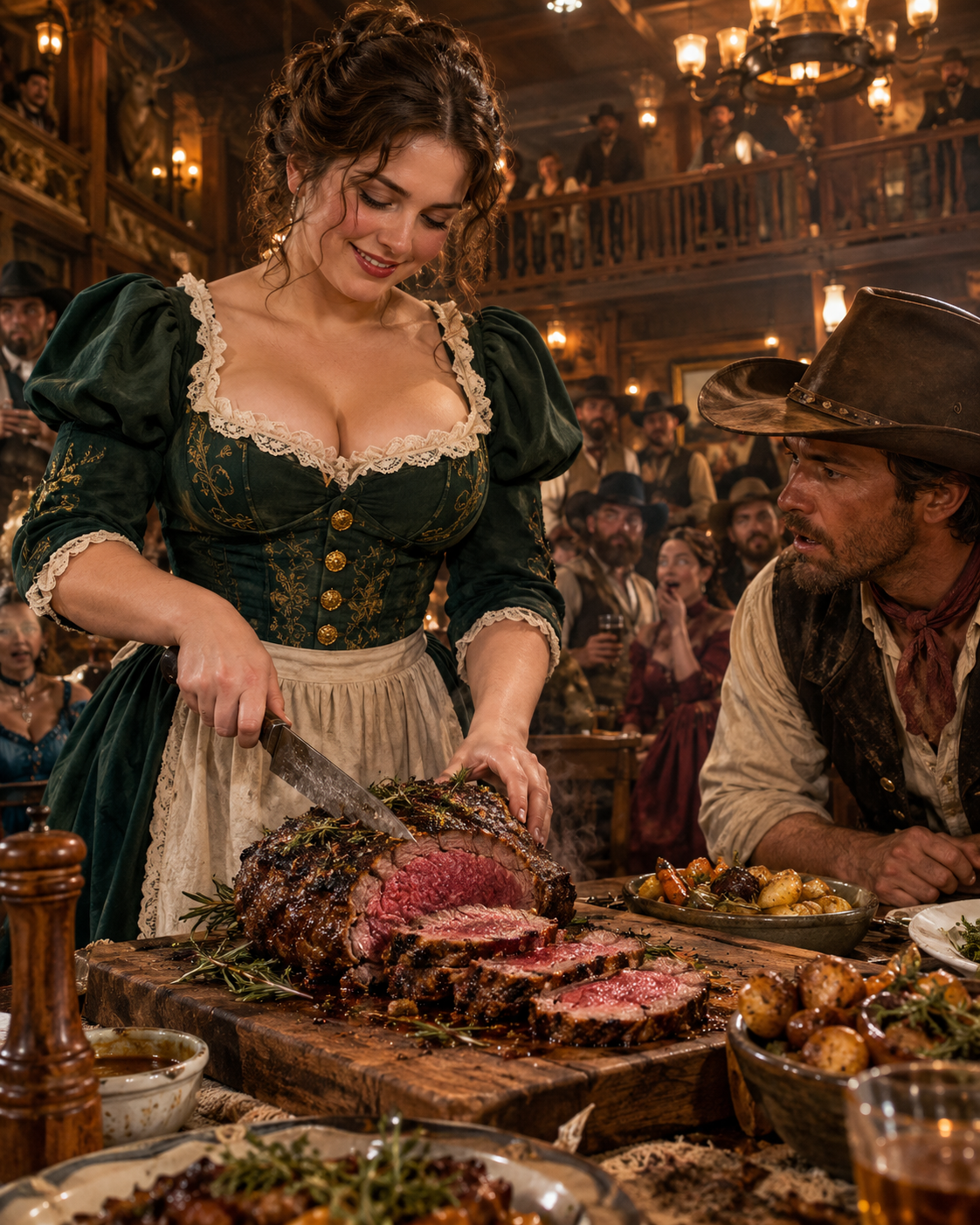
The entire dining room went silent when Nathaniel Hayes pushed away the steak everyone else had crossed town to taste.
Nathaniel turned the scrap of paper over.
The second line read:
“Because eight years ago, you promised my father you would never come back.”
For several seconds, Nathaniel did not move.
Outside the ranch house, wind dragged dry grass across the fence posts. Somewhere in the distance, a horse struck the ground with one impatient hoof.
Nathaniel read the sentence again.
Then a third time.
His hand closed slowly around the paper.
Thomas Whitaker.
Even after eight years, the name still had the power to turn an ordinary evening into something dangerous.
Nathaniel walked to the window.
Beyond the glass lay the dark outline of the Hayes ranch, hundreds of acres of cattle country stretching beneath a sky crowded with stars.
Eight years ago, he had been twenty-six.
Thomas had been the most respected hotel owner in Dodge City.
Nathaniel had been the reckless son of a rancher who believed money could solve every problem.
And Eleanor had been nineteen.
Too young to understand why two stubborn men could turn a single argument into a war.
Too young, Nathaniel thought bitterly, to know that sometimes the people who claimed to be protecting you were the ones making the decision that destroyed your life.
He unfolded the paper once more.
There was something else beneath the sentence.
A small date.
June 17, 1889.
Nathaniel’s face went pale.
He knew that date.
Everyone in Dodge City remembered it.
It was the night the old Whitaker warehouse burned.
The fire that had nearly destroyed Thomas’s business.
The fire that had killed a stable boy named Samuel Reed.
The fire that had been blamed on Nathaniel Hayes.
He had never been convicted.
There had been no proof.
But there had been witnesses who claimed they had seen him near the warehouse that night.
Thomas had believed them.
He had confronted Nathaniel the next morning and told him to leave town.
Nathaniel had refused.
Then Thomas had shown him something.
A letter.
A letter supposedly written by Nathaniel himself, arranging to buy stolen kerosene and set the warehouse ablaze.
Nathaniel had denied writing it.
Thomas had not believed him.
By sunset, Nathaniel had left Dodge City.
He never returned.
Until tonight.
He placed the note on the desk.
Then he heard footsteps behind him.
“You should have burned that.”
Nathaniel turned.
His ranch foreman, Caleb Mercer, stood in the doorway.
Caleb was an older man with a gray beard and the permanent expression of someone who had spent his entire life expecting trouble.
Nathaniel’s eyes narrowed.
“Where did you get that?”
“Eleanor gave it to one of the riders who brought your mail.”
“You’ve been reading my mail?”
“No.”
Caleb pointed at the paper.
“She asked me to make sure you saw it.”
Nathaniel stared at him.
“Why?”
“Because she knows you’re too stubborn to ask the right question.”
A humorless smile touched Nathaniel’s mouth.
“She sounds exactly like her father.”
Caleb shook his head.
“No. She doesn’t.”
Nathaniel said nothing.
Caleb stepped into the room.
“Thomas has been sick for months.”
Nathaniel’s expression changed.
“How sick?”
“Bad enough that Eleanor is running the hotel now.”
Nathaniel looked toward the paper.
“Why didn’t she tell me?”
“Maybe she did.”
Nathaniel’s eyes lifted.
“What does that mean?”
Caleb reached inside his coat and pulled out a small envelope.
He placed it on the desk.
Nathaniel stared at it.
The seal was broken.
Inside was a single newspaper clipping.
He unfolded it.
The headline was faded.
WHITAKER WAREHOUSE FIRE — NEW EVIDENCE SUPPRESSED.
Nathaniel read the article.
Then he stopped breathing for a moment.
The article claimed that a railroad clerk had witnessed a man leaving the warehouse shortly before the fire.
The man had not been Nathaniel.
His name was Silas Vane.
Nathaniel knew that name too.
Vane owned the Black Spur Saloon.
For eight years, he had been one of the most aggressive competitors of the Whitaker Grand.
Nathaniel looked up.
“Where did this come from?”
“Thomas’s old safe.”
“Who opened it?”
“Eleanor.”
Nathaniel’s fingers tightened around the clipping.
“Why now?”
Caleb hesitated.
“Because Thomas finally told her the truth.”
The room seemed to grow colder.
Nathaniel whispered, “What truth?”
Caleb looked directly at him.
“Your father didn’t send you away.”
Nathaniel froze.
“My father?”
“He did.”
Nathaniel stepped closer.
“Explain.”
“Your father went to Thomas the morning after the fire. He told him you couldn’t have done it.”
Nathaniel’s face hardened.
“Then why was I thrown out?”
“Because your father was dying.”
Nathaniel stared at him.
“What?”
“Not dying that morning. But he had been sick for years. He knew he wouldn’t live long enough to protect you from Vane.”
Caleb swallowed.
“He made a deal with Thomas.”
Nathaniel’s voice dropped.
“What deal?”
“If Thomas accused you publicly, Vane would believe the town had turned against the Hayes family. Your father thought Vane would stop investigating your ranch.”
Nathaniel’s eyes widened.
“And Thomas agreed?”
“He did.”
“Why?”
“Because Thomas had a daughter.”
The answer struck harder than any accusation.
Eleanor.
Caleb continued.
“Your father believed Vane was using the warehouse fire to destroy the Whitakers and force them to sell their property. If you stayed, Vane would come after you too.”
Nathaniel shook his head.
“That makes no sense.”
“It made sense to two frightened fathers who thought they were buying their children time.”
Nathaniel looked down at the clipping.
“Then why didn’t anyone tell me?”
Caleb’s eyes lowered.
“Because your father died three weeks later.”
Nathaniel said nothing.
He had known his father died.
He had not known about the deal.
For eight years, he had believed his father had simply allowed him to be disgraced and driven from town.
Eight years of resentment.
Eight years of believing he had been abandoned.
Caleb moved toward the door.
“There is one more thing.”
Nathaniel looked up.
“What?”
“Eleanor wants you at the Whitaker Grand tomorrow morning.”
“Why?”
“She says you’ll understand when you see the cellar.”
Nathaniel almost laughed.
“The cellar?”
Caleb nodded.
“And she said to tell you one more thing.”
“What?”
“She said not to bring a gun.”
The next morning, Nathaniel rode into Dodge City before sunrise.
The town was still waking.
Shopkeepers lifted shutters.
A baker carried trays of bread into the street.
The blacksmith’s hammer had not yet begun its rhythm.
But everyone who saw Nathaniel knew where he was going.
The Whitaker Grand.
The doors opened before he reached them.
Eleanor stood inside.
She wore a dark blue dress and had tied her hair behind her neck.
She looked older than she had the night before.
Not older in years.
Older in the way people looked after carrying responsibilities they had never asked for.
“You came.”
“You knew I would.”
“Yes.”
Nathaniel stepped inside.
“Where is your father?”
“Upstairs.”
“Does he know I’m here?”
“Yes.”
Nathaniel’s jaw tightened.
“And he wants me here?”
“He has wanted you here for eight years.”
That stopped him.
Eleanor turned toward the kitchen.
“Come.”
They walked past the dining room where Nathaniel had humiliated himself the night before.
The tables were empty now.
Sunlight crossed the polished floor.
Eleanor opened a narrow door beside the pantry.
A staircase descended into darkness.
At the bottom was a cellar lined with wooden shelves.
Wine bottles filled one wall.
Crates filled another.
Eleanor walked to the far corner and pushed aside three boxes.
Behind them was a small iron door.
She took a key from around her neck.
Nathaniel stared at it.
“That belonged to my father.”
“No.”
She unlocked the door.
“It belonged to yours.”
Nathaniel’s breath caught.
Inside was a wooden chest.
Eleanor lifted the lid.
There were documents.
Letters.
A revolver.
A blackened piece of cloth.
And a ledger.
Nathaniel picked up the cloth first.
He knew it immediately.
It was a piece of the coat he had been wearing the night of the fire.
But it wasn’t his coat.
It was his father’s.
Eleanor watched his face.
“Your father was at the warehouse.”
Nathaniel looked at her.
“What?”
“He arrived before the fire spread.”
“Why?”
“To confront Silas Vane.”
Nathaniel’s eyes moved to the ledger.
He opened it.
Names filled the pages.
Payments.
Dates.
Bribes.
Shipments.
At the bottom of one page was a name he recognized.
Silas Vane.
Beside it were payments to a railroad clerk, a deputy, and a judge.
Nathaniel’s hand trembled.
“He bought them.”
“Yes.”
“Then why wasn’t he arrested?”
“Because the ledger disappeared.”
Nathaniel looked up.
“Until now.”
Eleanor nodded.
“My father found it three months ago.”
“Why didn’t he go to the sheriff?”
“He tried.”
Nathaniel’s expression hardened.
“And?”
“The sheriff told him the past was buried.”
A voice came from the staircase.
“He was right.”
Thomas Whitaker stood there.
He looked smaller than Nathaniel remembered.
His shoulders were bent.
His face was pale.
But his eyes were still sharp.
Nathaniel stared at him.
For eight years, he had imagined this meeting.
In every version, he had shouted.
He had demanded an apology.
He had asked why.
Now the words refused to come.
Thomas descended slowly.
“I owe you the truth.”
Nathaniel looked at the ledger.
“You owe me eight years.”
Thomas stopped.
“Yes.”
Silence filled the cellar.
Then Thomas said, “I was wrong.”
Nathaniel looked at him.
“You believed I burned your warehouse.”
“I did.”
“You knew I didn’t.”
“I suspected.”
Nathaniel’s voice broke.
“You suspected?”
Thomas closed his eyes.
“Your father made me promise.”
“To destroy my name?”
“To keep you alive.”
Nathaniel stepped closer.
“And did it work?”
Thomas looked at him.
“No.”
The answer was quiet.
“But you’re alive.”
Nathaniel laughed bitterly.
“You call that living?”
Eleanor lowered her eyes.
Thomas reached for the chest.
“There is one final letter.”
He pulled out an envelope.
It was addressed to Nathaniel.
The handwriting belonged to his father.
Nathaniel stared at it for several seconds before opening it.
My son,
If you are reading this, then I failed to tell you the truth myself.
I wanted you to hate me.
Nathaniel stopped.
His vision blurred.
I knew you would be safer far from Dodge City. I knew you would hate me for sending you away. I accepted that hatred because I believed it was cheaper than burying you.
But there is something you must understand.
A man’s name can be rebuilt.
A man’s fortune can be rebuilt.
Even a man’s home can be rebuilt.
A life cannot.
Do not come back for revenge.
Come back only when you are ready to build something better than what was destroyed.
Nathaniel lowered the letter.
For the first time in eight years, he cried.
Not loudly.
Not dramatically.
He simply stood there with his father’s words in his hands and allowed the grief he had buried to rise.
Eleanor stepped beside him.
She did not touch him.
She didn’t need to.
After a while, Nathaniel wiped his face.
“Where is Vane?”
Thomas answered.
“At the Black Spur.”
Nathaniel looked toward the stairs.
“Then let’s finish this.”
By noon, the town was crowded around the courthouse.
Someone had spread the news that the Whitakers possessed evidence against Silas Vane.
Vane arrived smiling.
He wore a black coat and carried a silver-handled cane.
“You should have stayed dead, Thomas,” he said.
Thomas stood beside Eleanor.
“I tried.”
Vane laughed.
Then he saw Nathaniel.
His smile disappeared.
“Well,” Vane said. “The prodigal son.”
Nathaniel stepped forward.
“You know why I’m here.”
“I imagine you came to apologize.”
“For what?”
“For burning the warehouse.”
A murmur moved through the crowd.
Nathaniel looked at him.
“You’re still using the same lie.”
Vane’s eyes hardened.
“Careful.”
Eleanor stepped forward and placed the ledger on the courthouse table.
“This says otherwise.”
Vane glanced at it.
Then he laughed.
“That old thing?”
“It has your signature.”
“You think a book proves anything?”
“No.”
Eleanor opened the ledger.
“These do.”
She placed several letters beside it.
Then another.
And another.
The crowd grew silent.
Each letter contained the same thing: payments made to officials who had protected Vane.
The sheriff looked pale.
The judge refused to meet anyone’s eyes.
Vane stepped backward.
“You forged those.”
Nathaniel spoke quietly.
“No.”
Vane looked at him.
“Your problem, Nathaniel, is that you always think strength means standing alone.”
Nathaniel shook his head.
“No.”
He looked around the courthouse.
“I finally learned that strength means knowing when to stop standing alone.”
Behind him, townspeople began stepping forward.
A railroad worker brought another ledger.
A former deputy brought a letter.
An old stable hand produced a photograph taken the night of the warehouse fire.
One piece at a time, the truth assembled itself.
Vane’s power had depended on everyone being afraid to speak.
Now they were speaking.
By sunset, Silas Vane was arrested.
The town did not celebrate.
There was no cheering.
The Whitaker Grand did not hang a banner.
Thomas simply returned home and closed the door.
The next morning, Nathaniel found Eleanor sitting alone in the dining room.
Two cups of coffee waited between them.
“You’re leaving,” she said.
“For a few days.”
“To the ranch?”
“Yes.”
“Then you’ll come back?”
Nathaniel smiled.
“That depends.”
“On what?”
“Whether you ban me again.”
For the first time in eight years, Eleanor laughed.
It was a small sound.
But it changed the room.
Nathaniel sat across from her.
“I was angry at your father.”
“I know.”
“I was angry at mine.”
“I know.”
“I was angry at you.”
Eleanor looked down.
“I know.”
“But I was wrong about one thing.”
“What?”
“I thought losing the past meant I had to spend the rest of my life fighting it.”
Eleanor looked at him.
“And now?”
“Now I think some things are better answered by what we build next.”
She smiled.
“What are you going to build?”
Nathaniel glanced around the dining room.
“The finest steakhouse in Dodge City.”
Eleanor raised an eyebrow.
“You’d better not insult the chef.”
“I wouldn’t dare.”
Months later, the Whitaker Grand reopened its doors after renovations.
The dining room looked different.
Brighter.
Warmer.
At the entrance hung a small wooden sign.
It read:
Everyone gets a second chance.
Everyone except Nathaniel Hayes, who had already used his.
The town laughed when they saw it.
Thomas laughed too.
Even Nathaniel did.
But there was another change that mattered more.
Every year, on the anniversary of the warehouse fire, the Whitaker Grand served free meals to railroad workers, stable hands, widows, and anyone who could not afford a seat at the table.
Eleanor called it a reminder.
Nathaniel called it a debt.
Thomas called it forgiveness.
None of them were entirely wrong.
Years later, when people asked Nathaniel what had really happened that night in 1889, he never told the story the way the newspapers had.
He told them about fear.
About pride.
About two fathers who believed they could protect their children by making decisions for them.
And he always ended with the same words:
“A lie can survive for years when everyone is afraid to speak. But truth doesn’t need to be stronger than a lie. It only needs someone brave enough to tell it.”
Eleanor would sometimes hear him saying it from the kitchen.
Whenever she did, she would pause for a moment.
She remembered the night she had banned him.
She remembered the untouched steak.
She remembered the six words she had written on that scrap of paper.
You knew exactly why I did it.
At the time, she had believed those words were an accusation.
Years later, she understood they had been an invitation.
An invitation to remember.
To question.
To uncover what everyone had buried.
And most importantly, to choose what came after the truth.
Because the Whitaker Grand had survived the fire.
Nathaniel had survived the shame.
Thomas had survived his guilt.
Eleanor had survived the silence.
But survival was never the final victory.
The real victory was refusing to let the past decide what kind of people they would become.
And every evening, when the doors of the Whitaker Grand opened and the first warm light spilled onto the streets of Dodge City, Eleanor would look across the dining room at Nathaniel.
Sometimes their eyes met.
Sometimes they smiled.
And sometimes they said nothing at all.
They didn’t need to.
They had learned that not every silence was meant to hide the truth.
Some silences simply meant that the truth had finally become peaceful.
But peace, Nathaniel would eventually learn, was not the same thing as the end of trouble.
Three years after Silas Vane’s arrest, a letter arrived at the Whitaker Grand on a cold November morning.
Eleanor was standing behind the front desk when the courier handed it to her.
There was no return address.
Only her name.
She opened it.
Inside was a single sentence.
Vane has a brother.
Eleanor read it twice.
Then she looked toward the dining room.
Nathaniel was sitting beside the window, helping Thomas sort through the hotel’s accounts.
For a moment, she considered hiding the letter.
Not because she was afraid.
Because she was tired.
They had spent years rebuilding.
They had watched Thomas regain his health.
They had turned the Whitaker Grand into a place where travelers, ranchers, workers, and families could sit at the same tables without asking what side of town they came from.
They had finally stopped looking over their shoulders.
Eleanor folded the letter.
Then another piece of paper fell from the envelope.
This one was older.
Yellowed.
Burned along one edge.
She unfolded it carefully.
Her face changed.
Nathaniel noticed.
“What is it?”
Eleanor didn’t answer.
He crossed the room.
She handed him the paper.
Nathaniel read the first line.
Then he stopped.
It was a confession.
Not from Silas Vane.
From Samuel Reed.
The stable boy whose death had been blamed on the warehouse fire.
Nathaniel stared at the name.
“That isn’t possible.”
“I know.”
He kept reading.
The letter explained that Samuel had discovered Vane’s men storing stolen railroad supplies inside the warehouse.
He had threatened to tell the sheriff.
Vane’s men had caught him.
The fire had not been an accident.
But there was something worse.
Samuel had survived the initial fire.
He had been found alive.
And someone had taken him away.
Nathaniel looked up.
“Who?”
The bottom of the letter contained a name.
Eleanor whispered it.
“Jacob Vane.”
Nathaniel’s jaw tightened.
Silas had a brother.
And the brother had been there that night.
But the letter contained one final line.
Samuel Reed is alive.
For several seconds, neither of them spoke.
Then Thomas’s voice came from behind them.
“No.”
Nathaniel turned.
Thomas had gone pale.
“You know him,” Nathaniel said.
Thomas lowered himself into a chair.
“I know the name.”
“From where?”
Thomas looked at the letter.
“Because I paid him.”
Eleanor froze.
“You what?”
Thomas closed his eyes.
“After the fire, I was told Samuel was dead. But three days later, a man came to me. He said the boy had survived.”
Nathaniel stared at him.
“What did you do?”
“I paid him to find Samuel.”
“And?”
“He never came back.”
Thomas’s voice cracked.
“I thought he had lied.”
Nathaniel looked at Eleanor.
The peace they had built suddenly seemed fragile.
Not because the past had returned.
But because they realized it had never truly left.
That afternoon, they rode north.
They found the first clue at an abandoned railway station nearly thirty miles from Dodge City.
A name was carved into the wall.
Samuel Reed.
Below it was another name.
Jacob Vane.
And beneath both was a date.
The same date as the warehouse fire.
Nathaniel ran his fingers across the carving.
“He was here.”
Eleanor looked around.
“Recently?”
“No.”
Nathaniel studied the dust.
“But someone has been coming back.”
They found footprints behind the station.
Fresh ones.
Leading toward the woods.
Nathaniel reached for his revolver.
Eleanor stopped him.
“You promised.”
He looked at her.
“I promised not to bring a gun into the cellar.”
“That was three years ago.”
“I was hoping you’d forget.”
She almost smiled.
Then a gunshot cracked through the trees.
The bullet struck the wooden post beside Nathaniel’s head.
They dropped behind the station wall.
Another shot followed.
Then silence.
Nathaniel looked at Eleanor.
“Stay here.”
“No.”
“Eleanor.”
“You’ve spent half your life telling people to stay behind you.”
She pulled the old ledger from her coat.
“And I’m tired of listening.”
They moved through the trees together.
At the edge of a clearing stood a man.
He was tall.
Older than Nathaniel expected.
His hair was streaked with gray.
A rifle rested in his hands.
“You shouldn’t have come,” he said.
Nathaniel stopped.
“Jacob Vane?”
The man nodded.
“You found the letter.”
“Where is Samuel?”
Jacob’s expression changed.
“You really want to know?”
“Yes.”
“He died twenty-three years ago.”
Eleanor’s breath caught.
Nathaniel stared at him.
“But the letter says he’s alive.”
“It said that when it was written.”
Jacob lowered the rifle.
“He lived for eleven years after the fire.”
“Where?”
“In a town called Red Creek.”
“Why didn’t he come home?”
Jacob looked away.
“Because he believed everyone had forgotten him.”
Eleanor’s eyes filled with tears.
“Who told him that?”
Jacob looked at her.
“I did.”
Silence.
Nathaniel stepped forward.
“Why?”
“Because Silas wanted him gone.”
“And you helped him?”
“I was twenty-two.”
Jacob’s voice hardened.
“I was a coward.”
Nathaniel said nothing.
Jacob continued.
“I thought Silas was protecting the family. I thought if Samuel disappeared, the fire would disappear with him.”
“Instead,” Nathaniel said, “you destroyed two families.”
Jacob nodded.
“I know.”
He reached into his coat.
Nathaniel tensed.
But Jacob pulled out a small wooden box.
He placed it on the ground.
Inside was a photograph.
Samuel Reed stood beside a young woman and a little girl.
On the back was written:
To the people of Dodge City, if they ever remember me.
Eleanor touched the photograph.
“His family.”
“His wife and daughter,” Jacob said.
“Where are they now?”
“Red Creek.”
Nathaniel looked at Eleanor.
“We’re going.”
Jacob shook his head.
“You won’t find them.”
“Why?”
“Because Samuel’s daughter knows what happened.”
Eleanor frowned.
“What does that mean?”
Jacob looked at her with tired eyes.
“She has spent her whole life believing the Whitakers and the Hayes family were responsible for her father’s death.”
The words landed like a stone.
Nathaniel understood immediately.
“Then we owe her the truth.”
Jacob gave a bitter smile.
“Truth is expensive.”
Nathaniel looked at the photograph.
“So is a lie.”
They returned to Dodge City the following morning.
Thomas was waiting at the hotel.
He looked at the photograph.
For a long time, he said nothing.
Then he asked, “Does she hate us?”
“We don’t know.”
Thomas nodded.
“Then we go.”
Eleanor looked at him.
“You don’t have to.”
“I do.”
“You’re sick.”
Thomas smiled faintly.
“I have spent twenty-three years letting other people carry the consequences of my decisions.”
He stood.
“I’m not doing it anymore.”
They traveled to Red Creek three days later.
Samuel’s daughter was named Clara Reed.
She was thirty-two years old.
She owned a small school at the edge of town.
When Eleanor introduced herself, Clara closed the door.
“You’re a Whitaker.”
“Yes.”
“My father died because of your family.”
“No,” Eleanor said quietly.
“My father died because men were afraid of the truth.”
Clara stared at her.
“You expect me to believe that?”
“No.”
Eleanor handed her the photograph.
“We expect you to hear it.”
Clara looked at the picture.
Her hands began to shake.
Then she noticed the handwriting on the back.
She knew it.
Her mother had kept Samuel’s letters hidden for years.
Clara opened the door.
“Come inside.”
They told her everything.
Not just the parts that made them look innocent.
Everything.
Thomas admitted what he had done.
Nathaniel told her about the false accusation.
Eleanor told her about the ledger.
Jacob told her about the years he had spent hiding the truth.
When they finished, Clara sat by the window.
“I don’t know what I’m supposed to feel.”
Thomas answered.
“You don’t have to forgive us.”
She looked at him.
“Then why did you come?”
“Because forgiveness should never be demanded.”
Thomas’s voice trembled.
“But truth should be given.”
Clara looked down at the photograph.
For a long time, she said nothing.
Then she asked Nathaniel a question.
“Did you hate my father?”
“No.”
“Did you hate Jacob?”
Nathaniel paused.
“I did.”
“Do you still?”
Nathaniel looked toward the window.
“No.”
Clara frowned.
“Why?”
“Because hate kept me connected to the past.”
He looked at her.
“I’d rather remember what happened and decide what I do with it.”
Clara’s eyes filled with tears.
That evening, she walked with Eleanor outside the schoolhouse.
“I spent years imagining the people responsible for my father’s death,” Clara said.
“What did you imagine?”
“Monsters.”
Eleanor looked at her.
“And now?”
Clara sighed.
“Now I see frightened people who made terrible choices.”
Eleanor lowered her eyes.
“Sometimes that’s worse.”
“No,” Clara said.
“It’s better.”
Eleanor looked at her.
“Why?”
“Because monsters cannot change.”
Clara wiped her tears.
“People can.”
They returned to Dodge City a week later.
Jacob surrendered himself to the authorities.
He confessed to helping Silas Vane.
The confession reopened the investigation into the warehouse fire.
This time, the truth was recorded properly.
No rumors.
No convenient stories.
No powerful men deciding what everyone else should believe.
The name of Samuel Reed was cleared.
The name of Nathaniel Hayes was cleared.
And the Whitaker family stopped carrying a secret that had never belonged to them alone.
But the greatest change happened inside the Whitaker Grand.
Thomas placed a new portrait above the fireplace.
It was a photograph of Samuel Reed.
Beneath it was a simple plaque:
He was not forgotten.
Every year, on the anniversary of the fire, Clara came to Dodge City.
She spoke to the guests.
She told them about her father.
Not about how he died.
About how he lived.
How he loved horses.
How he sang badly while working.
How he saved every coin he earned because he wanted to buy land.
How he once dreamed of opening a school.
The children who listened never knew why the adults became quiet.
They only knew that the story mattered.
Years passed.
Thomas eventually died peacefully in his sleep.
His funeral was held in the same dining room where Nathaniel had once been publicly humiliated.
People filled every chair.
Eleanor stood beside the door.
Nathaniel stood beside her.
After the funeral, they remained alone.
Eleanor looked at the empty tables.
“He would have hated this many flowers.”
Nathaniel smiled.
“He would have complained about the coffee too.”
“He always did.”
They stood quietly.
Then Eleanor took Nathaniel’s hand.
“Do you remember the first night you came back?”
“Yes.”
“You tried to insult my cooking.”
“I was trying to insult you.”
“I know.”
“And you banned me.”
“I did.”
Nathaniel looked around the room.
“I think it was the best thing anyone ever did to me.”
Eleanor laughed softly.
“You have a strange way of saying thank you.”
“I’ve had years to practice.”
She leaned against him.
Outside, Dodge City continued moving.
Horses crossed the street.
Wagons rolled past.
Children laughed.
The world had not stopped because one family had suffered.
It had not stopped because one man had been falsely accused.
And it had not stopped because the truth had taken twenty-three years to surface.
That was perhaps the hardest lesson of all.
Life did not wait for people to become ready.
It kept moving.
So they had to decide whether they would move with it or spend their lives staring backward.
Nathaniel closed the doors of the Whitaker Grand that night.
Before turning the key, he looked once more at the dining room.
At the tables.
At the empty chairs.
At the portrait above the fireplace.
He remembered the untouched steak.
The silence.
The anger.
The letter.
The fire.
The lies.
The years he had lost.
And the years he still had.
Eleanor waited outside.
“You coming?”
Nathaniel smiled.
“Yes.”
He stepped into the street.
Behind him, the doors of the Whitaker Grand closed.
But they were never locked against the past again.
Because the past no longer had the power to decide who they were.
The truth had done something revenge never could.
It had given them back their future.
And from that day forward, whenever someone in Dodge City asked what had really happened at the Whitaker Grand, the old-timers would tell them about the steak.
They would tell them about the man who walked away from the table.
They would tell them about the fire.
They would tell them about the accusations, the missing boy, the hidden ledger, and the years of silence.
But eventually, someone would always ask the same question:
“Who won?”
And the answer was never Nathaniel.
Never Eleanor.
Never the Whitakers.
Never the Hayes family.
The answer was the truth.
Because in the end, the truth did not need to destroy anyone to matter.
It only needed to be heard.
And once it was, the people who had spent years believing they were enemies finally understood what they had been fighting for all along.
Not revenge.
Not pride.
Not even justice.
They had been fighting for the chance to live without lies.
And sometimes, that is the greatest victory a person can inherit.
Not a fortune.
Not a name.
Not power.
Just the freedom to walk into tomorrow without carrying yesterday on their back.
Years later, Eleanor would still tell the story differently whenever children asked why the portrait of Samuel Reed hung above the fireplace.
She would smile and say:
“Because every person deserves to be remembered for who they were, not for the lie someone told about them.”
Then she would open the doors.
The lamps would glow.
The tables would fill.
The kitchen would come alive.
And somewhere in the dining room, Nathaniel would laugh.
Life would continue.
Not because the past had been forgotten.
But because, at last, it had been understood.
And that was enough.
THE END.