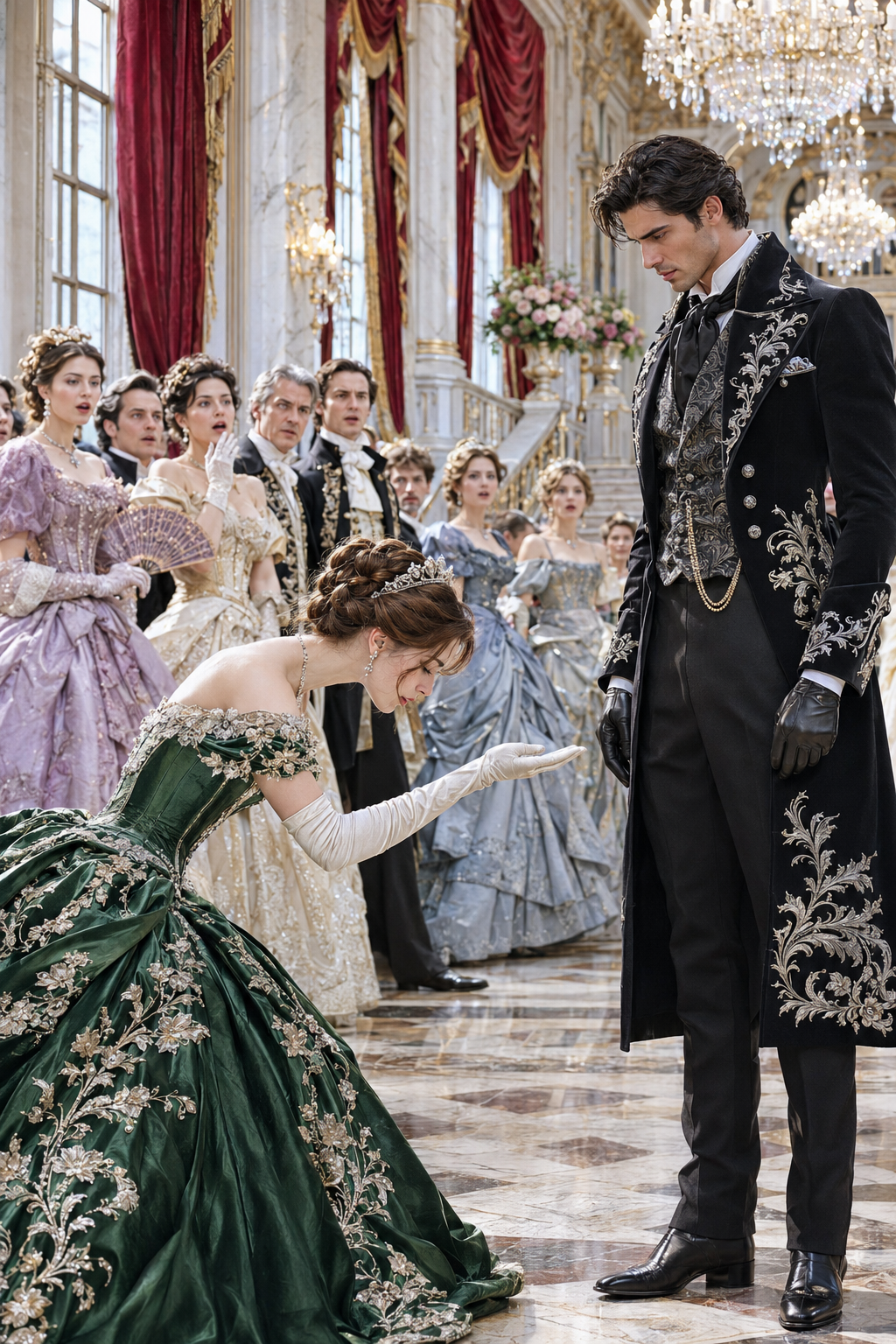
The entire ballroom burst into laughter when the Duke’s brother dropped his pocket watch.
“Miss Hulling,” the Duke said gravely, “before you enter, there’s something about my brother that you deserve to know.”
Marcus suddenly went pale.
Beatrice turned toward him, confused by the fear in his eyes. Until that moment, she had seen Marcus nervous, uncertain, and uncomfortable around strangers. But this was different. He looked like a man watching something precious slip through his fingers.
“Edward,” Marcus whispered. “Please don’t.”
The Duke, Edward Pendleton, stood perfectly still. His expression carried the tired sadness of someone who had kept a secret for far too long.
“I cannot allow another misunderstanding to hurt you,” he replied.
Beatrice looked between the brothers.
“Then perhaps someone should explain what is happening.”
Edward glanced toward the open workshop door.
“Five years ago, my brother designed a mechanical system that could have changed the way factories operate across England. It was brilliant. Revolutionary, even.”
Marcus closed his eyes.
“But something happened during its first public demonstration,” Edward continued. “An accident that nearly killed three men.”
Beatrice felt her stomach tighten.
“Was Marcus responsible?”
“That,” Edward said, “is what everyone believes.”
The silence that followed was painful.
Marcus turned toward the workshop.
“You should leave, Miss Hulling.”
His voice was barely audible.
Beatrice did not move.
“Did you cause the accident?” she asked gently.
Marcus stared at the floor.
“I built the machine.”
“That wasn’t my question.”
Edward looked at her with surprise.
For a long moment, Marcus said nothing. Then he lifted his eyes.
“I don’t know.”
Beatrice had expected almost any answer except that.
“How can you not know?”
“Because someone changed my calculations,” Marcus whispered. “And by the time I discovered it, everything had already gone wrong.”
Edward stepped forward.
“Marcus, you have never told me that.”
Marcus’s face tightened.
“You never asked.”
The words struck the Duke harder than any accusation.
For years, Edward had protected his younger brother from society, from gossip, and from people who treated him like a child. Yet in trying to protect Marcus, he had apparently stopped listening to him.
Beatrice looked toward the workshop.
“Then perhaps,” she said, “it’s time we examined those calculations.”
Marcus stared at her.
“You would believe me?”
“I believe that a question deserves an answer before people decide a man’s guilt.”
Something changed in his expression.
He stepped aside and opened the door wider.
Inside, Beatrice discovered a world unlike anything she had ever seen.
The workshop was filled with clocks, brass instruments, wooden models, and mechanical devices in various stages of construction. Shelves covered nearly every wall. Each drawer carried a carefully written label.
A large clock stood near the window, its face incomplete but its gears moving with astonishing precision.
Beatrice approached it.
“Did you make all of these?”
Marcus nodded.
“Most of them.”
“Good heavens.”
For the first time, he smiled without looking away.
Edward watched silently as Marcus began explaining the clock’s design. His words came slowly at first, then faster as Beatrice asked questions.
Within minutes, they were discussing the movement of a special gear that could prevent a clock from losing time when exposed to sudden changes in temperature.
Edward had never heard his brother speak so freely.
He suddenly understood something that made him deeply ashamed.
Marcus had not been silent because he had nothing to say.
He had been silent because almost nobody wanted to hear it.
Beatrice eventually noticed a large object covered by a gray sheet at the back of the room.
“What is that?”
Marcus’s smile disappeared.
“The machine.”
Edward stiffened.
“You kept it?”
“I kept what was left.”
Marcus walked toward the object and slowly removed the covering.
Beneath it stood a complicated arrangement of gears, metal arms, and cylinders mounted on a heavy oak frame.
Several components were damaged. One wheel had been bent badly, and a long steel shaft had snapped near its base.
Beatrice walked around it carefully.
“What was it supposed to do?”
“Regulate pressure automatically,” Marcus explained. “Steam engines are powerful, but sudden changes in pressure can be dangerous. My system was designed to respond before the pressure became unstable.”
“And it failed?”
Marcus nodded.
“It opened the wrong valve.”
Beatrice examined the mechanism.
“Then something must have told it to open that valve.”
Marcus looked sharply at her.
“Yes.”
She knelt beside the lower gears.
“And if the original calculations were correct, the problem might not have been the design.”
Edward frowned.
“What are you suggesting?”
Beatrice looked up.
“I’m suggesting that a machine cannot decide to betray its maker.”
For the next two hours, Marcus showed her his surviving plans.
Beatrice found herself fascinated by his mind. He noticed patterns that others overlooked and remembered measurements with incredible accuracy.
He also struggled whenever Edward interrupted or asked several questions at once.
Eventually, Beatrice placed a hand on the desk.
“Your Grace, would you allow your brother to finish one explanation before beginning another?”
Edward stared at her.
Then he slowly sat down.
“Of course.”
Marcus gave her a grateful glance.
By evening, they had discovered something strange.
The drawings used during the failed demonstration did not match the surviving machine.
One safety lever appeared in a different position.
“Could the lever have been moved after the accident?” Beatrice asked.
Marcus shook his head.
“It was welded into place.”
“Then someone altered the design before the machine was assembled.”
Edward rose from his chair.
“That’s impossible.”
“Why?”
“Because only three people had access to the final drawings.”
“Who?”
“My brother, the factory owner, and the engineer responsible for construction.”
Marcus lowered his head.
“Mr. Ashford.”
Edward’s expression darkened.
Richard Ashford was one of London’s wealthiest industrial investors. He had helped finance Marcus’s invention before the accident. Afterward, he had publicly blamed Marcus and withdrawn his support.
Worse, Ashford had gained control of several manufacturing contracts that Marcus’s invention might otherwise have transformed.
Beatrice considered the name.
“Does Mr. Ashford still have the original drawings?”
“He claimed they were destroyed,” Edward said.
“Then we should ask him.”
Edward laughed bitterly.
“Miss Hulling, Richard Ashford is not a man who answers uncomfortable questions.”
“Most dishonest men aren’t.”
Marcus looked at her in astonishment.
Then, unexpectedly, he laughed.
It was a warm, genuine sound.
Edward realized he had not heard it in years.
That evening, Beatrice returned to her aunt’s house expecting a confrontation.
She found something worse.
Her belongings had been placed in the entrance hall.
Her aunt, Lady Margaret Hulling, stood beside the staircase with her arms folded.
“I warned you.”
Beatrice looked at the small collection of bags.
“You’ve packed my things.”
“I will not have my household associated with a madman’s family.”
“Marcus is not mad.”
“Don’t be ridiculous. Everyone knows what happened.”
“Everyone knows what they’ve been told.”
Lady Margaret’s face hardened.
“Your father left you nothing. I gave you a home, food, clothing, and the chance to marry respectably.”
Beatrice felt the familiar sting of those words.
For eleven years, she had lived beneath her aunt’s roof, constantly reminded that she owed her survival to someone else’s generosity.
She was thirty-one now.
Every failed introduction and every passing birthday had become another weapon used against her.
“I am grateful for what you’ve given me,” Beatrice replied quietly. “But gratitude does not require me to surrender my judgment.”
Her aunt pointed toward the door.
“Then leave.”
Beatrice looked at her luggage.
She had less than twelve pounds to her name.
No husband.
No property.
No dependable income.
For one terrible moment, fear nearly overwhelmed her.
Then she remembered Marcus standing alone in the ballroom, surrounded by people who laughed because he was different.
She lifted her smallest bag.
“Goodbye, Aunt Margaret.”
She walked into the cold evening without looking back.
By midnight, Beatrice had rented a modest room above a dressmaker’s shop.
The landlady, Mrs. Wilkins, was a practical widow who seemed more interested in receiving her rent than judging her circumstances.
“You can stay as long as you pay on Friday,” she said.
Beatrice thanked her.
When she finally sat on the narrow bed, her courage gave way.
She covered her face and cried.
Not because she regretted defending Marcus.
But because bravery did not make poverty less frightening.
The next morning, a carriage stopped outside the dressmaker’s shop.
Marcus stepped out holding a small wooden box.
He had discovered what happened through Edward, who had received a furious letter from Lady Margaret.
When Beatrice came downstairs, Marcus looked troubled.
“My brother said your aunt dismissed you.”
“She did.”
“Because of me.”
“Because of her own choices.”
He studied her face.
“You’re unhappy.”
“I’m frightened,” she admitted. “There is a difference.”
Marcus seemed to consider that carefully.
Then he held out the box.
Inside lay her father’s old pocket watch.
She had mentioned it during their first conversation. The watch had stopped years earlier, and she had kept it as one of the few possessions that reminded her of her father.
“You left it in my workshop yesterday,” Marcus explained. “I repaired it.”
Beatrice lifted the watch.
Its familiar ticking filled the silence between them.
Her eyes burned.
“Marcus, how did you manage this?”
“The mainspring was broken. I made another.”
She opened the cover.
Inside, beside her father’s initials, Marcus had engraved a tiny message.
Time is never wasted when someone is understood.
Beatrice stared at the words.
No gentleman had ever given her anything so thoughtful.
“Thank you,” she whispered.
Marcus shifted nervously.
“I also came to offer you employment.”
She blinked.
“Employment?”
“I need someone to help examine the old designs. You understand the mathematics, and you notice things I miss.”
Beatrice hesitated.
“I cannot accept charity.”
“It isn’t charity.”
His voice became unexpectedly firm.
“I need your help, Beatrice.”
It was the first time he had used her given name.
She smiled.
“Then I suppose we should discuss my wages.”
Marcus visibly relaxed.
For the next three weeks, Beatrice visited the workshop every morning.
Edward insisted that an older housekeeper remain nearby whenever she worked there, partly to satisfy society’s expectations and partly to spare Beatrice further gossip.
But gossip came anyway.
London was shocked by the unmarried woman who had moved into rented rooms and begun working with the Duke’s supposedly foolish brother.
Some called her desperate.
Others suggested she was trying to secure a wealthy husband.
Lady Margaret encouraged both rumors.
Beatrice tried to ignore them.
Instead, she devoted her attention to the machine.
One afternoon, she discovered a faint mark beneath the base of a damaged gear.
“Marcus, come here.”
He knelt beside her.
She pointed to two small holes in the metal frame.
“Does this look familiar?”
Marcus stared.
Then his breathing quickened.
“The original safety catch.”
“What about it?”
“It was supposed to be attached here.”
Beatrice moved her finger toward another set of holes.
“But someone moved it.”
Marcus nodded rapidly.
“That would reverse the release sequence.”
“Could it explain the accident?”
“Yes.”
He stood so quickly that his chair toppled.
Edward entered at the noise.
“What happened?”
Marcus held up the damaged component.
“The machine didn’t malfunction because of my calculations. Someone deliberately changed the safety mechanism.”
Edward examined the metal.
“Can you prove when it was altered?”
Marcus’s excitement faded.
“No.”
Beatrice straightened.
“Then we need the construction records.”
Edward looked grim.
“Ashford’s records.”
Two days later, the Duke invited Richard Ashford to dinner.
Ashford arrived wearing a confident smile and an expensive dark coat.
He was handsome, charming, and accustomed to being admired.
When he saw Beatrice seated beside Marcus, his smile faltered.
“Miss Hulling. I hadn’t realized you were employed here.”
“I assist Mr. Pendleton with his engineering work.”
“How unusual.”
“Not nearly as unusual as finding a safety lever attached to the wrong side of a machine.”
Ashford stopped smiling.
Edward set down his glass.
“My brother has been reviewing the accident.”
“A regrettable tragedy,” Ashford replied smoothly.
“Indeed,” Edward said. “We would like to examine your construction records.”
Ashford folded his napkin.
“I’m afraid those documents were destroyed years ago.”
“How convenient,” Beatrice observed.
He turned toward her.
“Young lady, I would advise you to be careful when discussing matters you don’t understand.”
Marcus’s hands tightened beneath the table.
Beatrice noticed.
“I’m thirty-one, Mr. Ashford. And I understand that a misplaced safety mechanism can be deadly.”
Ashford’s eyes narrowed.
“Are you accusing me of something?”
“Not yet.”
A long silence followed.
Then Ashford laughed.
“I see the Duke’s eccentric brother has found himself an equally eccentric companion.”
Marcus flinched.
Beatrice felt anger rise in her chest.
But before she could speak, Marcus stood.
“Don’t insult her.”
The room fell silent.
Ashford stared at him.
“Excuse me?”
Marcus’s voice shook, but he continued.
“Beatrice is not foolish. She understands my work better than most engineers.”
Ashford gave a mocking smile.
“Then perhaps she can explain why your invention nearly killed innocent workers.”
Marcus went white.
Beatrice rose.
“That is precisely what we’re trying to discover.”
Ashford pushed back his chair.
“I will not remain here to be interrogated by a spinster and a man incapable of managing his own affairs.”
He bowed stiffly to Edward and departed.
Only after the front door closed did Marcus sit down.
His breathing was uneven.
“I shouldn’t have spoken.”
Beatrice moved beside him.
“You defended me.”
“He was angry.”
“Yes.”
“I made everything worse.”
“No, Marcus. You told the truth.”
He looked up.
She smiled gently.
“And I was very proud of you.”
His expression softened.
Neither noticed Edward quietly leaving the room.
The Duke went directly to his study and opened a locked drawer.
Inside lay a bundle of letters written by his late father.
He had not looked at them in years.
One letter contained a reference to Ashford and an unexpected payment made shortly before the disastrous demonstration.
Edward read the document twice.
Then a third time.
By dawn, he understood that his family had been hiding something far more serious than embarrassment.
The following morning, Edward summoned Beatrice and Marcus.
“I owe you both an apology,” he began.
Marcus looked confused.
“For what?”
“For believing that protecting you meant keeping you away from the truth.”
Edward placed the letters on the table.
Their father, the previous Duke, had secretly borrowed money from Ashford to cover debts created by a failed investment.
In exchange, he had promised Ashford an interest in Marcus’s invention.
But the agreement contained an unusual clause.
If the invention failed publicly, Ashford would gain ownership of its commercial rights.
Beatrice read the passage twice.
“That gives Ashford a motive.”
Edward nodded.
Marcus stared at the paper.
“My father knew?”
“I don’t know how much he understood,” Edward admitted. “But he signed the agreement.”
Marcus looked devastated.
For years, he had blamed himself for the accident.
Now he was being forced to question the father whose approval he had spent his childhood trying to earn.
“Why didn’t he tell me?”
Edward had no answer.
Beatrice quietly moved her chair closer.
Marcus did not speak again that morning.
Over the following days, he withdrew into the workshop.
He stopped eating regularly and refused several visitors.
When Beatrice tried to discuss the machine, he shook his head.
“It’s pointless.”
“Marcus—”
“Even if we prove what happened, people will always remember the accident.”
“Some will.”
“Then why continue?”
Beatrice watched him turn a small brass gear between his fingers.
“Because three men were injured, and they deserve the truth. Because your invention could prevent future accidents. And because you’ve spent five years believing something terrible about yourself.”
Marcus looked away.
“Perhaps I am what everyone says.”
Beatrice felt her heart ache.
She moved beside him.
“Look at me.”
He hesitated.
“Please.”
Slowly, he raised his eyes.
“You are a man who notices things other people overlook. You are patient, thoughtful, and remarkably kind. You struggle with certain conversations, but that does not make you incapable of understanding the world.”
His eyes filled with tears.
“My father called me defective.”
Beatrice swallowed.
“Then your father was wrong.”
Marcus covered his face.
For several minutes, she simply sat beside him.
When he finally spoke, his voice was rough.
“No one has ever said that to me.”
“Then someone should have said it long ago.”
He reached for her hand.
She let him take it.
And for the first time, Beatrice understood that her feelings had grown far beyond admiration.
She was falling in love with him.
But love, she knew, would not be enough to protect them from what was coming.
A week later, a former factory worker arrived at the Duke’s residence.
His name was Thomas Reed.
He had been one of the three men injured during the demonstration.
A deep scar crossed his left cheek, and he walked with a cane.
Edward received him in the drawing room.
Thomas refused tea.
“I came because I heard Mr. Pendleton was asking questions again.”
Marcus sat very still.
Thomas looked directly at him.
“I remember you.”
Marcus lowered his eyes.
“I’m sorry you were hurt.”
“I know.”
The answer surprised everyone.
Thomas continued.
“After the explosion, you came back into the building. The roof was falling, and you helped pull me out.”
Marcus stared at him.
“I remember the smoke.”
“You burned your hands carrying me.”
Beatrice looked down at Marcus’s fingers.
She had noticed the faint scars but never asked about them.
Thomas reached into his coat.
“I kept something from that day.”
He placed a folded piece of paper on the table.
It was an instruction sheet from the factory floor.
At the bottom was a handwritten order changing the placement of the safety mechanism.
The signature belonged to Richard Ashford.
Edward stood.
“Where did you get this?”
“The foreman gave it to me before he died. He said if anyone ever questioned what happened, I should make sure the truth came out.”
Marcus’s hands began trembling.
Beatrice examined the paper.
“This could prove everything.”
Thomas shook his head.
“Not by itself. Ashford will claim the signature is forged.”
“Then what do we need?” Edward asked.
“A witness who saw him give the order.”
“Do you know one?”
Thomas hesitated.
“Yes.”
“Who?”
“The factory foreman who survived the blast. Mr. Collins.”
Edward frowned.
“I thought Collins died.”
“So did everyone else.”
Thomas leaned forward.
“He’s alive. And he’s been hiding because Ashford threatened his family.”
They found Henry Collins three days later in a small village outside London.
He was living under another name and working as a carpenter.
At first, he refused to speak.
Then Beatrice told him about Marcus.
She described the years of ridicule, the abandoned invention, and the injured workers who still deserved answers.
Collins listened without moving.
Finally, he looked at Marcus.
“I knew you didn’t do it.”
Marcus’s face drained of color.
“Then why didn’t you say anything?”
Collins lowered his head.
“Because Ashford threatened to have my son imprisoned over a debt. I was afraid.”
Marcus stared at him.
“You let everyone blame me.”
“Yes.”
The older man’s voice broke.
“And I have regretted it every day.”
Beatrice expected Marcus to grow angry.
Instead, he asked a quiet question.
“Is your son safe now?”
Collins looked stunned.
“He is.”
“Then perhaps you can tell the truth.”
The man began to cry.
He agreed to testify.
But Ashford had already learned that someone was investigating him.
Two nights later, a fire broke out at the Duke’s estate.
The workshop was burning.
Beatrice arrived just as servants rushed across the courtyard carrying buckets of water.
Flames climbed the windows.
Edward stood near the entrance, shouting orders.
“Where’s Marcus?” Beatrice demanded.
No one answered.
Her blood turned cold.
Then she saw movement behind the smoke-filled doorway.
Marcus was inside.
He had returned for his original drawings.
“Marcus!” she screamed.
A heavy wooden beam crashed down near the entrance.
Edward tried to rush forward, but two servants held him back.
Beatrice grabbed a wet blanket and ran toward the doorway.
She could hear Marcus coughing somewhere beyond the flames.
“Marcus! Follow my voice!”
“Beatrice?”
“I’m here!”
A shadow appeared through the smoke.
Marcus stumbled forward clutching a leather portfolio.
Beatrice reached him just as part of the ceiling collapsed.
They fell together onto the stone courtyard.
Servants dragged them away as flames swallowed the workshop.
Marcus coughed violently.
Beatrice held his face between her hands.
“Why would you go back?”
“The drawings,” he whispered.
“Those papers weren’t worth your life!”
His eyes filled.
“They were the only proof that I ever made something worthwhile.”
Beatrice shook her head fiercely.
“No. You are worth more than anything you could ever build.”
Marcus stared at her.
Then he pulled her into his arms.
And there, beneath a sky filled with smoke, Beatrice finally allowed herself to cry.
The next morning, investigators discovered traces of oil deliberately poured along the workshop’s outer wall.
It was arson.
Edward immediately contacted the authorities.
Ashford denied all involvement.
He even claimed Marcus had started the fire himself in a fit of confusion.
But something unexpected happened.
Thomas Reed came forward publicly.
Then Henry Collins.
Their statements led investigators to a former employee of Ashford’s who admitted receiving money to set the fire.
Faced with the possibility of prosecution, the man named Ashford as the person who had ordered it.
Ashford was arrested.
The scandal shook London.
Newspapers that had once mocked Marcus now printed accounts of his intelligence, his courage during the factory accident, and the suspicious circumstances surrounding his invention.
At a formal hearing, Edward presented the financial agreement, the altered construction order, and the surviving mechanical evidence.
Collins testified that Ashford had personally instructed him to change the safety mechanism despite repeated warnings.
Ashford’s lawyer challenged every statement.
Then he turned toward Marcus.
“Mr. Pendleton, isn’t it true that you often become distressed when confronted with difficult questions?”
Marcus tightened his hands.
“Yes.”
“And that you sometimes struggle to explain yourself?”
“Yes.”
“Then how can this court trust your memory?”
The room grew still.
Beatrice watched Marcus’s face.
She wanted desperately to interrupt.
But Marcus slowly raised his head.
“Because having difficulty speaking does not mean I have difficulty remembering.”
A murmur passed through the room.
He continued.
“I remember the measurements. I remember the original valve positions. I remember every calculation. And I remember asking Mr. Ashford why the construction team had changed my design.”
The lawyer hesitated.
“What did he say?”
Marcus looked directly at Ashford.
“He told me that nobody would believe me if the machine failed.”
The words settled over the room.
For the first time, Ashford looked afraid.
The hearing did not end that day.
There were more witnesses, more documents, and weeks of argument.
But eventually the evidence became overwhelming.
Ashford was convicted for his role in the fire and the deliberate alteration of the machine. The court also ordered compensation for the injured workers, while the fraudulent contract was challenged and set aside.
Marcus’s reputation was restored.
Yet when Edward told him the news, Marcus did not celebrate.
He sat quietly beside the garden window.
“Five years,” he whispered.
Edward sat next to him.
“I know.”
“Five years believing I had hurt those men.”
Edward’s voice broke.
“I should have listened to you.”
Marcus looked at his brother.
“You were trying to help.”
“That doesn’t excuse it.”
“No,” Marcus agreed gently. “But we can do better now.”
Edward lowered his head.
For the first time since their childhood, the brothers embraced without embarrassment.
Spring arrived slowly that year.
The damaged workshop was rebuilt with larger windows and a safer heating system.
Marcus refused several offers from wealthy investors.
Instead, he established a small engineering company with clear safety standards and fair wages for its workers.
Thomas Reed became his workshop supervisor.
Henry Collins was hired to oversee construction.
Beatrice managed the accounts, reviewed technical drawings, and helped organize the growing business.
Her mathematical ability soon became impossible to ignore.
One afternoon, Edward visited the workshop and found a group of visiting engineers gathered around a new pressure regulator.
Beatrice was explaining a flaw in their proposed design.
One of the men looked skeptical.
“Are you certain, Miss Hulling?”
She smiled pleasantly.
“Entirely. But please feel free to test the numbers yourself.”
Ten minutes later, the engineer admitted she was correct.
Marcus watched from across the room with unmistakable pride.
That evening, he invited Beatrice into the garden.
The air smelled of fresh roses.
They walked slowly along the gravel path, past the fountain and beneath the branches of an old chestnut tree.
Marcus seemed unusually nervous.
“Beatrice, may I ask you something?”
“Of course.”
“If I say it badly, will you let me try again?”
She stopped walking.
“Always.”
He took a small wooden box from his pocket.
Her heart began racing.
Inside was a ring.
It was simple, elegant, and set with a small blue stone.
But what caught her attention was the tiny clockwork pattern engraved around the band.
“I made the setting myself,” Marcus explained.
Beatrice looked up at him.
He swallowed.
“Before you came into my life, I thought love was something meant for other people. People who knew what to say. People who could walk into a ballroom without everyone staring.”
His voice trembled.
“Then you spoke to me as though I mattered.”
“Marcus—”
“You didn’t try to change me into someone else. You wanted to know who I already was.”
Tears gathered in her eyes.
He took both her hands.
“I don’t know whether I will ever be comfortable at parties. I may always need quiet rooms and time to think. Sometimes I will misunderstand what you mean, and sometimes I will need you to explain.”
Beatrice smiled through her tears.
“And sometimes I will be stubborn, impatient, and quite impossible.”
Marcus laughed softly.
“Yes. I’ve noticed.”
They stood together beneath the chestnut tree.
Then Marcus became serious again.
“But I know that my life is better when you’re in it. And if you will let me, I would like to spend the rest of it making yours better too.”
He drew a steady breath.
“Beatrice Hulling, will you marry me?”
For years, Beatrice had believed she was too old, too poor, and too ordinary to be loved.
She had listened to people who treated marriage as a prize awarded only to beautiful young women with respectable fortunes.
But standing before Marcus, she finally understood how wrong they had been.
Love was not a reward for pleasing society.
It was the quiet joy of being seen.
“Yes,” she whispered.
Marcus blinked.
“Yes?”
She laughed.
“Yes, Marcus. I will marry you.”
He slipped the ring onto her finger.
Then she kissed him.
It was gentle and a little awkward, and they both started laughing afterward.
Their wedding took place six weeks later in a small country church.
Edward stood beside Marcus.
Mrs. Wilkins sat in the front pew, wearing the finest hat she owned.
Thomas Reed and Henry Collins attended with their families.
Several workers from the new engineering company filled the remaining seats.
Lady Margaret sent a letter requesting an invitation.
Beatrice read it carefully.
Then she wrote a polite reply.
She would welcome her aunt if she came with kindness and respect for Marcus.
Lady Margaret did not attend.
Beatrice felt a brief sadness, but no regret.
She had learned that forgiveness did not require her to invite cruelty back into her life.
After the ceremony, Edward raised a glass.
“I spent years believing my duty was to protect my brother from the world,” he said. “But I was wrong about what protection meant.”
He looked at Marcus.
“I should have helped the world recognize the man standing before us.”
Then he turned toward Beatrice.
“And I am grateful that someone wiser than I am showed me how.”
There was laughter, followed by warm applause.
Marcus stood beside his new wife, holding her hand.
Later that evening, when the guests had departed, Beatrice found him standing near the window with her father’s old pocket watch.
“Is something wrong?” she asked.
He shook his head.
“I was thinking about the night we met.”
“When you dropped your watch?”
“Yes.”
“And I offended half of London?”
“More than half, I think.”
She laughed.
Marcus opened the watch and listened to its steady ticking.
“I used to believe broken things were only worth keeping if they could be repaired.”
Beatrice rested her head against his shoulder.
“And now?”
He looked at her.
“Now I think people aren’t machines. They shouldn’t have to prove they’re useful before someone decides they deserve love.”
Beatrice smiled.
Outside, the garden lay quiet beneath the moonlight.
Tomorrow would bring ordinary problems.
There would be difficult customers, complicated designs, disagreements, and days when Marcus needed silence while Beatrice needed conversation.
Their lives would not become perfect simply because they loved each other.
But they had learned something more valuable than perfection.
They had learned to listen.
Years later, their engineering company would become known not only for its inventions but for giving opportunities to people other employers overlooked.
Marcus insisted that ability should be judged by honest work, not by polished conversation or family reputation.
Beatrice established an apprenticeship program for young women who wanted to study mathematics and mechanical design.
Together, they opened doors that had once been closed to them.
And whenever someone asked Beatrice why she had defended Marcus that first evening, she always gave the same simple answer.
“Because he deserved kindness before anyone knew how brilliant he was.”
That was the lesson she hoped others would remember.
A person’s worth is not measured by how easily they speak, how much money they possess, whether they marry young, or how well they fit into society’s expectations.
Sometimes the person everyone overlooks has the greatest gift to offer.
And sometimes the smallest act of courage—a few honest words spoken when everyone else is laughing—can change two lives forever.
For Beatrice and Marcus, their extraordinary story had begun with a broken watch.
But it was never really about fixing a clock.
It was about discovering that neither of them had ever been broken in the first place.
Many years after their wedding, Beatrice found Marcus standing alone in the workshop, holding the same pocket watch that had brought them together.
His hair had turned silver, and his hands were no longer as steady as they once were. But his eyes still carried the same gentle curiosity she had fallen in love with.
“Something wrong with the watch?” she asked.
Marcus smiled.
“Not at all. It still keeps perfect time.”
“Then why are you looking at it like that?”
“Because I was wondering what would have happened if you hadn’t spoken to me that evening.”
Beatrice stepped closer and slipped her arm through his.
“You probably would have repaired it yourself.”
“Yes,” Marcus said softly. “But I might never have learned that there was someone in the world who wanted to understand me.”
Outside the workshop, laughter drifted through the open windows.
Their daughter, Eleanor, was helping a group of young apprentices test a new mechanical device. Their son, James, was arguing cheerfully with his uncle Edward about the best way to improve its design.
Neither child had grown up believing that intelligence came in only one form.
They had been taught that kindness mattered more than appearances, that mistakes were opportunities to learn, and that nobody should be made to feel ashamed for being different.
Beatrice watched the children through the window.
“Do you remember what your father once said about you?” she asked Marcus.
His expression grew thoughtful.
“I remember.”
“And do you still believe him?”
Marcus looked toward the busy workshop, where people from different backgrounds worked side by side.
“No,” he answered. “Not anymore.”
Beatrice smiled.
“Good.”
A few moments later, Eleanor hurried inside.
“Father! There’s a boy at the gate asking for work.”
Marcus turned.
“What sort of boy?”
“He says nobody will hire him because he stammers. He brought drawings of a machine he designed, but the other workshops wouldn’t even look at them.”
Marcus became very still.
For a moment, he was no longer an older gentleman surrounded by a loving family.
He was the frightened young man standing alone in a crowded ballroom, waiting for people to stop laughing.
Then he handed the pocket watch to Beatrice.
“Show him in,” he said.
Eleanor smiled and hurried away.
Marcus straightened his coat and moved toward his desk.
Beatrice watched him prepare a clean sheet of paper, two pencils, and a comfortable chair.
When the nervous young man entered, he struggled to introduce himself.
“I—I was hoping that perhaps you might look at my drawings, sir.”
Marcus did not interrupt.
He did not finish the boy’s sentences or glance impatiently at the clock.
He simply waited.
When the boy finally handed him the drawings, Marcus studied them carefully.
Then he looked up.
“That’s an interesting design,” he said. “Would you like to explain how it works?”
The boy’s eyes widened.
“You—you really want to know?”
Marcus smiled.
“Very much.”
From the doorway, Beatrice felt tears gathering in her eyes.
Years earlier, she had offered Marcus the simple dignity of being heard.
Now he was offering that same kindness to someone else.
And suddenly, she understood the greatest achievement of their lives.
It was not the machines they had built, the money they had earned, or the respect they had finally won from London society.
It was the kindness they had passed on.
Marcus looked toward Beatrice, and she gave him the same encouraging smile she had offered him on the night they first met.
He smiled back.
The old pocket watch ticked steadily in her hand.
And as the young apprentice began explaining his invention, Marcus listened with the patience of a man who knew exactly how much that moment could mean.
Because sometimes, changing a person’s life does not require wealth, power, or extraordinary talent.
Sometimes it begins with the courage to stand beside someone when everyone else has turned away.
And sometimes the greatest gift we can give another human being is something the world has denied them for far too long.
The chance to be seen, to be heard, and to be valued exactly as they are.
THE END.