The Duke of Wickliffe married Charlotte Ainsworth on one condition: she would never share his bed, never bear his child, and never become the next woman buried beneath his family chapel. Charlotte accepted.
The Duke did not move for several seconds. In the darkness of the servants’ passage, Charlotte could hear the faint ticking of a clock somewhere beyond the wall, each measured sound strangely distinct beneath the thunder.
“The nursery?” he whispered.
The butler’s shadow shifted beneath the concealed door.
“Yes, Your Grace. Lord Henry was most particular. He instructed me to remove the coverings from the furniture and have a fire lit before he retired.”
Charlotte felt the Duke’s grip tighten around her fingers.
“Did he say why?”
“No, Your Grace. But he asked whether the old cradle was still there.”
The Duke released Charlotte’s hand.
“Do nothing until I speak with him.”
The footsteps retreated. Only when the passage had fallen silent did the Duke strike a match and relight the candle. Its small flame revealed a face Charlotte barely recognized. The weariness she had grown accustomed to seeing had been replaced by something sharper.
Fear.
Not for himself.
For her.
“Tell me what happened in that nursery,” Charlotte said.
He stared at the flame.
“My mother died there.”
Charlotte waited.
“Three weeks after my birth, according to the physician. My grandmother died in the same room after delivering my father. Two other women married into the family and died under circumstances the household refused to discuss.”
He unfolded the second page.
“My father spent the final years of his life investigating those deaths. I believed grief had unsettled his mind.”
“And now?”
His eyes lifted to hers.
“Now I believe someone persuaded me to fear the wrong thing.”
Charlotte took the paper carefully. The handwriting was cramped and hurried, as though its author had written against an approaching danger.
The final sentence had been underlined twice.
The evidence is where the child was never permitted to sleep.
Charlotte looked toward the ceiling.
“The nursery.”
The Duke nodded.
“Henry knows.”
“Perhaps. But knowing where something is hidden is not the same as knowing what it contains.”
She folded the letter and returned it.
“Then we must reach it before he does.”
For a moment, the Duke looked almost offended by her calmness.
“You cannot understand what you are proposing.”
Charlotte moved closer.
“Your Grace, I entered this house knowing you expected nothing from me except obedience to an arrangement. I have spent three weeks keeping rain out of your rooms, food on your servants’ tables, and this household from collapsing around its own memories.”
Her voice remained quiet.
“I will not allow a man with a pleasant smile to frighten me away from a locked room.”
Something in his expression changed.
“Charlotte.”
She waited.
“Call me Edmund.”
It was the first time he had offered her anything that belonged to him rather than to his title.
She inclined her head.
“Then we should make haste, Edmund.”
They reached the upper corridor through a narrow staircase concealed behind the linen cupboards. The nursery occupied the eastern end of the second floor, beyond a passage rarely used by the household.
Its door stood open.
A fire burned in the grate.
Someone had already entered.
Edmund stopped so abruptly that Charlotte nearly collided with him.
The room was unexpectedly beautiful beneath its decay. Pale blue wallpaper covered the walls, painted with faded birds and flowering branches. A rocking horse stood near the window. Tiny porcelain animals occupied a shelf above a low cabinet.
In the center rested an enormous carved cradle beneath a yellowed lace canopy.
But the floor around it had been disturbed.
Dust marked the places where furniture had stood untouched for years, and narrow scratches showed where the cradle had recently been dragged across the boards.
Charlotte knelt beside it.
“Someone moved this.”
Edmund crossed the room and inspected the cradle’s carved posts.
“My father ordered it sealed after my mother’s death.”
“Who had access?”
“The housekeeper, perhaps. Henry visited often when we were children.”
Charlotte examined the cradle’s underside. Three small brass screws fastened a wooden panel beneath the mattress support.
One screw was missing.
She held out her hand.
“Your penknife.”
Edmund hesitated, then produced it.
The first screw turned reluctantly. The second came loose with a faint metallic click. As she worked on the third, voices sounded in the corridor.
Edmund immediately moved toward the door.
Charlotte loosened the final screw and caught the panel before it struck the floor.
Inside was a shallow compartment lined with faded green velvet.
Empty.
Except for a narrow strip of paper caught beneath the lining.
She pulled it free.
A single word had been written across it.
Ashford.
Below it were four dates.
Charlotte recognized the final one from the letter describing Edmund’s mother’s death.
The other three stretched backward across nearly seventy years.
She looked at the doorway.
“Edmund.”
He turned.
Before she could speak, a familiar voice interrupted them.
“How extraordinary.”
Lord Henry stood in the entrance, one shoulder resting against the frame.
“I thought I heard someone moving about.”
His eyes traveled from Charlotte’s knees to the open compartment beneath the cradle.
For the first time, his smile disappeared completely.
“You should not have touched that.”
Charlotte rose slowly.
“Then perhaps you should explain why.”
Henry entered the room, closing the door behind him.
He did not look at Edmund.
He looked only at the strip of paper in Charlotte’s hand.
“Some family matters are best left to those who understand them.”
“I am a member of this family now.”
“By contract.”
The word hung between them.
Edmund stepped forward.
“Careful, Henry.”
His cousin gave a small laugh.
“You have married a woman with considerably more courage than judgment.”
Charlotte slipped the paper into her sleeve.
“How fortunate. Courage has proved more useful in this house.”
Henry’s expression hardened.
For one breath, all three stood still.
Then a violent crash sounded from the courtyard.
A servant shouted.
The firelight flickered as wind struck the windows.
Edmund moved to the glass. Below, a section of the old stable roof had collapsed beneath the storm.
A horse screamed.
Henry seized the distraction.
He lunged toward Charlotte.
Edmund turned in time to catch his cousin’s arm, but Henry drove his shoulder into him. Both men struck the edge of the cradle, sending its wooden canopy crashing to the floor.
Charlotte stepped backward, clutching the paper.
“Give it to me!” Henry snapped.
Edmund recovered and caught him by the collar.
“Enough.”
Henry struggled, then abruptly stopped.
“You foolish man,” he hissed. “You have no idea what she has found.”
Edmund tightened his grip.
“Then enlighten me.”
Henry’s eyes shifted toward Charlotte.
“Ask your wife what becomes of women who interfere in Wickliffe affairs.”
Edmund struck him.
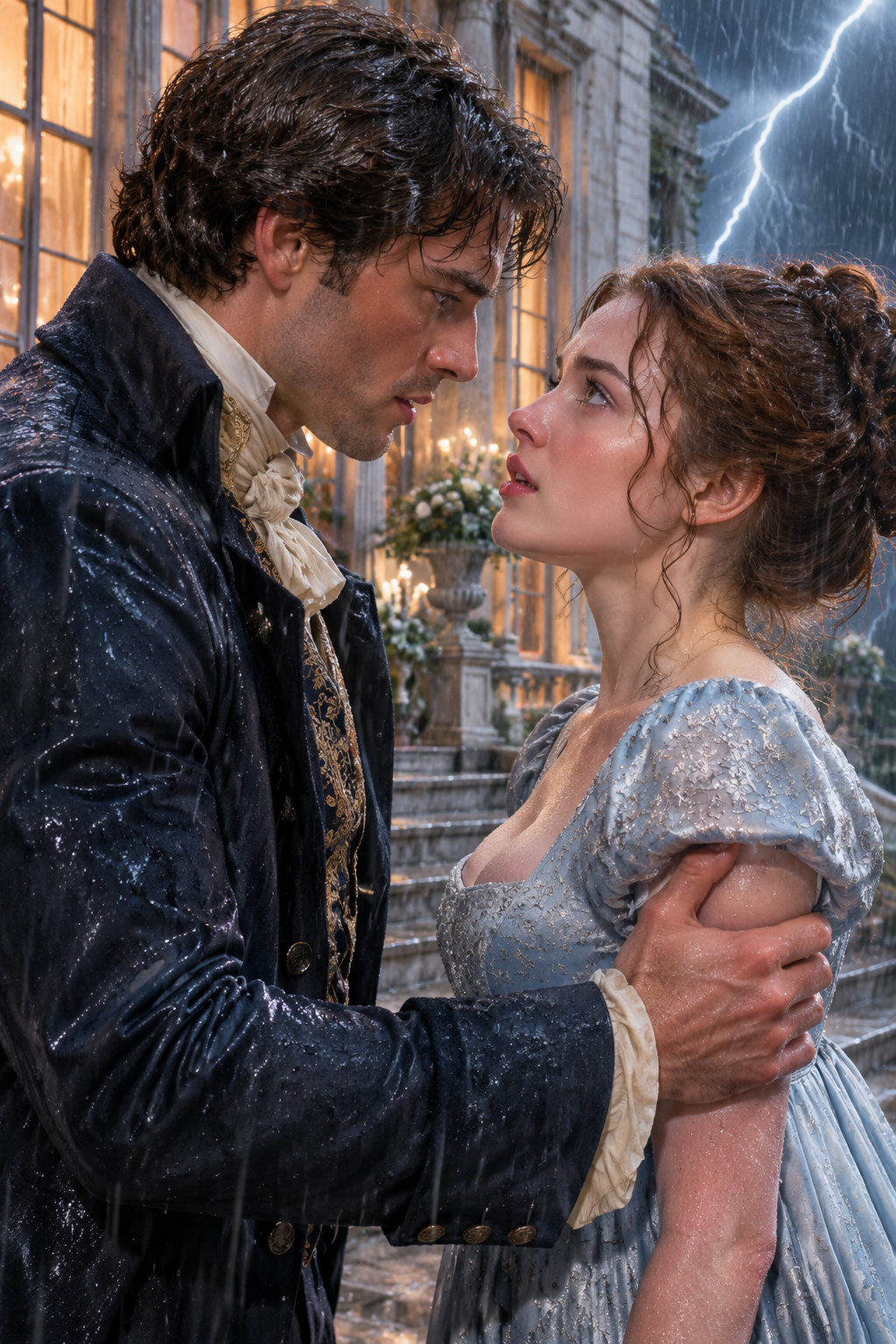
The blow was sudden and controlled, but it sent Henry staggering against the cabinet.
Porcelain figures shattered across the floor.
For a moment, neither man moved.
Then Henry touched his bleeding lip and smiled.
“There he is. A true Wickliffe after all.”
Charlotte stepped between them before Edmund could answer.
“Leave this room.”
Henry studied her.
Then he straightened his coat, retrieved his gloves from the floor, and walked toward the door.
At the threshold, he paused.
“Your husband’s father was a clever man, Duchess. Clever enough to hide things. Not clever enough to survive discovering them.”
The door closed behind him.
Charlotte heard Edmund draw a slow, uneven breath.
His face had turned pale.
“My father died of a fever.”
She looked at the empty doorway.
“Are you certain?”
He did not answer.
Outside, the storm pressed against the windows with renewed force.
Charlotte bent to retrieve the fallen canopy. Beneath its broken wooden arch, something glinted.
A small silver key.
It had been secured inside the carved head of a painted bird, concealed by a narrow sliding panel that had come loose when the cradle fell.
She picked it up.
Edmund stared.
“That was my mother’s cradle.”
Charlotte closed her fingers around the key.
“And your father knew someone would search beneath it.”
For the first time that night, Edmund seemed to understand the depth of what had been concealed from him.
They were not merely uncovering a family tragedy.
They were disturbing a secret someone had protected for generations.
By midnight, Wuthering Hall had become a prison of wind and water.
The flooded bridge remained impassable. The carriage house had partially collapsed, and the kitchen staff were struggling to preserve the remaining provisions.
Charlotte understood that they could not afford to let Henry suspect how much they knew.
She returned to the drawing room with Edmund shortly after midnight, carrying a tray of tea herself.
Henry sat beside the fire, holding a handkerchief against his lip.
His eyes moved to the tray.
“How domestic.”
Charlotte placed the cups on the table.
“I thought you might appreciate something warm.”
“How considerate.”
Edmund remained beside the mantelpiece.
“We have decided you may stay until the bridge is repaired. Afterward, you will leave.”
Henry stirred his tea.
“An inhospitable beginning to a family reunion.”
“You arrived uninvited.”
“And yet I seem to have arrived precisely when needed.”
Charlotte watched his hand.
He had not taken a single sip.
Instead, he studied the cup she had placed before Edmund.
She noticed the faintest change in his expression when Edmund moved away from it.
Then Henry rose.
“I shall retire. I trust the servants have prepared my room.”
Charlotte smiled politely.
“They have.”
Once he had gone, she lifted Edmund’s untouched cup and carried it toward the window.
“What are you doing?”
“Trusting my instincts.”
She poured a few drops into the soil of a neglected potted fern.
Edmund frowned.
“Charlotte, it is only tea.”
“Perhaps.”
She looked toward the closed door.
“But your cousin watched your cup more closely than he watched his own.”
Edmund reached for the teapot.
She stopped him.
“Leave it.”
In the morning, the fern’s most delicate leaves had curled inward.
It was not proof of poison. The plant had been neglected for months, and cold drafts swept through the room. Yet Charlotte sent for the housekeeper and instructed her to keep every cup and pot from the previous evening untouched.
She did not tell Edmund why until they were alone.
His reaction was quieter than she expected.
He simply sat down.
“My father drank tea every evening before he became ill.”
Charlotte crouched beside his chair.
“Who served him?”
Edmund closed his eyes.
“I don’t remember.”
“Think.”
He pressed his fingers against his brow.
“Henry was there.”
The words emerged almost unwillingly.
“He stayed with us during the final winter. My father had been investigating the family records. They argued constantly.”
“What about?”
“Money. Land. The inheritance.”
He looked at her.
“Henry’s branch of the family has always been in debt. My father refused to release certain properties from the estate.”
Charlotte thought of the gold ring on Henry’s hand and the immaculate traveling coat.
“Does Henry inherit if you die without children?”
Edmund nodded.
“Most of the entailed estate passes to him.”
“And if you have a child?”
“His claim ends.”
The room grew still.
Charlotte understood then why Henry had been so interested in their marriage.
He had expected a wife frightened into obedience, a husband determined to remain childless, and a family line prepared to end quietly.
Instead, Charlotte had begun asking questions.
She rose.
“We need to discover what that key opens.”
Edmund reached for her hand.
“Charlotte, listen to me. I married you because I believed keeping my distance would protect you. I thought the women of this family were doomed by something in our blood.”
His voice roughened.
“I could bear the thought of being alone. I could not bear the thought of burying another wife.”
Charlotte looked down at his hand around hers.
“You do not protect someone by refusing to let them stand beside you.”
Edmund lowered his eyes.
“No.”
She squeezed his fingers once.
“Then stand beside me now.”
They began searching the rooms that had belonged to Edmund’s father.
His private study remained locked, its furniture draped in sheets. Shelves of old legal volumes lined the walls, and a large desk stood beneath a portrait of a stern-looking man with Edmund’s eyes.
Charlotte tried the silver key in three drawers.
None opened.
Edmund examined a cabinet beside the fireplace.
“Father kept his private correspondence here.”
The key turned.
Inside lay a small leather-bound ledger, a bundle of sealed letters, and a thin packet wrapped in black ribbon.
Charlotte opened the ledger first.
The pages contained payments made over decades to physicians, servants, and lawyers.
Several entries had been marked with a small cross.
Beside each cross appeared the same name.
Ashford.
Yet the handwriting changed halfway through the book.
Charlotte compared the dates.
“The first payments were made before Henry was born.”
Edmund leaned closer.
“His grandfather.”
The ledger revealed a pattern stretching across three generations. Whenever a Wickliffe marriage threatened to produce an heir, an Ashford relative had arranged access to the household, paid a physician, or acquired influence over a servant.
The women’s deaths had not occurred under identical circumstances.
One had fallen ill weeks after childbirth.
Another had died from a fever that began before labor.
A third had suffered a sudden collapse after drinking medicinal wine prescribed by a visiting doctor.
Their tragedies had been gathered into a single terrifying legend.
A curse.
A convenient explanation that discouraged investigation.
Charlotte untied the black ribbon.
Inside were two letters and a physician’s signed statement.
The first letter had been written by Edmund’s father.
My son must never be permitted to believe his mother’s death was the consequence of bringing him into this world.
Charlotte stopped reading.
Edmund reached for the page.
His hands shook.
She gave it to him.
He read silently, his face changing with every line.
His father had discovered that the physician who attended Edmund’s mother had been bribed to alter the record of her illness. A servant had reported that someone entered her chambers repeatedly while she was recovering.
That servant disappeared.
The physician later confessed that certain medicines had been administered without his authorization.
Before the investigation could be completed, Edmund’s father had fallen ill.
The second letter was addressed to an old solicitor in York.
If I should die before the evidence reaches you, I beg you to protect my son from Henry Ashford and the men who have profited from this family’s grief.
Edmund lowered himself into his father’s chair.
For several moments, he stared at the page.
“My mother.”
Charlotte stood beside him.
“She was murdered.”
The words sounded almost too small for what they contained.
Edmund pressed his hand against his mouth.
“I spent my life believing my existence killed her.”
Charlotte did not offer him a comforting lie.
She rested her hand on his shoulder and remained there while he wept without sound.
When he finally looked up, there was no shame in his face.
Only grief that had waited too long to be understood.
“We must take this to the magistrate,” he said.
“And to the solicitor.”
“The bridge—”
“Will be repaired.”
Before he could answer, a faint sound came from the corridor.
A metallic click.
Charlotte turned.
The study door was closing.
Edmund crossed the room and seized the handle.
Locked.
From the outside.
A moment later, smoke slipped beneath the door.
Charlotte looked toward the fireplace.
The flames there were nearly extinguished.
The smoke was coming from the corridor.
“Henry.”
Edmund threw his shoulder against the door.
It did not move.
Outside, footsteps hurried away.
Charlotte ran to the window.
Two floors below, the courtyard was dark with rain.
The old stone ledge beneath the study window extended toward a narrow servants’ balcony, but the distance was too great to cross safely.
The smoke thickened.
Edmund searched the room for something heavy.
Charlotte pulled the bell cord.
Nothing happened.
The servants’ bells had long since stopped working.
She remembered the cracked marble in the entrance hall, the neglected pipes, the rotting shutters.
A house left to decay.
And yet she had spent three weeks learning every weakness it possessed.
“The water pipes,” she said.
Edmund turned.
“What?”
“The old washing chamber is beyond that wall. There is a service hatch behind the bookshelves.”
Edmund stared at her.
“How do you know?”
“I had the servants inventory every room after the flood.”
They pushed the bookcase aside.
Behind it was a narrow wooden panel.
Edmund struck it with a brass fire poker.
Once.
Twice.
The third blow split the timber.
Cool air rushed through the opening.
Charlotte climbed first, dragging the ledger beneath her gown. Edmund followed with the letters.
They emerged into a small washing chamber where the air smelled of damp linen.
Behind them, the study door gave way with a distant crash.
Flames surged into the room they had escaped.
Edmund seized Charlotte’s arm.
“Run.”
They reached the main staircase as servants began rushing toward the smoke.
Charlotte immediately took charge.
“Buckets from the kitchens. Wet blankets from the laundry. Keep everyone away from the upper corridor.”
The butler appeared, pale and breathless.
“Your Grace, Lord Henry has ordered the horses saddled.”
Edmund stopped.
“Where is he?”
“At the rear entrance.”
Charlotte looked toward the windows.
Rain continued falling, but the storm had weakened. If Henry reached the old forestry road, he might escape before the bridge became passable.
“Take the letters,” she told Edmund.
He shook his head.
“I’m not leaving you.”
“Then give them to someone he cannot reach.”
The Duke turned to the butler.
“Mr. Pritchard, lock these documents in the chapel safe. You are responsible for them until I return.”
The old man accepted the packet.
His expression changed when he saw the family crest.
“I wondered when this day would come.”
Charlotte looked at him.
“You knew?”
Pritchard swallowed.
“I knew your father feared Lord Henry, Your Grace. I never knew why.”
There was no time for further questions.
Edmund and Charlotte hurried through the service corridor toward the stables.
They found Henry beside a saddled horse, struggling to fasten a leather case behind the saddle.
The stable doors stood open, exposing the courtyard to the rain.
He froze when he saw them.
Edmund stepped forward.
“It is over.”
Henry glanced at Charlotte.
“Where are the papers?”
“Safe.”
“Nothing in this house has ever been safe,” Henry said.
His composure had finally deserted him.
He reached for the reins.
Edmund caught them first.
“You murdered my father.”
Henry’s face twisted.
“Your father destroyed himself.”
“He discovered what your family had done.”
“My family kept this estate alive!”
The words rang across the stable.
Henry looked suddenly older, his wet hair clinging to his forehead.
“For generations, the Wickliffes squandered fortunes while the Ashfords managed the debts. We maintained the land, negotiated the leases, paid the people your ancestors forgot existed.”
Charlotte watched him carefully.
“And when the inheritance threatened to remain with the Wickliffes, your family made sure their wives died.”
Henry said nothing.
That silence was enough to make Edmund take a step toward him.
But Charlotte caught Edmund’s sleeve.
“Let him speak.”
Henry gave a bitter laugh.
“You imagine every death was planned? Some were accidents. Others were opportunities. A physician needed money. A servant wanted employment. People make choices.”
“Women died,” Charlotte said.
“And men inherited,” Henry replied.
His voice had gone flat.
For a moment, the stable seemed to hold its breath.
Then Edmund said quietly, “My mother was not an opportunity.”
Henry looked at him.
“Your mother was going to give your father another child.”
Edmund went still.
“A second son,” Henry continued. “Another obstacle. My grandfather had already spent years securing the estate’s future.”
Charlotte understood the implication before Edmund did.
The pattern had not merely protected the Ashfords’ inheritance.
It had punished women whose children threatened it.
Henry’s gaze shifted toward Charlotte.
“And now you arrive, clever enough to examine the accounts, stubborn enough to ignore every warning.”
He stepped closer.
“Do you think I would allow you to produce another Wickliffe heir?”
Edmund moved between them.
“You will never threaten her again.”
Henry’s hand disappeared inside his coat.
Charlotte saw the movement.
“Edmund!”
A pistol appeared.
The shot shattered the silence.
A lantern hanging near the stable door exploded, scattering glass and burning oil across the straw.
The horses reared.
Edmund pulled Charlotte behind a stone pillar as flames climbed the wooden wall.
Henry staggered backward, startled by the consequences of his own shot.
The nearest horse broke its tether and bolted through the open doors.
For a moment, Henry stood frozen.
Then he ran.
Edmund started after him.
Charlotte seized his arm.
“The fire.”
He looked toward the burning straw.
Two horses remained trapped in their stalls.
The stable boy had fallen near the far wall.
Edmund hesitated only once.
Then he turned back.
Together, they dragged the boy toward the entrance while the grooms struggled with the terrified animals.
Smoke filled the rafters.
Charlotte pulled a wet blanket over the boy’s face and guided him outside.
Edmund freed the final horse just as a section of burning timber fell behind him.
He emerged coughing, his coat blackened, his hair wet with rain and sweat.
Charlotte caught him as he stumbled.
“Are you hurt?”
He shook his head.
“Henry—”
“Can run.”
She pressed a hand against his chest, feeling the rapid beat beneath his soaked clothing.
“The people inside mattered more.”
For a second, Edmund simply looked at her.
Then he drew her into his arms.
It was not a careful embrace.
It was desperate, trembling, and entirely unlike the distant man who had greeted her at the entrance weeks earlier.
Charlotte held him until the stable roof collapsed behind them.
By dawn, the fire had been contained.
The study was destroyed, along with a section of the eastern corridor, but the stone walls had prevented the flames from reaching the inhabited rooms.
The servants were exhausted.
The injured stable boy slept beside the kitchen fire.
Henry was gone.
Edmund stood in the courtyard, watching the rain finally diminish to a fine silver mist.
Charlotte joined him with two cups of broth.
“The bridge is still flooded,” she said.
“He knows the forestry road.”
“Then he may be miles away.”
Edmund accepted the cup.
“Or he may not.”
Charlotte followed his gaze.
Beyond the ruined stables, a dark figure was moving through the trees.
For one terrible moment, she thought Henry had returned.
Then the figure emerged into the open.
It was Pritchard.
Behind him walked three men carrying lanterns, and beyond them came a small cart bearing the insignia of the county magistrate.
Charlotte stared.
“How?”
The butler approached, his coat soaked through.
“The old mill crossing remained passable, Your Grace. I sent the kitchen boy with a message before midnight, when I saw Lord Henry ordering the study corridor cleared.”
Edmund looked at him.
“You suspected him?”
Pritchard lowered his head.
“I suspected he intended to burn something. I did not know it would be the house.”
The magistrate stepped forward.
Henry had been intercepted on the forestry road shortly before sunrise.
A horse with a damaged saddle had thrown him near the mill. He had attempted to continue on foot, but two estate workers recognized him from the description Pritchard had supplied.
He was now under guard.
The leather case had been recovered.
Inside were letters written by three generations of Ashford men, records of concealed payments, and a recently prepared document outlining Henry’s expected succession to the Wickliffe estate.
There was also a sealed packet addressed to Charlotte’s cousin.
Charlotte felt the blood drain from her face.
“My cousin?”
The magistrate nodded.
“He appears to have been corresponding with Lord Henry concerning your marriage settlement.”
Edmund turned to her.
She opened the packet.
The letters revealed that her cousin had been promised a substantial payment if Charlotte’s marriage ended without her gaining any lasting influence over the Wickliffe estate.
He had encouraged the arrangement because he believed she would be isolated, frightened, and easily persuaded to surrender the property she had married to protect.
Henry had intended to profit from both sides.
Charlotte read the final page slowly.
Her cousin had written:
She is practical but inexperienced. Once the Duke’s peculiar habits have exhausted her patience, she will accept a separation. I can then recover control of her inheritance.
Charlotte folded the letter.
For several moments, she said nothing.
Then she laughed.
It was a small, incredulous sound that startled even Edmund.
The magistrate raised an eyebrow.
“Your Grace?”
She handed him the document.
“Two gentlemen have spent a remarkable amount of time planning what I should do.”
Her expression settled.
“Neither thought to ask me.”
The investigation continued for months.
Henry was held while the magistrate and Crown authorities examined the evidence. His own letters and financial records linked him to the attempted destruction of the study, the threats against Charlotte, and his efforts to secure the estate through fraud and intimidation.
The older deaths required greater care.
Many witnesses were long dead, and some records had disappeared.
But Edmund’s father’s documents led investigators to surviving descendants of former servants, a retired physician’s papers, and a collection of legal records preserved in York.
The truth emerged slowly.
Not every death could be proven to be murder.
Yet several had unmistakably involved deliberate interference with medical treatment, and the false reports surrounding them had been carefully maintained by members of the Ashford family.
The supposed curse had never been a curse.
It was a story created to conceal wrongdoing, repeated so often that even those it harmed had come to believe it.
Henry was eventually convicted of the offenses that could be proved against him, including his attack at Wuthering Hall. His surviving correspondence became evidence in further proceedings concerning the family’s property and the deaths of the former duchesses.
Charlotte’s cousin faced a separate investigation into his attempts to interfere with her estate and marriage settlement.
For the first time in many years, the people who had profited from the Wickliffes’ fear were being held accountable.
But justice did not arrive in one triumphant moment.
It came through affidavits, hearings, difficult testimony, and long evenings spent reading the names of women whose lives had been reduced to entries in a family ledger.
Edmund attended every hearing.
Charlotte sat beside him.
When the final proceedings ended, they returned to Wuthering Hall beneath a clear spring sky.
The building was still scarred by the fire.
Scaffolding surrounded the eastern wing. Fresh timber lay stacked in the courtyard, and the air smelled of lime mortar and newly cut wood.
But the windows had been repaired.
The servants’ quarters were warm.
And the gardens, once buried beneath weeds, had begun to show the first pale flowers of the season.
Charlotte stood beneath the archway where she had arrived months earlier.
Edmund came to stand beside her.
“It looks different,” he said.
“It is different.”
He glanced toward the staircase.
“I have been considering the nursery.”
Charlotte’s hands grew still.
“What about it?”
“I thought we might restore it.”
She looked at him.
He did not smile immediately.
“The room itself, I mean. Not necessarily for the purpose it once served.”
Charlotte waited.
Edmund drew a careful breath.
“For years, I believed my only duty was to prevent another generation from suffering what mine had suffered. I thought refusing to love anyone was a kind of mercy.”
He looked toward the open front doors.
“My father tried to save me from a lie. Instead, I built my entire life around it.”
Charlotte touched his sleeve.
“You were a child when he died.”
“I am not a child now.”
“No.”
His eyes met hers.
“And I no longer wish to live as though every good thing must be punished.”
The words were simple.
They cost him more than any declaration of love could have.
Charlotte took his hand.
“What would you do with the nursery?”
He considered.
“Perhaps a library for the children of the estate. Somewhere they can learn, regardless of whether their parents can afford a tutor.”
Charlotte smiled.
“With proper windows.”
“And a sound roof.”
“Books that aren’t older than their grandparents.”
Edmund laughed.
“Your demands grow more extravagant by the day.”
“They always will.”
His expression softened.
“I find I no longer mind.”
The nursery reopened that autumn.
Its blue wallpaper was restored, though the faded birds were repainted in brighter colors. The old cradle was carefully preserved, not as a warning or an instrument of fear, but as part of the family’s history.
A small brass plaque beneath it carried the names of the women whose deaths had once been explained away by the curse.
Charlotte insisted that their names be recorded in full.
Not merely as wives.
Not merely as mothers.
As women who had lived.
A second plaque was placed beside the door.
It bore a sentence Edmund had chosen himself.
Let truth be kept where fear once lived.
On the morning the library opened, children from the surrounding villages crowded into the hall carrying books, slates, and nervous excitement.
Pritchard stood at the entrance in his best coat, looking as though he might cry.
The cook had prepared enough pastries for twice the expected number of guests.
Edmund watched from the doorway as Charlotte knelt beside a little girl who was struggling to sound out the title of a book.
He remembered the woman who had arrived in the rain with a trunk, a marriage contract, and no intention of being intimidated.
He remembered how she had climbed a ladder to repair his windows.
How she had counted flour when the bridge washed away.
How she had stood between him and the man who had spent decades teaching his family to be afraid.
Charlotte looked up and caught him watching her.
“Are you going to stand there all morning, Your Grace?”
He crossed the room.
“I was considering it.”
“Then you can consider it while carrying these books.”
She handed him a stack.
He accepted them solemnly.
“As my Duchess commands.”
The children giggled.
Charlotte rolled her eyes, but when he passed her, she caught his hand for a moment.
That evening, after the last visitors had departed and the house had settled into its new, familiar quiet, Edmund found Charlotte in the restored drawing room.
She stood beside the window, watching the final light disappear over the moors.
The fire burned warmly behind her.
There was no rain.
No dripping ceiling.
No footsteps in the corridor that made the servants fall silent.
Edmund approached without speaking.
Charlotte turned.
“Is something wrong?”
He shook his head.
“Not anymore.”
He took a small object from his pocket.
A wedding ring.
Not the plain band he had given her during their hurried ceremony, when their marriage had been little more than a legal agreement.
This one was gold, delicately engraved with a pattern of intertwined branches.
Inside, two words had been inscribed.
By choice.
Charlotte looked at the ring, then at him.
“Edmund.”
He held it between his fingers.
“When I married you, I asked for nothing because I believed I had nothing worth giving.”
His voice remained steady, though she could see the effort in his eyes.
“I cannot undo the fear I brought into this house. I cannot restore the years stolen from my parents, or the lives stolen from those women.”
He paused.
“But I can choose how I live the years that remain.”
Charlotte said nothing.
He continued.
“I do not know whether we shall ever have children. I do not know whether you will wish to remain here forever. But I know that I would rather face an uncertain future with you than spend another day hiding from one.”
He extended the ring.
“Charlotte Ainsworth, would you choose to be my wife again? Not because your estate needs protecting. Not because my family name demands it. Simply because we have found something worth keeping.”
Charlotte looked down at the ring.
For a moment, her eyes filled with tears.
Then she smiled.
“You have become terribly persuasive, Your Grace.”
Edmund gave a nervous laugh.
“Is that a yes?”
She held out her hand.
“It is.”
He slipped the ring onto her finger.
Then Charlotte stepped forward and kissed him.
There was no audience.
No arrangement.
No duty that needed satisfying.
Only two people standing in a house that had once taught them to fear the future, choosing to build one together.
Years later, visitors to Wuthering Hall would remark upon its beautiful gardens, its busy library, and the warmth of a household once known for its silence.
Some still whispered about the old curse.
But the children who learned to read beneath the nursery windows knew a different story.
They knew of a duchess who had refused to mistake fear for truth, and a duke who had found the courage to question everything he had been taught.
They knew that powerful families could build lies as carefully as they built houses, and that even the oldest lies could be dismantled when someone was willing to examine their foundations.
And above all, they learned that love was not proved by possession, sacrifice, or the surrender of one’s own voice.
It was proved in the quieter choices.
In listening.
In standing beside one another.
In opening a locked door when the world insisted it should remain closed.
Wuthering Hall had survived storms, fire, betrayal, and generations of grief.
But its greatest transformation had begun with something far smaller.
A woman had arrived at a house everyone else had given up on.
She had looked at its broken windows, its frightened inhabitants, and the man who believed himself cursed.
And instead of accepting that nothing could change, she had asked what needed repairing.
Sometimes the most dangerous inheritance is not a curse, but a lie.
And sometimes the bravest thing a person can do is refuse to pass it on.
THE END.