The Duke of Langdale brought his silent wife to dinner knowing the aristocrats would laugh at her. What he didn’t expect was for the Russian ambassador to recognize something in her eyes.
“Before I do, Lord Harrington, would you like to explain these payments?”
Norah’s question hung over the dining table like a blade.
For several seconds, nobody moved. The candles flickered against the silver dishes, and somewhere beyond the dining room, a servant dropped something in the kitchen.
Lord Harrington stared at the small leather notebook in Norah’s hands.
“I have no idea what you’re talking about,” he said.
“Then you won’t mind if I explain.”
Gareth looked from his wife to Harrington. He had entered this dinner expecting to endure another evening of insults and impossible negotiations. Now his supposedly silent wife was speaking Russian, challenging one of London’s most powerful aristocrats, and holding a notebook that appeared to terrify him.
“Norah,” Gareth said quietly, “what exactly have you discovered?”
She looked at him, and for a moment, something like regret crossed her face.
“Enough to know why your tenants are starving while certain gentlemen are getting richer.”
Lady Beatrice gave a sharp laugh.
“This is absurd. Are we seriously allowing a peasant girl to accuse Lord Harrington of dishonesty?”
Ambassador Leonid set down his wineglass.
“I would very much like to hear what the lady has to say.”
His calm voice ended the argument.
Norah opened her notebook.
“Three months ago, Lord Harrington arranged for the Langdale timber shipments to pass through a company called Northern Commercial Transport.”
Harrington shifted in his chair.
“That is a respected business.”
“Perhaps. But it was established only eight months ago, and its principal investor is a gentleman named Edward Vale.”
“An excellent businessman.”
“Who happens to be your wife’s cousin.”
The room fell silent again.
Harrington’s jaw tightened.
“Family connections are hardly a crime.”
“No,” Norah agreed. “But charging the Duke of Langdale three times the normal transportation rate, then secretly dividing the profits among your associates, is another matter.”
Gareth felt the blood drain from his face.
For months, Harrington had insisted that the timber agreement could not proceed without expensive middlemen. He had claimed that damaged roads, dangerous river crossings, and unpredictable shipping costs made every alternative impossible.
Gareth had believed him.
Not because he trusted Harrington, but because he had been desperate.
The previous winter had devastated Langdale. Heavy rain had destroyed crops, disease had killed livestock, and several tenant families had already abandoned their homes.
The estate needed money immediately.
The Russian timber contract was supposed to provide it.
Instead, every proposal Harrington presented seemed designed to leave the estate with almost nothing.
“How much?” Gareth asked.
Norah hesitated.
“How much have they taken from my people?”
“More than twelve thousand pounds in inflated charges and advance fees.”
Gareth stood so suddenly that his chair scraped across the floor.
“Twelve thousand?”
Harrington raised both hands.
“These are wild accusations based on the scribblings of an uneducated woman!”
Norah closed her notebook.
“Then perhaps we should discuss your debts.”
Harrington froze.
Even Lady Beatrice stopped smiling.
Norah continued in the same quiet voice.
“You owe substantial sums to three creditors in London. Your country estate is mortgaged, and the interest payments are overdue.”
Harrington’s face turned crimson.
“How dare you!”
“You needed the Langdale contract because the commissions would help cover those debts.”
“Enough!”
He slammed both fists against the table.
“You have no right to investigate my private affairs!”
“Then you admit the debts exist?”
Harrington opened his mouth, then closed it.
Ambassador Leonid watched him with growing interest.
Gareth, however, was no longer looking at Harrington.
He was staring at his wife.
“Where did you learn all this?”
Norah’s fingers tightened around the notebook.
“I’ve been listening.”
“For six months?”
“Yes.”
“To everything?”
“Almost everything.”
The answer hurt more than Gareth expected.
He remembered the evenings when he had spoken freely in her presence, believing she understood little of his affairs.
He remembered complaining about the estate, the creditors, and the cruel expectations of his new title.
He had even spoken about how embarrassing their marriage had become in society.
And Norah had heard every word.
Lady Beatrice leaned forward.
“Your Grace, surely you see what’s happening. This woman has deceived you from the beginning.”
Norah lowered her eyes.
“For once, Lady Beatrice, you are partly correct.”
Gareth felt something tighten in his chest.
“What do you mean?”
Before she could answer, Harrington seized the opportunity.
“She admits it! We don’t even know who she really is!”
He turned toward Leonid.
“Ambassador, I strongly advise you not to trust this woman. She may be working for our enemies.”
Leonid’s expression hardened.
“That is a serious accusation.”
“And a reasonable one,” Harrington insisted. “A woman of unknown origins, pretending to be mute, suddenly speaking Russian and producing private financial information? What else could she be?”
Gareth looked at Norah.
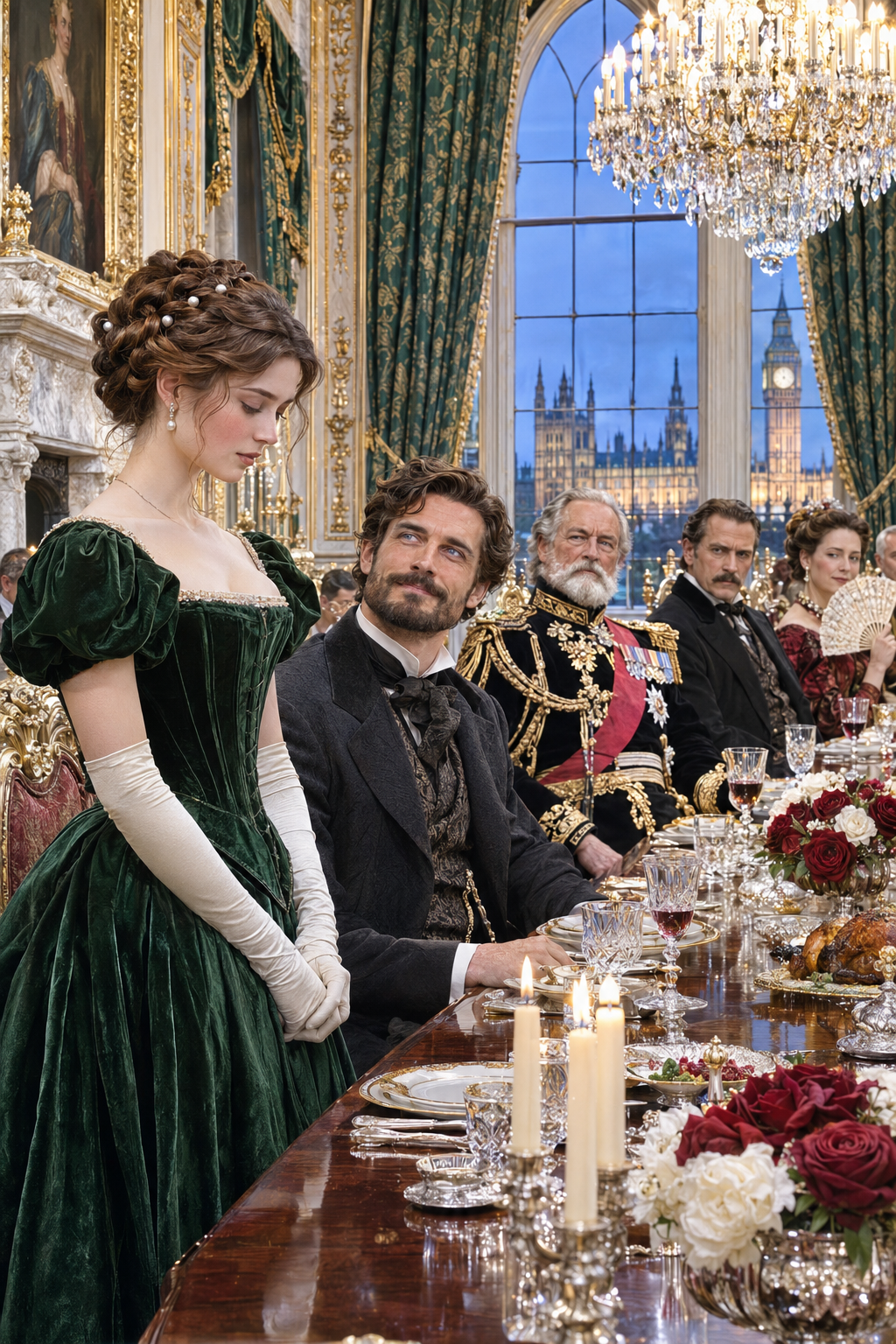
For the first time that evening, she seemed frightened.
Not of Harrington.
Of what Gareth might think.
“Norah,” he said softly, “tell me the truth.”
She took a slow breath.
“My father was not a farmer.”
Lady Beatrice gave a triumphant smile.
“I knew it.”
“He was a diplomat.”
The smile disappeared.
Norah looked directly at Ambassador Leonid.
“His name was Matthias Adler.”
Leonid’s face changed instantly.
He pushed back his chair.
“Matthias Adler of Vienna?”
Norah nodded.
For the first time, the ambassador appeared genuinely shaken.
“Good heavens.”
He stood.
Then, to the astonishment of everyone in the room, he bowed deeply to Norah.
“Your father was one of the finest minds I ever encountered.”
Gareth stared.
Leonid continued.
“He negotiated agreements that prevented conflicts between nations. He spoke seven languages and understood international commerce better than men who had spent their entire lives studying it.”
Norah’s eyes glistened.
“He taught me everything he could.”
“Then you are his daughter,” Leonid whispered. “The little girl who used to sit beside the fireplace while we discussed treaties.”
“I remember you bringing me sugared almonds.”
The ambassador laughed softly.
“And you correcting my German pronunciation when you were barely nine years old.”
A stunned silence filled the dining room.
Lady Beatrice looked as though someone had struck her.
Harrington slowly lowered himself into his chair.
Gareth could barely breathe.
His wife, the woman society had mocked as a speechless country girl, was the daughter of a respected European diplomat.
And she had never told him.
“Why?” he asked.
Norah turned toward him.
The warmth vanished from her face.
“Because after my father died, the world became a very different place.”
She explained that her father had left behind little money. His work had earned admiration but not wealth, and the debts connected to his final years had consumed what remained.
Her mother had already died.
Relatives who had once welcomed the Adler family suddenly became difficult to reach.
Eventually, Norah traveled to England, where an old family acquaintance offered her shelter in a rural household.
There she worked, read whatever books she could find, and kept her past to herself.
“People treated me differently when they believed I had nothing,” she said.
Gareth remembered the first time he had seen her.
She had been helping an elderly tenant carry firewood through the rain.
Her clothes were worn, her hands red from the cold, and she had refused the money he offered.
Later, when circumstances brought them together again, he had married her despite the objections of nearly everyone he knew.
But his reasons had not been entirely noble.
He had been tired of aristocratic women who measured a husband’s worth by his title.
He had wanted a wife who asked nothing of him.
And he had foolishly believed that a quiet woman would make his complicated life easier.
Now he understood how little he had known her.
“Why pretend you couldn’t speak?” he asked.
Norah swallowed.
“At first, I didn’t.”
Gareth frowned.
“I answered questions. I tried to join conversations. But people spoke over me, laughed at my accent, or acted as though my opinions were foolish.”
She glanced toward Lady Beatrice.
“Eventually, I discovered that silence made people careless.”
Leonid nodded slowly.
“They revealed things they would never have said in front of someone they considered intelligent.”
“Exactly.”
Norah looked back at Gareth.
“And when I realized someone was using your desperation to steal from Langdale, I decided to find out who.”
Harrington rose again.
“This is outrageous! Are we conducting a commercial negotiation or listening to a woman’s personal history?”
“We are doing both,” Leonid replied coldly.
He turned to Norah.
“Madam, can you prove your claims?”
“Yes.”
She reached beneath her shawl and produced a folded document.
Harrington’s expression changed.
“What is that?”
“A copy of the transportation agreement your associates signed.”
“That document is confidential!”
“Then you recognize it.”
Harrington said nothing.
Norah spread the paper across the table.
“Here are the payments assigned to Northern Commercial Transport. Here are the additional commissions. And here is the clause requiring every shipment to pass through the company’s warehouses, even when a cheaper route is available.”
Leonid examined the document carefully.
Gareth leaned over his shoulder.
The figures were unmistakable.
Every unnecessary expense reduced the money reaching Langdale.
Every delay placed another family at risk.
And Harrington had known.
Gareth slowly straightened.
“You sat in my home,” he said, his voice shaking, “and told me these costs were unavoidable.”
Harrington attempted a smile.
“Business is complicated, Your Grace.”
“You told me to raise my tenants’ rents.”
“That was sound financial advice.”
“You knew they could barely feed their children.”
“Sentiment has no place in commerce.”
Something inside Gareth finally broke.
“Those people are not numbers on a page!”
His voice echoed through the room.
“They are families. They have worked my land for generations. Their fathers buried my father’s horses. Their mothers cared for my mother when she was dying.”
Harrington looked away.
“And you expected me to squeeze the last pennies from them so you could pay your gambling debts?”
Harrington’s expression twisted.
“You’re a fool, Langdale. A duke who worries about peasants will soon have nothing left to rule.”
Gareth took a step toward him.
Norah touched his arm.
“Don’t.”
He looked down at her.
“Please,” she whispered. “Let me finish.”
Something in her voice stopped him.
Norah turned back to Leonid.
“The contract does not need Harrington’s company. In fact, it would be stronger without it.”
She opened the map again.
“The timber can be transported by river and barge toward Workington, where it can be loaded onto ships.”
Leonid studied the route.
“Have you calculated the costs?”
“Yes.”
She handed him several pages.
“I’ve spoken with boat operators, timber workers, and farmers familiar with the river. I’ve compared the seasonal water levels and the expenses of repairing the loading areas.”
Gareth stared at her.
“You’ve been traveling around the estate?”
“While you were in London.”
“And meeting merchants?”
“And farmers. And boatmen.”
“You never told me.”
“You never asked where I went.”
The words were not cruel.
That made them harder to hear.
Leonid studied the calculations for several minutes.
Then he smiled.
“This is remarkable.”
Harrington scoffed.
“A childish fantasy.”
“On the contrary,” Leonid replied. “It is the first practical proposal I’ve seen tonight.”
He pointed to the figures.
“The transport costs are substantially lower, and the delivery schedule is more reliable.”
Norah nodded.
“And the local farmers can be employed directly to prepare the timber, maintain the river access, and move supplies.”
Gareth looked up sharply.
“Employed?”
“Yes. Instead of taking more money from families who have nothing, the estate can pay them for the work required to fulfill the contract.”
The idea seemed almost too simple.
For months, every adviser had told Gareth that saving the estate required sacrifices from the poor.
Norah was suggesting the opposite.
Give them work.
Pay them fairly.
Let the estate recover because its people recovered.
Leonid tapped the map.
“There is one difficulty.”
Norah nodded.
“The initial cost.”
“Precisely. The loading facilities must be repaired before the first shipment.”
Harrington smiled again.
“At last, a problem your clever wife cannot solve.”
Norah turned a page.
“Actually, I’ve already considered it.”
She presented a second proposal.
“The Russian buyers could provide a limited advance against the first delivery, secured by the timber already standing on the Langdale estate.”
Leonid’s eyebrows rose.
“That would require approval.”
“Of course.”
“And guarantees.”
“Which the duke can provide.”
Gareth looked at the papers.
For the first time in months, he saw a possible future that did not involve evicting his tenants.
But Leonid was not finished.
“There is still a serious concern,” he said.
Everyone waited.
“If Lord Harrington’s company has already signed binding agreements, removing it could create legal complications.”
Harrington leaned back triumphantly.
“Exactly.”
He folded his arms.
“You may dislike my methods, but you cannot simply tear up a lawful contract.”
Norah looked at him.
“No. We cannot.”
His smile widened.
“However,” she continued, “a contract obtained through deliberate misrepresentation may be challenged.”
The smile vanished.
Norah turned toward Gareth.
“Your Grace, do you remember the document Harrington asked you to sign last month?”
Gareth nodded.
“The revised transportation agreement.”
“Did he explain the clause concerning exclusive shipping rights?”
“He said it was standard.”
“And did he tell you that his own associates controlled the company receiving those rights?”
“No.”
Norah looked toward Leonid.
“Then the duke may have grounds to challenge the agreement. But we must act carefully.”
Harrington suddenly grabbed his coat.
“I will not remain here to be insulted!”
He headed toward the door.
“Lord Harrington,” Leonid said.
The man stopped.
“If you leave now, I shall be forced to report that you abandoned negotiations after questions were raised about your financial interests.”
Harrington slowly turned.
“And if I stay?”
“Then you may answer those questions.”
For a moment, Gareth thought Harrington might attack the ambassador.
Instead, the nobleman returned to his chair.
His hands trembled.
Lady Beatrice leaned toward him and whispered something urgent.
Norah noticed.
So did Leonid.
“What did you say, Lady Beatrice?” he asked.
She stiffened.
“Nothing of importance.”
“Then perhaps you would care to explain why your name appears on this payment schedule.”
Norah had turned another page.
Lady Beatrice’s face went white.
Gareth looked at the document.
Several payments had been made to a private account connected to her family.
“You too?” he asked.
Lady Beatrice pressed a hand to her chest.
“I merely introduced certain investors.”
“For a fee,” Norah said.
“There is nothing improper about receiving compensation!”
“Not necessarily,” Norah agreed. “But you encouraged Gareth to accept Harrington’s proposal without telling him you would profit from it.”
Lady Beatrice stared at her.
“You ungrateful little creature.”
Gareth moved between them.
“Do not speak to my wife that way.”
Norah looked up at him in surprise.
He had defended her before, but never with such certainty.
Lady Beatrice gave a bitter laugh.
“So now the duke has discovered his wife is useful, and suddenly she’s worthy of respect?”
The words struck closer to the truth than Gareth wanted to admit.
He turned toward Norah.
But she was watching him with an expression he could not read.
Leonid cleared his throat.
“I believe we have heard enough accusations for one evening. The commercial question remains.”
He gathered Norah’s proposal.
“I am prepared to recommend this arrangement to the Russian purchasing commission.”
Gareth felt his heart leap.
“Then we have an agreement?”
“Not yet.”
Leonid looked directly at Norah.
“I require one final assurance.”
“Of course, Ambassador.”
“That the proposed savings are genuine, and that the people carrying out the work will receive the wages promised.”
Norah nodded.
“I would insist upon it myself.”
Leonid smiled.
“Then perhaps we should discuss the terms.”
For the next hour, the dining room changed completely.
The servants removed the untouched dessert.
Fresh candles were brought.
Maps covered the table where silver dishes had stood.
And Norah, who had entered the room as an object of ridicule, became the person everyone listened to.
She translated questions, explained costs, corrected estimates, and negotiated delivery schedules.
When Leonid proposed a penalty for delays caused by severe weather, she suggested a fairer clause protecting both parties.
When Gareth worried about the cost of hiring additional workers, she showed him how eliminating unnecessary commissions could cover the wages.
And when Harrington attempted to interrupt, Leonid simply raised one hand.
“I am speaking with Lady Langdale.”
The title sounded different now.
Not like a courtesy.
Like recognition.
At last, Leonid placed his pen on the table.
“I believe we have reached an understanding.”
Gareth stared at him.
“You mean—”
“The Russian commission will receive my recommendation for approval. Subject to the necessary guarantees and final signatures, we can proceed without Lord Harrington’s company.”
For several seconds, Gareth could not speak.
Then he sat down heavily.
His estate was not saved yet.
But for the first time, it had a real chance.
Norah quietly closed her notebook.
Harrington stood.
His face had lost all color.
“You think you’ve won,” he said.
Gareth looked up.
“This was never a game.”
Harrington gave a bitter smile.
“You have no idea how many people depend on the arrangements you’ve just destroyed.”
“Then perhaps they should have made honest arrangements,” Norah replied.
Harrington turned toward her.
“You’ll regret this.”
Leonid rose immediately.
“Threatening a lady in my presence would be a serious mistake.”
Harrington said nothing more.
He left without another word.
Lady Beatrice followed, her expensive gown sweeping across the floor.
When the door finally closed, Gareth felt the exhaustion of the evening settle over him.
Leonid approached Norah.
“Your father would have been proud.”
Her composure broke for the first time.
She looked down, blinking rapidly.
“Thank you.”
The ambassador took her hand.
“He once told me that intelligence without compassion is merely another form of power.”
Norah smiled through her tears.
“He used to say that to me.”
“And tonight, you proved you remembered.”
After Leonid departed, the house became quiet.
Gareth and Norah stood alone beside the dying fire.
For a long time, neither spoke.
Finally, Gareth said, “I owe you an apology.”
Norah looked at him.
“For what?”
“For almost everything.”
She gave a sad little smile.
“That is a rather large apology.”
“I know.”
He stared at the flames.
“I thought I was different from those people. I despised their cruelty, their pride, their obsession with bloodlines.”
He paused.
“But I married you believing you would never challenge me.”
Norah said nothing.
“I told myself I was rescuing you. I never considered that you might have dreams, knowledge, or reasons for keeping your own counsel.”
His voice grew quieter.
“I treated your silence as proof that there was nothing important you wished to say.”
Norah’s eyes filled.
“You were kinder than most.”
“That isn’t enough.”
“No,” she whispered. “It isn’t.”
Gareth nodded.
He deserved that answer.
“Do you hate me?”
Norah looked startled.
“No.”
“Then why do you look so sad?”
She walked toward the window.
Outside, the grounds lay beneath a thin layer of frost.
“Because I wanted you to know me before you knew what I could do for you.”
The words struck him harder than any accusation.
“I wanted you to love the woman who carried firewood in the rain,” she continued, “not the daughter of a diplomat. Not the woman who could negotiate contracts.”
Gareth approached slowly.
“I did care for that woman.”
“I know.”
“But I failed to see her.”
Norah turned.
“Yes.”
He reached for her hand, then stopped.
“May I?”
She hesitated before placing her fingers in his.
“I cannot undo six months,” he said. “But if you allow me, I would like to spend the rest of my life learning who you really are.”
Norah looked at their joined hands.
“I don’t need a duke who praises me in public and ignores me in private.”
“Then you shall have neither.”
She frowned.
“What?”
“You shall have a husband who listens.”
For the first time that night, she laughed.
It was a small, uncertain sound.
But Gareth thought it was the most beautiful thing he had ever heard.
Their troubles, however, were far from over.
Three days later, a letter arrived from Harrington’s solicitors.
It demanded an enormous payment for breach of contract and threatened legal action against the Langdale estate.
Gareth read it twice.
Then he carried it to Norah.
She examined the document carefully.
“He’s frightened,” she said.
“He’s threatening to ruin us.”
“Because he knows the agreement may not survive scrutiny.”
“Can we fight him?”
“Yes. But we must do it properly.”
Together, they traveled to London and met with an independent solicitor recommended by Leonid.
The investigation took weeks.
Bank records were examined.
Witnesses were questioned.
Former employees of Northern Commercial Transport came forward.
One clerk admitted that he had been instructed to alter invoices.
Another produced letters showing that Harrington had personally approved inflated charges.
The evidence grew stronger.
Then came the discovery that changed everything.
Harrington had borrowed money against the commissions he expected to receive from Langdale.
Without the contract, his creditors could demand immediate repayment.
His threats were not signs of strength.
They were acts of desperation.
When the solicitor presented the evidence, Harrington’s representatives abruptly requested a private settlement.
Gareth refused to accept one that concealed the wrongdoing.
“I want the money returned,” he said. “And I want the agreements canceled.”
Norah added one condition.
“No tenant of Langdale is to bear the cost of this dispute.”
After difficult negotiations, the disputed shipping arrangement was canceled, and a substantial portion of the improper charges was recovered.
The evidence was also placed before the appropriate authorities for further examination.
Harrington withdrew from public life as creditors pursued his remaining assets.
Lady Beatrice discovered that fashionable society could be remarkably unforgiving when scandal threatened its own reputation.
But Norah took no pleasure in their downfall.
One evening, Gareth found her reading beside the fire.
“Do you regret exposing them?” he asked.
“No.”
“Then why are you so quiet?”
She closed the book.
“Because ruining a dishonest man doesn’t feed a hungry child.”
Gareth sat beside her.
“Then let’s make certain the contract does.”
By early spring, the Russian agreement had received final approval.
The first advance payment arrived.
Work began immediately.
Farmers who had feared eviction were hired to prepare timber.
Boatmen repaired landing areas.
Carpenters built loading platforms.
Young men who had planned to leave Langdale found work close to home.
And women who had long managed households through desperate winters were invited to help organize supplies, wages, and food distribution.
Norah insisted that every worker receive a written record of payment.
“No hidden fees,” she told the estate manager. “No mysterious deductions. If someone earns a wage, they should know exactly what they’re being paid.”
Gareth supported her.
At first, some of his advisers objected.
They complained that the duchess was interfering in matters beyond her station.
Gareth listened patiently.
Then he said, “The duchess understands these matters better than any of us. I suggest we learn from her.”
Within months, the estate began to change.
The first timber shipment left Workington under a clear morning sky.
Gareth and Norah stood on the dock watching the workers secure the final load.
An elderly farmer named Thomas approached them.
His cap was twisted nervously between his hands.
“Your Grace,” he said to Gareth, “I wanted to thank you.”
Gareth smiled.
“You’ve earned your wages, Thomas.”
“It isn’t only the wages.”
The old man’s voice trembled.
“My youngest grandson was ill last winter. We couldn’t afford proper food, and my son was ready to leave the farm.”
He glanced toward Norah.
“Her Grace came to our cottage. She brought supplies and asked what work we could manage.”
Norah looked embarrassed.
“Anyone would have done the same.”
Thomas shook his head.
“No, my lady. Not everyone would.”
He swallowed.
“My grandson is well now. My son is working on the barges. And yesterday, for the first time in two years, my wife bought enough flour without worrying about what we’d eat next week.”
Gareth looked away.
He had spent so many nights worrying about the estate’s accounts that he had almost forgotten what the numbers represented.
People.
Children.
Meals.
Warm homes.
Thomas bowed awkwardly.
“God bless you both.”
After he left, Gareth stood quietly beside Norah.
“You saved them,” he said.
She shook her head.
“We gave them the chance to save themselves.”
He looked at the workers laughing along the dock.
“And you saved me.”
Norah turned toward him.
“From Harrington?”
“From becoming a man who believed a title mattered more than the people depending on him.”
She slipped her hand into his.
“Then perhaps we saved each other.”
That summer, the Langdale estate held its first harvest celebration in years.
Long tables were placed beneath the trees.
Children ran across the grass.
Farmers, laborers, servants, and merchants gathered together.
There were no separate tables for the important families.
No special entrance for the wealthy.
And when Gareth stood to speak, he did not begin by praising the contract.
He looked at Norah.
“Six months ago,” he told the crowd, “I believed leadership meant having all the answers.”
A few people laughed.
“I was wrong.”
He paused.
“I learned that the wisest person in a room may be the one nobody has bothered to listen to.”
Norah lowered her eyes.
Gareth continued.
“I also learned that wealth means very little if the people who create it cannot live with dignity.”
He raised his glass.
“To the workers of Langdale, whose strength has rebuilt this estate.”
The crowd cheered.
Then he turned toward his wife.
“And to the woman who taught me that respect is not something we give because of someone’s birth. It is something every human being deserves.”
Norah’s eyes filled with tears.
The applause grew louder.
But later that evening, when the music began and the crowd gathered to dance, Gareth found her standing quietly near the garden wall.
“Are you unhappy?” he asked.
“No.”
“Then what are you thinking?”
She smiled.
“About my father.”
Gareth stood beside her.
“He would have loved this.”
“He would have complained about the musicians.”
Gareth laughed.
“And then?”
“He would have danced anyway.”
For a while, they listened to the music.
Then Gareth held out his hand.
“Would you honor me with a dance, Lady Langdale?”
Norah pretended to consider.
“Are you certain? Society might be scandalized.”
“Society has survived worse.”
“And what if I step on your feet?”
“Then I shall consider it a fair punishment for my past foolishness.”
She laughed and took his hand.
As they walked toward the music, Norah glanced at the people celebrating beneath the lanterns.
She remembered the lonely months when she had believed that speaking would only bring more ridicule.
She remembered sitting through dinners where people discussed her as though she were furniture.
And she remembered the moment she had finally raised her voice.
For years, she had believed that knowledge was her greatest inheritance from her father.
Now she understood that he had given her something even more valuable.
The courage to use that knowledge for others.
Gareth drew her into the dance.
“Norah?”
“Yes?”
“I have one question.”
She smiled.
“Only one?”
“For now.”
“Then ask.”
He looked at her with quiet affection.
“Will you promise never to remain silent simply because someone makes you feel unworthy of speaking?”
Norah considered his words.
Then she answered.
“I’ll promise something better.”
“What is that?”
“I’ll speak when I have something worth saying. And I’ll never mistake another person’s silence for a lack of wisdom.”
Gareth smiled.
“A fair promise.”
They danced beneath the summer stars while laughter rose around them.
And far beyond the garden, the fields of Langdale stretched toward the dark hills, where families who had once feared the coming winter now had reason to hope.
Years later, people would still tell the story of the quiet duchess who had defeated powerful men at a dinner table.
Some remembered the Russian ambassador’s astonishment.
Others remembered Harrington’s disgrace.
A few preferred to talk about the extraordinary contract that had transformed the estate.
But the people of Langdale remembered something different.
They remembered a woman who had listened when nobody else would.
A woman who understood that the value of a business agreement was not measured only in gold, but in the lives it could improve.
And a duke who had learned that true nobility was not inherited through blood.
It was earned through humility, courage, and service.
Because the greatest mistake we can make is to judge someone’s worth by their clothes, their accent, their wealth, or their silence.
Sometimes the person everyone overlooks is the one who sees the truth most clearly.
And sometimes, the most powerful voice in the room belongs to someone who has spent a lifetime waiting to be heard.
And in the years that followed, the people of Langdale would discover that Norah’s greatest achievement was not the Russian contract, but what she chose to build with the opportunity it had given them.
With the estate finally earning a steady income, Norah proposed something that surprised even Gareth.
She wanted to open a school.
Not for the children of wealthy families, but for the sons and daughters of farmers, servants, and laborers.
“Education gave me the power to protect myself,” she told Gareth one evening. “Imagine what it could do for children who have never been given that chance.”
Gareth agreed without hesitation.
An unused building near the village church was repaired. Teachers were hired, books were purchased, and every child on the estate was welcomed, regardless of their family’s income.
Norah visited the school whenever she could.
She taught languages, arithmetic, and geography, but her favorite lessons were about courage and kindness.
One afternoon, she noticed a little girl sitting alone at the back of the classroom.
The child’s name was Emily. She was the daughter of a farm laborer, and she rarely spoke.
When Norah approached her, Emily lowered her head.
“Why don’t you answer your teacher’s questions?” Norah asked gently.
The little girl twisted her fingers together.
“Because the other children laugh when I get something wrong.”
Norah pulled a chair beside her.
“Do you know something, Emily? There was a time when I was afraid to speak, too.”
Emily looked up in surprise.
“But you’re a duchess.”
Norah smiled.
“A title doesn’t make someone brave.”
“Then what does?”
“Finding something more important than your fear.”
Emily thought about that.
“What if people still laugh?”
“Then let them laugh. Their laughter cannot decide what you are capable of becoming.”
The following week, Emily raised her hand for the first time.
Her answer was wrong.
A few children giggled.
But Norah, who happened to be visiting, smiled warmly.
“Thank you for trying, Emily. That’s how learning begins.”
The little girl smiled back.
And the next day, she raised her hand again.
Years passed.
The school grew, the timber business prospered, and Langdale became known as an estate where workers were treated fairly and children were encouraged to learn.
Gareth and Norah grew older together.
Their marriage was not without disagreements. They argued about expenses, decisions, and sometimes the smallest household matters.
But Gareth never again confused his wife’s quietness with weakness.
And Norah never again believed she had to hide her intelligence to be accepted.
One autumn evening, many years after that unforgettable dinner, a letter arrived at Langdale.
It was from Emily.
She had earned a position teaching at a school in another county.
Inside the envelope was a short message.
“Dear Lady Langdale,
You once told me that other people’s laughter could not decide my future.
I have carried those words with me every day.
Today, I stood before my first classroom.
There were thirty children waiting for me, and one little girl sitting silently at the back.
I recognized the fear in her eyes.
So I told her what you once told me.
Thank you for giving me the courage to find my voice.
With love and gratitude,
Emily.”
Norah read the letter twice.
Then she handed it to Gareth.
He finished reading and looked at his wife.
“Do you remember the night Ambassador Leonid came to dinner?”
Norah laughed softly.
“How could I forget?”
“I thought that evening would decide whether Langdale survived.”
“In a way, it did.”
Gareth shook his head.
“No. I thought the most important thing you accomplished was securing the contract.”
He looked down at Emily’s letter.
“But now I understand. You did something much greater.”
Norah rested her hand over his.
“What was that?”
“You made certain the next generation wouldn’t have to fight so hard just to be heard.”
For a moment, neither spoke.
Outside, the autumn wind moved gently through the trees.
At last, Norah folded Emily’s letter and placed it carefully inside the same leather notebook she had carried to the ambassador’s dinner so many years before.
The pages were worn now, and the ink had begun to fade.
But the notebook remained one of her most treasured possessions.
It reminded her of the night she had stopped allowing other people to define her.
And Emily’s letter reminded her why that decision had mattered.
Because a person’s greatest victory is not always defeating those who once looked down on them.
Sometimes, it is using that victory to make life better for someone else.
Norah had entered a room where everyone believed she had nothing worth saying.
She left that room having changed the future of an entire community.
But her true legacy was not the wealth she helped create, the powerful men she exposed, or even the respect she earned.
It lived in the children who learned to read.
In the families who no longer feared hunger.
In the workers who received honest wages.
And in the quiet little girl who grew up to become a teacher, carrying Norah’s kindness into another generation.
The greatest measure of a person’s worth is not how much power they hold over others, but how many lives become better because they chose to use that power with compassion.
And that was the legacy of Norah, Duchess of Langdale.
A woman once dismissed because she was silent, who proved that the strongest voices are not always the loudest.
Sometimes, they are simply the ones that speak when it matters most.
THE END.