The Duke of Blackthorn had forbidden every carriage from crossing his land.
The Duke did not move.
Behind the locked library door, the stranger waited, his breathing faintly audible through the ancient wood.
Eliza watched Blackthorn’s fingers tighten around the brass key until its sharp edge pressed into his skin.
“Who is that?” she whispered.
The Duke’s answer came so quietly that she almost missed it.
“A man I buried twelve years ago.”
The handle turned again, slowly this time, followed by the unmistakable sound of metal scraping against metal.
“Edward,” the voice called. “Open the door before someone else hears us.”
Eliza looked sharply at the Duke.
“Edward?”
He closed his eyes for a moment, as though hearing his own name had become an unbearable familiarity.
“Stand behind me.”
Instead, she stepped toward the library.
The Duke caught her wrist.
“Miss Harcourt, there are things in this house that you do not understand.”
“Then stop keeping me ignorant.”
Their eyes met, and something in her expression made his grip loosen.
He released her.
“Whoever is behind that door,” she said, “already knows my name.”
The stranger gave a low, humorless laugh.
“She has her father’s temperament.”
Edward’s face changed.
Without another word, he drew back the heavy bolt.
The library door opened inward.
An elderly man stood on the threshold, supporting himself with a silver-headed walking stick.
His coat was damp, and a thin scar crossed his left eyebrow.
He had the pallor of someone accustomed to rooms without sunlight.
But his eyes were sharp.
Too sharp for a man who appeared so frail.
Eliza recognized him from a miniature portrait she had once found among her father’s belongings.
“Sir Alistair Vale?”
The old man inclined his head.
“Your father remembered me, then.”
“He told me you died before I was born.”
“Your father was encouraged to believe many things.”
Edward moved between them.
“How did you enter my house?”
“Through the passage your grandfather built behind the west staircase.”
“That passage was sealed.”
“Apparently not as thoroughly as you imagined.”
Sir Alistair glanced toward the letter in Eliza’s hand.
His expression hardened.
“So the fool kept it.”
Eliza folded the paper and slipped it into her sleeve.
“If you have come to frighten me away, sir, you have chosen a poor beginning.”
“I have come to prevent another death.”
“Then perhaps you should begin by explaining the first.”
For the first time, Sir Alistair looked uncertain.
Edward noticed.
He stepped closer.
“Twelve years,” the Duke said. “For twelve years, I believed you had died in the fire.”
“The fire was necessary.”
Edward stared at him.
“Necessary?”
“To protect what remained of this family.”
A terrible stillness settled over the room.
Then Edward spoke.
“My mother died that night.”
Sir Alistair looked away.
Eliza saw the movement.
Small.
Instinctive.
Guilty.
“Did she?” she asked.
Both men turned toward her.
She held Sir Alistair’s gaze.
“Did the Duchess die in the fire, or is that merely another convenient story?”
The old man gripped his walking stick.
“You know nothing of what happened here.”
“Then I suggest you tell us before I discover it without your assistance.”
Edward almost smiled.
Almost.
But the expression vanished when Sir Alistair reached into his coat.
The Duke stepped forward immediately.
“Keep your hands where I can see them.”
The old man withdrew a folded document.
It bore the Blackthorn crest and a familiar red seal.
“The eastern road,” he said, “was never simply a road.”
He placed the document on the table.
“It was the only route by which the old iron mines could be reached without crossing Crown land.”
Eliza frowned.
“The mines were abandoned generations ago.”
“Officially.”
Edward took the document.
As he read, the color drained from his face.
“These are signatures authorizing the transportation of military supplies.”
Sir Alistair nodded.
“Supplies that were never delivered.”
Eliza approached the table.
Beneath the signatures were dates, quantities, and payments recorded in a careful hand.
One name appeared repeatedly.
Lord Edmund Blackthorn.
Edward’s father.
“My father was stealing from the Crown?” Edward asked.
“Your father discovered that someone else was.”
“Who?”
Sir Alistair said nothing.
Eliza studied the document.
One signature had been struck through with black ink.
Beneath it, she could make out the beginning of a name.
Alistair.
She looked up.
The old man followed her gaze.
His fingers tightened around the silver handle of his cane.
“You were involved,” she said.
“I served the family for thirty years.”
“That wasn’t my question.”
Edward laid the document on the table.
“No. It wasn’t.”
For the first time that evening, the balance of power shifted unmistakably.
Sir Alistair stepped backward.
“Both of you are making a mistake.”
“Perhaps,” Edward replied. “But I would rather make my own mistakes than continue living inside yours.”
The old man looked toward the open doorway.
Eliza noticed.
She moved quietly between him and the corridor.
His eyes narrowed.
“Your father tried to play the hero, Miss Harcourt.”
“My father tried to tell the truth.”
“And truth,” Sir Alistair said, “has buried more innocent people than lies ever did.”
He struck his walking stick against the floor.
A sharp metallic crack echoed through the library.
Then every candle along the western wall went out.
The room plunged into darkness.
Eliza heard footsteps.
A chair overturned.
Someone seized her shoulder.
She twisted away, catching the smell of wet wool and tobacco.
A door slammed.
By the time Edward found the lantern, Sir Alistair had vanished.
Only his walking stick remained on the carpet.
Its silver handle had broken open.
Inside was a narrow compartment.
Empty.
Edward picked it up.
“He wanted us to see the document,” Eliza said.
“Yes.”
“Which means he wanted us looking at the wrong thing.”
Edward examined the hollow handle.
Then his expression changed.
“The key.”
He reached inside his coat.
The brass key was gone.
For a moment, neither spoke.
Then Edward turned toward the windows.
Beyond the rain-streaked glass, the eastern woods stood black against the approaching night.
“He is going to the road.”
Eliza was already moving.
“Then we must reach it first.”
Edward caught up with her at the entrance hall.
“No. You will remain here.”
She stopped.
“Your Grace, my father spent his life carrying the consequences of what happened in this house.”
“And I have spent mine burying them.”
“Then perhaps it is time we stopped behaving like our fathers.”
His expression tightened.
“You do not understand the danger.”
“I understand perfectly well that a man who has concealed himself for twelve years has just stolen a key and disappeared toward a road you refuse to open.”
Edward looked at her for a long moment.
Then he called for the horses.
They rode out beneath a bruised evening sky.
The rain had softened to a cold mist, leaving the trees dripping and the road slick beneath the horses’ hooves.
Edward led the way, his dark coat moving with the wind.
Eliza followed close behind.
Neither spoke until the house disappeared among the trees.
“Your mother,” she said at last. “What truly happened to her?”
Edward kept his eyes on the road.
“She went to the eastern grounds the night the fire began.”
“Alone?”
“With my brother.”
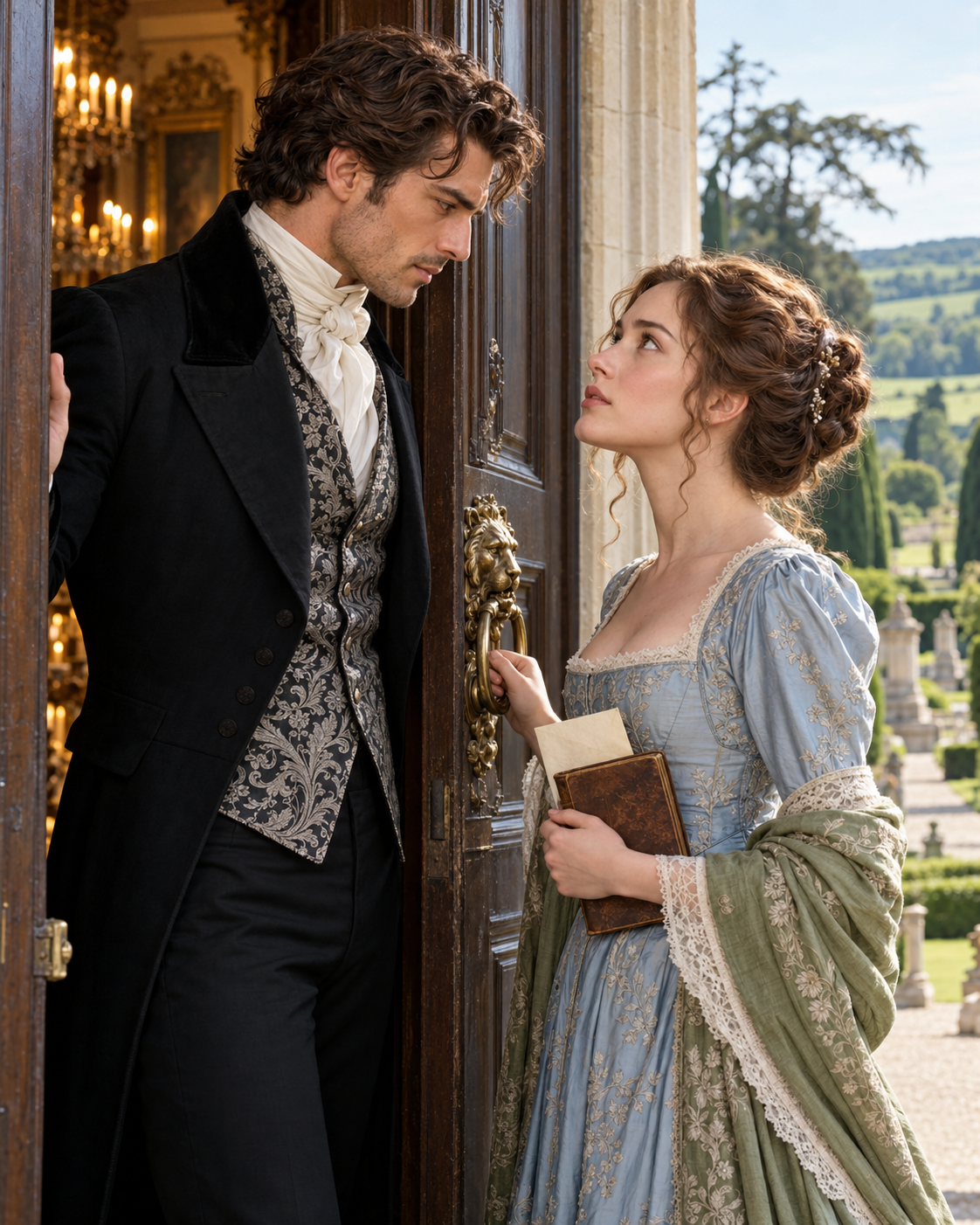
Eliza’s reins tightened.
“My father?”
“His name was Thomas Blackthorn.”
She repeated it silently.
Thomas.
The name belonged to a stranger, yet somehow it made the man who had raised her feel nearer.
“He was twenty-three,” Edward continued. “Stubborn. Impatient. Incapable of leaving an injustice untouched.”
A faint smile crossed his face.
“He sounds familiar.”
Eliza looked at him.
“You disapprove?”
“I am beginning to suspect I never stood a chance.”
For several yards, the sound of their horses filled the silence.
Then Edward spoke again.
“We quarreled before he left.”
“About what?”
“An accusation against our father. Thomas believed the estate accounts concealed something criminal. I believed he was searching for reasons to despise a man who had never understood him.”
“And your mother?”
“She believed Thomas.”
Edward lowered his head.
“I told her that if she followed him, she need not return.”
Eliza said nothing.
There was no comfort gentle enough to make such words harmless.
Edward looked toward the darkening woods.
“She never did.”
The horses slowed as the road narrowed.
Ahead stood a ruined stone archway overgrown with ivy.
Beyond it lay the eastern road, abandoned beneath twelve years of fallen branches.
A chain stretched between two iron posts.
The lock hung open.
Edward dismounted.
Eliza joined him.
Fresh carriage tracks cut through the mud.
“Someone has been here recently,” she said.
Edward crouched beside the marks.
“Today.”
A faint light flickered farther down the road.
They followed it on foot, leaving the horses sheltered beneath the trees.
The path descended toward a wooded hollow.
At its center stood a small stone building almost swallowed by ivy.
A disused tollhouse.
Its windows were boarded.
But light escaped through a gap beneath the door.
Edward drew Eliza behind a fallen oak.
Inside, voices argued.
“You promised the documents would be destroyed.”
A younger voice.
Unfamiliar.
Sir Alistair answered sharply.
“They should have been.”
“And the girl?”
“She knows nothing.”
“She came carrying Thomas Blackthorn’s letter.”
A pause.
“Then she knows too much.”
Eliza felt Edward’s hand settle over hers.
Not to restrain her.
To steady it.
She looked at him.
He placed one finger against his lips.
The younger man spoke again.
“The passage must be sealed before morning. Once the surveyors arrive, they’ll find everything.”
Eliza frowned.
Surveyors.
She had written to the county authorities three weeks earlier, requesting an official inspection of the road.
She had told no one at Blackthorn House.
Except the gatekeeper.
Edward seemed to reach the same conclusion.
His expression darkened.
“Who told them?” the younger man demanded.
Sir Alistair answered with a contemptuous sigh.
“The girl herself. She has been sending letters to the magistrate.”
A chair scraped.
“Then we finish this tonight.”
Footsteps approached the door.
Edward pulled Eliza deeper into the shadows.
The door opened.
A young man emerged, carrying a lantern and a leather satchel.
He wore the coat of a gentleman, but his boots were thick with mine dust.
Eliza recognized him.
“Mr. Fenwick?”
The man froze.
He was the assistant magistrate who had received her petitions.
His eyes widened as Edward stepped into the lantern light.
“Your Grace.”
Edward’s voice remained perfectly calm.
“I believe you have something belonging to my family.”
Fenwick looked toward the tollhouse.
Then he ran.
Edward caught him before he reached the trees.
The lantern fell, breaking against a stone.
Flames spread across the wet leaves before dying in the rain.
Fenwick struggled.
“You’re too late!”
Edward held him against the trunk of an oak.
“For what?”
Fenwick’s face twisted.
“For the woman.”
Eliza went cold.
“What woman?”
A voice answered from the tollhouse doorway.
“The one your father never found.”
Sir Alistair stood beneath the lintel.
In one hand he held the brass key.
In the other, a small pistol.
Edward released Fenwick.
“Put it down.”
“Your father should have listened to me,” Sir Alistair said.
“And you should have stayed inside that house.”
He raised the pistol.
Eliza moved before either man could react.
She struck Sir Alistair’s arm with the heavy branch she had picked up beside the fallen oak.
The shot went wide.
Birds erupted from the trees.
Edward seized the older man’s wrist, forcing the pistol to the ground.
Fenwick fled into the darkness.
Eliza started after him.
“Leave him!” Edward called. “The mine road ends at the river.”
Sir Alistair struggled beneath Edward’s grip.
“You fool. You don’t know what’s below.”
“Then show me.”
Edward took the key from his hand.
Inside the tollhouse, a narrow staircase descended beneath a trapdoor concealed by a rug.
The air rising through it smelled of damp stone.
And something else.
Woodsmoke.
Recent woodsmoke.
Edward lifted the lantern from the table.
Eliza followed him down.
The stairs ended at a long stone passage supported by old timber beams.
Water dripped steadily from the ceiling.
Somewhere in the darkness, a woman began to cough.
Edward stopped.
The lantern trembled in his hand.
“Mother?”
No answer came.
He moved forward.
At the end of the passage stood an iron door.
Its lock matched the brass key.
Edward turned it.
The mechanism resisted.
Then opened with a dull metallic sound.
Beyond lay a narrow chamber furnished with a bed, a table, and a small hearth.
A woman sat in a wooden chair beside the fire.
Her silver hair was braided loosely over one shoulder.
She looked toward the lantern, shielding her eyes.
Edward could not speak.
The woman rose slowly.
“Edward?”
The lantern slipped from his hand.
Eliza caught it before it struck the floor.
The Duchess took one uncertain step.
“My boy?”
Edward crossed the room.
He fell to his knees before her, burying his face against her hands.
For a long time, there were no words.
Only the quiet sound of a mother touching the hair of the son she had been forbidden to see.
Eliza turned away.
Some reunions deserved privacy.
But the chamber held evidence of years carefully stolen.
Fresh blankets.
Medicine bottles.
Books.
Letters tied with string.
Someone had been keeping the Duchess alive.
Someone had also been keeping her hidden.
Edward finally looked up.
“Why did you never come home?”
His mother touched his cheek.
“I tried.”
She glanced toward the doorway.
“Alistair told me you were dead.”
Edward closed his eyes.
“He told me the same of you.”
A silence passed between them.
Then the Duchess looked at Eliza.
Her face changed.
“Thomas?”
Eliza approached.
“No, Your Grace.”
The older woman’s eyes filled.
“I am his daughter.”
The Duchess reached for her hand.
“Then he survived.”
Eliza swallowed.
“For many years.”
“And now?”
“My father died last winter.”
The Duchess bowed her head.
Her fingers remained wrapped around Eliza’s.
“He was a good man.”
“He never spoke of this place.”
“He was trying to protect you.”
“From whom?”
The Duchess looked toward Edward.
“From the truth about his father.”
Edward rose.
“Tell me.”
She sat slowly, drawing a thin blanket around her shoulders.
“Your father discovered that Alistair had been selling government iron and transporting stolen arms through the old mine. He intended to expose him.”
“Then why did Thomas accuse Father?”
“Because Alistair altered the accounts and placed your father’s signature on every transaction.”
Edward remembered the document in the library.
The carefully arranged signatures.
The accusation designed to divide them.
“The night of the fire,” the Duchess continued, “Thomas found the original records beneath the tollhouse. He came to me because he feared Alistair would kill your father before the evidence could be presented.”
“And Father?”
“He was waiting for us here.”
She looked toward the hearth.
“Alistair arrived first.”
Edward’s jaw tightened.
“He started the fire?”
“He set the entrance ablaze to destroy the records. Your father tried to stop him.”
Eliza noticed the Duchess pressing one hand against her chest.
“Where is he now?”
The older woman closed her eyes.
“Your grandfather’s old burial chamber lies beyond the mine. Alistair sealed it after the collapse.”
Edward understood.
His father had not died peacefully in his bed, as he had been told.
He had died trying to expose the man entrusted with protecting his family.
“Why keep you alive?” Eliza asked.
The Duchess opened her eyes.
“Because I knew where Thomas hid the original ledger.”
“And where is it?”
The older woman looked toward the hearth.
“In the one place Alistair never thought to search.”
Before she could continue, a terrible cracking sound rolled through the passage.
Dust fell from the ceiling.
Edward turned.
Another crack.
Closer.
“The supports,” he said.
Eliza hurried toward the doorway.
From somewhere above came Sir Alistair’s voice.
“You should have left the past buried!”
Then a heavy impact shook the chamber.
The passage lights vanished.
Edward seized the lantern.
The Duchess rose unsteadily.
“We must go through the old drainage tunnel,” she said.
“It opens beyond the riverbank.”
She pointed toward a narrow arch hidden behind a hanging cloth.
Edward helped her through.
Eliza followed, but another crash sounded behind them.
One of the beams split.
The stone ceiling began to fall.
Edward pushed his mother forward.
“Keep moving!”
Eliza ducked beneath a collapsing support.
Her skirt caught on a jagged nail.
She pulled.
The fabric held.
The lantern swung wildly.
Edward turned back.
“Eliza!”
“Go with your mother!”
He looked at the narrow passage ahead.
Then at her.
Something hardened in his expression.
“No.”
He returned through the dust.
With one sharp movement, he tore the trapped fabric free.
A shower of stones struck the floor.
He caught her hand.
Together, they ran.
The tunnel narrowed, forcing them to crouch.
Behind them, the chamber collapsed with a deep, suffocating roar.
A gust of dust extinguished the lantern.
Darkness swallowed everything.
Eliza felt Edward’s hand tighten around hers.
“Don’t let go,” he said.
“I wasn’t intending to.”
They continued by touch, following the distant rush of water.
At last a pale thread of moonlight appeared ahead.
Edward helped his mother through an opening concealed by hanging roots.
Eliza crawled after them.
They emerged beside the river, soaked in mud and shivering beneath the cold night sky.
For several moments, none could speak.
Then hoofbeats sounded from the road above.
Edward turned sharply.
A carriage approached through the trees.
Its driver called his name.
“Your Grace!”
It was the gatekeeper from Blackthorn House.
He climbed down hurriedly.
“Miss Harcourt sent word to the magistrate before she came, sir. The constables are approaching from the northern road.”
Eliza looked at Edward.
“I thought it prudent.”
His breath escaped in something very close to laughter.
“You have a remarkable talent for disobeying instructions.”
“Only unreasonable ones.”
The gatekeeper knelt beside the Duchess.
“My lady?”
His voice broke.
She smiled faintly.
“Hello, William.”
The old servant removed his cap.
For twelve years he had tended the gates of a house waiting for someone who was never supposed to return.
Now he could only bow his head.
By dawn, Sir Alistair Vale had been arrested at the tollhouse.
Fenwick was caught attempting to cross the river, his satchel filled with stolen documents and payments.
The collapse had uncovered a second chamber beneath the road.
There, beneath a cracked stone slab, the constables discovered the missing records.
And beside them lay the remains of Lord Edmund Blackthorn.
The Duchess insisted on returning to the estate before giving her statement.
Edward rode beside her carriage.
Eliza sat inside, holding the older woman’s hand whenever the uneven road caused her pain.
As Blackthorn House appeared through the morning mist, the Duchess leaned toward the window.
“The windows are closed,” she murmured.
Edward heard her.
“Not for much longer.”
The weeks that followed brought little peace.
The county magistrate opened an investigation.
The original ledger confirmed that Sir Alistair had forged documents, arranged illegal shipments, and concealed evidence of Lord Blackthorn’s murder.
But the Duchess’s testimony raised another troubling question.
Why had Thomas remained silent after escaping?
The answer came from a bundle of letters discovered inside the Duchess’s old writing desk.
Thomas had escaped the mines injured and disoriented.
Sir Alistair found him and threatened to kill Edward unless Thomas disappeared and abandoned the Blackthorn name.
He had believed the threat.
With help from a distant cousin, he became Thomas Harcourt.
He married.
He raised Eliza.
And for years, he secretly gathered evidence against the man who had destroyed his family.
His final letter had been written when illness made it clear that he might never return to Blackthorn himself.
Eliza read it alone beside the library window.
The paper shook in her hands.
Her father had carried a grief she never knew existed.
Every birthday.
Every Christmas.
Every quiet evening beside the fire.
He had smiled across the supper table while believing his mother and brother long dead.
Edward found her there after sunset.
He stopped at the doorway.
“May I come in?”
Eliza wiped her cheeks before turning.
“It is your library.”
“That wasn’t what I asked.”
She looked at him.
Then nodded.
He approached quietly.
On the table lay Thomas’s last letter.
Edward did not touch it.
“He wrote about you often,” Eliza said.
Edward stared at the paper.
“What did he say?”
“That you were impossible to persuade, even as a child.”
Edward smiled faintly.
“That sounds like him.”
“He said you once carried an injured fox into the nursery and refused to let anyone remove it.”
“I was seven.”
“He said you cried when it died.”
Edward looked toward the window.
“Thomas told me I would make a terrible Duke because I cared too much about things I couldn’t save.”
Eliza folded the letter.
“Perhaps he was wrong about the terrible part.”
Edward turned toward her.
For a long moment, he studied her face.
“You brought my mother home.”
“I came to ask for a road.”
“And found rather more than you bargained for.”
“Considerably.”
He looked down at his hands.
They were still scarred from the falling stones.
“Before you came, I believed keeping people away was the only way to prevent further harm.”
Eliza waited.
He raised his eyes.
“But solitude does not protect the people one loves. Sometimes it merely leaves them facing danger alone.”
She stepped closer.
“Your brother knew that.”
“Yes.”
“And now you do.”
Edward reached for her hand, then hesitated.
Eliza noticed.
She offered it herself.
He held it gently.
There was no declaration.
No promise.
Only the quiet pressure of his fingers around hers.
Outside, the first stars appeared above the gardens.
The following morning, Edward ordered the shutters opened throughout Blackthorn House.
Sunlight entered rooms that had stood untouched for more than a decade.
Servants carried sheets from furniture.
Fires were lit.
Flowers appeared in empty vases.
The damaged family portrait was taken down.
But Edward refused to have the missing figure painted over.
Instead, he commissioned its restoration using an old miniature of Thomas.
When it returned, three figures stood beneath the oak tree once more.
Two brothers.
Their mother.
Together.
The eastern road reopened before winter.
Edward paid for its repairs and placed it under a permanent public right of passage, ensuring that no future Duke could close it merely because the world had become too painful to face.
The first carriage to cross carried medicine to a neighboring village.
The second brought children to visit relatives they had not seen in years.
And the third brought Eliza Harcourt back to Blackthorn House.
This time, the gates stood open.
Edward waited at the entrance.
He wore no coat despite the chill.
“You are late,” he said.
“The road is rather busy.”
“An unfortunate consequence of allowing people to use it.”
She smiled.
“I might have warned you.”
“You warned me of several things. I was foolish enough to ignore most of them.”
He offered his arm.
She accepted.
They walked through the gardens toward the old oak tree.
Autumn had turned its leaves a deep copper.
Beneath it stood a newly carved stone bearing two names.
Lord Edmund Blackthorn.
Thomas Blackthorn, later Harcourt.
Father and son.
Edward stopped before the memorial.
“Mother asked that they be remembered together.”
Eliza placed a small bunch of white flowers beside the stone.
“They would have liked that.”
Edward watched her.
Then reached into his pocket.
For an instant, Eliza thought he had brought another old letter.
Instead, he withdrew a small brass key.
The same key that had opened the chamber beneath the road.
He laid it in her palm.
“I considered throwing it into the river.”
“That would have been rather dramatic.”
“I am told I have a tendency toward dramatic gestures.”
“Only when you are frightened.”
He met her eyes.
“Then I suppose I am frightened now.”
Eliza’s smile softened.
“Of what?”
“Of asking you to stay.”
The leaves stirred above them.
Edward took a slow breath.
“For twelve years, I believed this house was a monument to everything I had lost.”
He glanced toward the windows where his mother now sat reading in the afternoon sunlight.
“You have shown me it can become something else.”
“Edward…”
“I do not ask you to forget your life beyond these gates. I would never wish to make your world smaller.”
He took her other hand.
“I only ask whether you might allow me a place within it.”
Eliza looked at the key resting between their fingers.
She thought of her father, who had spent years trying to find a way home.
Of a mother kept from her sons.
Of two brothers separated by a lie.
And of the man standing before her, who had finally learned that love could not survive behind locked doors.
“You are asking the wrong question,” she said.
Edward’s expression faltered.
She stepped closer.
“It is not whether I will stay within your gates.”
She placed the key back in his hand.
“It is whether you are prepared to walk beyond them with me.”
He looked at her for a moment.
Then smiled with a warmth she had never seen on his face.
“Every day, if you will have me.”
Eliza rose onto her toes and kissed him.
It was gentle, almost hesitant.
But when she drew back, Edward’s hand remained at her waist.
For the first time in twelve years, the Duke of Blackthorn had no desire to retreat into silence.
They married the following spring.
There were no grand displays of wealth, no elaborate procession arranged to impress the county.
The ceremony took place in the little chapel beside the eastern road.
The Duchess sat in the front pew, her hands folded around Thomas’s old silver watch.
And when the bells rang, their sound traveled through the open gates of Blackthorn House, across the repaired road, and into the villages beyond.
Years later, travelers would speak of the Duke who once refused to let anyone cross his land.
But those who truly knew the story remembered something different.
They remembered a young woman who refused to mistake fear for cruelty.
A man who learned that silence could become its own kind of prison.
And a family that discovered forgiveness did not require forgetting what had been lost.
The old brass key remained in the entrance hall, beneath the restored family portrait.
Beside it, Eliza placed a simple inscription.
“A locked door may keep danger outside, but it can also keep love from finding its way home.”
And every morning, as sunlight reached the long corridor, Edward opened the front doors himself.
Not because anyone had ordered him to.
Not because he had finally forgotten his grief.
But because some promises are best kept through ordinary acts of courage.
A door opened.
A road shared.
A hand held when walking into the unknown.
And in the house that had once been known for its silence, there was at last the sound of people living.
THE END.