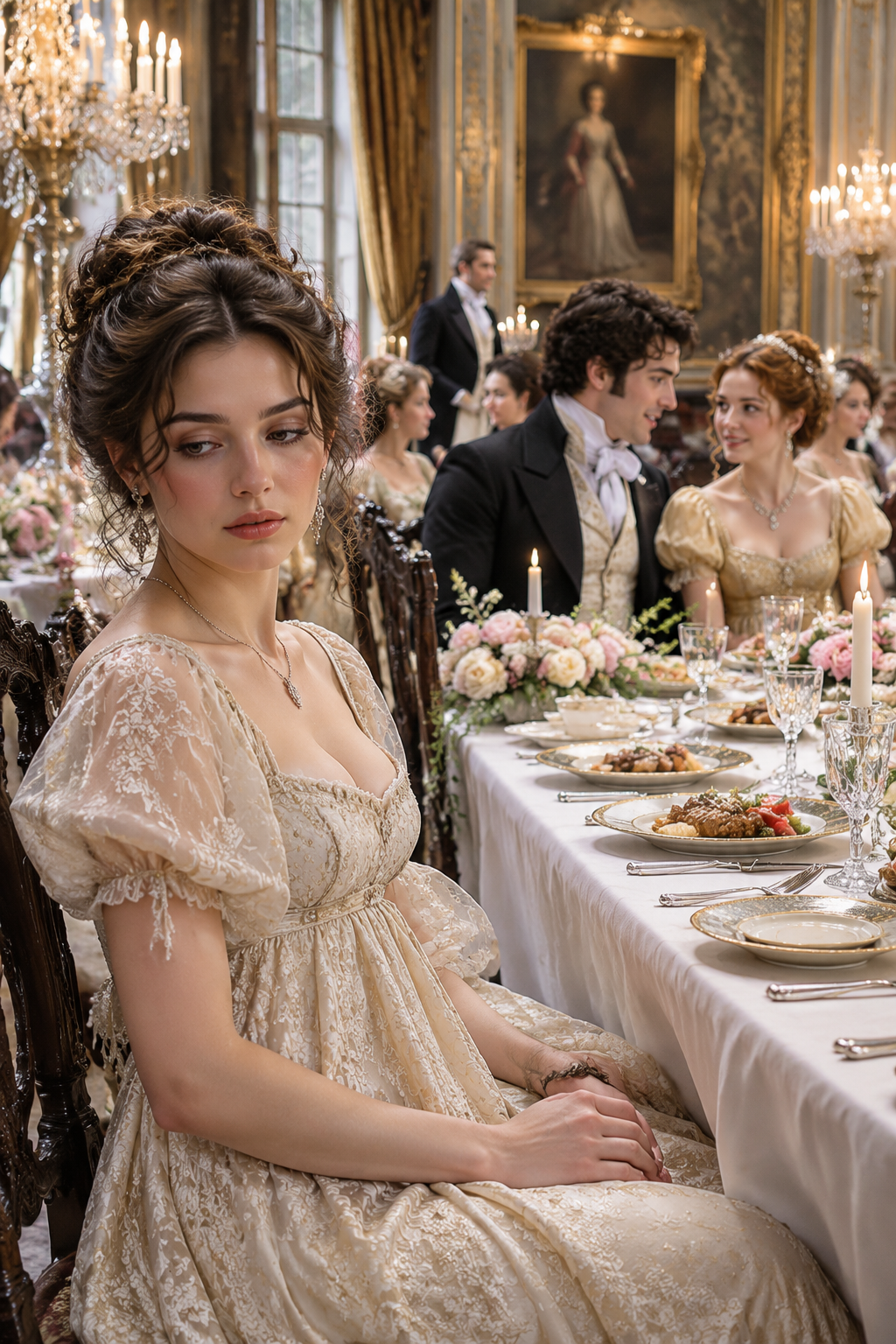
The Duke of Ashworth left his wife alone on their wedding night. By the time the candles burned low, Catherine understood what kind of marriage she had entered.
The letter lay between them like a door that had remained locked for years.
Catherine stared at it, her fingers resting against the edge of the paper. Damian sat beside her bed, looking more frightened than she had ever seen him.
“Read it,” he whispered. “You deserve to know the truth.”
She slowly unfolded the letter.
The handwriting was unmistakably his.
My dearest Catherine,
I do not know whether I will ever find the courage to say these words aloud. I have watched you bring warmth into a house that has been cold for far too long. I have seen you smile at servants, comfort frightened children, and give away more than most people possess.
And every time I see your kindness, I am reminded of how unworthy I feel of it.
I told myself our marriage would be a practical arrangement. I told myself that keeping my distance would protect us both. But the truth is that I have loved you for longer than you know.
I first noticed you at Lady Eleanor’s winter gathering, years before our marriage was arranged. You were the only person who stopped to help an elderly servant who had dropped a tray. Everyone else walked past. You stayed until every piece of broken porcelain had been collected.
I never forgot you.
But I once loved someone and lost her. I buried that grief so deeply that I convinced myself I could never risk loving again. When you became my wife, I was terrified that one day I would care for you as much as I had cared for her, only to lose you too.
So I did the cruelest thing. I tried to protect my heart by breaking yours.
If I have lost the chance to be loved by you, I will have no one to blame but myself.
Catherine lowered the letter.
For several moments, neither spoke.
“Who was she?” Catherine finally asked.
Damian looked down at his hands.
“Margaret. My first love. We were supposed to marry when I was twenty-four. She died of a fever before the wedding.”
His voice grew quieter.
“I watched her suffer. I promised myself I would never put myself through that kind of pain again.”
Catherine’s eyes filled with tears.
“And you thought I would be safer if you made me feel unwanted?”
“No,” he answered immediately. “I thought I was being sensible. I was wrong.”
“You didn’t just keep your heart from me, Damian. You made me feel as though I had done something wrong simply by wanting my husband to notice me.”
He closed his eyes.
“I know.”
She turned toward the window.
“I don’t know if I can forgive you yet.”
Damian nodded, even though the words clearly hurt him.
“Then I won’t ask you to. I will spend the rest of my life showing you that I can become a better man.”
For the first time since their wedding, Catherine believed he understood how deeply he had hurt her.
But understanding was only the beginning.
And forgiveness, she knew, could not be demanded like a duty.
The following days were difficult.
Catherine slowly recovered, but the illness had drained her strength. The doctor ordered her to rest, and Damian made certain she followed every instruction.
He personally brought her meals.
He sat beside her while she read.
He even learned how to prepare the tea she preferred, although the first few attempts were nearly undrinkable.
One afternoon, Catherine took a sip and raised an eyebrow.
“Is this supposed to taste like tea?”
Damian looked offended.
“I followed the instructions.”
“Which instructions?”
“The ones Cook gave me.”
Catherine laughed.
It was a small laugh, but Damian looked at her as though he had just witnessed something extraordinary.
“I have missed that sound,” he admitted.
Her smile faded slightly.
“You could have heard it every day.”
“I know.”
He did not make excuses.
That mattered more than he realized.
When Catherine was strong enough to sit in the garden, Damian began taking her outside. He did not force conversation. Sometimes they sat together in silence, watching the sunlight move across the lawn.
One morning, he brought her a small wooden box.
“What is this?”
“Something I should have given you on our wedding day.”
Inside lay a delicate gold necklace with a tiny pendant shaped like a rose.
Catherine touched it gently.
“It belonged to my mother,” Damian explained. “She wanted my future wife to have it.”
“Why didn’t you give it to me before?”
“Because I was afraid that giving you something so personal would make our marriage feel real.”
Catherine closed the box.
“Damian, I never needed expensive gifts. I needed to feel that I mattered.”
He lowered his head.
“I understand that now.”
She placed the box beside her.
“Thank you.”
It was not a declaration of love.
But it was a beginning.
Three weeks later, Catherine returned to the village.
She expected the children to be noisy, the mothers to be busy, and the little school to be waiting for her as usual.
Instead, she found the schoolroom filled with flowers.
The children had made paper decorations and hung them across the windows. A large handwritten sign stood above the blackboard.
WELCOME HOME, YOUR GRACE.
Catherine covered her mouth.
“Oh, my goodness.”
A little girl named Emily ran toward her and wrapped both arms around her waist.
“We thought you weren’t coming back!”
Catherine knelt carefully.
“I promised I would, didn’t I?”
The children crowded around her.
Damian stood near the doorway, watching.
He had arranged for new desks, better heating, and a proper library. He had also instructed his steward to provide medical supplies to the village so another fever outbreak would not catch the families unprepared.
Catherine turned to him.
“You did all this?”
“I thought it was time I became useful to the people who live on my land.”
She smiled.
“That’s a good place to start.”
Sir Henry arrived shortly afterward, carrying a stack of books.
He stopped when he noticed Damian standing beside Catherine.
“Your Grace,” he greeted him politely.
“Sir Henry.”
The two men exchanged a brief handshake.
Henry turned toward Catherine.
“I am glad to see you looking better. The children have been asking about you every day.”
“Thank you for looking after them.”
“Someone had to make sure they didn’t turn the classroom into a battlefield.”
Catherine laughed.
Damian watched them, and for a moment his old jealousy returned.
But this time, he did not allow it to control him.
Instead, he stepped forward.
“Sir Henry, I owe you my thanks. You helped my wife when I failed to recognize what she needed.”
Henry looked surprised.
“I only did what any decent man would do.”
“Still, I am grateful.”
Catherine glanced between them.
Something had changed.
Damian was no longer treating Henry as an enemy.
He was finally beginning to understand that Catherine’s happiness was not something he could control.
That evening, Catherine and Damian returned to Ashworth Hall together.
The house felt different.
Not because the furniture had changed or because the servants were suddenly happier.
It was because Damian had started opening doors that had remained closed for years.
He began eating breakfast with Catherine.
He asked about the school and remembered the names of the children she mentioned.
He accompanied her on visits to the cottages.
And when she spoke, he listened.
Still, Catherine remained cautious.
She had spent too long hoping for affection from someone who offered none. She would not surrender her independence simply because he had finally decided to become a husband.
One evening, Damian found her in the library.
She was sitting near the fireplace, reading a report about the village school.
“May I join you?”
She looked up.
“It’s your library.”
“That doesn’t answer my question.”
A faint smile touched her lips.
“Yes, you may.”
He sat across from her.
For a while, neither spoke.
Then Damian asked, “Have you ever wondered why I chose you?”
Catherine closed her book.
“I assumed it was because our families considered the match suitable.”
“That was the reason everyone else knew. It wasn’t mine.”
He leaned forward.
“When my father suggested the marriage, I recognized your name immediately. I had never forgotten you from that winter gathering. I knew you were kind, intelligent, and stronger than most people I had met.”
“Then why didn’t you tell me?”
“Because I wanted you to agree to the marriage freely. I thought revealing my feelings would influence your decision.”
Catherine studied him.
“And after we married?”
He gave a sad smile.
“After we married, I became a coward.”
She looked back at her book.
“That’s an honest answer.”
“I am trying to give you more of those.”
He reached into his coat and placed another document on the table.
Catherine glanced at it.
“What is this?”
“A proposal.”
She opened it.
It was a plan to establish a permanent village school, a medical room, and a fund to help families whose homes needed repairs.
At the bottom was a paragraph explaining that Catherine would have full authority over the educational program and its daily operations.
She looked up.
“You want me to run it?”
“If you wish. I know it matters to you.”
“Damian, this will take years.”
“Then we have years.”
Her eyes softened.
For the first time, she saw a future in which she did not have to choose between being a wife and being herself.
“You really mean this?”
“I do.”
She reached across the table and placed her hand over his.
“Then I would like to try.”
Damian’s fingers closed gently around hers.
He did not ask whether that meant she had forgiven him.
He knew better than to rush her.
The first winter after Catherine’s illness brought an unexpected challenge.
A letter arrived from London, bearing the seal of Lord Pembroke, Damian’s uncle and one of the most influential men in the family.
He was coming to Ashworth Hall.
The news disturbed Damian more than Catherine expected.
“Is something wrong?”
He folded the letter.
“My uncle has always believed that a marriage should serve the family’s interests. He was not pleased when I chose to marry you.”
“Why?”
“He wanted me to marry Lady Victoria Harcourt. Her family owns considerable land.”
Catherine raised an eyebrow.
“And now?”
“Now he believes our marriage has failed because we have no heir.”
Catherine felt a familiar discomfort.
Their marriage had never been ordinary, and they had not yet built the kind of relationship that made such expectations welcome.
“Does he intend to discuss that?”
“He intends to discuss everything.”
Lord Pembroke arrived two days later.
He was a tall man with silver hair, sharp eyes, and a manner that made every room feel smaller.
He greeted Catherine with a formal bow.
“Your Grace. I trust your health has recovered.”
“Thank you, my lord.”
He looked around the drawing room.
“I hear you have been spending a great deal of time among the villagers.”
“I have.”
“An admirable hobby, perhaps. But a duchess has responsibilities beyond teaching children.”
Catherine kept her expression calm.
“I agree. And caring for the people who depend on this estate is one of them.”
His mouth tightened.
Damian stepped forward.
“My wife has improved this estate more in a few months than some men manage in several years.”
Lord Pembroke ignored him.
“I came because the family has concerns. Ashworth needs an heir, Damian. And it needs a duchess who understands the importance of her position.”
Catherine placed her teacup down.
“I understand my position perfectly, my lord. I simply believe it should be used to do more than attend dinners.”
The older man looked genuinely surprised.
He had expected silence.
Instead, he found a woman who had learned to stand on her own.
That night, Damian found Catherine on the balcony.
“I am sorry about my uncle.”
“You don’t need to apologize for his opinions.”
“He has always believed that love makes people weak.”
Catherine looked at him.
“And what do you believe?”
Damian considered the question.
“I used to think the same. I thought keeping my feelings hidden made me stronger.”
“And now?”
“Now I think it takes far more courage to love someone honestly.”
Catherine smiled faintly.
“That’s a lesson you learned the hard way.”
“I did.”
He took a breath.
“Catherine, I want to ask you something. Not because my uncle expects it, and not because my family needs an heir.”
She waited.
“Would you consider allowing me to court you properly?”
Her eyes widened.
“Court me?”
“I know we are married, but I never gave you the chance to experience the beginning of a real romance. I would like to do that now. If you will let me.”
Catherine looked at him for a long moment.
Then she smiled.
“You may begin with breakfast tomorrow.”
He laughed softly.
“Breakfast?”
“Together. Without letters, without business, and without excuses.”
“I can manage that.”
“And Damian?”
“Yes?”
“You are making the tea.”
He bowed.
“As my duchess commands.”
Their courtship began with small things.
Breakfast became a daily ritual.
Damian started leaving handwritten notes beside Catherine’s books. Sometimes they were thoughtful. Sometimes they were awkward attempts at humor.
He learned to dance with her in the empty ballroom.
He took her riding along the river and listened as she explained her plans for the school.
One afternoon, they visited the old chapel where Margaret had been buried.
Catherine had never asked Damian to take her there. She understood that grief was not something a person could simply leave behind.
But one day, he brought her himself.
“I thought you should know where that part of my life ended,” he said.
They stood before the modest stone marker.
Damian placed a small bouquet of white flowers beside it.
“I loved her,” he said. “And for a long time, I believed loving someone again would mean betraying her memory.”
Catherine held his hand.
“You don’t have to forget her.”
“I know that now.”
He looked at the stone.
“She would have liked you. You remind me of the kindness I admired in her, but you are not her. You are Catherine. And I want to love you for exactly who you are.”
Catherine felt tears gather in her eyes.
“Thank you for bringing me here.”
He kissed her hand.
For the first time, his memories no longer seemed like walls between them.
They had become part of the story he was finally willing to share.
Spring arrived with a series of unexpected changes.
The village school expanded into two classrooms. More families moved to the estate because they had heard that Ashworth was a place where people were treated fairly.
Catherine became known throughout the county for her work.
Some praised her.
Others criticized her.
A few wealthy families considered her ideas far too generous.
But she continued.
One afternoon, Sir Henry brought news that a neighboring estate was planning to close its village school.
“The children will have nowhere to go,” he explained.
Catherine immediately began making plans.
“We should invite their families here. Perhaps we can arrange transport.”
Damian listened carefully.
“How many children?”
“Nearly forty.”
“Then we need another classroom.”
Catherine smiled.
“You haven’t even asked how much it will cost.”
He shrugged.
“I have learned that some things are worth paying for.”
Henry laughed.
“I must say, Your Grace, you have become rather difficult to recognize.”
Damian looked at him.
“Is that a compliment?”
“Absolutely.”
They spent the afternoon discussing the plans.
Later, when Henry had left, Damian approached Catherine.
“You seemed very happy today.”
“I was. Those children deserve an education.”
He took her hand.
“I like seeing you happy.”
Catherine leaned against him.
“And I like knowing you no longer need to compete with everyone who makes me smile.”
He chuckled.
“I am still learning.”
“I know.”
She kissed his cheek.
“That is what matters.”
But not everyone welcomed the changes at Ashworth Hall.
Lord Pembroke returned in the summer, this time with Lady Victoria Harcourt.
Victoria was elegant, beautiful, and accustomed to receiving attention. She had known Damian since childhood and had once expected to marry him.
Catherine greeted her politely.
“Lady Victoria. Welcome to Ashworth.”
Victoria smiled.
“Your Grace. I have heard so much about your wonderful little school.”
The word little carried a quiet insult.
“Thank you. We are hoping to expand it.”
“How generous. Though I suppose country life leaves one with considerable free time.”
Catherine recognized the challenge but refused to take the bait.
“Not as much as people imagine.”
Damian joined them.
“Victoria.”
“Damian. It has been years.”
He bowed.
“Indeed.”
Lord Pembroke watched the exchange closely.
During dinner, Victoria spoke about London society, expensive gowns, and upcoming events.
She seemed determined to remind everyone that she belonged in Damian’s world.
At one point, she turned to him.
“Do you remember the summer we spent at my father’s estate? You promised to take me riding every morning.”
“I remember the estate,” Damian replied. “I don’t recall making such a promise.”
Victoria laughed as though he had made a joke.
Catherine noticed something important.
Damian did not look at Victoria with affection.
He did not seem tempted by her attention.
He simply wanted the evening to end.
Later, when they were alone, Catherine asked, “Did you ever consider marrying her?”
“Our families discussed it. I never wanted it.”
“Why?”
He looked at her.
“Because I had already met the woman I wanted to marry.”
Catherine’s heart warmed.
“Even before you knew whether she would accept you?”
“Especially then.”
She laughed.
“Your confidence is impressive.”
“My confidence was never the problem. My courage was.”
He kissed her forehead.
“And I intend never to forget that.”
Two months later, Catherine discovered she was expecting a child.
The news came on an ordinary morning.
She had been feeling tired for several days, and the doctor was called to Ashworth Hall.
After the examination, the physician smiled.
“Your Grace, I have wonderful news.”
Catherine stared at him.
“Am I ill?”
“Quite the opposite.”
When the doctor explained, she sat completely still.
A child.
She was going to have a child.
For a moment, happiness and fear seemed to arrive together.
Damian entered the room just as she was holding the doctor’s report.
“What happened?”
She looked up.
“I believe you are going to become a father.”
He stopped.
The color drained from his face.
“Are you certain?”
The doctor laughed.
“Quite certain, Your Grace.”
Damian turned toward Catherine.
Then he knelt beside her chair and took both her hands.
“I don’t know what to say.”
“You could start by saying something.”
He laughed, but tears were already running down his face.
“I am going to be a father.”
“Yes.”
He pressed her hands against his forehead.
“Thank you.”
Catherine touched his cheek.
“We did this together.”
He kissed her fingers.
“I promise you, our child will never have to wonder whether they are loved.”
It was a promise he made not only to the child but to the woman who had once wondered the same thing.
The news transformed Ashworth Hall.
The servants celebrated.
The village children sent handmade cards.
Sir Henry arrived with a collection of books about childhood education, claiming that the baby should begin learning as early as possible.
Damian became almost comically protective.
He insisted that Catherine avoid riding, climbing stairs too quickly, carrying anything heavy, or even standing too long.
One afternoon, she found him speaking seriously with the housekeeper.
“Her Grace must not be exposed to unnecessary stress.”
Catherine folded her arms.
“Damian.”
He turned immediately.
“Yes, my love?”
“I am pregnant, not made of glass.”
“I know.”
“Then stop telling everyone to wrap me in blankets.”
The housekeeper quickly lowered her eyes, hiding a smile.
Damian sighed.
“I am trying to keep you safe.”
“And I appreciate that. But I still want to live my life.”
He approached her and gently touched her cheek.
“I suppose I have become rather frightened.”
“Of what?”
“Losing you.”
Catherine placed her hand over his.
“I cannot promise that life will never frighten us. But you cannot love me by keeping me locked away.”
He nodded.
“You are right.”
He kissed her forehead.
“I will try to remember that.”
As the months passed, Catherine’s belly grew, and so did the warmth between them.
Damian read to her in the evenings.
He learned how to prepare the nursery and argued with the carpenter over the safest crib.
He even wrote a letter to the baby, which Catherine discovered tucked inside a drawer.
She read it one afternoon while Damian was away.
My little one,
I have not yet met you, but I already love you more than I can explain. I hope you grow up knowing that kindness is not weakness and that love should never be something you must beg for.
Your mother taught me that.
She showed me that a person can change without losing the strength that made them who they are.
I hope you become brave enough to love honestly, and wise enough to recognize that the people you love must be free to be themselves.
Your loving father.
Catherine folded the letter carefully.
When Damian returned, she kissed him before he could remove his coat.
“You read it?”
“I did.”
“Was it terrible?”
“It was beautiful.”
He smiled.
“I meant every word.”
She placed his hand against her stomach.
A small movement stirred beneath his palm.
Damian froze.
“Was that…?”
Catherine nodded.
Their child had kicked.
His expression changed completely.
He bent down and pressed his cheek gently against her belly.
“Hello, little one,” he whispered.
For a long time, he stayed there, smiling.
The birth came on a cold November night.
Rain struck the windows, and the wind swept across the grounds.
Catherine’s labor began shortly after midnight.
Damian was awakened by her quiet cry.
He called for the doctor and summoned the midwife.
Then he refused to leave her side.
Hours passed.
Catherine gripped his hand so tightly that he thought she might break every bone in it.
“You can do this,” he whispered.
“I am beginning to dislike you very much.”
He almost laughed.
“I deserve that.”
At dawn, a baby’s cry filled the room.
The midwife smiled.
“A healthy boy, Your Grace.”
Damian looked at the tiny child in her arms.
Then he turned toward Catherine.
She was exhausted, but smiling.
“Would you like to hold him?”
He approached carefully.
His hands trembled as the midwife placed the baby in his arms.
For a moment, he could barely breathe.
“He is so small,” he whispered.
“He won’t stay that way,” Catherine said.
Damian looked down at his son.
“What shall we name him?”
Catherine considered the question.
“James. After your father?”
Damian’s eyes filled.
“My father would have been honored.”
He kissed the baby’s forehead.
“Welcome to the world, James Ashworth.”
Then he looked at Catherine.
“Thank you for giving me a family.”
She smiled.
“We gave each other one.”
The years that followed were not perfect.
There were disagreements about money, decisions about the estate, sleepless nights, and days when neither knew exactly what the other needed.
But something important had changed.
Damian no longer disappeared into silence when life became difficult.
When he was frightened, he spoke.
When Catherine was upset, he listened.
And when they disagreed, neither treated the other as an enemy.
Their son grew into a lively boy who loved books, horses, and exploring the gardens.
He was often found in the village school, where Catherine continued to teach even after becoming a mother.
Damian supported her work and eventually helped establish similar schools on neighboring estates.
The medical room became a permanent village clinic.
The families received fairer rents, better housing, and more support during difficult seasons.
Ashworth Hall slowly became known not simply as the home of a wealthy duke, but as a place where people mattered.
Sir Henry remained a dear friend.
He often visited the family and became one of James’s favorite companions.
And Lord Pembroke?
He eventually softened.
One afternoon, he watched James helping Catherine distribute books to village children.
“You have built something unusual here,” he admitted to Damian.
Damian looked toward his wife.
“She built it. I simply learned to stand beside her.”
Lord Pembroke followed his gaze.
“And you are happy?”
Damian smiled.
“More than I ever thought possible.”
Years later, on the anniversary of their wedding, Damian asked Catherine to meet him in the ballroom.
The room had been decorated with white roses, the same flowers that had filled their wedding ceremony.
A small table stood near the window.
On it lay a new letter.
Catherine recognized his handwriting.
“Another letter?”
Damian nodded.
“I thought it was time I gave you one that didn’t begin with an apology.”
She opened it.
My beloved Catherine,
On the day we married, I believed that love was a danger I could avoid by refusing to speak about it. I thought silence would protect me.
I was wrong.
You taught me that love is not measured by what we feel in secret, but by what we are willing to give in our daily lives.
You taught me that a home is not made by grand rooms, expensive paintings, or a family name. It is made by kindness, trust, and the courage to show up for one another.
I cannot give you back the months when you felt alone. I cannot erase the tears you cried because of me.
But I can promise that you will never again have to wonder whether you matter to me.
You are my greatest happiness, my closest friend, and the person who taught me how to live again.
Forever yours,
Damian.
Catherine looked up.
He was standing before her, holding out his hand.
“May I have this dance, Duchess?”
She smiled through her tears.
“You may, Your Grace.”
He drew her gently into his arms.
The music began.
As they moved across the ballroom, Catherine rested her head against his shoulder.
“Do you remember our wedding night?” she asked.
Damian closed his eyes briefly.
“I remember every moment.”
“I thought I had married a man who would never love me.”
“I know.”
“And now?”
He kissed her forehead.
“Now I spend every day trying to make sure you never feel that way again.”
She smiled.
“Then keep trying.”
“I intend to.”
Across the room, little James watched his parents dance before running toward them.
“Father! Mother! Come and see what I found!”
Damian laughed and lifted him into his arms.
Catherine looked at the two people who had become her family.
Once, she had believed her marriage would always be a lonely arrangement.
Instead, it had become something neither of them had known how to ask for at the beginning.
Not a perfect love.
Not a life without pain.
But a love built through honesty, patience, and the willingness to change.
Much later, when James was old enough to understand the history of Ashworth Hall, he asked his mother a question.
“Mother, how did you make Father fall in love with you?”
Catherine smiled.
“I didn’t.”
James looked confused.
“Then how did it happen?”
She glanced toward Damian, who was reading near the fireplace.
“I learned to live a happy life even when I wasn’t receiving the love I wanted. Your father had to decide for himself whether he was brave enough to become part of it.”
James considered that.
“Was he?”
Catherine laughed softly.
“He is still learning.”
Damian lowered his book.
“I heard that.”
James burst into laughter.
Catherine reached for her husband’s hand.
And in that simple moment, she understood something she wished she had known years earlier.
Love cannot be forced out of someone. It cannot be earned through endless sacrifice, nor can it survive on promises alone.
It must be shown through actions, day after day.
Damian had once believed that avoiding love would save him from grief. Instead, it nearly cost him the greatest happiness of his life.
Catherine had once believed that being a good wife meant waiting patiently for someone to notice her. Instead, she discovered that her worth had never depended on his attention.
Together, they learned that a lasting marriage is not built by one person constantly giving while the other remains silent.
It is built when two people choose to listen, respect one another, and keep showing up, even after making mistakes.
And that was the greatest legacy of Ashworth Hall.
Not its wealth.
Not its title.
Not even the family name.
It was the warmth that finally filled a home that had once been empty of love.
THE END.