The Duke of Ashbourne had forbidden his wife from loving him
The ballroom fell so silent that even the crackling fire seemed to fade.
Clara watched as the elderly steward carefully broke the seal. His hands trembled, not from fear of the people surrounding him, but from the weight of the truth he had carried for years.
Lord Henry took a step forward.
“That letter is private property. You have no right to read it!”
The steward looked at him calmly.
“With respect, my lord, I have spent seven years wishing I had the courage to do what I am about to do tonight.”
He unfolded the paper.
“My name is Thomas Whitmore. I served the Duke of Ashbourne’s family for thirty-two years. And I can no longer remain silent while an innocent man is accused of treason.”
A murmur swept through the ballroom.
Dominic stood motionless beside Clara. His expression was cold, but she noticed his fingers tightening around the back of a nearby chair.
The steward continued.
“Seven years ago, Lord Henry approached me with an offer. He wanted me to alter certain estate records and make it appear that the Duke’s father had been secretly transferring money to foreign agents.”
Henry’s face darkened.
“Enough! The man is senile!”
Thomas didn’t stop.
“I refused at first. But Lord Henry threatened my family. He promised to ruin my son, who was employed on the estate, and have him arrested for theft. I was frightened. I did what he asked.”
Clara felt her stomach tighten.
So the strange payments in the estate accounts hadn’t been ordinary mistakes.
They had been part of something much larger.
Thomas held up the letter.
“This is a copy of the original instructions I received from Lord Henry. It bears his signature and the date. I kept it because I knew one day I might need to prove what happened.”
Lord Henry laughed nervously.
“A forged document! Anyone could write my name!”
“Perhaps,” Clara replied. “But not everyone can explain why your personal account received payments matching the exact sums listed in the altered estate records.”
Henry turned toward her.
“What are you talking about?”
Clara took a small leather notebook from her handbag.
For weeks, she had been reviewing the estate’s neglected accounts. At first, she had simply wanted to understand why so many repairs had been delayed and why the tenants had been charged fees they could barely afford.
But the deeper she looked, the more troubling the numbers became.
Several payments had been transferred through false accounts. Each transaction appeared to have been approved by someone connected to the Duke’s household.
And every trail eventually led to Henry.
“I found these entries in the estate ledger,” she explained. “The payments were disguised as maintenance expenses. But the properties supposedly receiving the money never existed.”
One of the officials approached and examined the notebook.
“These figures match the transactions in the documents presented tonight,” he said.
Henry’s face lost its color.
Clara continued.
“Someone altered the records to make it appear that my husband was sending money to foreign agents. But the money was actually being diverted into accounts controlled by Lord Henry.”
Dominic turned toward his uncle.
“All these years,” he said quietly. “You allowed me to believe my father’s reputation had been destroyed by enemies of the Crown.”
Henry’s eyes narrowed.
“Your father was a weak man. The family needed someone stronger.”
“You destroyed his name.”
“I protected what belonged to me!”
The words escaped before Henry could stop himself.
A heavy silence followed.
The officials exchanged glances.
One of them stepped forward.
“Lord Henry, I must ask you to accompany us. We will need to examine these documents and your financial records.”
Henry suddenly moved toward the letter.
He grabbed for it, but the older steward stepped back.
Two officials immediately blocked his path.
“Don’t touch me!” Henry shouted. “I am a member of the aristocracy!”
“And I am the man who has finally stopped being afraid of you,” Thomas answered.
For the first time that evening, Lord Henry had nothing to say.
As the officials escorted him toward the ballroom doors, he looked back at Dominic.
“You think you’ve won? You have no idea what I sacrificed to keep this family standing!”
Dominic’s reply was quiet.
“Whatever you sacrificed, it was never yours to take from other people.”
The doors closed behind Henry.
But the room remained silent.
The accusation had been serious. The evidence was still going to require a formal investigation, and Dominic knew that a single evening could not erase years of suspicion.
Still, for the first time in a long while, he felt that the truth might finally have a chance.
He turned toward Clara.
She stood beside the Christmas tree, her face pale, her hands folded tightly in front of her.
“You saved me,” he whispered.
Clara shook her head.
“I only showed them what was already there.”
“No,” Dominic replied. “You stood beside me when everyone else was prepared to turn away.”
For a moment, neither spoke.
Then Dominic reached for her hand.
She allowed him to take it.
It was a small gesture, but to him it felt like the beginning of something he had almost lost before it had truly begun.
The guests slowly returned to their conversations, though many left early. Some offered Dominic words of support. Others avoided his eyes, embarrassed by how quickly they had believed the accusation.
Clara barely noticed them.
She had done what she needed to do.
And yet, as she looked at Dominic, she felt a strange sadness settling over her.
Because saving him was not the same as being loved by him.
And she was beginning to understand that she could no longer live on small moments of kindness and hope.
That night, after the last guests had departed, Dominic found Clara standing alone in the library.
The fire was nearly out.
“Why are you still awake?” he asked.
“I couldn’t sleep.”
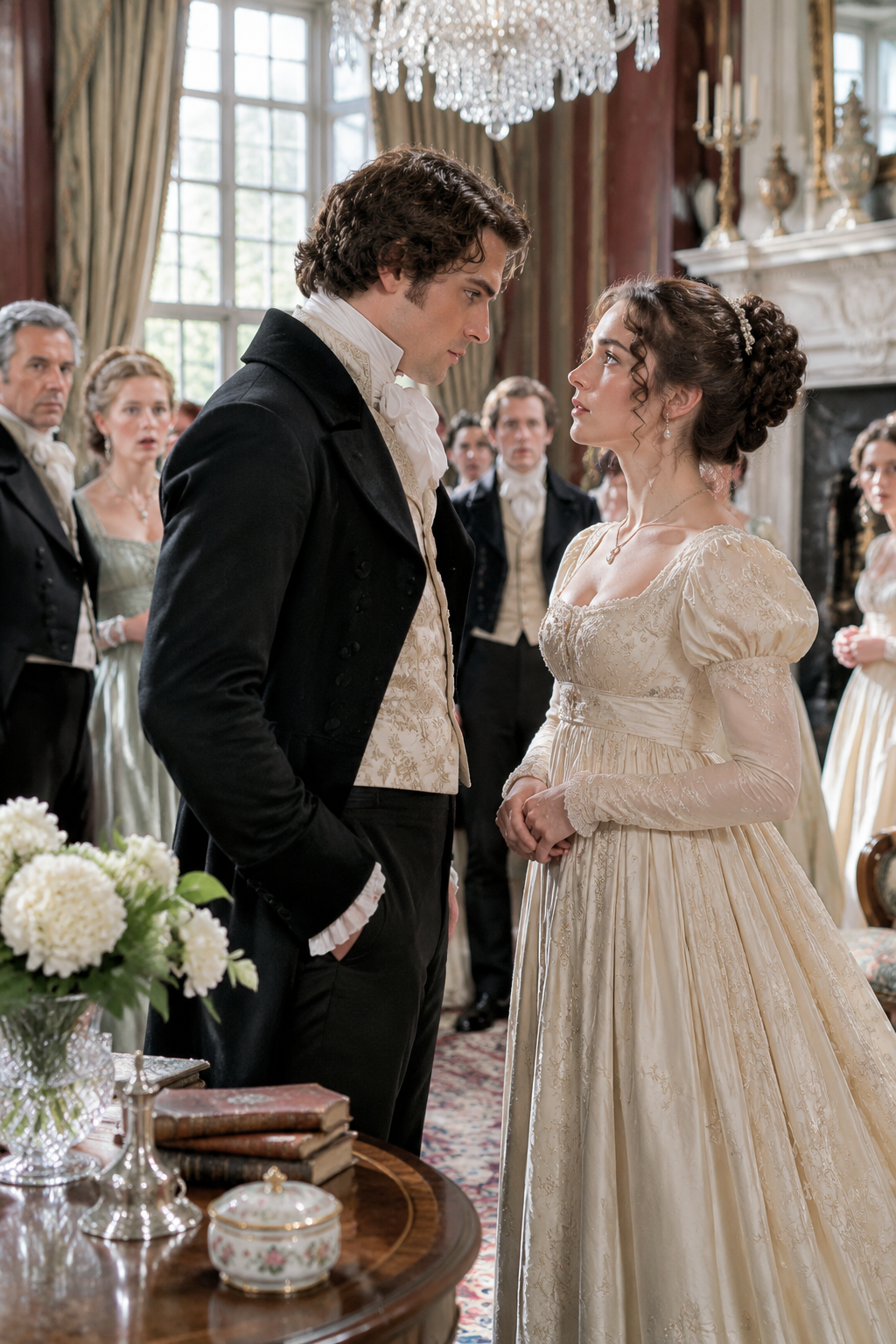
He approached her.
“Neither could I.”
For a moment, he seemed uncertain. The same man who could silence an entire room with a single glance now struggled to find the right words for his wife.
“Clara, I owe you more than I could ever repay.”
She looked at him.
“You don’t owe me anything.”
“I owe you the truth.”
She waited.
Dominic drew a deep breath.
“When I arranged our marriage, I thought I was making a sensible decision. My uncle had spent years spreading rumors about my family. I needed a respectable wife, someone whose presence would make the public question the stories he told.”
“And I needed someone to pay my father’s debts,” Clara replied.
He lowered his eyes.
“I know.”
“You made the arrangement very clear.”
“I did.”
“You told me there would be no love. No expectations. No affection.”
“I remember every word.”
Clara looked toward the dark window.
“Then why are you surprised that I learned to live without expecting anything from you?”
Her words struck harder than any accusation Henry had made that evening.
Dominic stepped closer.
“Because I was wrong.”
She turned to face him.
He looked at her as though he were finally seeing the woman who had been standing beside him all along.
“I thought I could keep you at a distance and still have the comfort of knowing you were there. I thought your kindness would simply become part of this house, something I could depend on without ever having to offer anything in return.”
His voice grew softer.
“But somewhere along the way, I began waiting for you. I began looking for you in every room. When I returned from London, the first thing I wanted was to know whether you were in the library or walking through the gardens.”
Clara’s eyes filled with tears.
“Dominic…”
“I know I have no right to ask you for anything. But I need you to know that this marriage stopped being an arrangement for me a long time ago.”
She looked down at their hands.
He was holding hers carefully, as though he feared she might disappear.
“Then why did you never tell me?”
He had no answer.
And that silence told her more than she wanted to know.
The following weeks brought more changes than either of them expected.
The investigation into Lord Henry’s actions uncovered a long history of fraud, intimidation, and false financial records. Several servants and former estate employees came forward with information.
Thomas Whitmore’s testimony proved especially important.
The letter he had brought to the Christmas ball was only one piece of evidence. His private records contained copies of instructions, payments, and correspondence that connected Henry to the forged accusations.
The officials eventually confirmed that Dominic had never been involved in treason.
His name was formally cleared.
The newspapers that had once questioned his loyalty now printed accounts of the conspiracy.
Some people apologized.
Others pretended they had never believed the accusations in the first place.
Dominic cared little for their opinions.
His father’s name had finally been restored, and that mattered more than any public praise.
He also made certain Thomas was rewarded for his courage. The former steward was given a comfortable home and enough money to live peacefully for the rest of his days.
But the greatest changes took place at Ashbourne.
Dominic began reviewing the estate accounts himself. He discovered that the tenants had been paying unnecessary fees for years and that several cottages needed urgent repairs.
He ordered the charges removed.
He approved funds for new roofs, improved roads, and repairs to the village school.
When one of his advisers questioned the expense, Dominic answered simply:
“A great estate is not made great by the size of its owner’s house. It is made great by the lives it supports.”
Clara heard about the decision from the housekeeper.
For the first time, she saw something in Dominic that went beyond his desire to please her.
He was changing because he had begun to understand what kind of man he wanted to be.
Yet their relationship remained uncertain.
Dominic tried.
He asked her to join him for breakfast. He sent flowers to her room. He began walking with her through the gardens and listening when she spoke about the tenants.
But Clara remained polite and distant.
She thanked him for the flowers.
She accepted his invitations.
She smiled when he made an effort.
But she no longer reached for him first.
And Dominic began to understand that a few weeks of kindness could not undo months of loneliness.
One afternoon, he found her in the east garden, speaking with the gardener about the winter roses.
“May I walk with you?” he asked.
“Of course, Your Grace.”
He winced slightly at the formality.
“Dominic,” he corrected gently. “You used to call me Dominic.”
“Did I?”
“Yes.”
She looked at him for a moment, then returned her attention to the roses.
He walked beside her in silence.
Finally, he said, “I have been thinking about what you told me in the library.”
“Which part?”
“That saving me was not the same as being loved by me.”
Clara stopped.
“I didn’t say that.”
“You didn’t need to.”
He looked down at the path.
“I have spent most of my life believing that being responsible was enough. I thought providing a home, money, and protection meant I had fulfilled every duty expected of me.”
“And now?”
“Now I understand that a person can have everything provided for them and still feel terribly alone.”
Clara’s expression softened.
“That is a difficult thing to learn.”
“It is.”
He hesitated.
“Would you tell me what I could do to make things right?”
She looked at him for a long moment.
“Do you want to make things right because you cannot bear the thought of losing your wife, or because you finally understand what it means to be a husband?”
Dominic didn’t answer immediately.
He knew she deserved honesty, not another polished promise.
“At first, perhaps I was afraid of losing you,” he admitted. “But now I know that even if you stayed, I could still lose you if I continued treating your heart as something I was entitled to.”
Clara looked away.
For one brief moment, she wanted to believe him.
But wanting to believe someone and trusting them were two very different things.
That evening, she made a decision.
She would leave for Bath.
She had relatives there who would welcome her, and the town offered the quiet life she had once imagined before her father’s debts had changed everything.
She did not intend to make a scene.
She did not intend to punish Dominic.
She simply needed to discover who she was outside the walls of Ashbourne.
The following morning, she began packing.
The housekeeper entered her room and stopped when she saw the open trunks.
“Your ladyship?”
Clara folded a dress carefully.
“I shall be leaving for Bath in two days.”
The housekeeper looked distressed.
“Has His Grace been told?”
“Not yet.”
“But surely—”
“Please,” Clara said gently. “I have made my decision.”
The older woman approached her.
“Forgive me for speaking out of turn, but this house was never the same after you arrived. Neither was the Duke.”
Clara smiled sadly.
“I know. But I cannot spend the rest of my life hoping he will become the husband I need.”
The housekeeper’s eyes filled.
“Perhaps he already has.”
Clara stopped folding.
For a moment, she said nothing.
Then she closed the trunk.
“Perhaps. But I need to know that for myself, not because everyone else tells me it is true.”
By late afternoon, Dominic noticed that Clara had not appeared for tea.
He sent a footman to ask whether she was unwell.
The man returned looking uncomfortable.
“Her ladyship is preparing to travel, Your Grace.”
Dominic looked up sharply.
“Travel?”
“To Bath, sir.”
The teacup in his hand remained suspended in the air.
“When?”
“Tomorrow morning, Your Grace.”
Dominic stood so quickly that the chair behind him scraped across the floor.
He crossed the hall and climbed the stairs two at a time.
When he reached Clara’s room, he found the door open.
Her trunks were packed.
She was standing beside the window, holding a small portrait of her mother.
“Clara.”
She turned.
“Dominic.”
“You’re leaving.”
It was not a question.
“Yes.”
He looked at the trunks, then back at her.
“Why?”
She seemed surprised by the question.
“Because I need to.”
“But I thought—after Christmas, after everything…”
“After everything, what?”
He opened his mouth, then closed it.
She placed the portrait on the table.
“Dominic, I am grateful for what you have done. I am grateful that you defended your father’s name and that you have begun to care for the people on your estate.”
“Then why isn’t that enough?”
“Because I am not a list of responsibilities to be completed.”
Her voice trembled, but she continued.
“I don’t want a husband who gives me flowers because he fears I might leave. I don’t want kindness offered as payment for everything I have done for him. I want to be loved without having to earn it.”
Dominic stared at her.
“And you believe I cannot love you?”
“I believe you are only beginning to understand what love asks of you.”
He looked away.
She approached him.
“When I first arrived here, I told myself that I could make this place feel like a home. I thought if I worked hard enough, if I cared enough, perhaps one day you would look at me and see more than the woman you had paid to marry.”
Her eyes filled with tears.
“But I cannot keep trying to become worthy of something that should never have been a bargain.”
Dominic felt something inside him break.
“Clara, please don’t go.”
She reached for his hand.
For a moment, he thought she had changed her mind.
Instead, she squeezed it gently.
“I am not leaving because I hate you. I am leaving because I am tired of feeling alone beside the man I married.”
He wanted to tell her that he loved her.
The words rose to his lips.
But he stopped.
Because for once, he understood that saying the right thing would not necessarily make anything right.
“How long will you be gone?” he asked.
“I don’t know.”
“Will you write?”
“If I have something to say.”
He nodded slowly.
It was the only answer he could give without asking her to promise what she did not feel.
That night, Dominic did not sleep.
He walked through the rooms of the estate, passing the library where Clara had spent countless evenings, the dining room where she had persuaded him to invite the servants to a Christmas supper, and the garden where she had planted roses that had survived the winter.
Everywhere he looked, he saw evidence of her presence.
And he finally understood something that frightened him more than losing his title ever could.
Clara had never asked him to become a different man overnight.
She had only wanted him to let her into his life.
And he had made her feel like an unwelcome guest in her own marriage.
Before dawn, he went to the stables.
“Prepare the carriage,” he ordered.
The stable master looked outside.
“Your Grace, there’s a storm coming.”
“I know.”
“The roads will be dangerous.”
“Then we will leave before the snow gets worse.”
But by the time the carriage was ready, Clara’s own carriage had already departed.
Dominic rode out on horseback.
Snow began falling heavily over the Derbyshire countryside. The wind cut through his coat, and the narrow roads quickly became difficult to see.
He rode faster.
He had spent years believing that control was the same as strength.
He had controlled his household, his business, his reputation, and even the terms of his marriage.
But he had never learned how to fight for something without trying to own it.
And now the only person he wanted beside him was riding away.
Several miles down the road, he finally saw the carriage.
It had stopped near a small stone bridge.
The horses were restless, and the driver was struggling to calm them.
Dominic jumped down from his horse.
“Clara!”
The carriage door opened.
She stepped out, wrapped in a dark traveling cloak.
“Dominic? What are you doing here?”
He approached, his boots sinking into the snow.
“I need to speak with you.”
“You should not have come. The roads are dangerous.”
“I know.”
He stopped in front of her.
For a moment, he seemed unable to speak.
Then, in a movement that stunned both Clara and the driver, the Duke of Ashbourne dropped to one knee in the muddy snow.
“Please,” he said.
Clara’s hand flew to her mouth.
“Dominic, get up!”
He shook his head.
“Not until you hear me.”
Snow settled on his shoulders and darkened his hair.
“I cannot ask you to forgive me simply because I am afraid of losing you. I know that. And I cannot undo the way I treated you when you first arrived.”
His voice trembled.
“But I can promise you that I will never again make you feel that your place in my life depends on how useful you are to me.”
Clara stared at him, tears mixing with the snow on her cheeks.
“I want to know your thoughts. I want to hear your disagreements. I want you beside me not because a marriage contract says you belong here, but because you choose to be there.”
He took a breath.
“I love you, Clara. Not because you saved my reputation. Not because you made my estate beautiful. Not because you became the woman everyone admires. I love you because you are you.”
She looked at him, trembling.
“I should have told you when I first realized it. But I was proud, and I was afraid. I thought that if I admitted how much you mattered to me, I would be giving someone the power to hurt me.”
He lowered his head.
“Instead, I hurt the one person who never wanted to harm me.”
For a long moment, Clara could not speak.
The wind swept across the road.
The driver looked away, giving them the privacy of the moment.
Dominic finally raised his eyes.
“I will not demand that you return. I will not use your father’s debts, your title, or our agreement to keep you beside me. If you still wish to go to Bath, I will make certain you travel safely. And if you decide that you can never love me, I will accept it.”
His voice broke.
“But if there is even a small part of you that believes we might begin again, I would spend the rest of my life proving that you were right to give me that chance.”
Clara looked down at the man kneeling in the snow.
She remembered the cold Duke who had greeted her on their wedding day.
She remembered the lonely dinners, the unanswered questions, and the nights when she had wondered whether she had made a terrible mistake.
But she also remembered the man who had stood beside her in the garden, who had begun listening to his tenants, and who had finally understood that love was not something a person could demand.
“Dominic,” she whispered, “I never wanted you to kneel before me.”
“I know.”
“I never wanted your title or your money.”
“I know.”
“I only wanted you to see me.”
He closed his eyes.
“I see you now.”
Clara slowly lowered herself until they were face to face.
“Then stand up,” she said. “And stop making me feel like I am the only one who has to be brave in this marriage.”
He looked at her in disbelief.
“Does that mean…”
“It means I am willing to try.”
He rose carefully, and Clara placed both hands against his chest.
“But listen to me,” she continued. “I will not return to the marriage we had before. If we are to begin again, we begin as two people who are free to choose one another. No more rules designed to protect your pride. No more silence when something hurts.”
Dominic nodded.
“Agreed.”
“And you must understand that I will not always agree with you.”
A faint smile appeared on his face.
“I would be disappointed if you did.”
For the first time in months, Clara laughed.
It was a small sound, almost lost beneath the wind, but Dominic heard it.
He reached for her hand.
This time, she did not pull away.
They returned to Ashbourne together.
The journey was slow, and the storm forced them to stop at a roadside inn for the night. Dominic arranged separate rooms, then waited in the common room until Clara came downstairs.
She found him sitting beside the fire, staring into the flames.
“Are you still awake?”
He looked up.
“I was hoping you might join me.”
She sat across from him.
For a while, they spoke about ordinary things. The snow, the condition of the roads, and the people at Ashbourne who would surely be surprised to see them return together.
Then Dominic said something that made her smile.
“I have been thinking about the terms of our marriage.”
Clara raised an eyebrow.
“That sounds dangerous.”
“I believe the original agreement should be destroyed.”
She looked at him.
“Why?”
“Because I no longer want our marriage to be built on a debt that was never yours to carry.”
He reached into his coat and placed a folded document on the table.
It was the original marriage agreement.
“I have already arranged for your father’s debt to be settled permanently. You owe me nothing. You never did.”
Clara looked at the paper.
For years, she had believed that the debt was the chain connecting her to Dominic.
Now he was offering to remove it.
“What about my father?”
“I have no intention of paying for another one of his gambling habits. But his creditors will have no claim against you, and I will not use his mistakes to control your future.”
Clara looked at him for a long time.
Then she pushed the document gently back toward him.
“Keep it.”
He frowned.
“Why?”
“Because I want you to remember what we must never become again.”
Dominic understood.
The following morning, he signed a separate declaration confirming that Clara’s property, money, and personal decisions were entirely her own. He also made arrangements to ensure that she would have the means to leave whenever she wished.
It was not the grand romantic gesture she might once have imagined.
It was something more important.
It was respect.
When they returned to Ashbourne, the household gathered in the entrance hall.
The housekeeper nearly cried when she saw Clara step through the doors.
“Your ladyship!”
Clara embraced her.
“I’m home.”
Dominic watched the scene quietly.
For years, he had believed that his estate was the place where he exercised authority.
Now he understood that a home was something different.
It was where people felt safe enough to be themselves.
The months that followed were not without difficulty.
Dominic did not suddenly become a perfect husband.
Sometimes he became too quiet when troubled. Sometimes Clara grew impatient when he retreated into his old habits. There were evenings when disagreements left them sitting at opposite ends of the library.
But they learned to speak.
When Dominic was angry, Clara asked him to explain rather than disappear.
When Clara felt overlooked, Dominic listened instead of defending himself.
They began taking breakfast together every morning.
Not because it was expected, but because neither wanted to begin the day without seeing the other.
Dominic also made a habit of asking Clara’s opinion before making decisions about the estate.
At first, his advisers were surprised.
Eventually, they learned that the Duchess had a better understanding of the tenants’ needs than most men who had managed the property for decades.
Clara established a small fund to help families facing illness, crop failures, or sudden financial hardship. She also helped improve the village school and arranged for young girls to receive proper instruction.
Dominic supported her efforts without taking credit for them.
One afternoon, a tenant approached the Duke outside the village church.
“Your Grace, the new cottages have made all the difference to my family. I don’t know how to thank you.”
Dominic shook his head.
“You should thank the Duchess. She was the one who first showed me how much needed to be done.”
The tenant smiled.
“Then you are a fortunate man, sir.”
Dominic looked across the churchyard.
Clara was speaking with a group of children, her laughter carrying through the crisp afternoon air.
“Yes,” he replied. “I am.”
Meanwhile, Thomas Whitmore became a frequent visitor at the estate. His health was not what it once had been, but he found great comfort in knowing that the truth had finally been told.
Dominic often invited him to dinner.
One evening, Thomas sat beside the fireplace and looked around the room.
“I remember this house before the Duchess arrived,” he said. “It was beautiful, but it was never warm.”
Clara smiled.
“Perhaps it simply needed a few more fires.”
Thomas shook his head.
“Not that kind, my lady.”
Everyone laughed.
Years later, people in Derbyshire would still tell the story of the Christmas Eve ball when the Duke of Ashbourne was accused of treason and his wife stood up to a powerful lord.
Some remembered the forged papers.
Others remembered the old steward’s testimony.
But those who knew the couple best remembered something else.
They remembered the Duke who once declared that his marriage would never contain love.
And they remembered the woman who taught him that love could not be purchased, ordered, or secured through a contract.
On the first anniversary of their reconciliation, Dominic arranged a small gathering at the estate.
There were no grand speeches or crowded ballroom celebrations.
Instead, he invited the people who had become part of their lives: the household staff, the village families, Thomas Whitmore, and a few close friends.
After dinner, he led Clara into the garden.
The winter roses were blooming again.
He took her hand.
“Do you remember the first Christmas we spent together?”
“Of course,” she replied. “You spent most of the evening looking as though you would rather be anywhere else.”
He laughed.
“I deserved that.”
“You certainly did.”
He looked at her.
“I have something to ask you.”
She smiled.
“Should I be worried?”
“Perhaps a little.”
He reached into his pocket and produced a small velvet box.
Inside was a simple gold ring set with a single clear stone.
Clara looked at it, surprised.
“Dominic…”
“I know we are already married. But I would like to ask you properly this time.”
He held her hands.
“Not because your father owes me money. Not because I need a respectable wife. Not because the world expects it.”
He paused.
“Will you marry me, Clara? Not as a duty, but as a choice. And if you say no, I will still be grateful for every day you have allowed me to share with you.”
Clara’s eyes filled.
She looked at the ring, then at the man standing before her.
“Yes,” she whispered. “But I have one condition.”
“Anything.”
“You must promise never to forget that I am not a possession.”
Dominic smiled.
“I promise.”
“And you must never again tell me that a marriage cannot contain love.”
He placed the ring on her finger.
“I believe I have learned that lesson rather thoroughly.”
She laughed and rested her forehead against his.
Then he kissed her.
It was not the kiss of a man claiming what belonged to him.
It was the kiss of a man grateful to be loved by someone who had every reason to walk away.
That winter, the people of Ashbourne celebrated Christmas with more warmth than the estate had known in decades.
The halls were filled with music, the tables were crowded with food, and the servants joined the family in the great dining room.
Clara insisted that no one should spend Christmas alone if there was room at their table.
Dominic watched her moving through the room, greeting guests and laughing with the children.
When she finally returned to his side, he pulled out her chair.
“May I have this dance, Duchess?”
She placed her hand in his.
“Only if you promise not to step on my feet.”
“I make no promises.”
They laughed as the music began.
And as the snow fell gently beyond the tall windows, Dominic understood that the greatest fortune he had ever received was not his title, his land, or his wealth.
It was the woman who had shown him that a home could be built with kindness, that a reputation could be restored with truth, and that love was not proven by how tightly one held another person.
It was proven by how freely one allowed them to choose to stay.
Clara had entered Ashbourne as a woman trapped by a debt.
She remained because she was finally free to leave.
And that was what made her decision to stay mean everything.
For love is not a bargain between two people. It is a choice they must continue making, even when pride, fear, and hardship give them every reason to turn away.