The Duchess of West Mand knew about her husband’s affair before he realized she had stopped wearing her wedding ring.
The man who arranged their marriage had been buried for eleven years.
At least, that was what Victoria had believed.
Edmund stood beside the library desk, staring at the miniature portrait illuminated by the dying fire.
The man wore a dark military coat, his expression composed, almost pleasant. A thin scar ran beneath his left ear, disappearing into the stiff white collar.
“His name was Lord Sebastian Vale,” Victoria said. “He was my father’s closest adviser.”
Edmund looked from the portrait to his wife.
“I saw him three weeks ago.”
Victoria did not answer immediately.
She reached for the back of a chair, her fingers closing around the carved wood.
“Are you certain?”
“He stood beside the conservatory doors at Harrington’s reception. Diana spoke to him before she approached me.”
The grandfather clock struck midnight.
Victoria lowered herself into the chair.
For eleven years, Sebastian Vale had existed in her memory as a dead man.
Now that memory had become something far more dangerous.
“Tell me everything,” she said.
Edmund pulled another chair toward the desk.
For the first time since the discovery of his affair, Victoria did not ask him to keep his distance.
And for the first time, he understood that being allowed closer did not mean he had been forgiven.
It meant she needed the truth.
***
Sebastian Vale had entered Victoria’s childhood like a shadow that belonged to the house.
He was present at family dinners, estate meetings, and every important conversation between her father and his solicitors.
He rarely raised his voice.
He never seemed hurried.
And he possessed an extraordinary talent for making other people’s decisions appear to have been their own.
When Victoria was nineteen, her father announced that she would marry Edmund, the young heir to West Mand.
She remembered standing beside the drawing-room window, watching autumn leaves gather against the wet stone terrace.
“Do you love him?” her father had asked.
“I hardly know him.”
“That was not my question.”
Victoria had looked toward Sebastian, who stood beside the fireplace with his hands folded behind his back.
He offered her a courteous smile.
“Affection is often more dependable when it has time to develop.”
Six months later, she became the Duchess of West Mand.
Three years after the wedding, Sebastian reportedly died during a journey abroad.
A sealed letter announced the tragedy.
A funeral was held without his body.
Victoria’s father wept at the memorial service.
Within a year, he too was dead.
Now, sitting in the library beside a husband who had betrayed her, Victoria wondered how much of her life had been arranged by a man who had never intended to disappear.
“Why would Sebastian want our marriage destroyed?” Edmund asked.
Victoria studied the portrait.
“Perhaps he doesn’t.”
Edmund frowned.
“Then what does he want?”
She turned the portrait over.
Beneath its faded velvet backing was a small handwritten inscription.
For Victoria, when the time is right.
Her father’s handwriting.
She felt a familiar ache beneath her ribs.
“Whatever he wants,” she said, “began long before Diana.”
***
By morning, Victoria had made three decisions.
The first was that no one outside the library would know what they had discovered.
The second was that Edmund would continue behaving as her husband in public.
The third was that she would visit her father’s former solicitor.
Alone.
Edmund objected to the last.
“If Vale is alive, you may be in danger.”
Victoria fastened the pearl button at her wrist.
“You have already demonstrated how poorly you judge danger, Edmund.”
He accepted the remark without protest.
“I know.”
She reached for her hat.
“But if someone is using Diana to reach us, I would rather not have you walking into a trap.”
Victoria paused at the doorway.
His concern sounded genuine.
That did not make it sufficient.
“Then make yourself useful,” she said. “Find out who introduced Diana to the gentleman at Harrington’s reception.”
Edmund nodded.
“And Victoria?”
She turned.
“I am sorry.”
She looked at him for a long moment.
“Then do something with your regret.”
The door closed softly behind her.
***
Mr. Arthur Bell had served Victoria’s family for nearly four decades.
His office occupied the upper floor of an old building near Lincoln’s Inn, where dust settled upon the bookshelves despite the efforts of a meticulous clerk.
When Victoria entered, Bell rose too quickly.
“Your Grace.”
She noticed his hands.
The elderly solicitor was gripping the edge of his desk.
“You recognize this, I presume?”
She placed Sebastian’s portrait before him.
Bell stared at it.
His lips moved without producing a sound.
“Where did you find that?”
“In a compartment my father instructed me never to open.”
Bell reached for his spectacles.
Victoria remained standing.
“I have been told Sebastian Vale is alive.”
The solicitor’s spectacles slipped from his fingers.
They struck the desk with a brittle crack.
For several seconds, neither spoke.
Then Bell walked to the door and turned the key.
“I had hoped,” he said, “that you would never have reason to ask me about him.”
Victoria felt her shoulders stiffen.
“Then you had better begin.”
Bell crossed to an iron cabinet and removed a leather-bound ledger.
He placed it before her.
“Your father discovered certain irregularities in the management of the West Mand estates shortly before your marriage.”
Victoria opened the book.
Columns of figures covered the yellowed pages.
Several payments had been entered under the names of charitable trusts.
“The money was being transferred through false accounts,” Bell continued.
“By whom?”
“Sebastian Vale.”
Victoria examined a signature at the bottom of a page.
It belonged to her father.
Or appeared to.
“He was stealing from us?”
“From both families. Your father discovered that Vale had also falsified documents granting him control over substantial portions of West Mand property.”
Victoria turned another page.
“Why wasn’t he prosecuted?”
Bell lowered his eyes.
“Because he threatened to destroy the marriage before it had begun.”
She looked up.
“Explain.”
“Vale had acquired letters suggesting that Edmund’s father was involved in illegal financial dealings. Whether the accusations were true hardly mattered. A scandal would have ruined the family and endangered the estate.”
Victoria closed the ledger.
“So our marriage was his protection.”
“At first.”
The words settled between them.
“At first?” she repeated.
Bell pulled an envelope from the back of the ledger.
“Your father and the late Duke eventually discovered the scheme together. They agreed to cooperate against Vale. Your marriage became the bond securing that agreement.”
Victoria looked at the envelope.
Its seal had been broken long ago.
Inside was a letter written by her father.
My dearest Victoria,
If you are reading this, then the danger I believed buried has returned.
She stopped.
The handwriting blurred.
She blinked once and continued.
Do not mistake the arrangements made for your protection as proof that your life belongs to those who made them.
You must choose what becomes of it.
Her father had signed his name beneath the final line.
Victoria read the letter again.
“Why was this kept from me?”
Bell’s face tightened.
“Your father believed silence would protect you.”
Victoria folded the paper carefully.
“Silence appears to have protected everyone except the people living with its consequences.”
Bell did not defend himself.
Then he said something that chilled her more than the entire ledger.
“Your Grace, Lord Vale did not simply vanish after the investigation.”
Victoria raised her eyes.
“He was permitted to disappear.”
“By whom?”
Bell hesitated.
“By the late Duke of West Mand.”
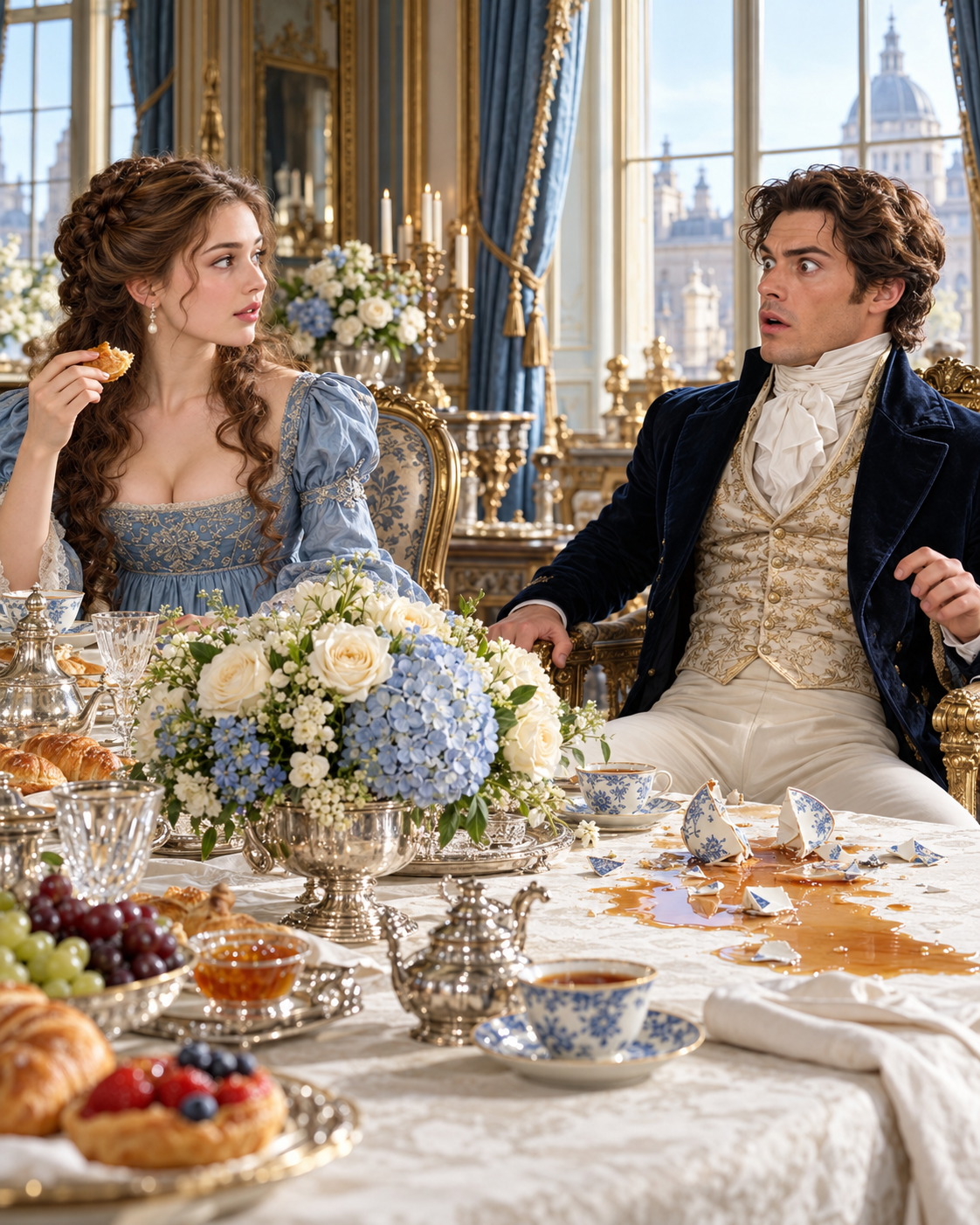
Edmund spent the morning reconstructing the evening at Harrington’s reception.
He questioned a footman, visited the club where several guests had gathered afterward, and finally persuaded Harrington himself to speak privately.
The older gentleman received him in a room overlooking a square where wet leaves collected beneath the trees.
“I remember the man,” Harrington said.
“Did you know him?”
“No. He arrived with Lady Diana.”
Edmund felt his stomach tighten.
“She introduced him as a distant relation. Mr. Grey, I believe.”
“Did they leave together?”
Harrington shook his head.
“The gentleman departed early. Lady Diana remained.”
Edmund leaned forward.
“Did anything seem unusual?”
Harrington considered.
“Only one thing.”
“What?”
“Lady Diana was frightened of him.”
Edmund remembered her hand trembling when she first approached him that evening.
He had mistaken it for nervous excitement.
He remembered how quickly she had drawn him into the conservatory, how urgently she had asked whether he was happy.
And he remembered how pleased he had felt to be wanted.
The realization made him look away.
“What makes you say she was frightened?”
Harrington set down his glass.
“Because when he touched her shoulder, she flinched.”
***
That afternoon, a note arrived at West Mand House.
It was addressed to Edmund.
He recognized Diana’s handwriting immediately.
Please come to the old orangery at four.
Do not bring Victoria.
I have something I should have told you.
Edmund read the note twice.
Then he carried it to Victoria’s sitting room.
She had returned from Bell’s office less than an hour earlier and was examining the ledger at her desk.
He handed her the message.
Her expression changed almost imperceptibly.
“You intend to go?”
“Yes.”
“Alone?”
“No.”
Victoria looked up.
Edmund pulled a chair toward her desk.
“I’ve made enough decisions without considering you.”
For a moment, she simply watched him.
Then she reached for her gloves.
“We leave in twenty minutes.”
***
The orangery stood beyond the eastern gardens, where the estate’s oldest glasshouse had fallen into disrepair.
Rain tapped against cracked panes.
Inside, the air smelled of damp earth and dead leaves.
Diana waited beside an empty stone fountain.
Her fashionable coat was buttoned incorrectly.
When she saw Victoria enter behind Edmund, she stepped backward.
“I told you not to bring her.”
Edmund stopped several feet away.
“You wrote that you had something to tell me.”
Diana’s gaze moved toward the door.
Victoria noticed the movement.
“Is someone coming?”
“No.”
“Diana.”
The younger woman’s fingers tightened around her handbag.
“He told me you wouldn’t believe me.”
Victoria approached slowly.
“Who told you?”
Diana looked at Edmund.
“I never meant for any of this to happen.”
Edmund felt his jaw tighten.
“You knew I was married.”
“Yes.”
“You knew Victoria.”
Diana’s eyes filled, but she refused to look away.
“Yes.”
Victoria stood beside the fountain.
“Then perhaps we should dispense with the explanations neither of us can afford.”
Diana drew a shaking breath.
“Sebastian Vale is my uncle.”
The rain seemed suddenly louder.
Edmund stared at her.
Victoria remained still.
“That is impossible,” Edmund said.
Diana shook her head.
“He is my mother’s half-brother. He came back into our lives two years ago.”
“Why?”
“Money. At first, he said he wanted repayment for something our family owed him.”
Diana opened her handbag.
“He knew things about my father. Things that would have destroyed him before he died.”
She withdrew a packet of letters.
“Then he began asking about West Mand.”
Victoria accepted the packet without touching Diana’s hand.
The first letter contained a list of Edmund’s habits.
His club.
His favorite riding paths.
The evenings he usually spent away from home.
The second described Victoria’s routine.
Her visits to the hospital charity.
Her weekly correspondence.
The hours she preferred to work undisturbed.
Edmund felt suddenly ill.
“You were watching us.”
Diana lowered her head.
“I was told to get close to you.”
“And you obeyed.”
“At first.”
Her voice broke on the final word.
Victoria turned another page.
“And afterward?”
Diana lifted her eyes.
“Afterward, I began to believe he was right about your marriage.”
Edmund said nothing.
“He told me you were both miserable, that Victoria wanted to leave but couldn’t because of the estates.”
Victoria looked directly at her.
“And you found that convenient.”
Diana accepted the judgment.
“Yes.”
For several seconds, only the rain spoke.
Then Diana pointed toward the final letter.
“He wanted Edmund to announce a separation.”
“Why?” Victoria asked.
“Because the trust established by your fathers contains a condition.”
Victoria’s fingers tightened around the papers.
“What condition?”
Diana looked toward the entrance again.
“If the marriage is dissolved, certain properties revert to the original holding company.”
Victoria remembered Bell’s ledger.
The false transfers.
The forged documents.
The quiet disappearance of Sebastian Vale.
“Vale’s company,” she said.
Diana nodded.
“He would gain control of the northern estates.”
Edmund stepped back as if the cold stone floor had shifted beneath him.
The affair had not merely wounded his marriage.
It had been used to threaten everything Victoria had spent years protecting.
Then a voice came from the doorway.
“How disappointing.”
Sebastian Vale stood beneath the broken arch, rain glistening on the shoulders of his dark coat.
“After all my careful work, Diana, you have become sentimental.”
***
He looked older than the portrait.
Silver marked his temples.
The scar beneath his ear had deepened into a pale, crooked line.
But Victoria recognized his smile.
It was the same courteous expression he had worn when advising her nineteen-year-old self to marry a man she barely knew.
“Sebastian,” she said.
He inclined his head.
“Your Grace.”
Edmund moved slightly in front of Victoria.
Sebastian noticed.
“An admirable gesture, Duke. Rather late, but admirable.”
Diana backed against the fountain.
“You said no one would be hurt.”
Sebastian barely glanced at her.
“My dear, people are hurt every day. It is how most useful arrangements are made.”
Victoria stepped out from behind Edmund.
“You went to remarkable lengths for land you do not own.”
Sebastian smiled.
“Ownership is such a temporary concept. Control is far more interesting.”
She looked at his empty hands.
“You came without your documents.”
“I don’t need documents. I need your husband to finish what he started.”
Edmund’s face hardened.
“I won’t leave Victoria.”
Sebastian’s expression remained pleasant.
“Your devotion has arrived at an inconvenient hour.”
He reached inside his coat and produced a folded paper.
Victoria recognized the handwriting before he offered it.
Her father’s.
Sebastian held it carefully between two fingers.
“Your father was not quite the honorable man you remember.”
Victoria did not move.
“Neither were you.”
“True. But I never claimed otherwise.”
He unfolded the paper.
“Your father agreed to surrender control of the northern estates if certain evidence was ever made public.”
“What evidence?”
Sebastian looked toward Edmund.
“Ask your husband what happened to the original financial records after his father died.”
Edmund frowned.
“I was never involved in the estate accounts.”
“No,” Sebastian said. “You were too young. But your family’s reputation rested upon their disappearance.”
Victoria studied the paper.
She recognized the signature.
Then she noticed the date.
It had been written four months after her father’s death.
She lifted her eyes.
“An impressive document.”
Sebastian’s smile thinned.
“Be careful.”
“My father must have been extraordinarily devoted to his business to sign agreements from the grave.”
For the first time, Sebastian’s composure fractured.
Only for a moment.
But Edmund saw it.
Victoria folded her arms.
“You forged his signature. Just as you forged the earlier accounts.”
Sebastian replaced the document inside his coat.
“A clever observation will not save your estates.”
“Perhaps not.”
Victoria glanced toward the doorway.
“But testimony might.”
Footsteps sounded outside.
Sebastian turned.
Mr. Bell entered beneath an umbrella, accompanied by two uniformed constables and a plainclothes inspector.
For one suspended instant, no one moved.
Then Sebastian looked back at Victoria.
“You knew.”
“I suspected.”
He gave a soft, humorless laugh.
“And you brought the police into a family disagreement?”
Victoria’s expression remained composed.
“You ceased to be family when you made other people’s lives your property.”
The inspector approached.
“Lord Vale, I have questions concerning several allegations of fraud, forgery, and coercion.”
Sebastian’s smile disappeared.
He looked at Edmund.
“Your wife has always been more dangerous than you understood.”
Edmund answered without hesitation.
“Only to men who mistake her restraint for weakness.”
***
The investigation lasted six months.
It reached into banking houses, private correspondence, and estate records that had not been examined for decades.
Sebastian’s disappearance had been arranged through false identities and the assistance of a financial agent who was now dead.
The late Duke had agreed to let him go in exchange for evidence that might have implicated several influential families.
That bargain had allowed Sebastian to retain access to funds and papers that later enabled his return.
Mr. Bell surrendered everything he had concealed.
Diana gave a full statement.
Her cooperation spared her from some consequences, but not from public disgrace.
Edmund did not attempt to rescue her reputation.
Nor did he seek another private meeting.
The final time he saw Diana was in a solicitor’s office, where she sat across the room in a plain blue dress.
She looked tired.
“I am sorry,” she told him.
He nodded.
“So am I.”
There was nothing more to say.
What had passed between them could not be made innocent simply because another man had exploited it.
Their choices remained their own.
Edmund understood that more clearly than he had understood anything during the affair.
He had wanted admiration without responsibility.
He had mistaken attention for affection and secrecy for intimacy.
Sebastian had recognized the weakness and used it.
But the weakness had belonged to Edmund long before Sebastian entered the room.
***
At West Mand, life continued.
The estate required management.
Tenants needed repairs to their cottages.
The hospital charity needed additional funding.
There were accounts to approve, letters to answer, and dinners at which the Duchess and Duke were expected to appear together.
Victoria resumed these obligations with her customary precision.
Edmund began attending estate meetings he had previously avoided.
At first, the stewards were surprised to see him.
Then they grew accustomed to his presence.
He learned the names of the farmers whose rents supported the house.
He visited properties in weather that would once have kept him beside the fire.
He read financial reports until their columns ceased to resemble a foreign language.
He did not mention these efforts to Victoria unless they concerned a decision she needed to make.
She noticed anyway.
One November morning, she found him standing beside the head gardener beneath a cold drizzle.
A storm had damaged the old greenhouse.
Edmund was helping examine the broken frames.
His coat was muddy.
He was listening rather than giving orders.
Victoria watched from the library window.
For several minutes, she remained there.
Then she returned to her correspondence.
Nothing in the room had changed.
Yet when she reached for her pen, she discovered she had forgotten what she intended to write.
***
That winter, the trial concluded.
Sebastian Vale was convicted on multiple charges connected to the forged financial documents and the coercion of Diana.
The court’s findings also exposed the failures of the men who had protected him years earlier.
There was no triumph in the newspaper account.
Only names.
Dates.
Transactions.
The dry language of consequences.
Victoria read the verdict at breakfast.
Edmund sat opposite her.
“Are you relieved?” he asked.
She folded the newspaper.
“I am glad it is finished.”
He hesitated.
“Is it?”
Victoria looked toward the window.
Snow had gathered along the garden walls.
“The legal matter is finished.”
Edmund understood what she had left unsaid.
He returned to his breakfast.
For several minutes, the room was quiet.
Then Victoria spoke.
“I’ve been considering the northern estate.”
He lifted his eyes.
“The properties Vale wanted?”
“Yes. I intend to establish an independent trust for the families who live there.”
Edmund placed his cup down.
“That will require a considerable transfer of assets.”
“I know.”
“And a change to our inheritance arrangements.”
“Yes.”
He considered the proposal.
Years earlier, he would have objected immediately.
The property had belonged to his family for generations.
His father had spoken of it as though the land were an extension of their blood.
Now Edmund remembered the tenants he had met.
The leaking roofs.
The elderly farmer who feared his sons would be forced to leave.
“What would you need from me?” he asked.
Victoria looked at him carefully.
“Your signature.”
He reached for the documents.
She studied his face.
“Don’t you want to read them first?”
Edmund paused.
Then, almost despite himself, he smiled faintly.
“Yes. I believe I should.”
And he did.
***
Spring returned slowly.
The gardens awakened beneath pale sunshine.
The drawing rooms were opened.
Fresh flowers appeared on the breakfast table.
One afternoon, Victoria found Edmund in the old library, examining the miniature portrait of Sebastian Vale.
He had placed it beside a pile of documents awaiting destruction.
“Bell says the remaining legal records can be archived,” he told her.
Victoria approached the desk.
She looked at the portrait.
The familiar face seemed smaller now.
Almost ordinary.
“Burn it,” she said.
Edmund lifted the miniature.
For a moment, he hesitated.
“Are you certain?”
Victoria studied the painted eyes.
Once, that man had influenced nearly every decision shaping her adult life.
He had chosen the circumstances of her marriage, manipulated her husband’s weakness, and assumed that affection could be turned into a legal instrument.
But he had failed to understand something simple.
A life could be influenced without being owned.
“Yes,” she said.
Edmund carried the portrait to the fireplace.
He placed it among the burning logs.
The velvet backing curled.
The painted face blackened.
Then the flames took it.
Victoria watched until nothing recognizable remained.
Edmund stood beside her.
Their shoulders did not touch.
“Did you ever love me?” he asked quietly.
The question emerged without warning.
Victoria looked into the fire.
“Yes.”
He closed his eyes.
The answer hurt more than he had expected.
“Do you still?”
She turned toward him.
For once, she did not immediately retreat behind courtesy.
“I don’t know.”
Edmund nodded.
It was not the answer he wanted.
But it was the first answer in months that carried no obligation to reassure him.
“Thank you for telling me.”
Victoria looked at his hands.
There were small cuts across his knuckles from repairing a damaged fence that morning.
Once, those hands had seemed incapable of anything more demanding than holding a glass or signing a letter.
Now they bore the evidence of work he had chosen.
It mattered.
But it did not erase what they had done.
“Edmund,” she said, “I cannot return to the woman I was before Diana.”
“I know.”
“And I will not spend the rest of my life pretending that suffering has made our marriage more beautiful.”
He met her eyes.
“I would never ask that.”
“You asked me to forgive you before you understood what forgiveness would cost.”
He lowered his gaze.
“Yes.”
She took a breath.
“I may never trust you as I once did.”
Edmund accepted the words in silence.
Then he said, “Perhaps you shouldn’t.”
Victoria looked surprised.
He continued carefully.
“I don’t want you to trust the man I promised to be. I want to become someone whose actions you can judge for yourself.”
Outside, a bird called from the garden.
Victoria turned toward the window.
For a long moment, neither moved.
Then she spoke.
“Tomorrow, we’re visiting the northern estate. The trustees wish to meet us.”
“I’ve already arranged the carriage.”
“At ten?”
“At half past nine. The roads are still poor.”
Victoria glanced back at him.
“A sensible decision.”
It was not affection.
It was not forgiveness.
But Edmund felt the significance of being addressed without contempt.
He did not attempt to turn the moment into more than it was.
***
The following summer, the Duke and Duchess of West Mand hosted a modest gathering to celebrate the opening of a school funded by the new northern trust.
There were no elaborate speeches about generosity.
Victoria had refused them.
The money, she insisted, belonged to the community whose labor had sustained the estate for generations.
Children gathered beneath the trees.
Parents stood beside the freshly painted doors.
The headmistress thanked the trustees.
When the ceremony ended, Edmund found Victoria alone beside a low stone wall overlooking the fields.
She held her gloves in one hand.
The afternoon sunlight caught the faint silver threads at her temples.
He stood beside her.
“Mrs. Hawthorne says the school can accommodate another thirty children next year.”
“Good.”
“And the village council has requested assistance with the bridge.”
“We should review their proposal.”
Edmund nodded.
They watched a group of children run across the grass.
One little girl stumbled.
Another stopped, helped her rise, and brushed the dust from her skirt.
Then they ran on together.
Victoria’s mouth softened into a small smile.
Edmund saw it but said nothing.
After a while, she spoke.
“My father once told me that a successful marriage was one that endured.”
Edmund looked toward her.
“I used to believe him.”
“And now?”
Victoria considered the question.
“I think endurance alone is a poor measure of happiness.”
He waited.
“A locked door endures. So does a prison.”
Edmund lowered his eyes.
“And yet,” she continued, “there are things worth maintaining, if the people responsible for them are willing to change.”
He looked at her again.
“Do you believe we can?”
Victoria held his gaze.
“I believe we have already changed.”
She slipped her gloves back on.
“But whether that change is enough remains ours to decide.”
Edmund offered his arm as they turned toward the school.
She looked at it.
Once, accepting that gesture had been automatic.
Later, it had become a performance.
Now she considered it for what it was.
A choice.
She rested her hand lightly upon his sleeve.
Together, they walked toward the waiting guests.
***
That evening, Victoria returned to her dressing room.
The house was quiet.
On her table stood the small velvet box that had once contained her wedding ring.
She opened it.
The ring lay where she had left it months earlier.
She lifted it into the light.
Its gold surface was scratched from years of wear.
For a long time, she held it between her fingers.
Then she placed it back inside the box.
She did not need to wear it to prove that she had stayed.
Nor did she need to discard it to prove that she had survived.
She closed the lid and set the box in a drawer.
Downstairs, Edmund was waiting with the evening accounts.
They had agreed to review the trust’s finances before dinner.
Victoria extinguished the lamp and left the room.
As she descended the staircase, she heard Edmund speaking with a young footman.
The boy had made an error in recording a payment.
Edmund corrected it patiently, then asked him to sit and work through the figures again.
There was no audience.
No applause.
No advantage to be gained.
Victoria paused on the landing.
The man in the hall was still imperfect.
So was she.
The difference was that neither of them could afford the comfort of pretending otherwise.
When Edmund noticed her, he rose.
“Everything is ready,” he said.
Victoria walked toward the table.
“Then let us begin.”
And they did.
Not with a declaration of undying love.
Not with the restoration of everything that had been lost.
But with two chairs, an open ledger, and the quiet willingness to face what stood before them.
Their marriage had survived, though survival was no longer its greatest achievement.
It had become a partnership in which neither person could hide behind rank, appearances, or promises.
Trust, Victoria understood, was not a debt the wounded must forgive, nor a prize the guilty could demand.
It was something built through ordinary choices, repeated when no one was watching.
And love, if it ever returned, would have to arrive without disguising itself as duty.
That was enough for this evening.
Tomorrow would ask its own questions.
For the first time in many years, Victoria knew she was free to answer them for herself.
THE END.