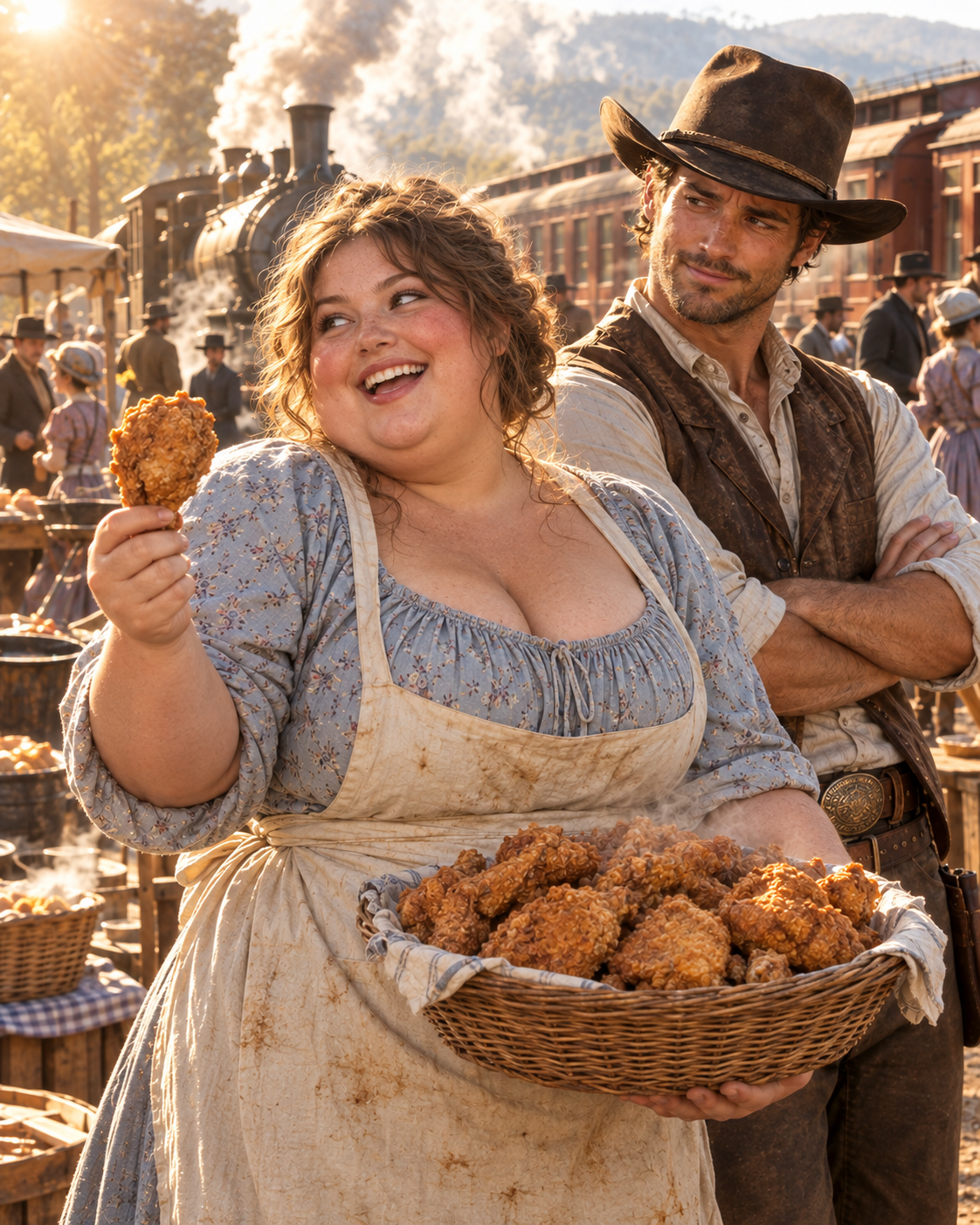
The day Holt Barlo dumped my fried chicken onto the dirt at Dunore Station, he called me a desperate nobody—but he had no idea I had just uncovered the reason his ranch was dying.
For a long moment, neither of us spoke.
Holt stared at the letter in my hand as though it had become something alive.
“Where did you get that handwriting?” he whispered.
I looked at him.
“From the letter your wife left in the kitchen drawer.”
His face drained of color.
“You found that?”
“She wrote three pages about the garden, the hens, and the accounts. At the bottom, she signed her name.”
Holt took the envelope from me.
His fingers trembled as he traced the words.
“That’s Clara’s handwriting.”
“I know.”
He sank into the chair.
For the first time since I had met him, Holt looked less like a rancher and more like a widower who had just been handed a piece of his past.
“Clara is dead,” he said quietly.
“I know.”
“Then who wrote this?”
“That is what we’re going to find out.”
He looked toward the dark window.
Outside, the wind dragged dust across the yard.
“Eleanor, if Calder is behind this, he could have killed her.”
I felt a chill move through me.
“Then we need to stop him before he does it again.”
Holt stood.
“No.”
I frowned.
“No?”
“You’re leaving.”
“I beg your pardon?”
“I won’t let you get caught in this.”
I almost laughed.
“You think I’m going to pack my basket and go back to Dunore Station while a man is trying to take your ranch?”
“Yes.”
“Well, you’re going to have to drag me.”
His jaw tightened.
“You don’t understand.”
“I understand perfectly.”
I placed the letter on the table.
“You’ve spent two years believing your wife died and left you with nothing but grief. Maybe she didn’t. Maybe she left you a warning.”
Holt stared at me.
“And if we walk away now,” I continued, “then whoever wrote this wins.”
He said nothing.
That silence was enough.
We began looking through Clara’s belongings that same night.
Her room had remained untouched since her death.
Holt had been unable to move anything.
Her blue dress still hung beside the wardrobe.
A dried sprig of lavender rested inside a small porcelain bowl.
There were books on the nightstand, a silver hairbrush, and a framed photograph of Clara standing beside Holt beneath the cottonwood tree.
I had never met her, yet the room felt full of her.
“She was stubborn,” Holt said.
I smiled faintly.
“Then we might have gotten along.”
A sad smile touched his mouth.
“You would have.”
We searched until midnight.
Nothing.
Then I noticed the photograph.
Clara was smiling, but one hand was behind her back.
Something small and metallic caught the light.
I removed the frame.
There was a key taped to its back.
Holt stared at it.
“Where does that go?”
“I don’t know.”
We searched the room again.
The key had a tiny brass tag attached to it.
One number was engraved there.
17.
Holt suddenly went still.
“Dunore Station.”
I looked at him.
“What?”
“Storage lockers.”
The next morning, before sunrise, we rode into town.
We told no one where we were going.
At Dunore Station, the platform was nearly empty.
Snow had begun falling lightly, covering the rails in white.
The stationmaster looked at the key.
“Locker seventeen?”
He pointed down the corridor.
“Hasn’t been opened in almost two years.”
Holt inserted the key.
The lock clicked.
Inside was a small wooden box.
Holt lifted it out.
There was a second envelope inside.
This one was addressed to him.
His hands shook as he opened it.
The letter was short.
“Holt,
If you are reading this, then I was right to be afraid.
Calder has been buying land around the ranch because he knows something we don’t.
The water beneath our eastern pasture is being diverted.
The creek is not drying naturally.
Someone has been cutting the underground irrigation line and poisoning the upper spring with salt.
I found payments in Calder’s ledger to a man named Silas Vane.
I don’t know who he is.
I also found records showing that Calder has been bribing the county inspector to declare our water rights invalid.
If the ranch loses the eastern pasture, we will not survive.
Do not trust anyone who tells you I was mistaken.
And Holt—if something happens to me, do not sell.
Whatever happens, do not sell.
Clara.”
Holt read the last line twice.
Then he closed his eyes.
“She knew.”
I took the ledger from the box.
“Let’s find Silas Vane.”
We barely made it back to the ranch before Holt’s foreman, Amos Reed, came running from the barn.
“Boss!”
Holt dismounted.
“What?”
“There was trouble at the east pasture.”
We followed him.
One of the ranch hands was kneeling beside the spring.
The water had turned cloudy.
A sharp chemical smell hung in the air.
Holt crouched beside it.
His face became hard.
“Salt.”
Amos nodded.
“Found these near the fence.”
He held up a pair of muddy boots.
I recognized the tread.
They belonged to Edgar Calder.
Holt stood.
“Get the men.”
“Where are you going?”
“To Calder’s.”
I caught his arm.
“No.”
He looked at me.
“No?”
“If he knows we’ve found Clara’s records, he’ll know exactly how much we know.”
Holt’s anger was burning.
“Then what do you suggest?”
“We let him think we’re scared.”
“You want me to pretend I’m scared?”
“You’ve been pretending you’re broken for two years.”
His eyes narrowed.
“What’s your point?”
“Use it.”
That evening, Holt went to Calder’s store alone.
He returned three hours later with a look that told me something had happened.
“What did he say?”
“He offered me forty thousand dollars for the ranch.”
I froze.
“Forty thousand?”
“He said it was generous.”
“Did he mention the water?”
“No.”
“Did he mention Clara?”
Holt shook his head.
“But he asked whether you’ve been asking questions.”
My stomach tightened.
“What did you tell him?”
“That you were leaving.”
I stared at him.
He smiled.
“I told him you were tired of this place.”
“And?”
“He believed me.”
“Good.”
Holt leaned against the table.
“There’s something else.”
“What?”
“Silas Vane works for the county water office.”
The room seemed to shrink.
“That means the inspector.”
“Yes.”
“So Calder doesn’t just want the ranch.”
Holt nodded.
“He wants the water rights.”
“And the surrounding land.”
“Yes.”
I looked at the map spread across the table.
Suddenly, everything made sense.
Calder had purchased the properties around Holt’s land.
If Holt lost his water rights, the ranch would become nearly worthless.
Then Calder could buy it cheaply.
But why had Clara died?
I couldn’t stop thinking about it.
“Did Clara’s death ever get investigated?”
Holt’s expression changed.
“She fell from the ridge.”
“Accident?”
“That was the official conclusion.”
“Did anyone see her?”
“No.”
“Was Calder nearby?”
“He claimed he was in town.”
I looked at him.
“Claimed?”
Holt nodded.
“There were no witnesses.”
The next morning, we traveled to the county records office.
The clerk was an old woman named Martha Bell.
When Holt gave her Clara’s name, her expression changed.
“You’ve come for the same file she did.”
Holt stiffened.
“What file?”
“Water rights.”
Martha lowered her voice.
“She came here three days before she died.”
“Was she alone?”
“No. A man followed her.”
“Who?”
Martha looked toward the hallway.
“Silas Vane.”
Holt’s fists clenched.
“What happened?”
“She asked for records showing the original water boundaries.”
“Did you give them to her?”
“I did.”
“Then what?”
“She left with copies.”
Martha hesitated.
“And Silas came back an hour later.”
“What did he want?”
“The copies.”
“Did you give them to him?”
“No.”
Martha smiled faintly.
“I told him I had burned them.”
I exhaled.
“Where are they?”
She looked at me.
“Not here.”
“Where?”
“In a place Clara told me to keep them.”
My heart began pounding.
Martha reached beneath the desk and pulled out a folded map.
“The eastern water line isn’t where the county says it is.”
She spread it across the table.
“The original boundary runs through Calder’s newly purchased land.”
Holt stared at it.
“If this is true, he bought all that land without realizing the water belongs to me.”
Martha nodded.
“He realized it afterward.”
“And that’s when he started sabotaging us.”
“Yes.”
I pointed to a mark on the map.
“What is this?”
Martha’s face became serious.
“That is the old Barlo tunnel.”
Holt looked at me.
“There was a tunnel beneath the eastern pasture.”
“What happened to it?”
“Collapsed years ago.”
Martha shook her head.
“Not completely.”
The three of us looked at one another.
That afternoon, Holt and I rode to the eastern pasture.
We found the entrance beneath a cluster of dead cottonwoods.
The old tunnel had been concealed behind fallen boards.
Inside, the air smelled of wet stone.
Our lanterns revealed fresh boot prints in the mud.
Someone had been there recently.
We followed the prints.
Twenty yards in, we discovered a wooden platform above a narrow underground stream.
Pipes ran from the stream toward the ranch.
Someone had installed a valve.
The valve had been deliberately closed.
Holt stared at it.
“That explains the dry creek.”
I knelt beside the pipe.
“There are scratches here.”
“What kind?”
“Tools.”
Then I saw something caught beneath the platform.
A small silver locket.
Holt picked it up.
His breath stopped.
“It was Clara’s.”
For a moment, he couldn’t speak.
Then we heard a sound.
Footsteps.
Someone was coming through the tunnel.
Holt blew out the lantern.
We pressed ourselves against the wall.
A figure entered carrying a lamp.
Silas Vane.
He walked directly to the valve.
Then another voice echoed behind him.
Calder.
“You should have finished this months ago.”
Vane answered, “The ranch should have collapsed by now.”
“It would have if that woman hadn’t arrived.”
My heart hammered.
Calder continued.
“She’s asking questions.”
“She knows nothing.”
“She found the invoices.”
Silas laughed.
“Then frighten her.”
“You don’t understand her.”
“I understand desperate people.”
I felt Holt tense beside me.
Calder’s voice dropped.
“Clara was just as stubborn.”
Silence.
Then Silas said, “You promised no one would know.”
“I kept my promise.”
“You pushed her.”
Holt’s hand moved toward his belt.
I grabbed his wrist.
Not yet.
Calder whispered something we couldn’t hear.
Then Silas said, “She fell.”
The words seemed to freeze the air.
Holt’s breathing changed.
I could feel his rage beside me.
Calder spoke again.
“And nobody will ever prove otherwise.”
That was enough.
Holt stepped into the light.
“You just did.”
Both men turned.
Calder’s face went white.
Silas reached for a pistol.
Holt was faster.
He knocked the weapon away and slammed Silas against the wall.
Calder ran.
I grabbed the fallen pistol and kicked it across the tunnel.
“Run after him,” I told Holt.
He hesitated.
“I’m not leaving you.”
“Go!”
Holt disappeared into the darkness.
Silas struggled.
“You don’t know what you’re doing.”
I looked him directly in the eyes.
“I know exactly what I’m doing.”
He smiled.
“You’re a cook.”
I shook my head.
“No.”
I held up Clara’s locket.
“I’m the woman who found her evidence.”
By the time we emerged from the tunnel, Holt had Calder pinned near the barn.
But Calder wasn’t alone.
Three armed men stood beside him.
Amos and the ranch hands had arrived from the house.
The entire ranch had gathered.
For months, those men had watched their home die without knowing why.
Now they finally understood.
Calder raised his hands.
“You’re making a mistake, Holt.”
“You killed my wife.”
Calder’s expression hardened.
“You can’t prove that.”
I stepped forward.
“We can.”
I held up the recorder.
Calder stared at it.
“You heard us?”
“Every word.”
His face changed.
Then Martha Bell appeared at the edge of the yard with the county sheriff.
Behind her came two deputies.
The sheriff looked at Calder.
“Edgar Calder, you’re under arrest.”
Calder laughed bitterly.
“You have no idea who you’re dealing with.”
The sheriff took the recording from me.
“I know exactly who I’m dealing with.”
Silas was arrested as well.
The investigation lasted weeks.
The county discovered falsified water records, bribery, theft, and sabotage.
The original water boundaries were restored.
Clara’s death was reopened.
The evidence from the tunnel, combined with the recording and the financial records, finally established what had happened.
Calder had confronted Clara at the ridge after she discovered his scheme.
Silas had been there.
During the argument, Calder shoved her.
She fell.
They had hidden her notes and created the appearance of an accident.
For nearly two years, Holt had carried the guilt of a man who believed he should have protected his wife.
When the truth finally came out, he stood beside Clara’s grave for a long time.
I stayed several steps away.
He didn’t speak.
Neither did I.
Then he turned.
“I thought I lost everything when she died.”
I looked at him.
“You lost someone.”
He nodded.
“But I still had a ranch.”
“Yes.”
“And I almost lost that too because I stopped looking at what remained.”
I smiled.
“You weren’t the only one who needed reminding.”
Holt walked toward me.
“Eleanor.”
“Yes?”
“You saved my ranch.”
“No.”
He frowned.
“I didn’t?”
“You helped save it.”
“What did I do?”
“You gave me a chance.”
He smiled.
“And what did you do?”
I looked back at the house.
“I noticed things.”
He laughed softly.
“That sounds like you.”
Spring came late that year.
The creek began running again after the underground valve was repaired.
The garden returned.
The hens multiplied.
The pantry filled.
The ranch hands began arguing over whose turn it was to wash dishes.
And every morning, before sunrise, I still cooked.
But I no longer carried my fried chicken to Dunore Station in a dented basket.
Instead, people came to the ranch.
Farmers.
Travelers.
Railroad workers.
Cowboys.
Families from town.
They came because they had heard about the woman who could turn scraps into a feast.
Holt built a small kitchen beside the barn.
Above the door, he hung a wooden sign.
“Eleanor’s Table.”
I complained that my name was too large.
He said it was exactly the right size.
One afternoon, a young girl came into the kitchen while I was kneading dough.
She couldn’t have been more than sixteen.
She stood quietly until I noticed her.
“Can I help?”
I wiped flour from my hands.
“What’s your name?”
“Lucy.”
“Do you know how to cook?”
She shook her head.
“Then you’re about to learn.”
She smiled.
As she began sorting potatoes, she asked, “Is it true you saved the Barlo Ranch?”
I glanced through the window.
Holt was repairing a fence with two of the ranch hands.
“No.”
Lucy looked surprised.
“Then who did?”
I thought about Clara’s hidden key.
The envelope beneath the kitchen door.
The records in the station locker.
The men who had finally stood together.
And the frightened woman who had refused to let someone else’s greed erase the truth.
“Everyone who refused to give up,” I said.
Lucy considered that.
“Even you?”
I smiled.
“Especially me.”
Years later, people would tell the story differently.
Some said Holt Barlo had defeated Calder.
Others said Clara’s evidence had saved the ranch.
Some insisted the sheriff deserved the credit.
But I knew the truth was more complicated.
A ranch is not saved by one person.
Neither is a life.
Sometimes survival begins with something as small as noticing that a fifty-pound sack weighs thirty-eight.
Sometimes courage looks like opening a locked box.
Sometimes it looks like staying when everyone expects you to leave.
And sometimes the person everyone calls a desperate nobody is simply the person who has been paying attention.
I had arrived at Dunore Station broke, hungry, and certain that the world had already decided my worth.
I left it with something no amount of money could buy.
A place at the table.
A purpose.
And the knowledge that being underestimated can become its own kind of strength.
As for Holt, he never stopped missing Clara.
I never asked him to.
Love does not disappear simply because a person is gone.
But grief eventually learned how to live beside hope.
One evening, years after the arrests, Holt and I stood beneath the old cottonwood tree.
The ranch stretched around us, green and golden beneath the setting sun.
He looked toward the eastern pasture.
“The creek is louder this year.”
I smiled.
“It has something to say.”
He looked at me.
“And what do you think it’s saying?”
I listened to the water.
Then I answered,
“That nothing stays buried forever.”
Holt took my hand.
For a while, we stood there without speaking.
Behind us, laughter rose from the kitchen.
Someone had burned the biscuits.
Someone else was blaming the cook.
And for the first time, I understood something I had never understood at Dunore Station.
A good life isn’t the life where nothing breaks.
It is the life where, after everything breaks, you decide what is worth rebuilding.
The Barlo Ranch had nearly died.
Holt had nearly disappeared inside his grief.
I had nearly believed the world when it told me I was nobody.
But the ranch survived.
Holt survived.
And so did I.
Not because we were stronger than everyone who tried to destroy us.
We survived because we refused to let other people’s cruelty decide what our future would be.
That was the lesson Clara had left behind.
That was the lesson the ranch taught me.
And that was the truth I carried with me every morning when the sun rose over the fields:
Sometimes, the smallest person in the room is the one holding the key to everything.
THE END.