The day Flint slammed a handler against the iron bars at the royal menagerie, the overseer blamed me for approaching him—because someone had secretly starved that dragon for a year.
Flint did not move.
He stood between me and the distant ridge, his enormous wings half-open, his body rigid beneath my hand.
For several seconds, I could hear nothing except the wind moving through the bare branches of the oak.
Then came the sound again.
A deep, distant rumble rolled across the valley.
It was not thunder.
It was a roar.
Flint answered.
The sound that left his chest was so powerful that the stone walls of the menagerie seemed to tremble.
I pulled my hand away.
“Flint?”
He did not look at me.
His eyes remained fixed on the ridge.
Something was coming.
I ran toward the main gate.
“Garrick!”
He emerged from the records room, startled by my voice.
“What happened?”
“There’s something on the ridge.”
Before he could ask anything else, another roar echoed through the valley.
Every dragon in the menagerie reacted.
Wings slammed against cages.
Chains rattled.
Several smaller dragons shrieked and pressed themselves against the far walls of their enclosures.
Garrick’s face went pale.
“Get everyone inside.”
“What is it?”
“I don’t know.”
He grabbed the keys from his belt.
“But whatever it is, the dragons know it.”
We had barely reached the eastern watchtower when the menagerie bells began ringing.
Once.
Twice.
Then continuously.
Guards poured from the barracks.
Someone shouted that there were shapes moving beyond the ridge.
I looked up.
At first, I saw only snow.
Then one of the shapes moved.
A wing emerged from behind the mountain.
It was enormous.
Far larger than Flint’s.
Another shape followed.
Then another.
My breath caught in my throat.
Dragons.
Not one.
Not two.
At least six.
They rose slowly above the ridge, their silhouettes dark against the evening sky.
The guards froze.
Garrick whispered something I could not hear.
Then Flint roared again.
The largest dragon answered.
It was a sound unlike anything I had ever heard.
Not anger.
Not a threat.
Recognition.
Flint spread his wings.
“He’s going to leave,” Garrick said.
“No.”
I stepped closer to the fence.
“He’s going to meet them.”
Flint turned his head.
For one strange moment, our eyes met.
I remembered the first morning I had seen him lying beneath the oak.
The hollow ribs.
The exhausted eyes.
The creature everyone had called beyond saving.
Now his wings were strong enough to lift him into the winter sky.
I placed my hand against the bars.
“Go.”
His eyes remained on mine.
“You don’t belong in a cage.”
Flint lowered his head.
Then he opened his wings.
The first beat sent a wave of cold air across the courtyard.
The second lifted him from the ground.
The guards stumbled backward.
I watched him rise above the walls of the menagerie.
For the first time, Flint was free.
But he did not fly toward the other dragons immediately.
He circled once above the oak.
Then twice.
As if memorizing the place.
As if saying goodbye.
I felt tears burning my eyes.
“Come back,” I whispered.
He gave one final roar and flew toward the mountains.
The other dragons followed.
Within minutes, the sky was empty.
Everyone remained silent.
Then Garrick looked at me.
“Do you think he’ll return?”
I looked at the mountains.
“I don’t know.”
Three days passed.
Flint did not return.
The council sent riders into the valley, but they found no trace of the dragons.
Some believed they had migrated south.
Others claimed the mountains had always been their home.
The guards returned nervous stories about enormous tracks in the snow.
No one knew where the dragons had gone.
But I knew one thing.
Flint had not escaped.
He had answered a call.
For the first time in his life, he had been given a choice.
And he had chosen the sky.
I tried to return to my duties.
The menagerie still needed feeding.
The cages still needed cleaning.
The dragons still needed care.
But every morning, I looked toward the oak.
It felt strangely empty without him.
My brother noticed.
“You miss him.”
We were sitting beside the kitchen window one morning, watching snow fall onto the little garden behind our house.
“Every day.”
“Do you think he misses you?”
I smiled sadly.
“I don’t know if dragons miss people.”
My brother thought for a moment.
“He waited for you every morning.”
I looked at him.
“So maybe they do.”
A week later, something happened that changed everything.
I was checking the western enclosure when one of the younger dragons began scratching violently at the ground.
I approached the fence.
“What is it?”
The dragon dug beneath the straw.
Something metallic appeared.
I crouched down and reached through the bars.
It was a small iron cylinder.
Inside was a folded piece of parchment.
My hands went cold when I saw the royal seal.
I brought it directly to Garrick.
He read it once.
Then again.
“This is from the old royal archives.”
“What does it say?”
He looked at me.
“It says dragons have been nesting in the northern mountains for generations.”
I frowned.
“Then why have we never seen them?”
“Because the records say they avoid human settlements.”
He turned the parchment over.
“There is more.”
His expression changed.
“The menagerie wasn’t built only to house captured dragons.”
I stared at him.
“What was it built for?”
“To study them.”
“Study them?”
Garrick nodded.
“And according to this record, every dragon brought here was supposed to be returned to the wild after treatment.”
I felt a chill.
“Then why weren’t they?”
Garrick did not answer.
He didn’t need to.
Someone had changed the policy.
Someone had decided that keeping dragons in cages was more profitable than releasing them.
We searched the archives for days.
The deeper we looked, the uglier the truth became.
For decades, the royal menagerie had captured young dragons from the northern valleys.
Some were sold to nobles.
Some were trained for war.
Others were displayed as symbols of royal power.
The records showed that several dragons had died in captivity.
Others had been classified as “dangerous” after resisting handlers.
And whenever a dragon became difficult to control, its food was reduced.
Weakness made obedience easier.
Flint had not been the first.
He had simply been the one who survived long enough for someone to notice.
I brought the evidence to the council.
This time, I was not alone.
Garrick stood beside me.
So did three senior keepers, two guards, and the royal archivist.
The council chamber was silent as the documents were read.
One councilor finally whispered,
“How long has this been happening?”
The archivist answered.
“At least thirty years.”
The room erupted.
Some demanded arrests.
Others demanded that the menagerie be shut down.
But the oldest councilor raised his hand.
“We cannot undo thirty years in one afternoon.”
He looked toward me.
“But we can decide what happens next.”
The council voted to close the menagerie to the public.
Every captive dragon was to be evaluated.
Any creature capable of surviving in the wild would be returned to its natural territory.
Those too injured to survive alone would remain under protection.
The decision was not celebrated.
It was painful.
Some dragons had spent so long in captivity that the outside world frightened them.
Freedom, we learned, was not always as simple as opening a gate.
A cage could be made of iron.
It could also be made of fear.
We began preparing the dragons one by one.
Some were transported to protected valleys.
Others were given larger territories within the royal grounds.
We planted trees.
Built shelters.
Created ponds.
For the first time, the menagerie stopped looking like a collection of cages.
It began to resemble a sanctuary.
But Flint was still missing.
Months passed.
Spring arrived.
Snow melted from the mountains.
Wildflowers appeared around the oak.
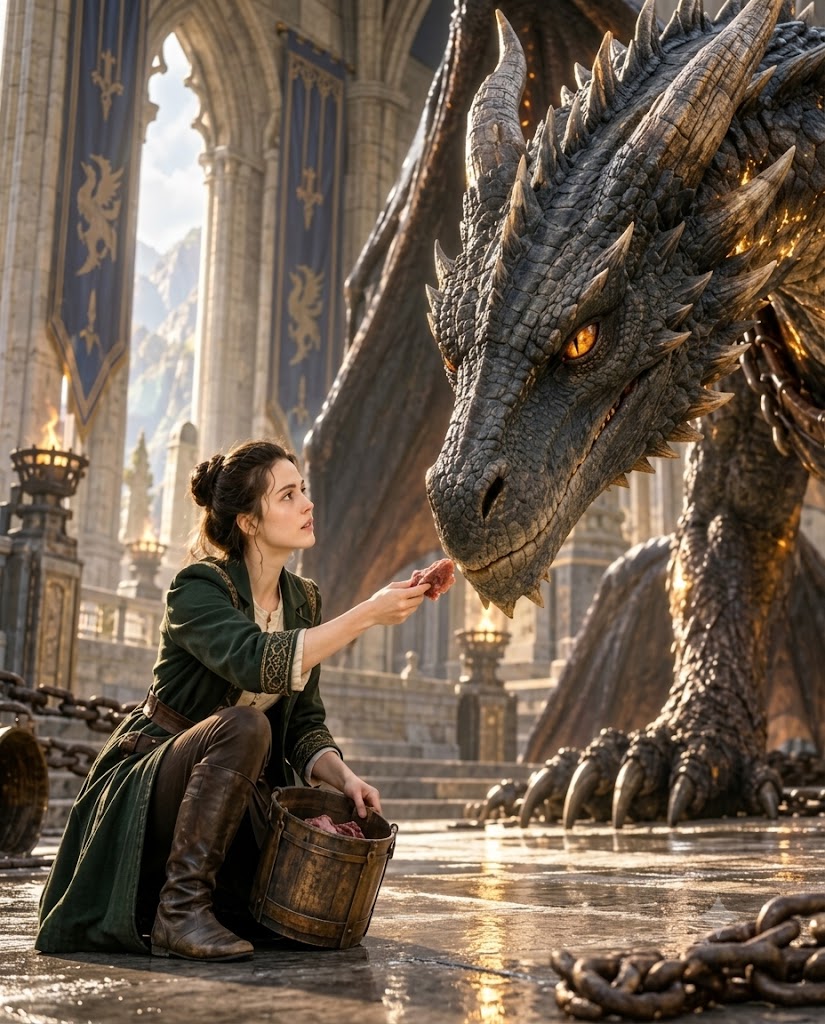
I kept a small bowl of cured meat beside the fence every evening.
Garrick teased me about it.
“You’re wasting food.”
“He might come back.”
“After six months?”
I shrugged.
“I told him to come back.”
Garrick smiled.
“You really believe dragons keep promises?”
“I believe Flint does.”
One evening, just before sunset, I was walking home when I heard wings.
I stopped.
The sound came from above.
A shadow crossed the road.
Then another.
I looked up.
My heart nearly stopped.
Flint descended from the clouds.
He landed in the meadow beyond the menagerie.
He was larger than I remembered.
His scales were darker.
His wings were scarred in places.
But his eyes were the same.
He looked at me.
I could not move.
Neither could he.
Then he lowered his head.
I ran.
I did not care that the guards shouted behind me.
I did not care about the mud beneath my boots.
I reached him and pressed both hands against his jaw.
Flint exhaled.
Warm air surrounded me.
“You came back.”
His eye closed.
Behind him, four other dragons descended.
They remained at a distance.
Garrick approached slowly.
“Are they following him?”
I shook my head.
“No.”
I understood then.
“They’re his family.”
Flint had not returned because he needed food.
He had not returned because he needed a keeper.
He had returned because he had chosen this place as part of his world.
And perhaps because he wanted us to know that leaving had never meant forgetting.
For several days, the dragons stayed near the mountains.
They came down at dusk.
Flint visited the oak.
Sometimes I sat beside him.
Sometimes he slept.
Sometimes we simply watched the sunset together.
Then one morning, he brought something to me.
He dropped a small object at my feet.
I picked it up.
It was a piece of polished black stone.
I looked at him.
“What am I supposed to do with this?”
He tilted his head.
Garrick laughed from behind me.
“Perhaps he thinks you’re finally worth something.”
I threw a handful of grass at him.
But that night, I placed the stone beside my bed.
I kept it for the rest of my life.
Not because it was valuable.
It wasn’t.
But because it reminded me of the first lesson Flint had taught me without ever speaking.
A creature does not become dangerous simply because it is afraid.
Sometimes fear is the wound.
Sometimes anger is the scar.
And sometimes the thing everyone calls a monster is simply something that has been hurt for too long.
The changes at the royal menagerie continued.
The council dismissed several officials connected to the old system.
New laws prohibited the capture of wild dragons except in cases where they were injured or posed an immediate danger to people.
Every feeding record had to be independently audited.
Handlers were required to undergo training in animal behavior.
Most importantly, the word “unmanageable” was removed from the official records.
A dragon could no longer be condemned simply because humans had failed to understand it.
Years later, people would come to the sanctuary from distant kingdoms.
They would ask about the black dragon beneath the oak.
Children would press their faces against the glass and whisper stories about Flint.
Some said he was the largest dragon in the northern mountains.
Others claimed he could understand every human word.
One little girl once asked me,
“Was he always kind?”
I thought about the question.
“No.”
She looked surprised.
“Then why did he become kind?”
I smiled.
“He was never given the chance to be anything else.”
She frowned.
“Was he bad before?”
I looked toward the mountains.
“He was hurt before.”
She nodded slowly.
“Is that the same thing?”
“No,” I said.
“It isn’t.”
That distinction became the foundation of everything we built.
People still made mistakes.
There were still frightened dragons.
There were still frightened humans.
But we learned to ask questions before passing judgment.
We learned to look at empty feeding troughs.
We learned to read old records.
We learned that cruelty could hide behind official stamps and neat handwriting.
And I learned something about myself, too.
For most of my life, I had believed that being overlooked meant being powerless.
I had been a laundry girl.
Then a cleaner.
Then a keeper.
None of those titles had sounded important.
But the first time I placed food on the ground in front of Flint, I had not possessed authority.
I had only possessed the willingness to notice that something was wrong.
Sometimes that is where change begins.
Not with a sword.
Not with a throne.
Not with someone powerful deciding to be merciful.
It begins with one person looking at something everyone else has stopped seeing.
Years later, Garrick retired.
On his final day, he stood beneath the oak beside me.
The tree had grown enormous.
Its branches stretched across half the sanctuary.
“Do you ever think about that first morning?” he asked.
“Every winter.”
He laughed.
“You nearly got yourself killed.”
“I know.”
“You stole meat from the royal stores.”
“I know.”
“You approached the most dangerous dragon in the kingdom.”
“I know.”
He shook his head.
“And you were right.”
I looked at him.
“About what?”
“That he was hungry.”
We stood quietly.
Then Garrick handed me a sealed envelope.
“What is this?”
“My retirement gift.”
Inside was a letter from the crown.
I read it twice.
The sanctuary was being renamed.
The Royal Menagerie would no longer exist.
Its new name would be the Northern Dragon Sanctuary.
And the first keeper named in its founding record was me.
I laughed when I saw it.
“Why are you laughing?”
“Because if someone had told the laundry girl all those years ago that her name would end up in a royal record, she would never have believed them.”
Garrick smiled.
“Neither would the dragon.”
As if summoned by the words, a roar rolled across the mountains.
We looked up.
Flint appeared above the distant ridge.
He was older now.
Slower.
But still magnificent.
He circled the sanctuary once before descending toward the oak.
I walked forward.
He lowered his head.
I placed my hand against his jaw.
His scales were warm.
They always were.
“Hello, old friend.”
His eye closed.
For a moment, I was back in that first winter.
Back when he had been nothing but ribs and scars.
Back when the world had already decided what he was.
But the dragon beneath the oak was no longer starving.
He was no longer chained.
And I was no longer the frightened girl who believed her life had already been decided for her.
We had both survived the judgment of people who had never bothered to understand us.
That evening, the sun disappeared behind the mountains.
Flint remained beside me until the first stars appeared.
Then he lifted his head toward the sky.
His family called from the valley.
He spread his wings.
I knew he would leave again.
And this time, I did not ask him to stay.
“Go,” I whispered.
“Come back when you want.”
He looked at me for one final moment.
Then he rose.
His wings carried him above the oak, above the sanctuary, above the stone walls that had once held him prisoner.
I watched until he became a dark shape against the moon.
Then even that disappeared.
I stood beneath the old tree alone.
But I did not feel lonely.
Some bonds are not measured by how tightly we hold on to someone.
They are measured by whether we are willing to let them go.
Flint had taught me that freedom was not a reward for becoming harmless.
It was something every living creature deserved before anyone decided what it was worth.
And perhaps that was the real lesson hidden beneath everything that had happened.
The world will always be quick to name its monsters.
It is easier to point at sharp teeth than to examine the hand that wounded them.
It is easier to call someone difficult than to ask what made them afraid.
It is easier to judge a life from the outside than to look closely enough to understand it.
But understanding requires courage.
It requires patience.
And sometimes, it requires one small act of kindness performed when nobody is watching.
For me, it had been a piece of stolen meat placed on frozen ground.
For Flint, it had been the first proof that not every human hand was raised to hurt him.
That small act had changed his life.
And somehow, it had changed mine too.
Years later, when people asked me how I had saved the most feared dragon in the kingdom, I always gave them the same answer.
“I didn’t save him.”
I would look toward the mountains.
“He was never beyond saving.”
“I simply stopped treating him like a monster long enough for him to show us who he really was.”
And whenever the wind came down from the northern peaks carrying the distant sound of wings, I would smile.
Because somewhere beyond those mountains, Flint was still flying.
Not because someone had finally decided he was worthy of freedom.
But because, at last, no one was standing in his way.
THE END.