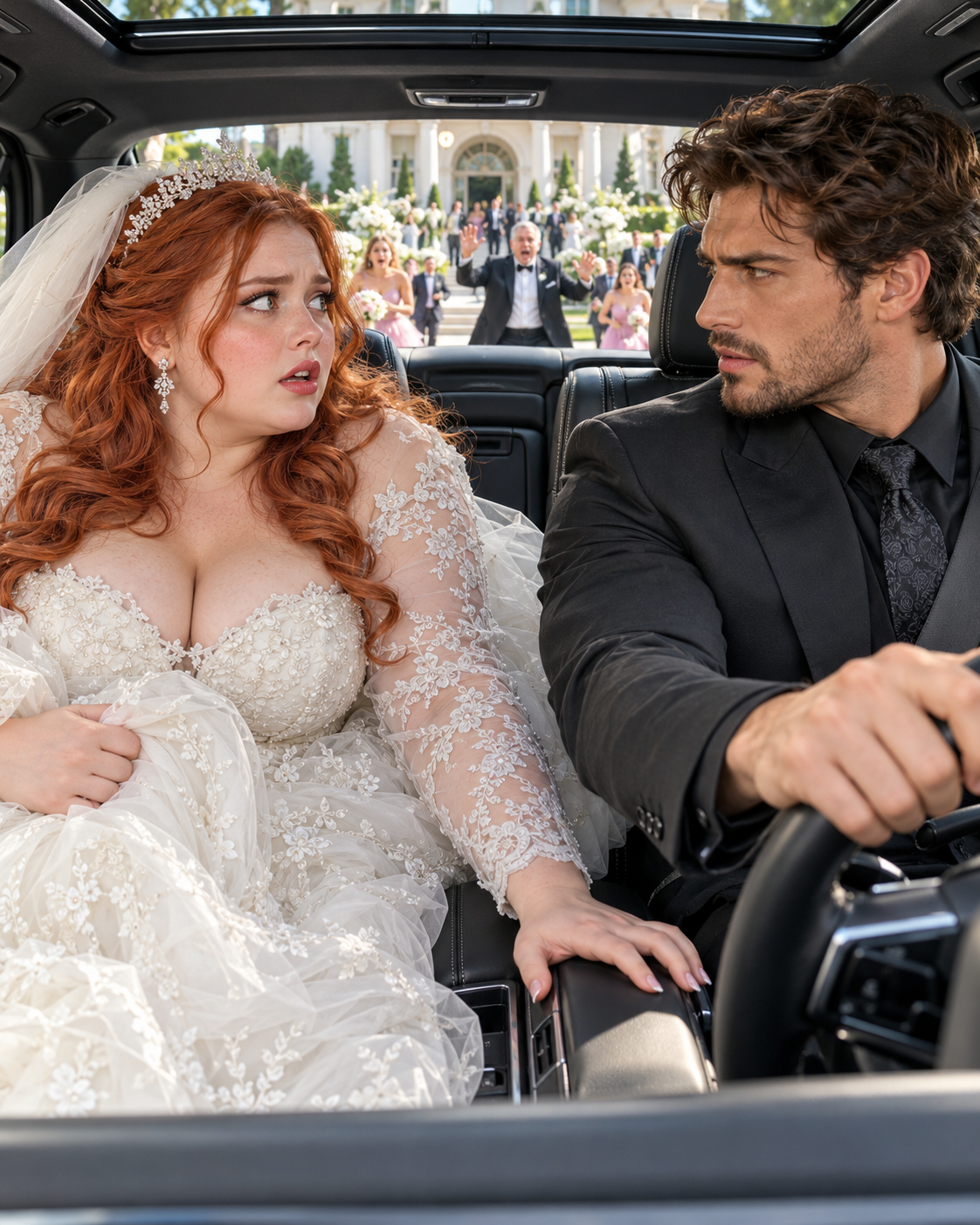
The bride was supposed to say “I do.” Instead, she ran from her own wedding, climbed into a stranger’s black car
The enormous ballroom doors swung open, and Marintella felt the blood drain from her face.
Standing beneath the golden lights was a woman wearing a charcoal-gray suit, her silver hair arranged in the same elegant style Marintella remembered from childhood.
For thirteen years, she had believed this woman was dead.
“Mrs. Whitmore?” Marintella whispered, barely recognizing her own voice.
Eleanor Whitmore had been her mother’s closest friend, the former chief accountant of the family distillery, and the last person to see her parents before the accident that destroyed their lives.
According to Uncle Richard, Eleanor had died overseas shortly afterward.
Yet here she stood, very much alive, carrying a weathered leather briefcase and looking directly at the man who had supposedly buried her.
Richard stumbled backward.
“That’s impossible,” he breathed.
Eleanor’s expression hardened.
“Apparently, Richard, you’ve been saying that about me for thirteen years.”
A wave of astonished murmurs spread through the ballroom.
Marintella looked from Eleanor to her uncle, struggling to understand what was happening.
Alexander Thorn stood beside the wedding table, his face pale and his jaw trembling.
His father, Victor Thorn, suddenly reached for his phone.
Before he could make a call, two men in dark suits appeared near the entrance.
They did not approach anyone or announce themselves.
They simply watched.
Eleanor crossed the marble floor slowly, stopping a few feet from Marintella.
“You look so much like your mother,” she said softly.
Marintella wanted to embrace her.
She wanted to demand answers.
Most of all, she wanted to know why someone who had once loved her family had allowed her to grow up believing she was dead.
But Eleanor spoke before she could ask.
“I owe you thirteen years of explanations, sweetheart, but right now, your family’s distillery is in danger.”
Marintella remembered the photograph on her phone.
The empty road.
The familiar redbrick buildings.
The warning beneath the image.
THEY ARE MOVING THE RECORDS TONIGHT. DO NOT TRUST THE MAN BESIDE YOU.
She turned toward Alexander.
“Who sent me this?”
Alexander swallowed.
“I don’t know.”
“Then why did you ask whether I’d shown the documents to anyone?”
He glanced toward his father.
For the first time, Marintella noticed something she had never seen in her former fiancé.
Genuine fear.
Eleanor placed her briefcase on the nearest table.
“Because the papers you found are only part of the arrangement,” she explained.
Victor Thorn stepped forward.
“This woman is a fraud. Richard, get security.”
But Richard remained frozen.
Eleanor opened the briefcase.
Inside were financial ledgers, notarized statements, photographs, and an old envelope bearing the handwritten initials of Marintella’s father.
Marintella recognized the handwriting immediately.
Her knees nearly buckled.
“My father wrote that.”
“Yes,” Eleanor answered.
“And he wrote it because he knew someone was stealing from him.”
The room erupted.
Victor demanded that the documents be confiscated.
Richard insisted that Eleanor had fabricated everything.
Alexander’s mother began whispering urgently into her husband’s ear.
But Marintella barely heard them.
She was staring at her father’s handwriting.
For thirteen years, she had possessed nothing more than photographs, memories, and a distillery everyone insisted she was too inexperienced to manage.
Now a letter written by her father lay inches from her trembling hands.
Eleanor gently pushed it toward her.
“Read it when you’re ready.”
Marintella opened the envelope.
The paper had yellowed with age, but the words remained clear.
My darling Marintella,
If you are reading this, something has gone terribly wrong.
There are people who believe the value of our family lies in the money we have accumulated.
They have forgotten the people who built it.
The distillery is yours, but never allow anyone to convince you that owning something means surrendering yourself to protect it.
You are worth more than every barrel of whiskey in Kentucky.
And you must never confuse obedience with love.
Marintella stopped reading.
Her vision blurred.
For years, Richard had told her that her father wanted her to be agreeable, grateful, and respectful of family decisions.
He had used her father’s memory to silence every question.
And now, from beyond the grave, her father was telling her the exact opposite.
She pressed the letter against her chest.
Then she looked at Richard.
“You knew.”
Her uncle shook his head.
“Marintella, please understand—”
“You knew what my father wanted.”
“Everything I did was to preserve this family!”
Eleanor’s voice cut through the room.
“No, Richard. Everything you did was to preserve your access to its money.”
Victor suddenly laughed.
A cold, humorless sound.
“Even if these accusations were true, you have no idea how business works, young lady.”
Marintella turned toward him.
“Then perhaps you can explain why your companies received millions from accounts connected to my distillery.”
Victor’s smile disappeared.
She continued.
“Or why those transactions were disguised as equipment purchases that never happened.”
Richard looked sharply at Victor.
The groom’s father remained silent.
That silence told Marintella more than another confession could have.
Eleanor closed her briefcase.
“The distillery wasn’t failing because of poor management,” she explained.
“It was being systematically drained.”
Every month, money disappeared through consulting fees, inflated supply contracts, and payments to companies with no legitimate connection to whiskey production.
Those companies eventually led to businesses controlled by Victor Thorn.
Richard had approved the transactions.
Then he had used the resulting debt to frighten Marintella into agreeing to marry Alexander.
Once the marriage took place, a complicated series of agreements would have transferred effective control of the distillery to the Thorn family.
Marintella would have retained her title.
She would have attended charity galas, posed for photographs, and smiled beside her husband.
But the company her parents built would have belonged to someone else in everything but name.
The realization was almost unbearable.
Her wedding had never been a celebration.
It had been the final signature on a carefully disguised takeover.
Then Alexander spoke.
“My father isn’t the only person involved.”
Victor whirled toward him.
“Be quiet.”
Alexander ignored him.
“There are investors behind the holding companies,” he said.
“They aren’t interested in bourbon, Marintella.”
Eleanor nodded grimly.
“They’re interested in using a respected American business to conceal financial activity.”
Victor moved toward his son.
“I said enough!”
Alexander stepped back.
“No, Dad. You promised nobody would get hurt.”
The words silenced the room.
Marintella stared at him.
“You knew about this?”
Alexander’s expression crumbled.
“I knew about the takeover.”
Her breath caught.
“I knew your uncle wanted you to sign control over after the wedding,” he admitted.
“But I thought the distillery was genuinely in trouble. I thought our family was saving it.”
“And you never thought to tell me?”
He lowered his eyes.
“I convinced myself you’d be happier without the responsibility.”
Marintella almost laughed.
Not because anything was funny.
Because the cruelty of that sentence was so familiar.
Her uncle had said the same thing.
Her father’s attorneys had said the same thing.
Every man who wanted authority over her life had somehow managed to describe that authority as kindness.
“You didn’t want to save me,” she said quietly.
“You wanted me to be easier to manage.”
Alexander said nothing.
And that was when Marintella finally understood that betrayal did not always arrive wearing a cruel expression.
Sometimes it came with flowers, affectionate promises, and a diamond ring.
Suddenly, Eleanor’s phone rang.
She answered, listened for several seconds, and went completely still.
“What happened?”
Marintella saw the fear in her eyes.
Eleanor ended the call.
“Someone has entered the distillery’s records building.”
Victor looked toward the exit.
For a fleeting moment, satisfaction crossed his face.
Marintella saw it.
And she knew.
The wedding disaster was only the beginning.
Outside, rain had started falling over the Kentucky streets.
A familiar black sedan waited beneath the hotel canopy.
Ivo Dantes stood beside it, wearing a dark overcoat, his expression unreadable.
Marintella hurried toward him with Eleanor close behind.
“Someone is destroying evidence,” she said.
“I know.”
“Then why are you standing here?”
“Because rushing into a situation without understanding it is exactly what they expect you to do.”
Marintella stared at him.
“My employees are there.”
“I’ve already contacted the people responsible for the building’s security,” Ivo replied.
“And Eleanor’s attorney has notified federal investigators.”
She blinked.
“You contacted investigators?”
“Your accountant did. My people helped preserve the information she needed.”
Behind them, Richard appeared at the hotel entrance.
“Marintella!”
Ivo’s gaze moved toward him.
Richard stopped immediately.
There was something almost satisfying about seeing the man who had controlled her childhood suddenly lose confidence.
But Marintella refused to hide behind Ivo.
She stepped forward.
“What do you want, Uncle Richard?”
He looked exhausted.
“Please. Come home. We can fix this.”
“You mean we can hide it.”
“I raised you!”
The words struck harder than she expected.
Because they were true.
Richard had been there after her parents’ funeral.
He had held her hand when nightmares woke her.
He had taught her how to ride a horse and brought birthday cakes to the enormous, lonely dining room.
For thirteen years, she had believed those memories meant he loved her.
Perhaps, in some twisted way, he had.
But love did not erase what he had done.
“You raised me,” Marintella said, “and then you used everything you knew about me to make sure I would never question you.”
Richard’s eyes filled with tears.
“Your father never understood what it took to protect the business.”
“My father understood that people aren’t property.”
Richard glanced at Ivo.
“You think this man is different? You have no idea who he is.”
Marintella looked toward the man beside the sedan.
Ivo did not interrupt.
He did not insist she defend him.
He simply waited.
“Maybe I don’t know everything about him,” she answered.
“But I know he gave me a choice when you gave me none.”
Richard opened his mouth.
Then closed it.
Marintella turned away.
For the first time, walking away from her uncle did not feel like betrayal.
It felt like breathing.
The drive to the distillery took nearly forty minutes.
Rain swept across the windshield as the car traveled through rolling Kentucky countryside, past horse farms, dark barns, and quiet roads bordered by autumn trees.
Eleanor sat beside Marintella in the back seat.
Ivo remained in front, speaking occasionally to an associate through his phone.
Marintella kept looking at her father’s letter.
Finally, she turned toward Eleanor.
“Why did you disappear?”
Eleanor’s hands tightened in her lap.
“Because your father found out about the first fraudulent accounts.”
Marintella waited.
“He asked me to investigate,” Eleanor continued.
“When I discovered the money transfers, I brought him the records. He planned to confront Richard after meeting with an independent attorney.”
“What happened?”
“The accident happened before that meeting.”
Marintella’s throat tightened.
“Are you saying Richard caused it?”
Eleanor shook her head.
“I don’t know. And I won’t accuse him of something I cannot prove.”
The answer was painful, but Marintella respected it.
For too long, people had treated their assumptions as facts whenever it benefited them.
She would not become one of them.
“Why didn’t you come back?”
“Someone broke into my home after the funeral,” Eleanor whispered.
“They took the original accounting files and left a warning. I was terrified. Richard told everyone I’d died, and I allowed that lie to protect myself.”
Marintella looked away.
Eleanor’s voice cracked.
“I should have fought harder for you.”
“Yes,” Marintella said.
The older woman flinched.
“But you’re here now.”
Eleanor’s eyes filled with tears.
“I am.”
“And we’re going to finish what my father started.”
They arrived at the distillery shortly after midnight.
The sprawling property stood beneath a stormy sky, its brick warehouses casting long shadows across the wet pavement.
For generations, the building had carried the scent of charred oak, sweet corn, and aging bourbon.
Tonight, the familiar place felt strangely vulnerable.
Several security vehicles stood outside the administration building.
A county sheriff’s deputy was speaking with a frightened maintenance worker.
Marintella stepped out before Ivo could open her door.
The worker recognized her immediately.
“Miss Marintella!”
“Is everyone safe?”
“Yes, ma’am. Nobody was hurt.”
Relief swept through her.
“What happened?”
“Two men came in with authorization papers. Said they were collecting financial records for the new owners.”
“New owners?”
The worker nodded.
“They said Mr. Thorn sent them.”
Ivo exchanged a look with Eleanor.
Inside the records building, cabinets stood open.
Several computers had been disconnected.
Boxes of documents were stacked beside the service entrance.
But nothing had been burned or destroyed.
The deputy explained that the men had been stopped after security questioned their authorization.
Their identities and instructions were being investigated.
Marintella walked through the cluttered office, trying to make sense of the attempted removal.
Then she noticed something peculiar.
A framed photograph of her parents had been moved from the wall.
Behind it, the plaster looked recently disturbed.
“Who moved this?”
Nobody answered.
She lifted the photograph.
A small metal panel was embedded in the wall.
Eleanor gasped.
“Oh, Daniel.”
Marintella looked at her.
“What?”
“Your father told me he had a place where he kept things nobody else could reach.”
The panel was secured with a combination lock.
Marintella stared at it.
Her father had loved puzzles.
When she was little, he would hide birthday presents in wooden boxes and give her clues to find the combinations.
One number appeared in nearly every puzzle.
The date her parents first met.
She entered it.
The lock clicked.
Inside was a narrow compartment containing an old external hard drive, two sealed envelopes, and a small velvet box.
Marintella opened the box first.
Inside rested her mother’s wedding band.
A folded note lay beneath it.
For the day our daughter learns that courage isn’t the absence of fear, but the decision not to let fear choose for her.
Marintella pressed the ring into her palm.
For thirteen years, she had believed her parents left her a building, a name, and an obligation she was too frightened to fulfill.
Now she understood that they had left her something far more important.
The right to decide what to do with it.
Eleanor carefully took possession of the sealed documents and arranged for them to be recorded and preserved through the attorney supervising the investigation.
The hard drive was secured for forensic examination.
No one wanted to risk damaging evidence that might finally explain how the family’s money had disappeared.
Marintella stood in the dark office while rain tapped against the windows.
Behind her, Ivo spoke.
“You’ve done enough for tonight.”
She turned.
“That’s what everyone keeps telling me.”
His mouth curved into the faintest smile.
“Then everyone keeps underestimating you.”
She studied him.
“Why are you helping me?”
“I was investigating Victor Thorn long before you climbed into my car.”
“That explains why you’re interested in him. It doesn’t explain why you paid the company’s debt.”
Ivo glanced toward the warehouses.
“My father once owned a small shipping company,” he said.
“When a larger organization squeezed him out, everyone told him to sell and walk away. He refused. They buried him in legal expenses until he lost everything.”
Marintella listened.
“I learned early that money can protect people,” Ivo continued.
“And it can also make monsters of those who worship it.”
“Which one are you?”
His expression changed.
“That’s a question you should never let someone else answer for you.”
She appreciated the honesty more than a reassuring lie.
“And the money you used to settle the debt?”
“A lawful loan through a registered investment company. Your attorneys will receive the documents. No ownership claim, no personal obligation, and no hidden conditions.”
Marintella raised an eyebrow.
“You expect me to believe you don’t want anything?”
“I want Victor’s financial network exposed.”
“And after that?”
Ivo looked at her for a long moment.
“After that, what you do with your life is entirely your business.”
She almost smiled.
But the next morning brought a revelation neither of them expected.
At eight o’clock, Marintella received a call from the distillery’s longtime operations manager, Samuel Brooks.
Samuel had worked for her father for more than thirty years.
His voice sounded unusually emotional.
“Miss Marintella, there’s something you need to see.”
He was waiting inside the oldest bourbon warehouse when she arrived.
Around them, hundreds of oak barrels rested on wooden racks, aging quietly beneath the high ceiling.
Samuel held a worn notebook.
“Your father kept a record of every employee who helped build this place,” he explained.
Marintella opened it.
Each page contained names, dates, handwritten notes, and small stories.
A cooper who had repaired barrels during a winter storm.
A single mother who worked night shifts to put her daughters through college.
A technician whose invention had saved thousands of dollars in production costs.
At the bottom of one page, her father had written:
We don’t own this place alone. We simply carry responsibility for everyone whose hands keep it alive.
Samuel cleared his throat.
“Your uncle planned to shut down two warehouses and eliminate sixty jobs once the merger was finished.”
Marintella looked up sharply.
“Sixty?”
He nodded.
“Most of those folks have been here longer than you’ve been alive.”
Suddenly, the money Ivo had quietly provided meant something far greater than a line on a balance sheet.
It meant Samuel could keep his health insurance.
It meant the workers could continue paying their mortgages.
It meant families across the county would not wake up to discover their livelihoods had disappeared overnight.
Marintella closed the notebook.
“Call a staff meeting.”
Samuel looked surprised.
“Today?”
“Yes. Everyone who can safely leave their stations.”
“What’s the announcement?”
She took a deep breath.
“That nobody is losing their job because of a wedding that never happened.”
By noon, nearly every employee stood inside the old bottling hall.
Marintella faced them wearing jeans, boots, and one of her father’s faded work jackets.
She had abandoned the wedding gown.
She had also abandoned the version of herself who believed authority required looking perfect.
“I know you’ve heard rumors,” she began.
“Some of them are true.”
The room grew quiet.
“Our company was placed in serious financial danger by people who were supposed to protect it.”
She paused.
“But emergency financing has cleared the immediate debt, and an independent accounting team is reviewing every transaction.”
A woman near the front began crying.
Samuel gently placed a hand on her shoulder.
Marintella continued.
“I cannot promise there will never be hard days. I cannot promise every decision will be easy. But I can promise that nobody will secretly trade away your future while I stand beside them smiling.”
A murmur spread through the hall.
“We’re going to rebuild this company honestly, and you’re going to have a voice in how we do it.”
For a moment, nobody moved.
Then Samuel began clapping.
Others joined him.
Soon the entire hall filled with applause.
Marintella’s eyes stung.
She had spent years believing leadership meant commanding a room.
Now she understood it could also mean telling people the truth and allowing them to stand with you.
But the fight was not over.
Three days later, federal investigators executed search warrants connected to several businesses controlled by Victor Thorn.
Banking records, corporate agreements, and communications were collected for examination.
The original documents Eleanor had preserved helped investigators reconstruct years of suspicious transactions.
Richard’s role in approving false expenses also came under scrutiny.
The investigation widened to include outside investors and companies operating across multiple states.
News outlets throughout Kentucky reported the scandal.
Photographs of Marintella in her wedding dress appeared beside headlines about the failed marriage and the financial investigation.
Some commentators called her brave.
Others accused her of humiliating her family.
Marintella stopped reading the coverage after the first morning.
She had learned that public approval was another kind of cage if she allowed it to determine her choices.
Then Alexander requested a meeting.
She almost refused.
But there were questions she still wanted answered.
They met in the office of her attorney, with no relatives and no cameras present.
Alexander looked different without his expensive suit and easy smile.
He appeared tired.
Older.
“I’ve given investigators everything I know,” he began.
Marintella folded her hands.
“Why?”
He swallowed.
“Because I finally understood what my father was asking me to become.”
She waited.
“I kept telling myself I could make the marriage work. That I could protect you after everything was signed.”
“You could have protected me by telling me the truth.”
“I know.”
For several seconds, neither spoke.
Then Alexander removed a small envelope from his coat.
Inside was a handwritten list of business meetings, names, and dates.
“These might help explain the transactions,” he said.
Her attorney accepted the envelope.
Alexander turned toward Marintella.
“I did care about you.”
She believed him.
That was the saddest part.
“I think you cared about the person I was when I never disagreed with you.”
He looked down.
“Maybe.”
Marintella felt the old instinct to comfort him.
To soften the truth.
To tell him he was not entirely responsible.
But she remained silent.
Alexander rose.
“I hope you find someone who makes you happy.”
She met his eyes.
“I hope you learn that loving someone means allowing them to choose.”
He left without another word.
Marintella watched the door close and felt something unexpected.
Not heartbreak.
Not triumph.
Peace.
Weeks passed.
The investigation continued, and the company’s financial position slowly stabilized under independent supervision.
Eleanor helped rebuild the accounting department, introducing transparent approval procedures and outside audits.
Samuel coordinated production schedules and reassured suppliers who had grown nervous about the scandal.
Marintella attended management meetings, reviewed contracts, and asked questions without apologizing for not knowing every answer.
She discovered that leadership was exhausting.
Some mornings, she made mistakes.
Other days, she faced decisions that offered no perfect solution.
But the distillery was finally becoming hers in a way it had never been before.
Not because her name appeared on its documents.
Because she was earning the trust of the people who worked there.
One afternoon, Ivo arrived without warning.
Marintella found him standing outside the barrel warehouse, watching workers load shipments into a delivery truck.
“You’re becoming difficult to find,” he said.
“I’m working.”
“I noticed.”
He handed her a folder.
She looked suspicious.
“Another surprise?”
“Your company’s loan documents. Everything is finalized and independently reviewed.”
She opened the folder.
The terms matched what he had promised.
Clear repayment provisions.
No hidden ownership rights.
No personal conditions.
Marintella looked up.
“You really didn’t try to buy my freedom.”
Ivo’s expression softened.
“Freedom that belongs to someone else isn’t freedom.”
She held his gaze.
“That’s a surprisingly decent philosophy for a man with your reputation.”
“I never said I was a decent man.”
“No,” she replied. “You didn’t.”
For a moment, the distance between them seemed smaller.
Ivo glanced at the old brick buildings.
“What happens now?”
“We renovate the visitor center, rebuild the distribution network, and give our employees a share in future profits once the business can support it.”
“Ambitious.”
“I’ve been told I’m inexperienced.”
“And?”
“And I’m starting to think experience is something people gain by doing things instead of waiting for permission.”
Ivo laughed quietly.
It was the first time she had heard him laugh without restraint.
Then his expression became serious.
“Marintella, there’s something I need to tell you.”
Her stomach tightened.
“About Victor?”
“About me.”
He looked toward the hills.
“My investigation began because Thorn-controlled companies were connected to financial activity that affected businesses I had worked with. I have legitimate interests to protect, and a complicated history.”
“I assumed as much.”
“I won’t pretend my past is spotless.”
“Then don’t.”
He turned toward her.
“I can’t promise you a simple life.”
Marintella smiled faintly.
“I’ve just escaped a wedding designed to steal my inheritance. Simplicity wasn’t exactly working for me.”
Ivo stepped closer.
“And what would you want from someone like me?”
She considered the question.
“A man who tells me the truth, respects my decisions, and understands that helping me doesn’t give him the right to own me.”
He nodded slowly.
“Fair.”
“And if you ever try to manage my life behind my back, I’ll show you exactly how much trouble a Kentucky distillery owner can cause.”
Ivo smiled.
“I believe you.”
There was no dramatic kiss.
No promise of eternal devotion.
Only two people standing beside an old warehouse, recognizing that whatever might happen between them would have to begin with respect.
For Marintella, that was enough.
The greatest challenge arrived two months later.
An attorney representing Richard requested that Marintella attend a confidential meeting.
Her uncle was cooperating with investigators and wanted to speak to her before the next legal proceedings.
Eleanor advised caution.
Ivo offered to arrange additional security.
Marintella declined his offer politely and attended with her own attorney.
Richard sat across the conference table looking far older than she remembered.
His expensive clothes seemed too large for his diminished frame.
For a long time, he simply stared at her.
Finally, he spoke.
“I never expected you to become this strong.”
Marintella felt no satisfaction.
Only sadness.
“You never gave me the opportunity.”
Richard lowered his head.
“I was afraid.”
“Of losing the distillery?”
“Of becoming irrelevant.”
She studied him.
He rubbed his hands together.
“Your father was always the brilliant one. People admired him. They trusted him. When he died, I finally had something important to manage.”
“And you couldn’t bear to give it back.”
Richard nodded.
A tear slipped down his cheek.
“I told myself I was protecting you.”
Marintella remained silent.
“Then I started believing my own excuses.”
He looked at her.
“Can you forgive me?”
The question lingered between them.
Once, she would have rushed to say yes.
She would have swallowed her pain to make him feel better.
But the woman sitting across from him was no longer that frightened girl.
“I don’t know,” she answered.
Richard’s face tightened.
“But I can promise I won’t spend the rest of my life hating you.”
He began to cry.
Marintella continued.
“Forgiveness isn’t something you can demand because you’re finally sorry. And it doesn’t erase what happened.”
“I understand.”
“I hope you do.”
She stood.
“Whatever happens in court, I hope you’ll tell the truth.”
Richard nodded.
“And Marintella?”
She stopped at the door.
“Your father would be proud of you.”
Her eyes filled.
“Maybe,” she whispered.
“But the important thing is that I’m finally learning to be proud of myself.”
She walked out without looking back.
The legal proceedings unfolded over the following months.
Investigators established that Victor Thorn had directed a complex financial scheme using multiple businesses, fraudulent invoices, and concealed transfers.
The financial records showed that Richard had knowingly approved improper transactions while concealing their consequences from Marintella.
Victor eventually pleaded guilty to federal financial crimes under an agreement reviewed by the court.
Richard also accepted responsibility for his role and faced sentencing.
Other individuals connected to the network remained subject to separate proceedings.
There was no magical resolution.
No single courtroom speech that repaired thirteen years of betrayal.
But the evidence was examined, responsibility was assigned, and the distillery emerged from the scandal with its ownership intact.
Marintella was not required to marry anyone.
She was not required to surrender her inheritance.
And she was no longer required to pretend that family loyalty meant remaining silent.
One year after the wedding that never happened, the distillery celebrated its reopening under a new name.
WHITMORE LEGACY DISTILLING — BUILT ON TRUST, NOT CONTROL.
Marintella had chosen to honor her mother as well as her father, recognizing the woman whose courage and quiet wisdom had shaped the values she was only now beginning to understand.
The restored visitor center stood beneath the bright Kentucky spring sunshine.
Tourists gathered near the tasting room.
Local musicians played beneath a white canopy.
Workers arrived with their families, laughing as children raced across the green lawn.
Samuel stood beside the entrance wearing the finest suit Marintella had ever seen him wear.
“You look nervous, boss,” he teased.
“I am nervous.”
“Good. Means you care.”
She laughed.
Eleanor approached carrying a small wooden box.
“There’s something you should have before the ceremony.”
Inside rested a silver necklace with a simple pendant.
Marintella recognized it instantly.
Her mother had worn it in nearly every family photograph.
“I kept it safe all these years,” Eleanor explained.
Marintella carefully fastened it around her neck.
“Thank you.”
Eleanor kissed her forehead.
“For becoming the woman your mother always believed you could be.”
The opening ceremony began shortly after noon.
Marintella stepped onto the small wooden platform facing the crowd.
A year earlier, standing before a room full of wealthy strangers had almost destroyed her.
Today, she stood before people who had helped her rebuild.
She looked across the familiar faces.
Samuel.
Eleanor.
The warehouse workers.
The accountants.
The delivery drivers.
Families who had trusted her when she was barely learning to trust herself.
And near the back, leaning against an old oak fence, stood Ivo Dantes.
He had come without a security entourage, expensive gifts, or any intention of drawing attention.
When she noticed him, he lifted his hand in a quiet greeting.
Marintella smiled.
Then she turned toward the microphone.
“A year ago, I almost lost this distillery,” she began.
The crowd grew silent.
“I thought the greatest tragedy would be losing the buildings, the barrels, and the name my parents left behind.”
She paused.
“But I learned that there are things far more valuable than property.”
She looked toward Samuel.
“The dignity of honest work.”
Toward Eleanor.
“The courage to tell the truth.”
Toward the workers and their families.
“And the right to decide what kind of future we want to build.”
Her voice grew stronger.
“For most of my life, I believed being a good daughter, a good niece, and a good woman meant keeping everyone else comfortable.”
Several people nodded.
“I believed that disagreeing made me selfish. That asking questions made me difficult. That standing up for myself meant I was ungrateful.”
She took a breath.
“But the people who truly love us don’t need us to become smaller so they can feel powerful.”
The crowd remained completely still.
“My parents didn’t leave me this business so I would spend my life defending their decisions. They left it to me because they trusted me to make my own.”
Tears shimmered in Eleanor’s eyes.
Marintella smiled through her own.
“So today, we’re celebrating more than a reopening.”
She looked across the buildings.
“We’re celebrating a company that belongs to its future, not the mistakes of its past.”
Applause erupted.
Samuel wiped his eyes.
Children cheered.
Employees embraced.
And Marintella felt something she had spent her entire life searching for.
She belonged.
Not because someone had chosen her.
Not because a powerful family had accepted her.
But because she had finally chosen herself.
Later that afternoon, after the crowds began to thin, Marintella found Ivo standing near the old wooden bridge overlooking the creek behind the distillery.
The sunlight reflected off the water, turning its surface gold.
“You stayed,” she said.
“I wanted to hear your speech.”
“And?”
“You sounded like someone who finally knows exactly where she belongs.”
Marintella leaned against the railing.
“I don’t know exactly where I belong.”
Ivo looked surprised.
“I thought that was the point.”
She shook her head, smiling.
“The point is that I don’t have to know everything yet.”
For a while, they watched the water moving beneath them.
Then Ivo reached into his coat.
Marintella raised an eyebrow.
“If that’s an engagement ring, I’m throwing you into the creek.”
He laughed.
“Relax. It’s a restaurant reservation.”
She blinked.
“A reservation?”
“Dinner. In Louisville. No business discussion, no financial documents, no secret arrangements.”
She pretended to consider.
“Are there lawyers involved?”
“No.”
“Family obligations?”
“None.”
“Complicated contracts?”
“Just the menu.”
Marintella smiled.
“And if I say no?”
“Then I’ll respect your decision.”
She watched him for a moment.
That simple answer meant more than a hundred extravagant declarations.
“Then I suppose I could say yes.”
Ivo offered his arm.
Marintella looked at it, then took his hand instead.
They walked back toward the distillery together.
Not as a rescuer and a rescued woman.
Not as a powerful man and a frightened bride.
But as two people choosing to share a small piece of the road ahead, without knowing where it would lead.
At the entrance, Marintella stopped beside a newly installed plaque.
It contained a sentence from her father’s final letter.
“Never confuse obedience with love.”
She traced the engraved words with her fingertips.
For years, she had believed freedom was something someone powerful would eventually give her.
Her uncle promised it would come after she learned to be responsible.
Alexander promised it would come after marriage.
Even Ivo had initially offered to purchase her escape.
But freedom had never been waiting inside a contract, a wedding ring, or a wealthy man’s protection.
It had begun the moment she decided that her life was worth defending.
The future would still hold disappointments.
There would be difficult decisions, broken promises, and people who tried to take advantage of her.
She would make mistakes.
She would occasionally trust the wrong person.
And she would discover that being independent did not mean never needing help.
It meant having the freedom to accept help without surrendering control over herself.
As the evening sun settled over the Kentucky hills, Marintella looked toward the distillery her parents had loved.
The windows glowed warmly.
Laughter drifted from the courtyard.
And somewhere inside, the slow, patient work of making bourbon continued.
She remembered the terrified bride who had climbed into a stranger’s car a year earlier.
That girl had believed she was running away from a wedding.
She had not realized she was running toward herself.
Marintella took one final look at the plaque.
Then she turned toward the life waiting beyond it.
For the first time, there was no one standing in her way.
And if there ever was again, she knew exactly what she would do.
She would stand tall.
She would speak the truth.
And she would remember that her worth had never depended on someone else’s permission.
Because the greatest inheritance her parents left her was not a fortune, a company, or a family name.
It was the courage to live a life that truly belonged to her.
THE END.