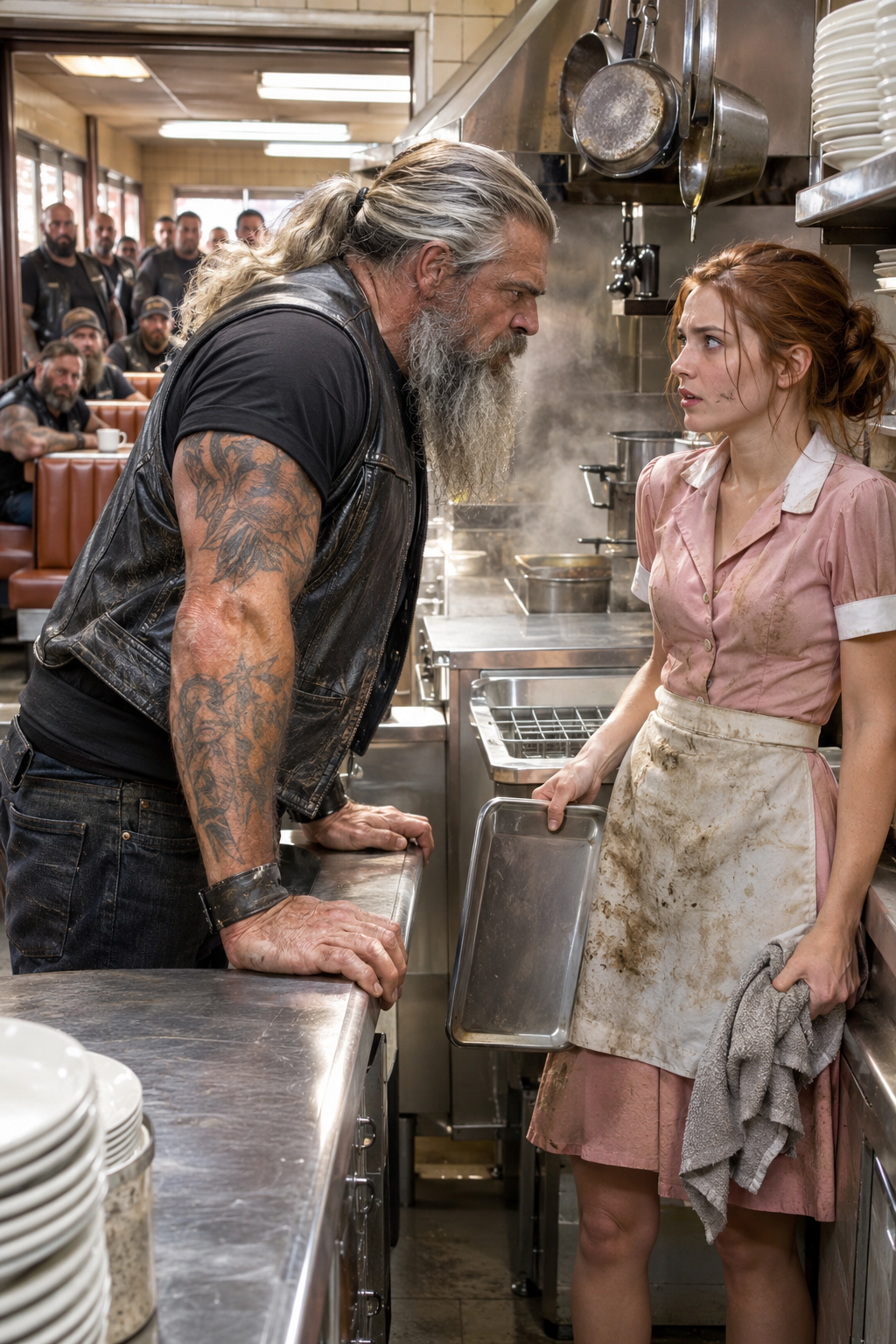
The biker had only $11.40 left when an 18-year-old dishwasher slipped two bowls of hot soup onto his table. By morning, she would lose her job for helping him.
McKenzie glanced at the envelope, then at the eighty motorcycles filling his parking lot. His expression hardened.
“If this is some kind of intimidation tactic, Brock, you’ve made a serious mistake.”
Brock shook his head. “Nobody’s here to intimidate anybody. We’re here for breakfast.”
He turned toward Cassidy, who stood frozen near the entrance, clutching a plastic bag containing everything she owned.
“And we’re here because somebody deserves a second chance.”
Cassidy looked at the riders. Several were older than her father would have been. Others carried their helmets beneath their arms. Not one of them appeared angry.
Brock handed her the envelope.
“Go ahead, sweetheart. Open it.”
Inside were several folded bills and a handwritten letter. Cassidy counted the money twice before looking up.
“There’s eight hundred dollars in here.”
“Eighty riders,” Brock explained. “Ten dollars each. Nobody was asked to give more.”
Cassidy immediately tried to return it.
“I can’t take this. I only gave you soup.”
An elderly biker with a gray beard stepped forward.
“Thirty years ago, somebody gave me a sandwich when I hadn’t eaten in four days. I never got the chance to thank him. You’re doing me a favor by taking that money.”
Cassidy pressed the envelope against her chest.
McBride appeared behind McKenzie, his face turning red.
“This is ridiculous. She broke company policy. I had every right to terminate her.”
Brock reached into his vest and removed a crumpled receipt.
“Then maybe you can explain this.”
He placed it in McKenzie’s hand.
It was the receipt from the previous evening. Brock had photographed it before leaving the diner.
Two coffees had been listed. Beneath them was a handwritten charge for employee meal theft, totaling twenty-six dollars.
“Your manager took my eleven dollars and forty cents,” Brock said. “Then he charged Cassidy for the rest.”
McKenzie frowned.
“Is that true?”
McBride hesitated. “It’s standard procedure.”
“No, it isn’t.”
Cassidy lowered her eyes.
“He’s done it before,” she whispered.
Everyone turned toward her.
McBride’s expression changed instantly.
“Watch what you’re saying, girl.”
For the first time that morning, Brock’s voice became cold.
“Don’t speak to her like that.”
McKenzie looked at Cassidy.
“What do you mean he’s done it before?”
Cassidy swallowed hard. She had spent months learning that silence was safer than honesty. But standing among eighty strangers who had come because of her, she suddenly found the courage to speak.
“He takes money out of our paychecks when customers complain. Sometimes he makes us work after clocking out. He says if we tell anyone, he’ll make sure nobody in town hires us.”
A waitress standing near the doorway began crying.
“She’s telling the truth, Mr. McKenzie.”
Another employee stepped forward. Then another.
Within minutes, five workers were describing things McKenzie had never known were happening inside his own business.
McBride backed toward the entrance.
“These people are lying.”
McKenzie held up his hand.
“Give me your keys.”
“What?”
“Your keys. You’re suspended pending an investigation.”
McBride stared at him in disbelief before throwing the keys onto the pavement.
“You’ll regret this.”
He shoved past the employees and disappeared around the building.
For several seconds, nobody spoke.
Then McKenzie turned toward Cassidy.
“I’m sorry. You can have your job back, effective immediately. I’ll also make sure you’re paid everything you’re owed.”
Cassidy looked at the diner windows.
She remembered the nights she had scrubbed dishes until her fingers cracked, the meals she had skipped, and the humiliation of being accused of stealing food nobody wanted.
“Thank you, sir,” she said quietly. “But I don’t think I want to work here anymore.”
McKenzie appeared surprised.
Brock smiled.
“Good thing I’ve got another offer.”
He explained Second Gear, the garage he had been trying to open for nearly a year. It would teach young people mechanics, welding, basic business skills, and everything they needed to build independent lives.
“I need somebody to help organize the place,” he said. “Someone who understands what it’s like to need a chance.”
Cassidy blinked.
“But I don’t know anything about motorcycles.”
“Neither did I when I started.”
For the first time in months, Cassidy laughed.
Then McKenzie cleared his throat.
“Brock, we still need to discuss the funding agreement.”
Brock’s smile faded.
McKenzie glanced at the riders.
“I appreciate what happened here today. But my investors won’t support a project publicly associated with your club.”
Brock looked at the men who had driven through the cold before sunrise to help a girl they had never met.
“Then keep your money.”
Cassidy’s heart sank.
She had heard Brock needed nearly sixty thousand dollars to open the garage. Now he was walking away from the only person willing to provide it.
McKenzie looked frustrated.
“You’re throwing away an enormous opportunity.”
“No,” Brock replied. “I’m refusing to build something good on the condition that I betray people who helped me become better.”
He turned toward the diner.
“Now, are you serving breakfast or not?”
The riders filled every available table. They ordered eggs, pancakes, biscuits, and coffee. Those who couldn’t find seats waited patiently outside.
By noon, the diner had recorded its busiest breakfast service in eleven years.
Every waitress received generous tips.
Cassidy helped carry coffee until Brock reminded her that she no longer worked there.
For a few hours, she felt something she hadn’t experienced since childhood.
She felt safe.
But that feeling wouldn’t last.
Three days later, Brock arrived at Second Gear to find Cassidy sitting outside the garage with a bruised cheek and a torn backpack.
He dropped his toolbox.
“What happened?”
“Nothing.”
“Cassidy.”
She looked away.
“My stepfather found me.”
Brock sat beside her.
Slowly, she told him everything.
Her mother had died when she was fifteen. Her stepfather, Raymond, had spent the following years drinking, gambling, and blaming Cassidy for every problem in his life.
On her eighteenth birthday, he threw her out after she refused to hand over her paycheck.
She had been homeless ever since.
Someone had posted photographs of the bikers at the diner online. Raymond had recognized her and discovered that she had received money.
“He wanted the envelope,” Cassidy whispered. “I told him it was mine.”
Brock clenched his jaw.
“Did you report him?”
“He said nobody would believe me.”
Brock stood and offered his hand.
“We’re going to the police.”
Cassidy looked terrified.
“What if he comes back?”
“Then we’ll make sure you know exactly who to call.”
Brock accompanied her to the sheriff’s office, where she gave a statement and received information about obtaining a protective order.
That evening, Nolen Ford and his wife, Margaret, offered Cassidy their spare bedroom.
Margaret placed clean towels on the bed and showed her where everything was.
“You don’t have to ask permission to eat here,” she said. “And you can lock your bedroom door whenever you want.”
Cassidy stared at the small room.
There was a lamp, a quilt, and a window overlooking a vegetable garden.
To anyone else, it might have seemed ordinary.
To Cassidy, it looked like a palace.
She waited until Margaret left before sitting on the bed and crying.
Meanwhile, Brock’s problems were growing.
Without McKenzie’s investment, Second Gear was running out of time. The building needed electrical repairs, new equipment, insurance, and permits.
The landlord had given Brock thirty days to settle the remaining deposit.
Brock sold his favorite motorcycle, a machine he had spent twelve years restoring.
It brought in seven thousand dollars.
He sold tools, furniture, and nearly everything he could live without.
Still, it wasn’t enough.
One afternoon, Cassidy found him staring at a stack of overdue bills.
“How much are we short?” she asked.
“Too much.”
She placed her envelope on the desk.
Brock pushed it back immediately.
“That’s yours.”
“But I want to help.”
“You already have.”
Cassidy frowned.
“Then let me do something else.”
She borrowed Margaret’s old laptop and began contacting local businesses. She explained what Second Gear would do and asked whether anyone had unused equipment they could donate.
Most ignored her.
Some refused after learning about Brock’s motorcycle club.
But a retired mechanic offered two workbenches. A hardware store donated safety glasses. A woman whose son had died from an overdose gave them five hundred dollars.
Every donation brought the garage a little closer to opening.
Then Cassidy had an idea.
She recorded a short video inside the unfinished building.
She spoke about being homeless, losing her job, and receiving help from people she had been taught to fear.
“These men didn’t ask what I could give them,” she said into the camera. “They asked what I needed. That’s what Second Gear is supposed to be. A place where your worst day doesn’t have to become the rest of your life.”
She posted the video online.
By morning, it had been viewed more than two hundred thousand times.
Donations began arriving from across Tennessee and neighboring states.
A schoolteacher sent twenty dollars. A truck driver sent fifty. A retired nurse donated an entire month’s pension payment.
Within a week, Second Gear had raised almost thirty thousand dollars.
Brock could hardly believe it.
For the first time, opening the garage seemed possible.
Then, eleven days before their deadline, disaster struck.
At two in the morning, Brock’s phone rang.
“Your garage is on fire.”
He drove through town so quickly that he barely remembered the journey.
When he arrived, flames were pouring through the roof. Firefighters struggled to contain the blaze as thick black smoke swallowed the building.
Cassidy arrived with Margaret moments later.
She screamed when she saw the flames.
Everything they had collected was inside.
The donated tools. The workbenches. The equipment. Months of paperwork.
Brock stood motionless, watching the roof collapse.
By sunrise, Second Gear was nothing more than a blackened shell.
A fire investigator discovered evidence suggesting the blaze had been deliberately started.
Security footage from a neighboring business showed a man approaching the garage shortly before the fire began.
The image was grainy, but Cassidy recognized the truck parked across the street.
It belonged to Raymond.
Her knees nearly gave way.
“This is because of me.”
Brock caught her shoulders.
“No. This happened because somebody chose to do something terrible.”
“But if you hadn’t helped me—”
“Don’t finish that sentence.”
Cassidy burst into tears.
Brock looked at the ruined garage.
He had lost almost everything he had worked for, yet the thought of Cassidy believing she was responsible hurt him more than the fire itself.
“You are not a mistake I made,” he told her.
Police arrested Raymond later that afternoon. Investigators also discovered several threatening messages he had sent Cassidy before the fire.
But his arrest couldn’t restore the garage.
The building was condemned. Insurance would cover some losses, but not nearly enough to rebuild.
Brock called a meeting with the riders.
“We tried,” he told them. “Sometimes trying isn’t enough.”
Nobody wanted to hear those words.
Cassidy stood near the back, her face pale.
When the meeting ended, she disappeared.
Brock assumed she had gone home with Margaret.
Instead, Cassidy walked nearly three miles to McKenzie’s office.
His receptionist tried to turn her away.
“Mr. McKenzie isn’t available.”
“Please tell him it’s Cassidy.”
Ten minutes later, she was sitting across from the wealthy businessman.
McKenzie looked uncomfortable.
“I heard about the fire. I’m very sorry.”
Cassidy placed a folder on his desk.
Inside were letters from young people who had applied to Second Gear.
One was from a seventeen-year-old boy whose father was in prison. Another came from a teenage mother who wanted to learn enough about cars to find steady employment.
There were forty-three letters.
“These kids were counting on us,” Cassidy said.
McKenzie sighed.
“I can’t change the circumstances surrounding my investment.”
“I’m not asking you to.”
She placed one final piece of paper on his desk.
It was a photograph of Brock standing outside the burned garage, holding a damaged toolbox that firefighters had recovered.
“He sold his motorcycle to help people he doesn’t even know,” she said. “When I lost my job, he gave away his last eleven dollars and forty cents. When my stepfather hurt me, he made sure I was safe.”
McKenzie stared at the photograph.
Cassidy continued.
“You have more money than most people in this town will ever see. But Brock has something money can’t buy.”
“And what’s that?”
“People who would stand beside him even if he had nothing left.”
McKenzie leaned back.
Cassidy gathered her belongings.
“I just thought you should know what kind of man you’re asking to change.”
She left without waiting for an answer.
That night, McKenzie remained in his office long after his employees had gone home.
He read every letter.
The final one was written by a sixteen-year-old named Ethan.
It contained only a few sentences.
My mom says I’m going to end up like my dad. My teachers think I’m trouble. Mr. McCoy is the first person who ever asked me what I wanted to become.
McKenzie read it again.
Then he opened a drawer and removed an old photograph.
It showed a skinny teenage boy standing beside a battered pickup truck.
That boy was McKenzie himself.
Before the restaurants, expensive suits, and successful investments, he had been a frightened sixteen-year-old living with an abusive father.
A local mechanic named Walter had given him his first job.
Walter had never asked about his family or judged his mistakes.
He had simply handed him a wrench and told him he was capable of more.
McKenzie had spent decades building wealth, yet somewhere along the way, he had forgotten the man who made it possible.
The following morning, Brock received an unexpected call.
“Meet me at the old Henderson dealership,” McKenzie said.
Brock nearly refused.
But something in McKenzie’s voice made him agree.
When he arrived, Cassidy and Nolen were already waiting.
The dealership had been vacant for years. It contained six service bays, classrooms, offices, and a large parking area.
McKenzie stood beside the entrance holding a set of keys.
“I bought this property eighteen months ago,” he explained. “I planned to demolish it and build another restaurant.”
He handed the keys to Brock.
“Plans change.”
Brock stared at him.
“What are you doing?”
“Offering Second Gear a permanent home.”
Brock didn’t move.
“And the conditions?”
McKenzie shook his head.
“There’s no condition about your club. We’ll have proper safety standards, financial oversight, and qualified instructors. The same requirements I’d expect from any youth program.”
Cassidy covered her mouth.
McKenzie continued.
“I’ll pay for the necessary renovations and replace the equipment you lost. The property will belong to a nonprofit established for the program.”
Brock looked at Cassidy.
She was already crying.
“Why?” he asked.
McKenzie glanced toward the empty service bays.
“Because somebody once gave me a chance when I didn’t deserve one. At least, that’s what I believed back then.”
He paused.
“And because an eighteen-year-old girl reminded me that I’d forgotten.”
Three months later, Second Gear officially opened.
Hundreds of people attended the ceremony.
The eighty riders who had visited the diner returned, along with teachers, business owners, firefighters, and families from across the county.
Nolen Ford, finally recovered from his injuries, became the program’s lead mechanic.
Margaret volunteered to teach budgeting and help students prepare for job interviews.
Cassidy became the youngest employee at Second Gear while studying for her high school equivalency diploma.
She also began learning mechanics.
Her first successful engine repair earned applause from everyone in the garage.
But the most important moment of opening day happened when a thin teenage boy approached Brock.
It was Ethan.
“Do you really think I can do this?” he asked.
Brock handed him a wrench.
“Only one way to find out.”
Ethan smiled.
Across the room, Cassidy watched them.
She remembered standing in a diner kitchen, wondering whether two bowls of soup were worth risking her job.
She had believed her life was ending that night.
Instead, something extraordinary had begun.
Over the following years, Second Gear helped dozens of young people find employment, finish school, and escape dangerous situations.
Not every student succeeded immediately. Some disappeared for weeks before returning. Others struggled with anger, addiction, or family problems.
Brock never pretended that a wrench could fix everything.
But he made sure the door remained open.
Cassidy eventually earned her automotive technician certification and moved into an apartment of her own.
On her twenty-third birthday, she became Second Gear’s operations director.
That evening, she invited Brock to dinner at the same diner where they had first met.
McBride was long gone. An investigation had uncovered years of wage violations, and the affected employees had received compensation.
The diner now operated under a manager who treated her staff with respect.
Cassidy and Brock sat in their original booth.
A young waitress approached.
“What can I get you?”
Cassidy smiled.
“Two bowls of chicken soup, please.”
Brock laughed.
“You’ve been waiting five years to do that, haven’t you?”
“Pretty much.”
When the soup arrived, Cassidy placed something on the table.
It was a small wooden frame containing a ten-dollar bill, a one-dollar bill, a quarter, a dime, and a nickel.
Eleven dollars and forty cents.
Brock stared at it.
“What’s this?”
“The amount you had when we met.”
Cassidy pushed the frame toward him.
“I used to think money was what separated people who could help from people who couldn’t. You taught me that wasn’t true.”
Brock rubbed his eyes.
“You taught me first.”
Just then, Cassidy noticed a young woman standing outside the diner.
She wore a thin jacket despite the cold and held a little boy’s hand. The child stared through the window at the food.
Cassidy excused herself.
A few minutes later, the woman and her son were sitting in the booth across from them, eating warm soup and fresh bread.
The woman repeatedly tried to explain that she couldn’t pay.
Cassidy shook her head.
“You don’t owe me anything.”
The little boy smiled as he lifted his spoon.
Brock watched Cassidy return to their table.
“Some things never change,” he said.
Cassidy looked at the framed money between them.
“Some things shouldn’t.”
Years later, visitors to Second Gear would notice that frame hanging beside the entrance.
Beneath it was a simple inscription.
The price of changing a life is not always measured in dollars.
Sometimes, students asked Cassidy about the money.
She would tell them about a rainy night, two hungry bikers, and a frightened dishwasher who had almost nothing to give.
She would explain that kindness hadn’t magically solved every problem. There had been pain, setbacks, fear, and moments when giving up seemed easier than continuing.
But one small act had inspired another, until people who had once been strangers became the reason hundreds of young lives changed direction.
And whenever someone asked Brock what made him invest so much in a girl he barely knew, he always gave the same answer.
“She saw two hungry men when everyone else saw two bikers.”
That was the lesson he carried for the rest of his life.
The world would always have people who judged others by their clothes, their mistakes, their bank accounts, or the circumstances they were born into.
But it would also have people like Cassidy.
People willing to look beyond appearances.
People who understood that generosity didn’t begin when you had enough.
It began when you decided that someone else’s suffering mattered.
And sometimes, all it took to remind the world of that truth was a cold Tennessee night, eleven dollars and forty cents, and two bowls of hot soup.
But Brock McCoy would live long enough to discover that the greatest reward for changing someone’s life was seeing them change the lives of others.
Eight years after Second Gear opened, Brock began experiencing chest pains.
At first, he blamed the long hours and refused to visit a doctor. There were engines to repair, students to teach, and bills to pay.
Then, one afternoon, he collapsed beside a workbench.
Cassidy was reviewing applications in her office when she heard someone shouting.
She rushed into the garage and found Brock lying on the concrete floor.
“Call an ambulance!” she screamed.
Nolen Ford knelt beside his oldest friend while Cassidy held Brock’s hand.
“Stay with me,” she whispered. “Please, Brock.”
At the hospital, doctors discovered a serious blockage in one of his coronary arteries. He needed emergency surgery.
Cassidy sat in the waiting room for six hours, unable to eat or speak.
Margaret eventually sat beside her.
“He’s a fighter,” she said gently.
Cassidy wiped her eyes.
“He’s the closest thing I’ve ever had to a father.”
Margaret squeezed her hand.
“And you’re the daughter he never had.”
When Brock finally opened his eyes, Cassidy was sitting beside his hospital bed.
He managed a weak smile.
“Who’s running the garage?”
Cassidy laughed through her tears.
“That’s seriously your first question?”
“Somebody’s gotta make sure Nolen doesn’t burn the place down.”
She leaned forward and hugged him carefully.
For once, Brock didn’t make another joke.
He simply held her.
During his recovery, Cassidy took full responsibility for Second Gear. She negotiated contracts, supervised instructors, and expanded partnerships with local businesses.
Brock had always believed she was capable of running the organization.
Now she proved it.
Six months later, Second Gear opened a second location in another Tennessee town.
Among its first instructors was Ethan, the frightened sixteen-year-old who had once believed he would end up in prison like his father.
He was now a certified mechanic, a husband, and the proud father of a little girl.
At the opening ceremony, Ethan stood before the crowd.
“Brock didn’t save me by telling me what to become,” he said. “He saved me by showing me that I had a choice.”
Brock sat in the front row, his eyes shining.
Cassidy watched him with a smile.
She knew exactly how Ethan felt.
Then, shortly before Christmas, an unexpected visitor arrived at Second Gear.
It was Raymond.
He had served several years in prison for setting fire to the original garage. His hair had turned gray, and his shoulders seemed permanently bent.
Cassidy froze when she recognized him.
Brock immediately stepped between them.
“What do you want?”
Raymond looked down.
“I’m not here to cause trouble.”
He removed a folded letter from his jacket.
“I wrote this a long time ago. I didn’t know if she’d ever want to read it.”
Cassidy stared at the man who had made her childhood miserable.
For years, she had imagined what she would say if she ever saw him again.
Now that he stood before her, none of those words seemed necessary.
“I’m sorry,” Raymond whispered.
His voice cracked.
“I know that doesn’t fix anything.”
Cassidy remained silent.
“I blamed you for things that weren’t your fault. I hurt you because I was angry at my own life.”
He placed the letter on a nearby desk.
“I don’t expect forgiveness. I just wanted you to know that I’m trying to become somebody different.”
Cassidy took a deep breath.
“I hope you do.”
Raymond looked up.
“But that doesn’t mean you get to be part of my life again,” she continued.
He nodded slowly.
“I understand.”
After he left, Brock turned toward her.
“You okay?”
Cassidy watched Raymond disappear beyond the parking lot.
“I think I finally am.”
She had learned that forgiveness didn’t require forgetting what someone had done. Kindness didn’t mean allowing dangerous people back into your life.
Sometimes, moving forward meant leaving certain doors permanently closed.
The following spring, Brock announced his retirement.
Second Gear organized a celebration without telling him how many people had been invited.
When he arrived, he found the parking lot filled with motorcycles, cars, and hundreds of former students.
Some had become mechanics. Others owned businesses. Several had returned to school and built careers Brock could never have imagined.
They had traveled from different states to thank him.
McKenzie stood beside the entrance, holding a microphone.
“Years ago, I almost refused to support this man because of what he wore,” he told the crowd. “Today, I consider him one of the finest men I’ve ever known.”
Applause erupted.
Then Cassidy stepped forward.
She carried a small envelope.
Brock immediately recognized the handwriting on the front.
It was his own.
“What’s that?” he asked.
Cassidy smiled.
“The envelope you gave me outside the diner.”
She had kept it all those years.
Inside was a photograph of the eighty riders who had come to her rescue, along with a letter she had written the previous evening.
She unfolded it and began reading.
“When I was eighteen, I thought my life was worth less than two bowls of soup. I believed I was somebody people could throw away whenever I became inconvenient.”
Her voice trembled.
“Then a man with eleven dollars and forty cents showed me that my life mattered. He gave me something I had never been able to find on my own. A reason to believe in tomorrow.”
Brock lowered his head.
Cassidy continued.
“Everything I’ve accomplished began with somebody believing in me before I knew how to believe in myself.”
She turned toward him.
“Thank you for being my family.”
Brock stood and pulled her into his arms.
The crowd rose to its feet.
Even Nolen Ford, who had spent decades pretending nothing could make him cry, removed his glasses and wiped his eyes.
That evening, after everyone had gone home, Brock and Cassidy remained inside the garage.
They walked past the empty workbenches and photographs of graduating students.
Brock stopped beside the framed eleven dollars and forty cents.
“You know something?” he said.
“What?”
“I used to think losing my last eleven bucks was the worst thing that could happen that night.”
Cassidy smiled.
“Turns out it was the best investment you ever made.”
Brock laughed.
Outside, the sun was disappearing behind the Tennessee hills.
He handed Cassidy the keys to Second Gear.
“It’s yours now.”
She looked at the keys resting in her palm.
“Are you sure?”
“Never been more sure of anything.”
Years passed.
Brock grew older, and eventually, his health prevented him from riding motorcycles.
But every Friday afternoon, Cassidy picked him up and brought him to Second Gear.
He sat near the entrance, drinking coffee and telling stories to students who never seemed to get tired of hearing them.
One winter morning, Brock passed away peacefully in his sleep.
He was seventy-four.
Cassidy received the call just before sunrise.
For a long time, she sat on the edge of her bed, holding the phone against her chest.
The man who had changed everything was gone.
At his funeral, more than a thousand people gathered.
Motorcycles stretched along the road as far as the eye could see.
Former students stood beside businessmen, teachers, police officers, and families whose lives Brock had touched.
Cassidy delivered the final tribute.
“Brock never believed a person’s past had to determine their future,” she said. “He taught us that nobody becomes stronger by standing alone.”
She looked at the photograph beside his coffin.
“And although he’s gone, everything he gave us is still here.”
After the funeral, Cassidy returned to Second Gear.
She unlocked the front door and walked toward Brock’s favorite workbench.
Someone had left a note there.
It was from a new student.
Thank you for giving me a chance. I promise I’ll make it count.
Cassidy pressed the note against her heart.
For the first time since Brock’s death, she smiled.
She finally understood that losing someone didn’t mean losing everything they had given you.
Their love survived in the decisions you made, the people you helped, and the kindness you carried forward.
Several months later, Cassidy established the Brock McCoy Foundation, providing emergency housing, meals, and vocational training to homeless teenagers.
Above the entrance to its first shelter, she placed a simple wooden sign.
Everybody deserves something warm on a night like this.
It was the same sentence she had spoken to Brock all those years ago.
On opening night, rain poured across Tennessee.
A seventeen-year-old girl arrived at the shelter wearing soaked shoes and carrying a garbage bag filled with clothes.
She looked frightened, exhausted, and ashamed.
Cassidy welcomed her inside.
“Are you hungry?”
The girl nodded.
“I don’t have any money.”
Cassidy smiled and placed a steaming bowl of chicken soup before her.
“That’s all right.”
The girl stared at the bowl.
“Why are you helping me?”
Cassidy glanced at the photograph of Brock hanging on the wall.
“Because somebody helped me once.”
The girl began eating.
Outside, thunder rolled across the distant hills. Inside, the shelter was warm.
Cassidy sat beside the young stranger, listening patiently as she began telling her story.
And somewhere between the first spoonful of soup and the girl’s first genuine smile, another life began to change.
Brock McCoy was no longer there to witness it.
But his kindness was.
It lived in every open door, every donated meal, every young person who discovered that their life was worth saving.
That was his true legacy.
Not the motorcycles he had ridden.
Not the money he had raised.
Not even the garage he had built.
His greatest achievement was creating a world that was a little kinder than the one he had entered.
And it had all begun with an eighteen-year-old dishwasher who refused to let two strangers go hungry.
She had given away two bowls of soup, never imagining that her small act of compassion would continue feeding people long after that rainy night had ended.
Because kindness, when passed from one person to another, never truly disappears.
It becomes something greater than the person who first offered it.
It becomes hope.
And hope, even when it begins with nothing more than a bowl of soup, can change the world.