The 700-pound motorcycle was crushing a man’s chest, flames were spreading across the fuel tank, and everyone on Highway 50 was too afraid to get close. Then a terrified 17-year-old boy stepped forward.
Wrench wasn’t carrying a weapon, a threat, or even a warning for the boys who had been tormenting Leo Harrison.
He was carrying a small wooden box.
And inside that box was something that would change Leo’s life forever.
The school courtyard fell into an uneasy silence as fifty motorcycles lined the entrance. Students pressed against classroom windows, teachers hurried outside, and Principal Richard Caldwell emerged from the administration building with his phone already in his hand.
Wrench walked slowly toward Leo, favoring the leg that had nearly cost him his life three months earlier. A long scar disappeared beneath his jeans, and he leaned slightly on a black walking cane.
Behind him came Grizzly, Bones, Colt, and dozens of leather-clad riders.
The three boys who had overturned Leo’s wagon stood motionless.
“Leo Harrison?” Wrench called.
Leo looked up from the scattered notebooks at his feet.
His heart was hammering.
The engines had stopped, but the sudden attention was almost as overwhelming as the noise. He squeezed his ear defenders against his head and stared at the ground.
Wrench noticed immediately.
He raised one hand toward the riders.
“Give him some room, brothers.”
The men stepped back.
Then Wrench lowered himself onto one knee, wincing as his injured leg bent.
“Hey, Professor,” he said softly.
Leo blinked.
Only one person had ever called him that.
“You remember me?”
Leo nodded.
“Your left femoral artery was damaged,” he whispered. “You lost approximately two liters of blood before the ambulance arrived.”
Wrench smiled.
“Yeah. That’s one way of putting it.”
“You shouldn’t kneel on that leg. Your rehabilitation isn’t finished.”
A few bikers chuckled.
Wrench laughed, then carefully stood.
“Still looking out for me, huh?”
Leo glanced at the wooden box.
“What is that?”
Wrench’s expression changed.
“Something I should’ve given you a long time ago.”
Before he could open it, Principal Caldwell pushed through the gathering crowd.
“Absolutely not!” the principal shouted. “This is school property! You cannot bring an entire motorcycle gang onto campus!”
Grizzly stepped forward.
“We’re not here to cause trouble.”
“Then explain why fifty intimidating men have surrounded my students!”
Wrench turned toward him.
“Because one of your students saved my life, and we came to thank him.”
Caldwell hesitated.
The courtyard had gone quiet enough for everyone to hear.
Wrench pointed toward Leo.
“That boy pulled me out from under a burning motorcycle. He stopped me from bleeding to death. He stayed beside me when he could’ve run.”
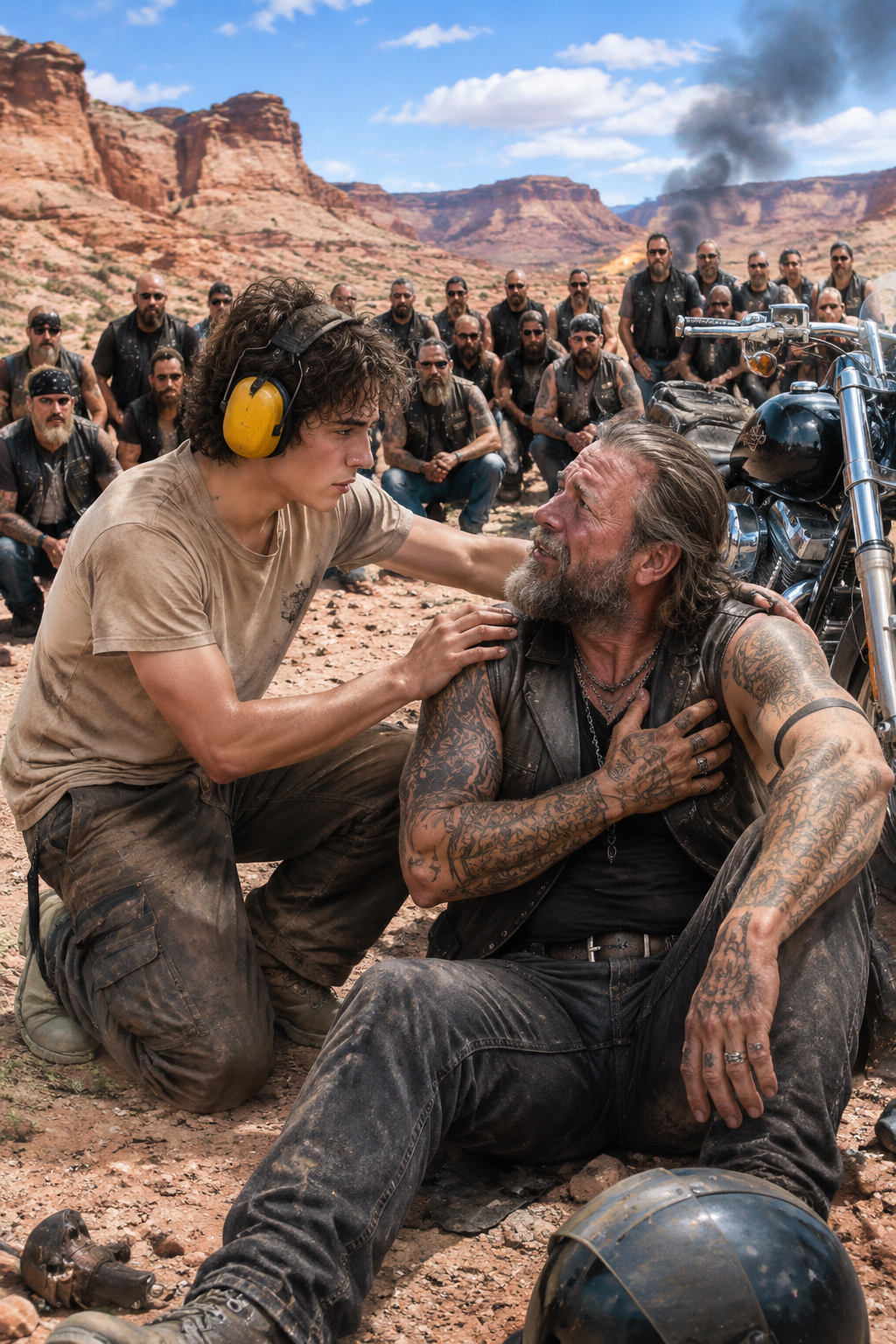
The principal glanced at Leo, then at the crowd.
“Well, that’s certainly commendable, but—”
“But nothing,” Wrench interrupted. “I came to honor a hero.”
He opened the wooden box.
Inside lay a beautifully crafted silver medal suspended from a dark blue ribbon. Engraved across its surface were the words:
COURAGE IS NOT THE ABSENCE OF FEAR.
IT IS THE CHOICE TO HELP DESPITE IT.
Beneath the inscription was Leo’s name.
But the medal wasn’t what made Wrench’s hands tremble.
Underneath it rested an old photograph.
A smiling woman stood beside a little boy holding a toy motorcycle.
Wrench lifted the photograph carefully.
“This is my wife, Sarah,” he said. “And that’s my son, Daniel.”
His voice cracked.
“They died eleven years ago.”
Leo looked up.
Wrench swallowed.
“Car accident. A truck crossed the center line. By the time the emergency crews reached them, it was too late.”
The enormous biker stared at the photograph.
“For eleven years, I kept thinking about everything I couldn’t do that day. Every second I wasn’t there. Every chance I never got.”
He looked directly at Leo.
“Then you came along.”
A muscle tightened in his jaw.
“When I was lying under that motorcycle, I thought I was going to die. And all I could think was that maybe I’d finally see them again.”
The courtyard remained completely silent.
“But then I heard your voice.”
Wrench took a shaky breath.
“You kept telling me to stay alive. You were scared half to death, but you wouldn’t leave.”
Leo shifted uncomfortably.
“I calculated the mechanical advantage,” he murmured.
Wrench smiled through wet eyes.
“Maybe you did, Professor. But you also gave an old man a reason to fight.”
He placed the medal back in its box.
“And there’s something else.”
Grizzly handed him a large envelope.
Wrench offered it to Leo.
Inside was a letter from the engineering department at Westbridge Technical University.
Leo read the first sentence.
Then he read it again.
His fingers began to shake.
The letter invited him to attend a summer engineering program with tuition, accommodation, and materials fully covered.
For a moment, he couldn’t speak.
He had applied to that program months earlier.
His mother had explained that they couldn’t afford it, even if he was accepted.
Now someone had paid for everything.
Leo looked at Wrench.
“Why?”
Wrench shrugged.
“Turns out fifty rough-looking motorcycle enthusiasts can raise a little money when they put their minds to it.”
Behind him, Bones grinned.
“And some of us know people who work at universities.”
Colt added, “We sent them the story of your lever. They wanted to see what else you could build.”
Leo stared at the letter.
His dream had always been to become a mechanical engineer.
He loved machines because they followed rules. Forces could be measured. Problems could be solved. Equations didn’t laugh when he misunderstood a joke.
But he had never imagined that the same men who frightened everyone else would be the ones to open a door for him.
“Thank you,” he whispered.
Wrench shook his head.
“No, kid. Thank you.”
Then a voice came from behind them.
“Are you seriously giving him a medal?”
Everyone turned.
The speaker was Derek Lawson, the tallest of the three boys who had overturned Leo’s wagon.
Derek’s father owned several businesses in town, and Derek had spent years behaving as though the school belonged to him.
He folded his arms.
“He probably just got lucky.”
Wrench’s expression hardened.
“What’s your name, son?”
“Derek.”
“Well, Derek, luck didn’t tie a tourniquet around my leg. Luck didn’t figure out how to lift seven hundred pounds of steel.”
Derek rolled his eyes.
“Whatever.”
Grizzly took a step forward, but Wrench raised his hand.
“No.”
He looked at Leo’s belongings scattered across the pavement.
“Did you do that?”
Derek said nothing.
“Did you knock over his wagon?”
One of Derek’s friends shifted nervously.
“It was just a joke.”
Wrench looked at the overturned wagon.
Then he looked back at the boys.
“Funny thing about jokes. They’re supposed to make everybody laugh.”
Derek’s face reddened.
Principal Caldwell cleared his throat.
“I believe this matter should be handled internally.”
“Then handle it,” Wrench replied.
Caldwell stiffened.
“I beg your pardon?”
“That boy saved my life. And from what I’m seeing, he can’t even walk through your school without being humiliated.”
The principal’s expression became defensive.
“We have a strict anti-bullying policy.”
Leo suddenly spoke.
“I reported it fourteen times.”
Every face turned toward him.
His voice was barely audible.
“Fourteen written reports. Between September third and November eighteenth.”
Caldwell went pale.
Leo continued, staring at the ground.
“Seven incidents involved property damage. Four involved physical contact. Three involved threats.”
Derek opened his mouth.
“He’s lying!”
Leo reached into his backpack and pulled out a thick folder.
“I kept copies.”
Wrench looked at the folder, then at Caldwell.
The principal said nothing.
And for the first time that afternoon, the crowd’s attention shifted away from the bikers.
It settled on the adults who were supposed to protect Leo.
That evening, a video of the confrontation spread across social media.
By midnight, it had been viewed more than two million times.
By morning, the school district had announced an investigation.
But Leo didn’t know any of that.
He was sitting at his kitchen table, staring at the university letter.
His mother, Emily Harrison, stood beside him with tears in her eyes.
“Sweetheart,” she whispered, “this is incredible.”
Leo carefully smoothed the paper.
“There’s a problem.”
Emily’s smile faded.
“What problem?”
“The program requires students to complete a group engineering project.”
She pulled out a chair.
“Okay.”
“I don’t work well in groups.”
“We can talk to the program coordinators.”
“What if they don’t like me?”
Emily reached across the table.
“Leo, you don’t have to make everyone like you.”
He looked at her.
“You just have to be yourself.”
Leo considered that.
“People say that, but sometimes being myself makes other people uncomfortable.”
Emily had no immediate answer.
Because he was right.
She had watched teachers mistake his silence for disrespect. She had watched classmates mock his routines. She had watched strangers speak about him as though he couldn’t understand.
And she had spent seventeen years wondering whether the world would ever see the extraordinary person she saw every day.
Now, suddenly, fifty motorcycle riders had.
But the next morning brought something neither of them expected.
A black SUV pulled into their driveway.
A man in an expensive suit stepped out, carrying a briefcase.
His name was Victor Lawson.
Derek’s father.
Emily opened the door cautiously.
“Can I help you?”
Victor smiled without warmth.
“I believe we need to discuss your son’s recent behavior.”
Leo stood behind his mother.
Victor glanced at him.
“My son has been receiving threats because of that ridiculous video.”
Emily crossed her arms.
“Your son has been bullying mine for years.”
“Allegedly.”
“We have documentation.”
Victor’s smile disappeared.
“Mrs. Harrison, I donate a considerable amount of money to that school. I know the superintendent personally.”
He opened his briefcase and removed several papers.
“My attorney believes your son’s public accusations have damaged Derek’s reputation.”
Emily stared at him.
“Are you threatening to sue a seventeen-year-old boy?”
“I’m offering you an opportunity to resolve this quietly.”
He placed a document on the table.
A confidentiality agreement.
If Emily signed it, the Lawson family would provide a financial settlement, and Leo would withdraw his complaints.
If she refused, Victor warned, the family would consider legal action.
Leo looked at the document.
Then he noticed something.
The settlement agreement described his reports as “unsubstantiated allegations.”
That phrase bothered him.
“They aren’t allegations,” Leo said.
Victor turned.
“Excuse me?”
“I have evidence.”
Victor gave a thin smile.
“Young man, you don’t understand how these things work.”
Leo’s breathing quickened.
He hated being interrupted. He hated when people dismissed facts.
“I understand what evidence is.”
Victor stepped closer.
“Listen carefully—”
“Get out of my house,” Emily said.
Victor looked stunned.
She pointed toward the door.
“Now.”
He collected his papers, his face darkening.
“You’ll regret this.”
After he left, Emily locked the door.
Only then did her hands begin to tremble.
Leo watched her.
“Mom?”
“I’m okay.”
“Your heart rate is elevated.”
She laughed weakly.
“That’s because I’m angry.”
Leo stared at the driveway.
“Did I do something wrong?”
Emily knelt beside him.
“No, sweetheart.”
“Then why is he trying to punish us?”
She took a long breath.
“Because some people would rather protect their pride than admit they’ve hurt someone.”
Leo thought about that for a while.
Then he said something she would remember for the rest of her life.
“An incorrect answer doesn’t become correct just because the person saying it is powerful.”
Emily pulled him into her arms.
And for the first time in months, Leo didn’t pull away.
Two days later, Wrench arrived at the Harrison house.
This time, he came alone.
He parked his motorcycle down the street and walked to the front door, carrying a bag of groceries.
Emily invited him inside.
When he heard about Victor Lawson’s visit, his expression turned grim.
“That man threatened you?”
Emily nodded.
Wrench sat quietly for several seconds.
Then he reached for his phone.
“Grizzly needs to hear about this.”
Emily immediately shook her head.
“Please. I don’t want anyone getting hurt.”
Wrench looked surprised.
“Ma’am, neither do I.”
He put the phone away.
“I spent a lot of years thinking strength meant making people afraid of me.”
He glanced toward Leo, who was assembling a small motor at the kitchen table.
“Your boy taught me something different.”
Emily studied him.
“What are you going to do?”
Wrench smiled faintly.
“Find somebody who knows the law better than Lawson does.”
The following Monday, Emily met with an attorney named Rebecca Shaw.
Rebecca was a former public defender whose father had ridden motorcycles with Grizzly for nearly thirty years.
She listened carefully, reviewed Leo’s reports, and examined the proposed settlement.
Then she closed the folder.
“Mrs. Harrison, your son has a stronger case than you realize.”
Rebecca explained that the school had documented knowledge of repeated harassment and had apparently failed to respond effectively.
She also warned that Victor’s threats should be preserved.
But what interested her most was a photograph Leo had taken two weeks earlier.
It showed Derek and his friends standing beside Leo’s damaged wagon.
In the background was a school security camera.
Rebecca leaned forward.
“Leo, do you know whether that camera was working?”
Leo nodded.
“It records at thirty frames per second. The maintenance technician replaced its power supply on October twenty-sixth.”
Rebecca blinked.
“How do you know that?”
“I watched him do it.”
She smiled.
“Of course you did.”
Rebecca immediately sent a formal preservation request for the surveillance footage.
Three days later, the school district’s attorney contacted her.
The footage had been located.
And it showed far more than anyone expected.
Derek had repeatedly shoved Leo, damaged his belongings, and encouraged other students to surround him.
One recording showed Leo sitting alone in a hallway while Derek kicked his ear defenders across the floor.
Another captured a teacher witnessing the harassment and walking away.
But the most damaging footage showed Principal Caldwell speaking privately with Derek after an incident.
Instead of disciplining him, Caldwell appeared to reassure the boy that the matter would disappear.
When Rebecca presented the evidence at a school board meeting, the room erupted.
Parents demanded answers.
Teachers exchanged uneasy looks.
Victor Lawson sat in the front row, his jaw clenched.
And Leo sat beside his mother, wearing his ear defenders, wishing the fluorescent lights weren’t so bright.
Rebecca addressed the board.
“This isn’t simply a case of students being cruel. It’s a case of adults repeatedly failing to act.”
Caldwell insisted that the recordings were being taken out of context.
Then Rebecca asked one question.
“Mr. Caldwell, did you receive fourteen written complaints from Leo Harrison?”
The principal hesitated.
“Some complaints were brought to my attention.”
“Fourteen?”
“I don’t recall the exact number.”
Rebecca lifted a folder.
“Your signature appears on eleven of them.”
The room fell silent.
Caldwell stared at the papers.
Victor suddenly stood.
“This is a disgrace! My son is being publicly humiliated!”
A woman near the back of the room rose from her chair.
Her daughter had also been bullied.
“So was mine!” she shouted.
Another parent stood.
“And my boy!”
Within minutes, several families began describing similar experiences.
Leo watched them with growing confusion.
He had believed he was the only one.
He hadn’t understood how many other students had been suffering in silence.
The board voted to place Caldwell on administrative leave pending a formal investigation.
Derek and his friends faced disciplinary proceedings, and the district agreed to review its complaint procedures.
Victor left the meeting without speaking to anyone.
But outside, something unexpected happened.
Derek approached Leo.
His face was pale.
For once, he wasn’t surrounded by his friends.
“Hey,” he muttered.
Leo looked at him.
Derek shoved his hands into his pockets.
“My dad’s furious.”
Leo said nothing.
“He says you ruined everything.”
Leo considered the statement.
“I didn’t make you hurt me.”
Derek looked away.
“No.”
“You chose to do that.”
Derek swallowed.
“Yeah.”
For several seconds, neither spoke.
Then Derek whispered, “I’m sorry.”
Leo studied his face.
He wasn’t sure what to say.
He had spent years imagining an apology.
Now that it had arrived, it felt strangely small compared with everything that had happened.
“Are you apologizing because you understand what you did,” Leo asked, “or because you got caught?”
Derek’s eyes filled with tears.
“I don’t know.”
Leo nodded slowly.
“Then you should figure that out.”
He walked away.
And Derek didn’t try to stop him.
Summer arrived six weeks later.
Leo traveled to Westbridge Technical University with his mother, carrying two suitcases, a laptop, and the silver medal Wrench had given him.
On the first morning, he entered a laboratory filled with students from across the country.
There were robotic arms, 3D printers, wind tunnels, and engineering equipment he had only seen in videos.
For the first time in his life, Leo felt as though he had walked into a place designed specifically for his mind.
Then the instructor announced the final project.
Each team would build a rescue device capable of lifting a heavy object in a simulated emergency.
Leo’s stomach tightened.
The instructor continued.
“The winning design will be presented at the National Young Engineers Exhibition.”
Students began forming groups.
Leo remained seated.
Nobody approached him.
He stared at the assignment sheet, remembering the burning motorcycle, the screaming, the smell of gasoline.
His hands began to tremble.
Then a girl with short curly hair stopped beside his desk.
“You’re Leo Harrison, right?”
He nodded.
“I’m Maya Chen.”
She pointed toward the project description.
“I heard you used a lever to lift a motorcycle.”
“Approximately seven hundred pounds.”
Maya grinned.
“That’s ridiculous.”
Leo frowned.
“It was physically possible.”
“I meant ridiculously impressive.”
“Oh.”
She pulled out a chair.
“Want to build something better?”
Leo hesitated.
“Better than what?”
“The lever.”
He looked at her.
Then, slowly, he smiled.
Over the next four weeks, Leo and Maya worked alongside two other students, Andre and Sofia.
Their first design failed.
Their second prototype jammed under pressure.
Their third bent its support frame.
Each failure frustrated Leo more than he could explain.
He wanted the calculations to work.
He wanted the materials to behave as predicted.
He wanted the world to follow the equations.
One afternoon, after a hydraulic seal ruptured during testing, Leo slammed his notebook shut.
“It’s wrong!”
The other students froze.
Leo’s breathing became rapid.
“I checked the pressure limits. I checked the load distribution. It should work!”
Maya approached carefully.
“Leo, can I show you something?”
He shook his head.
“No.”
She stopped.
“Okay. I’ll wait.”
Ten minutes later, Leo returned to the workbench.
Maya pointed toward a small fracture in the frame.
“The equations were right,” she said. “But we assumed the material was uniform.”
Leo examined the fracture.
His expression changed.
“The weld.”
Andre nodded.
“The weld.”
For the first time, Leo understood something important.
Working with other people didn’t mean surrendering control.
It meant seeing things he might have missed.
They redesigned the frame, added a mechanical backup, and built a compact lifting device that could be operated by one person.
They called it the Guardian Lift.
It used a folding lever assembly, a ratcheting support mechanism, and interchangeable contact pads to stabilize heavy objects.
It wasn’t glamorous.
It wasn’t beautiful.
But it worked.
During the final demonstration, their device lifted an eight-hundred-pound test load high enough to create a safe rescue gap.
The laboratory erupted in applause.
Leo covered his ears.
Then he laughed.
Maya stared at him.
“Did you just laugh?”
Leo nodded.
“The safety factor was 2.4.”
She burst out laughing too.
Their team won first place.
But the real surprise came two weeks later.
A representative from a regional fire and rescue equipment manufacturer contacted the university.
The company wanted to help develop the Guardian Lift into a practical emergency rescue tool.
And they wanted Leo involved.
When Emily heard the news, she cried so hard that Leo handed her an entire box of tissues.
“Mom, your eyes are producing an excessive amount of tears.”
She laughed.
“I know, sweetheart.”
“Are you sad?”
“No.”
“Then why are you crying?”
She hugged him.
“Because sometimes happiness is too big to stay inside.”
Leo considered that explanation.
Then he hugged her back.
In October, the university invited Leo’s team to demonstrate the Guardian Lift at a public safety exhibition.
Firefighters, paramedics, engineers, and rescue organizations gathered inside a massive convention center.
Leo stood beside the device, nervously adjusting his ear defenders.
He had prepared a twelve-minute presentation.
He had memorized every technical specification.
He had practiced answering thirty-seven possible questions.
But nothing prepared him for what happened when he looked toward the audience.
Wrench was sitting in the front row.
Beside him were Grizzly, Bones, Colt, and several other riders.
Emily sat next to them, smiling.
Wrench raised his hand.
Leo smiled back.
Then the demonstration began.
Everything went perfectly for the first six minutes.
The Guardian Lift raised the test weight smoothly.
The ratchet engaged.
The safety lock held.
The audience applauded.
Then a sharp metallic crack echoed through the hall.
One of the supporting brackets snapped.
The load shifted violently.
A technician standing beside the apparatus stumbled backward and fell, his lower leg trapped beneath the edge of the heavy demonstration platform.
People screamed.
The instructor rushed forward.
“Shut it down!”
Leo froze.
For one terrible second, he was back on Highway 50.
The smoke.
The heat.
The crushing weight.
The sound of a man struggling to breathe.
His vision narrowed.
He could hear every voice, every footstep, every alarm.
Too much.
Far too much.
Then he saw Wrench standing at the edge of the crowd.
The biker wasn’t shouting.
He simply placed one hand over his heart.
And Leo remembered.
“Stay with me.”
The words he had spoken in the ravine returned to him.
Leo took one breath.
Then another.
He looked at the broken bracket.
The platform was unstable, but the Guardian Lift’s backup ratchet remained intact.
He turned toward the firefighters rushing forward.
“Don’t pull him!”
The nearest firefighter stopped.
Leo pointed to the platform.
“The load is shifting toward the damaged support. If you pull him, it could collapse farther.”
The rescue crew examined the structure.
Leo quickly explained how to position a second support and engage the mechanical lock without loading the fractured bracket.
The firefighters took control of the rescue, using Leo’s instructions alongside their own safety procedures.
Within minutes, they stabilized the platform.
The technician was freed.
He was conscious, frightened, and injured, but alive.
The hall erupted in relieved applause.
Leo barely heard it.
He was staring at the broken bracket.
His invention had failed.
His hands began shaking.
“I made a mistake.”
Maya stood beside him.
“The bracket failed, Leo.”
“I should have detected the defect.”
“We all inspected it.”
“I should have—”
“Leo.”
She gently placed the damaged component on the table.
“Look at me.”
He did.
“You didn’t ignore the failure. You helped us respond to it.”
Leo swallowed.
“But someone got hurt.”
“Yes,” she said. “And we’re going to investigate why, and make sure it doesn’t happen again.”
Wrench approached slowly.
“Professor?”
Leo looked up.
“I failed.”
Wrench studied the damaged machine.
Then he looked at the young man who had once saved him with a steel post and a boulder.
“Kid, do you know how many times I’ve dropped a wrench?”
Leo blinked.
“No.”
“Thousands.”
“That’s statistically plausible.”
Wrench smiled.
“Do you know how many engines I’ve rebuilt because I got something wrong?”
Leo shook his head.
“More than I care to admit.”
He placed a hand on Leo’s shoulder.
“Making something useful doesn’t mean making something that can never fail. It means taking responsibility when it does.”
Leo stared at the broken bracket.
Then he nodded.
“I need to improve the design.”
Wrench grinned.
“Now you’re talking.”
The incident prompted a complete safety review.
The university suspended demonstrations while engineers examined the failure.
The investigation found a manufacturing defect in a replacement bracket that had not been included in the original prototype.
Leo insisted on adding redundant supports, improved inspection procedures, and a clearly marked emergency shutdown system.
The project was delayed for months.
But when the redesigned Guardian Lift passed independent testing, it was stronger, safer, and easier to operate.
The manufacturer offered to fund further development.
Leo accepted on one condition.
He wanted the company to make a version affordable enough for volunteer rescue organizations with limited budgets.
The executives initially resisted.
Lower prices meant smaller profits.
But Leo arrived at the next meeting with a spreadsheet showing how standardized parts, simpler assembly, and bulk purchasing could reduce manufacturing costs.
He presented his calculations without looking up from his notes.
When he finished, the room was silent.
Then the company’s chief engineer smiled.
“Mr. Harrison, I think we can work with that.”
Two years passed.
Leo graduated from high school with honors and began studying mechanical engineering at Westbridge.
The school district implemented new reporting procedures and independent oversight for bullying complaints.
Principal Caldwell never returned to his position.
Derek Lawson completed his disciplinary requirements and eventually began volunteering at a youth mentoring program.
He and Leo never became friends.
But one afternoon, Derek sent him a letter.
It contained no excuses.
Only an acknowledgment of the harm he’d caused and a promise to treat people differently.
Leo kept the letter.
Not because it erased the past.
But because it reminded him that people could choose to change.
Meanwhile, Wrench continued his rehabilitation.
He regained most of his mobility, although his injured leg still ached on cold mornings.
Every Sunday, he visited the Harrison house.
Sometimes he helped Leo repair machines.
Sometimes they watched documentaries.
Sometimes they sat in comfortable silence.
Wrench learned that silence didn’t always mean sadness.
Leo learned that friendship didn’t always require conversation.
And Grizzly, who had once frightened entire rooms simply by entering them, became an unlikely advocate for students with disabilities.
The motorcycle charter began organizing annual fundraising rides for adaptive technology, emergency equipment, and anti-bullying education.
They called the event the Harrison Ride.
Leo hated the name.
“It’s unnecessarily personalized,” he complained.
Grizzly laughed.
“Too late, Professor. Already printed the shirts.”
On the third anniversary of the Highway 50 accident, the charter organized its largest ride yet.
Hundreds of motorcycles gathered beneath a bright autumn sky.
Firefighters, paramedics, teachers, engineers, and families attended.
A small stage stood near the entrance to the highway overlook.
And beside it was the latest version of the Guardian Lift.
The device had now been distributed to dozens of rescue organizations for field evaluation and training.
Its design had already helped responders in several emergencies.
But Leo wasn’t thinking about those achievements.
He was staring at the crowd.
He had been asked to give a speech.
A speech.
In front of hundreds of people.
He stood backstage, gripping his notes.
“I can’t do it.”
Emily stood beside him.
“You don’t have to.”
“But I promised.”
“You can change your mind.”
Leo looked toward the stage.
Wrench was waiting near the microphone.
His scarred leg was planted firmly on the ground.
Three years earlier, that man had been trapped beneath a burning motorcycle.
Three years earlier, Leo had been a frightened boy who could barely speak to strangers.
Now they were standing together at an event created because of one desperate moment on a lonely highway.
Leo took a breath.
“I want to try.”
Emily smiled.
“Then try.”
When Leo stepped onto the stage, the crowd began applauding.
He immediately raised one hand.
The applause faded.
He adjusted his ear defenders.
Then he unfolded his notes.
“My name is Leo Harrison.”
His voice trembled.
“I am twenty years old. I study mechanical engineering. I have autism.”
He paused.
“Three years ago, I witnessed a motorcycle accident.”
The crowd listened.
“I was afraid. The fire was loud. The man was screaming. I wanted to leave.”
Leo looked at Wrench.
“But I knew something about levers.”
A few people smiled.
“I used that knowledge to help him.”
He glanced down at his notes.
“Afterward, many people called me brave. I didn’t understand why. I was terrified.”
His fingers tightened around the paper.
“I thought bravery meant not being afraid.”
He paused.
“Now I think bravery means deciding that something matters more than your fear.”
Wrench lowered his head.
Leo continued.
“Some people thought I couldn’t help because I was different. Other people thought the men who came to help me were dangerous because of how they looked.”
He looked toward the rows of leather jackets.
“Both assumptions were incomplete.”
The audience remained silent.
“I don’t think people should have to become heroes before they deserve respect.”
Emily covered her mouth.
Leo’s voice grew steadier.
“I deserved respect before I saved anyone. So did every student who was bullied. So does every person who communicates differently, thinks differently, or needs help.”
He swallowed.
“And the people who helped me deserved to be judged by what they did, not just by what they wore.”
Grizzly removed his sunglasses.
Leo looked down at the final paragraph of his speech.
“Machines have something called a mechanical advantage. A small force can move a much larger weight when it is applied in the right way.”
He smiled faintly.
“I think kindness works like that.”
A breeze moved across the stage.
“One person helps another. That person helps someone else. And eventually, something that seemed impossible begins to move.”
He folded his notes.
“Thank you.”
For a moment, nobody made a sound.
Then Wrench stood.
He began clapping.
Grizzly followed.
Then Bones.
Then Colt.
Within seconds, hundreds of people rose to their feet.
Leo instinctively pressed his ear defenders closer.
But this time, he didn’t want to run.
He looked toward his mother.
She was crying.
He looked toward Wrench.
The enormous biker was crying too.
Leo laughed softly.
“Excessive tear production,” he whispered.
After the ceremony, Wrench asked Leo to walk with him.
They followed a narrow path toward the highway overlook.
Below them, cars moved along Highway 50.
The ravine where the accident had happened was visible beyond the guardrail.
Wrench stopped beside a newly installed memorial plaque.
Leo read the inscription.
ON THIS ROAD, ONE ACT OF COURAGE BECAME A LIFETIME OF SERVICE.
Wrench reached into his jacket.
“I’ve got something for you.”
Leo turned.
The biker held out an old, scratched metal wrench.
Leo recognized it immediately.
It was the same wrench he’d used to tighten the improvised tourniquet three years earlier.
The paramedics had returned it to Wrench after the accident.
“I kept it,” Wrench said.
Leo took it carefully.
The metal was worn, stained, and slightly bent.
“It isn’t suitable for precision work anymore,” he observed.
Wrench laughed.
“No, I guess not.”
Leo turned the wrench over.
“Why are you giving it to me?”
Wrench looked toward the ravine.
“Because for a long time, I thought that day was the worst thing that ever happened to me.”
His voice softened.
“I lost my bike. Nearly lost my leg. Nearly lost my life.”
He paused.
“But I found a family I didn’t know I needed.”
Leo looked at him.
“You already had a family. The charter.”
Wrench nodded.
“I did.”
Then he smiled.
“But families can grow.”
Leo stared at the wrench.
After a moment, he reached into his backpack and removed a small rectangular case.
“I have something for you too.”
Inside was a miniature model of the Guardian Lift, carefully machined from aluminum.
On its base were engraved four words.
FOR MY FIRST FRIEND.
Wrench stared at the inscription.
His eyes filled.
“Leo…”
“I know you have other friends,” Leo said quickly. “The phrase refers to my perspective, not yours.”
Wrench let out a broken laugh.
Then he pulled Leo into a hug.
For a moment, Leo stiffened.
Unexpected physical contact still made him uncomfortable.
But Wrench began to release him, and Leo gently held on.
Just for a few seconds.
Long enough.
When they separated, Wrench wiped his face.
“You know something, Professor?”
“What?”
“That day on the highway, you didn’t just save my life.”
Leo waited.
“You helped me want to live it again.”
The two stood quietly beside the road.
Far below, traffic continued moving.
The world hadn’t become perfect.
There were still cruel people, broken systems, dangerous roads, and machines that failed.
Leo still struggled with sudden noises.
He still needed routines.
He still sometimes found conversations exhausting.
Wrench still carried grief for his wife and son.
His leg still hurt.
Neither of them had been magically transformed into someone else.
But both had discovered something that changed the way they understood themselves.
Leo had learned that being different didn’t make him less capable of changing the world.
Wrench had learned that strength wasn’t measured by the fear you inspired, but by the safety you offered.
And together, they had learned that the most important things in life often begin with the smallest decisions.
A boy choosing not to run.
A stranger choosing to say thank you.
A group of men choosing kindness over intimidation.
A mother choosing to stand against someone powerful.
A young man choosing to speak even when his voice shook.
As the sun lowered over Highway 50, Grizzly’s voice called from the parking lot.
“Hey, Professor! You coming?”
Leo looked toward the motorcycles.
Then he looked at Wrench.
“Are the engines going to be loud?”
“Probably.”
“Can you ask them to start one at a time?”
Wrench smiled.
“For you? Absolutely.”
Leo nodded.
“Then I’m coming.”
They walked back together.
One limping slightly.
The other carrying an old wrench.
Neither looked like the kind of person the world expected to be a hero.
And that was precisely the point.
Because courage doesn’t always arrive wearing a uniform.
Compassion doesn’t always wear a gentle face.
And intelligence doesn’t always speak in the way the world expects.
Sometimes, the person everyone overlooks is the one who sees the solution.
Sometimes, the person everyone fears is the one who offers protection.
And sometimes, all it takes to change a life is the decision to see another human being for who they truly are.
Years later, when Leo became an engineer and was asked what inspired his work, he never began by talking about awards, inventions, or the university that had accepted him.
He always talked about a man trapped beneath a motorcycle.
He talked about the weight of the machine, the angle of the steel post, and the boulder that became a pivot.
Then he explained the lesson that mattered most.
“A lever can lift something heavier than the person holding it,” he would say. “But kindness can lift something no machine ever could.”
And whenever someone asked what that was, Leo would smile.
“A human life.”
Not simply by keeping a heart beating.
But by giving someone dignity, belonging, and a reason to believe tomorrow could be better than yesterday.
Because the greatest rescue on Highway 50 wasn’t only the moment a frightened boy lifted seven hundred pounds of steel.
It was everything that happened afterward.
It was the moment two people, who had both been misunderstood by the world, finally recognized the humanity in each other.
And neither of them ever had to face the world alone again.
The story has already reached its conclusion, but there was one final chapter in Leo Harrison’s life that would reveal just how far a single act of courage could reach.
Ten years after the accident on Highway 50, Leo stood inside a newly opened emergency rescue training center, watching firefighters practice with the latest generation of the Guardian Lift.
His invention was now being used by rescue teams across the country. It had helped free people trapped beneath vehicles, collapsed machinery, and fallen structures.
On the wall behind him hung a photograph of a seventeen-year-old boy kneeling beside a wounded biker.
Below it were the words:
EVERY LIFE IS WORTH SAVING. EVERY PERSON HAS SOMETHING TO GIVE.
Leo was thirty now.
He still wore ear defenders when the world became too loud. He still preferred precise explanations to small talk. And he still carried the old metal wrench in his briefcase whenever he traveled.
But he no longer believed that being different meant he had to face life alone.
A familiar voice interrupted his thoughts.
“Professor, you’re getting famous without me.”
Leo turned.
Wrench stood in the doorway, his beard almost entirely gray.
He walked with a cane now, and his injured leg had never completely recovered.
But his smile was the same.
“You’re seventeen minutes late,” Leo said.
Wrench laughed.
“Good to see you too, kid.”
They embraced.
Then Wrench handed him a folded newspaper.
The headline read:
GUARDIAN LIFT SAVES SIX CHILDREN AFTER SCHOOL BUS ACCIDENT.
Leo carefully unfolded the article.
A school bus had overturned on a mountain road during a storm. Rescue workers had used his device to stabilize part of the wreckage and create enough space to free six trapped children.
All six had survived.
Leo read the article twice.
Then he sat down.
Wrench watched him.
“You okay?”
Leo nodded slowly.
“I wasn’t there.”
“No, you weren’t.”
“I didn’t rescue them.”
Wrench pulled out a chair.
“Leo, you built something that helped other people rescue them.”
Leo stared at the newspaper.
For years, he had measured success through calculations, testing results, and safety improvements.
But now he was beginning to understand something larger.
The work of his hands could reach places he would never visit.
It could help people he would never meet.
And those people might someday help others.
“That’s a significant multiplication of impact,” Leo whispered.
Wrench smiled.
“Yeah, Professor. I suppose it is.”
Later that afternoon, the training center held a small ceremony.
Among the guests was a twelve-year-old boy named Oliver, one of the children rescued from the bus.
Oliver approached Leo nervously, holding a handwritten letter.
“My mom says you’re the reason I’m alive.”
Leo knelt so they were at eye level.
“The firefighters saved you,” he replied. “They were very skilled.”
Oliver shook his head.
“But they used your machine.”
“Yes.”
The boy hesitated.
“Can I ask you something?”
“Of course.”
Oliver looked down at his shoes.
“I have autism too. Kids at my school say I’m weird.”
Leo went very still.
For a moment, he saw himself at seventeen, kneeling beside an overturned wagon while his classmates laughed.
He remembered the loneliness.
The fear.
The feeling that no matter how hard he tried, the world would never make room for him.
Then he looked at Oliver.
“Do you like building things?”
Oliver’s face brightened.
“Robots.”
“What kind?”
“Mostly small ones. But I want to build a robot that can help people during earthquakes.”
Leo smiled.
“That’s an excellent engineering problem.”
Oliver stared at him.
“Do you think I could actually do it?”
Leo considered the question carefully.
Then he reached into his briefcase and removed the old wrench.
He placed it gently in Oliver’s hands.
“This helped save a man’s life before I ever designed a rescue machine.”
Oliver turned it over.
“It’s just a wrench.”
“Yes,” Leo said. “And I was just a frightened teenager who knew something about physics.”
The boy looked up.
Leo continued.
“You don’t have to become somebody else to do something important. You need opportunities to learn, people who respect you, and the courage to keep trying.”
Oliver held the wrench against his chest.
“Can I keep it?”
Leo glanced toward Wrench.
The old biker nodded.
Leo smiled.
“Yes. But there’s one condition.”
“What?”
“When you build something that helps another person, you must tell them where the wrench came from.”
Oliver nodded enthusiastically.
“I promise.”
That evening, after the guests had gone, Leo and Wrench sat outside the training center.
The sunset painted the sky orange and gold.
For a long time, neither spoke.
Then Wrench broke the silence.
“You know, I used to think the story ended when you pulled me out from under that bike.”
Leo looked at him.
“It didn’t.”
“No,” Wrench said. “It was just beginning.”
Leo watched Oliver walking toward the parking lot with his mother, carefully carrying the old wrench.
“Perhaps it still is.”
Wrench smiled.
“Perhaps it is, Professor.”
And somewhere in that moment, the full meaning of what had happened on Highway 50 became clear.
A boy had saved a stranger.
The stranger had helped the boy find his place in the world.
The boy had grown into a man whose inventions saved other strangers.
And now another frightened child was carrying a reminder that his differences did not diminish his possibilities.
The kindness had traveled farther than anyone could have predicted.
It had crossed generations.
It had changed lives.
And it was still moving.
Because the true measure of a good deed is not how loudly the world applauds it, but how many lives become better because it happened.
That was the legacy of Leo Harrison and Tommy “Wrench” Gallagher.
Not a motorcycle.
Not a medal.
Not even a remarkable invention.
But a simple truth:
You may never know how far your kindness will travel, or whose life it will touch next. So when you have the chance to help someone, never underestimate what one small act of courage can begin.
THE END.