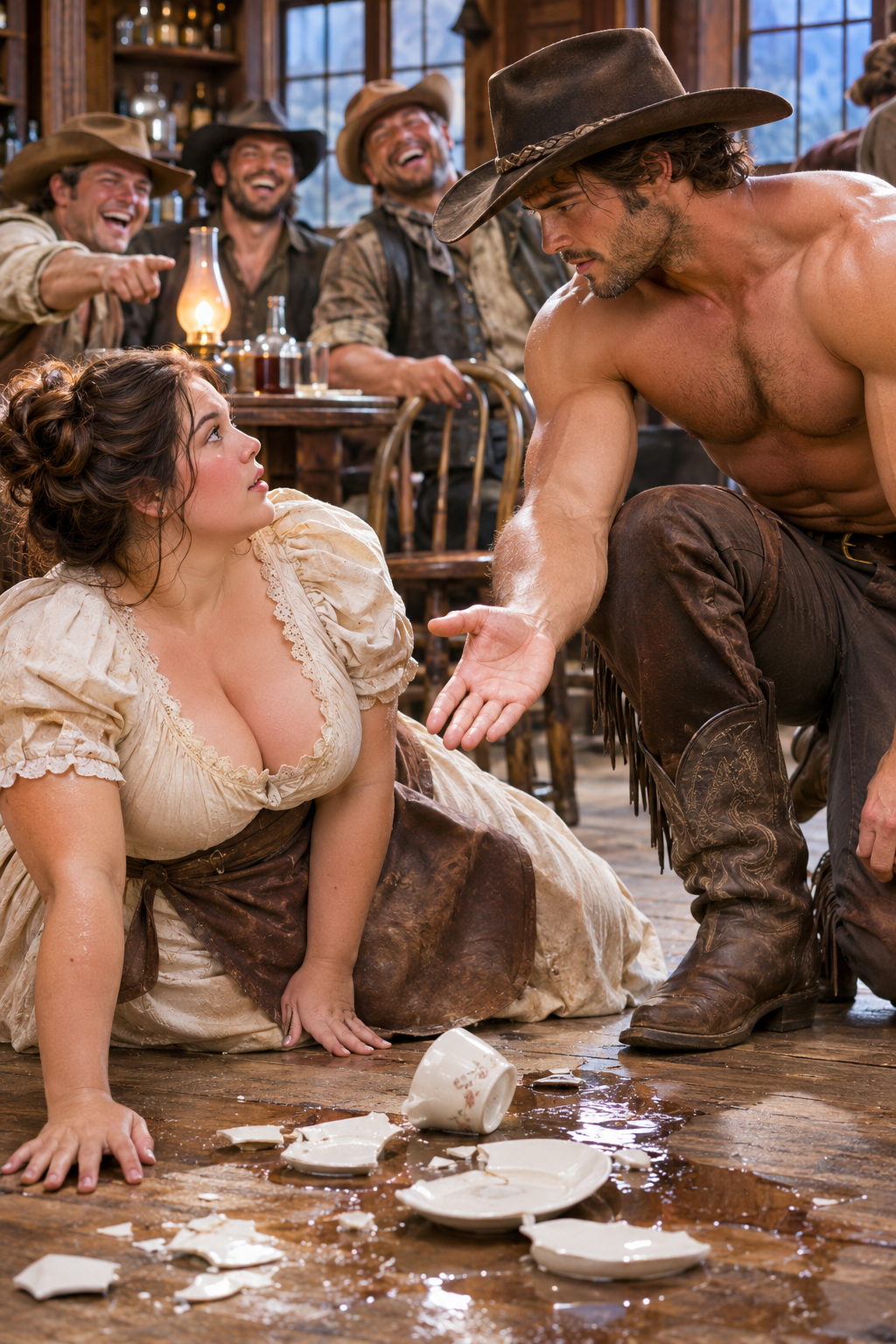
Silas Crowley deliberately tripped the waitress, sending her crashing to the floor with a tray of broken dishes. Then he laughed as blood ran down her palm.
Rebecca stood beside the livery stable, watching the afternoon sunlight disappear behind the mountains. In her pocket rested the contract Henry Callahan had signed, its folded edges pressing against her fingers like a promise she wasn’t quite ready to believe.
For years, she had imagined opening a shop with her father’s tools hanging neatly along the walls. She could almost smell the leather, hear the steady rhythm of her hammer, and see her name painted above the door.
But dreams were easy when they remained dreams. Turning one into reality meant risking the little security she had left.
Henry waited without speaking.
Finally, Rebecca looked up. “I’ll accept your offer, Mr. Callahan. But there’s one more thing you should know.”
“I’m listening.”
“If I discover you’re anything like Silas Crowley, I’ll leave before you can finish making excuses.”
Something resembling a smile touched Henry’s face.
“Then I suppose I’d better give you no reason to leave.”
Three days later, Rebecca climbed into a wagon bound for Black Pine Ranch, carrying two trunks, her father’s leatherworking tools, and every dollar she had saved.
She didn’t know that Silas Crowley was watching from the window of the Copper Bell.
And she certainly didn’t know that her decision had just placed her in the middle of a dangerous battle that had been unfolding for years.
The journey into the mountains took nearly six hours.
By the time Black Pine Ranch appeared through the pine trees, snow had begun falling in delicate white flakes.
Rebecca expected a wealthy cattleman’s estate, perhaps a grand house surrounded by servants and expensive furnishings.
Instead, she found a working ranch built from determination rather than luxury.
Weathered barns stood beside sturdy corrals. Smoke curled from the chimneys of several modest buildings. Men moved through the yard carrying feed, repairing fences, and preparing livestock shelters for the coming winter.
Henry stopped the wagon beside a long workshop.
“This will be yours,” he said.
Rebecca stepped inside.
Sunlight entered through two large windows. There was a workbench, shelves for supplies, a heavy cutting table, and a small iron stove.
It wasn’t beautiful.
Not yet.
But it was more space than she had ever been allowed to call her own.
She ran her fingers across the workbench.
“Why give me an entire building?”
“Because good work requires proper tools and room to do it.”
Rebecca turned toward him.
“You barely know me.”
“I know what I saw in that saddle. And I know you recognized dangerous leather when three experienced buyers didn’t.”
She studied his expression, searching for the hidden obligation behind his generosity.
There was none she could see.
That evening, she met the ranch’s housekeeper, Martha Bell, a silver-haired widow whose sharp eyes missed nothing.
Martha showed Rebecca to a comfortable room overlooking the eastern pasture.
“You’ll eat with the rest of us,” she explained. “Mr. Callahan doesn’t believe anyone’s too important to share a table.”
“Does he always treat his workers this well?”
Martha hesitated.
“He tries.”
Something in her voice caught Rebecca’s attention.
“Tries?”
Martha looked toward the window.
“This ranch has had its share of troubles, dear. And Mr. Callahan has carried more than his share of them.”
Before Rebecca could ask another question, Martha changed the subject.
For the next two weeks, Rebecca worked harder than she ever had at the Copper Bell.
But there was a difference.
Every stitch she made belonged to a skill she loved.
She repaired saddles, replaced worn straps, reinforced harnesses, and discovered that several pieces of expensive tack had been constructed from the same defective leather Henry had shown her.
One afternoon, she laid five damaged reins across her workbench.
“Mr. Callahan, I need you to see this.”
Henry entered with his foreman, Thomas Reed, a broad-shouldered man with a graying beard.
Rebecca pointed to the leather.
“These weren’t simply made from poor hides. Someone treated them with a chemical mixture that weakened the fibers.”
Thomas frowned.
“Could that happen accidentally?”
“Once, perhaps. But every damaged piece comes from the same shipment.”
Henry’s jaw tightened.
“Who supplied it?”
Thomas looked uncomfortable.
“Crowley Trading Company.”
Rebecca felt the room grow colder.
“Silas Crowley?”
Henry nodded slowly.
“He controls most of the cattle transportation and leather supplies in this valley.”
“Then why do business with him?”
“Because the nearest alternative is nearly a hundred miles away. And Crowley has spent years making certain nobody else can compete.”
Rebecca stared at the damaged reins.
“Then he’s not just a cruel man.”
“No,” Henry answered. “He’s a dangerous one.”
That night, Rebecca couldn’t sleep.
She kept remembering the satisfaction on Silas’s face when he tripped her, the way he had expected everyone to accept his cruelty.
Now she wondered how many people had suffered because nobody challenged him.
Three mornings later, trouble arrived.
A young ranch hand named Daniel burst into the workshop, his face pale.
“Miss Dawson! There’s been an accident!”
Rebecca dropped her needle.
Outside, several men were carrying an injured cowboy toward the bunkhouse.
His name was Eli Mercer, a nineteen-year-old who had been riding a nervous stallion along the northern fence.
A rein had snapped.
The horse had bolted.
Eli had been thrown against a fallen tree.
Rebecca followed them inside, where Martha was already preparing bandages.
Eli groaned as Thomas examined his shoulder.
“The doctor’s coming from town,” Thomas said. “But it’ll take hours.”
Rebecca noticed something hanging from Daniel’s hand.
The broken rein.
She took it carefully.
The leather had separated at the exact point where the suspicious treatment had weakened it.
Her stomach twisted.
“I warned you these were dangerous.”
Thomas looked stricken.
“We replaced every rein from that shipment.”
“Apparently not every one.”
Henry appeared in the doorway.
His eyes moved from Eli’s injured body to the broken leather in Rebecca’s hands.
For a moment, his face revealed something deeper than anger.
Fear.
Then he turned to Thomas.
“Check every piece of equipment on this ranch. Nothing leaves the barns until Rebecca approves it.”
Thomas nodded immediately.
“And send word to every ranch that purchased supplies from Crowley,” Henry continued. “I don’t care if they’re competitors. They need to know.”
Rebecca looked at him with unexpected respect.
“You’ll lose money doing that.”
Henry met her eyes.
“Money can be earned again. A dead boy doesn’t get another chance.”
Fortunately, Eli survived with a fractured collarbone and several bruised ribs.
But the accident changed everything.
Within days, ranchers from across Pine Hollow began arriving with broken harnesses and damaged saddles.
Rebecca examined each piece, recording the defects in a leather-bound notebook.
The evidence was unmistakable.
Silas Crowley had been selling dangerous equipment throughout the valley.
And someone had been helping him hide it.
One evening, as Rebecca worked late, she heard footsteps outside.
A shadow crossed the workshop window.
“Who’s there?” she called.
No answer.
She reached for the heavy awl beside her workbench.
The door opened.
A small boy stood trembling in the doorway.
He couldn’t have been older than twelve.
His coat was torn, and his cheeks were red from the cold.
“Are you Miss Dawson?”
“Yes.”
“My mother said you might help us.”
“What’s your name?”
“Samuel Price.”
Rebecca recognized the surname. The Price family owned a struggling ranch near the southern ridge.
Samuel pulled a folded paper from his coat.
“My father bought supplies from Mr. Crowley. One of the harnesses broke, and our wagon overturned. Father hurt his leg.”
Rebecca took the paper.
It was a debt notice.
Crowley claimed the Price family owed him nearly four hundred dollars for damaged merchandise and transportation fees.
“He says he’ll take our cattle if we don’t pay by Christmas,” Samuel whispered.
Rebecca read the notice twice.
Then she noticed something peculiar.
The signature at the bottom wasn’t Silas Crowley’s.
It belonged to Nathaniel Briggs, the county’s deputy sheriff.
“Why would a deputy sign a private debt collection notice?” she murmured.
Samuel shook his head.
“I don’t know. But my mother says nobody will stand against Mr. Crowley.”
Rebecca crouched until they were eye to eye.
“Tell your mother to keep every receipt she has. And tell her not to sign anything else.”
“Can you stop him?”
Rebecca wanted to say yes.
Instead, she answered honestly.
“I don’t know yet. But I’m going to try.”
After Samuel left, Rebecca carried the notice to Henry.
He examined the signature, and his expression darkened.
“Briggs has been Crowley’s friend for years.”
“Then the law is helping him steal from people.”
“Some of the law,” Henry corrected. “Not all of it.”
Rebecca folded her arms.
“What are you going to do?”
Henry studied her for a long moment.
“What do you think we should do?”
The question surprised her.
She had expected instructions, perhaps a warning to stay out of trouble.
Instead, he was asking for her judgment.
“We need proof,” she said. “Not just damaged leather. Records. Payments. Names. Something he can’t explain away.”
Henry nodded.
“Then that’s what we’ll find.”
The opportunity came sooner than either expected.
Two days later, Rebecca traveled into Pine Hollow to purchase needles and heavy thread.
As she passed the Copper Bell, she heard shouting from inside.
A woman emerged carrying a wooden box.
Rebecca recognized her immediately.
Clara Whitcomb, the restaurant’s former cook.
Her eyes were swollen from crying.
“Clara?”
The woman stopped.
“Rebecca? I heard you were working at Black Pine.”
“What happened?”
Clara looked back toward the restaurant.
“I was dismissed. Mr. Crowley complained about his breakfast, and Mr. Haskell blamed me.”
Rebecca’s expression hardened.
“Silas again.”
Clara laughed bitterly.
“He practically owns that place now. Haskell owes him money.”
She lowered her voice.
“And that’s not all. Crowley keeps records in Haskell’s office. I’ve seen Briggs carrying envelopes in there after closing.”
Rebecca felt her pulse quicken.
“What kind of records?”
“I don’t know. But last week I heard Crowley say that once Callahan lost his ranch, the whole valley would belong to him.”
Rebecca went still.
“Lost his ranch?”
Clara nodded.
“He said something about a payment coming due before New Year’s.”
That evening, Rebecca confronted Henry in his study.
“Is Black Pine in financial trouble?”
Henry looked up from his desk.
“Who told you that?”
“Does it matter?”
He remained silent.
Rebecca stepped closer.
“You hired me under a contract promising wages through winter. If the ranch is in danger, I deserve to know.”
Henry set down his pen.
For the first time since meeting him, he looked exhausted.
“Three years ago, my younger brother, William, borrowed money to expand our cattle operation. He believed Crowley could help us reach eastern markets.”
“What happened?”
“Crowley manipulated the shipping prices. The cattle arrived late, several died, and the buyers refused the remaining stock.”
Henry stared at the fire.
“William blamed himself. He rode out during a storm to retrieve a missing herd.”
Rebecca waited.
“He never came home.”
The silence that followed seemed to fill the entire room.
“I’m sorry,” she whispered.
Henry nodded without looking at her.
“After his death, I discovered that William had signed a loan agreement using part of Black Pine as collateral. Crowley purchased the debt.”
“And now?”
“Unless I repay it by December thirty-first, he can attempt to seize the ranch.”
“How much?”
“Eight thousand dollars.”
Rebecca’s breath caught.
It was more money than she could imagine.
“Why didn’t you tell your workers?”
“Because they’re frightened enough about winter. And because I’m still trying to find a way.”
Rebecca looked at the man standing before her.
She understood now why Martha had spoken of burdens.
But she also saw the danger of carrying them alone.
“You should have told Thomas.”
Henry looked up sharply.
“Why?”
“Because he’s spent twenty years helping build this ranch. Because people can’t help solve a problem they don’t know exists.”
Henry’s face tightened.
“I won’t ask my workers to sacrifice their livelihoods for my mistakes.”
“Then don’t ask them to sacrifice anything. Ask them to help you think.”
For a long moment, neither spoke.
Then Henry gave a weary smile.
“You have an irritating habit of being right, Miss Dawson.”
“My father used to say the same thing.”
The following morning, Henry gathered his workers in the dining hall.
He explained the debt, the deadline, and the possibility that Black Pine might be lost.
No one spoke at first.
Then Thomas stepped forward.
“Mr. Callahan, my family has lived on this ranch for twenty-one years. If Crowley thinks we’ll quietly hand it over, he’s mistaken.”
Others nodded.
Daniel offered to organize a cattle drive to sell animals directly to buyers beyond the valley.
Martha suggested selling preserved goods and winter supplies at the Christmas market.
Rebecca proposed something different.
“What if we prove Crowley deliberately damaged the ranch’s business?”
Henry turned toward her.
“If we can establish fraud, we may be able to challenge the debt.”
Thomas frowned.
“But where do we find proof?”
Rebecca remembered Clara’s words.
“The Copper Bell.”
The plan was risky.
Rebecca knew Haskell’s office well. She had cleaned it countless times while working at the restaurant.
But entering without permission would give Crowley exactly the accusation he needed.
Instead, she approached Haskell during the busy Christmas market.
He looked surprised to see her.
“Come to ask for your job back?”
“No. I’ve come to offer you a chance to tell the truth.”
His smile vanished.
Rebecca placed several damaged leather samples on the counter.
“Crowley’s been selling defective supplies. People are getting hurt. And I know he’s been using your office for private business.”
Haskell glanced nervously toward the dining room.
“Keep your voice down.”
“Then speak to me outside.”
He followed her into the alley.
There, away from customers, his confidence crumbled.
“You don’t understand,” he whispered. “Crowley owns my debts. If I cross him, he’ll take everything.”
“He’s already taking everything,” Rebecca replied. “Your independence. Your reputation. Your ability to treat people fairly.”
Haskell looked away.
“I can’t help you.”
Rebecca turned to leave.
Then he caught her arm.
“Wait.”
He released her immediately.
“There are ledgers,” he whispered. “Crowley keeps copies of his transactions in a locked cabinet. He says he doesn’t trust banks.”
“Will you testify?”
Haskell swallowed.
“If you can guarantee my family won’t starve.”
“I can’t guarantee that,” Rebecca said. “But I can guarantee Crowley won’t stop threatening you while you keep obeying him.”
Haskell stared at the ground.
Finally, he nodded.
“Come tomorrow morning. Before the restaurant opens.”
Rebecca returned to Black Pine with hope burning in her chest.
But someone had followed her.
That night, shortly after midnight, the workshop caught fire.
Rebecca woke to the sound of shouting.
She rushed to her window and saw orange flames rising beyond the barn.
“My tools!”
She grabbed her coat and ran outside.
Henry was already directing men toward the burning building.
“Stay back!” he shouted when he saw her.
Rebecca ignored him.
“My father’s tools are inside!”
She raced toward the doorway, but Henry caught her arm.
“The roof could collapse!”
“Everything I have left of him is in there!”
Henry looked into her face.
Then he released her.
“Tell me exactly where.”
“Under the eastern workbench. A wooden chest.”
Without another word, Henry wrapped a wet blanket around his shoulders and disappeared into the smoke.
Rebecca stood frozen.
Seconds stretched into eternity.
A beam crashed through the roof.
Someone screamed.
Then Henry emerged, coughing violently, carrying the wooden chest against his chest.
Rebecca rushed forward.
He placed it in her hands.
The leather straps were scorched, but the chest was intact.
“You foolish man,” she whispered.
Henry managed a breathless smile.
“I’ve been called worse.”
Behind them, the workshop collapsed.
By dawn, nothing remained but blackened beams and smoking ashes.
Thomas found an oil-soaked rag near the rear wall.
The fire had been deliberate.
And everyone knew who had ordered it.
Rebecca stood before the ruins, gripping her father’s chest.
For the first time, she considered leaving.
Not because she was afraid of hard work.
Because she was afraid that everyone who helped her would suffer.
Henry approached quietly.
“You’re free to go,” he said. “Your contract guarantees your wages, even if I have to sell my horse to pay them.”
Rebecca looked at the burned workshop.
Then at the ranch hands clearing the debris.
Then at Henry, whose hands were blistered from saving something precious to her.
“I’ve spent my whole life leaving places where powerful men thought they could decide my worth,” she said.
Henry waited.
“I’m tired of running.”
Something changed in his expression.
“Then we’ll face this together.”
The next morning, Rebecca returned to Pine Hollow.
But when she reached the Copper Bell, she found the doors locked.
A crowd had gathered outside.
Haskell was dead.
According to Deputy Briggs, the restaurant owner had fallen down the cellar stairs during the night.
Rebecca felt the blood drain from her face.
Only yesterday, Haskell had promised to show her Crowley’s ledgers.
Now he was gone.
Briggs approached her.
“Miss Dawson, I hear you’ve been causing trouble.”
Rebecca forced herself to remain calm.
“I heard Mr. Haskell died.”
“Unfortunate accident.”
“Was anyone with him?”
Briggs smiled coldly.
“Careful. Asking too many questions can lead to unpleasant answers.”
Rebecca looked directly at him.
“Then perhaps you should start giving honest ones.”
His smile disappeared.
“You’d do well to remember your place.”
The words struck her like an echo from the Copper Bell.
But this time, Rebecca didn’t lower her eyes.
“My place is wherever I choose to stand.”
She walked away before he could respond.
That afternoon, Clara arrived at Black Pine carrying a small canvas bag.
Her hands shook as she opened it.
Inside were three leather-bound ledgers.
“Haskell gave these to me the night before he died,” she whispered. “He said if anything happened, I should take them to someone brave enough to use them.”
Rebecca opened the first book.
Pages of transactions filled the ledger.
There were payments to Briggs, falsified cattle weights, fraudulent transportation charges, and records of deliberately delayed shipments.
Then she found William Callahan’s name.
Beside it was a notation written in Crowley’s unmistakable handwriting.
“Hold shipment until buyer withdraws. Acquire debt afterward.”
Rebecca’s heart pounded.
Henry had been right.
His brother hadn’t simply made a terrible business mistake.
He had been trapped.
But the worst discovery waited in the final ledger.
A payment dated three years earlier.
Five hundred dollars to Nathaniel Briggs.
Beside it, four chilling words:
“North ridge. Storm night.”
Rebecca stared at the page.
William’s death had occurred on the north ridge during a storm.
Was it possible that Crowley had arranged more than financial ruin?
She closed the ledger.
“We need someone outside Pine Hollow,” she said.
Henry agreed.
A federal marshal named Andrew Bennett was stationed in Red Creek, two days away.
Thomas volunteered to ride through the mountain pass with copies of the evidence.
But the winter storm arrived before he could leave.
Snow fell relentlessly for three days.
Roads disappeared.
The mountain pass became impassable.
And December thirty-first drew closer.
On Christmas Eve, Silas Crowley arrived at Black Pine Ranch with Deputy Briggs and four armed men.
Henry met them in the yard.
Rebecca stood beside him, holding the ledgers beneath her coat.
Crowley surveyed the damaged workshop with obvious satisfaction.
“Terrible thing, fire,” he remarked.
Henry’s hands curled into fists.
“What do you want?”
Crowley produced a document.
“Your debt is due in seven days. I’m offering you a generous opportunity to surrender the property now.”
“And if I refuse?”
Crowley smiled.
“Then I’ll take it legally. Along with your cattle, your buildings, and everything else your family built.”
His eyes shifted toward Rebecca.
“Miss Dawson. I see you’ve found another employer to disappoint.”
Rebecca stepped forward.
“I’ve found something else, Mr. Crowley.”
“Oh?”
“Proof.”
For the first time, his expression flickered.
Rebecca withdrew a copied ledger page.
“I know about the shipments you delayed. The false charges. The payments to Deputy Briggs.”
Briggs reached for his revolver.
Henry moved instantly between him and Rebecca.
“Touch that gun,” Henry said quietly, “and you’ll regret it.”
Crowley raised a hand.
“Now, gentlemen. There’s no need for unpleasantness.”
He looked at Rebecca.
“Those are serious accusations.”
“They’re supported by your own records.”
Crowley studied her for several seconds.
Then he laughed.
“Do you really think anyone will believe a dismissed waitress over me?”
Rebecca felt the old humiliation rise inside her.
But she remembered the workshop, Samuel Price, Eli’s broken shoulder, and Haskell’s frightened face.
“I don’t need everyone to believe me,” she answered. “I only need the truth to reach someone who can act on it.”
Crowley’s smile vanished.
He stepped closer.
“You should have stayed at the restaurant.”
“And you should have learned that kindness isn’t weakness.”
For a moment, his face twisted with rage.
Then he turned toward Henry.
“Seven days, Callahan.”
He climbed into his carriage.
But before leaving, he looked back at Rebecca.
“You’ve made a terrible mistake.”
The following morning, Thomas discovered that the ranch’s northern fence had been cut.
Nearly two hundred cattle had escaped into the snow-covered wilderness.
Without them, Henry couldn’t raise enough money even to negotiate the debt.
Every able-bodied worker saddled a horse.
Rebecca insisted on joining the search.
Henry hesitated.
“The weather’s dangerous.”
“So is losing the ranch.”
They rode into the mountains beneath a gray sky.
By afternoon, they found tracks leading toward a narrow ravine.
But something was wrong.
The cattle hadn’t wandered naturally.
Someone had driven them there.
Thomas examined hoofprints beside the trail.
“Three riders. Maybe four.”
Henry looked toward the ravine.
“Crowley’s men.”
A distant bellow echoed through the trees.
They hurried forward.
Below them, dozens of cattle stood trapped on a frozen slope. More were scattered along the ridge.
Then a gunshot cracked through the air.
Henry’s horse reared.
Another shot struck a tree beside Rebecca.
“Get down!” Thomas shouted.
Three armed riders emerged from the pines.
One was Deputy Briggs.
“You should’ve accepted Crowley’s offer!” he yelled.
Henry drew his revolver but didn’t fire.
“Briggs! Put down your weapon!”
Briggs laughed.
“Not this time.”
He aimed directly at Henry.
Rebecca saw the movement before anyone else.
She kicked her horse forward, knocking Henry’s mount sideways.
The shot missed him.
But Rebecca’s horse stumbled on the icy ground.
She fell hard, sliding toward the edge of the ravine.
Her fingers caught a frozen root.
Below her, jagged rocks waited beneath thirty feet of empty air.
“Rebecca!”
Henry jumped from his horse and ran toward her.
Briggs raised his weapon again.
Then Thomas fired into the snow beside the deputy’s boots.
“Drop it!”
The other ranch hands emerged from the trees, surrounding the attackers.
Briggs hesitated.
Henry reached the edge and dropped onto his stomach.
“Give me your hand!”
Rebecca struggled to hold on.
The root was tearing loose.
“I can’t reach!”
“Yes, you can!”
She looked into his eyes.
For once, the strong, silent rancher sounded terrified.
“Rebecca, please.”
She stretched her injured hand upward.
Their fingers touched.
Then Henry caught her wrist and pulled with all his strength.
Thomas rushed forward to help.
Together, they dragged her onto solid ground.
Rebecca collapsed against Henry, trembling.
For several seconds, neither spoke.
Then Henry held her face between his hands.
“I thought I’d lost you.”
His voice broke.
Rebecca looked at him, stunned by the emotion he had finally allowed himself to show.
“You didn’t.”
He rested his forehead against hers.
“I don’t think I could survive losing someone I love again.”
The words hung between them.
Rebecca’s breath caught.
Henry closed his eyes.
“I didn’t mean to say it like that.”
She touched his cheek.
“I’m glad you did.”
Behind them, Thomas cleared his throat.
“Begging your pardon, but we still have a deputy to tie up.”
Despite everything, Rebecca laughed.
They secured Briggs and his accomplices, then spent the remaining daylight guiding the cattle out of the ravine.
That evening, Thomas searched the deputy’s saddlebags.
Inside he found a sealed letter from Crowley.
It contained instructions to scatter Henry’s cattle, prevent him from reaching Red Creek, and destroy any documents Rebecca Dawson possessed.
More importantly, it mentioned William Callahan.
“Make certain Callahan never learns what Briggs did to his brother.”
Henry read the sentence three times.
His face turned white.
For years, he had blamed himself for William’s death.
Now the truth was finally within reach.
Briggs refused to speak at first.
But when Thomas explained that Crowley’s letter could leave him facing charges without his employer’s protection, the deputy began to tremble.
“I didn’t kill William,” he insisted.
Henry stepped forward.
“Then tell me what happened.”
Briggs stared at the floor.
“Crowley ordered us to drive the missing cattle toward the north ridge. William followed them into the storm.”
“You knew he’d follow?”
Briggs nodded miserably.
“We thought he’d turn back. But he kept going. Crowley said it would teach him a lesson.”
Henry’s voice became dangerously quiet.
“And when he didn’t return?”
“We searched the next morning. Found his horse near the cliff.”
Henry closed his eyes.
Rebecca took his hand.
For a moment, she feared grief would turn him toward vengeance.
Instead, he stepped away.
“You’ll tell that to the marshal.”
On December twenty-eighth, the storm finally weakened.
Thomas rode toward Red Creek with the ledgers, Crowley’s letter, and two witnesses.
Henry remained at Black Pine to protect the ranch.
The next three days passed with unbearable slowness.
On New Year’s Eve, Silas Crowley arrived at the county courthouse carrying the foreclosure documents.
He wore an expensive black coat and a confident smile.
Henry stood across from him with Rebecca, Clara, Martha, Samuel’s parents, and nearly thirty ranchers.
Crowley laughed when he saw the crowd.
“Quite a gathering for a man about to lose everything.”
Henry said nothing.
The county clerk began reviewing the documents.
Crowley placed his gold watch on the table.
“Let’s finish this.”
Then the courthouse doors opened.
Thomas Reed entered, followed by Marshal Andrew Bennett and two armed officers.
The room fell silent.
Bennett approached the clerk.
“These proceedings are suspended pending an investigation into fraud, bribery, attempted murder, and conspiracy.”
Crowley’s face drained of color.
“On whose authority?”
“Mine,” Bennett answered, displaying his credentials.
He turned toward Crowley.
“Silas Crowley, you’re under arrest.”
Crowley backed away.
“This is ridiculous! These people are lying!”
Bennett placed the ledgers on the table.
“We have your records. We have your signed instructions. And we have testimony from Deputy Briggs.”
Crowley looked wildly around the room.
His gaze settled on Rebecca.
“You,” he hissed.
She stood perfectly still.
“You could’ve stayed quiet.”
Rebecca met his eyes.
“So could everyone you’ve hurt. That’s what you counted on.”
Crowley lunged toward her.
Henry stepped forward, but Rebecca didn’t retreat.
Before Crowley could reach her, the marshal seized his arm and forced him against the table.
The handcuffs closed with a sharp metallic click.
For the first time in years, Silas Crowley had no one to frighten into silence.
The courtroom erupted in whispers.
Then Samuel Price’s mother began to cry.
Clara embraced Martha.
Thomas placed a hand on Henry’s shoulder.
And Rebecca felt something she hadn’t experienced since her father’s death.
The certainty that justice, though delayed, could still arrive.
The investigation continued through winter.
Crowley’s fraudulent debts were challenged in court, and his business records revealed a network of intimidation stretching across three counties.
Briggs confessed to accepting bribes and helping conceal the circumstances surrounding William’s death.
The court eventually ruled that the loan used to threaten Black Pine had been obtained through fraud.
Henry kept his ranch.
The Price family kept their cattle.
Several other ranchers recovered property Crowley had unlawfully seized.
And the Copper Bell, once a symbol of fear and humiliation, reopened under Clara Whitcomb’s management after she purchased the business with help from a group of local investors.
But Rebecca’s story was far from finished.
In early spring, Henry approached her while she worked beneath a temporary shelter beside the barn.
The destroyed workshop had not yet been rebuilt.
She was repairing a saddle when he placed a folded paper on her table.
“What’s this?”
“A deed.”
Rebecca opened it.
Her eyes widened.
It was for a small building on Pine Hollow’s main street.
The building she had once dreamed of renting.
Henry watched her carefully.
“It’s available for purchase. I thought you should know.”
Rebecca looked up.
“Are you offering to buy it for me?”
“No.”
She raised an eyebrow.
“Good.”
Henry smiled.
“I’m offering you a business partnership. I can provide the initial investment. You provide the skill and management. You’ll own the majority, and you can purchase my share whenever you’re ready.”
Rebecca studied the proposal.
“Why would you do that?”
“Because you’re the best leatherworker I’ve ever met. And because Pine Hollow needs someone who understands what honest business looks like.”
She considered the paper for a long time.
Then she shook her head.
Henry’s smile faded.
“You don’t want it?”
“I want the shop,” she said. “But I don’t want to begin my independence owing everything to someone else.”
He nodded slowly.
“I understand.”
Rebecca reached into her trunk and withdrew a small account book.
“Between my wages, private repair orders, and the compensation awarded for the fire, I have enough for a down payment.”
Henry looked surprised.
“You’ve been saving all this time?”
“Every penny I could.”
She smiled.
“I’ll take a small loan from the bank. On my own name and credit.”
Henry studied her with unmistakable pride.
“Then I know you’ll succeed.”
Rebecca hesitated.
“There is one thing I would like from you.”
“Anything.”
“Help me move my father’s workbench into the shop.”
Henry laughed.
“I believe I can manage that.”
Six weeks later, a new sign appeared above a freshly painted storefront.
DAWSON LEATHER & SADDLE
REPAIRS • CUSTOM WORK • HONEST PRICES
On opening morning, Rebecca stood in the doorway wearing a simple blue dress and her father’s old leather apron.
The shop smelled of fresh wood, polished leather, and possibility.
Her tools hung neatly along the walls.
The workbench stood beneath the front window.
And for the first time in her life, every inch of the room belonged to her.
Customers began arriving before sunrise.
Thomas brought three saddles for repair.
Clara ordered leather straps for the Copper Bell’s new dining chairs.
Samuel Price arrived carrying a small pouch of coins.
“My mother says we can afford a new harness now,” he announced proudly.
Rebecca knelt beside him.
“Then let’s make sure it’s one that lasts.”
By noon, the shop was crowded.
Henry arrived carrying a bouquet of wildflowers.
Rebecca laughed when she saw him.
“Mr. Callahan, those won’t help me repair saddles.”
“No,” he replied. “But I thought they might brighten the place.”
He placed them on her counter.
Then he grew serious.
“Rebecca, there’s something I’ve wanted to ask you for a long time.”
She folded her arms.
“If you’re about to offer me charity again, we’ve discussed this.”
Henry smiled.
“Not charity.”
He reached into his coat and withdrew a small velvet box.
Rebecca’s breath caught.
“I spent years believing that loving someone meant protecting them from every danger,” he said. “After William died, I thought the safest thing was to keep everyone at a distance.”
He looked around the shop.
“Then you arrived and taught me that respect isn’t about deciding what’s best for another person. It’s about standing beside them while they decide for themselves.”
Rebecca felt tears gathering.
Henry opened the box.
Inside lay a simple gold ring.
“I don’t want to rescue you, Rebecca Dawson. You’ve never needed rescuing.”
His voice softened.
“I want to build a life with you. One where neither of us has to carry everything alone.”
He paused.
“Would you consider marrying me?”
Rebecca looked at the ring.
Then at the man who had once stepped aside and allowed her to defend herself.
The man who had trusted her judgment, protected her freedom, and learned to share his own burdens.
She smiled through her tears.
“On one condition.”
Henry chuckled.
“I suspected there might be one.”
“My shop stays mine.”
“Of course.”
“And I continue working.”
“I wouldn’t dream of stopping you.”
“And when we disagree, you don’t get to decide simply because you’re the loudest man in the room.”
Henry raised an eyebrow.
“Rebecca, I believe you’re usually the loudest one.”
She laughed.
Then she stepped forward and kissed him.
“Yes, Henry. I’ll marry you.”
Outside, the church bells began ringing for the afternoon service.
Neither noticed the curious faces gathering at the window.
By evening, all of Pine Hollow knew.
They married that autumn beneath the golden branches of an old cottonwood tree at Black Pine Ranch.
There were no extravagant decorations, no expensive gifts, and no grand speeches.
Just friends, family, laughter, and the quiet happiness of two people who had learned to trust each other.
Martha cried throughout the ceremony.
Thomas pretended he had dust in his eyes.
Clara baked a wedding cake large enough to feed half the county.
And Samuel Price, now apprenticing at Rebecca’s shop, carried the rings with such seriousness that everyone smiled.
Years passed.
Dawson Leather & Saddle became one of the most respected businesses in the region.
Rebecca trained young women and men who had been told their backgrounds made them unworthy of skilled work.
She paid fair wages, insisted on safe materials, and never allowed a customer’s wealth to determine how her employees were treated.
Henry expanded Black Pine Ranch, but he also helped establish a cooperative shipping company so local ranchers would never again depend on one powerful buyer.
Together, they helped build a community where opportunity wasn’t reserved for those born with money.
One afternoon, many years later, Rebecca was working at her bench when a young waitress entered the shop.
The girl’s eyes were red, and her hands trembled.
“Mrs. Callahan,” she whispered, “I heard you used to work at the Copper Bell.”
Rebecca set down her needle.
“I did.”
The girl hesitated.
“My employer says I’m worthless. He tells me I should be grateful just to have a job.”
Rebecca recognized the defeated expression immediately.
She remembered broken dishes, blood on her palm, and laughter that had once filled a silent restaurant.
She pulled out a chair.
“Sit down, dear.”
The girl obeyed.
Rebecca poured her a cup of tea.
Then she asked the same question Henry had asked her so many years before.
“Would you like my help, or would you rather handle this yourself?”
The girl stared at her.
Nobody had ever asked her that before.
After a long silence, she whispered, “I think I’d like to learn how to handle it.”
Rebecca smiled.
“Then you’ve come to the right place.”
Through the shop window, she saw Henry walking toward her with their youngest daughter perched on his shoulders.
The little girl was laughing, her bright hair dancing in the autumn wind.
Rebecca watched them with a heart full of gratitude.
Not because her life had become perfect.
There had been difficult winters, disagreements, losses, and days when courage felt impossibly far away.
But she had learned something worth more than any fortune.
True strength wasn’t the ability to make others obey.
It was the courage to stand upright without forcing anyone else to kneel.
And real love wasn’t a hand that pulled someone into a life they hadn’t chosen.
It was a hand offered freely, waiting patiently until the other person decided whether to take it.
Rebecca glanced at the old scar across her palm.
Once, it had reminded her of humiliation.
Now it reminded her of the day she discovered her own worth.
Silas Crowley had believed that wealth gave him the right to decide another person’s place in the world.
But in the end, his cruelty had cost him everything, while the woman he had tried to humiliate had built a life richer than anything his money could buy.
Because dignity cannot be purchased, respect cannot be demanded, and kindness is never wasted.
Sometimes, the greatest change in a person’s life begins with a single moment when someone refuses to treat them as less than human.
And sometimes, all it takes to help another person find their strength is to offer a hand, step aside, and let them rise on their own.
The young waitress sat across from Rebecca, turning her teacup nervously between her hands.
“My name is Emily,” she said. “Emily Carter.”
Rebecca smiled gently. “Well, Emily Carter, the first thing you need to understand is that another person’s cruelty does not determine your worth.”
Emily looked toward the workshop, where Samuel was teaching two apprentices how to cut leather.
“But what if standing up for myself costs me my job?”
“Then you make a plan before you stand. Courage doesn’t mean ignoring consequences. It means refusing to let fear make every decision for you.”
Over the following weeks, Rebecca helped Emily find work with Clara at the Copper Bell. She also invited the young woman to learn bookkeeping in the evenings.
Emily proved remarkably talented with numbers.
Within a year, she was managing the restaurant’s accounts, earning a fair wage, and saving money for a future she had once believed impossible.
One evening, Emily returned to Dawson Leather & Saddle carrying a small wrapped parcel.
Inside was a beautifully bound account book.
On its first page, she had written:
For the woman who taught me that knowing my worth was only the beginning. Building a life worthy of it was the next step.
Rebecca read the words twice before closing the book.
“Thank you, Emily.”
Emily shook her head.
“No, Mrs. Callahan. Thank you for giving me a chance.”
Rebecca took her hand.
“I gave you an opportunity. What you made of it belongs entirely to you.”
That night, after the children had gone to bed, Rebecca sat with Henry on the porch of Black Pine Ranch.
The mountains stood dark against a sky crowded with stars.
Henry noticed the account book resting in her lap.
“Something important?”
Rebecca smiled.
“Very.”
She told him about Emily, about the frightened girl who had walked into her shop, and about the confident young woman who had returned that afternoon.
Henry listened quietly.
“Do you ever think about that day at the Copper Bell?” he asked.
“Sometimes.”
“Do you wish I’d handled Crowley differently?”
Rebecca considered the question.
Then she shook her head.
“No. You gave me something I didn’t know I needed.”
“What was that?”
“The chance to discover that I could defend myself.”
Henry slipped his hand into hers.
“And you gave me something I didn’t know I’d lost.”
Rebecca turned toward him.
“What?”
“The courage to trust someone enough to let them stand beside me.”
They sat together in comfortable silence.
Beyond the porch, the ranch stretched into the darkness, its fences strong, its barns full, its future secure.
Rebecca thought of her father and the little wooden chest he had left behind. She thought of William Callahan, whose tragic death had nearly destroyed Henry. She thought of Clara, Samuel, Emily, and the countless people whose lives had changed because someone had finally refused to remain silent.
None of them could undo the suffering they had endured.
But they had found a way to keep that suffering from becoming the final chapter of their lives.
Henry kissed her forehead.
“Ready to go inside?”
Rebecca looked once more toward the distant lights of Pine Hollow.
Then she stood and took his hand.
“Yes,” she said softly. “Let’s go home.”
And as the door closed behind them, Rebecca understood the greatest lesson her journey had taught her.
A person’s life is not defined by the moment they are knocked down, by the cruelty they endure, or by the power someone else holds over them.
It is shaped by the choices they make afterward, the courage they find to begin again, and the kindness they choose to pass on.
For Rebecca Dawson, a broken tray of dishes had once seemed like the end of everything.
Instead, it had become the beginning of a life she never would have dared to imagine.
And the most beautiful part of that life wasn’t the ranch, the successful shop, or even the love she had found.
It was knowing that somewhere in Pine Hollow, another frightened young woman was beginning to believe in herself.
Because the greatest victories are not the ones we keep for ourselves.
They are the ones that give others the courage to win their own.