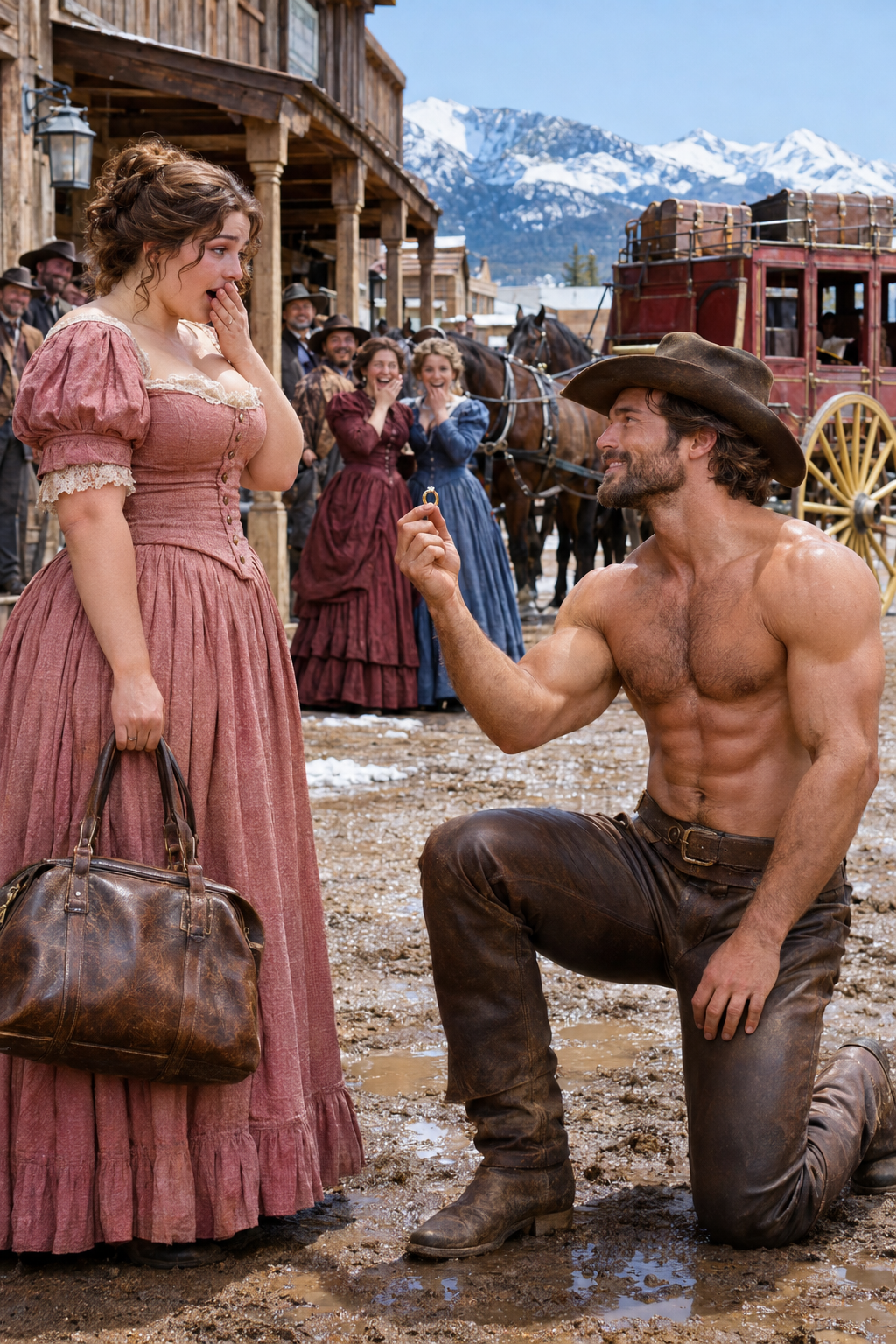
Rebecca Turner was one step away from leaving Cold Water forever when the richest rancher in the valley dropped to his knees in the mud.
Thomas unfolded the paper and held it out for Rebecca to see.
It was a legal document, stamped with the seal of the county court. Several names appeared near the bottom, but one stood out more than the others.
Jonathan Hayes.
Rebecca began reading.
The document concerned a piece of land on the eastern edge of Cold Water, a stretch of property that belonged to her late father, Samuel Turner.
Her breath caught.
“My father’s land?”
Jonathan lowered his eyes.
“Yes.”
She read the next paragraph, then looked up at him.
According to the document, Jonathan had filed a petition claiming ownership of the property. If approved, the land would become part of his ranch. The petition also included a statement suggesting that Samuel Turner had willingly transferred his rights to Jonathan several years earlier.
“That isn’t possible,” Rebecca whispered. “My father never sold that land.”
Thomas folded his arms, looking satisfied.
“Now you understand why he is suddenly interested in marrying you. He wants to secure his claim before you discover what he has done.”
The crowd began murmuring.
Rebecca turned toward Jonathan.
“Is it true?”
Jonathan did not answer immediately.
That silence hurt more than Thomas’s accusation.
“Is it true?” she repeated.
“Yes,” Jonathan finally said. “I filed the petition.”
Rebecca’s face went pale.
“And you intended to marry me before or after taking my father’s property?”
“Rebecca, listen—”
“No. I have listened to enough men telling me what I should accept.”
She pushed the document against his chest.
“You asked me not to leave because you wanted to explain something. Well, explain it.”
Jonathan looked at the paper, then at Thomas.
“Not here.”
“Why not? You had no trouble making your proposal in front of the entire town.”
Thomas chuckled.
“Careful, Hayes. Perhaps you should tell her about the signature.”
Jonathan’s eyes hardened.
“What do you know about the signature?”
“More than you think.”
Rebecca looked between them.
“What signature?”
Thomas took another folded sheet from his coat.
“This is a copy of your father’s original agreement. Look at the bottom.”
Rebecca took it with trembling fingers.
The signature looked like her father’s handwriting.
But there was something wrong with it.
She had spent years watching Samuel sign letters, receipts, and the little notes he left beside her breakfast. She knew the way his final letter always curved upward.
This signature ended abruptly.
And the date was impossible.
“My father died in March,” she whispered. “This says he signed in June.”
The crowd fell silent.
Thomas’s expression shifted for a fraction of a second.
Jonathan noticed.
“Where did you get that?”
“From someone who knows how your business is conducted.”
“Who?”
Thomas tucked his hands into his coat.
“That isn’t important.”
“It is if you’re holding forged documents.”
Thomas’s smile disappeared.
Rebecca looked again at the paper.
“Mr. Hayes, did you know this was forged?”
Jonathan’s answer came quietly.
“No.”
“Then why did you file the claim?”
“Because I believed your father had left the land in my care.”
“In your care?”
Jonathan nodded.
“Your father and I had an agreement. He wanted to build a school and a medical clinic on that property. He asked me to protect the land until the town could afford to maintain it. I agreed.”
Rebecca stared at him.
“My father never told me that.”
“He intended to. But he became ill before he could finish the arrangements.”
“Then why didn’t you tell me?”
Jonathan looked away.
“Because the land records were incomplete. I thought I could resolve the matter quietly before involving you.”
“And you thought proposing marriage would help?”
“No.”
“Then why did you do it?”
Jonathan opened his mouth, but Thomas interrupted.
“Because he’s desperate.”
Thomas stepped toward Rebecca.
“You should hear the rest. Hayes has debts. His ranch is facing foreclosure, and your father’s land is the only thing that can save him.”
A murmur spread through the crowd.
Jonathan did not deny it.
Rebecca felt something inside her collapse.
“So that is the truth.”
Jonathan looked directly at her.
“The truth is that my ranch is in trouble. But I never intended to use your father’s property to pay my debts.”
“Then why did you file the petition?”
“Because I believed securing the title under my name was the only way to prevent someone else from taking it.”
Thomas laughed.
“A noble explanation. Convenient, too.”
Rebecca looked down at the paper once more.
“Who is trying to take it?”
Before Jonathan could answer, a familiar voice came from behind the crowd.
“I believe I can answer that.”
An elderly man stepped forward, carrying a black leather briefcase.
It was Judge Henry Collins, the retired county judge who had known Samuel Turner for more than thirty years.
He looked at Thomas, then at Jonathan.
“Perhaps everyone should stop talking long enough to examine the evidence.”
Thomas’s face lost its color.
The judge opened his briefcase and removed a small envelope sealed with red wax.
“Samuel Turner left this with me shortly before his death. He instructed me to deliver it to his daughter when the ownership of the eastern property became disputed.”
Rebecca reached for it.
Her father’s handwriting appeared across the front.
To my beloved Rebecca.
For a moment, the street disappeared.
She could almost hear his voice.
She broke the seal.
Inside was a letter and a smaller document.
“My dearest Rebecca,” she began reading aloud, her voice trembling, “if you are holding this letter, it means I am no longer here to explain the things I should have told you.”
She stopped to steady herself.
“My greatest regret is leaving you with unanswered questions. The land east of the river was never meant to become anyone’s private fortune. I purchased it with the dream of building a school where children could learn without their families having to choose between books and bread.”
Rebecca pressed the letter against her chest.
“Jonathan Hayes promised to help me protect it. He is a stubborn man, but I believe his heart is honest. If anyone tries to claim that land as personal property, know that I never intended such a thing.”
She turned the page.
The next paragraph made her knees weaken.
“However, there is one person I fear may try to destroy what we planned. A man who has spent years pretending to be my friend while quietly buying debts and taking advantage of struggling families.”
Rebecca looked up.
The judge’s voice was grave.
“Continue.”
She swallowed.
“His name is Thomas Whitaker.”
The crowd erupted.
Thomas stepped backward.
“That is absurd!”
The judge raised one hand.
“Let her finish.”
Rebecca looked at the final lines.
“If Thomas ever presents a document claiming ownership of this property, do not believe it. He once offered to purchase the land at a fraction of its value. When I refused, he threatened to make certain that my family would lose everything.”
Rebecca lowered the letter.
Her hands were shaking.
Thomas’s face had turned crimson.
“An old man’s dying imagination! That proves nothing.”
The judge opened the smaller document.
“Perhaps this will.”
It was the original deed, bearing Samuel’s authentic signature and the county’s official seal.
The land belonged to a charitable trust established by Samuel Turner, with Jonathan Hayes named as its temporary trustee.
There was no transfer of ownership.
No sale.
And certainly no permission to use the property as collateral for private debt.
Jonathan closed his eyes in relief.
Rebecca looked at him.
“Why didn’t you show me this before?”
“I didn’t have it,” he answered. “Your father left the original deed with the judge. I had only the preliminary agreement. When I discovered someone had filed a competing claim, I began investigating.”
“Who filed it?”
The judge looked toward Thomas.
“Thomas Whitaker.”
A hush fell over the street.
Thomas’s mouth opened, but no words came out.
Then he laughed.
“You cannot prove that I forged anything.”
The judge calmly removed another document.
“This is a statement from the clerk who witnessed you submitting the petition. He has also provided a written account of the payment you made to obtain the false signature.”
Thomas turned sharply toward the road.
For one brief moment, Rebecca thought he might run.
But two county deputies emerged from the crowd.
“Thomas Whitaker,” one of them said, “we need you to come with us.”
“This is ridiculous!” Thomas shouted. “Do you know who my father is?”
“Yes,” the deputy replied. “And I imagine he will be very interested in hearing about this.”
Thomas looked desperately toward Rebecca.
“Tell them this is a misunderstanding. Rebecca, you know me. We were going to be married.”
Rebecca’s eyes filled with tears, but her voice remained steady.
“I knew the man you pretended to be.”
Thomas’s expression twisted.
“You think Hayes is any better? He lied to you, too!”
Rebecca looked at Jonathan.
There was no denying it.
Jonathan had kept secrets. He had made decisions without consulting her. And whatever his intentions, he had allowed her to stand in the dark while her father’s legacy was being threatened.
But Thomas had deliberately tried to steal it.
The difference mattered.
“Take him away,” the judge ordered.
As the deputies led Thomas toward the sheriff’s office, he turned one last time.
“You’ll regret this, Rebecca!”
She watched him disappear into the rain.
For the first time that day, she felt no need to answer.
Only when the crowd began to disperse did she notice that Jonathan was still standing beside her.
The ring remained in his hand.
He slowly closed his fingers around it.
“I owe you an apology,” he said.
Rebecca wiped the rain from her cheek.
“You owe me more than one.”
“I know.”
“You should have told me about the land. You should have trusted me enough to let me make my own decisions.”
Jonathan nodded.
“You’re right.”
“And you shouldn’t have asked me to marry you in the middle of a street when I was already heartbroken.”
A faint, sad smile crossed his face.
“I suppose I didn’t choose the most sensible moment.”
“You didn’t.”
He looked at the stagecoach.
“Are you still leaving?”
Rebecca glanced toward the open door.
She had spent the morning believing Cold Water had nothing left for her. Now the town seemed strangely unfamiliar, as though she had returned to a place she had never truly known.
“I don’t know,” she admitted.
Jonathan placed the ring inside his pocket.
“Then don’t decide because of me. If you want to go, I’ll make sure your ticket is honored. If you want to stay, I’ll help you find a place of your own.”
She studied him.
“And if I never want to marry you?”
“Then I’ll still help protect your father’s land.”
There was no grand declaration.
No promise that he would wait forever.
Just a simple answer from a man who seemed, for the first time, to understand that love could not be demanded.
Rebecca looked at the coach driver.
“Please give me a moment.”
The driver sighed and shut the door.
The coach rolled away without her.
But Rebecca did not turn toward Jonathan.
She walked toward the small boardinghouse where she had been staying, carrying her suitcase and her father’s letter.
She needed time.
And this time, she intended to take it.
Three days passed.
During those days, Jonathan did not come to her boardinghouse.
He did not send flowers or ask the townspeople to speak on his behalf.
Instead, he appeared at the courthouse with the judge and signed a sworn statement surrendering any personal interest in the eastern property.
He also agreed to provide the timber and labor necessary to begin construction of the school, despite the fact that doing so would put further pressure on his struggling ranch.
Rebecca learned about it from Mrs. Cooper.
“He’s a difficult man,” the older woman said while Rebecca was repairing a torn sleeve. “Always has been. But I’ve never seen him work so hard to make something right.”
Rebecca kept her eyes on the needle.
“Perhaps he should have worked harder before.”
Mrs. Cooper smiled.
“Perhaps. But people are not measured only by the mistakes they make, child. Sometimes they’re measured by what they do after realizing they’ve made them.”
On the fourth morning, Rebecca walked to the eastern property.
The rain had stopped.
The land stretched beneath a pale blue sky, with tall grass moving gently in the wind. Beyond the fence stood a small wooden marker bearing her father’s name.
Jonathan was there, speaking with two carpenters.
When he saw Rebecca, he dismissed them and approached.
“I wasn’t sure you’d come.”
“I wasn’t sure either.”
She looked across the field.
“Father used to bring me here when I was little. He said one day this place would be full of children.”
Jonathan smiled.
“He told me about those visits.”
“He did?”
“He said you used to collect stones and insist that each one was a different kind of treasure.”
Rebecca laughed softly.
“I remember that.”
For a moment, they stood in comfortable silence.
Then she turned toward him.
“Why did you really ask me to marry you?”
Jonathan looked down.
“I could tell you it was because I loved you. That would be true, but it wouldn’t be the whole truth.”
Rebecca waited.
“When I heard you were leaving, I realized I might never have another chance to tell you what I felt. I had watched you for months, Rebecca. I admired the way you treated people when there was nothing to gain. I admired how you carried yourself even when life gave you every reason to become bitter.”
He paused.
“But I also knew I was asking you to trust a man who had not given you enough reason to trust him. I was afraid. And instead of speaking honestly, I tried to solve everything with one question.”
Rebecca looked at him.
“You thought a ring could fix what silence had broken.”
“Yes.”
“That’s not how it works.”
“I understand that now.”
She walked a little farther into the field.
“My father believed people could build something good if they worked together. But he also believed no one should own another person’s future.”
Jonathan followed at a respectful distance.
“Then I hope you’ll help me build what he imagined.”
Rebecca turned.
“Not as your wife?”
“Not unless you choose that someday.”
“And not as someone who owes you anything?”
“Never.”
She considered his answer.
“Then I have a proposal of my own.”
Jonathan raised his eyebrows.
“I’m listening.”
“I want to oversee the school. I want the children of ranchers and farmers to have the same opportunities. And I want the medical clinic built beside it, just as Father intended.”
Jonathan nodded.
“Done.”
“I’ll need access to the trust’s records, and I want the town council involved in every major decision.”
“Agreed.”
“And I want my own salary. I won’t work for free just because you happen to be generous.”
For the first time that morning, Jonathan laughed.
“I wouldn’t dream of asking you to.”
Rebecca extended her hand.
“Then we have an agreement, Mr. Hayes.”
He shook it.
“Jonathan.”
“Jonathan,” she corrected herself.
Neither of them noticed the smile spreading across their faces until it was already there.
The months that followed were difficult.
Thomas Whitaker’s trial revealed a network of fraudulent land claims and unpaid debts. Several families came forward with evidence that he had cheated them out of their farms. His father, embarrassed by the scandal, withdrew financial support and sold much of the family’s property to repay the victims.
Thomas was eventually convicted of fraud and forgery.
His fall changed Cold Water.
People who had once been afraid to challenge powerful families began speaking openly about the wrongs they had suffered.
The eastern property became the center of a new project.
Jonathan sold a portion of his cattle herd to finance the first stage of construction. He worked alongside the carpenters, often returning to his ranch long after sunset.
Rebecca organized donations, negotiated with suppliers, and persuaded several neighboring towns to contribute books and medical equipment.
She proved to be an extraordinary leader.
Some people questioned whether a young woman without a wealthy family could manage such an ambitious project.
Rebecca answered by working harder than anyone else.
By late autumn, the schoolhouse stood proudly beside the newly completed clinic.
Its white walls gleamed in the morning sunlight, and a small bell hung above the front entrance.
On opening day, families gathered outside.
Children ran across the grass, laughing and chasing one another. Farmers arrived in their best clothes. Mothers carried homemade pies, while the town doctor examined the clinic’s new instruments with unmistakable pride.
Rebecca stood near the entrance, holding a ribbon.
Jonathan approached carrying a small wooden box.
“Before you cut that ribbon,” he said, “there’s something I’d like to give you.”
She smiled.
“If it’s another legal document, I’ll read it after lunch.”
He laughed.
“It’s not.”
Inside the box was a small brass key.
“What does it open?”
“The office at the school. Your office.”
Rebecca turned it over in her hand.
“I thought I already had the key.”
“You did. This one is different.”
“How?”
Jonathan looked toward the children gathering near the entrance.
“Your father wanted this place to belong to the whole town. I thought you should have the first key because you helped make that possible.”
Rebecca’s eyes filled.
“Thank you.”
Jonathan hesitated.
“There is something else.”
He reached into his coat.
The plain gold ring was still there.
It had become slightly scratched during the months he carried it, and its surface no longer shone as brightly as it had on that rainy afternoon.
“I kept it,” he said. “Not because I expected you to change your mind. I kept it because it reminds me of the day I nearly lost something important by trying to hurry it.”
Rebecca looked at the ring.
“Jonathan…”
“I won’t ask you to marry me today. I won’t ask you tomorrow, either. I only want you to know that my feelings haven’t changed.”
He paused.
“But if you ever decide that you want to build a life with me, I hope it will be because you want to—not because you need a home, money, protection, or anyone’s permission.”
Rebecca looked at the children.
A little boy was struggling to carry a stack of books. Another child rushed over to help him. Near the clinic, an elderly woman sat talking with the doctor, no longer worried about how she would pay for treatment.
The dream her father had left behind was alive.
And she had helped bring it into the world.
She turned back to Jonathan.
“You know what I learned from all this?”
“What?”
“That a person can offer you a thousand promises, but only their actions tell you what those promises are worth.”
Jonathan nodded.
“I’ve learned that, too.”
Rebecca took the ring from his hand.
He looked surprised.
She held it between her fingers for a moment, then slipped it onto her own palm.
“I’m not ready to give you an answer today,” she said.
His expression softened.
“I understand.”
“But I’d like you to have dinner with me tomorrow.”
He blinked.
“Dinner?”
“Yes. Somewhere without a crowd, without a stagecoach waiting, and without half the town listening.”
Jonathan smiled.
“I would like that very much.”
Rebecca handed him the ribbon.
“Now, Mr. Hayes, we have a school to open.”
He took his place beside her.
Together, they cut the ribbon.
The bell rang, and the children poured into the building.
That evening, as the sun sank behind the distant hills, Rebecca returned to her father’s old marker at the edge of the property.
She placed a small wildflower beside it.
“I think you would have liked what we built,” she whispered.
The wind moved gently through the grass.
For years, Rebecca had believed that losing Thomas meant losing the future she had imagined. She had thought that being rejected by a man with money made her less worthy of love.
But she had been wrong.
Thomas had rejected her because he measured people by what they possessed.
Jonathan had nearly lost her because he believed he could protect her by making decisions for her.
And Rebecca herself had almost boarded that stagecoach because she had mistaken a painful ending for the end of every possibility.
Now she understood something her father had tried to teach her long ago.
A person’s worth is never determined by the wealth they carry, the family they come from, or the promises someone makes to them.
It is revealed in the courage to stand for what is right, the humility to admit when they are wrong, and the kindness they choose to give when nobody is watching.
Love, she realized, was not a rescue.
It was not a bargain.
It was not a golden ring offered in the rain.
It was two people standing side by side, free to walk away, yet choosing to stay.
And for the first time in her life, Rebecca was not waiting for someone else to decide what her future would be.
She had already begun building it.
Years later, when children from neighboring counties came to study at the Turner School, they would hear stories about how it had been founded.
Some would say it began with a brave rancher who risked his fortune to protect a piece of land.
Others would say it began with a young woman who refused to let powerful men decide what she was worth.
But Rebecca always told them the same thing.
“It began with a promise,” she would say, “and it survived because people chose to keep that promise together.”
Jonathan would often stand by the doorway, watching her teach.
On the anniversary of the school’s opening, he finally asked her a question.
Not in the middle of a muddy street.
Not before an audience.
And not with the expectation that she owed him an answer.
He simply took her hand beneath the old oak tree and asked whether she would like to spend the rest of her life building something beautiful with him.
This time, Rebecca did not need to look toward a stagecoach.
She did not need to ask what she would gain.
She looked at the man beside her, at the school they had built, and at the children whose futures were brighter because someone had cared enough to fight for them.
Then she smiled.
“Yes, Jonathan. This time, yes.”
And when he placed the plain gold ring on her finger, it no longer represented a desperate attempt to stop someone from leaving.
It represented a choice freely made.
A choice built on honesty, respect, patience, and love.
The richest man in Cold Water had once believed his wealth made him powerful.
But the greatest thing he ever gained was not another acre of land, another herd of cattle, or another dollar in the bank.
It was the understanding that true love does not ask someone to surrender their independence.
It gives them a reason to stand beside you without ever losing themselves.
And Rebecca Turner, the woman who had once boarded a stagecoach believing she had nowhere left to go, spent the rest of her days reminding the people of Cold Water of one simple truth:
Never let someone else’s inability to see your worth convince you that you have none.