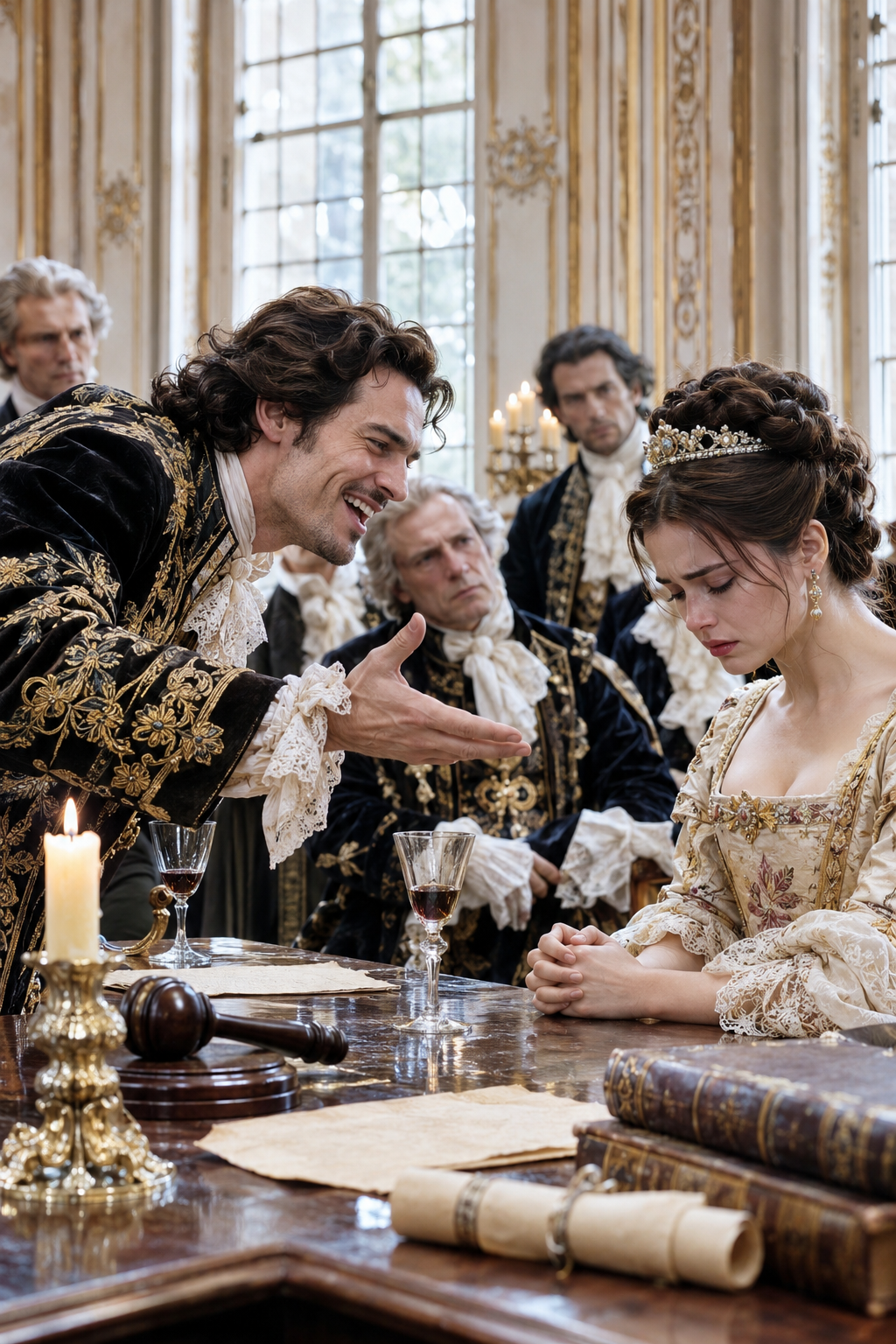
“Perhaps my wife should return to the drawing room before she embarrasses herself further,” Duke Tavern Montlair announced before twelve of the most respected scholars in the region.
“There are two relief gates beneath this channel,” Elvara said, pointing her lantern into the inspection shaft. “The builders designed them to release excess water before the pressure became dangerous. If we can open them, we might still save Pelwick.”
Tavern looked at the narrow opening, then at the furious river. Rain ran down his face, and for the first time that evening, he seemed completely uncertain of himself.
“How do you know they’re down there?”
“Because I’ve seen a smaller version of this system before. My father maintained one at our mill.”
The elderly scholar, Professor Aldren, crouched beside her. He examined the markings carved into the stones surrounding the opening.
“These symbols match the inscription,” he said. “Your Grace, I believe your wife is correct.”
Another terrible sound came from the retaining wall. A section of stone shifted, sending muddy water spraying across the channel.
Elvara turned toward the estate workers. “I need ropes, another lantern, and someone who understands heavy machinery.”
A broad-shouldered man stepped forward. His name was Thomas Reed, and he had maintained the estate’s waterwheels for nearly twenty years.
“I’ll go with you, Duchess.”
Tavern immediately objected. “Absolutely not. Thomas can handle whatever needs to be done.”
“Does Thomas know which gate must be opened first?”
The worker shook his head.
“Does anyone else?”
Nobody answered.
Elvara looked directly at her husband. “Then I’m going down.”
Before Tavern could protest again, she removed her heavy outer coat and allowed Thomas to secure a rope around her waist.
The ladder inside the shaft was cold, slippery, and covered in rust. Elvara descended carefully, holding the lantern close to the wall.
The noise grew louder with every step. Water thundered somewhere beneath her feet, and the entire structure seemed to breathe under the pressure.
When she reached the bottom, she found herself standing in ankle-deep water inside a narrow underground chamber.
Thomas followed moments later.
Two enormous iron wheels stood against opposite walls. Thick metal rods disappeared into the stone beneath them.
Elvara raised her lantern.
“There they are.”
Thomas approached the nearest wheel and grabbed its handle.
“Wait!” she cried.
He immediately released it.
Elvara wiped decades of dirt from a small bronze plate attached to the mechanism. Beneath the grime were several ancient symbols.
She recognized the first two, but the third was unfamiliar.
For a moment, doubt crept into her mind.
The system was larger and more complicated than anything she had encountered at her father’s mill. One mistake could release thousands of gallons of water directly toward Pelwick.
“Professor Aldren!” she shouted toward the shaft.
The scholar’s face appeared above them.
“I need your help translating something.”
Tavern watched as the elderly man climbed down without hesitation.
Elvara pointed to the bronze plate when he reached the chamber.
“What does that last symbol mean?”
Aldren adjusted his spectacles and leaned closer.
“It means before. Or possibly preceding.”
Elvara studied the other markings.
“Then this isn’t simply a label. It’s a sequence.”
Together, they examined the second wheel. Its plate contained a different set of symbols.
Within minutes, they understood what generations of estate owners had forgotten.
The smaller western relief gate needed to be opened first, allowing water to escape into an abandoned diversion channel. Only then could the larger eastern gate be safely released.
Opening them in the wrong order would send a sudden surge toward the town.
Professor Aldren slowly removed his spectacles.
“We would have opened the wrong gate.”
Elvara looked at him. “That’s why I needed you.”
The old man stared at her, surprised.
After everything that had happened upstairs, he had expected anger or satisfaction. Instead, she was treating him as a partner.
Above them, Tavern called down impatiently.
“Have you found a solution?”
“Yes,” Elvara answered. “But we need to hurry.”
Thomas positioned himself beside the western wheel and pulled with all his strength.
Nothing happened.
He tried again, his boots sliding across the wet floor.
“It’s seized.”
Elvara examined the mechanism. Years of neglect had left the iron covered in rust, and debris had collected around its lower assembly.
Thomas called for tools.
Two additional workers descended into the chamber, carrying hammers, iron bars, and a small container of oil.
They worked desperately while the water around their ankles continued rising.
Aboveground, Tavern sent riders toward Pelwick with orders to evacuate the lowest streets. He also instructed the remaining workers to move families toward higher ground.
Then he returned to the inspection shaft.
“How much longer?”
Nobody answered immediately.
The wheel finally moved a fraction.
Thomas grunted. “It’s giving.”
All three workers pulled together. The iron mechanism released a horrible grinding sound that echoed throughout the chamber.
Elvara watched the metal rod slowly rise.
“Keep going!”
Suddenly, the wheel spun forward, throwing Thomas against the wall.
A deep roar erupted beneath them.
Water rushed through the ancient diversion channel for the first time in decades.
For several seconds, everyone stood perfectly still.
Then a worker above shouted, “The western outlet is flowing!”
Elvara closed her eyes briefly in relief.
They had opened the first gate.
But their victory lasted less than a minute.
A violent impact shook the chamber, extinguishing one of the lanterns.
Water burst through a crack near the eastern mechanism.
Thomas grabbed Elvara’s shoulder.
“We need to get out!”
She looked at the second wheel.
The western channel was relieving some pressure, but it wasn’t enough. The eastern gate still needed to be opened.
If they abandoned the chamber now, the retaining wall could collapse before Pelwick had been fully evacuated.
“How much time do we have?” Professor Aldren asked.
Elvara watched the crack spread.
“Not much.”
Tavern heard the panic below and began descending the ladder.
When he reached the chamber, the water was already approaching their knees.
He saw his wife standing beside the eastern wheel, examining the mechanism while everyone else shouted around her.
“Elvara, we’re leaving.”
“The second gate isn’t open.”
“Let the workers handle it.”
“They need my help.”
He grabbed her hand. “I will not lose you over this.”
She pulled away.
“And what about the people in Pelwick? Are their lives worth less than mine?”
Tavern had no answer.
Thomas and the other workers attempted to turn the eastern wheel. Unlike the first mechanism, this one moved easily at first.
Then it stopped abruptly.
Thomas tried reversing it.
Something beneath the floor struck the metal assembly with tremendous force.
“There’s something blocking the gate,” he said.
Elvara studied the rising rod. It had moved only a short distance.
She noticed a smaller lever positioned behind the main wheel, almost hidden against the stone.
“There’s a locking mechanism.”
Professor Aldren examined the markings beside it.
“Release after the western passage is opened,” he translated.
Elvara nodded.
The ancient builders had included a safety lock to prevent workers from opening the gates in the wrong order.
Unfortunately, the locking lever was badly corroded.
Thomas attempted to move it, but it refused to budge.
Water climbed past their knees.
One of the workers lost his footing and nearly disappeared beneath the surface. Tavern caught him by the arm and pulled him upright.
“Everyone who isn’t needed must leave,” Elvara ordered.
Professor Aldren hesitated.
“Go,” she told him. “You’ve given us what we need.”
The scholar climbed toward the surface with the injured worker.
Thomas remained beside the mechanism.
Tavern looked from the ladder to his wife.
“What can I do?”
Elvara almost didn’t recognize the question.
In seven years of marriage, she could not remember him asking for her instructions with such sincerity.
“Help Thomas with the lever.”
He removed his expensive coat, rolled up his sleeves, and stepped into the muddy water.
Together, the two men struggled against the rusted mechanism.
Elvara watched the locking assembly carefully.
“Again!”
They pulled harder.
The lever moved slightly before slipping back into place.
A section of stone fell from the ceiling and shattered beside them.
Tavern glanced upward.
For the first time in his life, his title meant absolutely nothing. His education, wealth, and family name could not protect him from the water surrounding his legs.
Only the knowledge of the woman he had mocked could guide them out.
“Once more,” Elvara said.
Thomas repositioned the iron bar. Tavern braced himself beside him.
Both men pulled.
With a sharp metallic crack, the locking lever finally dropped.
“The wheel!” Elvara shouted.
They rushed toward the eastern mechanism.
Thomas grabbed one side while Tavern took the other. Elvara joined them, and together they forced the enormous wheel forward.
The chamber shook.
The iron rod rose slowly.
Somewhere beneath them, the ancient gate began lifting.
A tremendous roar filled the underground passage.
For one horrifying moment, Elvara thought the entire structure was collapsing.
Then the water surrounding their legs began to move away.
“The gate is opening!” Thomas cried.
They continued turning until the mechanism reached its final position.
Aboveground, workers shouted with excitement as water thundered through the eastern relief channel and into the wide, unoccupied floodplain beyond the estate.
The river’s pressure against the retaining wall began to decrease.
Elvara watched the water level inside the chamber fall.
It was working.
But before anyone could celebrate, another piece of the ceiling broke loose.
Thomas pointed toward the ladder.
“Out! Now!”
Elvara helped him reach the shaft first. Tavern remained behind her, refusing to climb until she was safely on the ladder.
By the time they emerged, the rain had weakened.
Workers stood along the channel, staring at the enormous streams of water pouring through the newly opened outlets.
Professor Aldren hurried toward them.
“The wall has stopped moving!”
Elvara turned toward Pelwick. In the distance, lanterns glowed along the road leading to higher ground.
“Has the town flooded?”
“We haven’t received word yet.”
The next hour felt longer than the entire night.
Elvara refused to return to Morvane Hall until a messenger arrived from Pelwick.
When a young rider finally appeared, his horse was covered in mud.
Tavern hurried forward.
“Tell me what happened.”
“The lower streets took some water, Your Grace. A few buildings were damaged, but the river stopped rising before it reached the houses farther inland.”
“And the people?”
“Everyone we know of is accounted for. No lives were lost.”
Elvara lowered her head.
Her hands began shaking.
Throughout the emergency, she had forced herself to concentrate on the next task. Now that the danger had passed, the fear she had been holding back finally overwhelmed her.
Thomas quietly offered her his coat.
Tavern watched as she accepted it.
He wanted to embrace her, but something stopped him.
He remembered the laughter in the meeting room. He remembered telling her to leave before she embarrassed herself.
The shame was almost unbearable.
By sunrise, the storm had passed.
News of the duchess’s actions spread throughout Pelwick. Families emerged from temporary shelters, farmers returned to their properties, and workers inspected the damaged riverbanks.
At Morvane Hall, the scholars gathered once again around the same table where they had dismissed Elvara only hours earlier.
Nobody was laughing now.
Professor Aldren stood beside the ancient inscription.
“Our original translation was wrong,” he announced. “The passage instructs workers to release accumulated water during periods of dangerous pressure. We misunderstood the technical language.”
One younger scholar cleared his throat.
“Given the age of the inscription, our interpretation was understandable.”
Tavern looked at him sharply.
“Understandable?”
The man lowered his eyes.
“My wife identified the mistake before the situation became critical. Instead of listening, I publicly humiliated her. Had she obeyed me, Pelwick might have been destroyed.”
Silence settled over the room.
Tavern turned toward Elvara, who stood near the fireplace wearing a borrowed dress.
“I owe you an apology.”
She studied his face.
“So do several gentlemen in this room,” he continued. “But none owes you more than I do.”
Professor Aldren stepped forward.
“Duchess, I am deeply sorry. You demonstrated greater wisdom than any of us last night.”
Elvara shook her head gently.
“I couldn’t have understood the entire system without your translation.”
The professor looked surprised.
“You were willing to reconsider your mistake,” she added. “That mattered.”
Tavern dismissed the meeting shortly afterward.
When they were alone, he approached his wife.
“Elvara, can we talk?”
She nodded.
They sat beside the fireplace, where the warmth slowly returned to their exhausted bodies.
“Why didn’t you ever tell me how much you knew about waterworks?” he asked.
Elvara looked at him for a long moment.
“I did.”
He frowned.
“When?”
“During our first summer together. You were discussing repairs to the southern mill. I mentioned that the wheel was probably losing power because of the water level.”
Tavern searched his memory.
“You told me estate matters were too complicated to discuss over dinner,” she continued. “Another time, I offered to help review the irrigation plans. You said the engineers had everything under control.”
He lowered his gaze.
“Eventually, I stopped offering.”
Those words hurt him more than any accusation could have.
He had always believed their marriage was peaceful. Elvara rarely challenged his decisions, rarely interrupted his meetings, and seldom expressed dissatisfaction.
He had mistaken her silence for agreement.
Now he understood that much of it had been disappointment.
“My father taught me to read plans when I was nine,” she said. “By fifteen, I was helping him calculate how much grain the mill could process. I loved learning how things worked.”
Tavern looked at her with genuine astonishment.
“Why did you give all that up?”
“Because whenever I spoke about it here, someone reminded me that a duchess should have more suitable interests.”
She paused.
“And usually, that someone was you.”
He felt tears gathering in his eyes.
“I have been a terrible husband.”
Elvara didn’t rush to comfort him.
“You haven’t always been cruel, Tavern. But you’ve often made me feel invisible. There is a difference between providing someone with a beautiful home and giving them a meaningful place in your life.”
He nodded slowly.
“Can you forgive me?”
“I hope I can. But I need more than an apology after a frightening night.”
“What do you need?”
“To be heard when there isn’t a disaster forcing you to listen.”
Three days later, Tavern visited Pelwick with Elvara.
The townspeople gathered around them as they walked through the damaged streets.
An elderly woman approached the duchess, holding the hand of a little girl.
“My granddaughter was sleeping when the evacuation bell rang,” she explained. “We heard what you did at the channel.”
Elvara smiled gently.
“Many people helped.”
The woman squeezed her hand.
“But someone had to make them listen.”
Tavern heard every word.
That afternoon, he ordered a complete inspection of the estate’s waterworks. He also announced the formation of a permanent waterworks commission.
Several aristocrats expected the positions to be given exclusively to educated gentlemen from respected families.
Instead, Tavern appointed Professor Aldren, Thomas Reed, experienced mill workers, engineers, and representatives from Pelwick.
He invited Elvara to lead the commission.
Not everyone approved.
Lord Bellmont, a wealthy neighboring landowner, confronted him during the first formal gathering.
“Surely you don’t intend to give ordinary laborers equal standing with educated men.”
Tavern glanced toward Thomas, whose hands still bore injuries from the storm.
“When the retaining wall was failing, those hands were considerably more useful than my family name.”
Bellmont looked offended.
“And placing your wife in charge? People will talk.”
“They already do,” Tavern replied. “Fortunately, my wife has given them something worth talking about.”
Elvara accepted the position on one condition.
Every member would have the right to question a decision, regardless of rank, education, or background.
The commission began its work immediately.
Over the following months, forgotten channels were cleared, damaged gates were repaired, and new warning procedures were established throughout the region.
Elvara also arranged for experienced workers to teach younger apprentices, ensuring that practical knowledge would not disappear with the older generation.
Her marriage changed more slowly.
There were still moments when Tavern interrupted her or assumed he understood something better than she did.
But now, when she pointed it out, he stopped and listened.
Some evenings, they sat together reviewing engineering plans. Other nights, he asked about her childhood, her father, and the years she had spent at the mill.
He discovered that his wife had a wonderful sense of humor, an extraordinary memory, and an endless curiosity about the world.
These were qualities she had possessed long before their wedding.
He simply hadn’t taken the time to discover them.
Nearly a year after the storm, another period of heavy rain threatened Pelwick.
This time, the warning bells sounded early. Workers inspected the channels, monitored the rising water, and operated the relief gates according to the commission’s instructions.
The river passed safely through the estate.
No emergency expedition was necessary.
When the final report arrived, Tavern carried it into Elvara’s study.
“Everything worked exactly as planned.”
She smiled. “That’s what good preparation is supposed to look like.”
He placed the report on her desk.
“May I ask your opinion about something?”
“Of course.”
He unfolded a proposal for improving the water supply to several neighboring villages.
“I have some ideas, but I’d like to hear yours before making any decisions.”
Elvara looked at him.
There was no audience to impress, no approaching disaster, and no frightened workers waiting outside.
He was asking simply because he valued what she thought.
She moved her chair closer to his.
“Show me what you’ve been working on.”
Years later, the people of Pelwick still told the story of the duchess who descended into a flooded chamber and saved their town.
But Tavern remembered that night for another reason.
He had nearly lost hundreds of lives because he believed knowledge belonged only to certain people. He had nearly lost the happiness of his marriage for the very same reason.
The greatest mistake of his life had not been mistranslating an ancient inscription.
It had been spending seven years beside an extraordinary woman without truly getting to know her.
And the greatest lesson Elvara taught him was not about rivers, machinery, or forgotten gates.
It was that intelligence does not depend on a title, wisdom does not always come from a classroom, and respect should never have to be earned through a crisis.
Sometimes, the person with the answer has been standing beside us all along.
All we have to do is stop assuming we know better and give them a chance to speak.