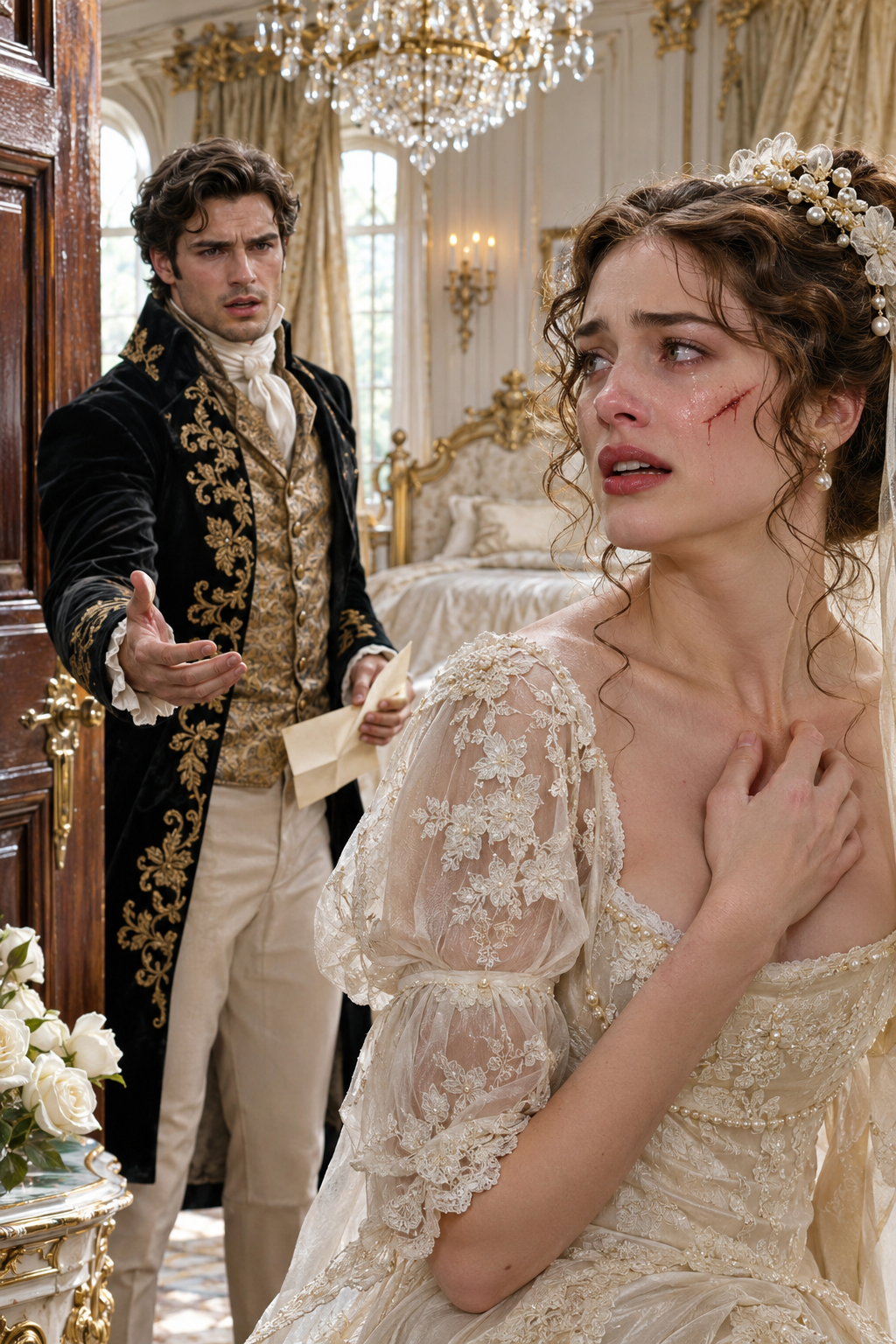
On his wedding night, the Earl of Stanmere stood before his new bride, holding a carefully written speech explaining why he would never love her.
“Received from Lady Honoria Vance, payment in full for the continued medical treatment of Miss Clara Ravenscroft.”
Julian read the words twice, hoping he had misunderstood them. Beneath the statement were several dates, amounts, and the signature of Clara’s physician. The payments had begun nearly eight months before he had written his marriage proposal.
“You?” he whispered, looking up at his wife. “You’ve been paying for Clara’s treatment?”
Honoria nodded. “Her physician believed that interrupting her treatment would seriously harm her chances of recovery. I couldn’t allow that to happen.”
Julian rose from his chair and walked toward the window. He felt as though the ground beneath him had disappeared. For months, he had thanked God for the mysterious stranger who had given his sister another chance at life. Tonight, he had intended to explain to that very woman why she should never expect affection from him.
“Why didn’t you tell me?” he asked.
“Clara was afraid you would refuse the assistance. She said you would rather sell the last piece of furniture in your house than accept charity.”
“She had no right to conceal this from me.”
“Perhaps not,” Honoria answered calmly. “But she wanted to live, Julian. Surely you cannot blame her for that.”
His anger disappeared as quickly as it had risen. He lowered his head, remembering the nights Clara had struggled to breathe while he sat helplessly beside her bed.
“Was our marriage another act of charity?”
Honoria’s expression changed. For the first time that evening, she looked genuinely hurt.
“No. Although I suspected you might think so.”
She walked toward the fireplace and stood beside him.
“Your letter to my father was the first honest proposal I had received in years. Other gentlemen wrote about my beauty, my charming personality, and their supposed devotion. Most had never spoken to me. They wanted my fortune but lacked the courage to admit it.”
“And I was different?”
“You told the truth. You were desperate, frightened for your sister, and determined to protect the people who depended on you. I respected that.”
Julian looked down at the speech he had prepared. Every sentence suddenly seemed cruel. He had written about separate bedrooms, personal freedom, and the absence of romantic expectations. He had even included a promise never to embarrass her by pretending to feel something he did not.
Without another word, he dropped the pages into the fireplace.
Honoria watched the flames consume them.
“What was written there?” she asked.
“Something I would have regretted saying for the rest of my life.”
He turned toward her.
“I cannot promise you love tonight, Honoria. It would be dishonest. But I can promise that I will never again treat you as though you are merely the solution to my financial problems.”
She studied his face before offering a small smile.
“That seems a reasonable beginning.”
They spent the remainder of their wedding night talking. Julian told her about his father’s debts, the failed harvests, and the terrible decisions he had made trying to save Stanmere. Honoria listened without interrupting. When morning arrived, neither had slept, yet Julian felt a strange sense of relief.
For the first time in years, he was no longer carrying his troubles alone.
Three days later, they traveled to Stanmere Hall. Honoria had heard descriptions of the estate from Clara, but nothing prepared her for what she found. Rainwater leaked through the ceilings. Several rooms had been closed because they were too expensive to maintain. Outside, neglected fields stretched toward a village filled with damaged cottages.
Julian expected her to complain.
Instead, she requested the estate’s financial records.
His elderly steward, Mr. Bennett, appeared deeply uncomfortable when Honoria entered the study.
“Her ladyship wishes to examine the accounts?” he asked.
“Yes,” Julian replied.
“But, my lord, such matters are generally handled by gentlemen.”
Honoria smiled politely. “Then I shall endeavor not to frighten the numbers.”
Within two days, she discovered several problems that had escaped Julian’s attention. Suppliers were charging unreasonable prices. Certain fields were being rented for far less than their value. Expensive repairs had been postponed until they became even more costly.
She also discovered that Julian had been quietly paying for food and medicine for several struggling families.
“You could have saved considerable money by stopping these payments,” she observed.
“I know.”
“Why didn’t you?”
“Because their children would have gone hungry.”
Honoria closed the account book.
“Then those payments will continue.”
Together, they developed a plan. Part of the dowry would settle the most urgent debts. Another portion would repair the cottages, improve drainage, and restore the damaged farmland. They would sell unnecessary possessions rather than dismiss loyal servants.
Julian had expected his wife to spend her fortune restoring the grandeur of Stanmere Hall. Instead, her first major expense was replacing the roof of a widow’s cottage.
When he asked why, Honoria looked genuinely surprised.
“We have several dry bedrooms. Mrs. Fletcher has none.”
Word of the new countess spread throughout the village. At first, people stared at her scar. Children sometimes asked questions that made their parents blush. Honoria never became angry.
One afternoon, a little girl named Elsie approached her outside the village school.
“Does your face hurt, my lady?”
“Not anymore.”
“Were you frightened when it happened?”
“Very frightened.”
Elsie considered this carefully.
“My mother says being brave means not being frightened.”
“Your mother means well,” Honoria replied. “But courage is doing what must be done even when you’re terribly afraid.”
Julian heard the conversation from a nearby doorway. Something about her answer stayed with him.
Over the following weeks, he began noticing things he had overlooked before. Honoria laughed easily when she felt comfortable. She loved gardening, disliked overly sweet tea, and possessed a wonderful talent for making difficult people laugh at themselves.
She was also stubborn enough to argue with him for an entire afternoon about the placement of a new village well.
He lost the argument.
More surprisingly, he discovered that he enjoyed losing it.
Clara arrived at Stanmere near the beginning of spring. She was still weak, but her physician was pleased with her progress. The moment she saw Honoria, she hurried forward and embraced her.
Julian watched his sister cry against his wife’s shoulder.
“I was so afraid you would never meet properly,” Clara admitted.
“Your brother and I are managing quite well,” Honoria assured her.
Later that evening, Clara found Julian alone in the library.
“You’re falling in love with her,” she announced.
Julian nearly spilled his drink.
“Don’t be ridiculous.”
“You look at her whenever she enters a room.”
“I look at everyone who enters a room.”
“Not like that.”
He told Clara to mind her own affairs, but after she left, he found himself thinking about her words.
He wanted Honoria’s company at breakfast. He missed her when she visited the village without him. When something amusing happened, she was the first person he wanted to tell.
Yet whenever he considered expressing his feelings, shame stopped him. How could he convince her that his affection was genuine after admitting that he had married her for money?
His opportunity to answer that question arrived sooner than expected.
An invitation came for a grand London ball. Julian suggested declining it, knowing how cruel society had been toward Honoria.
She shook her head.
“I spent years allowing other people to decide where I belonged. I would rather not continue doing so.”
On the evening of the ball, Honoria wore a deep blue gown. Her hair was arranged without attempting to conceal her scar. When she descended the staircase, Julian stood speechless.
“Is something wrong?” she asked.
“No,” he answered. “You look beautiful.”
She smiled, but he noticed the uncertainty in her eyes.
At the ball, conversations softened whenever they approached. Some guests greeted them warmly, while others exchanged amused looks. Julian kept Honoria beside him, introducing her proudly.
Then Lord Tully appeared.
“Well, Ravenscroft,” he said loudly. “I hear your estate has undergone quite a transformation. Marriage appears to have been profitable.”
Julian stiffened.
“Stanmere is recovering, thank you.”
Tully turned toward Honoria.
“And how does it feel, my lady, knowing your father finally discovered your market value?”
Several gentlemen laughed nervously.
Honoria’s fingers tightened around her fan, but she remained composed.
“I imagine it feels considerably better than discovering one has no manners, Lord Tully.”
A few guests chuckled. Tully’s face darkened.
“Careful, my lady. Your husband might demand another payment for enduring that sharp tongue.”
Julian stepped forward.
“That will be enough.”
Tully raised his eyebrows.
“Surely you remember our little wager? Half the gentlemen here believed you wouldn’t manage six months without seeking comfort elsewhere.”
Honoria turned toward Julian.
“A wager?”
The room suddenly became painfully quiet.
Julian remembered hearing rumors about such bets before the wedding. He had dismissed them, believing that ignoring the cruelty was easier than confronting it.
Now he understood what his silence had allowed.
“Did you participate?” Honoria asked.
“No. But I knew gentlemen were making such wagers.”
Her face fell.
Julian turned back toward Tully.
“My wife possesses more courage, intelligence, and generosity than any man who has placed a bet upon our marriage. While you were laughing at her appearance, she was saving lives and rebuilding homes.”
Tully gave a mocking smile.
“An impressive speech from a man whose loyalty cost forty thousand pounds.”
Julian’s voice hardened.
“I married her because I needed money. That is true, and I will not deny it. But remaining silent while men like you insulted her was the greatest disgrace of my life.”
He looked around the room.
“Anyone who considers my wife an acceptable subject for entertainment should consider our acquaintance finished.”
Then he offered Honoria his arm.
“Would you care to dance?”
For several seconds, she could only stare at him.
Finally, she placed her hand upon his arm.
They walked onto the dance floor together. The orchestra resumed playing, and the surrounding guests slowly returned to their conversations.
Julian barely noticed them.
“I’m sorry,” he whispered.
“For what?”
“For every occasion when I should have defended you and didn’t.”
Honoria looked into his eyes.
“Thank you for doing so tonight.”
When the dance ended, Julian wanted to tell her he loved her. Before he could speak, however, an elderly gentleman approached them.
It was Honoria’s father.
Lord Vance looked considerably older than Julian remembered.
“Honoria,” he said quietly. “May we speak?”
She hesitated before agreeing.
They entered a private sitting room, where her father remained standing beside the door.
“I heard what happened,” he began.
“Then you heard nothing particularly new,” Honoria replied.
Her father flinched.
“I thought the dowry would protect you. I believed that securing a respectable marriage would guarantee your happiness.”
“You made me feel as though happiness was something you had to purchase on my behalf.”
Lord Vance lowered his head.
“After the fire, I blamed myself. I should have been there. You were only a child, and you did what I should have done. Every time I saw your injuries, I remembered my failure.”
Honoria’s eyes filled with tears.
“Father, I never blamed you for the fire.”
“But I blamed myself. And instead of helping you understand your worth, I spent years trying to compensate for what I believed you had lost.”
He struggled to continue.
“When gentlemen rejected you, I increased the dowry. I convinced myself that I was helping. I never understood what that must have felt like.”
Honoria wiped her cheeks.
“I didn’t need you to find someone willing to marry me. I needed you to believe that someone could love me.”
Her father began crying.
Julian quietly stepped away, allowing them privacy as Honoria embraced the man whose misguided protection had caused her so much pain.
That night, their carriage journey home was unusually silent. Honoria looked out the window while Julian searched for the right words.
Eventually, he reached for her hand.
“Your father was wrong about something.”
She turned toward him.
“What was that?”
“He believed forty thousand pounds was necessary to persuade a man to spend his life with you.”
Julian took a deep breath.
“I would give every penny of it back if doing so could erase the circumstances under which I married you.”
Honoria’s lips parted.
“Julian, you don’t have to say these things because of what happened tonight.”
“I’m saying them because I have been too frightened to say them before.”
He held her hand more firmly.
“I love you, Honoria.”
She stared at him, searching his expression for any sign of obligation or pity.
“Are you certain?”
“I have never been more certain of anything.”
Tears slipped down her cheeks.
“I have wanted to hear those words,” she confessed. “But I was afraid that if you ever said them, I wouldn’t know whether to believe you.”
“Then allow me the rest of my life to prove them.”
She leaned toward him, and Julian kissed her gently. There was no audience, no financial agreement, and no obligation.
Only two people who had finally found the courage to be honest about their hearts.
During the next two years, Stanmere continued to recover. Harvests improved, village businesses reopened, and the estate began producing a steady income. Clara regained enough strength to enjoy long walks and eventually married a kind gentleman who adored her.
Julian never forgot the sacrifices that had made those improvements possible.
One morning, he invited Honoria into the library. On his desk lay a small velvet box and a collection of legal documents.
“What have you done now?” she asked suspiciously.
“With the assistance of our solicitor, I have arranged for a substantial portion of the estate’s future income to be placed under your independent control. You will have financial security that does not depend upon my goodwill.”
“Julian, I already trust you.”
“I know. But I want your freedom to be protected by more than trust.”
Then he opened the velvet box.
Inside was a simple diamond ring.
Honoria looked at him in confusion.
“We are already married.”
“Yes. But I never properly asked you.”
He took her hand and lowered himself onto one knee.
“Honoria Ravenscroft, would you marry me again? Not because of my debts, your father’s wishes, or any arrangement made between our families. Would you marry me simply because I love you, and because there is no other woman with whom I wish to spend my life?”
She covered her mouth, laughing through her tears.
“Yes, Julian. Of course I would.”
Their second wedding ceremony was held in the small church at Stanmere. It was a renewal of their vows, but to Julian, it felt like the marriage he should have offered her from the beginning.
The church was filled with villagers, servants, friends, and family. Clara sat in the front row beside Honoria’s father. Little Elsie scattered flower petals along the aisle.
Honoria wore an ivory gown and no veil over her face.
When Julian saw her approaching, tears filled his eyes.
He remembered their first wedding, when he had stood before her thinking about creditors, contracts, and financial obligations.
This time, he thought only about how fortunate he was that she had chosen him.
“I once believed that marrying you would save my estate,” he told her during their vows. “I had no idea that you would teach me how to become a better man.”
Honoria squeezed his hands.
“And I once believed that being accepted was the most I could hope for. You have shown me that being loved is something entirely different.”
They shared fifty-one years of marriage. Those years brought children, grandchildren, celebrations, disappointments, and losses. Their life was not perfect, but neither ever faced its difficulties alone.
Long after Lord Tully and his cruel wagers had been forgotten, the people of Stanmere still remembered the countess who had repaired their homes before repairing her own.
In their old age, Julian and Honoria often sat together in the garden overlooking the village.
One autumn afternoon, Honoria asked him a question.
“Do you ever wonder what would have happened if my father had never offered that dowry?”
Julian smiled and kissed her wrinkled hand.
“I suspect I would have remained a very foolish man for considerably longer.”
She laughed.
“And was I worth forty thousand pounds?”
“My darling, that was the worst calculation anyone ever made.”
When Honoria died peacefully at an advanced age, Julian remained beside her, holding her hand until her final breath.
Among her possessions, he later discovered the original letter he had written to her father. She had preserved it for more than half a century.
On the back, in her familiar handwriting, were a few words.
“He came to me because he needed a fortune. He stayed because we discovered something that no fortune could purchase.”
Julian kept that letter beside his bed for the remainder of his life.
He had spent his youth believing that wealth could solve every problem and that appearances determined a person’s place in the world. Honoria had taught him otherwise.
Her scar had never been the shameful thing society imagined it to be. It was evidence of a little girl’s willingness to risk everything for someone she loved.
The true ugliness had belonged to those who mocked her without knowing her heart.
And the greatest fortune Julian Ravenscroft ever received was not the forty thousand pounds that saved his estate.
It was the woman who taught him that kindness is more valuable than status, courage is more beautiful than perfection, and genuine love begins when we stop judging people by what the world sees and start appreciating them for who they truly are.
Three months after Honoria’s death, Julian received an unexpected visitor.
It was Elsie, the little girl who had once asked Honoria about her scar. She was now a grandmother herself and had spent nearly thirty years teaching at the village school.
She carried a wooden box filled with letters.
“Your lordship, there is something we would like you to have.”
Julian invited her into the sitting room, where Honoria’s favorite chair remained untouched beside the fireplace.
“What is all this?” he asked.
“Letters from people whose lives your wife changed.”
Julian opened the first envelope. It came from a physician whose education Honoria had secretly funded. Another came from a woman whose family had avoided starvation because of her generosity. A third was written by a former servant who had established a successful business with Honoria’s encouragement.
There were dozens more.
As Julian read, he discovered acts of kindness that even he had never known about.
“She never told me about these things,” he whispered.
Elsie smiled through her tears.
“She never wanted recognition. She simply wanted people to have a chance.”
Among the letters was a proposal from the villagers. They wished to establish a scholarship in Honoria’s memory, allowing children from poor families to receive an education.
Julian immediately agreed to fund it.
But he had one condition.
“No child shall ever be refused because of their appearance, their family’s circumstances, or any physical difference.”
Within months, the Honoria Ravenscroft Education Fund was established.
At the opening ceremony, Julian stood before a gathering of villagers. His hands trembled as he unfolded his prepared speech.
For a moment, he remembered another speech he had written more than fifty years earlier.
That speech had been intended to keep Honoria out of his heart.
This one was intended to keep her memory alive.
“When I first married my wife, I believed I was making a sacrifice,” he began. “I thought I was surrendering my chance at happiness to save my family’s estate. I could not have been more mistaken.”
He looked toward the children gathered before him.
“My wife understood something that took me years to learn. Every person deserves dignity. Every person deserves opportunity. And no human being should ever be made to feel that they must purchase the right to be loved.”
Several people quietly wiped their eyes.
Julian continued supporting the school until his health began to fail.
One winter evening, his eldest daughter found him sitting beside the fireplace, holding a portrait of Honoria painted shortly after their second wedding.
The artist had once offered to soften the appearance of her scar.
Julian had refused.
“Paint her exactly as she is,” he had instructed. “I want my children to know the woman I love.”
Now, decades later, he gently touched the portrait.
“Father, you should rest,” his daughter said.
“In a moment, my dear.”
She sat beside him and rested her head against his shoulder.
“Do you miss Mother terribly?”
“Every morning,” he answered. “And every evening. But I would rather endure this sorrow than have lived a single year without knowing her.”
That night, Julian asked for the original marriage proposal and Honoria’s wedding ring.
His daughter placed both beside him.
He closed his eyes, remembering the young woman who had sat beside the fireplace on their wedding night, patiently waiting for him to discover that the world had been wrong about her.
By morning, Julian Ravenscroft had passed away peacefully.
He was buried beside Honoria beneath an old oak tree overlooking the village they had rebuilt together.
Their children placed a simple inscription upon their shared gravestone.
“Together, they learned that love is not found in perfection, but in the courage to see beyond it.”
Generations passed. Stanmere Hall changed, fashions disappeared, and the names of the aristocrats who had once mocked Honoria faded from memory.
But the school remained open.
Children continued receiving opportunities because of a woman who had once been considered unworthy of love.
Her greatest legacy was not her wealth, her title, or even her remarkable marriage. It was the kindness she had passed from one life to another.
London society had once looked at Honoria Vance and seen only a scar.
Julian Ravenscroft had eventually looked at that same woman and seen everything that made life worth living.
And perhaps that is the greatest lesson their story leaves behind.
Never mistake physical beauty for goodness, wealth for worth, or someone’s imperfections for a reason to love them less.
The qualities that make a person truly beautiful are often the very things that cannot be seen in a mirror.
Honoria’s face carried the mark of a fire.
Her heart carried the warmth that changed an entire community.
And that warmth continued to live long after she was gone.
THE END.