On a cold evening in Manhattan, inside one of New York City’s most exclusive restaurants, a quiet act of kindness was about to change several lives.
Ruby stood motionless in the narrow service corridor, one hand pressed against the wall as she tried to slow her breathing.
The voices behind the closed office door had stopped.
For several seconds, there was nothing but the distant clatter of dishes from the kitchen and the low hum of the restaurant’s ventilation system.
Then came footsteps.
Ruby moved.
She slipped through the swinging kitchen door, grabbed an empty tray from a nearby station, and forced herself to walk as though nothing had happened.
“Ruby.”
Her heart nearly stopped.
She turned.
One of the men from the office stood several feet behind her.
Harold Witmore’s financial adviser.
His expression was calm, almost friendly.
“Everything all right?” he asked.
Ruby forced a smile.
“Of course.”
“You were back there for a while.”
“I was looking for extra wine glasses.”
The man glanced toward the corridor.
Then back at her.
“Next time, ask someone.”
Ruby nodded.
“Sure.”
She walked away without looking back.
Only when she reached the main dining room did she allow herself to breathe.
That night, she finished her shift with shaking hands.
She told herself she was imagining things.
Maybe the twelve million dollars had a legitimate explanation.
Maybe the conversation had been about an investment, a transfer, or some complicated transaction she didn’t understand.
But one phrase kept returning to her.
“Move it before the gala.”
And another.
“Once the money is clean, nobody can trace it back to Witmore.”
Ruby knew enough about money laundering to understand that those words were not innocent.
Harold Witmore was one of the major investors behind Belmont House.
He was also scheduled to appear at a prestigious hospitality gala in Manhattan that weekend.
The same gala where Belmont House was expected to receive an award for excellence.
Ruby went home that night on the subway, sitting near the window and watching Manhattan disappear behind streaks of reflected light.
She checked her phone.
No messages.
No missed calls.
Nothing unusual.
Yet when she reached her apartment building, she noticed a black SUV parked across the street.
It had been there before.
She had seen it two nights earlier.
Ruby stopped.
The SUV did not move.
She entered the building without looking directly at it.
Upstairs, she locked her apartment door and checked the windows.
Then she sat on the edge of her bed.
For the first time, she wondered about Dante.
She remembered the way he had watched the room that night at Belmont House.
The way he noticed everything.
The way the other employees seemed strangely uncomfortable around him.
And the way he had looked at her when she used sign language.
Not surprised.
Not amused.
Just quietly grateful.
Ruby picked up her phone.
She stared at his name in her contact list.
She had never asked for his number.
But after his second visit, he had left it with the restaurant manager in case Ruby ever needed to communicate with him about future reservations.
She almost called.
Then she stopped.
“What would I even say?”
She put the phone down.
A minute later, it rang.
Unknown number.
Ruby froze.
She answered without speaking.
“Ruby Collins?”
Her stomach tightened.
“Who is this?”
“You should forget what you heard.”
The call ended.
Ruby stared at the screen.
Then the lights in her apartment flickered.
She stood up.
Someone was moving outside her door.
She backed away.
Three seconds later, there was a knock.
Not loud.
Not aggressive.
Almost polite.
Ruby didn’t move.
A second knock came.
Then a voice.
“Ruby, it’s me.”
She recognized it.
Dante.
She opened the door only after looking through the peephole.
Dante stood in the hallway wearing a dark coat.
Two men stood farther down near the elevator.
Ruby immediately noticed they weren’t restaurant employees.
“Dante?”
He looked at her face and understood.
“You received a call.”
Ruby swallowed.
“How do you know?”
“Because the people who made it aren’t very good at being subtle.”
She stepped aside.
Dante entered but stopped several feet away from her.
He did not touch anything.
He simply looked around the apartment.
“Pack a bag.”
Ruby stared at him.
“What?”
“You need to leave.”
“I can’t just leave.”
“You can.”
“No, I have a job.”
Dante looked at her.
“Ruby, someone knows you heard the conversation.”
The room went silent.
She lowered her voice.
“You know about it.”
“I know enough.”
“Who are you?”
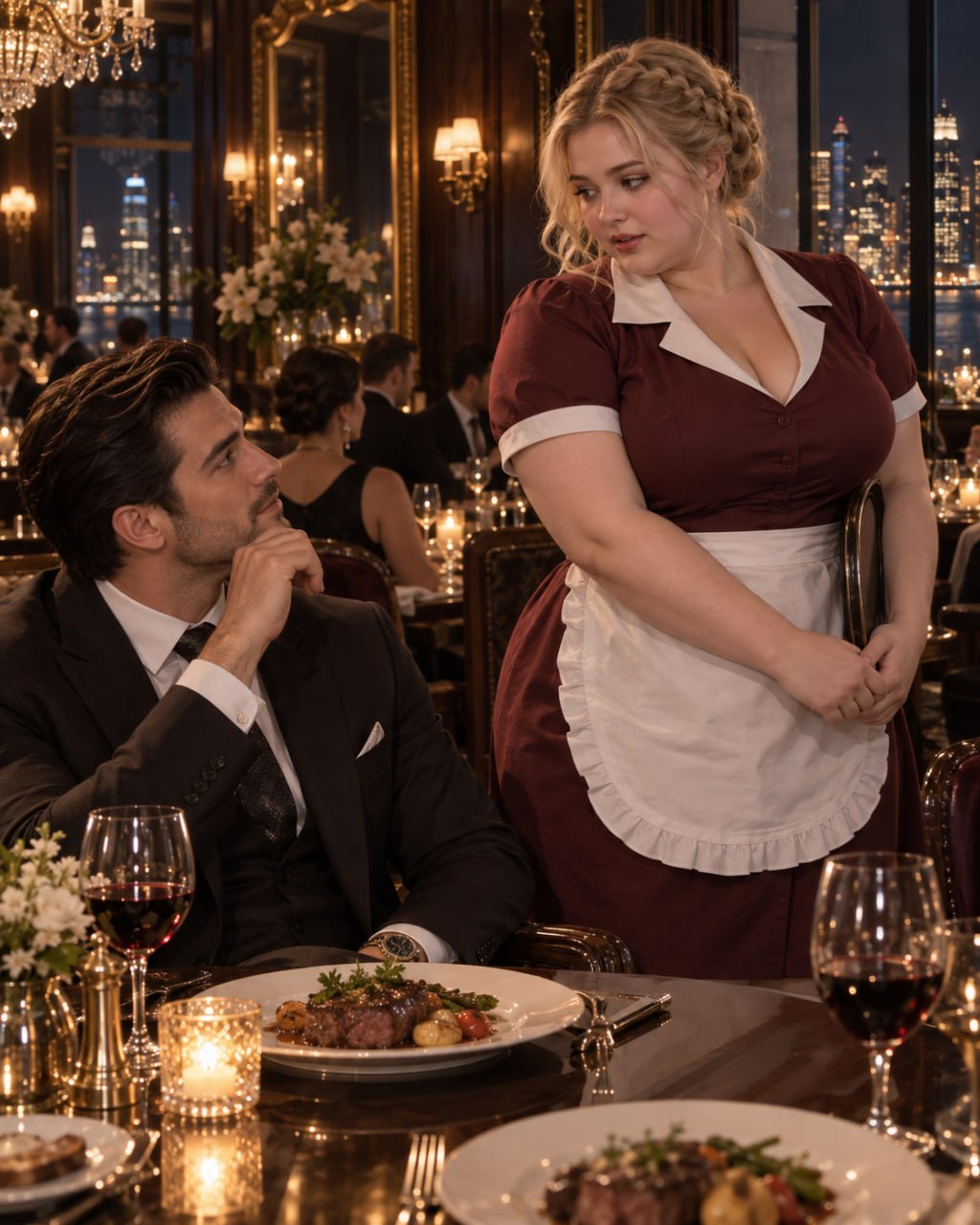
Dante didn’t answer immediately.
Instead, he looked toward the window.
“The question you should be asking is whether you trust me enough to stay alive long enough to learn the answer.”
Ruby stared at him.
Under different circumstances, she might have laughed.
But nothing about that night felt like a joke.
She packed a small bag.
Dante’s security team took her to a private residence outside Manhattan.
The house was quiet, heavily secured, and nothing like the luxurious penthouses Ruby had imagined wealthy people lived in.
There were no flashy decorations.
No photographs.
No unnecessary furniture.
Everything seemed designed for privacy.
Ruby stood in the guest room doorway.
“This is your house?”
“One of them.”
She looked at him.
“You have more than one?”
“Yes.”
“Of course you do.”
For the first time, Dante almost smiled.
The next morning, Ruby woke to the smell of coffee.
She walked downstairs and found Dante sitting at the kitchen table.
He had two cups waiting.
“You don’t sleep much, do you?” Ruby asked.
“Not when people are trying to find someone under my protection.”
Ruby sat opposite him.
“Why are you protecting me?”
Dante looked down at his coffee.
“Because you were kind to me when you had nothing to gain from it.”
“That doesn’t explain anything.”
“It explains enough.”
Ruby shook her head.
“You’re hiding something.”
“Yes.”
“Are you dangerous?”
Dante looked directly at her.
“Yes.”
Ruby expected fear.
Instead, she felt something stranger.
Honesty.
He wasn’t pretending to be harmless.
“I don’t hurt innocent people,” he added.
“That sounds like something a dangerous person would say.”
“It does.”
For several moments, neither spoke.
Then Dante placed a folder on the table.
Inside were documents showing transfers between companies connected to Belmont House.
Ruby recognized several names from the conversation she had overheard.
“The money was being moved through shell companies,” Dante explained. “Twelve million dollars was transferred through several accounts. Some of it was disguised as construction expenses. Some as hospitality consulting fees.”
Ruby looked at the documents.
“And Harold Witmore?”
“He approved the transfers.”
“Can you prove it?”
Dante’s expression hardened.
“That’s the problem.”
The evidence was complicated.
The money trail existed, but it had been deliberately fragmented.
Witmore had made sure nothing connected directly to him.
The gala was the final piece.
A public hospitality event attended by investors, executives, politicians, journalists, and industry leaders.
Witmore planned to use the event to announce another major expansion.
If he succeeded, the suspicious transactions could disappear beneath layers of new investments.
Ruby looked at the folder.
“What can I do?”
Dante shook his head.
“Nothing.”
She frowned.
“You didn’t bring me here to tell me I can do nothing.”
“I brought you here because you’re the witness they didn’t expect.”
Ruby closed the folder.
“I heard them.”
“Yes.”
“And I can testify.”
“Yes.”
“But you’re afraid they’ll come after me.”
Dante didn’t answer.
That was answer enough.
For the next two days, Ruby stayed under protection.
She spoke with investigators.
She reviewed documents.
She described exactly what she had heard without exaggerating.
She refused to invent details she couldn’t remember.
That mattered.
The investigators were careful.
They didn’t want a dramatic story.
They wanted the truth.
Meanwhile, Belmont House continued operating as if nothing had happened.
Ruby’s coworkers told customers she was taking personal leave.
Nobody mentioned the black SUV.
Nobody mentioned the phone call.
Nobody mentioned Harold Witmore.
Then, on the morning of the gala, Ruby received a message.
It contained only six words.
“We know where your mother lives.”
Her hands went cold.
Dante saw her face change.
“What is it?”
Ruby handed him the phone.
He read the message.
For the first time since she had met him, she saw something unmistakable in his expression.
Anger.
Not panic.
Not fear.
Anger.
He immediately increased security around Ruby’s family.
He also contacted the investigators.
The gala could not be postponed without raising suspicion.
Ruby had a choice.
Stay hidden.
Or walk into the room where the people responsible would be watching her.
That afternoon, she stood in front of a mirror wearing a simple dark blue dress.
She looked like the same waitress who had walked into Belmont House weeks earlier.
But she no longer felt like the same person.
Dante stood near the doorway.
“You don’t have to do this,” he said.
Ruby looked at him through the mirror.
“Yes, I do.”
“You’re afraid.”
“Absolutely.”
“Good.”
She turned.
“Good?”
“Fear tells you to be careful. It doesn’t have to tell you to stop.”
Ruby smiled faintly.
“You always talk like that?”
“Only when I’m trying to convince someone stubborn.”
She laughed.
For a moment, the tension disappeared.
Then the car arrived.
The gala was held in a grand hotel overlooking Central Park.
Black cars lined the entrance.
Photographers stood behind barriers.
Guests in formal clothing moved beneath chandeliers and golden lights.
Harold Witmore arrived surrounded by executives.
He smiled for cameras.
He shook hands.
He looked completely comfortable.
Then Ruby walked inside.
The smile disappeared from his face.
For one brief second, his expression revealed recognition.
Then he recovered.
“Ruby,” he said quietly.
“What a surprise.”
She looked at him.
“Is it?”
His eyes narrowed.
Before he could say anything else, a journalist approached.
“Mr. Witmore, could we get a comment about the new expansion?”
Witmore turned toward the cameras.
His smile returned.
Ruby watched him carefully.
She realized something.
He had spent years building an image so polished that people would rather doubt the truth than question it.
That was why she had to speak.
Not loudly.
Not dramatically.
Just clearly.
The gala program continued.
Awards were presented.
Speeches were made.
Champagne glasses rose beneath the lights.
Finally, Harold Witmore stepped onto the stage.
He began talking about integrity.
About trust.
About the future of American hospitality.
Ruby felt something tighten inside her.
The words sounded almost absurd.
Dante stood across the room, surrounded by security.
He didn’t signal her.
He didn’t tell her what to do.
He simply looked at her.
The decision was hers.
Ruby stood.
The room gradually became quiet.
Several people turned.
Witmore stopped speaking.
Ruby walked toward the microphone.
The host looked confused.
“Miss Collins?”
Ruby nodded.
“I need to say something.”
Witmore stepped down from the stage.
“Ruby, this isn’t appropriate.”
She looked at him.
“You’re right.”
A murmur moved through the room.
“This isn’t the place for rumors.”
She paused.
“That’s why I’m not going to tell you a rumor.”
She began describing what she had heard in the service corridor.
She gave dates.
Times.
Names.
She explained the exact words she remembered.
She admitted what she did not know.
She did not claim to understand every transaction.
She did not accuse anyone of anything she couldn’t support.
Then investigators entered the room.
The atmosphere changed instantly.
Witmore’s face went pale.
One investigator approached him.
“Mr. Witmore, we’d like to speak with you.”
“This is ridiculous.”
“No,” Ruby said quietly.
“This is what happens when people stop being afraid to tell the truth.”
Witmore looked at her.
For the first time, the confidence disappeared.
The investigation that followed lasted months.
Financial records were examined.
Shell companies were traced.
Bank transfers were reconstructed.
Employees were interviewed.
Eventually, the evidence established the existence of a twelve-million-dollar laundering operation connected to companies controlled through Witmore’s network.
Witmore was arrested and later prosecuted.
Belmont House faced enormous scrutiny.
Several executives resigned.
The restaurant’s reputation suffered.
But the people who had been silent began speaking.
One employee admitted she had suspected something for years.
Another provided documents.
A former accountant came forward with records that investigators had been unable to locate.
Ruby’s testimony became one piece of a much larger case.
She never considered herself a hero.
When reporters asked why she had risked everything, she always gave the same answer.
“I heard something wrong, and I decided not to pretend I hadn’t.”
Months later, Belmont House offered Ruby a promotion.
A management position.
A substantial salary increase.
Her own office.
For someone who had spent years struggling financially, it was exactly the kind of opportunity she once believed would change her life.
She declined.
Instead, she accepted a position at a culinary academy that offered hospitality training to young people from low-income communities.
Her first class was held in a modest teaching kitchen in Queens.
There were twelve students.
Some had never worked in a restaurant.
Some had dropped out of school.
One student arrived late and stood nervously near the door.
Ruby smiled.
“Come in.”
“I don’t have a uniform.”
“Neither did I when I started.”
The student looked surprised.
Ruby handed him an apron.
“Let’s begin.”
Weeks passed.
Ruby taught them how to carry plates, speak with customers, handle pressure, and understand that hospitality was not simply about food.
It was about making people feel seen.
One afternoon, Dante visited the academy.
He stood at the back of the classroom and watched silently.
When the lesson ended, Ruby walked toward him.
“You’re late.”
“I had business.”
“You always have business.”
“Yes.”
She smiled.
“You brought anything?”
Dante handed her a small paper bag.
Inside was a pastry from a bakery in Manhattan.
Ruby laughed.
“Seriously?”
“You said your students liked these.”
“They do.”
He looked through the classroom.
“They’re good students.”
“They’re learning.”
“So are you.”
Ruby looked at him.
“I thought I was supposed to be teaching.”
“You are.”
He paused.
“But teaching doesn’t mean you’ve stopped learning.”
For a moment, Ruby remembered the night she had first met him.
A quiet man sitting alone in an expensive restaurant.
A room full of people who had chosen not to understand him.
And one waitress who had simply decided that kindness was easier than cruelty.
She realized then that neither of them had saved the other in the way people might imagine.
Dante had given her protection when she needed it.
Ruby had given him something far less tangible.
She had reminded him that kindness could exist without an agenda.
Their friendship grew slowly.
There were no grand promises.
No dramatic declarations.
Just coffee.
Occasional dinners.
Conversations that lasted longer than expected.
Silence that never felt uncomfortable.
Dante continued living in a world Ruby only partly understood.
Ruby continued building a life that had nothing to do with power or money.
But they respected the distance between those worlds.
One evening, months after the gala, Ruby stood outside the academy after class.
The city was beginning to glow beneath the evening sky.
Cars moved along the avenue.
Students laughed inside the building.
Dante stood beside her.
“You ever regret it?” he asked.
“Regret what?”
“Walking into that room.”
Ruby thought for a moment.
“I regret being scared for so long.”
Dante nodded.
“That’s different.”
“Yes.”
She looked toward the academy.
“I used to think being kind meant being soft.”
“And now?”
Ruby smiled.
“Now I think kindness is a decision.”
Dante looked at her.
“A decision?”
“To treat someone with dignity even when nobody is watching.”
The city continued moving around them.
New York did not stop for their conversation.
It never did.
People hurried past.
Taxis crossed the intersection.
Lights came on in apartment buildings.
Somewhere downtown, another restaurant was opening its doors for the evening.
And somewhere inside that city, people who had once believed money could buy silence were learning that silence was never guaranteed.
Ruby had started with almost nothing.
No influence.
No powerful connections.
No protection.
Just a willingness to treat a stranger with respect.
That small decision had opened a door she could never have imagined.
It had led her into danger.
It had forced her to find courage she didn’t know she possessed.
And eventually, it had brought her somewhere more meaningful than the promotion she once thought she wanted.
She had discovered that success wasn’t always about climbing higher.
Sometimes it was about reaching back.
Sometimes it was about using what you had learned to give someone else a beginning.
And sometimes, the smallest act of kindness could travel much farther than anyone expected.
Ruby looked at Dante.
“Coffee?”
He nodded.
“Coffee.”
They walked down the street together.
No cameras.
No reporters.
No gala.
No applause.
Just two people moving through an ordinary New York evening.
And for Ruby, that was enough.
Because the greatest lesson she had learned was not about money, power, or fear.
It was about people.
You never truly know what someone is carrying when they walk through your door.
You may never know what your smallest kindness means to them.
But you can choose how you make them feel.
And sometimes, that choice becomes the beginning of everything.
A few months later, on a quiet Saturday morning, Ruby arrived at the academy before anyone else.
The building was still.
No voices came from the classrooms.
No footsteps echoed through the hallway.
She unlocked the kitchen and turned on the lights one by one.
The familiar smell of coffee drifted through the room.
On the counter sat a small envelope.
There was no name on it.
Ruby opened it carefully.
Inside was a photograph.
It showed the first class she had ever taught at the academy.
Twelve students stood awkwardly in their borrowed uniforms.
Ruby was in the center, smiling as though she had known exactly what she was doing.
She hadn’t.
She had been terrified.
On the back of the photograph was a handwritten sentence.
“Thank you for giving us a place to begin.”
Ruby stared at the words for a long moment.
Then she smiled.
She knew who had left it.
Dante never needed to sign his name.
Later that morning, the students arrived.
The quiet kitchen quickly became loud again.
Someone dropped a spoon.
Someone complained about an early class.
Someone else was arguing about whether a customer should ever be allowed to send back a perfectly cooked steak.
Ruby stood behind the counter and listened.
She loved the noise.
She loved the chaos.
She loved watching young people who once doubted themselves begin to believe they belonged somewhere.
At the end of class, one of the students approached her.
“Ms. Collins?”
“Yes?”
“I got an interview.”
Ruby smiled.
“For where?”
“A restaurant downtown.”
“That’s wonderful.”
“I’m nervous.”
Ruby placed a hand on his shoulder.
“You should be.”
He looked confused.
“Being nervous means you care.”
She handed him a clean apron.
“Just remember what we practiced.”
“What if they don’t like me?”
“Then you’ll find another place.”
“And if I fail?”
“You learn.”
“And if I fail again?”
Ruby smiled.
“You keep going.”
The student nodded.
Then he walked away.
Ruby watched him leave.
Years earlier, she had believed success meant never falling.
Now she understood something different.
Success was knowing what to do after you fell.
That afternoon, Dante arrived at the academy.
He waited outside until the last student had left.
Ruby stepped onto the sidewalk.
“You’re early.”
“I’m learning.”
She laughed.
“That’s my line.”
“I’m borrowing it.”
They started walking.
The city was bright after the rain.
Water reflected the buildings in broken pieces of light.
For a while, neither spoke.
Then Dante said, “I received a letter.”
Ruby glanced at him.
“From who?”
“Someone from Belmont House.”
“What did they want?”
“They asked whether I would consider investing in the restaurant after the restructuring.”
Ruby stopped walking.
“You’re not seriously thinking about it.”
“No.”
“Good.”
Dante smiled.
“I thought you’d say that.”
“Why?”
“Because you don’t trust them.”
Ruby shook her head.
“It’s not that.”
“Then what?”
She looked back at the academy.
“I don’t want the place to become what it was again.”
Dante nodded.
“Neither do I.”
They continued walking.
The restaurant eventually reopened under new ownership.
The old name remained, but almost everything else changed.
New management.
New financial controls.
New policies.
And, most importantly, a new culture.
Ruby never returned as an employee.
But once a year, she was invited to speak to the staff.
She always told the same story.
Not about the twelve million dollars.
Not about Dante.
Not about Harold Witmore.
She talked about a customer sitting alone at a table.
A customer whom other people had decided was inconvenient.
A customer who simply wanted to be treated like everyone else.
And she would ask the new employees one question.
“What kind of person are you when nobody important is watching?”
Some people expected her to talk about ambition.
Some expected her to talk about integrity.
But Ruby always gave the same answer.
“That’s the moment your character matters most.”
Years later, the students Ruby had taught began working across New York.
One became a chef.
Another became a hotel manager.
Another opened a small neighborhood café in Brooklyn.
The student who had once been afraid of his first interview eventually became the manager of a respected Manhattan restaurant.
Whenever someone asked him who had helped him get there, he always mentioned Ruby.
Not because she had handed him a job.
She hadn’t.
She had taught him how to believe that he deserved the opportunity to try.
Ruby eventually understood that this was her real legacy.
Not a promotion.
Not money.
Not a title.
People.
One person at a time.
One lesson at a time.
One small act of respect at a time.
On a cold evening several years after the gala, Ruby stood outside the academy again.
Snow had begun falling over Queens.
The streets were quieter than usual.
Dante approached carrying two cups of coffee.
“You remembered.”
“I always remember.”
Ruby accepted one.
They stood beneath the awning and watched the snow fall.
“Do you ever think about that night?” Dante asked.
“All the time.”
“What would you have done differently?”
Ruby considered the question.
“Maybe I would have been less afraid.”
Dante smiled.
“I don’t think anyone can promise that.”
“No.”
She looked at him.
“But I think I would still do the same thing.”
“Why?”
Ruby took a sip of coffee.
“Because the person sitting at that table deserved kindness.”
Dante looked at her quietly.
“And you deserved it too.”
Ruby smiled.
Neither of them said anything after that.
They didn’t need to.
The snow continued falling.
The city continued moving.
And somewhere inside the academy, the lights were still on.
A new generation was learning how to cook.
How to serve.
How to listen.
How to welcome strangers.
How to remain decent when nobody was keeping score.
Ruby looked through the window at the empty classroom.
She finally understood that the night at Belmont House had never really been about twelve million dollars.
It had been about choices.
Harold Witmore had chosen greed.
Others had chosen silence.
Some had chosen fear.
Dante had chosen protection.
Ruby had chosen kindness.
And in the end, those choices shaped far more lives than anyone could have predicted.
Money could disappear.
Power could change hands.
Reputations could collapse.
Buildings could close.
But the way one person made another person feel could remain long after everything else was gone.
Ruby turned toward Dante.
“Ready?”
“For what?”
“To go home.”
He nodded.
They walked away from the academy together.
Behind them, the building stood quietly beneath the falling snow.
Inside, the lights remained on.
Waiting for tomorrow.
Waiting for another student.
Another beginning.
Another person who might walk through those doors believing they had nothing special to offer.
And perhaps that was the most important lesson of all.
You never know which small decision will become the turning point in someone’s life.
You may never see the result.
You may never receive a thank-you.
You may never even realize that someone remembered the way you treated them.
But kindness does not become less valuable because nobody applauds it.
Sometimes, the smallest gesture is the one that survives.
Sometimes, a simple act of respect becomes a reason for someone else to keep going.
And sometimes, without ever knowing it, you become the person who gives someone else the courage to begin again.
For Ruby Collins, it had started with a stranger sitting alone at a table in Manhattan.
For everyone else, it became a reminder that character is not measured by what you do when the world is watching.
It is measured by what you choose when nobody is.
And that choice, no matter how small, can change everything.
THE END.