New York City, 1893. Beneath the chandeliers of a glittering Fifth Avenue ballroom, where America’s richest families gathered beneath silk banners and electric lights
Sebastian Vain had barely finished his sentence when the doors of the private club opened.
The room fell strangely quiet.
Evelyn Hartley stood in the doorway.
She wore a dark blue walking dress, simple by the standards of Fifth Avenue society, with a narrow-brimmed hat in one hand and an expression that made three gentlemen immediately look down at their glasses.
Sebastian stared at her.
For once in his life, he had nothing clever to say.
Evelyn walked toward the table.
Her boots clicked steadily against the polished floor.
No one stopped her.
No one dared.
She reached the chair opposite Sebastian and placed her gloves beside an untouched glass of whiskey.
“I believe,” she said calmly, “you were discussing me.”
One of Sebastian’s friends coughed.
Another suddenly became fascinated by the ceiling.
Sebastian leaned back.
“If you heard everything, Miss Hartley, there is little point pretending otherwise.”
“Good.”
She sat down.
“You said thirty days.”
Sebastian’s eyebrows lifted.
“Did I?”
“You said you could make me fall in love with you within thirty days.”
A nervous silence spread across the table.
Then Sebastian smiled, though there was less confidence in it now.
“I may have been speaking carelessly.”
“You were.”
“I had been drinking.”
“I noticed.”
A few men tried to hide their laughter.
Sebastian gave them a warning glance.
Evelyn folded her hands.
“Then let us make your careless statement useful.”
He studied her.
“What do you propose?”
“You have thirty days.”
“And?”
“You may court me.”
Sebastian smiled again.
“But if you fail, you will pay every dollar you wagered.”
“That was already the arrangement.”
“No.” Evelyn’s eyes sharpened. “The money is not enough.”
The room became silent again.
“What, then?”
“You will stand before this same circle of people and admit that you were wrong about me.”
Sebastian stared at her.
“And if I succeed?”
Evelyn paused.
“If you succeed, I will admit publicly that I misjudged you.”
“That hardly seems fair.”
“Neither was your wager.”
The answer landed harder than any insult.
Sebastian slowly rose from his chair.
“Thirty days, Miss Hartley.”
“Thirty days.”
He offered his hand.
She looked at it for several seconds before taking it.
His fingers closed around hers.
Neither of them noticed how long they remained there.
The first week was war.
Sebastian sent flowers.
Evelyn returned them.
He sent books.
She kept one and returned the others.
He invited her to dinner.
She accepted only if three other women were present.
He arranged a carriage ride through Central Park.
She brought her cousin.
Every attempt he made to charm her became another opportunity for Evelyn to remind him that she was not impressed.
Yet Sebastian discovered something unexpected.
He enjoyed being challenged.
For years, people had either feared him, flattered him, or wanted something from him. Evelyn did none of those things.
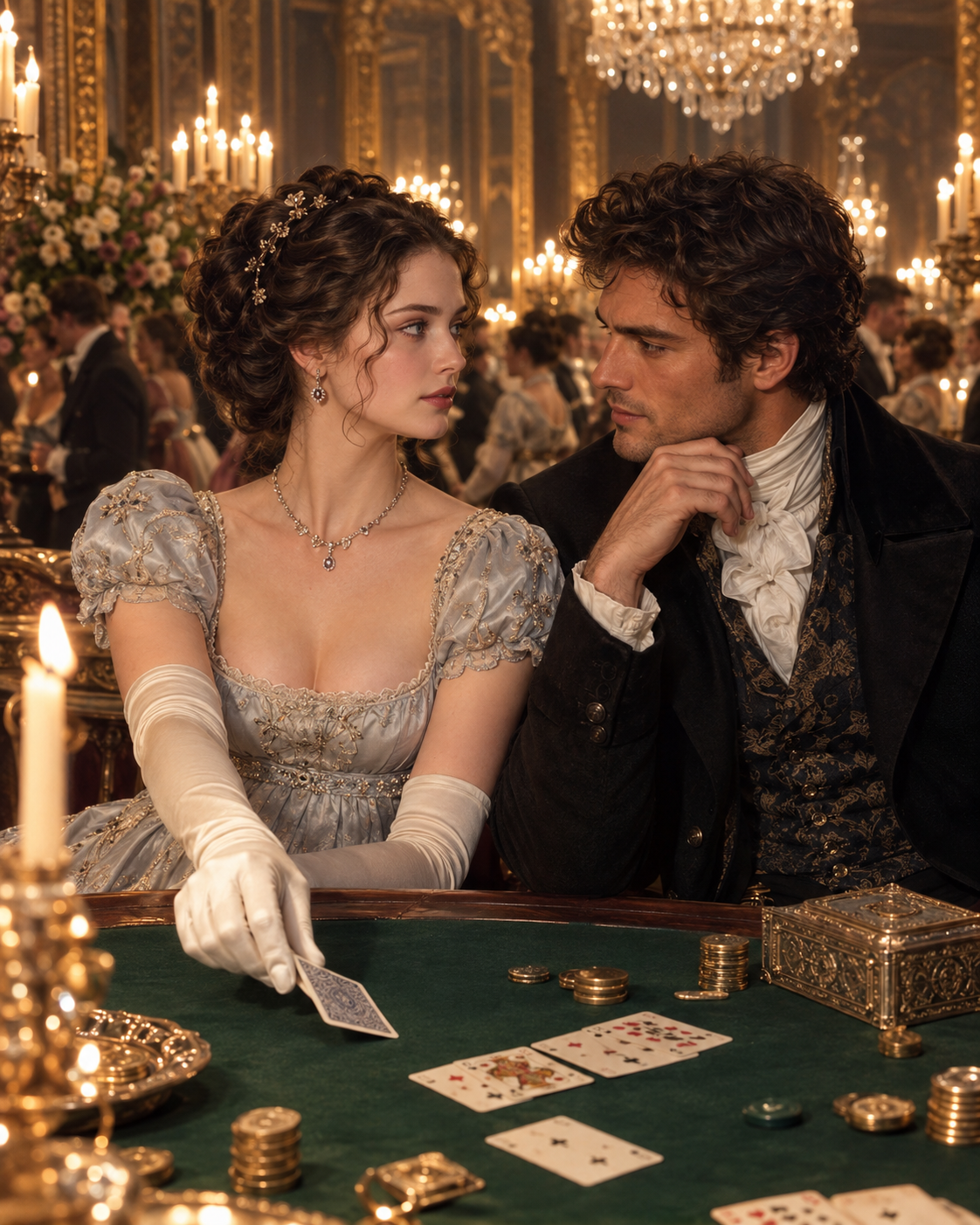
She disagreed with him openly.
She laughed when he was ridiculous.
She corrected him when he was arrogant.
And when he tried to hide behind his title, she simply looked at him until he remembered that she was speaking to Sebastian, not the Duke of Ashworth.
One afternoon, they walked through Washington Square after a charity luncheon.
The March wind pushed dry leaves along the pavement.
“You hate me,” Sebastian said.
“I find you exhausting.”
“That is not the same thing.”
“No.”
He glanced at her.
“Do you dislike me?”
“I did.”
“Past tense?”
Evelyn looked straight ahead.
“Do not become pleased with yourself.”
He laughed.
“I wouldn’t dream of it.”
They walked several more steps.
Then Evelyn noticed an elderly bookseller struggling with a wooden crate near the curb.
Before she could move, Sebastian stepped forward.
He lifted the crate without hesitation and carried it inside.
The bookseller thanked him.
Sebastian merely nodded.
When he returned, Evelyn was watching him.
“What?”
“Nothing.”
“You are staring.”
“I am wondering why the newspapers never mention that.”
“They would have no use for it.”
“Perhaps.”
That was the first moment something changed.
Not dramatically.
Not visibly.
But enough.
The second change came at a dinner in Newport.
The wealthy families who spent their summers along Rhode Island’s coast had gathered at a sprawling mansion overlooking the Atlantic. American flags hung beside the entrance, brass lanterns illuminated the terrace, and the sound of a string quartet drifted through open windows.
Sebastian had been surrounded by admirers all evening.
Evelyn expected him to enjoy the attention.
Instead, she found him standing alone on the veranda.
“You escaped,” she said.
“I was rescued by the ocean.”
“You have always been dramatic.”
“It is one of my few consistent qualities.”
She smiled.
He looked at her.
For a moment, neither spoke.
“You know,” he said quietly, “I don’t remember when this stopped being a game.”
Evelyn’s smile disappeared.
“Sebastian.”
“I know.”
“No.”
He stepped closer.
“I know what you are going to say.”
“Then listen anyway.”
He did.
“You made a wager about me before you knew me.”
“Yes.”
“You cannot simply decide that your feelings make the wager harmless.”
His expression changed.
“I know.”
“Do you?”
He looked toward the ocean.
“No,” he admitted. “Perhaps I am only beginning to.”
That honesty unsettled her more than any flirtation could have.
She had expected arrogance.
She had expected charm.
She had not expected regret.
Before she could answer, voices sounded behind them.
A group of guests emerged onto the veranda.
Their conversation stopped when they saw Sebastian and Evelyn standing together.
Then came the whispers.
Evelyn heard her own name.
She heard the word wager.
She heard someone laugh.
Her stomach tightened.
Sebastian noticed.
“Come with me.”
“Where?”
“Somewhere quiet.”
She followed him through the side corridor and into the garden.
The sea wind was colder there.
“I hate this,” she whispered.
“The gossip?”
“The feeling that every person in America has decided my life is entertainment.”
Sebastian’s voice softened.
“I understand.”
“No, you don’t.”
He looked at her.
“You are right.”
It was perhaps the first time he had said those words without irony.
Evelyn looked away.
“I spent years becoming someone who could stand alone,” she said. “Then one careless sentence in a ballroom became enough for strangers to decide what I am.”
Sebastian reached for her hand.
This time, she allowed him to take it.
“I don’t want to be another person deciding that for you.”
Her fingers tightened around his.
Neither mentioned the wager again that night.
By the third week, the wager had become almost irrelevant.
They spoke for hours.
About New York.
About America.
About the expectations placed on wealthy families.
About their childhoods.
About the things neither had told anyone else.
Sebastian admitted that his reputation had become a kind of armor.
“If everyone expects the worst from you,” he said one evening, “you never have to risk disappointing them.”
Evelyn understood more than she wanted to.
She told him about the years of hearing that she was too independent, too outspoken, too old-fashioned in one room and too unconventional in another.
“You were never difficult,” Sebastian said.
“You barely know me.”
“I know enough.”
Those words stayed with her.
But happiness made them careless.
And society noticed.
The newspapers began printing their names together.
One column described Evelyn as “the mysterious American beauty who has captured the attention of the Duke.”
Another called their relationship “the season’s most entertaining courtship.”
Evelyn hated every word.
Sebastian pretended not to care.
Then one morning, a folded newspaper arrived at Evelyn’s home.
A story claimed that Sebastian had made a substantial private wager concerning her.
The details were wrong in some places.
But not all of them.
Evelyn read the article twice.
Then a third time.
Her hands trembled.
That evening, Sebastian came to see her.
He found her waiting in the drawing room.
“You knew,” she said.
He stopped.
“Knew what?”
“The newspapers.”
His expression hardened.
“Who showed you?”
“That is not an answer.”
“No.”
“You knew they were going to publish it?”
“I suspected.”
“And you said nothing.”
“I was trying to protect you.”
Evelyn laughed bitterly.
“By keeping me ignorant?”
“I wanted to settle it first.”
“Settle what?”
“The debt.”
She stared at him.
“What debt?”
Sebastian said nothing.
That silence told her enough.
The wager was not merely a careless joke anymore.
There was money involved.
A great deal of it.
And Sebastian had been trying to arrange something behind her back.
“You never intended to tell me.”
“I intended to tell you when it was finished.”
“When what was finished?”
He stepped closer.
“When I had paid it.”
Evelyn stepped away.
“You still don’t understand.”
“What?”
“I don’t want you paying for me.”
“That is not what I am doing.”
“Then what are you doing?”
He had no answer that could survive the look in her eyes.
She shook her head.
“I thought you were different.”
“I am.”
“Then why does this feel exactly like every other time a man has decided he knows what is best for me?”
“Evelyn—”
“No.”
She picked up the newspaper.
“You made a wager about my heart before you knew whether I even wanted you near me.”
“I regret that.”
“And then, when you finally realized you cared, you decided to fix everything without telling me.”
His voice lowered.
“I was afraid.”
She stopped.
It was the one answer she had not expected.
“Afraid of what?”
“Of losing you.”
The room became painfully quiet.
But Evelyn was too hurt to let the confession soften her.
“You should have trusted me enough to let me choose.”
Then she walked away.
The next morning, Sebastian did something the newspapers could not understand.
He disappeared.
For several days, no parties.
No clubs.
No social appearances.
No charming remarks.
No mysterious carriage rides.
Behind closed doors, he began selling property, settling debts, and arranging the money connected to the wager.
He did not tell Evelyn.
He did not send word through friends.
He simply worked.
By the time the final day arrived, the debt had been settled.
Every dollar.
Every obligation.
Every promise made in that careless room.
Evelyn, meanwhile, had decided she would not attend the final gathering.
She had no intention of standing before New York society and playing a part in a game she no longer recognized.
But that evening, an invitation arrived.
No elaborate seal.
No romantic message.
Only six words written in Sebastian’s hand.
“You deserve to hear this from me.”
She went.
The same ballroom was filled with guests.
The same chandeliers glittered overhead.
The same polished floor reflected hundreds of shoes.
But something felt different.
Sebastian stood at the center of the room.
He looked nothing like the reckless man who had once entered rooms expecting them to bend around him.
When Evelyn arrived, he saw her.
He did not approach.
Instead, he waited until everyone was watching.
Then he raised his glass.
“I owe this room an explanation.”
Whispers moved through the crowd.
Sebastian continued.
“Several weeks ago, I made an arrogant wager concerning Miss Evelyn Hartley.”
Evelyn’s heart tightened.
He looked directly at her.
“I said I could make her fall in love with me within thirty days.”
Someone laughed nervously.
Sebastian did not.
“I was wrong.”
Silence.
“I was wrong because I believed affection was something that could be won through persistence, charm, money, or reputation.”
His voice carried across the ballroom.
“It is not.”
Evelyn could barely breathe.
Sebastian reached into his coat and removed a folded document.
“The wager has been settled.”
He placed it on the table.
“I have paid every debt connected to it.”
A murmur spread through the room.
“But that is not enough.”
He looked at Evelyn again.
“So tonight, I release Miss Hartley from every condition, every promise, every consequence, and every expectation created by that wager.”
He tore the document in half.
Then again.
The pieces fell onto the table.
“She owes me nothing.”
No one spoke.
Sebastian’s expression softened.
“And I ask nothing from her.”
Evelyn felt tears gathering in her eyes.
He continued.
“I only want her to know that somewhere between the first argument and the last conversation, I stopped trying to win.”
His voice faltered for the first time.
“I began hoping she might choose me.”
The room seemed to disappear.
Evelyn remembered the first night.
The glass.
The silence.
His amused expression.
The wager.
The arguments.
The garden.
The ocean.
The bookseller.
All of it.
Sebastian stepped away from the table.
He did not ask her to come closer.
He did not ask for forgiveness.
He simply stood there and waited.
That was when Evelyn understood the difference.
For the first time, he had left the decision entirely in her hands.
She crossed the ballroom.
One step.
Then another.
The whispers returned, but she barely heard them.
When she reached him, she stopped.
“You are an extraordinarily foolish man,” she whispered.
A faint smile appeared.
“I have been told.”
“You hurt me.”
“I know.”
“You should have trusted me.”
“I know.”
She looked down.
“And I am still angry.”
“I know.”
She finally looked into his eyes.
“But I love you.”
Sebastian froze.
For several seconds, the most notorious man in New York seemed completely incapable of speaking.
Then Evelyn smiled through her tears.
“Did you expect me to make this easy?”
“Never.”
She reached for his hand.
This time, he took it gently.
No wager.
No audience.
No conditions.
Just two people standing beneath the same chandeliers where their story had begun.
The orchestra slowly started again.
Someone laughed.
Someone else whispered.
Then the room returned to motion.
But Evelyn no longer cared.
Sebastian leaned closer.
“Thirty days,” he murmured.
She shook her head.
“No.”
“No?”
“I think thirty days was far too long.”
He smiled.
“Then how long?”
Evelyn looked toward the ballroom, then back at him.
“A lifetime.”
And for once, Sebastian Vain had no clever answer.
He simply kissed her hand.
Years later, people would still tell the story of the glass thrown at the ballroom.
They would remember the wager.
They would remember the scandal.
They would remember the Duke who claimed he could win a woman’s heart and the woman who turned his wager against him.
But Evelyn remembered something else.
She remembered the moment Sebastian finally stopped trying to possess the outcome.
That was when she trusted him.
Their story had begun with pride, gossip, and a reckless challenge.
It survived because both of them eventually learned that love could not be negotiated like a business contract or won like a game.
A wager asks, “What will I get if I succeed?”
Love asks a different question.
“What am I willing to give without being promised anything in return?”
For Sebastian, the answer became simple.
Everything.
For Evelyn, the answer was equally simple.
Her heart.
And in the end, the scandal that had once threatened to destroy them became only the beginning of a life neither of them had expected.
Months passed before Evelyn Hartley and Sebastian Vain allowed themselves to believe that the worst of the gossip had finally faded.
New York society, however, had a remarkably short memory when there was a new scandal waiting around the corner.
By spring, their engagement had become old news.
By summer, the newspapers had found someone else to discuss.
And by autumn, Evelyn had begun to enjoy something she had once believed impossible.
Peace.
Their wedding was smaller than society expected.
There were no enormous crowds outside St. Patrick’s Cathedral, no parade of carriages stretching down Fifth Avenue, and no attempt to turn their marriage into a spectacle.
Evelyn had insisted upon it.
“I have spent enough of my life being watched,” she told Sebastian.
He smiled.
“Then we shall give them nothing to watch.”
They married on a cool October morning.
The ceremony was elegant but intimate, attended by family, a handful of trusted friends, and several people who had known Evelyn long before her name became associated with the Duke of Ashworth.
When she walked toward him, Sebastian forgot every carefully prepared word.
She noticed.
“You look nervous,” she whispered.
“I am.”
“You?”
“Terrified.”
She smiled.
“Good.”
“Good?”
“It means you understand what this means.”
He took her hand.
“I have never understood anything better.”
Their marriage did not magically transform them into different people.
Sebastian was still stubborn.
Evelyn was still outspoken.
He still hated admitting when he was wrong.
She still had a remarkable talent for making him admit it anyway.
But there was one difference.
Neither of them ran when things became difficult.
They had learned that love was not proved by the absence of conflict.
It was proved by what happened afterward.
For a while, life was almost ordinary.
They spent winters in New York and summers traveling between Newport and the countryside.
Evelyn became involved in charitable work, particularly organizations supporting young women who had been denied opportunities because of their circumstances.
Sebastian quietly funded several of them.
When Evelyn discovered what he had done, she confronted him.
“You could have told me.”
“I thought you would object.”
“I do object.”
“Then I was correct.”
She tried not to smile.
“You are impossible.”
“And yet you married me.”
“I have regretted that decision at least twice this week.”
“Only twice?”
She laughed.
Those moments were the ones neither newspaper could ever capture.
But their peace did not last forever.
One winter evening, Sebastian received a letter from England.
He read it in silence.
Evelyn noticed immediately.
“What happened?”
“Nothing.”
She looked at him.
“Sebastian.”
He folded the letter.
“It concerns Ashworth.”
His family estate had been losing money for years.
The debts had grown quietly beneath generations of expensive traditions, neglected properties, and obligations that no one had wanted to acknowledge.
The Duke had managed to settle his personal debts, but the larger estate was another matter.
He had avoided discussing it because he feared Evelyn would believe he had married her for money.
Instead, she sat beside him.
“How bad is it?”
He hesitated.
“Bad enough.”
“Then we deal with it.”
“You don’t have to.”
“I know.”
He looked at her.
“That is precisely why I am asking.”
For the first time since their marriage, Evelyn saw the old fear in his eyes.
The fear of failing.
The fear of disappointing everyone.
The fear that if he could not maintain the life expected of a duke, he would become nothing.
She took his hand.
“You once told me that if everyone expects the worst from you, you never have to risk disappointing them.”
He smiled faintly.
“I remember.”
“Perhaps it is time to disappoint them.”
His eyebrows rose.
“How?”
“By becoming someone who does not care what they expect.”
The solution was not easy.
Sebastian sold several properties.
He reduced household expenses.
He closed accounts that existed only to satisfy social expectations.
He invested in American rail and manufacturing ventures instead of preserving traditions that were slowly draining the estate.
People criticized him.
Some called him reckless.
Others claimed Evelyn was controlling him.
The newspapers had a field day.
Evelyn read one particularly cruel article over breakfast.
Sebastian watched her.
“You should stop reading those.”
“I agree.”
She folded the newspaper.
Then opened another.
He laughed.
“You are impossible.”
“I married you.”
“That is becoming your favorite defense.”
“It is a strong one.”
Months later, the estate stabilized.
The crisis had not destroyed them.
If anything, it had made them stronger.
But one evening, another letter arrived.
This one was from New York.
It contained news neither expected.
The man who had originally insulted Evelyn at the ballroom had fallen into financial trouble.
His family had lost much of its fortune.
He had become the subject of public ridicule.
Evelyn read the letter twice.
She expected to feel satisfaction.
Instead, she felt tired.
“Do you want me to do something?” Sebastian asked.
“No.”
“Are you sure?”
“Yes.”
She folded the letter.
“I spent too much time believing justice meant watching people suffer for what they had done.”
Sebastian said nothing.
“What I understand now,” she continued, “is that I don’t need his downfall to prove that he was wrong about me.”
Sebastian smiled.
“That sounds like my wife.”
She looked at him.
“You’re very pleased with yourself.”
“Always.”
She laughed.
Years continued to pass.
Their home became filled with books, music, flowers, and the noise of family gatherings.
They eventually had children.
A daughter first.
Then a son.
Evelyn became a patient mother, though Sebastian insisted she was incapable of refusing their daughter anything.
“That child has you completely under her command,” he said one afternoon.
“She has you too.”
“I am merely being diplomatic.”
“You bought her a pony.”
“She asked.”
“She is four.”
“She asked very convincingly.”
Evelyn shook her head.
Their children grew up hearing the story of how their parents met.
But Sebastian always told it incorrectly.
According to him, Evelyn had been hopelessly fascinated by him from the first night.
According to Evelyn, Sebastian had spent the first six months trying to recover from being rejected by her.
Their children never knew which version was true.
They suspected neither parent was entirely reliable.
One summer, many years after the original wager, they returned to New York.
The ballroom where everything had begun was being renovated.
Evelyn stood outside with Sebastian.
The building looked smaller than she remembered.
“So much happened in there,” she said.
Sebastian took her hand.
“You threw a glass at me.”
“I did not throw it at you.”
“You threw it near me.”
“There is a difference.”
“You terrified half the room.”
“I was angry.”
“I noticed.”
She smiled.
“Do you regret making that wager?”
He considered the question.
“Yes.”
She looked surprised.
“Really?”
“I regret the man I was when I made it.”
He squeezed her hand.
“But I don’t regret meeting you.”
Evelyn looked up at him.
“That is a better answer.”
“I have had years to practice.”
She leaned against his shoulder.
For a while, they simply stood there.
No orchestra.
No champagne.
No gossip.
No audience.
Only the quiet street and the sound of passing carriages.
“Do you ever wonder,” Evelyn asked, “what would have happened if I hadn’t heard you that night?”
“Constantly.”
“And?”
“I suspect I would have remained an arrogant idiot.”
She laughed.
“Probably.”
“And you?”
She thought about it.
“I might still be unmarried.”
“Then I owe that wager my gratitude.”
“No.”
She turned toward him.
“You owe me an apology.”
He smiled.
“I have given you dozens.”
“And I expect dozens more.”
“Fair enough.”
She kissed his cheek.
“Come home.”
He offered his arm.
“Gladly.”
As they walked away, neither noticed the elderly doorman watching them from the entrance.
He had been there decades earlier, on the night of the scandal.
He remembered the shattered glass.
He remembered the silence.
He remembered Sebastian’s arrogant smile.
And now he watched the same man walk down the street holding his wife’s hand as though it were the most valuable thing he had ever possessed.
Perhaps that was the real ending to the story.
Not the wedding.
Not the wager.
Not the apology.
Not even the years of happiness afterward.
It was the quiet transformation of two people who had once believed love was something that could be controlled.
Sebastian had learned that love could not be won.
Evelyn had learned that protecting her independence did not mean refusing to trust another person.
And together they learned something neither had understood when they first met:
The strongest promises are not made when everything is easy.
They are made when pride has been stripped away, when mistakes have been admitted, and when two people are free to walk away—but choose to stay.
Years later, their children would ask about the famous wager.
Sebastian would sigh dramatically.
Evelyn would roll her eyes.
Then she would tell them the truth.
“It began with a foolish man who thought he could win a woman’s heart.”
Their daughter would ask, “And did he?”
Evelyn would look at Sebastian.
He would smile.
“No,” she would say.
“He learned that it was never his to win.”
And that was the story they carried with them for the rest of their lives.
A story that began with an insult in a glittering New York ballroom.
A story that passed through anger, pride, gossip, heartbreak, forgiveness, and love.
A story that proved the most meaningful endings are not always about getting everything right from the beginning.
Sometimes they are about having the courage to admit when you were wrong.
To trust again after being hurt.
To let another person choose freely.
And to understand that love becomes lasting not when two imperfect people stop making mistakes, but when they decide that no mistake will matter more than the life they are building together.
The wager was forgotten.
The scandal faded.
The newspapers moved on.
But the love remained.
And in the end, that was the only part of the story that truly mattered.
THE END.