“My own daughter can’t be trusted with a simple ledger,” Walter Miller announced in front of half the town.
Caleb stared at the paper for so long that Grace began to wonder whether he had forgotten she was sitting across from him.
Outside, the wind slammed against the little cabin. Snow hissed through the cracks around the door, and the fire struggled to keep the room warm.
“Caleb?” she asked softly. “What is it?”
He turned the paper toward her.
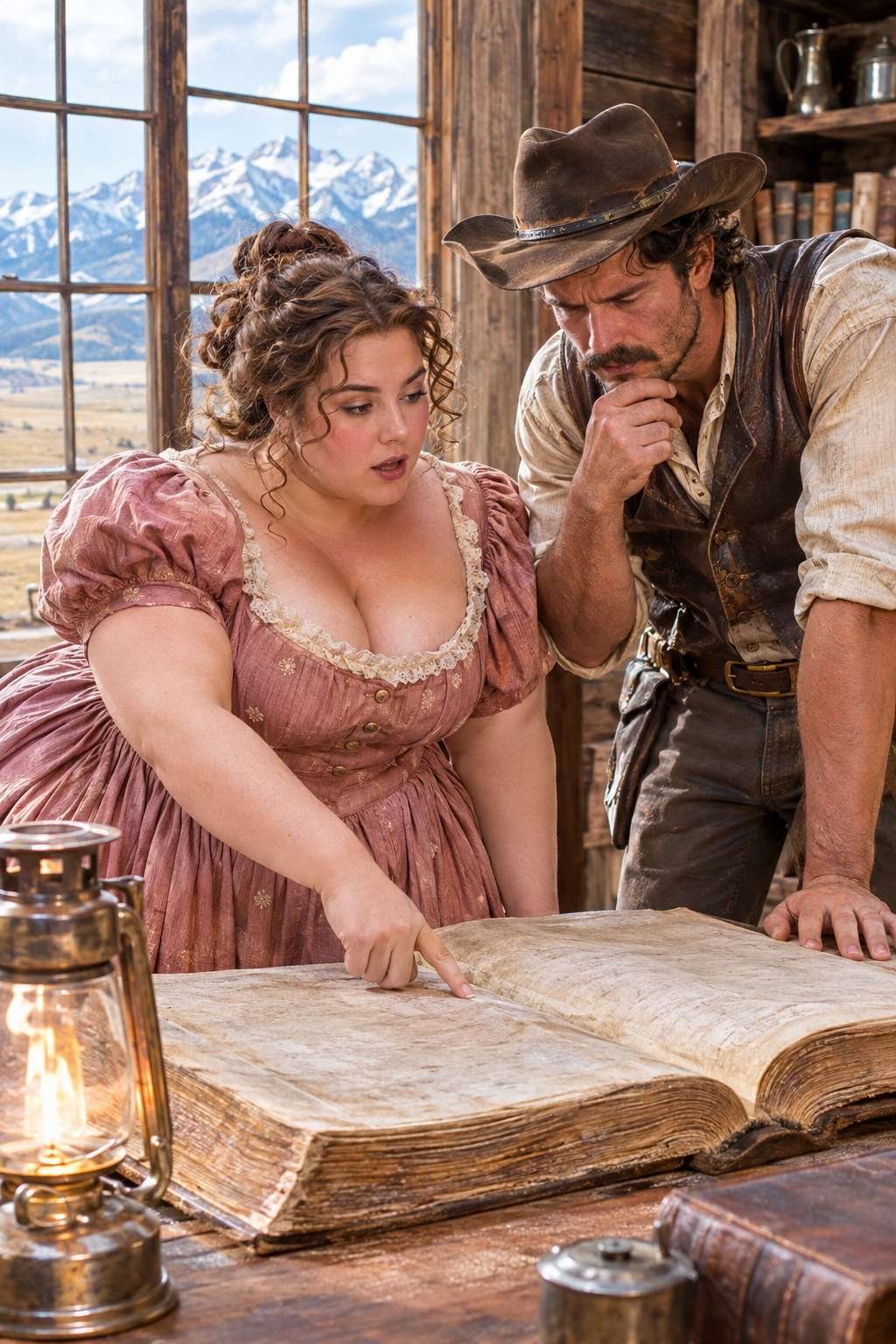
It was an old purchase offer from Henry Dawson, dated nearly eighteen months earlier. Grace had seen plenty of business agreements in her father’s store, but something about this one immediately caught her attention.
The amount Dawson had offered for High Meadow Ranch’s south pasture was far below its actual value.
But that wasn’t what had made Caleb go pale.
At the bottom of the document, beneath Dawson’s signature, was another name.
Walter Miller.
“My father witnessed this agreement?” Grace whispered.
“He did more than witness it,” Caleb replied. “He came here with Dawson. They told me the pasture was nearly worthless and that selling it would save me trouble.”
“Why would they want it so badly?”
Caleb looked toward the window, where snow had completely buried the lower pane.
“I’ve been asking myself that question for two years.”
Grace examined the paper again.
There was a handwritten note along the bottom, partly hidden beneath an old fold.
She moved closer to the fire to read it.
“Payment to be completed upon confirmation of the eastern boundary survey.”
She frowned.
“Why would Dawson need another survey if he already knew which land he wanted?”
Caleb didn’t answer.
Instead, he reached for a small leather notebook beside his coat.
“My brother Daniel used to keep records of every spring, creek, and grazing trail on this property. He believed the south pasture was worth more than people realized.”
“Because of the water?”
“That’s what I always thought.”
Caleb opened the notebook. Several pages were filled with Daniel’s careful handwriting.
Near the back, Grace noticed a rough drawing of the ranch.
A narrow creek crossed the south pasture, disappearing beneath a rocky ridge before emerging farther east.
Beside the ridge, Daniel had written three words.
Check beneath limestone.
Grace traced the writing with her finger.
“What did he mean?”
“I never found out.”
Caleb closed the notebook.
“Daniel died before he could explain.”
The sadness in his voice was so deep that Grace stopped asking questions.
For a while, they listened to the storm.
Then Caleb spoke again.
“Six years ago, Daniel went out during a blizzard to bring back a missing horse. I told him to wait until morning. He wouldn’t listen.”
Caleb rubbed his hands together.
“When he didn’t return, I went looking. Found him two days later.”
Grace watched the firelight move across his face.
“I’ve spent six years thinking that if I’d gone with him, he’d still be alive.”
“You couldn’t control the storm,” she said.
“I could’ve stopped him.”
“Maybe. Or maybe you both would’ve died.”
He looked at her.
Grace hesitated before continuing.
“My father spent years telling me everything that went wrong was my responsibility. A missing shipment. A customer complaint. A mistake someone else made.”
She swallowed.
“Eventually, I started believing him.”
Caleb’s expression softened.
“Your father was wrong about you.”
“And maybe you’re wrong about yourself.”
For the first time that night, Caleb gave a small, tired smile.
Neither spoke for several minutes.
Then a sudden crash came from outside.
Caleb stood immediately.
Something heavy had struck the cabin wall.
He took the rifle from above the door and listened.
Another crash followed.
“Stay here,” he told Grace.
He opened the door just enough to look outside.
A broken tree branch had fallen against the cabin, knocking loose part of the woodpile.
Caleb stepped into the storm to secure it.
Grace waited beside the fire, holding her breath until he returned.
His coat was covered in snow.
“The wind’s getting worse,” he said. “We won’t be leaving tonight.”
Grace glanced at the little room.
There was one narrow bed, a wooden bench, and a fireplace that needed constant attention.
Caleb noticed her concern.
“You take the bed. I’ll stay by the fire.”
“You’ll freeze.”
“I’ve slept in worse places.”
Grace folded her arms.
“And I’ve spent twenty-seven years being told what to do. I’m not starting again tonight.”
That earned a genuine laugh from him.
They agreed to take turns sleeping while the other tended the fire.
But neither rested much.
Grace kept thinking about Dawson’s offer, the strange boundary survey, and the freight charges that had brought her to High Meadow Ranch.
Something connected them.
She just couldn’t see it yet.
By morning, the storm had weakened.
Caleb opened the door and found snow piled almost to his waist.
They spent hours clearing a path to the horses.
When they finally started home, the sky was pale and quiet, as though the previous night’s violence had never happened.
Halfway down the trail, Caleb stopped.
Fresh wagon tracks crossed the road.
Grace stared at them.
“Someone traveled through here during the storm?”
“After the worst of it,” Caleb said.
He crouched beside the tracks.
“Two horses. Heavy wagon.”
“Could it be a supply delivery?”
“Not on this road.”
He followed the tracks with his eyes.
They led toward High Meadow Ranch.
Caleb climbed back into the saddle.
“Stay close.”
By the time they reached the ranch, Grace knew something was wrong.
The barn doors stood open.
A frightened ranch hand named Thomas hurried toward them.
“Mr. Foster! Thank heaven you’re back.”
“What happened?”
“Two men came yesterday afternoon. Said they were from Dawson Freight. They had papers claiming you owed them money.”
Caleb’s jaw tightened.
“Did you let them inside?”
“They said they had authority to inspect the accounts. I told them you weren’t here, but they pushed past me.”
Grace’s heart began pounding.
“Did they enter the office?”
Thomas nodded.
“I tried to stop them.”
She ran.
The office door was open.
Drawers had been pulled out. Papers covered the floor. The account books were scattered across the desk.
Grace went straight to the cabinet where she kept her records.
The delivery receipts were gone.
So were the copies she’d made of several suspicious invoices.
Caleb appeared behind her.
“Grace?”
“They took the evidence.”
She opened another drawer.
Empty.
Her hands began trembling.
“They knew exactly what to look for.”
Caleb placed a steady hand on her shoulder.
“Not everything is lost.”
Grace looked at him.
He nodded toward her traveling bag.
She had kept the original copies from her father’s mercantile hidden inside its lining.
But when she hurried to her bedroom, her bag was lying on the floor.
The stitching along one side had been cut open.
Grace sank onto the bed.
The hidden papers were gone.
For several seconds, she couldn’t speak.
Then she noticed something beneath the bedframe.
A small piece of folded paper had slipped from the torn lining.
She reached down and pulled it free.
It contained only three entries, but each showed the same freight charge recorded twice.
One entry included a date, an invoice number, and Walter’s initials.
Grace pressed the paper against her chest.
“They missed one.”
Caleb knelt beside her.
“Then we still have a beginning.”
But the relief lasted only a moment.
Thomas appeared in the doorway.
“Mr. Foster, there’s something else.”
Caleb stood.
“What?”
“One of those men left a notice. Said Dawson would return tomorrow with the county sheriff.”
Grace felt the blood drain from her face.
“Why the sheriff?”
Thomas handed Caleb a folded document.
It was a formal demand for payment.
According to the notice, High Meadow Ranch owed Dawson Freight more than three thousand dollars in unpaid charges.
The amount was enormous.
Enough to force a struggling rancher to sell valuable land.
At the bottom was a warning.
If payment was not made within ten days, Dawson intended to seek seizure of property.
Caleb read it twice.
Then he handed it to Grace.
She recognized the figures immediately.
“These are the same charges we’ve been questioning.”
Caleb looked toward the south pasture.
“So that’s their plan.”
“They’re trying to make you sell.”
“And if I refuse, they’ll take it another way.”
Grace stared at the document.
For the first time, she understood how carefully the scheme had been arranged.
Her father hadn’t merely been stealing money.
He had helped create a debt that could destroy Caleb’s ranch.
And Walter had sent her away just as she began discovering it.
That evening, Grace sat at the kitchen table rebuilding the missing records from memory.
She wrote until her fingers cramped.
Caleb brought her coffee and quietly set it beside her.
“You should rest.”
“Not yet.”
“You’ve been working for hours.”
She looked up.
“My father thinks he can frighten me into silence. If I stop now, he’ll be right.”
Caleb pulled out a chair.
“Then tell me what you need.”
Grace studied him.
“Someone who believes me.”
“I already do.”
The simple answer nearly broke her heart.
The next morning, Dawson arrived with Walter Miller and Sheriff Bennett.
Dawson wore a dark coat and polished boots that seemed completely out of place on the muddy ranch road.
Walter climbed down from the wagon looking furious.
“Grace!”
She stood on the porch beside Caleb.
Her father pointed at her.
“Get your belongings. You’re coming home.”
“No.”
Walter stopped.
“What did you say?”
“I said no.”
His face reddened.
“You’ve embarrassed this family enough.”
Caleb stepped forward.
“Mr. Miller, your daughter works here. She makes her own decisions.”
Walter looked up at the towering rancher.
“You have no idea what kind of trouble she’s capable of causing.”
“I’ve seen her work,” Caleb replied. “I know exactly what she’s capable of.”
Dawson cleared his throat.
“We’re not here to discuss family matters.”
He turned to the sheriff.
“Mr. Foster has refused to settle a legitimate business debt.”
Sheriff Bennett was an older man with tired eyes and a thick gray mustache.
He examined the notice.
“Mr. Foster, have you received these supplies?”
“No.”
Dawson gave a sharp laugh.
“Of course he says that.”
Grace stepped forward.
“Sheriff, may I see the invoices?”
Walter immediately interrupted.
“She has no authority here.”
Caleb answered before Grace could.
“She keeps my books.”
The sheriff handed her the documents.
Grace examined them carefully.
Several figures were familiar.
Then she noticed something that made her pulse quicken.
One delivery was dated April 14.
Another was dated April 16.
Both listed the same wagon, the same driver, and the same shipment number.
But the goods were supposedly delivered twice.
She pointed to the entries.
“Mr. Dawson, how did one wagon deliver the same shipment on two different days?”
Dawson’s smile disappeared.
“Clerical error.”
“Then why was Caleb charged for both?”
“Another error.”
Grace turned the page.
“And why does that same error appear eleven times?”
Silence settled over the porch.
Sheriff Bennett leaned closer.
“Eleven?”
“Yes, sir.”
Dawson reached for the papers.
“This is ridiculous.”
Grace held them out of reach.
“Then perhaps you can explain why several shipments were charged for goods that never arrived.”
Walter stepped toward her.
“Enough!”
His voice was so loud that one of the horses startled.
Grace flinched before she could stop herself.
Caleb moved between them.
“You won’t speak to her that way on my property.”
Walter stared at him.
For a moment, nobody moved.
Then Dawson gave the sheriff a cold smile.
“These are serious accusations. I suggest we settle this properly.”
“I agree,” Grace said.
Dawson looked surprised.
She continued.
“Let’s speak to the people who handled those deliveries.”
Sheriff Bennett nodded.
“That sounds reasonable.”
Dawson’s expression hardened.
“Fine. Bring your witnesses.”
He climbed into the wagon.
Walter lingered.
He looked at Grace with an expression she had known since childhood.
Disappointment mixed with a threat.
“You have no idea what you’re doing.”
Grace met his eyes.
“For the first time in my life, Father, I think I do.”
After they left, Caleb turned to her.
“You were brave.”
Grace shook her head.
“I was terrified.”
“Being brave doesn’t mean you weren’t afraid.”
She looked toward the disappearing wagon.
“They’ll come back with something worse.”
Caleb nodded.
“Probably.”
And he was right.
Two nights later, someone set fire to the small storage shed behind the barn.
Thomas spotted the flames before they spread to the hay.
Caleb and the ranch hands worked desperately, carrying buckets from the well.
Grace helped move supplies away from the burning building.
By the time the fire was out, the shed was ruined.
But the barn and horses were safe.
In the ashes, Caleb found the broken neck of a whiskey bottle wrapped with burned cloth.
Someone had started the fire deliberately.
Grace stared at the evidence.
“They’re trying to scare us.”
Caleb’s face was grim.
“They’re getting desperate.”
The following morning, Sheriff Bennett arrived to investigate.
Grace told him about the missing records and the suspicious freight charges.
He listened without interruption.
When she finished, he rubbed his forehead.
“Miss Miller, accusations against respected businessmen require proof.”
“We have proof.”
“Some proof,” he corrected gently.
Grace knew he was right.
The surviving invoice showed suspicious entries, but it didn’t prove who had arranged them.
They needed someone who had actually seen the missing shipments.
That afternoon, Caleb rode with Grace to the neighboring homestead.
The owner, Samuel Reed, had lived beside the freight road for nearly fifteen years.
He was the witness they had spoken with before the storm.
Samuel greeted them nervously.
“I was hoping you wouldn’t come back.”
Caleb frowned.
“Why?”
“Dawson sent a man here yesterday.”
Grace felt a chill.
“What did he want?”
“He offered me fifty dollars to forget what I saw.”
“Did you take it?”
Samuel shook his head.
“No. But he said my family might regret refusing.”
Grace looked toward the small house, where Samuel’s wife stood watching from the doorway.
“I understand if you’re frightened,” she said.
Samuel removed his hat.
“I’m frightened all right. But I’ve been thinking about those wagons.”
He led them into his barn.
From beneath a loose floorboard, he removed a narrow notebook.
“I write down freight traffic because the wagons sometimes damage my fence. Dates, drivers, loads. Everything.”
Grace opened it.
Her eyes widened.
There were entries covering nearly three years.
On several dates when Dawson claimed supplies had reached High Meadow Ranch, Samuel had recorded the wagons traveling in the opposite direction.
Other entries showed empty wagons returning from the south road.
And beside one date, Samuel had written a particularly important note.
Miller wagon turned toward old quarry. No ranch delivery.
Grace looked up.
“Old quarry?”
Samuel nodded.
“South of the ridge. Nobody uses it much anymore.”
Caleb went very still.
“That’s near the boundary Dawson wanted surveyed.”
Samuel studied him.
“Your brother used to ride out there.”
Caleb’s eyes narrowed.
“Daniel?”
“Sure did. He was interested in something under those rocks.”
Grace remembered the notebook in the line cabin.
Check beneath limestone.
Suddenly, the strange land offer made more sense.
But she still needed to know what Daniel had discovered.
They thanked Samuel and promised to protect his family as best they could.
On the ride home, Caleb was unusually quiet.
Finally, Grace asked, “What are you thinking?”
“That Daniel may have found something important before he died.”
“And Dawson knows about it?”
“Maybe.”
“Then we need to find out what it is.”
Caleb glanced at the darkening sky.
“Tomorrow.”
But when they reached the ranch, Thomas was waiting with a telegram.
Caleb opened it.
His expression changed.
“What does it say?” Grace asked.
He handed it to her.
The message came from the county clerk.
A new claim had been filed against the south pasture.
Henry Dawson was requesting legal recognition of mineral rights beneath the land.
Grace read the message again.
“Mineral rights?”
Caleb nodded slowly.
“That’s what he wanted all along.”
The next morning, they rode to the old quarry.
The ground was still wet from the storm, and patches of snow clung to the shaded hillsides.
Caleb carried Daniel’s notebook.
Grace carried a small lantern and a folded copy of the ranch survey.
They followed the creek until it disappeared beneath a wall of pale limestone.
Near the base of the ridge, Caleb found a narrow opening hidden behind fallen brush.
He stopped.
“I’ve never noticed this before.”
Grace knelt beside him.
There were old tool marks around the entrance.
Someone had worked there years earlier.
Caleb lit the lantern.
They entered carefully.
The passage was narrow, but after several yards it opened into a small chamber.
Water dripped from the ceiling.
The lantern light revealed pale stone walls streaked with darker veins.
Caleb crouched beside an old wooden box.
Its lid had rotted.
Inside were rusted tools, several pieces of broken rock, and a small metal container.
Grace opened the container.
There was a folded letter inside, protected by oilcloth.
The handwriting belonged to Daniel.
Caleb took it with trembling fingers.
He read silently.
Then he sat down on a flat stone.
“Caleb?” Grace whispered.
He handed her the letter.
Daniel had written about finding a mineral deposit beneath the south ridge.
He believed the rock contained valuable silver-bearing ore, but he hadn’t yet confirmed its worth.
He planned to have samples examined before telling anyone.
Near the end, he mentioned speaking to Walter Miller about arranging transportation for the samples.
Grace’s heart sank.
“My father knew.”
Caleb nodded.
“He knew before Dawson ever offered to buy the pasture.”
The letter also mentioned a second set of samples stored with a surveyor in Cheyenne.
That gave them something more valuable than a rumor.
It gave them a trail to follow.
They left the quarry carrying Daniel’s letter and the surviving rock samples.
Neither noticed the rider watching from the distant ridge.
By the time they returned home, Walter Miller was waiting in the yard.
Alone.
Grace stopped beside Caleb.
Her father looked older than he had a week earlier.
His coat was dusty, and his face had lost its usual confidence.
“I need to speak to my daughter,” he said.
Caleb glanced at Grace.
“That’s her decision.”
Grace dismounted.
“What do you want?”
Walter looked toward the ranch house.
“Somewhere private.”
“No. Whatever you have to say, you can say here.”
Her father lowered his voice.
“Dawson has gone too far.”
Grace stared at him.
“What does that mean?”
Walter rubbed his face.
“I thought we were only making money from freight charges. He told me the ranch would eventually be sold, and we’d recover everything.”
Grace felt sick.
“You knew the supplies weren’t being delivered.”
Walter said nothing.
“You knew Caleb was being charged for goods he never received.”
“I never meant for anyone to get hurt.”
Grace looked at him with disbelief.
“You stole from him for years.”
Walter’s shoulders sagged.
“Dawson handled the shipments. I only approved the accounts.”
“And took your share.”
He looked away.
Grace felt tears burning behind her eyes.
For years, she’d believed her father was strict because he valued honesty and hard work.
Now she understood that his anger had never been about her mistakes.
It had been about the things she might discover.
“Why did you send me here?” she asked.
Walter hesitated.
“Dawson wanted you away from the mercantile.”
“Then why send me to the very ranch you were cheating?”
“He thought Foster would dismiss you after reading my letter. You’d have nowhere to go, and you’d come home.”
Grace stared at him.
“You wanted me desperate enough to stop asking questions.”
Walter’s silence was answer enough.
Then he reached into his coat.
“I brought something.”
It was a small packet of papers.
Grace recognized the missing freight receipts.
“I took these from Dawson’s office,” Walter said.
“Why?”
“Because he’s planning to blame everything on me.”
Caleb stepped closer.
“What proof do you have?”
Walter swallowed.
“Letters. Payment records. Instructions signed by Dawson.”
Grace studied him carefully.
“Where are they?”
“At the store.”
“Then bring them to Sheriff Bennett.”
Walter shook his head.
“Dawson has men watching the place. He threatened to ruin me if I spoke.”
Grace’s voice became steady.
“You helped him ruin someone else.”
Her father looked at her.
For once, he had no answer.
Caleb spoke quietly.
“If you want to make this right, you’ll have to tell the truth.”
Walter looked from Caleb to Grace.
Then he nodded.
“I’ll testify.”
But before anyone could respond, a gunshot cracked across the yard.
The bullet struck the fence beside Walter.
Horses reared.
Caleb grabbed Grace and pulled her behind the water trough.
A second shot shattered a window.
Thomas ran from the barn carrying a rifle.
On the distant hill, a rider turned his horse and disappeared among the trees.
Walter crouched behind the wagon, shaking.
“He knows,” he whispered.
Caleb stared toward the ridge.
“Dawson knows you’re talking.”
Sheriff Bennett arrived before sunset.
After hearing Walter’s confession and examining the recovered receipts, he agreed to arrange a formal hearing.
He also sent two deputies to protect Samuel Reed and his family.
But Dawson was already moving.
That night, he disappeared from town.
His office was locked.
His warehouse had been emptied.
And the county clerk reported that Dawson had attempted to transfer his claim on the south pasture to an outside mining company.
Grace understood immediately.
“If he sells the claim before the hearing, this could become much harder to untangle.”
Caleb nodded.
“We need to stop him.”
Sheriff Bennett organized a search.
Walter agreed to show the deputies where Dawson kept his private records.
Grace insisted on going with them.
Caleb objected at first.
“It’s dangerous.”
“So is letting Dawson destroy the evidence.”
He looked at her for a long moment.
Then he nodded.
“Then we go together.”
They reached the abandoned freight station shortly before dawn.
Walter had told them Dawson sometimes used the building to store documents away from his office.
The station stood beside an unused stretch of wagon road.
One window glowed faintly.
Sheriff Bennett raised his hand, signaling everyone to stop.
Inside, a man was moving between two desks.
Dawson.
He was feeding papers into a stove.
Grace’s stomach tightened.
“The records.”
The sheriff approached the door.
“Henry Dawson! This is Sheriff Bennett. Come outside.”
For a moment, nothing happened.
Then Dawson’s voice answered.
“I haven’t broken any law.”
“Then you won’t mind answering some questions.”
A chair scraped across the floor.
Suddenly, the back door flew open.
Dawson ran toward a waiting horse.
Caleb moved first.
He crossed the yard in long strides and caught the reins before Dawson could mount.
Dawson swung at him with a heavy leather bag.
Caleb stumbled but held on.
The bag fell open.
Papers scattered across the muddy ground.
Grace hurried forward and grabbed several sheets before the wind carried them away.
Dawson pulled a revolver.
“Let go!”
Caleb froze.
Sheriff Bennett raised his rifle.
“Drop it, Dawson.”
For several terrible seconds, nobody moved.
Then Walter stepped forward.
“Henry, it’s over.”
Dawson turned toward him.
“You miserable fool. We could’ve owned half this valley.”
Walter’s voice shook.
“You’ve already taken enough.”
Dawson glanced between the sheriff and Caleb.
Then, slowly, he lowered the revolver.
Sheriff Bennett took the weapon and placed him under arrest.
Grace looked down at the papers in her hands.
They were payment records.
Each showed money transferred from Dawson’s freight business to Walter Miller.
There were also letters discussing false deliveries, inflated debts, and the planned purchase of High Meadow Ranch.
One letter contained a sentence that made Grace’s breath catch.
Once Foster is forced to sell, the south ridge will be ours before anyone learns what lies beneath it.
She handed the letter to the sheriff.
“This is what they were hiding.”
The investigation lasted several weeks.
Walter testified against Dawson, admitting his role in the false charges.
Samuel Reed presented his notebook.
Grace reconstructed the ranch accounts and explained the duplicate entries one by one.
The surviving invoices, Dawson’s letters, and the freight records supported her findings.
The county authorities moved to challenge Dawson’s claim, and the disputed debt was set aside while the fraud case proceeded.
Dawson faced criminal charges for his part in the scheme.
Walter also faced punishment.
His cooperation did not erase what he’d done.
Grace attended the hearing and watched her father admit, under oath, that he had deliberately lied about her abilities.
The courtroom became completely quiet.
Walter looked toward her.
“My daughter found the errors before anyone else. I sent her away because I was afraid she’d expose me.”
Grace felt tears rise, but she did not look away.
For the first time in her life, her father had spoken the truth about her in public.
It didn’t undo the years of cruelty.
But it ended the lie.
After the hearing, Walter approached her outside.
“Grace.”
She stopped.
He held his hat in both hands.
“I don’t expect forgiveness.”
She studied his face.
“Then what do you expect?”
“I wanted you to know I’m sorry.”
Grace took a slow breath.
“I spent my whole life trying to become someone you would respect.”
Walter lowered his eyes.
“And I never gave you a chance.”
“No,” she said softly. “You didn’t.”
He looked at her hopefully.
“Could you ever come home?”
Grace glanced across the street.
Caleb stood beside the wagon, waiting patiently.
She smiled faintly.
“I already have a home.”
Walter nodded.
It was the first time he had accepted her answer without arguing.
As spring turned into summer, High Meadow Ranch slowly recovered.
The fraudulent charges were removed from its accounts, and Caleb began rebuilding the storage shed.
The disputed mineral claim was eventually rejected, leaving the south pasture under his ownership.
A surveyor confirmed that the ridge contained silver-bearing rock, though its commercial value remained uncertain.
Several businessmen offered Caleb large sums for mining rights.
He refused to rush.
“I’ve spent years protecting this land,” he told Grace. “I’m not handing it over just because someone promises a fortune.”
Grace smiled.
“Daniel would probably agree.”
Caleb looked toward the ridge.
“I think he would.”
Together, they arranged for the creek and grazing land to be protected before considering any future mining agreement.
Caleb also set aside part of the ranch’s earnings to help neighboring homesteaders repair fences and replace livestock lost during the harsh winter.
When Samuel Reed protested that he couldn’t accept the money, Caleb simply said, “You helped save this ranch. Let me help save yours.”
Grace watched these small acts of kindness spread through the valley.
For so long, she had lived in a world where people used money to control one another.
At High Meadow, she discovered that money could also be used to give people a chance.
One evening, as the sun settled behind the mountains, Caleb found her sitting on the porch with a ledger open across her knees.
“You’re still working?”
“Someone has to keep this ranch from going broke.”
He smiled.
“I was hoping you might take the evening off.”
Grace closed the book.
“What did you have in mind?”
Caleb held out his hand.
“A walk.”
They followed the fence toward the south pasture.
Wildflowers had begun growing where the snow had melted.
The creek moved quietly through the grass.
For a while, they walked without speaking.
Then Caleb stopped beside a large cottonwood tree.
“Grace, there’s something I’ve been meaning to tell you.”
She looked up at him.
He seemed strangely nervous.
“Are the accounts wrong again?”
Caleb laughed.
“No.”
“Then what is it?”
He took a breath.
“When you arrived, I thought you were just another person passing through. Someone who’d stay a few weeks and leave.”
Grace smiled.
“I thought you were a frightening giant who might throw me out before supper.”
“Was I?”
“A little.”
He shook his head, amused.
Then his expression grew serious.
“You brought life back into this place.”
Grace felt her throat tighten.
“Caleb—”
“After Daniel died, I stopped believing I deserved much happiness. I thought keeping the ranch running was all I had left.”
He looked toward the mountains.
“But you reminded me that being alive means more than surviving.”
Grace reached for his hand.
“You did the same for me.”
Caleb turned toward her.
“I don’t want you to stay because you need work. Or because you have nowhere else to go.”
He paused.
“I want you to stay because you want to.”
Grace felt tears gathering in her eyes.
For years, she’d been treated like a burden.
Now someone was asking her to choose.
Not ordering her.
Not threatening her.
Simply asking.
“I do want to stay,” she whispered.
Caleb reached into his pocket and brought out a small silver ring.
It was plain, with a tiny engraved wildflower.
“I had this made in town,” he said. “I wasn’t sure I’d have the courage to give it to you.”
Grace laughed through her tears.
“You faced armed men without blinking.”
“That was easier.”
He took her hand.
“Grace Miller, would you marry me?”
She looked at the ring, then at the enormous, gentle man standing before her.
“Yes.”
Caleb blinked.
“Yes?”
She smiled.
“Yes, Caleb Foster. I’d be honored.”
He slipped the ring onto her finger.
Then he bent down and kissed her.
It was a quiet kiss beneath a Wyoming sunset, with no audience except the mountains and the evening birds.
But to Grace, it felt like the beginning of an entirely new life.
They married that autumn in a small ceremony attended by ranch hands, neighbors, and friends.
Samuel Reed stood beside Caleb.
Thomas helped decorate the porch with late-season flowers.
Sheriff Bennett attended wearing his best coat.
Grace wore a simple cream-colored dress.
She had sewn it herself.
Walter Miller did not attend.
He had written asking permission, but Grace wasn’t ready.
Instead, she sent him a short letter.
I hope you continue becoming a better man. I am building a life of my own now.
She meant every word.
Forgiveness, she had learned, did not require returning to the place where she’d been hurt.
Sometimes it meant letting go of bitterness while keeping the boundaries that protected her peace.
Years passed.
High Meadow Ranch grew into one of the most respected properties in the valley.
Grace managed its finances with the same careful attention that had once angered her father.
Caleb continued working the land, though he no longer carried every burden alone.
They built a larger home near the creek.
On the porch stood the sturdy oak chair Caleb had repaired for Grace during her first weeks at the ranch.
She refused to replace it.
When visitors asked why she kept such an ordinary piece of furniture, Grace would smile.
“Because it was the first thing someone gave me without expecting anything in return.”
Caleb would always correct her.
“Not quite. I expected you to sit in it.”
And she would laugh.
Sometimes, on quiet evenings, they spoke about Daniel.
Caleb no longer avoided his brother’s name.
He told stories about their childhood, their arguments, and the dreams they’d shared for the ranch.
Grace listened, knowing that love did not erase grief.
It simply made room for life to continue beside it.
One spring morning, Grace received a letter from Walter.
He had lost ownership of the mercantile after the fraud case and had spent years working to repay what he could.
He wrote that he was helping a small shopkeeper keep honest accounts.
At the bottom, he added:
I finally understand that a person’s worth is not measured by how useful they are to someone else. I wish I had learned that before I hurt you.
Grace read the letter twice.
Then she folded it and placed it in a drawer.
She did not cry.
She did not rush to answer.
But she felt something inside her settle.
The past no longer controlled her.
That evening, Caleb found her sitting beneath the cottonwood tree.
“Everything all right?” he asked.
Grace looked across the pasture.
The grass moved gently in the wind.
The mountains stood blue against the fading sky.
“Yes,” she said. “Everything is all right.”
Caleb sat beside her.
She rested her head against his shoulder.
For a long time, they watched the sun disappear.
Grace thought about the frightened woman who had arrived at High Meadow Ranch with a torn heart, a hidden packet of evidence, and nowhere else to go.
She had believed her father’s rejection meant she had failed.
Instead, it had led her to the first place where she was truly valued.
She had uncovered a crime, helped save a ranch, and found the courage to stand against the man who had controlled her life.
But the greatest thing she had gained wasn’t the land, the money, or even the respect of the town.
It was the freedom to decide who she wanted to be.
And beside her sat a man who loved her without asking her to become anyone else.
Grace reached for Caleb’s hand.
“Do you ever wonder what would’ve happened if my father hadn’t sent me here?”
Caleb considered the question.
“Sometimes.”
“And?”
He smiled.
“I think I would’ve spent the rest of my life looking for something without knowing what was missing.”
Grace squeezed his hand.
“And I would’ve spent mine believing I wasn’t enough.”
Caleb turned toward her.
“You were always enough, Grace.”
She smiled through sudden tears.
This time, she believed him.
Because the most important lesson Grace Miller learned was not that cruel people eventually face consequences, or that honesty can defeat greed.
It was something quieter and far more powerful.
The people who reject you do not get to decide your value.
A painful ending can become the doorway to a better beginning.
And sometimes, the place you’re sent because someone thinks you don’t belong is the very place where you finally discover that you do.
THE END.