My husband gave his former lover the Harlow emeralds in front of forty guests. Then he asked me to surrender my seat at the head of the banquet table so she could sit beside him.
Edmund stared at my solicitor as though the man had just insulted him in his own home.
“What could you possibly know about my properties that I do not?”
Mr. Whitmore calmly removed a document from his leather case.
“The West Farms, Your Grace, do not belong to you.”
For several seconds, nobody spoke. Edmund looked at the document, then at me, before releasing a short, uncomfortable laugh.
“That’s ridiculous. Those farms have belonged to my family for generations.”
“Until seven years ago,” Mr. Whitmore replied. “When your creditors threatened to seize them, the properties were purchased through a private financial arrangement.”
Edmund’s smile disappeared.
“Purchased by whom?”
“Your wife.”
Beatrice stopped adjusting her emerald necklace.
My father, who had remained silent beside the fireplace, stepped forward.
“Every penny came from Clara’s personal fortune. She saved those farms when no bank in England would lend you another shilling.”
Edmund turned toward me.
“You bought my land?”
“I saved it, Edmund. There is a difference.”
Mr. Whitmore explained that the deeds had been legally transferred as part of the arrangement that rescued the estate. Edmund had signed the necessary papers himself, apparently without bothering to understand them.
For seven years, I had allowed him to collect a portion of the income and maintain the appearance of ownership.
He had mistaken my generosity for ignorance.
“You had no right to keep this from me!” Edmund snapped.
“I never kept it from you. You simply never cared enough to ask how your debts were being paid.”
Beatrice suddenly interrupted.
“Surely this is a private family matter. Perhaps we should discuss it after the banquet.”
I looked at her.
“How interesting. You seemed perfectly comfortable involving yourself in family matters when you accepted my husband’s gift.”
Her fingers immediately closed around the emeralds.
Edmund lowered his voice.
“Clara, whatever misunderstanding has occurred, we can resolve it tomorrow. Our guests are waiting.”
“Of course,” I replied. “We mustn’t disappoint them.”
I instructed Mr. Whitmore to secure his documents and invited my father to join Eleanor in the drawing room.
Edmund appeared relieved.
He believed I had agreed to protect him from embarrassment.
In truth, I wanted him to have every opportunity to explain himself before the evening ended.
Dinner began shortly afterward. Candles burned along the long dining table, silver dishes gleamed, and servants moved quietly between the guests.
Beatrice remained in my traditional seat beside Edmund.
I sat several places away, beside my father.
For nearly half an hour, Edmund behaved as though nothing had happened. He discussed hunting, politics, and the coming winter. He even announced plans to make improvements to several properties.
I wondered how many of those improvements he expected me to finance.
Then Lord Pembroke, an elderly friend of the Harlow family, noticed the necklace around Beatrice’s throat.
“Good heavens,” he said. “Are those the Harlow emeralds?”
Beatrice smiled proudly.
“His Grace was kind enough to give them to me.”
Several guests exchanged uncomfortable glances.
Lord Pembroke looked toward Eleanor.
“I thought those jewels were reserved for the Duchess.”
“They are,” Eleanor answered.
Edmund cleared his throat.
“Mother, traditions occasionally need to change.”
“Indeed,” Eleanor replied. “Especially when a man forgets the difference between generosity and theft.”
The entire table fell silent.
Beatrice’s smile tightened.
Edmund placed his wineglass down harder than necessary.
“Mother, please.”
Eleanor continued eating.
I almost smiled.
For years, she had defended her son, even when his behavior disappointed her. But that evening, something had changed.
Before Edmund could redirect the conversation, the butler entered and approached him.
“Your Grace, Sir Julian Crane has arrived.”
The color drained from Beatrice’s face.
Edmund nearly knocked over his glass.
“He wasn’t expected until tomorrow.”
The butler hesitated.
“He insists the matter cannot wait.”
I set down my fork.
“Then we mustn’t keep him waiting.”
Edmund shot me a warning look, but I had already instructed the butler to admit our unexpected visitor.
Sir Julian entered wearing a dark coat, carrying a narrow leather folder. He was a man whose reputation traveled faster than his carriage.
He greeted the assembled guests politely before turning toward Beatrice.
“Lady Vale. I trust you received my correspondence.”
Beatrice looked desperately at Edmund.
“This is hardly the appropriate occasion.”
“I have been hearing that for six months,” Sir Julian replied.
Edmund rose.
“Come into my study. We shall settle everything privately.”
Sir Julian remained where he stood.
“I would prefer some assurance that there is actually something to settle. You promised me security against the West Farms.”
My father slowly leaned back in his chair.
Mr. Whitmore reached for his leather case.
Edmund’s expression became desperate.
“The arrangement requires a minor adjustment.”
“An adjustment?”
“The ownership documents are temporarily complicated.”
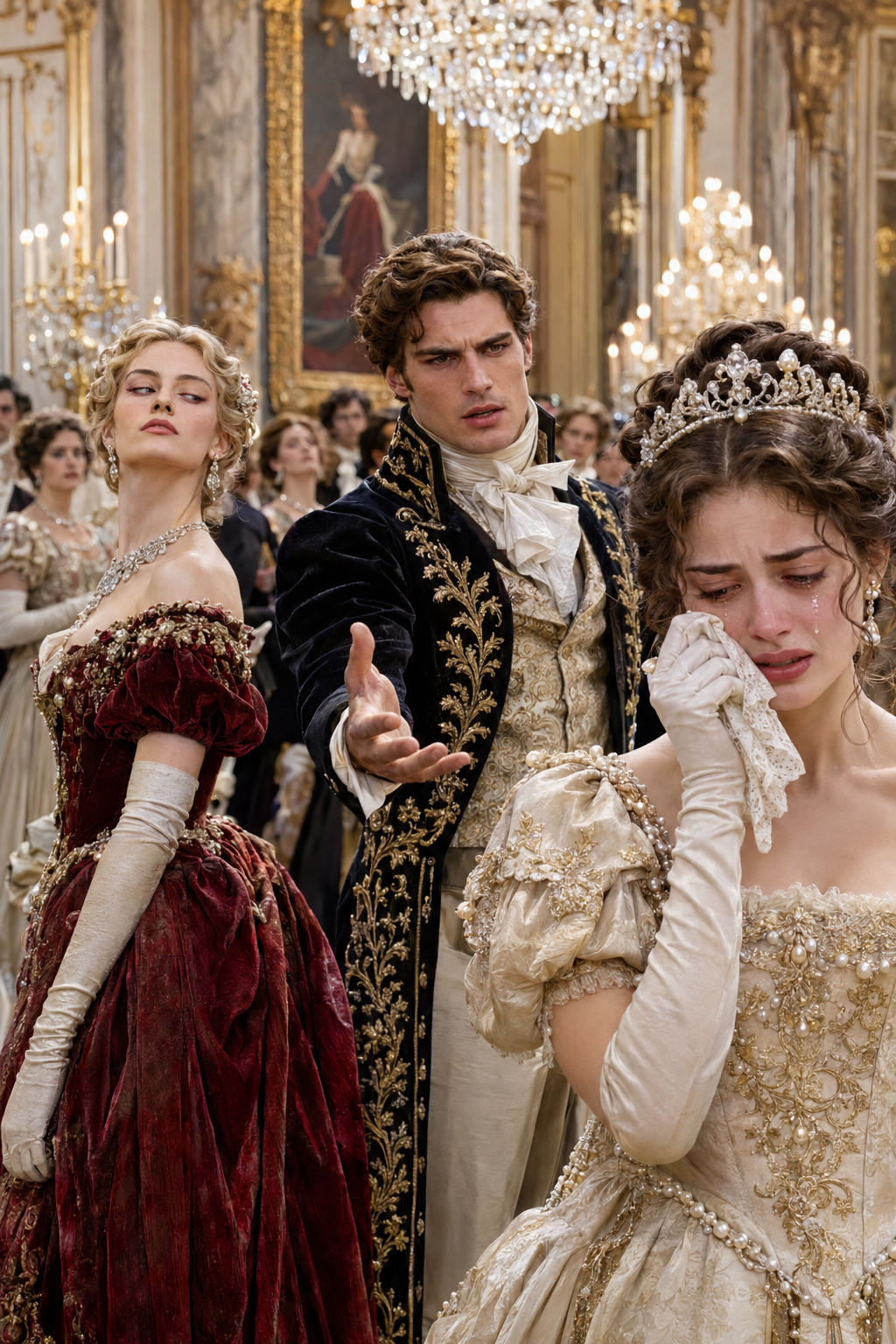
Sir Julian studied him.
“Are you telling me you offered property that you do not own?”
Nobody moved.
Beatrice suddenly stood.
“Edmund, you promised me this would be handled!”
Her voice was louder than she intended.
A woman near the end of the table gasped.
Edmund looked furious.
“Sit down, Beatrice.”
But she had already lost control.
“You told me Clara would sign whatever you placed before her!”
I turned toward her.
“Did he?”
Beatrice froze.
Edmund closed his eyes.
There it was. The first honest thing either of them had said all evening.
I reached into the small bag beside my chair and removed the letters I had taken from Edmund’s study.
“I believe these may help clarify the situation.”
Beatrice recognized the handwriting immediately.
“Those are private!”
“So were my marriage vows.”
I handed the correspondence to Mr. Whitmore.
He examined the letters before selecting one dated three weeks earlier.
With my permission, he read a passage in which Beatrice urged Edmund to obtain my signature on financial documents without explaining their contents.
Another letter discussed how quickly the debt could be settled once I was persuaded to surrender control of the farms.
Edmund sank into his chair.
Sir Julian’s expression hardened.
“You assured me your wife had agreed.”
“She would have,” Edmund muttered.
I stared at him.
“Would I?”
He looked away.
Beatrice suddenly pointed toward me.
“You have everything! Money, a title, a magnificent house. What difference would a few farms make to you?”
My father rose from his chair.
“Those farms support hundreds of people. Their livelihoods are not gambling money for irresponsible aristocrats.”
Beatrice’s face flushed.
“You have no idea what I’ve suffered.”
“Then explain it,” I said.
She hesitated before claiming that her late husband’s debts had left her with nothing. She spoke of cruel creditors, unpaid servants, and the fear of losing her home.
For a moment, I almost felt sorry for her.
Then Sir Julian opened his folder.
“Your late husband’s debts were settled shortly after his death. The money you owe me was borrowed afterward.”
He produced a record of her loans.
Expensive gowns. Jewelry. Gambling losses. A fashionable London residence she could not afford.
Her desperate circumstances were largely the result of choices she had made herself.
Beatrice looked around the table, searching for sympathy.
She found none.
Still, I had one final piece of evidence.
I unfolded the half-burned letter Margaret had recovered from the fireplace.
“Tell me, Beatrice. What did you intend to do once Edmund had paid your debts?”
She shook her head.
“I don’t know what you’re talking about.”
I handed the letter to Edmund.
He read the surviving lines.
His expression changed slowly.
The letter described a plan to persuade him that I was an unsuitable wife, encourage a permanent separation, and eventually secure Beatrice’s place in his household.
But the most revealing sentence was near the damaged edge.
Once he has served his purpose, I shall have no further need of his promises.
Edmund read it twice.
Then he looked at Beatrice.
“What does this mean?”
She reached for his arm.
“Darling, you must understand—”
“Don’t call me that.”
Her hand fell.
“You were going to leave me?”
Beatrice’s silence answered him.
I watched my husband discover, in front of the very people he had hoped to impress, that the woman he had chosen over me had been using him.
For the first time that evening, he looked genuinely heartbroken.
I had imagined that seeing him suffer might bring me satisfaction.
Instead, I felt strangely tired.
Seven years of loyalty had brought me to a dining table where my husband was grieving the dishonesty of another woman.
Not once had he stopped to consider what his own dishonesty had done to me.
Sir Julian gathered his documents.
“Lady Vale, your debt remains outstanding. My solicitor will contact you regarding the lawful recovery of the amount owed.”
Beatrice grabbed Edmund’s sleeve.
“You cannot abandon me!”
He pulled away.
“Get out.”
She stared at him.
“After everything we shared?”
“Leave my house!”
His voice echoed through the dining room.
Beatrice turned toward the door.
“Wait,” Eleanor said.
Everyone looked at her.
“The necklace.”
Beatrice instinctively covered the emeralds.
“Edmund gave them to me.”
“And they were never his to give.”
Eleanor explained that the jewels had been placed under the protection of a family trust. They could be worn by the Duchess of Harlow but could not be given away at Edmund’s pleasure.
Mr. Whitmore confirmed her statement.
Beatrice’s hands trembled as she struggled with the clasp.
Finally, she removed the necklace and placed it on the table.
Eleanor instructed a servant to arrange a carriage.
Beatrice left without another word.
No one followed her.
The banquet ended shortly afterward. Guests departed with quiet farewells, and several women stopped to squeeze my hand.
Lord Pembroke approached my father and apologized for having underestimated his contribution to the Harlow estate.
My father simply nodded.
When the last carriage disappeared down the driveway, Edmund asked to speak with me alone.
We entered the drawing room where, years earlier, he had promised to spend his life making me happy.
He poured himself a drink but did not touch it.
“Clara, I have made a terrible mistake.”
I sat beside the fireplace.
“Which one?”
He looked startled.
“The situation with Beatrice.”
“Only that?”
He rubbed his forehead.
“I was foolish. She manipulated me.”
“She certainly did. But she did not force you to humiliate me.”
He remained silent.
“She did not force you to give away the emeralds. She did not force you to offer my property to a moneylender. Those were your decisions.”
His eyes filled with tears.
“I thought you would understand.”
“I understood for seven years.”
I told him about the nights I had spent reviewing accounts while he attended parties. The letters I had written to creditors. The repairs I had funded after storms destroyed tenant cottages.
I reminded him of the winter when I had quietly sold several pieces of my own jewelry to pay the estate workers before Christmas.
He had purchased a new horse that same month.
“I never knew,” he whispered.
“You never asked.”
He knelt beside my chair.
“Please, Clara. Give me another chance. We can begin again.”
For years, I had wanted to hear those words.
But now that they had finally come, I realized he was asking for forgiveness because he had lost everything he thought he could gain.
“Would you be apologizing if Beatrice had truly loved you?”
He opened his mouth.
No answer came.
That silence settled the matter.
The following morning, Mr. Whitmore returned to discuss my options.
A formal divorce would be difficult, expensive, and damaging to both families. But a legal separation and an independent financial arrangement could protect my fortune and allow me to live apart from Edmund.
I chose separation.
Edmund would retain his title and the ancestral residence. He would also retain responsibility for his personal expenses and debts.
My properties and their income would remain under my control.
I agreed to provide a limited allowance for essential maintenance of the ancestral house, provided that every payment was properly accounted for.
The servants would receive their wages. The tenants would remain protected.
But Edmund’s extravagant lifestyle would no longer be my responsibility.
When he received the agreement, he became angry.
“You expect me to live on this?”
I looked at the figures.
“Hundreds of families manage on considerably less.”
“You’re treating me like a child.”
“No, Edmund. I am finally expecting you to behave like an adult.”
He signed three days later.
Before I left Harlow Hall, Eleanor visited my bedroom.
She carried a velvet box.
Inside lay the emerald necklace.
“These belong with you,” she said.
I gently closed the box.
“I think they should remain here.”
“Clara, you are still the Duchess.”
“I know. But I no longer need a necklace to remind me of my worth.”
Eleanor sat beside me.
“I owe you an apology.”
I took her hand.
“You helped me when it mattered.”
“I should have helped you sooner. I watched my son take advantage of your kindness because I was afraid of what confronting him might do to our family.”
Her voice broke.
“In protecting his reputation, I helped him become a man I could hardly recognize.”
We embraced.
It was the first time she had held me not as a daughter-in-law, but simply as a daughter.
I moved into a comfortable house overlooking the West Farms. Margaret came with me, along with several servants who freely chose to enter my employment.
For the first time in years, I woke without wondering which financial disaster awaited me.
My father visited often.
Together, we established a small school for the children of the estate workers. We repaired cottages, improved drainage across the farmland, and created an emergency fund for families facing illness or hardship.
I began meeting tenants personally.
One afternoon, an elderly farmer removed his hat and thanked me for saving his family’s home.
“My father worked this land,” he told me. “I thought my children would be the last.”
I assured him that no family would lose its home because of Edmund’s foolish decisions.
As I watched him return to his fields, I understood that protecting my fortune had never been about becoming richer.
It was about deciding what my resources could accomplish.
News of Beatrice reached me several months later.
Her expensive belongings had been sold to satisfy part of her debts. She had moved into modest accommodations and was living under strict financial arrangements.
Eventually, she sent me a letter asking for money.
She claimed she had learned her lesson.
I declined her request for cash but arranged for a respectable employment agency to help her find suitable work.
She never replied.
Edmund’s transformation took considerably longer.
At first, he complained bitterly about his reduced circumstances. He sold several horses, dismissed unnecessary personal attendants, and stopped entertaining lavishly.
Then something unexpected happened.
Without my money available to rescue him, he began learning how to manage what remained.
He attended meetings with estate managers. He reviewed bills. He discovered how much it actually cost to maintain the house he had once considered proof of his importance.
Eleanor wrote to me occasionally about his progress.
I was pleased, but I did not return.
Nearly two years after the banquet, Edmund visited my home.
He arrived without expensive gifts or dramatic declarations.
He looked older. His clothes were simpler, and his manner was quieter.
We walked through the gardens before sitting beneath an apple tree.
“I came to thank you,” he said.
“For what?”
“For refusing to save me again.”
I studied his face.
He explained that he had spent much of his life believing his title made him more important than other people. He had considered my father’s merchant fortune beneath him, even while depending upon it.
He had mistaken privilege for achievement.
“I cannot undo what I did,” he continued. “But I finally understand that you deserved a husband who respected you.”
I appreciated hearing those words.
They did not erase the past, but they allowed me to remember it without the same bitterness.
“Do you think you could ever forgive me?” he asked.
“I already have.”
Hope appeared in his eyes.
“But forgiveness does not mean returning to the life I left.”
He lowered his head.
After a moment, he nodded.
“I understand.”
And this time, I believed him.
We parted peacefully that afternoon.
Years passed, and the West Farms flourished. The little school grew into a larger building, and several of its earliest students eventually became teachers, nurses, and successful business owners.
Margaret married a kind man and remained one of my closest friends.
My father lived long enough to see the prosperity we had created together.
As for Eleanor, she spent many happy afternoons at my home, telling stories and watching the children play beyond the garden walls.
One autumn evening, she brought the velvet box containing the emeralds again.
This time, she had a different suggestion.
With the family’s agreement and the necessary legal arrangements, the jewels were eventually sold, and their proceeds established an educational fund for girls from families who could not afford further schooling.
The necklace that had once been used to humiliate me became an opportunity for young women to build independent lives.
I could think of no better purpose for it.
At the opening of a new classroom funded by those emeralds, a little girl approached me holding a book against her chest.
“Your Grace,” she asked, “were you always brave?”
I smiled.
“No, sweetheart. For a long time, I was afraid.”
“Of what?”
“Of disappointing people. Of being alone. Of discovering that someone I loved did not love me in the same way.”
She considered my answer.
“What made you stop being afraid?”
I looked toward the fields, where families were returning home beneath the golden evening sky.
“I learned that being kind does not mean allowing people to hurt you. And loving someone does not mean giving them permission to destroy your happiness.”
She smiled and ran back to her classmates.
I remained beside the classroom window for a while, listening to their laughter.
Once, I had believed that my greatest achievement was saving the Harlow estate.
I had been wrong.
My greatest achievement was learning that I could protect others without sacrificing myself.
Edmund had inherited a title, Beatrice had chased a position, and both had believed that wealth could purchase importance.
But genuine dignity was never something that could be inherited, borrowed, or worn around one’s neck.
It came from the choices we made when nobody could force us to do the right thing.
I had entered that autumn banquet as a woman whose loyalty was taken for granted.
I had left it knowing that loyalty without respect becomes a burden, generosity without boundaries invites exploitation, and forgiveness without accountability changes nothing.
I did not need revenge to reclaim my happiness.
I needed the courage to stop paying the price for someone else’s choices.
And when I finally stopped trying to save a marriage that was destroying my peace, I discovered how much good I could do with the life I had saved instead.
Ten years after the autumn banquet, I received a letter that brought the past back to my doorstep.
It was from Beatrice.
I recognized her handwriting immediately, although the elegant curves had become uneven.
She was living in a small village near the coast, where she earned her living making dresses and repairing clothing.
She was no longer asking for money.
Instead, she was asking for forgiveness.
“Dear Clara,” the letter began, “I spent years believing that women like us were enemies competing for the same things. I thought your happiness had been stolen from me, when in truth, I was destroying my own.”
She admitted that losing everything had forced her to confront the person she had become.
For the first time in her life, she understood the satisfaction of earning an honest living.
At the bottom of the letter, she had written something that surprised me.
“I cannot expect you to forgive me. But I hope the life I have built since then proves that I am no longer the woman who sat in your chair.”
I read the letter beside my bedroom window.
Then I took out a fresh sheet of paper.
“Dear Beatrice, I forgave you long ago. I hope you will eventually learn to forgive yourself. What matters now is what you choose to do with the years ahead.”
I sent the reply that afternoon.
There was nothing more that needed to be said.
Several months later, Eleanor became seriously ill.
Edmund sent a carriage for me, and I returned to Harlow Hall for the first time in years.
The familiar rooms seemed smaller than I remembered. The grand staircase, the expensive paintings, and the magnificent dining room no longer held any power over me.
Edmund met me at the entrance.
“She’s been asking for you.”
I hurried upstairs.
Eleanor was resting beneath a thick blanket. When she saw me, her tired face brightened.
“My dear girl.”
I sat beside her and held her hand.
For several hours, we talked about the school, the farms, and the young women whose education had been funded by the emeralds.
Then she asked Edmund to come closer.
“I want you both to hear something.”
He sat on the opposite side of her bed.
“This family spent generations believing that its greatest treasure was its name. We were wrong.”
She turned toward me.
“Our greatest treasure was the woman who taught us what that name should stand for.”
Edmund lowered his head.
Eleanor passed away peacefully two days later, with both of us beside her.
At her funeral, hundreds of tenants gathered outside the church. Many had benefited from her quiet generosity during the final years of her life.
Edmund stood beside me as the church bells rang.
“She was proud of you,” he said.
“I was proud of her, too.”
After the funeral, Edmund invited me to walk through the gardens.
He told me that he had revised his will and made arrangements to support the school after his death.
He had also established a fund for elderly estate workers who could no longer earn a living.
“I should have done these things years ago,” he admitted.
“Doing them now still matters.”
He smiled sadly.
“You always knew how to make something worthwhile out of what remained.”
Before I departed, he asked whether I regretted marrying him.
I considered the question carefully.
“I regret the years I spent believing that your happiness was more important than my own. But I don’t regret the woman I became afterward.”
He accepted my answer without argument.
It was perhaps the most respectful conversation we had ever shared.
As the years continued, my hair turned silver, and walking across the West Farms became more difficult.
Yet every morning, I could hear the school bell from my garden.
One spring afternoon, a young woman arrived at my house carrying a medical bag.
She introduced herself as Elizabeth Carter.
I immediately recognized her.
She was the little girl who had once asked me whether I had always been brave.
“Your Grace, I qualified as a physician last month.”
For a moment, I could not speak.
She explained that the educational fund had paid for much of her schooling. She had returned to establish a medical practice serving families who could not afford expensive treatment.
“I wanted you to be the first person I told.”
I embraced her with tears in my eyes.
Of all the things my father’s fortune had purchased, nothing had ever seemed more valuable than that moment.
Elizabeth eventually opened her practice near the school. Other former students returned as teachers, nurses, and business owners.
The opportunities they received became opportunities they offered to others.
What began with one woman’s refusal to surrender her property had grown into something far greater than I could have imagined.
On my seventieth birthday, the villagers organized a celebration in the school courtyard.
Children decorated the entrance with flowers. Families brought homemade cakes, and former students traveled from distant towns to attend.
Above the entrance hung a newly carved wooden sign.
THE CLARA HARLOW SCHOOL.
I stood before it, overwhelmed.
Elizabeth approached me with a smile.
“We thought it was time the school carried the name of the woman who made it possible.”
I looked at the faces surrounding me.
There were no emeralds around my neck. No expensive silk gown. No grand banquet table at which I needed to defend my place.
Yet I had never felt richer.
That evening, I returned home and opened an old wooden chest containing the documents from my marriage.
Among them were the original deeds to the West Farms.
I remembered the frightened young woman who had purchased those properties to save her husband’s family.
She had believed that if she gave enough, sacrificed enough, and remained patient enough, she would eventually earn the love she deserved.
I wished I could have told her that love was never supposed to be something she had to purchase.
I placed the deeds beside my final will, which ensured that the farms would continue supporting the community long after I was gone.
Then I closed the chest.
Outside, the sun was setting over the fields.
Children were laughing on their way home, and smoke rose gently from the cottages I had once fought to protect.
I thought about Edmund, Beatrice, Eleanor, and my father.
Each had taught me something different about human nature.
My father had taught me the value of honest work.
Eleanor had taught me that admitting a mistake was an act of courage.
Beatrice had taught me how dangerous envy could become.
And Edmund had taught me the importance of never surrendering my self-respect in exchange for affection.
I carried no hatred toward any of them.
Life was too precious to spend its final chapters arguing with the past.
The greatest victory of my life had not been watching those who betrayed me lose everything.
It had been building something beautiful after they were gone.
People often remembered the autumn banquet as the night a duke lost control of his fortune.
I remembered it differently.
It was the night a woman finally understood that her life belonged to her.
And because she found the courage to reclaim it, generations of young women would grow up knowing that their lives belonged to them, too.
That was my true inheritance.
Not a title.
Not a mansion.
Not a necklace of priceless emeralds.
But a legacy of dignity, independence, and kindness that no one could ever take away.
And at last, I was truly at peace.
THE END.