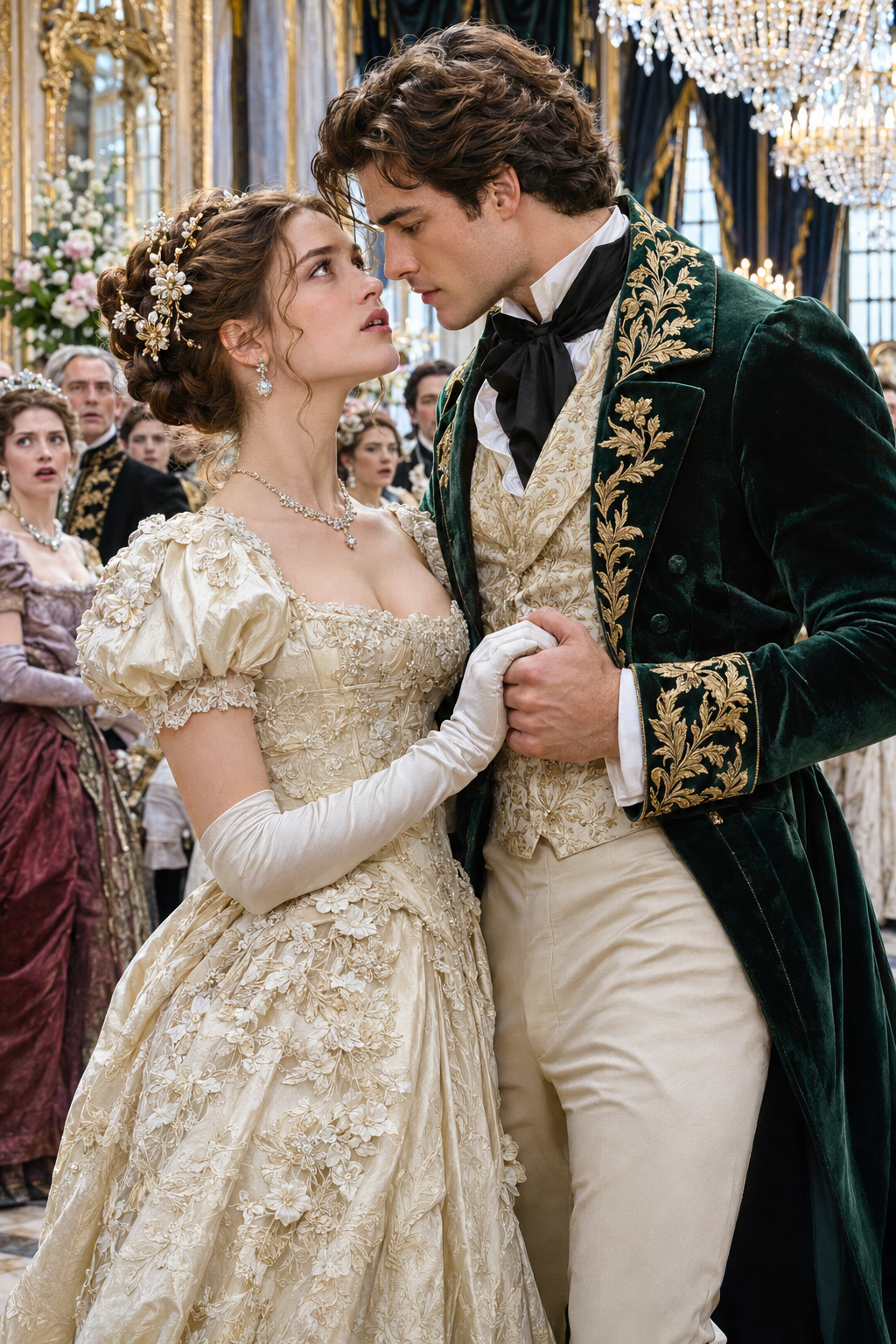
My aunt punished me for embarrassing a wealthy lord by forcing me to dance with the most feared man in the ballroom. She expected him to put me in my place.
I waited for Sebastian to continue, but he seemed to be searching for the right words. His fingers tightened around mine, and for the first time since we met, the Duke of Blackmore looked genuinely afraid.
“Four years ago, I was engaged to Lady Eleanor Whitmore,” he began. “Our families approved of the arrangement. Everyone believed we were perfectly suited for each other.”
“Were you?”
“I believed we were. Unfortunately, I was the only one who believed it.”
He released my hand and walked toward the fireplace.
“Three weeks before our wedding, I discovered that Eleanor was in love with another man. His name was Lord Adrian Caldwell. He had been one of my closest friends since childhood.”
I felt a sharp pain in my chest.
“Did she tell you herself?”
“No. I received a letter intended for Adrian. A servant delivered it to me by mistake.”
Sebastian stared into the flames.
“I confronted Eleanor privately. I offered to release her from our engagement without damaging her reputation. I even suggested that we announce the decision as mutual.”
“That sounds remarkably generous.”
“She refused. Her father was deeply in debt, and marrying me would have saved her family from financial ruin. She wanted my title, my fortune, and Adrian’s affection.”
“And the duel?”
His expression darkened.
“Adrian challenged me after learning that I intended to end the engagement. He accused me of destroying Eleanor’s future. During our argument, he struck me in front of several witnesses.”
“Surely you had every right to defend yourself.”
“Perhaps. But pride is a dangerous thing, Vivienne. I accepted his challenge when I should have walked away.”
Adrian had survived the duel, Sebastian explained, but his injury had left him with a permanent weakness in his right arm. Eleanor’s family blamed Sebastian for everything. They claimed he had become violently jealous over an innocent friendship.
“And you allowed them to spread those lies?”
“Exposing Eleanor would have destroyed her reputation. I thought remaining silent was the honorable choice.”
I shook my head.
“Protecting someone from embarrassment is one thing. Allowing them to destroy your life is another.”
Sebastian turned toward me.
“Do you think differently of me now?”
“Yes.”
His face fell.
“I think you’re considerably more foolish than I originally believed.”
He blinked.
“You sacrificed your happiness to protect people who had already betrayed you. That was foolish, Sebastian. But it does not make you cruel.”
For several seconds, he said nothing.
Then he crossed the room and pulled me into his arms.
I could feel his heart beating beneath his coat.
“I had prepared myself for you to leave,” he whispered.
“You should know by now that I rarely do what people expect.”
He laughed softly, although his eyes were suspiciously bright.
That evening, something changed between us. Until then, our courtship had been filled with laughter, thoughtful conversations, and a growing affection neither of us had fully acknowledged.
Now there was trust.
At least, I believed there was.
Three days later, my aunt received an invitation to a grand dinner hosted by the Countess of Wexford. Nearly every influential family in London would attend.
Sebastian had also been invited.
My aunt was delighted.
“You must wear the blue silk,” she announced. “And please, Vivienne, try to behave like a woman who may soon become a duchess.”
“I wasn’t aware that duchesses were forbidden from speaking.”
“They are expected to know when silence is appropriate.”
“How fortunate that Sebastian appreciates conversation.”
She closed her eyes as though asking heaven for patience.
The evening began pleasantly enough. Sebastian greeted me at the entrance, complimented my dress, and remained beside me throughout the first hour.
Then I noticed a beautiful woman watching us from across the room.
She wore a pale silver gown, and her dark hair was decorated with pearls. Several gentlemen surrounded her, but her attention remained fixed on Sebastian.
“Who is that?” I asked.
Sebastian followed my gaze.
His entire body became still.
“Eleanor.”
Before I could respond, she began walking toward us.
“Sebastian,” she greeted him warmly. “How wonderful to see you again.”
“Lady Eleanor.”
Her eyes moved toward me.
“And this must be Miss Ashcraftoft. I’ve heard so much about you.”
“How interesting. I only recently heard about you.”
Sebastian cleared his throat.
Eleanor smiled, but something in her expression changed.
“I hope Sebastian has been treating you well. He can be rather difficult when things don’t go according to his wishes.”
“I haven’t found that to be a problem.”
“Not yet, perhaps.”
She touched Sebastian’s sleeve.
“Would you excuse us for a moment? There are some private matters I would like to discuss with him.”
Sebastian stepped away from her hand.
“Anything you wish to say may be said in front of Miss Ashcraftoft.”
Her smile vanished.
“Very well. Adrian has returned to London.”
Sebastian’s jaw tightened.
“He intends to attend the Harrington ball next week,” she continued. “I thought you deserved a warning.”
“I require no warning.”
“Perhaps not. But your young companion might appreciate knowing what happens when old disagreements are reopened.”
She excused herself before either of us could answer.
I watched her disappear into the crowd.
“What a charming woman,” I muttered.
Sebastian did not laugh.
“Vivienne, I would prefer that you avoid her.”
“Because she’s dangerous?”
“Because she has a talent for turning innocent situations into scandals.”
“Then perhaps she should avoid me.”
He looked at me with obvious concern.
“I mean it.”
“So do I.”
Over the following days, rumors began spreading through London.
Some claimed Sebastian was courting me merely to make Eleanor jealous. Others suggested he had never recovered from their broken engagement.
One particularly ridiculous story claimed I had been promised a large allowance in exchange for marrying him.
My aunt was horrified.
“You cannot allow people to speak about you this way!”
“Would you prefer that I visit every household in London and correct them personally?”
“This is not amusing.”
“No, it isn’t. But it would be considerably less unpleasant if people minded their own affairs.”
The worst rumor arrived two days before the Harrington ball.
According to several ladies, Sebastian had supposedly threatened Adrian again.
My aunt begged me to withdraw from the courtship until the matter was settled.
I refused.
However, when Sebastian visited that afternoon, he surprised me by suggesting the very same thing.
“Perhaps we should postpone our public appearances together,” he said.
“Why?”
“Your reputation is suffering.”
“My reputation has survived twenty-three years of my personality. I imagine it can survive another week.”
“This is different.”
“Because you are involved?”
“Because I care about you.”
His voice rose unexpectedly.
“I know what these people are capable of. I cannot stand by and watch them punish you for being associated with me.”
I stared at him.
“And your solution is to abandon me before they have the opportunity?”
“That is not what I meant.”
“Then explain what you mean.”
He looked away.
“I thought giving you some distance might protect you.”
“Sebastian, you cannot build a relationship with someone while constantly preparing for them to disappear.”
He remained silent.
“If you no longer wish to court me, tell me honestly. But do not make that decision on my behalf and call it kindness.”
He looked genuinely wounded.
“I have never wanted anything more than I want you.”
The confession escaped him so suddenly that we both froze.
He took a deep breath.
“I simply don’t know how to keep you without exposing you to everything I have spent years trying to escape.”
I moved closer.
“You keep me by trusting me.”
He lowered his forehead against mine.
“I am trying.”
“Then try a little harder.”
When the evening of the Harrington ball arrived, we entered together.
The conversations around us became noticeably quieter.
I could feel people staring, but Sebastian held my arm with quiet determination.
We had barely reached the center of the ballroom when a gentleman approached us.
He was handsome, elegantly dressed, and carried himself with the confidence of someone accustomed to being admired.
His right arm remained unusually stiff at his side.
I knew immediately who he was.
“Blackmore,” he said.
“Caldwell.”
Adrian looked at me.
“So this is the unfortunate young lady everyone has been discussing.”
“Unfortunate?” I repeated.
“I meant no offense.”
“Then you should choose your words more carefully.”
A few nearby guests turned toward us.
Adrian laughed.
“Eleanor mentioned that you were outspoken.”
“And yet you still decided to approach me. How brave.”
Sebastian placed a gentle hand against my back.
“We have nothing to discuss, Caldwell.”
“Don’t we? I thought Miss Ashcraftoft might appreciate hearing both sides of our little disagreement.”
“You have had four years to tell your side.”
“And you have had four years to hide behind your title.”
The atmosphere changed immediately.
Guests began gathering around us.
Eleanor appeared beside Adrian, looking distressed in a way that seemed carefully rehearsed.
“Please, Adrian,” she said. “We agreed not to cause a scene.”
“I’m merely concerned for the young lady.”
He looked directly at me.
“Do you know that the man beside you nearly killed me because he couldn’t accept that Eleanor preferred another gentleman?”
“I know that you challenged him to a duel.”
His expression faltered.
“Is that what he told you?”
“Yes.”
“And naturally, you believed him.”
“I generally believe people until they give me a reason not to.”
Adrian’s smile became cold.
“Then perhaps you should ask him why Eleanor was so desperate to escape their engagement.”
Sebastian stepped forward.
“Enough.”
Adrian appeared delighted by his reaction.
“There he is. The real Duke of Blackmore.”
I suddenly understood what was happening.
Adrian wanted Sebastian to lose his temper. One angry response would confirm every ugly rumor they had spread.
I stepped between them.
“Lord Caldwell, may I ask you something?”
“Certainly.”
“If Sebastian was such a terrible man, why did Lady Eleanor refuse his offer to release her from their engagement?”
Eleanor’s face went pale.
Adrian stared at me.
“That’s absurd.”
“Is it?”
I turned toward Eleanor.
“Did he offer to end the engagement privately?”
She glanced around the ballroom.
“This is hardly an appropriate conversation.”
“Neither is publicly accusing a man of violence while deliberately provoking him.”
Someone behind me murmured in agreement.
Eleanor’s composure began to crumble.
“You know nothing about what happened.”
“Then correct me.”
She opened her mouth, but no words came.
Adrian reached for her arm.
“We needn’t entertain this nonsense.”
A voice interrupted him.
“Actually, I believe you should.”
An elderly gentleman stepped out of the gathering crowd. Sebastian recognized him immediately.
“Sir Edmund.”
Sir Edmund Fairfax had been a close friend of Sebastian’s late father. More importantly, he had served as a witness during the dispute between Sebastian and Adrian.
“I have remained silent for years,” Sir Edmund announced. “At Blackmore’s request. But I cannot continue watching an honorable man’s name dragged through the mud.”
Adrian’s face changed.
“Sir Edmund, I suggest you remember your position.”
“I remember it perfectly. I also remember delivering the duke’s written offer to release Lady Eleanor from her engagement.”
The ballroom became completely silent.
Sir Edmund turned toward Eleanor.
“You refused that offer. You insisted the wedding proceed, despite your attachment to Lord Caldwell.”
Eleanor began trembling.
“You promised never to discuss that letter.”
“I promised to respect the duke’s wishes. I did not promise to support your lies.”
Adrian attempted to interrupt, but Sir Edmund continued.
“And as for the duel, I witnessed your challenge, Caldwell. Blackmore offered you an opportunity to withdraw. You refused.”
A wave of whispers passed through the room.
Sebastian stood motionless beside me.
For four years, he had carried the weight of accusations he could have disproved. Now, without raising his voice or lifting a hand, he was finally hearing someone defend him.
Eleanor’s eyes filled with tears.
“You don’t understand,” she whispered. “My father would have lost everything.”
Sebastian looked at her.
“I understood your circumstances, Eleanor. That was why I protected you.”
“Then why are you allowing this?”
“Because protecting you should never have required me to spend the rest of my life ashamed of something I did not do.”
She lowered her head.
Adrian stormed out of the ballroom. Eleanor followed moments later, leaving behind a room filled with uncomfortable silence.
Sebastian thanked Sir Edmund quietly.
Then he turned toward me.
“Would you care to dance?”
I looked around at the astonished guests.
“Now?”
“Especially now.”
I accepted his hand.
As we moved across the ballroom, I noticed my aunt standing near the musicians. Her mouth was slightly open, and for once, she appeared incapable of offering criticism.
Sebastian drew me closer.
“You realize you have just made yourself the subject of every conversation in London.”
“I was beginning to worry people had forgotten about me.”
He laughed.
And this time, there was no sadness behind it.
Two days later, Sebastian invited me to visit Blackmore Hall with my aunt.
The estate was magnificent, but what surprised me most was how peaceful it felt. The housekeeper greeted Sebastian with genuine affection, and the gardeners spoke to him without fear.
Children from the nearby village waved as our carriage passed.
This was not the home of a cruel, bitter man.
It was the home of someone who had quietly built a meaningful life away from the judgment of society.
Sebastian showed me his library, the gardens, and a small schoolhouse he had helped establish for the children of his tenants.
“You never mentioned any of this,” I said.
“I didn’t think it was particularly interesting.”
“Helping children learn to read is considerably more interesting than listening to Lord Peton discuss imaginary hunting adventures.”
He smiled.
Later that afternoon, we walked through the rose garden alone.
Near an old stone fountain, Sebastian stopped.
“Vivienne, there is something I have wanted to ask you for several weeks.”
“Another dangerous question?”
“The most dangerous one yet.”
He reached into his coat and withdrew a small velvet box.
Inside was a beautiful ring set with a deep blue sapphire.
“It belonged to my mother,” he explained. “She believed marriage should be a partnership between two people who could be entirely themselves in each other’s company.”
His voice became unsteady.
“I cannot promise you a life without difficulties. I cannot promise that society will always approve of us. And I suspect we will disagree about a great many things.”
“Almost certainly.”
“But I can promise never to ask you to become someone else.”
He lowered himself onto one knee.
“Vivienne Ashcraftoft, would you do me the extraordinary honor of becoming my wife?”
For once, I found myself struggling to speak.
I had spent years believing marriage would require me to surrender the very qualities that made me who I was.
Yet here was a man asking me to marry him because of those qualities.
“Yes,” I whispered.
His eyes widened.
“Yes?”
“Good heavens, Sebastian. Don’t make me repeat myself before I change my mind.”
He stood, slipped the ring onto my finger, and kissed me.
When we returned to the house, my aunt noticed the ring immediately.
She sat down rather abruptly.
“I suppose congratulations are in order.”
“Thank you, Aunt Helena.”
She looked between us.
“I never imagined that dance would lead to this.”
“Neither did I.”
After a long pause, she took my hand.
“Vivienne, I owe you an apology.”
I nearly dropped my gloves.
“I have spent years trying to teach you how to be accepted,” she continued. “I thought that was the best way to secure your future. Perhaps I should have been more concerned with whether you were happy.”
I squeezed her hand.
“You were trying to protect me.”
“Yes. Although I suspect I occasionally made a terrible mess of it.”
“Occasionally?”
She gave me a stern look before laughing.
Sebastian watched us with a smile.
We married three months later in the small church near Blackmore Hall.
I wore my mother’s pearls, and Aunt Helena cried throughout the ceremony while insisting afterward that something had irritated her eyes.
Sir Edmund attended, along with several friends who had stood beside Sebastian when few others would.
Lord Peton was not invited.
I considered that my wedding gift to myself.
Marriage did not magically turn Sebastian and me into perfect people. He still had a habit of retreating into silence when something troubled him. I still occasionally spoke before considering the consequences.
But we learned.
When we disagreed, we talked. When we hurt each other, we apologized. Neither of us used silence as punishment or affection as a reward for obedience.
Blackmore Hall gradually became a lively home filled with books, music, laughter, and visitors who were welcome regardless of their social importance.
I helped expand the village school, arranging lessons for girls whose families had previously believed education was unnecessary.
Sebastian supported the idea without hesitation.
Years later, our eldest daughter came home from a gathering in tears because another girl had called her difficult.
“Perhaps I should learn to be quieter,” she said.
Sebastian looked at me across the dinner table.
I sat beside her.
“Being honest does not mean you must be unkind,” I explained. “And being kind does not mean you must pretend. Learn the difference, darling, but never make yourself smaller simply because someone finds your courage inconvenient.”
She considered my words before climbing into her father’s lap.
“Was Mother difficult when you met her?”
Sebastian smiled.
“Wonderfully difficult.”
“Did you love her immediately?”
“I certainly knew I wanted another dance.”
That evening, after the children had gone to bed, Sebastian and I stood on the terrace overlooking our gardens.
He wrapped his arms around my waist.
“Do you ever regret embarrassing Lord Peton?”
“Not for a single moment.”
“Even though it resulted in a rather severe punishment?”
I turned toward him.
“The best punishment I ever received.”
He kissed my forehead.
Looking back, I realized that my aunt’s greatest mistake had given me my greatest blessing.
She had believed happiness depended on learning how to please the right people. Sebastian had spent years believing that peace depended on hiding his pain and accepting the judgment of others.
We had both been wrong.
True happiness came when we stopped allowing other people’s expectations to determine our worth.
There will always be someone who misunderstands you. Someone who criticizes your choices, questions your character, or expects you to become more convenient for their comfort.
But you do not owe the world a false version of yourself.
You owe yourself the courage to live honestly, the humility to admit when you are wrong, and the wisdom to recognize those who love you without demanding that you disappear.
My aunt had sent me across a crowded ballroom to teach me a lesson.
And she succeeded, although not in the way she intended.
I learned that the right person will never require you to earn love by surrendering your identity.
Sometimes, the very thing the world considers your greatest flaw is the reason someone finally sees you clearly.
And sometimes, what begins as a punishment becomes the most beautiful chapter of your life.
Many years later, Aunt Helena came to live with us at Blackmore Hall.
Age had softened her sharp tongue, although she still insisted that my dinner arrangements lacked proper elegance and that Sebastian allowed the children far too much freedom.
One winter evening, I found her sitting beside the fireplace, watching our youngest daughter teach a servant’s child how to read.
“Your mother would have been proud of you,” she said unexpectedly.
I lowered my embroidery.
“You rarely speak about her.”
“Because you remind me so much of her. She was fearless, stubborn, and terribly inconvenient whenever someone behaved dishonestly.”
“Then I suppose it runs in the family.”
Helena smiled, but tears gathered in her eyes.
“When your parents died, I promised myself that nothing would ever happen to you. I thought respectability would keep you safe. I never considered how lonely you might become trying to satisfy everyone.”
I moved beside her and took her hand.
“You gave me a home when I needed one. I have never forgotten that.”
“Even after everything I put you through?”
“Even after that dreadful blue dress you insisted I wear.”
She laughed through her tears.
That was the last winter we spent together.
When she passed away peacefully the following spring, I discovered a letter among her belongings addressed to Sebastian.
He opened it in our bedroom while I stood beside him.
Inside, she had written only a few sentences.
“Dear Sebastian, thank you for loving Vivienne in all the ways I was too frightened to understand. I once believed you were the worst possible gentleman for her. How fortunate that I was wrong.”
Sebastian folded the letter carefully and placed it inside his desk.
Neither of us spoke for a long time.
Life continued, as it always does.
Our children grew older. The village school expanded. Blackmore Hall became a place where young people gathered to exchange ideas, where disagreements were welcomed, and where no guest was expected to pretend to be someone they were not.
One afternoon, an unexpected visitor arrived.
It was Eleanor.
Her beauty had changed with the years, and the confidence she once carried so effortlessly had disappeared.
“I came to apologize,” she told Sebastian.
Adrian had eventually abandoned her, and she had spent years living with the consequences of choices she once believed would secure her happiness.
“I envied you both,” she admitted. “Not your fortune or your position. I envied the way you looked at each other.”
Sebastian listened without interrupting.
“I cannot change what happened,” she continued. “But I hope you can forgive me.”
He nodded gently.
“I forgave you a long time ago, Eleanor. I simply chose not to carry what happened into the rest of my life.”
Before she left, I invited her to stay for tea.
She looked surprised.
“After everything I did?”
“An apology cannot change yesterday,” I replied. “But it can change what happens tomorrow.”
She accepted.
It was then that I understood how much Sebastian and I had grown. We no longer needed anyone to suffer for us to feel that justice had been served. Our happiness was enough.
On our thirtieth wedding anniversary, our children arranged a celebration in the ballroom at Blackmore Hall.
Sebastian’s hair had turned silver, and my reflection no longer resembled the outspoken young woman who had embarrassed Lord Peton all those years ago.
But when the musicians began playing, Sebastian approached me with the same quiet confidence I remembered from our first meeting.
“Miss Ashcraftoft,” he said, bowing formally. “Would you honor me with this dance?”
“I’m afraid my husband might object.”
“Is he a jealous man?”
“Only when someone takes the last piece of his favorite cake.”
He laughed and offered his hand.
Our children watched as we moved slowly across the ballroom.
“Do you remember what you told me during our first dance?” he asked.
“That my aunt considered you a punishment?”
“Yes.”
“I’m afraid I was terribly mistaken.”
He smiled.
“And what would you call me now?”
I looked at the man who had stood beside me through every joy, disappointment, disagreement, and loss.
“My greatest unexpected happiness.”
His eyes filled with tears.
He kissed my hand as the music ended, and our children applauded.
I rested my head against his shoulder, wishing that moment could last forever.
Of course, nothing lasts forever. Children leave home, seasons change, and even the strongest hands eventually grow weak.
But a life built on genuine love leaves something behind that time cannot easily erase.
Our children learned to choose kindness without surrendering their courage. They learned that forgiveness did not require forgetting, that honesty carried responsibility, and that love was never an excuse to control another person’s life.
Those lessons became more valuable to us than any title, fortune, or grand estate.
And whenever someone asked how the feared Duke of Blackmore had fallen in love with his outspoken wife, Sebastian always gave the same answer.
“She was the first person who spoke to me without wanting something from me. And I was fortunate enough to recognize what that was worth.”
As for me, I never forgot the frightened young woman standing beside her aunt in that crowded ballroom, convinced she was about to endure the most miserable dance of her life.
If I could speak to her now, I would tell her not to be afraid.
I would tell her that some of life’s greatest blessings arrive disguised as disappointments.
That rejection can redirect us toward something better.
That being misunderstood by many people matters far less than being truly understood by the right one.
And that the greatest love stories are not about finding someone perfect.
They are about finding someone with whom you can be imperfect, honest, vulnerable, and still deeply loved.
My aunt once believed that dancing with Sebastian would teach me to keep my mouth shut.
Instead, that dance gave me a husband who listened, a family that valued honesty, and a lifetime of happiness I never could have imagined.
And if I were given the chance to live my life all over again, I would embarrass Lord Peton, endure my aunt’s anger, and cross that ballroom without a moment’s hesitation.
Because waiting on the other side was the man who would become my home.
The End.