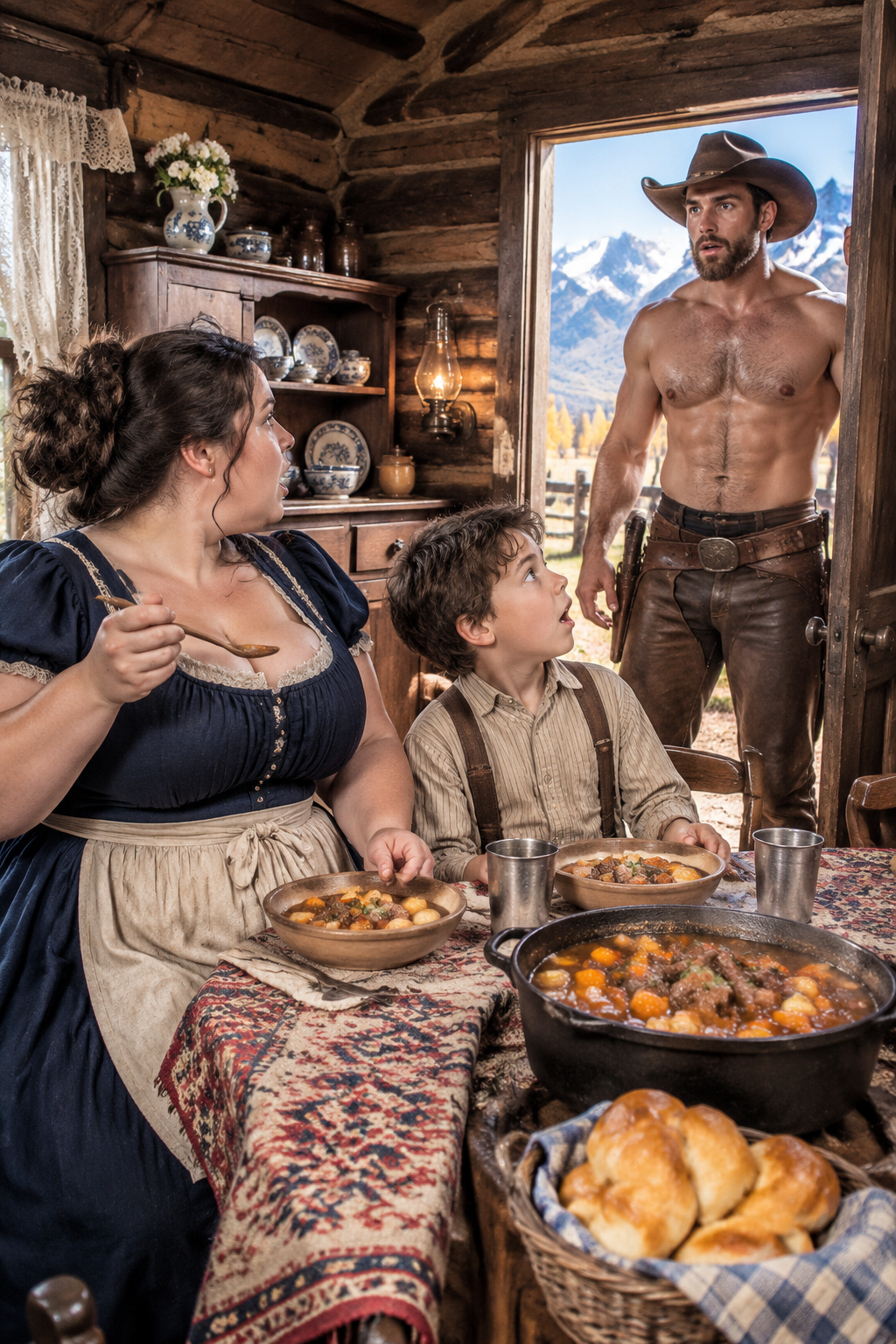
Mason Hart came home to his Montana ranch expecting silence. Instead, he heard his eight-year-old nephew laughing with a woman he barely knew—and something about it made him uneasy.
Mason stared at the folded paper lying between him and Emma. For several seconds, neither of them spoke.
The handwriting was unmistakable. His father had written those words with the same heavy strokes Mason remembered from childhood.
“Where did you get this?” Mason finally asked.
Emma took a slow breath.
“Sarah gave it to me two weeks ago. She found it inside an old box in your father’s bedroom. She didn’t know what it meant, but she thought it might be important.”
Mason unfolded the paper carefully.
It was a letter addressed to Arthur Voss.
His father’s name appeared at the bottom, followed by a date from nearly twenty years earlier.
Mason read the first few lines.
Then his expression changed.
“Why would my father write to that man?”
Emma folded her hands.
“I think you should read the whole thing before deciding what it means.”
Mason continued.
The letter wasn’t a business agreement or a friendly message. It was a warning.
His father had accused Arthur Voss of attempting to pressure several local ranchers into selling their land. Some had been struggling with loans. Others had inherited property they could no longer afford to maintain. Arthur had offered them money, but the agreements contained conditions that would eventually give him control of their land.
Mason felt his stomach tighten.
He remembered Arthur’s name. Everyone in the county did. Voss owned several large properties and had a reputation for finding opportunities whenever someone was desperate.
The letter ended with a sentence that made Mason read it twice.
“If anything happens to me, make sure my family never loses the land that generations before us worked so hard to protect.”
Mason lowered the paper.
“What does this have to do with Emma?”
She looked down.
“Nothing at first. I was hired to help Sarah and Noah. But when I heard Arthur was asking about the ranch, I started paying attention.”
“Why?”
“Because I’ve seen what he does to families who don’t have anyone standing beside them.”
Mason leaned back.
He wanted to believe her. But too many questions remained.
“How do you know so much about him?”
Emma hesitated.
“Because my father lost his ranch to him.”
The words settled heavily in the room.
Mason studied her face.
Emma explained that her family had once owned a small cattle ranch outside a nearby town. When her father became ill, medical bills and missed payments put them behind financially. Arthur Voss had appeared with an offer to help.
At first, everything seemed reasonable.
Then the interest increased, the deadlines changed, and the legal documents became impossible to understand. By the time her father realized what had happened, they had lost the property.
“He spent the rest of his life believing he had failed us,” Emma said quietly. “He hadn’t. He was sick, he was scared, and he trusted the wrong person.”
Mason looked at the paper again.
“And you think Arthur is trying to do the same thing here?”
“I don’t know for certain. But I heard him asking about your mortgage. He wanted to know how much time you had left and whether the bank would consider selling the property.”
Mason stood.
“Why didn’t you tell me sooner?”
“Because I didn’t want to frighten Sarah. And because I didn’t have proof.”
He rubbed his forehead.
For months, he had been trying to protect his family from problems he barely understood. Now he was discovering that the people around him had been carrying pieces of the burden without him.
Before he could respond, a small voice came from the doorway.
“Uncle Mason?”
Noah stood there holding a glass of water.
“Are you mad at Emma?”
Mason looked at his nephew.
“No, buddy. Why would you ask that?”
“Because you look like you do when people are fighting.”
Mason’s expression softened.
He crouched beside him.
“Nobody’s fighting. We’re just trying to figure something out.”
Noah nodded, then looked at Emma.
“She makes the house feel nice again.”
Mason swallowed.
“I know she does.”
That night, he barely slept.
He sat at his father’s old desk, examining the mortgage notice, the letter to Arthur, and every document he could find concerning the ranch.
At sunrise, he called the bank.
The news wasn’t good.
The final payment deadline was less than three weeks away. If he couldn’t arrange a solution, the foreclosure process would move forward.
The loan officer explained that the bank had already received inquiries from a potential buyer interested in acquiring the property.
Mason asked for the buyer’s name.
There was a pause.
“Arthur Voss Holdings.”
Mason gripped the phone.
“Don’t accept anything from them.”
“Mr. Hart, we’re not discussing an offer. We’re discussing your outstanding balance. You need to understand that the bank has a legal obligation to recover the debt.”
Mason ended the call.
He had spent his entire life believing that hard work was enough to keep the ranch alive. Now he understood that hard work alone couldn’t protect him from contracts, interest, and people who knew how to use desperation against others.
He needed help.
The thought was uncomfortable, but his father’s letter seemed to stare at him from the desk.
Don’t make the mistake of thinking that carrying everything alone makes you stronger.
Mason picked up his phone and called Sarah.
She answered on the fourth ring.
“Mason? Is everything okay?”
“No. But I think it’s time we talked about everything.”
There was silence.
Then Sarah began to cry.
She told him that she had known the ranch was in financial trouble for months. Their father had left behind debts, and the business had never fully recovered after his death. She had tried to keep the payments current, but the cost of maintaining the property had become overwhelming.
“I thought you were already dealing with enough,” she whispered. “You were away so much, and I didn’t want to make you feel like you had failed Dad.”
Mason closed his eyes.
“You should have told me.”
“I know.”
“No, Sarah. Listen to me. We’re family. You don’t have to protect me from the truth.”
For the first time in months, they spoke honestly.
Sarah admitted that she had considered selling part of the property, but she couldn’t bring herself to make the decision without Mason. She also explained that Emma had done more than clean the house and care for Noah. She had helped Sarah organize bills, contact suppliers, and find ways to reduce expenses.
“She never asked for anything,” Sarah said. “She just kept showing up.”
Mason looked through the window.
Emma was outside with Noah, helping him feed the horses.
“Yeah,” he said softly. “I’m beginning to understand that.”
Later that afternoon, Mason asked Emma to accompany him into town.
They needed to speak with someone who knew the history of the ranch and might be able to explain the documents his father had left behind.
The local attorney, Margaret Collins, had represented Mason’s father for nearly thirty years.
When Mason placed the old letter on her desk, Margaret’s expression became serious.
“Where did you find this?”
“In my father’s desk.”
She read it carefully, then removed her glasses.
“Your father suspected Arthur Voss was trying to acquire this land long before you knew anything about it.”
“Did he have proof?”
Margaret opened a filing cabinet and searched through several folders.
“Your father kept records of every agreement he ever signed. He was meticulous. He believed that if someone wanted to take advantage of him, the paperwork would eventually reveal it.”
She pulled out an old file.
Inside were copies of property surveys, financial statements, correspondence, and a handwritten list of names.
Mason recognized several of them.
They were ranchers from neighboring communities.
“Your father helped these families review their loan agreements,” Margaret explained. “Some of them had signed documents they didn’t fully understand. He worked with a few local attorneys to challenge the worst provisions.”
Emma leaned forward.
“Did he succeed?”
“Sometimes. But Arthur was very good at making sure every agreement looked legal on the surface.”
Margaret turned another page.
Then she stopped.
“Interesting.”
“What?”
She pointed to a document showing a transfer of land rights.
“Your father never completed the final transfer of the western pasture. He kept it under a separate legal arrangement.”
Mason frowned.
“What does that mean?”
“It means the ranch may have more protection than the bank records suggest. But I need to examine the original deed and the trust documents before I can tell you exactly what rights remain.”
Mason felt the first small spark of hope.
“How long will that take?”
“A few days, assuming the records are still available.”
Margaret looked directly at him.
“However, you need to be careful. If Voss has already made an offer to the bank, he may be trying to force a quick decision before anyone reviews the older documents.”
As they left the office, Emma walked beside Mason in silence.
Finally, he turned toward her.
“Thank you.”
She looked surprised.
“For what?”
“For telling me the truth. And for helping Sarah.”
Emma smiled faintly.
“Your sister did most of the hard work. She just needed someone to remind her she wasn’t alone.”
Mason nodded.
He had a feeling his father would have liked hearing that.
The next few days were filled with phone calls, paperwork, and long conversations around the kitchen table.
Mason stopped pretending he could solve everything from a distance.
He brought in an accountant to review the ranch’s finances. He contacted several neighboring ranchers and asked whether they would be willing to discuss a cooperative arrangement for purchasing feed and sharing equipment.
Some agreed immediately.
Others were hesitant.
One older rancher named Walter Briggs had known Mason’s father since they were teenagers.
When Mason visited him, Walter listened without interrupting.
Then he leaned back in his chair.
“Your old man once helped me when I was about to lose my place. Didn’t ask for a dollar. Just told me to stand up and fight for what was mine.”
Mason looked at him.
“I didn’t know that.”
“Your father never wanted people to feel indebted to him.”
Walter stared out the window.
“Arthur Voss tried the same trick on me. Offered to buy my western acreage when my wife was sick. I almost signed.”
“Why didn’t you?”
“Your father showed me something in the contract. A clause that would have given Voss access to the water rights. Once he controlled those, the rest of my ranch wouldn’t have been worth much.”
Mason remembered the letter.
“Would you be willing to help me?”
Walter gave a small smile.
“I was wondering when you’d finally ask.”
Within days, Walter connected Mason with three other ranchers who had experienced similar pressure from Voss. Together, they began reviewing their records and discussing ways to protect their land.
For the first time, Mason realized that his father’s legacy was much bigger than the fences and cattle he had left behind.
He had built relationships.
And those relationships were now becoming a lifeline.
But Arthur Voss wasn’t going to sit quietly while people began comparing notes.
One evening, a black SUV pulled into the ranch driveway.
Mason recognized the vehicle immediately.
Arthur stepped out wearing a dark coat and an expensive watch. He looked around the property as though he were inspecting something he already owned.
“Mason Hart,” he said, extending his hand.
Mason didn’t take it.
“Mr. Voss.”
Arthur smiled.
“I hear you’ve been making a few calls.”
“People talk.”
“They certainly do.”
Arthur glanced toward the barn.
“Your father was a stubborn man. A good rancher, but not particularly realistic about business.”
Mason felt his jaw tighten.
“Don’t talk about my father.”
Arthur raised both hands.
“No offense intended. I’m simply saying that the world has changed. Keeping a property like this running costs money. Sentiment doesn’t pay the bills.”
“What do you want?”
Arthur pulled a folder from beneath his arm.
“An opportunity to make this easier for everyone.”
He opened it on the hood of his vehicle.
The offer was generous compared with the amount the ranch owed the bank. But the fine print transferred not only the main ranch but also the western pasture and its water rights.
Mason remembered Walter’s warning.
“I’m not signing anything.”
Arthur’s smile faded slightly.
“You should think carefully. You have a deadline.”
“I am thinking carefully.”
Arthur closed the folder.
“Then let me make something clear. The bank doesn’t care about family history. Neither does the law.”
Mason stepped closer.
“Then we’ll let the law decide.”
Arthur studied him for a moment.
“Your father said almost exactly the same thing.”
He returned to his SUV.
Before getting inside, he looked toward the house.
“Be careful who you trust, Mason. Sometimes the people closest to you have their own reasons for staying.”
Then he drove away.
Mason stood in the driveway long after the vehicle disappeared.
Emma came out of the house.
“Was that him?”
“Yes.”
“What did he say?”
Mason told her about the offer.
Emma’s face grew pale when he mentioned the western pasture.
“He tried to take the water rights from my father too.”
Mason looked at her.
“Are you sure?”
“Positive. The contract was almost identical.”
They went inside and called Margaret.
The attorney listened carefully, then asked Mason to send her a copy of the offer.
After reviewing it, she confirmed that the terms deserved serious attention.
But she also delivered some difficult news.
The original deed to the western pasture was missing from the county records.
Without it, proving the separate legal arrangement could become much harder.
Mason felt the hope he had been holding onto begin to fade.
“What do we do?”
“Find the original documents,” Margaret replied. “Your father wouldn’t have kept that arrangement without a reason. Look through every old file, box, and storage space.”
The next morning, Mason and Emma began searching the barn.
They went through dusty cabinets, old equipment boxes, and shelves filled with records from decades earlier.
At the back of a storage room, Noah appeared holding a small wooden box.
“Is this important?”
Mason took it.
The box was old, with a brass latch and a faded label bearing his father’s initials.
Inside were photographs, a pocket watch, and several folded papers.
Beneath them was a small envelope addressed to Mason.
His hands trembled slightly as he opened it.
The letter was short.
“Son, if you are reading this, then someone has finally made you look beyond the problems directly in front of you. The ranch was never meant to be yours alone. Look for the people whose names appear beside mine in the old ledger. They know what we promised each other.”
Mason read the letter twice.
Then he opened the ledger.
There were six names.
He recognized Walter’s immediately.
The others belonged to families who had owned ranches in the county for generations.
Emma leaned closer.
“What do you think it means?”
“I think Dad built something he never told us about.”
They called the families one by one.
Three of them agreed to meet that evening.
The meeting took place at Walter’s ranch.
The old men and women gathered around a large dining table, bringing folders, photographs, and memories of Mason’s father.
At first, they spoke about the past.
Then Walter placed an old agreement in front of Mason.
“Your father didn’t just help us with our loans,” he explained. “He helped us create a land protection agreement. We each contributed a small portion of our property rights to a shared arrangement. The goal was to prevent anyone from taking control of the valley’s water and access roads by buying one ranch at a time.”
Mason stared at the document.
“So the western pasture…”
“Was included in that agreement,” Walter said. “Your father kept a separate interest in it, but he never completed the final paperwork to transfer it into the family estate.”
Mason looked confused.
“Why?”
Walter exchanged a glance with Margaret, who had joined them for the meeting.
“Because your father was waiting for the right moment to finalize it. He wanted to make sure every family involved understood the agreement and had legal protection.”
Margaret examined the pages.
“If the signatures and original deed can be verified, this could prevent Voss from acquiring the water rights through the mortgage process.”
Mason looked around the table.
“Why didn’t anyone tell me?”
Walter gave a sad smile.
“Your father thought he’d have more time.”
The room went quiet.
Then one of the older women spoke.
“He also thought you’d come around eventually. He knew you loved the ranch, but he worried you were becoming so focused on protecting it that you’d forget what it was meant to protect.”
Mason lowered his eyes.
For the first time, he understood the full meaning of his father’s letter.
The ranch wasn’t just a place.
It was a promise between families.
And he had nearly allowed himself to believe that he had to save it alone.
The following morning, Margaret contacted the county clerk and requested a review of the historical land records.
The process would take time.
Unfortunately, the bank’s deadline was approaching too quickly.
Mason needed another solution.
That afternoon, he sat with Sarah and Emma at the kitchen table.
“I don’t want to sell the ranch,” he said. “But I also don’t want us to lose everything trying to keep it.”
Sarah nodded.
“What are you thinking?”
Mason explained a plan he had been discussing with Walter and the other ranchers.
They would form a cooperative business. It would allow them to share equipment, purchase supplies in bulk, coordinate cattle sales, and generate additional income through seasonal ranch experiences and local agricultural partnerships.
It wouldn’t solve every problem overnight.
But it could give the ranch a future.
Sarah looked at him.
“Do you think people will actually agree?”
“I think they already have.”
Emma smiled.
“Your father would be proud.”
Mason looked at her.
“Maybe. But I wish I’d understood all this before.”
Emma shook her head.
“Sometimes people don’t understand what they have until they’re afraid of losing it.”
For the first time, Mason smiled without forcing it.
They spent the next several days preparing financial projections and meeting with potential partners.
Walter offered the use of his machinery.
Another rancher agreed to provide cattle for a shared livestock program.
A local restaurant owner expressed interest in buying beef directly from the cooperative.
The plan was beginning to look possible.
Then the bank called.
The foreclosure deadline had been moved forward because the loan had been transferred to a new servicing department.
Mason demanded an explanation.
The representative told him that the bank had received additional documentation and was now proceeding under the existing schedule.
He immediately contacted Margaret.
She was furious.
“Someone has submitted paperwork suggesting that the property is ready for sale. I need to see exactly what they’ve received.”
Mason felt his blood run cold.
He thought of Arthur.
But this time, there was another problem.
The paperwork included a signature that looked remarkably like his own.
Mason had never signed it.
He sent the document to Margaret.
She examined the signature and found several inconsistencies.
“It may be forged,” she said. “But we need an independent review. Don’t confront anyone until we have the original.”
Mason returned to the ranch.
He was angry, frightened, and exhausted.
Sarah was in the kitchen when he entered.
“What happened?”
He showed her the document.
She covered her mouth.
“That’s your signature.”
“It’s supposed to be.”
Sarah shook her head.
“I didn’t sign anything either.”
They both turned toward the hallway.
Emma was standing there.
For one terrible moment, Mason wondered whether Arthur’s warning had been right.
Had Emma been sent to the ranch for a reason?
Had she been gathering information all along?
He hated himself for thinking it, but fear had a way of making every possibility seem real.
“Emma,” he said carefully. “Did you know about this?”
She looked at the document.
Then she shook her head.
“No.”
“Are you certain?”
Her eyes filled with tears.
“I’ve spent six weeks helping your sister keep this family together. I didn’t do all that to help someone take your land.”
Mason looked away.
He wanted to believe her.
But he needed proof.
Emma quietly removed her coat.
“I think you should speak to someone before deciding what you believe.”
Then she went upstairs.
That evening, Mason found a small envelope on the kitchen counter.
Inside was a letter from Emma.
She explained that she had never intended to stay permanently. She had accepted the job because Sarah had needed help and because she knew what it felt like to watch a family lose its home.
She also explained that she had been collecting public records concerning Arthur’s past dealings.
She had planned to give them to Margaret once she had enough information.
At the bottom, she had written:
“I know you have every reason to be suspicious. I only hope you understand that not everyone who walks into your home is looking for something to take.”
Mason sat at the table for a long time.
Then he picked up his phone and called Margaret.
The next morning, they met at her office.
She had found something important.
The signature on the questionable document appeared to have been copied from an old loan application. The paperwork had been submitted through a third-party representative connected to a company that had previously done business with Arthur Voss.
It wasn’t enough to prove Arthur had ordered the forgery.
But it was enough to challenge the document and request an investigation.
Margaret also had better news.
The county had located a historical record referencing the original land protection agreement.
A clerk had discovered that the western pasture deed had been recorded under an older parcel number, which had not appeared in the recent electronic searches.
They now had a path toward verifying the agreement.
Mason felt hope return.
But he also knew the clock was still ticking.
The bank agreed to postpone the final action for forty-eight hours while Margaret submitted the necessary documents.
Forty-eight hours.
That was all they had.
Mason returned to the ranch and found Noah sitting on the porch.
The boy was holding his father’s old pocket watch.
“Grandpa used to let me hold this,” Noah said.
Mason sat beside him.
“Did he?”
Noah nodded.
“He said it was important to know when to stop working and spend time with people.”
Mason smiled sadly.
“That sounds like him.”
“Are you going to save the ranch?”
Mason looked across the fields.
“I don’t know yet.”
Noah leaned against his arm.
“I hope you do. I like it when everybody is here.”
Mason put his arm around him.
“So do I.”
That night, the entire family worked together.
Sarah organized the financial records.
Emma prepared the documents she had collected about Arthur’s previous transactions.
Mason and Walter contacted the other ranchers to gather signed statements confirming the agreement their families had made with his father.
For the first time, nobody was pretending everything was fine.
They were frightened.
They were tired.
But they were facing the problem together.
The next morning, Margaret called.
“The county has verified the original deed,” she said. “And the land protection agreement is valid.”
Mason closed his eyes.
“What does that mean?”
“It means the western pasture and its water rights cannot be transferred separately under the terms of the agreement. The bank can pursue its legal claim against the property subject to those existing rights, but Voss cannot acquire the entire valley’s water access through your mortgage.”
Mason exhaled.
“Can we stop the foreclosure?”
“We have a strong basis to challenge the proposed transfer and request a temporary injunction. But the bank still needs a credible repayment plan.”
Mason looked at the financial projections on his desk.
“We have one.”
“Then bring everything to the hearing.”
The hearing was scheduled for the following afternoon.
Mason barely slept.
He kept thinking about the ranch, his father, Sarah, and Noah.
He also thought about Emma.
He had treated her like an outsider when she had done more to help his family than he had in months.
Before leaving for town, he found her in the barn.
“Emma.”
She turned.
“I owe you an apology.”
She looked at him without speaking.
“I was so afraid of losing the ranch that I started seeing everyone as a threat. I should have listened to you.”
Emma lowered her eyes.
“I understand why you were suspicious.”
“That doesn’t make it right.”
He paused.
“Will you come with us tomorrow?”
Emma looked surprised.
“Are you sure?”
“Yes. You’ve been part of this fight from the beginning.”
She smiled faintly.
“Then I’ll be there.”
The hearing took place in a small county courtroom.
Mason sat beside Margaret, with Sarah, Emma, Walter, and several neighboring ranchers behind him.
Arthur Voss arrived shortly before the proceedings began.
He looked as confident as ever.
When the judge entered, the room became silent.
Margaret presented the historical deed, the land protection agreement, and the statements from the ranching families.
She explained how the original arrangement had been created to protect shared water access and prevent the gradual loss of agricultural land through separate acquisitions.
Then she presented the questionable transfer document.
The bank’s representative confirmed that it had been received through a third party and had been used during the loan review.
Margaret argued that the signature required independent examination and that no irreversible action should be taken while its authenticity remained in dispute.
Arthur’s attorney objected.
He argued that the mortgage was valid, the debt was real, and the bank had every right to recover the money.
Margaret didn’t deny the debt.
Instead, she presented the cooperative business plan, including signed commitments from neighboring ranchers and purchase agreements from local businesses.
She showed that Mason had a realistic plan to repay the loan without surrendering the protected land rights.
Then Walter took the stand.
He spoke about Mason’s father.
He explained how the old man had helped struggling ranchers understand their contracts and protect their families.
“He never asked us to repay him,” Walter said. “He just asked us to remember that the land meant more than money.”
The courtroom remained silent.
Finally, Margaret submitted the documents Emma had collected.
They included public records showing that several families had lost property under agreements with similar financial structures.
She did not accuse Arthur of personally committing fraud without proof.
She simply asked the court to consider the pattern and prevent the transfer from proceeding until the questionable documents could be investigated.
The judge reviewed everything carefully.
After a short recess, she returned with her decision.
The court granted a temporary injunction preventing the disputed land transfer and preserving the existing water rights while the case was investigated.
The foreclosure process would be paused under the terms of the order, provided Mason met the bank’s revised repayment conditions and submitted regular financial updates.
It wasn’t a complete victory.
The debt remained.
The ranch still needed work.
And the investigation into the questionable signature was far from over.
But the immediate threat had been stopped.
Mason looked at Sarah.
She was crying.
Walter shook his hand.
Emma smiled through tears.
For the first time in weeks, Mason felt he could breathe.
Arthur Voss left the courtroom without speaking to him.
As he passed, he paused.
“This isn’t over.”
Mason met his eyes.
“No. It isn’t.”
But he no longer felt afraid.
The next several months were not easy.
The cooperative took time to organize. Some plans worked better than others. Weather damaged part of the hay crop, and equipment repairs cost more than expected.
There were mornings when Mason questioned whether he had made the right decision.
But he never returned to his old habit of disappearing whenever things became difficult.
He attended meetings.
He called Sarah.
He asked Walter for advice.
He listened to Emma.
And he made time for Noah.
The cooperative gradually began producing results.
By purchasing feed together, the ranchers reduced their expenses. Shared machinery helped them complete work faster. The local restaurant partnership created a steady market for their beef.
They also began hosting small seasonal events for families interested in learning about ranch life.
Noah loved those days.
He became the unofficial guide, showing visitors the horses and explaining how the cattle were cared for.
His laughter became a regular sound around the ranch.
The bank accepted the revised repayment schedule.
Mason made the first payment on time.
Then the second.
And the third.
A year after his unexpected return, the ranch was no longer on the edge of foreclosure.
It wasn’t wealthy.
It wasn’t perfect.
But it was stable.
The investigation into the questionable transfer document eventually confirmed that Mason’s signature had been copied without authorization. The evidence connected the submission to a former contractor who had worked with one of Voss’s companies.
Arthur denied knowing anything about it.
Without stronger evidence of his direct involvement, no criminal charge was brought against him for the forged document.
However, the court’s protection of the shared land agreement remained in place, and the ranchers had become far more careful about reviewing any financial offer.
Arthur stopped visiting the valley.
He still owned property elsewhere, but he no longer had the same easy access to vulnerable ranchers.
Mason understood that protecting something sometimes meant being willing to stand up publicly, even when the outcome wasn’t guaranteed.
One spring morning, he found Emma sitting on the porch with a cup of coffee.
The fields were turning green again.
Noah was outside trying to teach one of the horses to follow him.
Mason sat beside her.
“You know,” he said, “when I first came home, I thought you were the biggest problem I had.”
Emma laughed softly.
“I noticed.”
“I thought you’d changed everything.”
“I did change a few things.”
He smiled.
“Apparently, that was exactly what we needed.”
They watched Noah run across the yard.
After a while, Mason spoke again.
“Are you planning to stay?”
Emma looked at him.
“I haven’t decided.”
“Sarah would be disappointed if you left.”
“Sarah can speak for herself.”
Mason smiled.
“Then I’ll speak for myself.”
Emma waited.
“I’d like you to stay. Not because we need someone to look after the house. Not because I need help with Noah. I want you here because you’ve become important to us.”
Emma looked toward the fields.
“I came here thinking I was helping your family through a difficult time. I didn’t expect to find a place where I could feel at home again.”
Mason nodded.
“Neither did I.”
She reached for his hand.
And for the first time, neither of them felt the need to hide what they were feeling.
Over the following months, their friendship grew into something deeper.
They didn’t rush it.
There were no grand promises or dramatic declarations.
Just shared mornings, honest conversations, and the quiet comfort of knowing someone would be there when the day became difficult.
Sarah noticed the change before either of them admitted it.
One evening, while they were preparing dinner, she leaned toward Mason.
“Dad would have liked her.”
Mason smiled.
“Yeah. I think he would have.”
Sarah became quiet.
“I wish he could see all this.”
Mason looked around the kitchen.
The repaired cabinets.
The family photographs.
Noah’s drawings attached to the refrigerator.
The warm light falling across the table.
“He can,” Mason said softly. “Not the way we wish. But everything he taught us is still here.”
That summer, the ranch hosted its first community gathering.
Neighbors came from miles away. Some brought food. Others brought tools, equipment, or simply stories about Mason’s father.
Walter stood near the barn and raised a glass.
“To the man who taught us that land is worth protecting, but people are worth protecting even more.”
Everyone lifted their glasses.
Mason looked around at the faces gathered beneath the Montana sky.
He thought about how close he had come to losing everything.
He had almost lost the ranch because he believed asking for help meant admitting defeat.
He had almost lost Emma because he mistook kindness for interference.
And he had nearly repeated the same mistake his father had warned him about.
After the gathering, Mason walked into his father’s old office.
He placed the original letter inside a wooden frame and hung it above the desk.
Below it, he added a photograph taken that evening.
Sarah was laughing.
Noah stood between Mason and Emma.
Walter and the other ranchers filled the background.
Everyone looked tired, happy, and completely at home.
Mason stood there for a long time.
Then he heard Noah calling from the porch.
“Uncle Mason! Come on! We’re waiting!”
Mason turned off the office light and walked outside.
The evening air was cool.
The horses were settling in the barn, and the last sunlight stretched across the fields.
Noah ran toward him and grabbed his hand.
Emma stood beside Sarah, smiling.
Mason looked at the ranch.
For years, he had believed that being the head of the family meant carrying every burden alone. He had thought strength meant never showing fear, never asking for help, and never allowing anyone to see how close he was to breaking.
His father had understood the danger of that belief.
A family wasn’t a collection of people waiting for one person to save them.
It was a group of people willing to stand beside one another when life became difficult.
The ranch survived because Mason finally allowed others to help him protect it.
The land remained in the family, but its greatest value was never measured in acres, cattle, or money.
It was measured in the people who cared enough to fight for it together.
And as Mason watched Noah laugh beneath the wide Montana sky, he finally understood the lesson his father had tried to leave him.
You don’t prove your strength by carrying everything alone. You prove it by having the courage to trust others, share the weight, and let the people who love you stand beside you.
Sometimes, the greatest thing a person can save isn’t a home or a piece of land.
It’s the family that makes that place worth coming home to.
THE END.