“Marry Lord Wycliffe, or watch your family lose everything.”
“Before the wedding?” I repeated, my voice sounding strangely distant. “What exactly do you mean?”
The solicitor, Mr. Harcourt, looked from me to my husband with the expression of a man who had accidentally stepped into a battlefield.
Adrienne closed the ledger before him.
“Leave us, Harcourt.”
“But Your Grace—”
“Now.”
The solicitor gathered his papers with trembling fingers and hurried from the room.
I remained standing beside the desk, staring at the documents bearing my father’s signature.
“Tell me,” I said.
Adrienne rose slowly. “Eleanor, there are circumstances you do not understand.”
“Then explain them.”
He approached, but I stepped backward.
“Did you pay my father’s debts?”
Silence.
That silence frightened me more than any confession could have.
“Yes,” he finally admitted.
The room seemed to tilt beneath my feet.
“How much?”
“Twenty-eight thousand pounds.”
I gripped the back of a chair.
Twenty-eight thousand pounds. More money than our estate could have produced in a decade.
“And when did you arrange this?”
“Before I proposed.”
I stared at the man I had married, searching his face for the gentle husband who had listened to my opinions, laughed at my stubbornness, and promised never to demand anything I was unwilling to give.
“Did my father know?”
“Yes.”
“My aunt?”
“Yes.”
A terrible understanding began forming.
“Was our marriage part of the arrangement?”
“No.”
“Then why did everyone know except me?”
Adrienne’s expression tightened.
“Because I feared you would refuse my help.”
“You were correct.”
“Eleanor—”
“You allowed me to believe I had chosen freely, while everyone around me knew you had purchased my family’s salvation.”
His face changed.
“I purchased nothing.”
“Then why was the payment concealed?”
He had no immediate answer.
I turned toward the door.
“Where are you going?”
“To discover what else my husband believes I am too foolish to understand.”
I left before he could see me cry.
By evening, the entire household knew something was wrong.
I refused dinner, locked myself in the blue sitting room, and stared at the rain striking the windows.
I had loved Adrienne because he treated me as an equal.
Now I wondered whether equality had been another beautiful illusion.
Shortly after midnight, someone knocked.
“Eleanor,” Adrienne called softly. “Please.”
I did not answer.
“I know you are angry. You have every right.”
Still, I remained silent.
Then he said something that made my heart ache.
“I would rather lose your affection through honesty than preserve it through another lie.”
His footsteps retreated.
I pressed my forehead against the cold glass.
For the first time since our wedding, I wished I had never met him.
The following morning brought a visitor I least wished to see.
My aunt arrived without invitation, carrying a pearl-handled parasol and an expression of profound irritation.
“Your husband has sent word that you are distressed,” she announced.
“Did he also tell you why?”
“He has done more for this family than you could ever repay.”
“There it is,” I whispered. “Repay.”
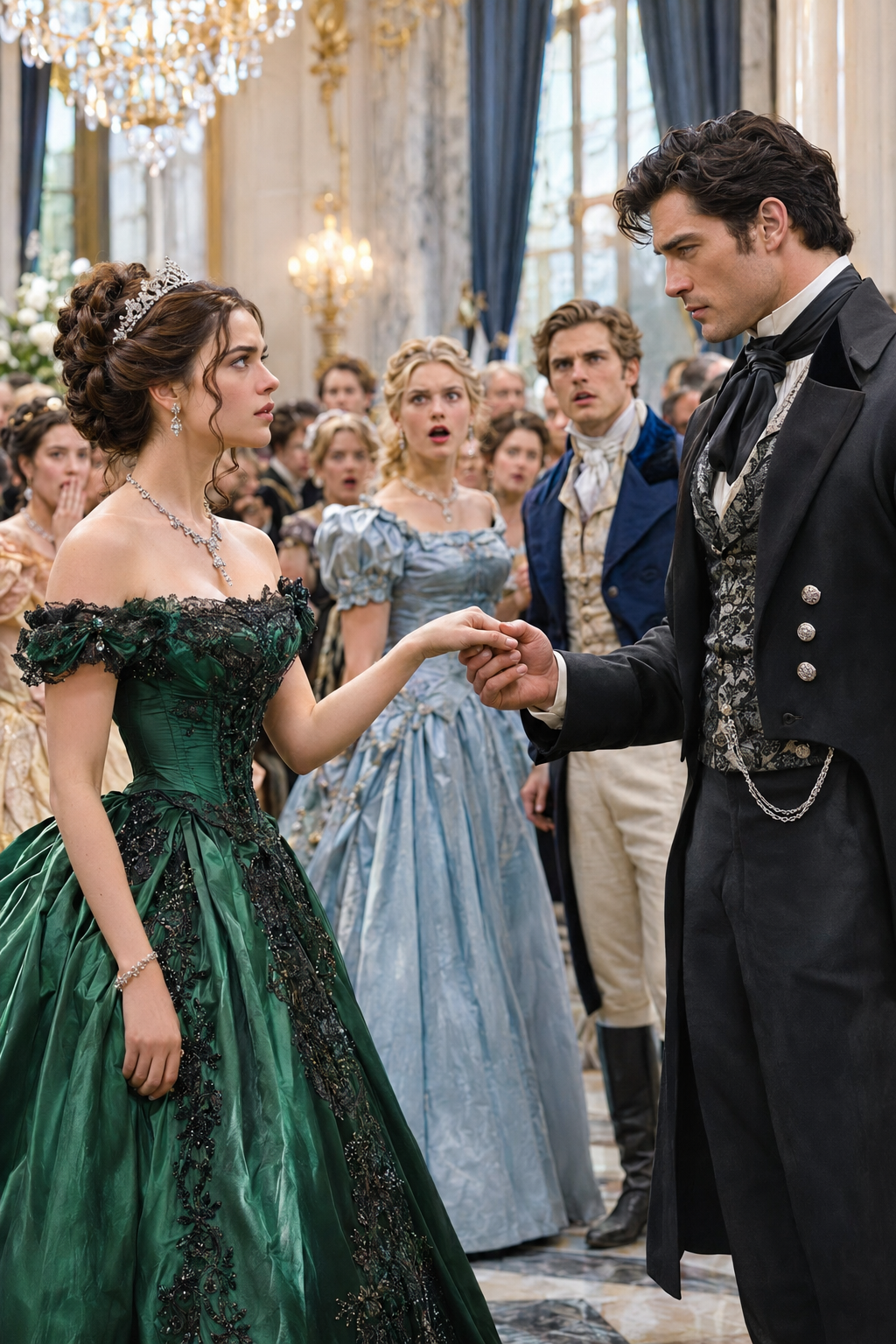
She frowned.
“What nonsense are you imagining?”
“Did you encourage him to marry me because he settled Father’s debts?”
My aunt looked away.
That was answer enough.
“You knew,” I said.
“Of course I knew. Someone had to protect this family from your foolish pride.”
“And Lord Wycliffe?”
Her lips tightened.
“What about him?”
“Did he know the duke intended to pay our debts?”
“No. And I suggest you keep it that way.”
Something in her voice caught my attention.
“Why?”
“Because Malcolm Wycliffe is not a man who accepts humiliation gracefully.”
Before I could question her further, she stood.
“You have married a wealthy, respectable duke who appears absurdly devoted to you. Stop searching for reasons to be miserable.”
She departed, leaving behind the faint scent of lavender and a warning I could not dismiss.
Three days passed.
Adrienne gave me space, although flowers appeared outside my door each morning.
On the fourth day, I discovered a small volume of poetry beside my breakfast tray.
Inside, he had written:
I cannot undo my mistake. I can only promise that your freedom will never again be the price of my protection.
I read those words until the ink blurred.
That afternoon, I decided to return to Fairchild Manor.
Not to escape my marriage, but to speak with my father.
Adrienne found me preparing to depart.
“Will you return?” he asked.
“I do not know.”
Pain crossed his face, but he nodded.
“The carriage is yours. So is every freedom I promised you.”
I almost embraced him.
Instead, I climbed into the carriage.
Fairchild Manor looked smaller than I remembered.
The gardens were overgrown, the eastern windows needed replacing, and the ancient stone lions guarding the entrance had lost their noses.
My father received me in his library.
He appeared ten years older than he had at my wedding.
“Eleanor,” he said warmly. “My darling girl.”
I did not return his smile.
“Did you sell me to the Duke of West Haven?”
His face drained of color.
“Good heavens, no!”
“Then explain the agreement.”
He sank into his chair.
For several moments, he stared at his hands.
“Your aunt told me the duke wished to help us anonymously.”
“Why?”
“He said he admired your concern for our tenants.”
“And you accepted twenty-eight thousand pounds without questioning his motives?”
My father looked ashamed.
“I was desperate.”
He opened a drawer and withdrew a folded letter.
“This arrived before your engagement. I should have shown you.”
The letter was written in Adrienne’s unmistakable hand.
Lord Fairchild,
The assistance I offer is unconditional. Your daughter must never be made to feel indebted to me. I ask no promise concerning her future, and should she choose another gentleman, my assistance will remain unchanged.
I read it twice.
Then a third time.
My knees weakened.
Adrienne had not bought my hand.
He had tried to ensure that no one else could.
“Why did you hide this?” I whispered.
My father covered his face.
“Because your aunt convinced me that if you knew the extent of our ruin, you would sacrifice yourself to save us.”
I folded the letter carefully.
“Father, I might have helped you find another solution.”
“I know that now.”
Before I could respond, the library door opened.
Our old steward, Mr. Bellamy, entered carrying a leather portfolio.
“Forgive the interruption, my lord, but there is something Lady Eleanor ought to see.”
My father stiffened.
“Bellamy, this is hardly the time.”
“With respect, sir, it is long past time.”
He placed the portfolio before me.
Inside were copies of mortgages, receipts, and correspondence stretching back five years.
At first, I understood very little.
Then I noticed a familiar signature.
Malcolm Wycliffe.
Again.
And again.
“Why is Lord Wycliffe’s name on these documents?”
Bellamy’s jaw tightened.
“Because, my lady, I believe he engineered your father’s ruin.”
The words struck like thunder.
Bellamy explained that several creditors had unexpectedly demanded repayment within the same month. Others had purchased old debts at inflated prices. Repairs had been delayed because estate funds disappeared through suspicious transactions.
Every trail led toward companies associated with Wycliffe.
“Why did you not tell Father?” I demanded.
“I tried. The previous solicitor dismissed my concerns. Then the records began disappearing.”
My father stared at the documents.
“Malcolm offered to marry Eleanor because he wished to help us.”
“No, my lord,” Bellamy replied. “He wished to acquire the estate through her.”
A chill moved through me.
“And his previous wives?”
Bellamy hesitated.
“That, my lady, is a question I have long feared asking.”
That night, I wrote to Adrienne.
Not a letter of forgiveness.
A request for help.
He arrived before sunrise.
When I saw him standing in the entrance hall, exhausted from traveling through the night, something inside me broke.
“You came,” I whispered.
“You asked.”
Nothing more.
No accusation.
No demand.
I handed him Bellamy’s documents.
He examined them in silence.
Then his expression hardened in a way I had never seen.
“Where did you obtain these?”
“From our steward.”
Adrienne turned another page.
“Good God.”
“What is it?”
He pointed to a company name.
“Blackthorn Holdings.”
“You recognize it?”
“I have been investigating that company for two years.”
My heart began pounding.
“Why?”
He looked at me.
“Because my younger sister died after marrying a man financially connected to it.”
I stared at him.
“You never told me you had a sister.”
“Her name was Charlotte.”
His voice became painfully quiet.
“She married at nineteen. Her husband isolated her from everyone who loved her. When she finally wrote asking me to bring her home, the letter arrived too late.”
“What happened?”
“She fell from a balcony.”
The silence that followed was terrible.
“Was it an accident?”
“The authorities said so.”
“And you?”
“I never believed it.”
He closed the portfolio.
“Her husband was Malcolm Wycliffe’s cousin.”
Suddenly, the pieces of our lives seemed connected by something far darker than coincidence.
“Did you marry me because you suspected Wycliffe?”
Adrienne looked wounded.
“No. I began investigating him after learning he intended to marry you. By then, I already cared for you.”
“Why did you not tell me?”
“Because I had no proof. And because I wanted our marriage to belong to us, not to the shadow of my sister’s death.”
I reached for his hand.
This time, he did not move away.
“I believe you,” I whispered.
His fingers tightened around mine.
But our reconciliation was interrupted by the sound of breaking glass.
A scream echoed from the courtyard.
We rushed outside.
Bellamy lay beside the stable wall, blood spreading across his coat.
A horse had been released, and the stable lanterns had been smashed.
Adrienne knelt beside him.
“Who did this?”
Bellamy struggled to breathe.
“Black carriage,” he whispered. “Two men.”
Then he seized my wrist.
“The blue ledger… old chapel… beneath the altar.”
His eyes closed.
For one dreadful moment, I believed him dead.
Adrienne pressed his fingers against Bellamy’s neck.
“He is alive. Send for a physician!”
As servants rushed forward, I looked toward the distant chapel beyond the orchard.
Someone had attacked Bellamy to prevent us from discovering the truth.
And whatever lay beneath that altar was worth killing for.
We waited until darkness.
Adrienne insisted that I remain inside.
I refused.
“If my family is involved, I will not hide behind you.”
He studied me for a moment.
Then, despite everything, he smiled.
“I had forgotten how impossible you are.”
“You married me knowing perfectly well.”
We took a lantern and crossed the orchard.
The chapel had stood abandoned since my grandmother’s death. Ivy covered its walls, and the roof sagged beneath years of neglect.
Inside, the air smelled of damp stone.
Adrienne lifted the altar cloth.
Beneath it, we discovered a loose floor tile.
He pried it free.
A narrow cavity contained a small iron box.
Inside lay a blue leather ledger, three letters, and a silver locket.
I opened the ledger.
Every page contained names, payments, dates, and coded initials.
Adrienne read over my shoulder.
“These are transfers from Wycliffe’s private accounts.”
“To whom?”
“Judges. Solicitors. Estate agents.”
He turned another page.
Then stopped breathing.
“Charlotte.”
Her name appeared beside a payment dated two days before her death.
Below it were the words:
Final settlement. No further correspondence.
Adrienne gripped the edge of the altar.
I had never seen him look so utterly devastated.
He opened one of the letters.
It was addressed to Bellamy.
If anything should happen to me, preserve these records. Lord Wycliffe has threatened my life, and I fear he intends to silence every woman who knows his affairs.
The signature was unfamiliar.
Margaret Wycliffe.
His second wife.
My blood turned cold.
“She knew,” I whispered.
Adrienne nodded.
“And someone made certain she could never testify.”
A noise sounded behind us.
The chapel door slammed shut.
Then came the unmistakable scrape of a bolt.
Adrienne rushed toward it.
Locked.
A moment later, smoke drifted beneath the door.
“Adrienne?”
He looked toward the windows.
Flames appeared along the wooden frame.
“They are burning the chapel.”
I clutched the ledger against my chest.
Outside, someone laughed.
“Such a pity,” a familiar voice called. “A duke and his pretty wife, lost in an unfortunate accident.”
Lord Wycliffe.
Adrienne seized a wooden bench and hurled it against the nearest window.
The glass shattered, but iron bars prevented escape.
Smoke thickened.
My eyes began watering.
“Give me the ledger,” Wycliffe shouted. “And perhaps I shall allow the lady to live.”
Adrienne pulled me behind him.
“You will not touch her!”
Wycliffe laughed again.
“You noble fools. Always believing affection makes you stronger.”
Flames climbed the chapel walls.
I began coughing.
Adrienne removed his coat and wrapped it around my face.
“Listen carefully,” he said. “There is a narrow opening behind the confessional. I noticed it when we entered.”
“What about you?”
“I will follow.”
“No.”
“Eleanor—”
“I will not escape by abandoning you.”
He looked at me with such fierce tenderness that I nearly wept.
“Then we escape together.”
We rushed toward the confessional.
Behind its rotting panels, a narrow passage descended into darkness.
Adrienne forced the wood aside.
I crawled through first, clutching the ledger.
The passage was barely wide enough for my shoulders.
Behind me, the chapel roof groaned.
Then came a tremendous crash.
“Adrienne!”
“I am here!”
His voice was muffled by smoke.
I crawled faster.
The passage ended at a wooden hatch beneath the orchard.
I pushed.
It would not move.
I pushed again, screaming with effort.
At last, the rotten wood gave way.
Cold night air flooded my lungs.
I scrambled outside and turned back.
“Adrienne!”
No answer.
I dropped to my knees.
“Please!”
A hand emerged from the darkness.
I seized it with both of mine.
Together, we dragged him into the grass.
His face was blackened with soot, and blood ran from his temple.
But he was breathing.
I wrapped my arms around him.
“You promised to follow,” I sobbed.
He managed a weak smile.
“I have discovered that disappointing my wife is a most unpleasant occupation.”
Behind us, the chapel collapsed into a furnace of sparks.
We had survived.
But Wycliffe was still free.
By morning, Adrienne had sent trusted riders to London carrying copies of the ledger.
The original remained hidden beneath my mattress.
He also summoned a magistrate from a neighboring county, one with no known connection to Wycliffe.
Yet before the magistrate arrived, another disaster struck.
My father disappeared.
His bedroom stood empty.
On his pillow lay a single note.
Bring the ledger to Blackthorn Hall before midnight, or Lord Fairchild will answer for his daughter’s disobedience.
I read the message with shaking hands.
Adrienne immediately ordered his men to prepare.
“We will surround the property.”
“No,” I said.
He looked at me sharply.
“Eleanor, absolutely not.”
“He expects you to attack. He knows you have soldiers and influence. If you approach openly, he will kill Father.”
“I will not permit you to walk into that house alone.”
“Then do not permit it,” I replied. “Help me outthink him.”
For the next hour, we argued.
Finally, we devised a plan.
I would enter Blackthorn Hall carrying a convincing imitation of the ledger.
Adrienne and his men would approach through the old servants’ entrance, using a passage described by Bellamy, who had regained consciousness.
And the real evidence would remain safely beyond Wycliffe’s reach.
At eleven forty-five, I arrived at Blackthorn Hall.
The building rose against the moonless sky like a fortress.
Two servants escorted me into a vast drawing room.
Wycliffe waited beside the fireplace.
My father sat in a chair, his hands bound.
His face was bruised.
“Eleanor,” he whispered. “You should not have come.”
Wycliffe smiled.
“How touching. A daughter willing to sacrifice herself for her father.”
“Release him.”
“The ledger first.”
I held up the blue book.
His eyes gleamed.
“Come closer.”
I obeyed, stopping several feet away.
“Why did you choose my family?” I asked.
“Because your father was weak, your aunt was ambitious, and you possessed precisely the sort of spirit I enjoy breaking.”
Revulsion rose inside me.
“You ruined us deliberately.”
“I merely encouraged circumstances.”
“And your wives?”
His smile faded.
“Careful, Eleanor.”
“Did Margaret discover your accounts?”
He stepped toward me.
“She became troublesome.”
“And Charlotte?”
For the first time, genuine surprise crossed his face.
“What do you know of Charlotte?”
“Enough.”
His expression turned ugly.
“That foolish girl should have obeyed her husband.”
I forced myself to remain calm.
“Did you order her death?”
He laughed.
“I ordered nothing. I simply paid a man to resolve a family inconvenience.”
My stomach twisted.
There it was.
The confession Adrienne had waited years to hear.
I glanced toward the mantel clock.
Midnight.
Wycliffe extended his hand.
“The book.”
I placed it before him.
He opened the cover.
Then froze.
The pages were blank.
His head snapped upward.
“You little—”
The drawing room doors burst open.
Adrienne entered with four armed men.
“Step away from my wife.”
Wycliffe seized a pistol from the mantel.
Everything happened at once.
My father shouted.
Adrienne lunged forward.
The pistol fired.
A deafening crack filled the room.
I screamed.
Adrienne staggered.
Blood spread across his shoulder.
For one horrifying instant, I could not move.
Then Wycliffe grabbed me, pressing the pistol against my throat.
“One step closer,” he snarled, “and she dies.”
Adrienne straightened despite his wound.
His face was pale, but his eyes remained steady.
“Let her go.”
Wycliffe backed toward the balcony.
“You think your title protects you? I have bought judges, magistrates, and half the men who pretend to serve the Crown!”
“You have confessed enough,” Adrienne replied.
Wycliffe sneered.
“To whom?”
A voice answered from the doorway.
“To a magistrate, Lord Wycliffe.”
An elderly gentleman stepped forward, accompanied by two officers.
Beside him stood Mr. Harcourt, holding a written statement.
Wycliffe’s grip tightened.
“You have no proof.”
“The accounts, the correspondence, and your own words provide considerable proof,” the magistrate replied.
But Wycliffe was not finished.
He dragged me onto the balcony.
Below us lay a steep drop into the stone courtyard.
“If I cannot have her,” he whispered, “neither shall you.”
I felt his weight shift.
He intended to throw us both over.
In that instant, I remembered every warning I had ever received.
Be quiet.
Be obedient.
Do not anger powerful men.
I had spent my life being told that survival depended upon submission.
But submission had never saved Margaret.
It had never saved Charlotte.
And it would not save me.
I drove my heel into Wycliffe’s foot and struck his wounded pride with the heaviest object within reach: the brass candlestick standing beside the balcony door.
He cried out.
The pistol fell.
I twisted free.
Wycliffe lunged after me, but Adrienne reached us first.
Despite his injured shoulder, he seized Wycliffe’s collar and dragged him away from the railing.
The officers rushed forward.
Within moments, Malcolm Wycliffe was restrained.
He struggled violently.
“You cannot do this to me! Do you know who I am?”
Adrienne looked down at him.
“Yes,” he said quietly. “At last, everyone will.”
I ran into my husband’s arms.
He winced.
“You are bleeding!”
“A minor inconvenience.”
“You were shot!”
“An admittedly larger inconvenience.”
I laughed through my tears.
Then I kissed him, heedless of the magistrate, the officers, and every rule of respectable society.
For once, I did not care who was watching.
The investigation that followed shook London.
The ledger revealed a network of fraudulent loans, bribery, forged contracts, and suspicious payments connected to several deaths.
Former servants came forward.
A physician admitted he had been pressured to falsify Margaret Wycliffe’s death certificate.
Charlotte’s former maid testified that she had heard threats shortly before her mistress fell.
The evidence was not simple, and justice did not arrive overnight.
Powerful men fought desperately to protect their reputations.
But the truth had begun escaping from the darkness, and no amount of money could force it back.
Months later, Wycliffe was convicted of conspiracy, fraud, and crimes connected to the deaths of his wives and Charlotte.
Several accomplices were convicted as well.
When the sentence was announced, Adrienne stood beside me in the courtroom.
His hand trembled slightly in mine.
I knew he was thinking of his sister.
“Are you satisfied?” I whispered.
He watched Wycliffe being led away.
“No verdict can bring Charlotte back.”
Then he looked at me.
“But perhaps another woman will live because he can no longer harm her.”
I squeezed his hand.
That was enough.
Not happiness.
Not yet.
But the beginning of peace.
My aunt’s involvement proved more complicated.
She had known Wycliffe was manipulating our finances, although she claimed she never understood the full extent of his cruelty.
I believed her ignorance only partly.
When she visited me after the trial, she appeared diminished.
“I thought I was saving our family,” she said.
“You were saving our name,” I replied. “There is a difference.”
Her eyes filled with tears.
“I was afraid.”
“So was I.”
She lowered her head.
For the first time in my life, my aunt had no answer.
I did not embrace her.
Forgiveness, I had learned, was not something another person could demand simply because regret had become inconvenient.
But I did not close the door forever.
Some wounds needed time.
Others needed accountability.
And a few required both.
As for my father, he returned to Fairchild Manor determined to become the man his tenants deserved.
He sold several unnecessary luxuries, dismissed the dishonest agents, and placed the estate accounts under independent supervision.
Bellamy recovered slowly, although he insisted on returning to work before his physician approved.
I visited frequently.
Together, we established a fund to repair the cottages, improve sanitation, and provide schooling for tenant children.
Adrienne offered to finance everything.
This time, I refused.
Not because I doubted his intentions.
But because I had an idea of my own.
For years, the women of our village had produced beautiful lace, embroidery, and woven goods that merchants purchased for almost nothing.
I proposed establishing a cooperative where they could sell directly to customers in London.
My father thought the idea impractical.
Adrienne thought it magnificent.
“You are only saying that because you love me,” I accused.
“Undoubtedly,” he replied. “But I also happen to believe you are correct.”
We invested carefully.
Within a year, the cooperative was profitable.
Within two, it employed more than forty women.
And for the first time in generations, Fairchild Manor began paying its debts through honest work rather than desperate bargains.
Yet the greatest change occurred within my marriage.
Adrienne never again concealed a financial decision that affected us both.
I never again mistook his desire to protect me for proof that he wished to control me.
We argued often.
About estate management.
About politics.
About whether Shakespeare was superior to Milton.
Once, we disagreed so fiercely over the construction of a new schoolhouse that the butler quietly removed the silverware from the dining table.
But every disagreement ended with conversation rather than punishment.
And every morning, Adrienne asked for my opinion before making decisions that concerned our shared life.
One winter evening, nearly three years after our wedding, I found him standing beside the nursery window.
Our daughter slept peacefully in her cradle.
We had named her Charlotte Margaret.
After two women whose voices had been silenced, but whose courage had helped reveal the truth.
Adrienne watched her with an expression of wonder.
“She has your eyes,” he whispered.
“And your stubbornness.”
“That seems rather unfair to the child.”
I laughed.
He slipped an arm around my waist.
“Do you ever regret marrying me?”
I turned toward him.
“Sometimes.”
He looked startled.
“Sometimes?”
“When you leave books scattered across the library. When you insist that dreadful poetry is charming. And especially when you pretend not to hear me asking you to close the windows.”
He smiled.
“And otherwise?”
I rested my head against his chest.
“Otherwise, I would choose you a thousand times.”
His arms tightened around me.
After a moment, he spoke quietly.
“I have often wondered whether you would have loved me if I had possessed nothing.”
I lifted my head.
“Adrienne, do you truly believe I fell in love with your fortune?”
“No. But I wonder whether our paths would have crossed.”
I considered his question.
Then I remembered the day we met.
The leaking cottage.
The frightened family.
The arrogant duke who had dared to comment on my behavior.
“I think,” I said, “that if you had been a poor farmer, I would have found you arguing with someone about a broken fence.”
“And you would have corrected me?”
“Immediately.”
“And then?”
“Then I would have married you anyway, provided you learned to repair the fence.”
His laughter filled the nursery.
Our daughter stirred, opened her eyes, and made a small indignant sound.
Adrienne bent to lift her.
I watched him cradle her with the same gentleness he had shown me on our wedding night.
The same patience.
The same respect.
And I understood something that had taken me years to learn.
Love was not proved by grand sacrifices alone.
It was proved in the ordinary moments when one person possessed the power to command another, yet chose instead to listen.
It was proved by truth, even when truth was uncomfortable.
By apologies that led to change.
By protection that did not become possession.
And by the courage to stand beside someone without standing in their way.
Years later, when Charlotte Margaret was old enough to ask how her parents had met, Adrienne told her that I had insulted him beside a leaking cottage.
I corrected him immediately.
“I merely suggested that a gentleman should make himself useful.”
Our daughter giggled.
“And did Papa?”
“Oh, eventually,” I replied.
Adrienne placed a hand over his heart.
“Your mother has been correcting me ever since.”
Charlotte considered this with great seriousness.
“Then I shall correct gentlemen too.”
Adrienne looked at me.
I looked at him.
And we both burst into laughter.
But when our daughter grew quiet, I took her small hands in mine.
“There is something you must remember, darling.”
She leaned closer.
“Never believe that your worth depends upon what someone is willing to pay for you, what title they offer you, or how much power they possess.”
Her eyes widened.
“Then what does it depend upon, Mama?”
“Nothing,” I said gently. “Your worth is already yours. No one gives it to you, and no one has the right to take it away.”
Adrienne knelt beside us.
“And if someone truly loves you,” he added, “they will never ask you to become smaller so that they may feel greater.”
Charlotte nodded solemnly, although I knew she was too young to understand everything.
One day, she would.
I hoped she would never need to learn those lessons through fear.
Outside, sunlight fell across the gardens of West Haven.
Beyond them lay the cottages where our story had begun.
Their roofs were repaired now.
Children played in the lanes.
Women walked to the cooperative carrying baskets of finished lace.
Life had not become perfect.
There were still debts to manage, disagreements to resolve, and grief that occasionally returned without warning.
But there was freedom.
There was purpose.
And there was love.
Not the kind that demanded obedience.
The kind that made courage possible.
I had once been told that marriage was the price I must pay to save my family.
Instead, I had discovered that no family could truly be saved by sacrificing the freedom of one of its members.
My husband had entered my life with wealth, influence, and secrets.
I had entered his with pride, suspicion, and a heart determined never to surrender.
We had both made mistakes.
We had both been afraid.
Yet we had chosen, again and again, to tell the truth, to forgive where forgiveness was earned, and to build something neither of us could have created alone.
That evening, as Adrienne took my hand and our daughter ran laughing ahead of us, I thought of the frightened young woman who had once stood before a marriage contract.
She had believed her only choices were obedience or ruin.
How wrong she had been.
For the greatest fortune I ever possessed was not the estate, the jewels, or the title of duchess.
It was the knowledge that I could walk beside the man I loved without ever having to walk behind him.
And if I could return to that terrible afternoon when my aunt demanded I marry Lord Wycliffe, I knew exactly what I would tell my younger self.
A life built upon fear may appear secure, but its walls are only another kind of prison.
True love does not purchase your silence.
It gives you the courage to speak.
And sometimes, the bravest thing a woman can do is refuse the future others have chosen for her, so she may discover the extraordinary life waiting beyond their expectations.
THE END.