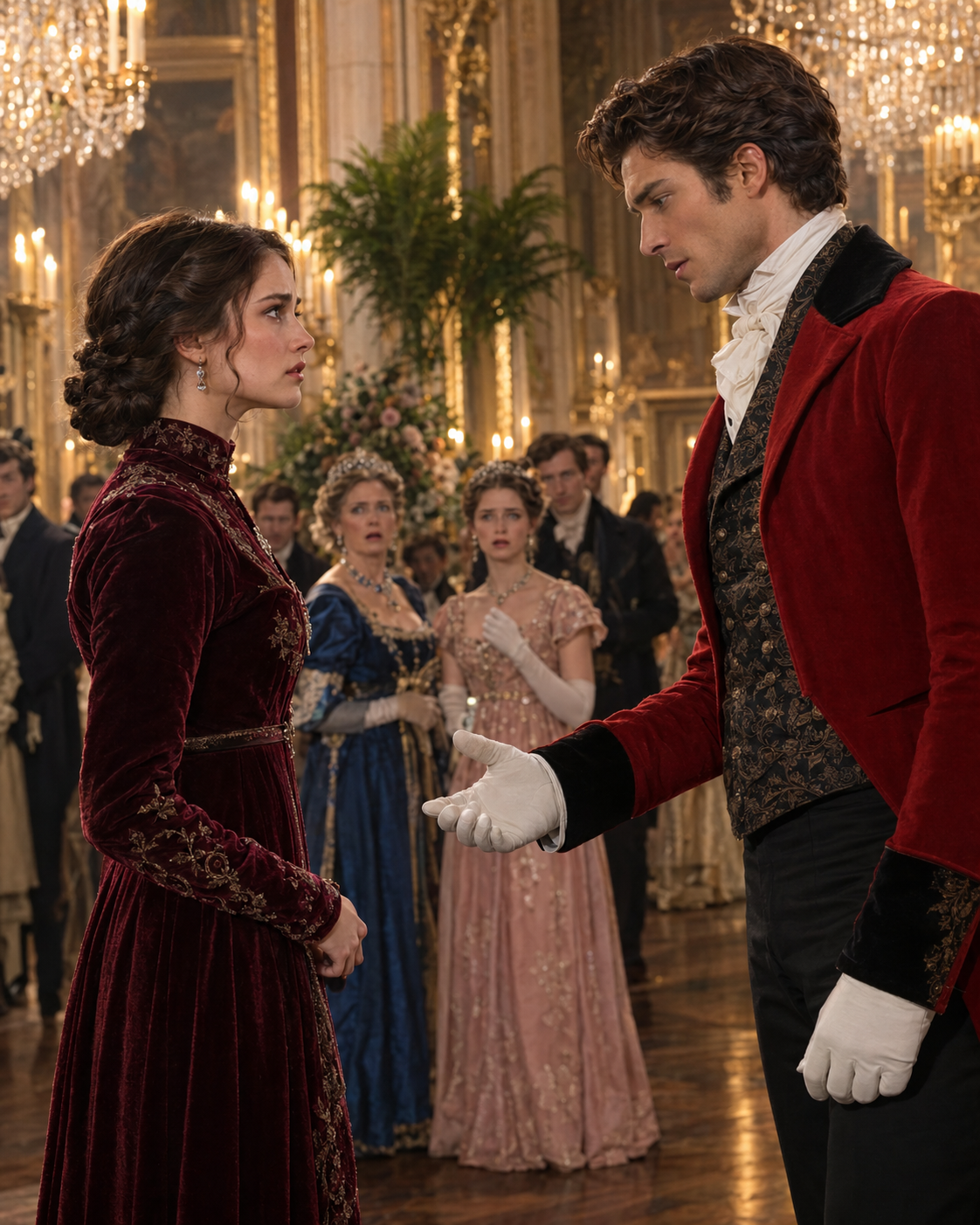
London glittered beneath a cold winter sky, and inside one of England’s most prestigious ballrooms, every chandelier seemed determined to make the night look more beautiful than it truly was.
Beatrice did not raise her voice.
That was what unsettled Lady Harcourt most.
The breakfast room was filled with the pale morning light of a London winter, and beyond the tall windows, carriages rolled through the wet streets while servants hurried beneath umbrellas.
Yet inside the room, everything had gone still.
Lady Harcourt stood at the end of the table with one hand pressed against the back of a chair.
“You will leave for Yorkshire within the week,” she said.
Beatrice folded her napkin carefully beside her untouched tea.
“No.”
The single word seemed almost absurdly quiet.
Lady Harcourt stared at her.
“No?”
“No.”
For years, Beatrice had learned that resistance invited punishment.
Silence had been safer.
Agreement had been easier.
She had watched her father retreat into his study whenever his wife became angry, and she had watched her stepsisters learn to survive by giving Lady Harcourt exactly the answers she wanted.
But the previous evening had changed something inside her.
Not because a duke had spoken to her.
Not because a book had arrived.
It was because, for the first time, someone had looked at her without asking what she could provide.
“You forget your position,” Lady Harcourt said.
“I remember it very well.”
“You live under my roof.”
“And I know whose money keeps that roof standing.”
The color drained from Lady Harcourt’s face.
Beatrice finally looked up.
“I have seen the ledgers.”
For several seconds, only the ticking clock could be heard.
Lady Harcourt’s fingers tightened around the chair.
“What ledgers?”
“The estate accounts.”
“You had no permission to examine them.”
“I did not need permission to understand them.”
Her stepmother stepped closer.
“You insolent girl.”
Beatrice did not move.
“The Harcourt estate is carrying three mortgages,” she continued calmly.
“The northern property has been losing money for four years.”
“The London townhouse is being maintained partly through borrowed funds.”
“And there are creditors expecting payments before spring.”
Lady Harcourt’s expression hardened.
“You know nothing about finance.”
“I know enough to know that sending me to Yorkshire will not solve any of it.”
That was the moment the balance of the room changed.
Lady Harcourt realized that Beatrice was no longer the girl who had stood obediently in old clothes while her sisters were dressed in silk.
She was a woman who had been listening.
Watching.
Remembering.
And calculating.
“You think a few figures make you powerful?” Lady Harcourt whispered.
“No.”
Beatrice rose from the table.
“I think truth does.”
Before Lady Harcourt could answer, the door opened.
A servant entered carrying another small package.
“Another delivery for Miss Beatrice.”
Lady Harcourt turned sharply.
“From whom?”
The servant hesitated.
“The Duke of Rothwell, my lady.”
Beatrice felt her heart beat once, hard enough to make her breath catch.
Lady Harcourt reached for the package.
Beatrice stepped forward first.
“Give it to me.”
The servant obeyed.
The parcel contained no jewelry.
No flowers.
No romantic declaration.
There was only a handwritten note and several folded sheets of paper.
Beatrice opened the note.
The Duke’s handwriting was precise.
“I hope you found yesterday’s conversation less tedious than the rest of the evening.”
Despite herself, Beatrice smiled.
Beneath the note were copies of several public estate reports concerning properties in Yorkshire and neighboring counties.
At the bottom, one sentence had been written by hand.
“You mentioned that your family’s accounts are troubled. If you wish to understand the numbers more clearly, these may be useful.”
That was all.
No promise.
No demand.
No attempt to purchase her gratitude.
Beatrice understood immediately.
The Duke was not offering to rescue her.
He was offering her information.
The distinction mattered.
She folded the papers and slipped them into the pocket of her gown.
Lady Harcourt watched her with growing suspicion.
“What exactly does he want from you?”
“I don’t know.”
“You expect me to believe that?”
“I expect nothing from you.”
Lady Harcourt’s lips tightened.
“You will end this nonsense.”
“What nonsense?”
“This fascination.”
Beatrice shook her head.
“He has not declared anything.”
“He sent you a book.”
“So?”
“He sent you documents.”
“So?”
Lady Harcourt stared at her.
“You are becoming dangerous.”
Beatrice’s expression softened.
“No, Lady Harcourt. I am becoming difficult to frighten.”
The words landed harder than a shout.
That afternoon, Beatrice went to the small library that had become her refuge.
She spread the estate accounts across the desk and placed the Duke’s documents beside them.
For years, she had been told that numbers were a man’s business.
Her father had once laughed gently when she asked why the household spent more maintaining certain properties than those properties produced.
“Do not trouble yourself with such things,” he had said.
But Beatrice had troubled herself anyway.
She discovered that the problem was worse than she had imagined.
The estate was not merely burdened by debt.
It was being drained.
Payments disappeared into vague expenses.
Maintenance contracts were unusually expensive.
Several suppliers were receiving far more than the work they performed justified.
Beatrice traced the names through old correspondence.
One appeared again and again.
Edmund Vale.
Her stepmother’s brother.
Beatrice sat back slowly.
She had met Uncle Edmund only a handful of times.
He was charming, loud, and always seemed to know exactly when the family had received money.
Now she understood why.
Someone had been feeding him from the estate.
And someone had been allowing it.
The door opened.
Her father stood there.
He looked older than he had the week before.
“Your stepmother tells me you’re refusing Yorkshire.”
“Yes.”
He closed the door behind him.
“Beatrice, this cannot continue.”
“I agree.”
Her father stared at the papers on the desk.
“What are those?”
“Your accounts.”
He frowned.
“Where did you get them?”
“They were in your study.”
“You had no right.”
“I know.”
The disappointment in his face hurt more than anger would have.
But she kept going.
“Father, did you know Uncle Edmund has been paid thousands through estate contracts?”
He froze.
“What?”
Beatrice turned the ledger toward him.
“These payments are authorized under your signature.”
He stared at the figures.
“I don’t remember approving all of these.”
“Then someone has been signing in your name.”
His face became pale.
For the first time, Beatrice saw something other than exhaustion in his eyes.
She saw fear.
“What are you suggesting?”
“I am suggesting that sending me away is the least important problem in this house.”
He lowered himself into the chair.
“Where did you learn to read accounts like this?”
Beatrice looked toward the window.
“No one taught me.”
Her father swallowed.
“That is my fault.”
She looked back at him.
“Yes.”
He flinched.
It was the first honest answer she had ever given him without softening it.
That evening, her father confronted Lady Harcourt.
The argument carried through the corridor.
Beatrice heard raised voices, a chair scraping against the floor, and her father’s rare moment of fury.
Then silence.
A few minutes later, Lady Harcourt entered Beatrice’s room.
Her face was composed again.
“You have poisoned your father’s mind.”
“No.”
“You have humiliated this family.”
“No.”
“You think the Duke will marry you?”
Beatrice’s hands remained folded in her lap.
“I have never asked him to.”
Lady Harcourt stepped closer.
“Then what do you want?”
Beatrice considered the question.
“I want the truth.”
Her stepmother laughed bitterly.
“The truth will not protect you.”
“Perhaps not.”
Beatrice stood.
“But a lie cannot protect anyone forever.”
The following days became a quiet war.
Lady Harcourt tried everything she could without openly destroying the family.
She withheld Beatrice’s allowance.
She instructed servants not to assist her.
She sent invitations back unopened.
She told acquaintances that Beatrice was unstable, difficult, and desperate for attention.
Beatrice answered none of it.
Instead, she worked.
With her father’s reluctant permission, she examined every estate payment she could find.
She compared invoices.
She checked dates.
She discovered that several properties had been leased below market value to men connected to Uncle Edmund.
She found maintenance payments for buildings that had not been repaired.
She found commissions paid to companies that existed only on paper.
And then she found something worse.
A letter.
It was hidden inside an old accounting book.
The handwriting belonged to Uncle Edmund.
The letter referred to a plan to force the sale of one of the family’s most valuable properties.
Once sold, the proceeds would cover the debts temporarily.
The remaining money would disappear through another series of transactions.
Beatrice read the letter twice.
Then she took it to her father.
He read it in silence.
When he finished, he covered his eyes.
“How long have I been blind?”
“Too long.”
He looked at her.
“Can you forgive me?”
Beatrice did not answer immediately.
“I don’t know.”
Her father nodded.
It was the first time he had allowed her honesty without demanding comfort in return.
Two days later, the Duke of Rothwell visited.
The announcement caused Lady Harcourt to nearly drop the teacup in her hand.
Beatrice entered the drawing room to find him standing near the fireplace.
He wore a dark coat, simple compared with the extravagant fashion favored by many aristocrats.
His expression was as unreadable as ever.
“Your Grace.”
“Miss Beatrice.”
Lady Harcourt forced a smile.
“How kind of you to call.”
“I came to speak with Miss Beatrice.”
“Of course.”
Lady Harcourt’s smile tightened.
“We are all delighted by your interest.”
The Duke looked at her.
“I did not say I was interested.”
The room went silent.
Beatrice nearly smiled.
Lady Harcourt recovered quickly.
“Then why are you here?”
“To ask Miss Beatrice a question.”
He turned toward Beatrice.
“Would you like to leave this house for an hour?”
Lady Harcourt immediately objected.
“She is not permitted.”
The Duke’s gaze returned to her.
“Then I shall ask Miss Beatrice herself.”
Beatrice picked up her gloves.
“I would like to go.”
Lady Harcourt looked furious.
But she could not forbid a duke without making the family situation far worse.
Outside, the winter air was sharp.
They walked through the quiet streets before entering Hyde Park.
For several minutes, neither spoke.
Finally, Beatrice said, “You knew.”
“I suspected.”
“About the accounts?”
“Yes.”
“How?”
“Your answers at the ball.”
She looked at him.
“You noticed that?”
“I notice people who speak carefully.”
“And you thought I was hiding something.”
“I thought you were protecting something.”
She looked away.
“I am not accustomed to being understood.”
“I know.”
They walked farther.
Beatrice stopped beside a bare tree.
“Why did you send me *Meditations*?”
The Duke considered the question.
“Because you were angry.”
“I did not appear angry.”
“You were.”
She looked at him.
“And?”
“And I thought you might appreciate a book written by a man who understood that other people’s behavior cannot always be controlled.”
A quiet laugh escaped her.
“That sounds almost like advice.”
“It is.”
She looked at him for a moment.
“Your Grace, I don’t need rescuing.”
“I know.”
“I mean it.”
“So do I.”
That answer surprised her.
The Duke continued.
“If I wanted to rescue you, I would offer money.”
Beatrice’s expression changed.
“You haven’t.”
“No.”
“Why?”
“Because I think you would refuse.”
“I would.”
“I know.”
They both smiled.
Then the Duke became serious.
“I can, however, introduce you to people who understand estate management.”
Beatrice hesitated.
“Why?”
“Because you are capable.”
That simple word struck deeper than praise.
Capable.
Not beautiful.
Not charming.
Not useful.
Capable.
For the first time, someone had named the quality she had spent years developing in silence.
“Thank you,” she whispered.
The Duke inclined his head.
“Do not thank me yet.”
“For what?”
“You have a war ahead of you.”
Beatrice looked toward the gray London sky.
“I know.”
“And your enemy may not be your stepmother.”
She understood immediately.
“Uncle Edmund.”
“Yes.”
The next morning, Beatrice met with one of the Duke’s estate advisers.
For several hours, she learned how land leases were structured, how debts could be renegotiated, and how dishonest contracts could be challenged.
She took notes until her fingers cramped.
When she returned home, she found Lady Harcourt waiting.
“You went behind my back.”
“I went with my father’s permission.”
“He will regret giving it.”
“Perhaps.”
“You think this will make you important?”
“No.”
Beatrice removed her gloves.
“I think it might make me useful.”
Her stepmother sneered.
“You are still a woman in a man’s world.”
Beatrice looked directly at her.
“Then perhaps the world should become accustomed to women who understand it.”
Lady Harcourt slapped the table.
“You have become insufferable.”
“No.”
Beatrice’s voice remained calm.
“I have become visible.”
The confrontation finally reached its breaking point when Uncle Edmund arrived at the townhouse.
He entered with the confidence of a man who believed the house belonged to him.
He found Beatrice waiting in the library.
Her father stood behind her.
Lady Harcourt remained near the fireplace.
Uncle Edmund laughed.
“What is this?”
Beatrice placed the letter on the desk.
His smile disappeared.
“I believe this belongs to you.”
He did not touch it.
“Where did you get that?”
“Does it matter?”
“Yes.”
“Then tell me.”
He looked at Lady Harcourt.
She said nothing.
His face hardened.
“You have no idea what you are doing.”
“I know exactly what I am doing.”
“You think these figures prove something?”
“My father’s solicitor has already reviewed them.”
Uncle Edmund turned toward her father.
“This is absurd.”
Her father spoke quietly.
“No.”
The room fell silent.
“I believe my daughter.”
Uncle Edmund stared at him.
“You would choose her over family?”
Her father looked exhausted.
“She is my family.”
Lady Harcourt’s face changed.
Beatrice noticed it.
For the first time, she understood that her stepmother had never expected her husband to choose anyone.
Especially not Beatrice.
Uncle Edmund reached for the letter.
Beatrice moved it away.
“You are not taking that.”
His expression became threatening.
“Give it to me.”
“No.”
“Beatrice.”
Her father’s voice was warning.
But she did not move.
Uncle Edmund stared at her.
Then the library door opened.
The Duke of Rothwell entered with two men behind him.
One was a solicitor.
The other was an estate accountant.
Uncle Edmund’s confidence collapsed.
The Duke looked around the room.
“I believe we are just in time.”
The investigation lasted several weeks.
There was no dramatic arrest in the ballroom or sensational scene in the streets.
Instead, there were documents.
Statements.
Contracts.
Bank records.
Quiet meetings.
The kind of evidence that destroyed a dishonest man more effectively than anger ever could.
Uncle Edmund was forced to repay what could be recovered.
Several fraudulent contracts were canceled.
The estate’s creditors agreed to new terms once the extent of the deception became clear.
But the family still faced difficult years.
They had no magical fortune waiting to erase their mistakes.
They had to rebuild.
Lady Harcourt’s influence diminished.
She remained in the house for a time, but the power she once held was gone.
Eventually, she chose to leave for Bath.
Before departing, she came to Beatrice’s room.
“I never understood you,” she said.
Beatrice stood beside the window.
“No.”
“I thought you were weak.”
“I know.”
“I was wrong.”
Beatrice looked at her.
Lady Harcourt seemed smaller somehow.
Not defeated.
Simply human.
“Why did you hate me?” Beatrice asked.
Her stepmother looked away.
“Because you reminded me of your mother.”
Beatrice went still.
“You knew her.”
“I knew enough.”
“What does that mean?”
Lady Harcourt sighed.
“She was kind without being foolish.”
A bitter smile appeared.
“And people like me were always afraid of women like her.”
Beatrice said nothing.
Lady Harcourt reached the door.
“I hope you become nothing like me.”
Beatrice watched her leave.
“I hope I become nothing like you either.”
Months passed.
Spring came softly to London.
The trees in Hyde Park turned green, and the gray streets filled again with sunlight.
Beatrice no longer wore clothes chosen to make her disappear.
She still disliked extravagant gowns.
She preferred simple fabrics and practical designs.
But she wore them because she liked them.
Her father’s estate began recovering.
He gave her responsibility for several properties.
She proved unexpectedly good at it.
What had once been dismissed as curiosity became her profession.
She established better contracts.
Reduced waste.
Negotiated fair leases.
And slowly, the family stopped merely surviving.
They began rebuilding.
As for the Duke of Rothwell, he did not propose immediately.
He never rushed her.
They met in gardens, libraries, galleries, and quiet country roads.
Their conversations were rarely sentimental.
They argued about books.
They disagreed about politics.
They laughed more than either expected.
And one evening, nearly a year after the ball, the Duke brought Beatrice back to the same ballroom where everything had begun.
The chandeliers were brighter than she remembered.
The orchestra played a waltz.
People turned to look when they entered.
But this time, Beatrice was not standing against the wall.
She was wearing a gown of deep blue silk.
It was elegant, simple, and entirely her choice.
The Duke offered his hand.
“Would you walk with me?”
She smiled.
“You already know my answer.”
“I prefer hearing it.”
She placed her hand in his.
“Yes.”
They stepped onto the floor.
For a moment, Beatrice remembered the woman she had been that night.
The woman in the suffocating plum velvet gown.
The woman who had believed dignity meant enduring everything silently.
She understood now that she had been wrong.
Dignity was not silence.
It was knowing when to speak.
It was refusing to let cruelty define your worth.
It was having the courage to stand when everyone expected you to kneel.
The Duke leaned closer.
“You are thinking too loudly.”
She laughed.
“I was remembering the dress.”
“The infamous plum gown?”
“Yes.”
“I hated it.”
“I know.”
He smiled.
“It did, however, accomplish one thing.”
“What?”
“It made you impossible to overlook.”
Beatrice looked at him.
“I thought I was supposed to disappear.”
“So did everyone else.”
“And you?”
“I have never been very good at following everyone else.”
The music carried them across the floor.
Outside, London glittered beneath the evening sky.
The same city.
The same grand ballroom.
But an entirely different woman stood beneath the chandeliers.
Beatrice had once believed her stepmother’s cruelty was the story of her life.
Then she believed the Duke’s attention might become the story instead.
She eventually understood that neither was true.
The real story was hers.
She had not been saved by a duke.
She had not escaped because someone powerful chose her.
She had learned to recognize her own strength, and when the moment came, she used it.
The Duke had simply been the first person to see it clearly.
And perhaps that was the greatest gift anyone could give another human being.
Not a fortune.
Not a title.
Not a rescue.
Just the courage to believe that the person standing quietly in the corner may already possess everything necessary to change the room.
Years later, Beatrice would keep the plum velvet gown.
Not because she loved it.
She kept it because it reminded her of the woman she had been before she understood her own worth.
Sometimes she would touch the heavy fabric and remember the suffocating collar, the cruel smile of her stepmother, and the moment a stranger had crossed an entire ballroom simply because he had noticed that she was trying not to be noticed.
Then she would close the wardrobe.
And return to her life.
A life she had chosen for herself.
Because the most powerful transformation is not becoming beautiful enough to be admired, wealthy enough to be respected, or important enough to be feared.
It is becoming so certain of your own worth that another person’s attempt to diminish you no longer has the power to decide who you are.
And that was the lesson Beatrice carried long after the music stopped.
Never confuse being overlooked with being powerless.
Sometimes, the quietest person in the room is simply waiting for the right moment to stand.
THE END.