Josie slid into the diner booth and smiled at the man she thought was her blind date.
Emmett looked at the phone, and for the first time that evening, the confidence disappeared from his face.
“I don’t know what you’re talking about.”
Severin leaned back against the booth. “Fourteen calls to Lyall in the past three days. Six of them this afternoon. Interesting, considering you told me you hadn’t spoken to him in months.”
Lyall’s face turned pale.
Josie looked between the two men. Suddenly, the armed strangers, the fake diamond, and Emmett’s accusation began to make sense.
This wasn’t a robbery that had gone wrong.
It was a plan.
And she had accidentally walked straight into it.
“Those calls were business,” Emmett said.
“What business?”
“Collecting your money.”
“Then why did you tell Lyall to use the back entrance tonight?”
Emmett opened his mouth, but nothing came out.
The diner was so quiet that Josie could hear the refrigerator humming behind the counter. Somewhere near the kitchen, a waitress was crying softly.
Severin’s driver, a broad-shouldered man named Vincent, remained beside the booth.
“There’s more, boss,” he said. “The two men who just walked in? One of them works for Lyall.”
Severin slowly turned toward the armed strangers.
Neither of them looked particularly confident anymore.
Emmett tightened his grip on his gun.
“Everybody needs to calm down.”
“I’m perfectly calm,” Severin replied. “You’re the one pointing a gun at an innocent woman.”
“You don’t know she’s innocent.”
“Actually,” Josie said quietly, “I think I can prove it.”
Every face turned toward her.
Her heart was pounding so hard that she could barely breathe, but she forced herself to look directly at Lyall.
“Your pocket watch.”
Lyall instinctively covered the gold chain hanging from his vest.
“What about it?”
“Take it out.”
“Don’t be ridiculous.”
Severin studied him. “You heard her.”
Lyall reluctantly removed the watch. It was an old-fashioned gold piece with a thick chain and a decorative pendant attached near the clasp.
Josie pointed at the pendant.
“That little gold ornament. It opens, doesn’t it?”
Lyall stepped backward.
“No.”
“Yes, it does. My grandfather used to repair antique jewelry. I’ve seen that kind of setting before.”
Emmett suddenly shouted, “She’s wasting our time!”
But Severin had already noticed Lyall’s reaction.
“Vincent.”
The driver approached Lyall, who clutched the watch against his chest.
“Don’t touch me!”
Vincent took it from him without much difficulty and placed it on the table.
Josie picked up the pendant carefully. There was a narrow seam around its edge and a tiny hinge beneath the decorative pattern.
She pressed the clasp.
The ornament opened.
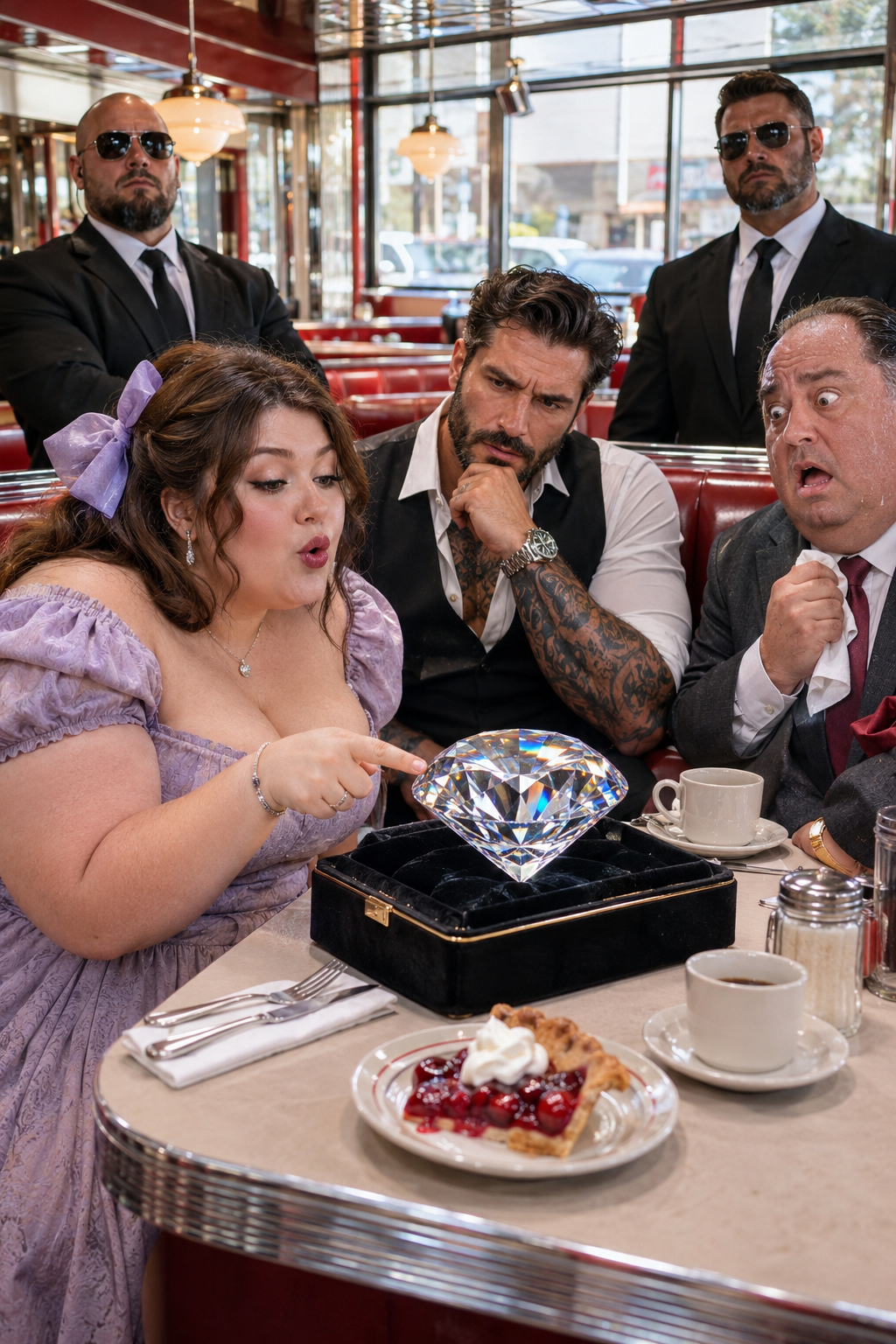
Inside, resting against a piece of dark velvet, was another diamond.
Even beneath the diner’s cheap fluorescent lights, the difference was remarkable.
Josie lifted it with shaking fingers.
The stone was nearly identical in size and shape to the fake, but its brilliance was different. She breathed across its surface, watched the moisture disappear, and examined the edges.
“This is the one you were supposed to receive,” she told Severin. “I’d need proper equipment to confirm everything, but this looks like a genuine diamond.”
Lyall looked as though he might collapse.
Severin stared at the stone for several seconds.
Then he laughed.
It wasn’t a pleasant laugh.
“You brought my payment into this diner, hid it on your watch chain, and handed me a piece of glass.”
Lyall shook his head desperately.
“Severin, please. Let me explain.”
“I’d love to hear it.”
“It wasn’t my idea!”
Emmett turned toward him.
“Shut your mouth, Lyall.”
But Lyall was already panicking.
“He said you’d never notice! He said you’d send the diamond to an appraiser tomorrow, and by then everything would be taken care of!”
Josie felt sick.
“What does that mean?” she asked.
Lyall looked at her, then lowered his eyes.
Severin answered for him.
“It means I wasn’t supposed to leave this diner alive.”
The words settled over the room.
Josie stared at Emmett.
He had been standing beside Severin when she first arrived. He had spoken respectfully, opened doors, and behaved like someone who could be trusted with his boss’s life.
Now he was holding a gun on a woman who had done nothing except tell the truth.
Severin folded his hands.
“Twenty years, Emmett.”
Emmett’s jaw tightened.
“Twenty years I’ve trusted you. I paid your mother’s hospital bills. I helped your brother when he lost his business. I stood beside you when your wife died.”
“And I spent twenty years taking orders!” Emmett shouted. “Twenty years cleaning up your problems while you collected everything!”
Severin’s expression didn’t change.
“So you decided to collect my life instead?”
Emmett’s face twisted with anger.
“You were getting weak. Everybody knew it. Turning down deals, shutting down operations, talking about going legitimate. You were going to destroy everything we built.”
“Everything we built?”
Severin looked almost disappointed.
“You mean everything you wanted to inherit.”
One of the armed strangers shifted nervously near the entrance.
Vincent noticed.
“Don’t,” he warned.
For a moment, nobody moved.
Then Emmett grabbed Josie’s shoulder and dragged her out of the booth.
She screamed as he pulled her against his chest.
The cold barrel of his gun pressed against the side of her head.
“Everybody back!”
Severin stood immediately.
“Let her go.”
“Get me a car. Now.”
“She’s got nothing to do with this.”
“She does now.”
Josie couldn’t stop shaking. Her grandfather’s face flashed through her mind. She remembered his workshop, the smell of coffee, and the patient way he had taught her to hold a gemstone without dropping it.
She wondered if she would ever see another morning.
Across the diner, the elderly deaf man was still sitting at his table. He looked confused and frightened, unable to understand everything happening around him.
Josie’s eyes met his.
She tried to give him a reassuring smile, but her lips wouldn’t cooperate.
Emmett began pulling her toward the entrance.
“Move!”
Severin stepped into the aisle.
“Listen carefully, Emmett. Whatever you think you’re getting out of this, you’re wrong.”
“Get out of my way.”
“Let the woman go, and you might still have a future.”
Emmett laughed bitterly.
“You think I’m stupid?”
“No. I think you’re scared.”
That struck a nerve.
Emmett raised his voice, ordering the two gunmen to clear the entrance.
Neither obeyed.
They were staring through the front windows.
Three of Severin’s bodyguards had appeared outside.
Another stood near the kitchen doorway.
The men who had entered the diner suddenly realized they were surrounded.
One lowered his weapon.
“I’m not dying for this.”
His partner followed.
Emmett cursed at them.
“You cowards!”
In that moment of distraction, Vincent moved.
He caught Emmett’s arm as Severin pulled Josie away. A gunshot shattered a hanging light above the counter.
Josie hit the floor.
Glass rained across the tiles.
Someone screamed.
By the time she looked up, Vincent and another bodyguard had forced Emmett to the ground. His gun lay several feet away.
The two other gunmen were disarmed.
Lyall attempted to escape through the kitchen, but a bodyguard intercepted him before he reached the back door.
It was over almost as quickly as it had begun.
Josie sat on the floor, staring at her hands.
They wouldn’t stop trembling.
Severin crouched beside her.
“Are you hurt?”
She shook her head.
“Look at me, Josie.”
She raised her eyes.
“Are you hurt?”
“No,” she whispered.
He offered his hand.
She took it.
When she stood, her knees nearly gave out, and Severin caught her elbow.
For several seconds, neither spoke.
Then Josie looked toward the elderly man.
“Mr. Ellis.”
She hurried across the diner, stepping around broken glass.
The old man was breathing heavily, his hands shaking against the table.
Josie sat beside him and signed slowly.
“It’s over. You’re safe.”
His eyes filled with tears.
He reached for her hand and held it tightly.
Severin watched from across the room.
A few minutes later, police sirens approached.
Josie expected Severin’s men to disappear before the officers arrived. Instead, he instructed Vincent to secure the weapons and cooperate with the police.
Emmett looked up in disbelief.
“You’re handing me over?”
Severin adjusted his jacket.
“You tried to murder me in a diner full of innocent people.”
“You can’t do this!”
“I believe I just did.”
When officers entered, they found the four suspects restrained, the weapons on the floor, and more than a dozen witnesses ready to explain what had happened.
Vincent handed over the phone records.
Josie gave her statement and surrendered both stones for examination.
An officer asked her how she had become involved.
She almost laughed.
“I was supposed to be on a date.”
The officer glanced toward Severin.
“With him?”
“No. Definitely not.”
For the first time that night, Severin smiled.
Nearly two hours passed before Josie was allowed to leave. The diner was closed, its windows flashing with red and blue lights.
She sat outside beneath the awning, holding a paper cup of coffee that had gone cold.
Her phone showed three messages from Grant Fowler.
The first apologized for being late.
The second asked whether she was still waiting.
The third said he had decided to go home.
Josie stared at the messages.
Then she deleted the dating app.
“I take it the evening didn’t go as planned.”
She looked up.
Severin stood beside her.
“That’s one way of putting it.”
He sat at the opposite end of the bench.
For a while, they watched the police finish their work.
“Why did you help me?” he finally asked.
Josie frowned.
“What do you mean?”
“You could have kept quiet about the diamond. You could have told me it looked genuine and walked away.”
“My grandfather taught me never to lie about something’s value.”
“Even when telling the truth might cost you?”
“Especially then.”
Severin looked down at his hands.
“My grandfather used to say something similar.”
“Was he a jeweler?”
“A mechanic. He believed a man was only as good as the promises he kept.”
Josie glanced at him.
“What happened to that belief?”
Severin was silent for a long moment.
“I suppose somewhere along the way, I forgot it.”
He reached into his jacket and removed a small leather case.
“I believe this belongs to you.”
Josie stared at it.
She recognized the worn brown leather immediately.
Her breath caught.
“Where did you get that?”
“Vincent made a call while you were speaking with the police.”
She opened the case.
Inside was a jeweler’s loupe with a scratched silver frame.
Her grandfather’s initials were engraved along the side.
J.W.
Josie covered her mouth.
She had pawned it six months earlier when her mother’s medical expenses became more than she could handle. It was the last valuable thing she owned that had belonged to him.
She had promised herself she would get it back.
But every paycheck disappeared into rent, groceries, and overdue bills.
“How did you know?”
“I asked your employer about you. He mentioned it.”
Tears slipped down her cheeks.
“You redeemed it?”
“Yes.”
“I can’t accept this.”
“Why not?”
“Because I don’t want to owe you anything.”
Severin nodded slowly.
“Then consider it a thank-you. No debt. No conditions.”
Josie held the loupe against her chest.
For the first time since the gunshot, she allowed herself to cry.
Severin waited until she was ready to speak.
Then he made her an offer.
“I own several legitimate businesses that deal with jewelry, antiques, and estate collections. I need someone who knows the difference between genuine value and expensive nonsense.”
Josie wiped her eyes.
“Are you offering me a job?”
“As my personal appraiser.”
She stared at him.
“After tonight?”
“Because of tonight.”
“What happens when I tell you something you don’t want to hear?”
“I’ll pay you to tell me anyway.”
Despite everything, Josie smiled.
“I have conditions.”
“Name them.”
“Everything has to be legal. Proper records, independent verification, no stolen property. And I won’t work around guns.”
Severin considered her words.
“Agreed.”
“And I don’t want special treatment.”
“That might be difficult.”
“Why?”
“Because you’re apparently the only person in this city who isn’t afraid to tell me I’m wrong.”
Josie looked at him.
“Oh, I’m afraid of you.”
Severin laughed.
“Fair enough.”
Just then, a gray sedan parked across the street switched on its headlights.
Vincent, standing near Severin’s car, immediately straightened.
“Boss.”
Severin followed his gaze.
The sedan remained stationary.
Its engine was running.
Josie’s stomach tightened.
“Not again.”
Vincent moved closer.
“We noticed that car earlier. It’s been here since before the police arrived.”
Severin stood.
“Stay beside me, Josie.”
The sedan pulled away from the curb and stopped directly in front of them.
Its rear passenger door opened.
A woman in her early fifties stepped out, wearing a dark coat and carrying a leather briefcase.
Vincent positioned himself between her and Severin.
The woman calmly raised a badge.
“Detective Helen Mercer. Financial Crimes.”
Severin’s expression darkened.
“I wondered when you’d show up.”
“Your lieutenant has been under investigation for eight months.”
She glanced at Josie.
“And apparently, tonight he made a rather serious mistake.”
Josie looked from the detective to Severin.
“What’s going on?”
Mercer opened her briefcase.
“We believe Emmett Croll and Lyall Brandt have been operating a stolen jewelry network. They were using legitimate businesses to move diamonds and other valuables across state lines.”
Severin’s jaw tightened.
“Using my businesses?”
“Some of them, yes.”
The detective removed a photograph.
It showed an elaborate diamond necklace displayed inside a glass case.
“This was stolen from a private estate eighteen months ago. We believe the center stone was removed and prepared for resale.”
Josie studied the picture.
“Eleven carats?”
Mercer nodded.
“The diamond you found tonight may be the missing stone.”
Severin closed his eyes briefly.
He had nearly accepted stolen property as payment, exactly the kind of transaction that could have destroyed his efforts to separate himself from his criminal past.
Mercer continued.
“We’re going to need access to your business records.”
Vincent looked uncomfortable.
Severin said nothing.
Josie watched him carefully.
This was a different kind of danger.
There were no guns pointed at anyone. No men shouting orders.
Just a choice.
Severin could refuse to cooperate, call his lawyers, and try to protect the empire he had spent decades building.
Or he could prove that his promise to Josie meant something.
Finally, he spoke.
“You’ll have my cooperation. I’ll arrange for my attorneys to provide the records through the proper channels.”
Vincent turned toward him in surprise.
“Boss?”
“All of them,” Severin repeated.
Mercer studied his face.
“You understand that this investigation could uncover crimes beyond Croll’s operation?”
“I understand.”
“And cooperation doesn’t guarantee immunity.”
“I’m aware.”
The detective nodded.
“Then we’ll be in touch.”
She returned to the sedan and drove away.
Josie stood beside Severin, watching the taillights disappear.
“You might lose a lot,” she said.
“I might.”
“Are you okay with that?”
He looked toward the diner.
“No. But I’m starting to think keeping everything has already cost me enough.”
Over the following months, the investigation uncovered a network far larger than anyone had expected.
Dozens of stolen valuables were recovered. Emmett and Lyall eventually pleaded guilty to multiple charges connected to the thefts and the attempted ambush. Their accomplices also faced prosecution.
The eleven-carat diamond was returned to its rightful owner.
Severin’s cooperation exposed illegal activities within his own organization, including conduct he could not blame on anyone else. He accepted legal consequences, paid substantial financial penalties, and withdrew from several businesses.
It was not an easy transformation.
There were days when his attorneys advised him to fight every demand. There were former associates who called him a traitor. Some people disappeared from his life the moment his influence began to fade.
But he kept going.
Josie accepted the appraisal position only after an independent attorney reviewed her employment agreement and the business established strict procedures for verifying ownership.
Her first office was small, with a sturdy desk, bright lamps, and shelves filled with reference books.
On the wall, she hung a photograph of her grandfather.
His loupe never left her desk.
One afternoon, an elderly woman arrived carrying a simple gold ring. She explained that her late husband had bought it decades earlier, and she needed money to repair her home’s heating system.
Josie examined the ring.
Its diamond was modest, but the setting was rare and beautifully crafted.
The woman expected a few hundred dollars.
Josie explained that it was worth considerably more and helped her find a reputable buyer.
After the woman left, Severin appeared in the doorway.
“You could have made a substantial profit on that ring.”
“I know.”
“Instead, you helped her sell it somewhere else.”
“She needed the money more than we did.”
Severin looked at the empty chair.
Then he nodded.
“Good.”
A year after the incident, the Kettle Street diner was still serving coffee, pancakes, and its famous homemade pie.
The shattered light had been replaced.
Mr. Ellis continued visiting every Thursday evening.
And on one particular Thursday, Josie walked through the door and found Severin sitting in the same back booth where they had first met.
She smiled.
“Is this seat taken?”
“Only if you’re waiting for Grant Fowler.”
Josie laughed and sat down.
The waitress brought two coffees.
Across the room, Mr. Ellis waved enthusiastically.
Josie waved back.
Severin placed a small velvet box on the table.
She raised an eyebrow.
“Please tell me that’s not another eleven-carat diamond.”
“Open it.”
Inside was a simple silver bracelet engraved with three words.
KNOW YOUR WORTH.
Josie ran her fingers across the engraving.
“My grandfather used to tell me that.”
“I know,” Severin said. “You’ve mentioned it.”
She smiled, fastening the bracelet around her wrist.
“Thank you.”
Severin lifted his coffee.
“You know, I spent most of my life believing that money could buy anything worth having.”
“And now?”
“Now I know the most valuable things are usually the ones nobody can sell you.”
Josie looked around the diner.
At the waitress who remembered everyone’s favorite order.
At Mr. Ellis, smiling over his slice of pie.
At the man across from her who was finally learning that power and respect were not the same thing.
She thought about how close she had come to losing everything that Thursday night.
All because she had sat in the wrong booth.
But perhaps the most important thing she had discovered wasn’t the diamond hidden inside a gold pendant.
It was that courage didn’t require her to stop being afraid. Honesty didn’t become less important when the truth was inconvenient. And kindness was never a weakness, even in a room filled with dangerous people.
Her grandfather had spent his life teaching her how to recognize genuine diamonds.
What he had really taught her was something much greater.
How to recognize genuine worth.
And no amount of money in the world could ever replace that lesson.
Three weeks after their dinner at Kettle Street, Josie arrived at work to find Severin standing beside her desk with an unusual expression on his face.
“We have a visitor,” he said.
“Someone selling jewelry?”
“Someone asking for you.”
An elderly woman stood in the reception area, holding a small wooden box. Her gray hair was neatly pinned back, and her hands trembled as she approached Josie.
“My name is Margaret Whitmore,” she said. “I believe you found something that belonged to my family.”
Josie immediately recognized the name.
Margaret was the rightful owner of the eleven-carat diamond recovered from Lyall’s pocket watch.
“I wanted to thank you in person,” Margaret continued.
She opened the wooden box, revealing the restored necklace. The diamond had been returned to its original setting, surrounded by smaller stones.
“My husband gave me this on our fortieth wedding anniversary. He passed away shortly before it was stolen.”
Josie gently touched the edge of the box.
“It’s beautiful.”
“It is. But what made it precious was the man who gave it to me.”
Margaret reached into her handbag and removed an envelope.
“I’d like you to have this.”
Inside was a check for fifty thousand dollars.
Josie’s eyes widened.
“Mrs. Whitmore, I can’t accept this.”
“Please. You have no idea what you’ve given back to me.”
Josie looked at the necklace, then at the check.
An idea suddenly came to her.
“Would you consider helping me with something instead?”
Margaret smiled.
“Tell me.”
For years, Josie had watched desperate customers enter pawnshops carrying their most treasured possessions. Some needed money for medical bills. Others were trying to keep their homes or feed their children.
Many accepted far less than their belongings were worth because they had nowhere else to turn.
Josie wanted to change that.
She explained her dream of opening a community appraisal center where people could receive honest evaluations without being pressured to sell.
Margaret listened carefully.
When Josie finished, the elderly woman turned toward Severin.
“What do you think?”
Severin smiled.
“I think she’s going to need a bigger building.”
Six months later, the Whitmore Community Appraisal Center opened its doors.
Margaret provided the initial funding. Severin contributed through his legitimate business, and Josie supervised the entire operation.
They named its main appraisal room after Josie’s grandfather.
On opening day, Mr. Ellis arrived carrying a bouquet of flowers.
Josie hugged him before signing her thanks.
Her mother stood nearby, crying proudly as she looked at the photograph of her father hanging above the entrance.
“He would have loved this,” she whispered.
Josie squeezed her hand.
“I wish he could see it.”
Her mother smiled.
“In a way, he can. Everything he taught you is here.”
Later that afternoon, Severin found Josie alone in the appraisal room.
He placed a folder on her desk.
“What’s this?”
“Something you’ve earned.”
Inside were documents granting Josie an ownership stake in the legitimate appraisal business she had helped build.
She stared at him.
“Severin, this is enormous.”
“You’ve increased our business, protected our reputation, and helped more people than I can count. You’re not just an employee anymore.”
Josie looked up.
“Are you sure?”
“For once in my life, absolutely.”
She stood and hugged him.
Severin seemed surprised at first. Then he gently returned the embrace.
“Thank you,” she whispered.
“No, Josie. Thank you.”
Two years passed.
Emmett and Lyall remained in prison, serving their sentences. Severin continued rebuilding his life, accepting responsibility for his past and earning trust through his actions rather than demanding it through fear.
Josie’s community center helped hundreds of families.
She also began teaching young appraisers, sharing the lessons her grandfather had taught her when she was a little girl.
One morning, a nervous teenage boy entered the center carrying an old pocket watch.
“My grandmother needs medicine,” he explained. “I was hoping this might be worth something.”
Josie examined the watch carefully.
It wasn’t particularly valuable, but she knew someone who collected pieces from that manufacturer.
She arranged a fair sale and connected the family with a local assistance program.
Before leaving, the boy asked her a question.
“Why are you being so nice to me?”
Josie smiled.
“Because someone helped me once when I needed it.”
That evening, she returned to the Kettle Street diner.
Severin was already waiting.
Two slices of apple pie sat on the table.
“You’re late,” he said.
“Traffic was terrible.”
They both laughed.
It was the same excuse she had given him on the night they first met.
Josie sat down and looked around the familiar diner.
“Do you ever wonder what would have happened if I’d found the right booth that night?”
Severin considered the question.
“I probably wouldn’t be sitting here.”
His answer made her smile fade.
She knew he wasn’t joking.
He reached across the table and gently tapped her grandfather’s loupe, which she still carried everywhere.
“You saved my life, Josie. But more importantly, you reminded me that I could live differently.”
Josie shook her head.
“You made that choice yourself.”
“Maybe. But sometimes a person needs someone to remind them they still have a choice.”
Outside, rain began falling against the windows.
Inside, Mr. Ellis waved from his usual table, the waitress poured another round of coffee, and the familiar warmth of the diner surrounded them.
Josie thought about the woman she had been two years earlier.
She had been struggling financially, worried about her mother, and disappointed by a life that seemed to offer more problems than opportunities.
She had walked into that diner hoping to meet someone who might change her life.
Instead, she had changed someone else’s.
And in doing so, she had discovered a future more meaningful than anything she could have imagined.
She never became wealthy by taking advantage of desperate people. She never needed to compromise her principles to succeed.
Her greatest achievement wasn’t the money she earned or the diamonds she discovered.
It was knowing that every person who walked through her doors would be treated with dignity, regardless of how much they owned.
Severin raised his coffee cup.
“To wrong booths.”
Josie lifted hers.
“And second chances.”
Their cups touched gently.
Years later, whenever someone asked Josie how her remarkable journey had begun, she always told them the same story.
About a Thursday night.
About a mistaken identity.
About a fake diamond and a dangerous man who had forgotten what truly mattered.
But she always ended with the lesson her grandfather had given her long before she understood its meaning.
A diamond doesn’t become genuine because someone insists that it is.
And a person’s worth isn’t measured by their wealth, their reputation, or the power they hold over others.
It is revealed through the choices they make when nobody can force them to do the right thing.
Josie had made her choice that night.
Severin had eventually made his.
And because of those choices, countless other lives had changed for the better.
Sometimes, what seems like the biggest mistake of your life can lead you exactly where you need to be.
You just have to carry enough courage to tell the truth, enough kindness to help someone else, and enough faith to recognize an unexpected opportunity when it arrives.
Josie had walked into the wrong booth that Thursday evening.
But in the end, she had found the right path.
And she never stopped being grateful for it.
THE END.