In the glittering world of American high society, where old fortunes, powerful families, and carefully guarded reputations could determine a person’s entire future
The answer began with one unexpected move from the Duke that no one in the ballroom saw coming.
Ashborne crossed the crowded room without hesitation.
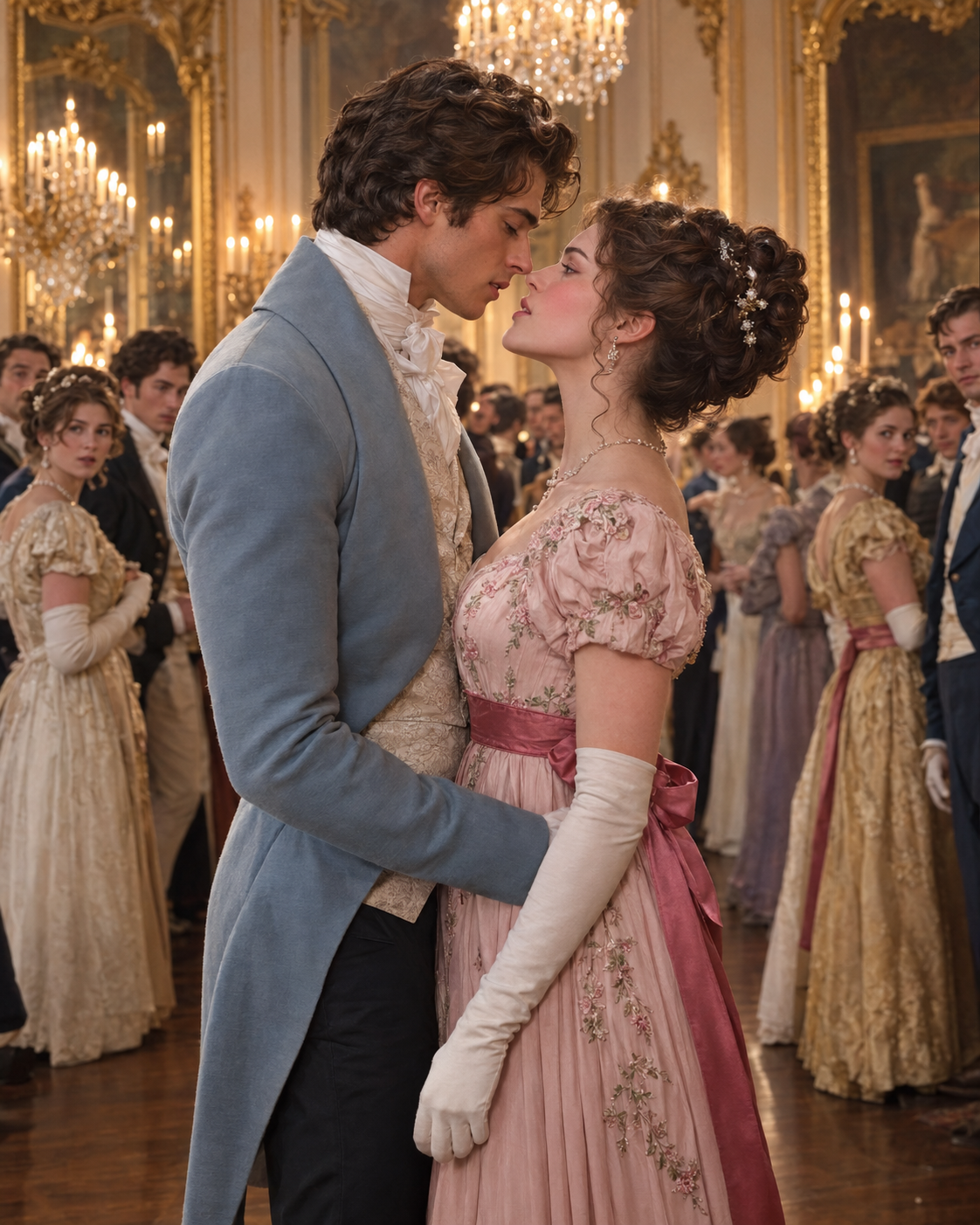
For one suspended moment, Brieny could hear nothing but the soft rhythm of the orchestra behind her. The chandeliers of the Manhattan ballroom cast warm light across hundreds of faces, yet every instinct told her that something had changed.
The Duke stopped before her.
He did not glance toward her cousin.
He did not acknowledge the whispers spreading among the guests.
He simply extended his hand.
“Come with me.”
Brieny stared at him.
“That was not part of our arrangement.”
“No,” Ashborne said quietly. “It was not.”
His voice was calm, but there was something underneath it that made her place her hand in his.
They walked away from the ballroom together.
Only when the doors closed behind them did Brieny allow herself to breathe.
“What happened?”
“My uncle has been speaking to your cousin.”
The words chilled her.
“My cousin?”
Ashborne nodded.
“He has been asking questions about your family’s debts. More importantly, he has been asking how much pressure would be required to make you disappear from my side.”
Brieny felt the color leave her face.
“He cannot do that.”
“He does not need to.”
Ashborne turned toward her.
“He only needs to make you believe you have no choice.”
Brieny had lived with that feeling for months.
She knew exactly what it was like to wake in the morning with a letter from a creditor on the table. She knew the humiliation of watching servants quietly leave because wages could no longer be guaranteed. She knew what it meant to sit across from a lawyer and hear the words foreclosure and eviction spoken as if they were ordinary pieces of conversation.
Her family had been falling apart one bill at a time.
And now someone intended to use that desperation against her.
“What does your uncle want?”
“My inheritance.”
Ashborne’s answer came without emotion.
“He believes that if I marry according to his wishes, control of several family interests will remain within the branch of the family he favors. If I refuse, he has threatened to challenge my authority through a series of legal maneuvers.”
Brieny looked at him carefully.
“And I ruin his plans.”
“You make them considerably more difficult.”
“So that is all I am?”
She regretted the question immediately.
Ashborne’s expression changed.
“No.”
The single word was almost too quiet to hear.
Brieny looked away.
“You hired me to play a role.”
“I did.”
“And now you are protecting me because my role has become inconvenient?”
“No.”
“Then why?”
For the first time since she had met him, the Duke seemed to have no prepared answer.
He looked toward the tall windows overlooking Manhattan.
Outside, the city glittered beneath the dark sky. Carriages moved along the avenue, their lamps passing like small stars between the buildings. America seemed impossibly large beyond those windows, a place where fortunes could rise in a season and disappear in a week.
Finally, Ashborne spoke.
“Because I made a bargain with you.”
Brieny almost laughed.
“That is a remarkably cold explanation.”
“It is the only explanation I am prepared to give tonight.”
She stepped closer.
“And if I told you I no longer believed it?”
His gaze returned to hers.
“Then I would ask what you believe instead.”
Brieny could not answer.
Before she could, the door opened.
A servant entered carrying a sealed envelope.
“For Miss Lindley.”
She recognized the handwriting immediately.
Her cousin.
Her fingers tightened around the envelope.
Ashborne watched her open it.
Inside was a single sheet of paper.
A demand.
Not for money.
For obedience.
Her cousin knew about the arrangement.
He knew about the debt.
And he had apparently learned enough about Ashborne’s family conflict to threaten Brieny with public exposure.
If she continued appearing beside the Duke, her cousin would make certain every newspaper in New York heard the story of the ruined Lindley family and the woman who had sold her reputation to save it.
Brieny folded the paper.
“He knows.”
“Yes.”
“He will tell everyone.”
“Let him.”
She stared at Ashborne.
“You do not understand.”
“I understand perfectly.”
“My family’s name will be destroyed.”
Ashborne stepped toward her.
“Your family’s name is already being destroyed by people who believe your desperation gives them ownership of your choices.”
His voice hardened.
“I will not allow that.”
Brieny’s eyes burned.
“You cannot simply decide that.”
“No,” he said. “But I can decide what I am willing to stand beside.”
That was the moment everything changed.
Not because he kissed her.
Not because he made some grand declaration.
But because he stopped speaking as though she were part of a contract.
He was speaking as though her dignity mattered to him.
The following morning, Ashborne did something Brieny had never expected.
He paid the entire family debt.
Not the promised £3,000.
Everything.
The creditors received payment before noon.
The eviction proceedings stopped.
The servants who had left were contacted and offered their positions again.
The lawyer who had warned Brieny that the family estate might be lost arrived at the house with documents confirming that the immediate danger had disappeared.
Brieny could hardly believe it.
She went straight to Ashborne.
“You paid it.”
“Yes.”
“You said I would receive £3,000.”
“I know.”
“That was our agreement.”
“It was.”
“Then why did you pay everything?”
He looked up from his desk.
“Because I could.”
“That is not an answer.”
“It is the answer I have.”
Brieny placed the documents on his desk.
“You cannot purchase my gratitude.”
“I am not trying to.”
“Then what are you trying to purchase?”
Ashborne was silent.
The question seemed to strike deeper than she intended.
At last he said, “Nothing.”
She stood very still.
He continued.
“When we made the arrangement, I told myself I was purchasing freedom from unwanted attention. You told yourself you were purchasing time for your family. It was simple.”
“And now?”
“Now it is not simple.”
His eyes met hers.
“I have spent most of my life making certain that nothing could reach me. Then you arrived and somehow turned every carefully locked door into an invitation.”
Brieny’s heart beat faster.
“Ashborne…”
“I know.”
He rose.
“I know exactly what I am saying.”
For a moment neither moved.
Then the sound of footsteps interrupted them.
The door opened sharply.
Her cousin stood there.
He had come without permission, without apology, and with the confidence of a man who had spent years believing Brieny would always surrender before him.
“You have made quite a spectacle of yourself,” he said.
Brieny straightened.
“You should leave.”
He laughed.
“You think a title protects you?”
Ashborne moved between them.
“No.”
The Duke’s voice was dangerously calm.
“I think the law does.”
Her cousin’s smile faded.
Ashborne placed a folder on the desk.
Inside were copies of correspondence, financial records, and signed statements.
Brieny recognized several names.
Her cousin’s name appeared repeatedly.
“What is this?”
“Evidence.”
“Of what?”
“Of where the money went.”
Silence filled the room.
Brieny looked at her cousin.
He had been telling everyone that the family’s collapse was her fault.
He had blamed poor decisions, extravagance, and incompetence.
But the documents told another story.
Funds had been transferred.
Accounts had been altered.
Promises had been made without authorization.
Her cousin had not merely watched the family fall.
He had profited from it.
Brieny felt something inside her break—not her courage, but the last fragile piece of loyalty she had mistaken for love.
“You knew,” she whispered.
Her cousin said nothing.
“You knew what was happening to us.”
“I was trying to protect my own interests.”
“And you let us lose everything?”
“You would have lost it anyway.”
Ashborne’s expression became unreadable.
“Leave.”
Her cousin hesitated.
“I will not be ordered—”
“You will leave,” Ashborne repeated, “or the documents go to the authorities before sunset.”
That ended the argument.
The door slammed behind him.
Brieny stood motionless.
She expected relief.
Instead, tears filled her eyes.
Ashborne did not touch her.
He waited.
That small act of restraint meant more than any gesture could have.
Finally she whispered, “I should have seen it.”
“No.”
“I trusted him.”
“That does not make you foolish.”
“It makes me—”
“Human.”
She looked at him.
Ashborne’s voice softened.
“Trust given in good faith is not a weakness. Betrayal belongs to the person who chooses it.”
Brieny wiped her eyes.
“And what about you?”
“What about me?”
“I trusted you too.”
He took a slow breath.
“That,” he said, “is the one thing I am most afraid of.”
The confession left them both silent.
For all his wealth, his title, his influence, Ashborne had never seemed afraid of anything.
Yet now he stood before her without the armor he wore in public.
Brieny realized that his coldness had never been emptiness.
It had been protection.
A wall built after years of being used by people who wanted his name, his money, or his position.
And she had somehow become the person standing on the other side of that wall.
The weeks that followed were different.
Their arrangement technically remained.
They still appeared together at dinners and receptions.
They still allowed society to believe whatever it wished.
But the performance had become almost unnecessary.
They no longer needed rehearsed gestures.
They understood each other’s silences.
At a charity dinner in Boston, Brieny reached for Ashborne’s arm without thinking.
At a garden gathering outside Washington, he looked for her before entering the house.
At a crowded reception in Philadelphia, she caught him watching her from across the room.
Neither pretended not to notice.
But neither spoke about it either.
Then came the final confrontation.
Ashborne’s uncle invited them to his estate.
The invitation was impossible to refuse without creating a scandal.
Brieny knew it was a trap.
Ashborne knew it too.
“You do not have to come,” he told her.
“Yes, I do.”
“Why?”
“Because this began as an arrangement.”
He raised an eyebrow.
“And?”
She smiled.
“And I intend to see it through.”
His expression softened.
“Dangerous woman.”
“You knew that when you hired me.”
“I am beginning to suspect I knew nothing about you.”
They arrived at the estate just before sunset.
The dinner was elegant.
Too elegant.
Every word was polite.
Every smile carefully measured.
Then Ashborne’s uncle made his move.
He announced that several members of the family had agreed that the Duke should reconsider his current association and accept a more suitable match.
Brieny felt every eye turn toward her.
She remained calm.
Ashborne did not move.
His uncle smiled.
“Surely, my dear, you understand that society has expectations.”
Brieny looked at him.
“I understand that society has many expectations.”
“And?”
“And I have discovered that I am not obliged to satisfy all of them.”
A few guests shifted uncomfortably.
The uncle’s smile vanished.
“You are forgetting your position.”
“No,” Brieny said.
“I am remembering mine.”
Ashborne looked at her then.
There was pride in his eyes.
Not the distant approval of a patron.
Something warmer.
Something real.
His uncle stood.
“This is absurd.”
Ashborne finally spoke.
“No.”
Everyone became silent.
“This is finished.”
His uncle stared at him.
“You cannot simply abandon the family agreement.”
“I already have.”
“And your inheritance?”
“I have secured my affairs independently.”
“You would risk everything for her?”
Ashborne glanced at Brieny.
“No.”
He paused.
“I would refuse to risk her for anything.”
The room fell silent.
It was not a declaration designed for applause.
It was not romantic theater.
It was a choice.
And everyone understood it.
They left the estate that night beneath a cold American sky.
The carriage was quiet.
Brieny watched the lights disappear behind them.
“You meant it.”
“Yes.”
“You really would have walked away from everything?”
“I have spent years being told what I should want.”
He looked at her.
“I would like to know what it feels like to choose something for myself.”
“And what did you choose?”
Ashborne did not answer immediately.
Instead, he took her hand.
Not for an audience.
Not because the arrangement required it.
Simply because he wanted to.
“You.”
Brieny’s eyes filled with tears.
“That sounds dangerously like breaking the contract.”
“It is.”
“What happens now?”
He smiled faintly.
“Now we stop pretending.”
The words were simple.
The consequences were not.
They knew society would talk.
There would be gossip.
There would be questions about the American heiress with a ruined family and the Duke who had crossed an ocean only to find himself attached to a woman no matchmaker had selected for him.
There would be people who claimed Brieny had manipulated him.
Others would claim Ashborne had rescued her.
Both would be wrong.
Because neither had rescued the other.
They had simply met at a moment when both were tired of living according to other people’s rules.
Months later, Brieny stood on the terrace of their New York home watching the city awaken.
The house no longer felt like a symbol of survival.
It felt like a beginning.
Her family’s finances had stabilized.
The evidence against her cousin had been placed in the proper hands.
Ashborne’s uncle had lost much of the influence he once held.
And the Duke himself had become noticeably less distant.
Not softer with everyone.
Only with her.
Brieny turned when she heard footsteps.
Ashborne approached carrying two cups of coffee.
“You are awake early.”
“So are you.”
“I have learned that mornings are quieter when the world has not yet discovered what it wants from me.”
She smiled.
“And what does the world want from you today?”
“Nothing.”
He handed her a cup.
“I have decided it can wait.”
She leaned against the railing.
For a while they watched Manhattan together.
The city below was already moving—carriages, workers, merchants, families, dreams.
Brieny thought about the woman she had been when she first entered his life.
Desperate.
Afraid.
Certain that survival meant surrendering control.
She had believed £3,000 was the price of saving her family.
She had been wrong.
Money had opened the first door.
Courage had carried her through the second.
And trust had changed everything after that.
Ashborne looked at her.
“Do you regret it?”
“The bargain?”
“Yes.”
Brieny considered the question.
“I regret needing it.”
He nodded.
“But I do not regret meeting you.”
Neither spoke for several seconds.
Then she reached for his hand.
This time there was no audience.
No contract.
No carefully constructed performance.
Only two people who had once entered an arrangement for entirely practical reasons and discovered something neither had planned for.
Love had not arrived with a grand announcement.
It had appeared quietly—in protection, in honesty, in the willingness to stay when leaving would have been easier.
Brieny finally understood that the most valuable thing Ashborne had given her was never the money.
It was the freedom to choose her own future.
And Ashborne learned something equally important.
A guarded heart could survive without opening.
But it could not truly live that way forever.
The bargain had begun as a transaction.
It ended as a choice.
And sometimes, in a world determined to decide who we should become, the most courageous thing a person can do is simply refuse to let desperation make the final decision.
For Brieny and Ashborne, that refusal became the beginning of everything they had once believed impossible.
THE END.